8 Costs in a HubSpot Implementation Partner Quote, Canada
The eight lines in a Canadian HubSpot partner quote, with CAD list prices, converted vendor figures, BC PST and a calculator for comparing two quotes.
 Joshua Jackai
21 min read
Published 6 November 2026 · Last updated and fact-checked November 2026
Short answer: Partner prices I found convert to about CA$4,234 (Lean Labs) to CA$55,062 or more (Avidly), with no published CAD benchmark. So compare eight lines, not totals: onboarding, licence, scoping, build, migration, integrations, training and tax. Content Hub Professional lists at CA$7,020 a year, and 7% BC PST on it is not recoverable.
Picture a marketing lead in Burnaby with two HubSpot quotes open. One says CA$15,000. The other says $9,000, with no currency named. The second looks cheaper. Not yet. One may include HubSpot’s onboarding fee, and the other may leave it for you to pay. Neither one mentions PST, which a BC firm cannot claim back.
The partner cost pages I read quoted US dollars, euros or no currency at all, and none priced the Canadian tax lines. This guide does the part they skip for a Canadian buyer: real CAD list prices, Bank of Canada conversions and the tax lines that stay on your books. It covers HubSpot websites and Content Hub work, not a full CRM rebuild across every hub.
Key takeaways
- HubSpot’s Canadian pricing page lists a required CA$3,700 onboarding fee with Marketing Hub Professional, and CA$9,100 with Enterprise. The Content Hub page shows no such line.
- Content Hub Professional is CA$585 a month in CAD against US$450. At the Bank of Canada’s 1.4113 rate, that US price is CA$635, so CAD list runs CA$601 a year lower.
- HubSpot says BC and Saskatchewan PST is not recoverable. On CA$7,020 of licence in BC, that is CA$491.40 a year.
- HubSpot caps bulk redirect uploads at 500 per upload, so a larger site needs several files in its migration line.
- A review of software surveys found 60% to 80% of projects overran effort or schedule (Moløkken and Jørgensen, 2003). That is why a fixed scope matters more than a low first number.
| # | Cost line | Who bills it | Published figure, converted to CAD | Can you claim it back? |
|---|---|---|---|---|
| 1 | HubSpot onboarding | HubSpot | CA$3,700 or CA$9,100 on Marketing Hub | GST and HST usually yes |
| 2 | Content Hub licence | HubSpot | CA$7,020 a year, Professional | PST no; GST and HST usually yes |
| 3 | Scoping | Partner | Often folded into the fee; no public figure | GST and HST usually yes |
| 4 | Theme and page build | Partner | From CA$7,057 (vendor); from CA$9,700 (my price) | GST and HST usually yes |
| 5 | URL and content migration | Partner | From CA$9,879 (vendor); from CA$2,500 (my price) | GST and HST usually yes |
| 6 | Integrations and lead source | Partner | From CA$21,170 (vendor); from CA$2,600 (my reporting) | GST and HST usually yes |
| 7 | Training and handover | Partner | About CA$353 a session (vendor) | GST and HST usually yes |
| 8 | Tax and currency | Government and bank | 7% BC PST; CA$601 a year between CAD list and the US price | PST no |
In this guide
1. HubSpot’s onboarding fee: CA$3,700 on Marketing Hub Professional
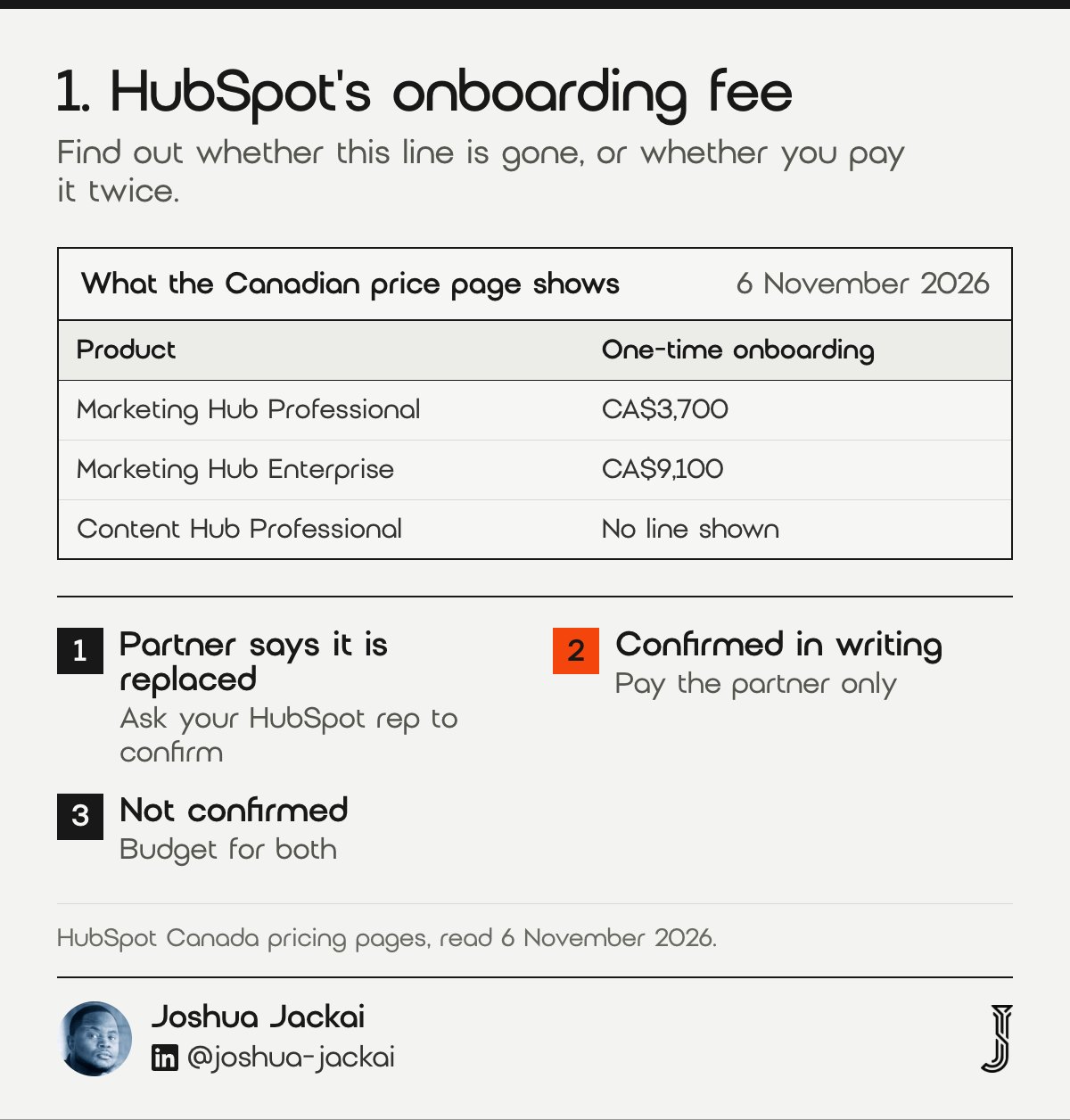
HubSpot’s own onboarding is a one-time fee on top of the licence. Marketing Hub Professional carries CA$3,700 and Enterprise carries CA$9,100 on the Canadian page I read on 6 November 2026. A partner quote should say plainly whether it replaces this line or sits beside it, because the answer can change the winner.
- Who bills it: HubSpot, not the partner
- Marketing Hub Professional: CA$3,700, once
- Marketing Hub Enterprise: CA$9,100, once
- Content Hub Professional: no onboarding line on the page I read
- Ask: is this fee removed, and who confirms it in writing?
Start here, because this line can move the comparison more than any partner’s hourly rate. HubSpot’s Marketing Hub page says you are charged for onboarding automatically when you buy Professional or Enterprise. The Content Hub page I read the same day shows no onboarding line, so a website-only buyer may owe nothing here. Do not assume that. Check the order form.
Partners often say they can replace the fee. Avidly, a HubSpot partner that prices in euros, says a partner can have the line removed and then bills its own work instead, at €6,000 to €35,000 or more. That is CA$9,439 to CA$55,062 at the Bank of Canada’s 1.5732 rate. INSIDEA, another partner, says the fee is often waived when an accredited partner delivers onboarding.
Both are partners describing their own market. I found no HubSpot page that states the rule. So ask your HubSpot rep, and keep the answer in writing.
“Cost shown does not include the required, one-time Professional Onboarding for a fee of CA$3,700,” HubSpot stated on its Canadian pricing page.
2. Content Hub licence: CA$7,020 a year before tax
The licence is the one line that repeats every year, whoever builds the site. Content Hub Professional lists at CA$585 a month on annual billing, or CA$7,020 a year, with 3 core seats. It suits a firm whose website lives on HubSpot. A firm on WordPress may not need it at all.
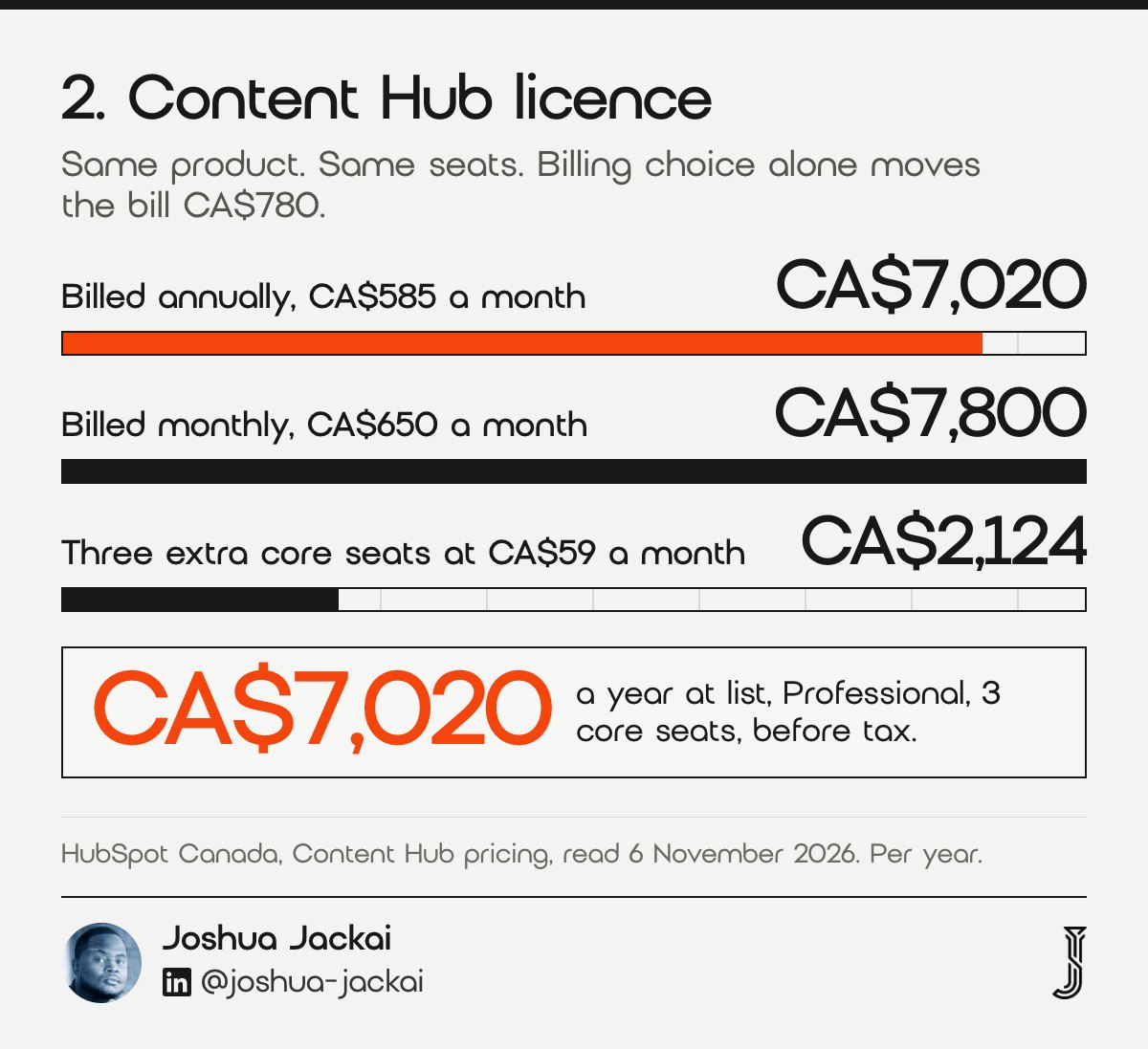
- Professional, annual billing: CA$585 a month, CA$7,020 a year
- Professional, monthly billing: CA$650 a month, CA$7,800 a year
- Enterprise: CA$1,950 a month, CA$23,400 a year, 5 core seats
- Extra core seat, Professional: from CA$59 a month
- Page limit, Professional: up to 10,000 website pages
Same product. Same seats. Annual billing costs CA$780 less over a year on HubSpot’s Canadian list, though the page says monthly billing also starts with an annual commitment on Professional, so read that part closely. The bill grows through seats. Three extra seats at CA$59 add CA$2,124 a year before any tax.
Ask each partner which hubs the plan assumes. A quote built on Marketing Hub plus Content Hub is a very different bill. Marketing Hub Professional alone lists at CA$1,034 a month, or CA$12,408 a year. If you already suspect that bill is too high, my audit of HubSpot costs for Canadian firms walks through seats, contacts and hubs in order.
The licence also outlasts the partner. The partner’s invoice ends at launch. This one comes back at renewal, whether anyone logs in or not. So put three years of it on your sheet, not one: at today’s list, that is CA$21,060 before tax.
“Price shown in CAD and subject to applicable tax,” HubSpot stated on its Content Hub pricing page.
3. Scoping and discovery: the line that decides the other seven
Scoping is the paid or unpaid work that turns your request into a list of pages, redirects, forms and integrations. Published price pages rarely show it as its own number. It suits every buyer, because a survey review found 60% to 80% of software projects overrun effort or schedule, and an unwritten scope has nothing to hold the price.
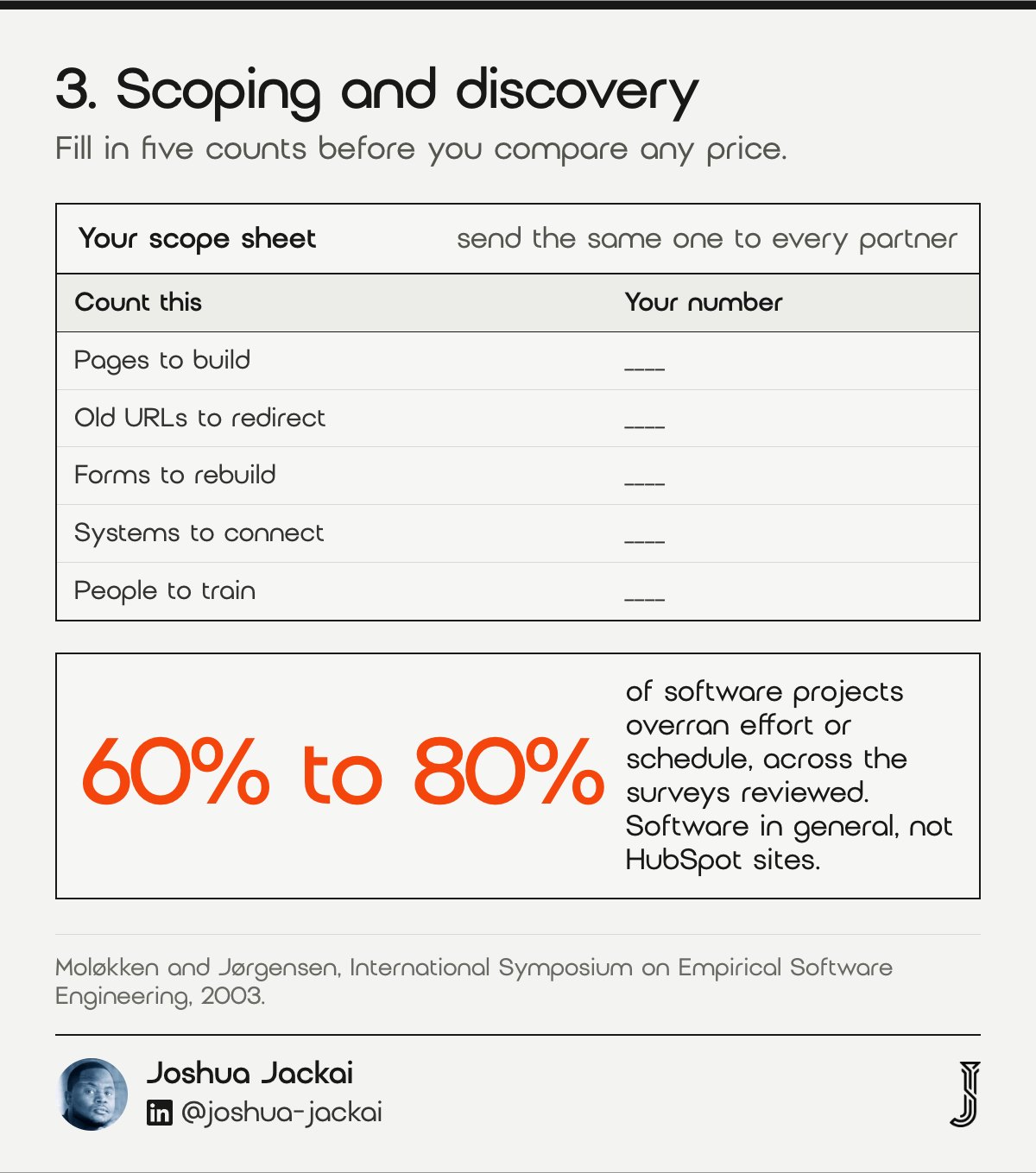
- What you should receive: a written count of pages, URLs, forms and systems
- Typical price form: folded into the fee, or a small paid phase
- Vendor note: INSIDEA says its fee is “locked at proposal”
- Warning sign: a total with no counts behind it
- My own version: a CA$995 audit, credited if a project starts within 30 days
Do not compare two totals until both rest on the same counts. Write the five numbers yourself before you ask for quotes: pages, URLs, forms, connected systems and people to train. If a partner works from your sheet, the quotes become comparable. If one refuses and offers a package instead, you have learned something too.
Moløkken and Jørgensen put typical overruns at 30% to 40% across the surveys they reviewed. Those were software projects in general, not HubSpot sites, so read it as a reason for caution rather than a forecast. On a CA$15,000 fee, 30% would be CA$4,500. That gap is your reason to ask who pays when scope grows.
The cheap quote is not always the honest one. Jørgensen and Grimstad paid 46 outsourcing companies to estimate the same five software projects, with some specifications manipulated, including a note about the client’s unrealistic low-cost hopes. Field effects were much smaller than laboratory ones, so do not expect a low budget hint to bend a quote much. Give partners your real budget.
“Most projects (60-80%) encounter effort and/or schedule overruns,” Kjetil Moløkken and Magne Jørgensen wrote in their review of software surveys.
4. Theme and page build: from CA$9,700 on my own price table
The build is what most owners picture when they ask what a partner costs: the HubSpot theme, page templates, modules and the pages themselves. Lean Labs lists implementation from $5,000, about CA$7,057 if that means US dollars. My own HubSpot site starts at CA$9,700 for up to five pages. It suits firms moving their main website.
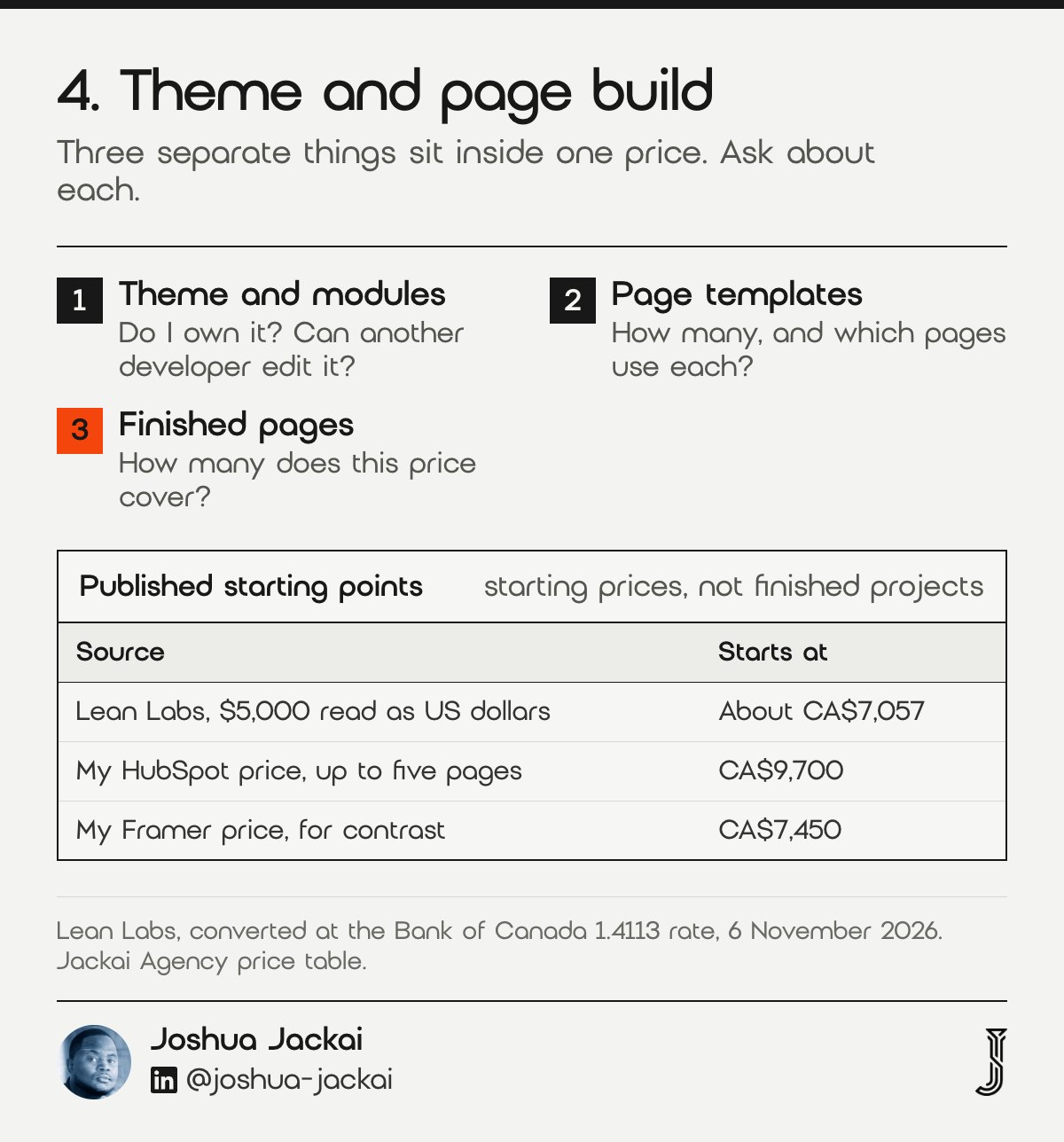
- Vendor starting point: $5,000, currency unnamed, about CA$7,057
- My price: from CA$9,700, up to five pages, HubSpot
- Same build on Framer, for contrast: from CA$7,450
- Ask: do I own the theme, and can another developer edit it?
- Directory check: Clutch minimums ran $1,000+ to $25,000+ across eight Canadian listings
I price HubSpot higher than Framer because the same five pages take longer to build on it. That is my experience of my own table, not a market fact, and other studios may differ.
Directories give you a rough floor. On Clutch’s Canadian HubSpot page, the eight listings I read ranged from $25 to $49 an hour up to $200 to $300 an hour. Minimum projects ran from $1,000+ to $25,000+. Clutch shows no currency code, so ask. That spread is wide because these firms do not sell one product.
Buying this work is hard for a plain reason. You cannot easily inspect a theme before it ships. Economists call that a credence good, where the expert knows more than the buyer does. Dulleck and Kerschbamer describe the worry well: paying for a service that was not provided, or for treatment you did not need. Ask to see two live sites the partner built on HubSpot. Then ask who can edit them today. A client’s site with a named owner tells you more than a logo wall.
“One worries about paying for a service that was not provided or receiving some unnecessary treatment,” Uwe Dulleck and Rudolf Kerschbamer wrote in the Journal of Economic Literature.
5. URL and content migration: 500 redirects per upload
Migration moves pages, blog posts and old URLs onto HubSpot without losing the rankings you already have. Lean Labs lists migration from $7,000, about CA$9,879. HubSpot caps bulk redirect uploads at 500 and bulk URLs at 140 characters. It suits any firm with an existing site, and the URL count should sit in the quote.
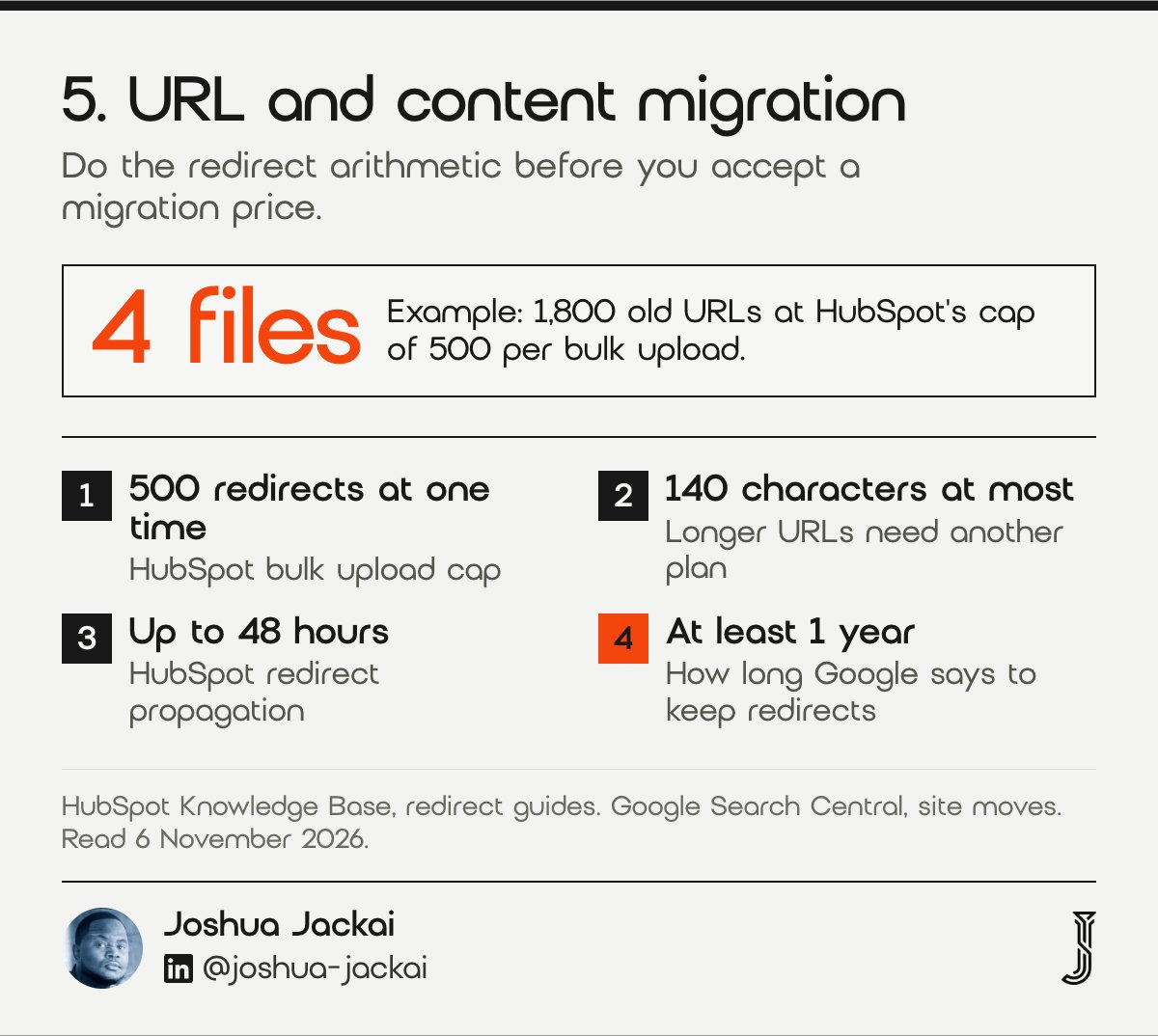
- Bulk cap: 500 redirects at one time
- URL length in bulk: 140 characters at most
- Propagation: up to 48 hours, per HubSpot
- Keep redirects: generally at least 1 year, per Google
- My prices: migration only from CA$2,500; with a five-page HubSpot rebuild from CA$11,950
Limits like these are why a migration line deserves its own row. An old site with 1,800 URLs needs at least 4 upload files under HubSpot’s limit. Long URLs need a separate plan. None of this is hard, but someone has to map every old address to a new one, and that mapping is the real labour.
Google’s site move guide tells you to map old URLs to new ones and keep the redirects for as long as you can. If you plan to leave the old platform and its hosting, confirm where those redirects will live. HubSpot notes that its redirects work only for domains connected to and hosted in HubSpot.
So ask each partner three things. How many URLs does your price cover? Who checks them in Search Console after launch? What happens to the 501st redirect? My HubSpot migration page shows how I handle this route, and my post on rebuilding WordPress without losing SEO covers the same mapping work on a different platform.
“A maximum of 500 redirects can be added or updated in bulk at one time,” HubSpot stated in its redirect guide.
6. Integrations and lead source tracking: the widest price gap
This line covers forms, CRM connections and the fields that record where each lead came from. It is where quotes spread most, because one connector and a custom sync are different jobs. Lean Labs lists integrations from $15,000, about CA$21,170. It suits firms that connect HubSpot to another system, or that need source reporting.
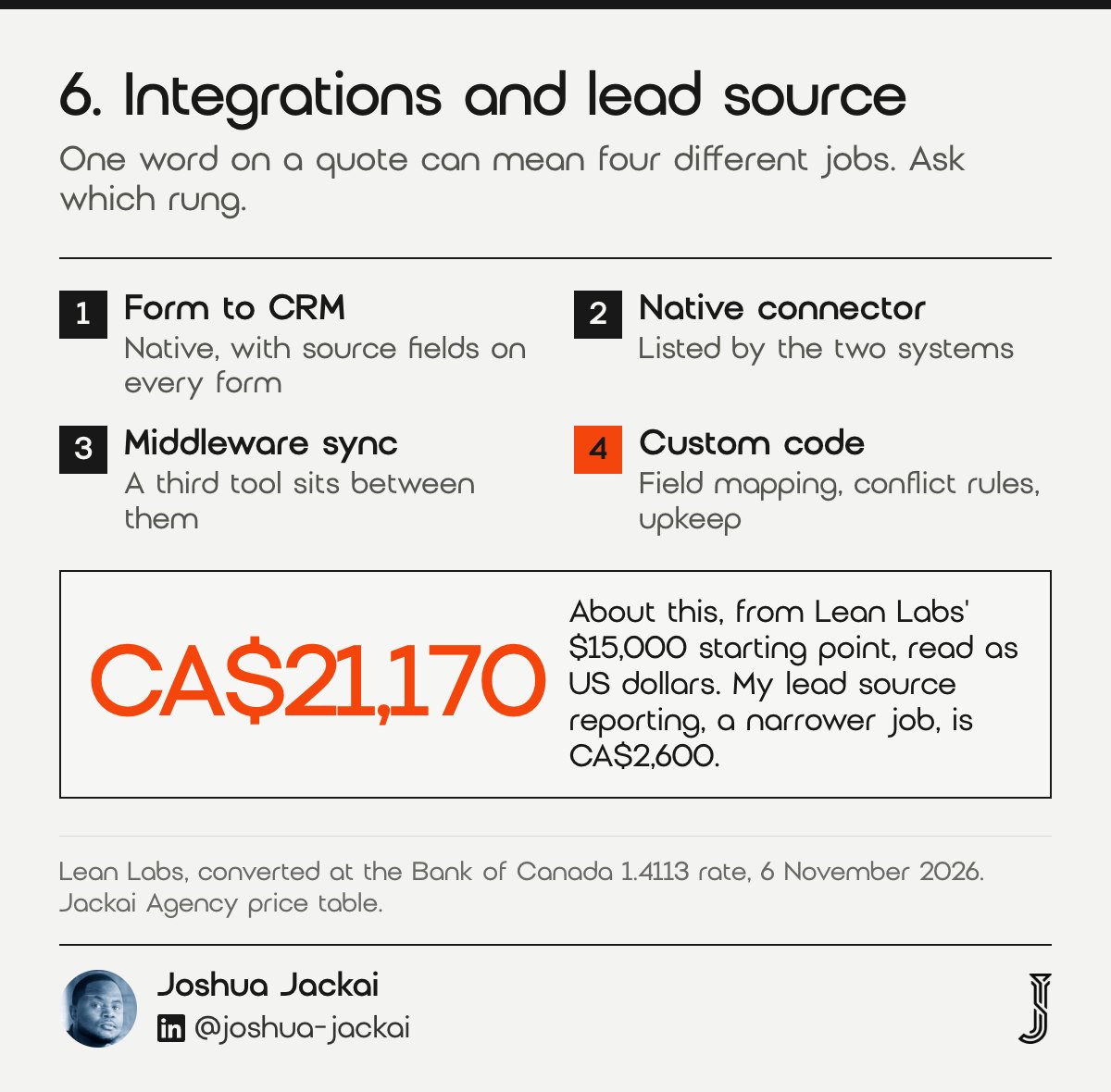
- Vendor starting point: $15,000, currency unnamed, about CA$21,170
- My lead source reporting: CA$2,600, a narrower job
- Scope question: native connector, middleware or custom code?
- Data question: which fields sync, and which system wins a conflict?
- Check after launch: one test lead from each form, read in the CRM
Those two numbers do not compete. Mine covers lead source reporting on forms. A custom sync to an ERP is another kind of work. A quote that says “integrations included” without naming the systems tells you nothing, so ask for the list.
Data quality belongs in this line too. Wang and Strong showed that people who use data judge it on far more than accuracy. Their framework spans intrinsic, contextual, representational and accessibility quality. In plain terms, a lead source field can be correct and still be useless if nobody can find it or trust it during a sales meeting.
Ask the partner to show you the finished report, not just the sync. Pick a real question, such as how many of last month’s leads came from paid search, and ask where you would read the answer. If no one can show it, the integration is unfinished. My guide to website lead tracking in Canada covers the source fields I would ask for.
“Their improvement efforts tend to focus narrowly on accuracy,” Richard Wang and Diane Strong wrote in the Journal of Management Information Systems.
7. Training and handover: the line most likely to get cut
Training teaches your staff to edit pages, read reports and keep the data clean after the partner leaves. INSIDEA lists extra sessions at $250, about CA$353 each. It suits any team that will run the site itself. Cutting this line looks like a saving, yet one study of 454 salespeople found their tool widely rejected six months after rollout.
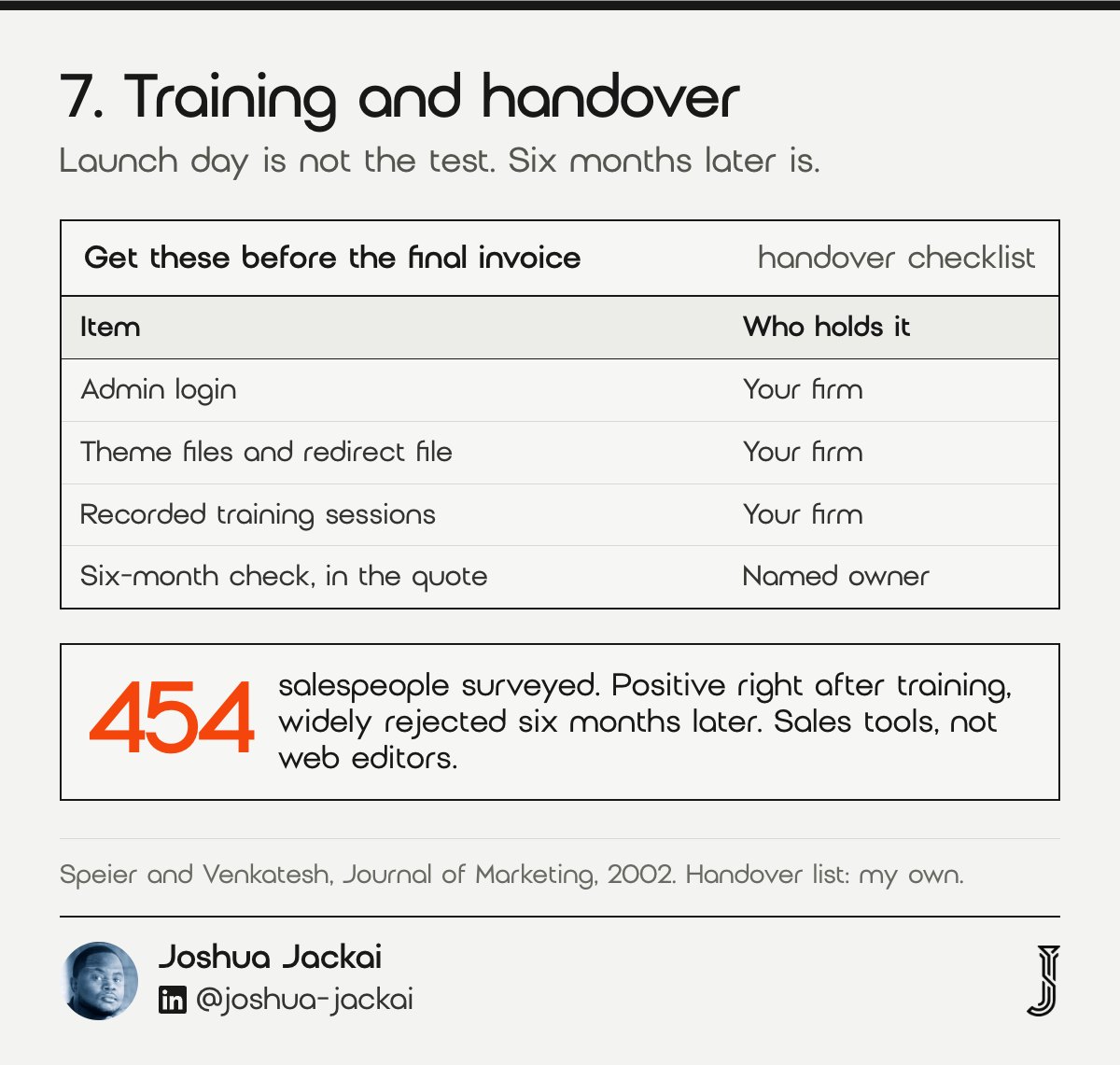
- Vendor price: $250 a session, about CA$353
- Handover items: admin access, theme files, redirect file, recorded sessions
- Named owner: one person inside your firm
- Ask: what can my team do without calling you?
- Check date: six months after launch
Skipping training looks harmless on launch day. Speier and Venkatesh surveyed 454 salespeople at two firms after a sales force automation rollout. Right after training, perceptions were positive. Six months later, the tools had been widely rejected. Salespeople are not your web editors, so treat this as a warning about timing rather than a forecast for your team.
The practical move is a second check. Book one short session about six months out, and put it in the quote. Ask your editor to change a page while the partner watches. Ask your sales lead to open the lead report. If either one cannot do it, you still have time to fix the problem while the partner remembers the build.
Venkatesh and Bala make a related point in their review of technology adoption: managers need to decide which interventions support use, and that decision does not end at installation. Handover is where that decision lands. Ownership matters as well. Confirm in writing that your firm holds the admin login, and my note on who owns your website in Canada lists what else to check.
“Six months after implementation, the technology had been widely rejected,” Cheri Speier and Viswanath Venkatesh wrote in the Journal of Marketing.
8. Tax and currency: the lines that stay on your books
Tax is the line none of the cost pages I read prices in Canadian terms. HubSpot may collect GST, HST, PST or QST by province. Registered firms can usually claim GST and HST, but HubSpot says BC and Saskatchewan PST is not recoverable. At 7%, that is CA$491.40 a year on CA$7,020 of Content Hub.
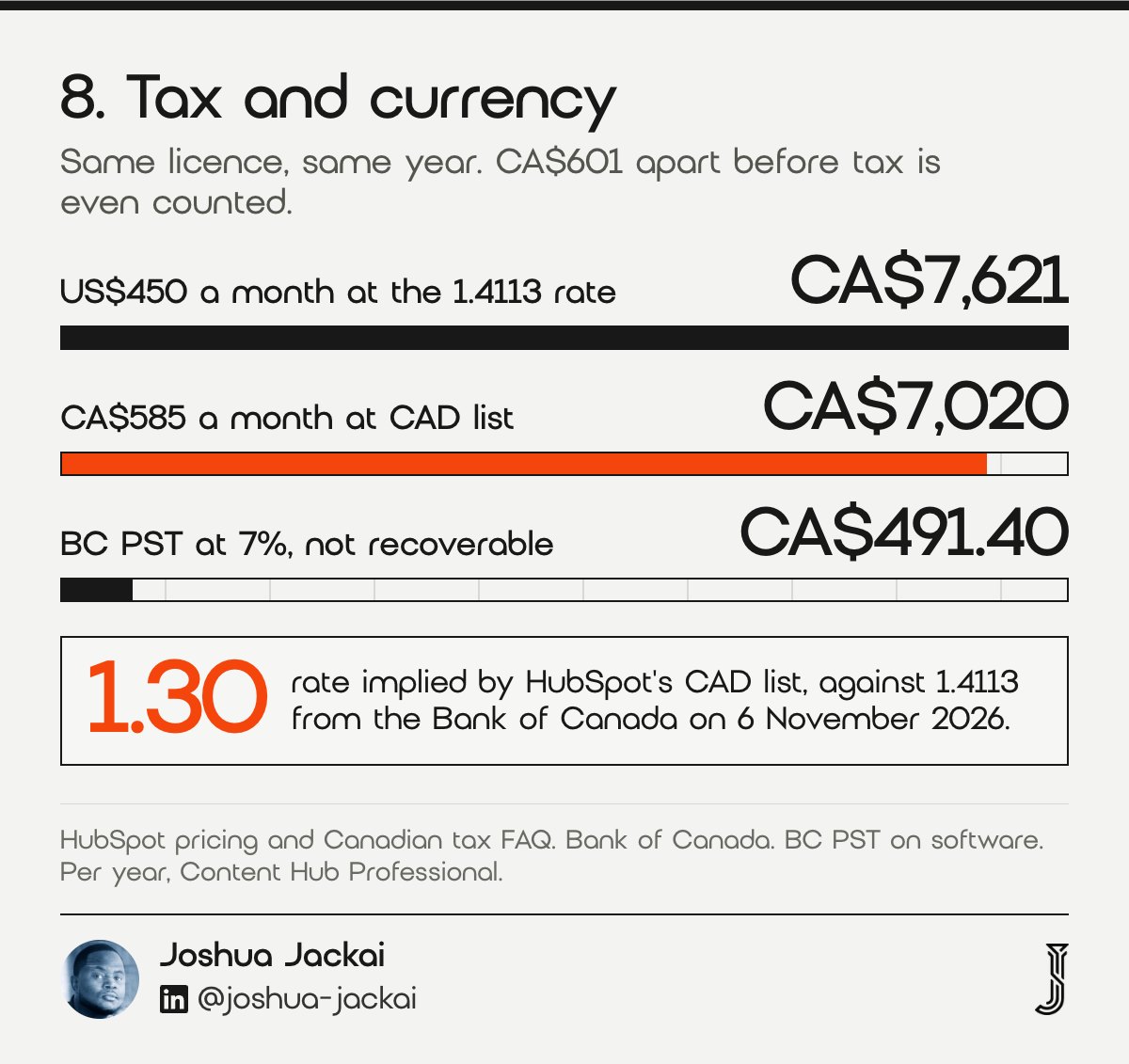
- BC PST on software: 7%, including software as a service
- Services to software: no PST on install, configure or modify work, per BC
- Simple web design: no PST where no software or audio and video is supplied, per BC
- GST and HST: usually claimable by registered firms, per HubSpot
- Currency: CA$585 list against CA$635 at the 6 November rate
Here is the part that surprised me. HubSpot’s CAD list implies a rate of about 1.30, since CA$585 divided by US$450 is 1.30. The Bank of Canada published 1.4113 on 6 November 2026. Same licence, same year, CA$601 apart. Ask for CAD on the order form, and recheck, because list prices and rates both move.
For partner work, BC’s software page says you do not pay PST on services to software, and custom software can be exempt. BC’s telecommunication page says simple web design is not taxed, but a site whose function goes past viewing content can count as software. So ask your accountant how a bundled quote should be split. I am a web designer, not a tax adviser.
Tax lines are easy to miss for a reason. Chetty, Looney and Kroft found that tax-inclusive price tags cut grocery demand by 8%. Buyers under-react to whatever is not on the tag. Put the tax on your comparison sheet.
“The PST imposed by British Columbia and Saskatchewan is not a recoverable tax,” HubSpot stated in its Canadian indirect tax FAQ.
“Consumers underreact to taxes that are not salient,” Raj Chetty, Adam Looney and Kory Kroft wrote in the American Economic Review.
Compare the eight cost lines
The matrix sets all eight lines against who bills them, what published figure exists and how firm that figure is. Filter by who sends the invoice, so you can see which parts a partner controls and which parts no partner can negotiate away. Vendor conversions use the Bank of Canada rate for 6 November 2026.
| Cost line | Invoice from | Published figure | How firm | Source |
|---|---|---|---|---|
| HubSpot onboarding | HubSpot | CA$3,700 or CA$9,100, Marketing Hub | List price | HubSpot Canada |
| Content Hub licence | HubSpot | CA$7,020 a year, Professional | List price | HubSpot Canada |
| Scoping | Partner | No public figure | Ask | Moløkken and Jørgensen, 2003, on overruns |
| Theme and page build | Partner | From CA$7,057 (converted); from CA$9,700 (my price) | Starting price | Lean Labs; my price table |
| URL and content migration | Partner | From CA$9,879 (converted); from CA$2,500 (my price) | Starting price | Lean Labs; my price table |
| Integrations and lead source | Partner | From CA$21,170 (converted); CA$2,600 (my reporting) | Starting price | Lean Labs; my price table |
| Training and handover | Partner | About CA$353 a session (converted) | Vendor rate | INSIDEA; Speier and Venkatesh, 2002 |
| Tax and currency | Government and bank | 7% BC PST on software; CA$601 a year between CAD list and the US price | Rule, and a daily rate | BC government; HubSpot; Bank of Canada |
Converted figures use the Bank of Canada rates for 6 November 2026. Vendor pages that show “$” with no currency code are read as US dollars.
Calculate two quotes on the same terms
The calculator puts two quotes into first-year Canadian dollars, including any HubSpot onboarding still owed, the licence and PST on that licence. It leaves out GST and HST because registered firms usually claim them. Defaults are placeholders, not benchmarks, so replace every one with the figures on your own quotes.
Defaults are placeholders, not benchmarks. Enter the figures on your own quotes. GST and HST are left out because registered firms can usually claim them. Confirm your tax position with your accountant.
Partitioned prices are why this matters. Greenleaf, Johnson, Morwitz and Shalev reviewed the research on prices split into a base and mandatory surcharges, and raise the concern that buyers underestimate the total. Consumers were the subjects, not procurement teams, but I see no reason a busy owner reading two PDFs is immune.
"Consumers do not always fully attend to or process all price information," Eric Greenleaf and colleagues wrote in the Journal of Consumer Psychology.
How to choose a HubSpot implementation partner in Canada
Choose on the written scope first and the price second. Ask five questions, and give every partner the same counts for pages, URLs, forms, systems and people. A low price with no counts behind it cannot be compared. For complex work, talking through the design with one or two partners can beat a blind bid.
- Does your price replace HubSpot's onboarding fee, and who confirms that in writing?
- Which hubs and how many seats does your plan assume in year one?
- How many pages, URLs, forms and integrations does this figure cover?
- Who pays when the count goes up, and at what rate?
- Which currency is this in, and which lines carry PST?
A partner badge alone will not answer these. HubSpot's directory shows who is listed, not what your project will cost. Ask for two live sites and the name of someone who can edit them today.
Blind bidding has limits here too. Bajari, McMillan and Tadelis studied private building contracts in Northern California and found auctions may perform poorly when projects are complex and the design is incomplete. Buildings are not websites. Still, a half-specified HubSpot project looks a lot more like their complex case than a commodity purchase. Once two partners have your counts, a real conversation will teach you more than a third PDF.
"Auctions may perform poorly when projects are complex, contractual design is incomplete, and there are few available bidders," Patrick Bajari and colleagues wrote in the Journal of Law, Economics, and Organization.
How I got these numbers, and what they cannot tell you
I read HubSpot's Canadian pricing pages in a browser on 6 November 2026, took conversion rates from the Bank of Canada that day, and read vendor pages the same day. No source I found publishes a Canadian benchmark for partner fees, so this guide gives list prices, converted vendor figures and my own table, never an average.
- Lean Labs and INSIDEA show "$" without a currency code. I read both as US dollars and say so wherever I convert them. Lean Labs' overall range of $3,000 to $30,000 or more converts to about CA$4,234 to CA$42,339 at the 1.4113 rate.
- Clutch shows "$" without a currency code. I report those figures unconverted, and I read eight listings, not the whole directory.
- Vendor figures are marketing pages and are not peer reviewed. Starting prices tell you little about a finished project.
- The peer-reviewed studies come from software, sales technology, retail and construction. None tested HubSpot partners.
Questions about HubSpot implementation partner cost in Canada
These five questions come up when Canadian buyers compare partners. Each answer adds a practical detail, and every price is a list price or a converted vendor figure from 6 November 2026. Confirm any figure on your own order form, because HubSpot can change its Canadian list prices and bank rates move daily.
How much does a HubSpot implementation partner cost in Canada?
I found no published Canadian benchmark for partner fees. Vendor pages convert to about CA$4,234 at the low end and CA$55,062 or more at the high end. Lean Labs ties its low end to single-hub setups with little migration. Get counts in writing, then ask for a fixed figure.
Can a partner replace HubSpot's onboarding fee?
Some partners say yes, including Avidly and INSIDEA, but they are describing their own market and I found no HubSpot page stating the rule. You would still pay the partner for the work. Ask your HubSpot rep to confirm any removal on your order form.
Is HubSpot cheaper in Canadian dollars?
Yes for Content Hub Professional on 6 November 2026: HubSpot listed CA$585 a month against US$450, about CA$635 at the Bank of Canada's 1.4113 rate. That gap is CA$601 a year. Rates and list prices both change, so recheck them on signing day.
Do I pay PST on HubSpot in BC?
Yes, when HubSpot collects it. BC PST on software is 7%, and HubSpot says it is not recoverable, which is CA$491.40 a year on CA$7,020 of Content Hub. BC says services to software carry no PST. Have your accountant review any bundled quote.
Do I need a partner for a HubSpot website?
Not always. A small team on Starter can build simple pages alone, and the Content Hub page shows no onboarding fee. A partner earns the money when you have many URLs to redirect, custom templates to build or another system to connect, and nobody in-house can own it.
How I price the website part for Canadian firms
I quote the website part of this work at fixed prices in Canadian dollars. A five-page custom HubSpot site starts at CA$9,700, and a migration with a five-page HubSpot rebuild starts at CA$11,950. If your project is mainly a CRM rebuild across several hubs, a partner that scopes CRM work is the better first call.
I sell the build and migration work in lines 4 and 5, so read my prices as a seller's prices, and ask me the same five questions you would ask anyone else.
You can price your route on the quote calculator, read what is included on my HubSpot website redesign page, or start with the CA$995 website audit, which is credited if a project starts within 30 days. Bring the eight lines from this guide. If a quote is missing one of them, that is the first thing I would ask about.
Sources
Peer-reviewed
- Bajari, P., McMillan, R. and Tadelis, S. (2008). Auctions Versus Negotiations in Procurement: An Empirical Analysis. The Journal of Law, Economics, and Organization. doi.org/10.1093/jleo/ewn002
- Chetty, R., Looney, A. and Kroft, K. (2009). Salience and Taxation: Theory and Evidence. American Economic Review. doi.org/10.1257/aer.99.4.1145
- Dulleck, U. and Kerschbamer, R. (2006). On Doctors, Mechanics, and Computer Specialists: The Economics of Credence Goods. Journal of Economic Literature. doi.org/10.1257/002205106776162717
- Greenleaf, E. A., Johnson, E. J., Morwitz, V. G. and Shalev, E. (2015). The Price Does Not Include Additional Taxes, Fees, and Surcharges: A Review of Research on Partitioned Pricing. Journal of Consumer Psychology. doi.org/10.1016/j.jcps.2015.04.006
- Jørgensen, M. and Grimstad, S. (2010). The Impact of Irrelevant and Misleading Information on Software Development Effort Estimates: A Randomized Controlled Field Experiment. IEEE Transactions on Software Engineering. doi.org/10.1109/TSE.2010.78
- Moløkken, K. and Jørgensen, M. (2003). A Review of Software Surveys on Software Effort Estimation. International Symposium on Empirical Software Engineering. doi.org/10.1109/ISESE.2003.1237981
- Speier, C. and Venkatesh, V. (2002). The Hidden Minefields in the Adoption of Sales Force Automation Technologies. Journal of Marketing. doi.org/10.1509/jmkg.66.3.98.18510
- Venkatesh, V. and Bala, H. (2008). Technology Acceptance Model 3 and a Research Agenda on Interventions. Decision Sciences. doi.org/10.1111/j.1540-5915.2008.00192.x
- Wang, R. Y. and Strong, D. M. (1996). Beyond Accuracy: What Data Quality Means to Data Consumers. Journal of Management Information Systems. doi.org/10.1080/07421222.1996.11518099
Government, industry and vendor (not peer reviewed; all read 6 November 2026)
- Bank of Canada. Daily exchange rates, USD to CAD and EUR to CAD.
- Province of British Columbia. PST on software and PST on telecommunication services.
- Google Search Central. Site moves with URL changes.
- HubSpot. Content Hub pricing, Marketing Hub pricing, Canadian indirect taxes FAQ, bulk redirect upload and URL redirects.
- Avidly. HubSpot onboarding fees 2026. Vendor figures in euros.
- Clutch. HubSpot partners in Canada. Directory listings, currency not stated.
- INSIDEA. HubSpot implementation cost. Vendor figures, currency not stated.
- Lean Labs. HubSpot implementation cost with a partner. Vendor figures, currency not stated.