Professional Services Website Design Vancouver: 7 Best Tips
Seven website checks for Vancouver law, accounting and consulting firms: what the first screen should say, the BC Code and CPABC rules a site must follow, team labels, licences, fees and a safe contact form, with my CAD prices.
 Joshua Jackai
20 min read
Published 24 November 2026 · Last updated and fact-checked November 2026
I am a web designer, not a lawyer or an accountant. Confirm rule questions with your regulator.
Short answer: Good professional services website design in Vancouver lowers the buyer’s risk and follows your regulator’s rules. The Law Society of British Columbia’s Code of Professional Conduct (the BC Code) bans marketing that is false, inaccurate or unverifiable (rule 4.2-5), and CPABC Rule 217.1 bans claims a member cannot substantiate. Fixed builds on my table start at CA$4,950.
Law firms, accounting practices and consulting firms in Vancouver ask me the same thing before a redesign: what should the site say, and what are we allowed to say? The second question matters more here than in most industries. A plumber can call themselves the best in town. A BC lawyer or CPA writes website copy under a code of conduct, and the website counts as marketing. This guide gives you seven checks I run on every professional services site, with the rule or the study behind each one.
In this guide
Key takeaways
- Perceived risk rises from search to experience to credence services, so legal, accounting and advisory buyers start out more cautious than retail buyers (Mitra, Reiss and Capella, Journal of Services Marketing, 1999).
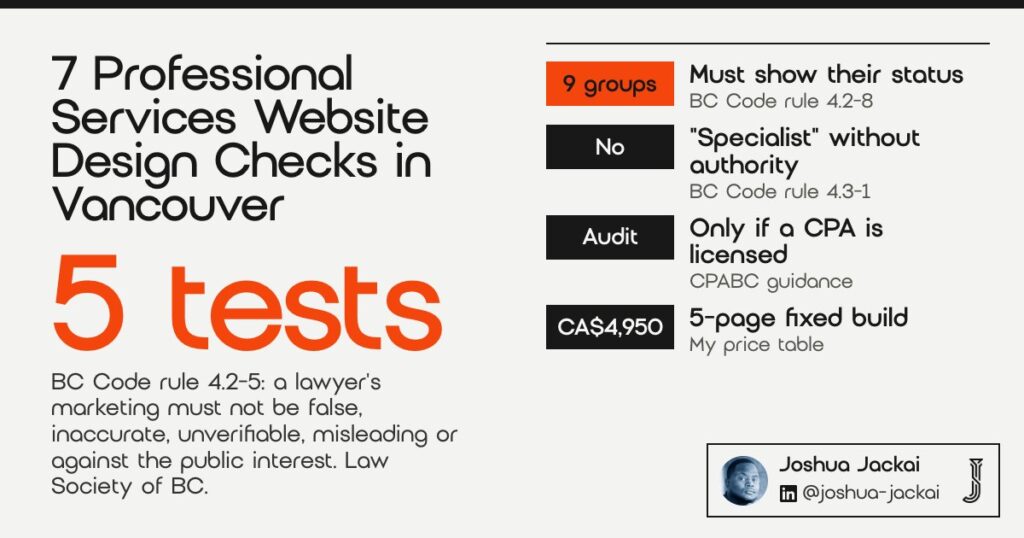
- The Law Society of British Columbia lists 5 tests for any lawyer’s marketing, including the website: not false, not inaccurate, not unverifiable, not reasonably capable of misleading, not contrary to the best interests of the public (BC Code rule 4.2-5).
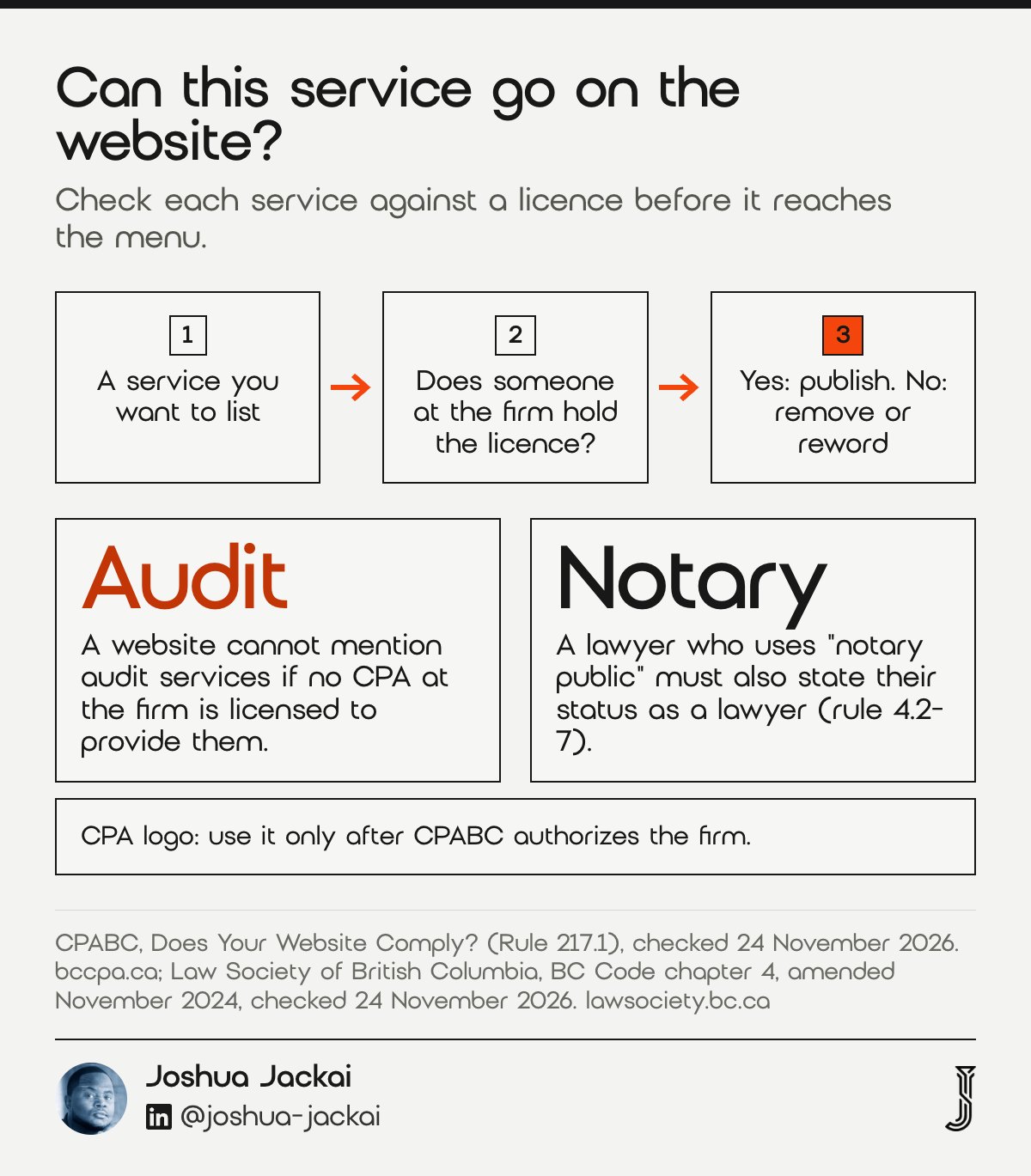
- Chartered Professional Accountants of British Columbia (CPABC) says a firm website cannot mention audit services if no CPA at the firm is licensed to provide them (CPABC, Does Your Website Comply?).
- In a study of 6,831 consumers across 25 websites, brand strength was critical for financial services sites (Bart and colleagues, Journal of Marketing, 2005).
- My fixed prices run from CA$4,950 for a 5-page small business site to CA$7,450 and up for a custom B2B site, and a CA$995 audit is credited within 30 days.
| # | Check | Who it applies to | What it protects | Source |
|---|---|---|---|---|
| 1 | Say what you do, for whom, in BC | Every firm | First impression in 50 ms | Lindgaard 2006, Mitra 1999 |
| 2 | Make every claim verifiable | Lawyers, CPAs | Discipline risk, buyer trust | BC Code 4.2-5, CPABC 217.1 |
| 3 | Drop “specialist” unless you hold it | Lawyers | Discipline risk | BC Code 4.3-1 |
| 4 | Label every person’s status | Law and CPA firms | Accurate staff pages | BC Code 4.2-8, CPABC |
| 5 | Match service pages to licences | CPA firms, notary work | Accurate service pages | CPABC guidance, BC Code 4.2-7 |
| 6 | Show people, process and fees | Every firm | Lower credence risk | Dulleck 2006, Ostrom 1995 |
| 7 | Make first contact safe and private | Every firm | Trust, BC privacy law | Gefen 2003, BC PIPA s.4 and s.11 |
1. What should the first screen of a professional services website say?
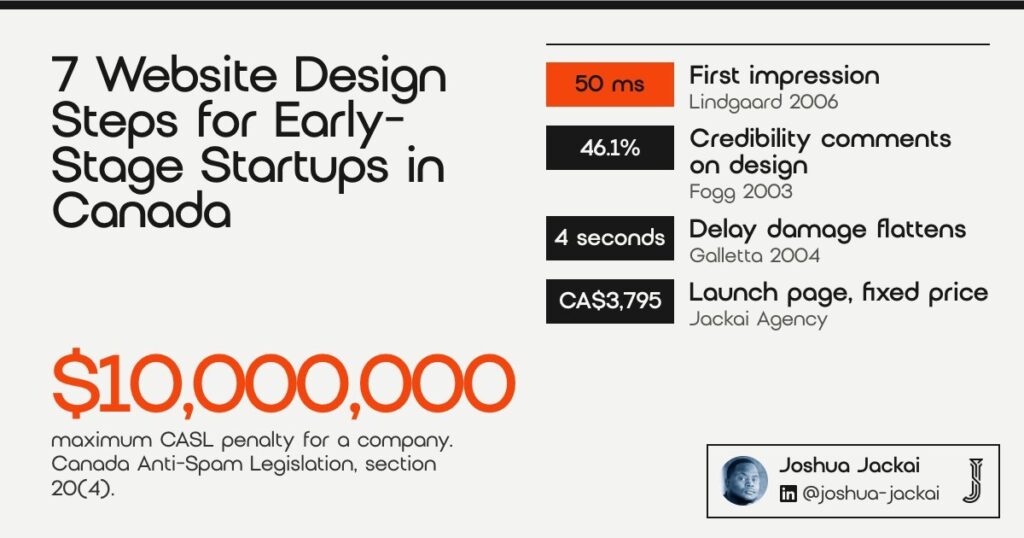
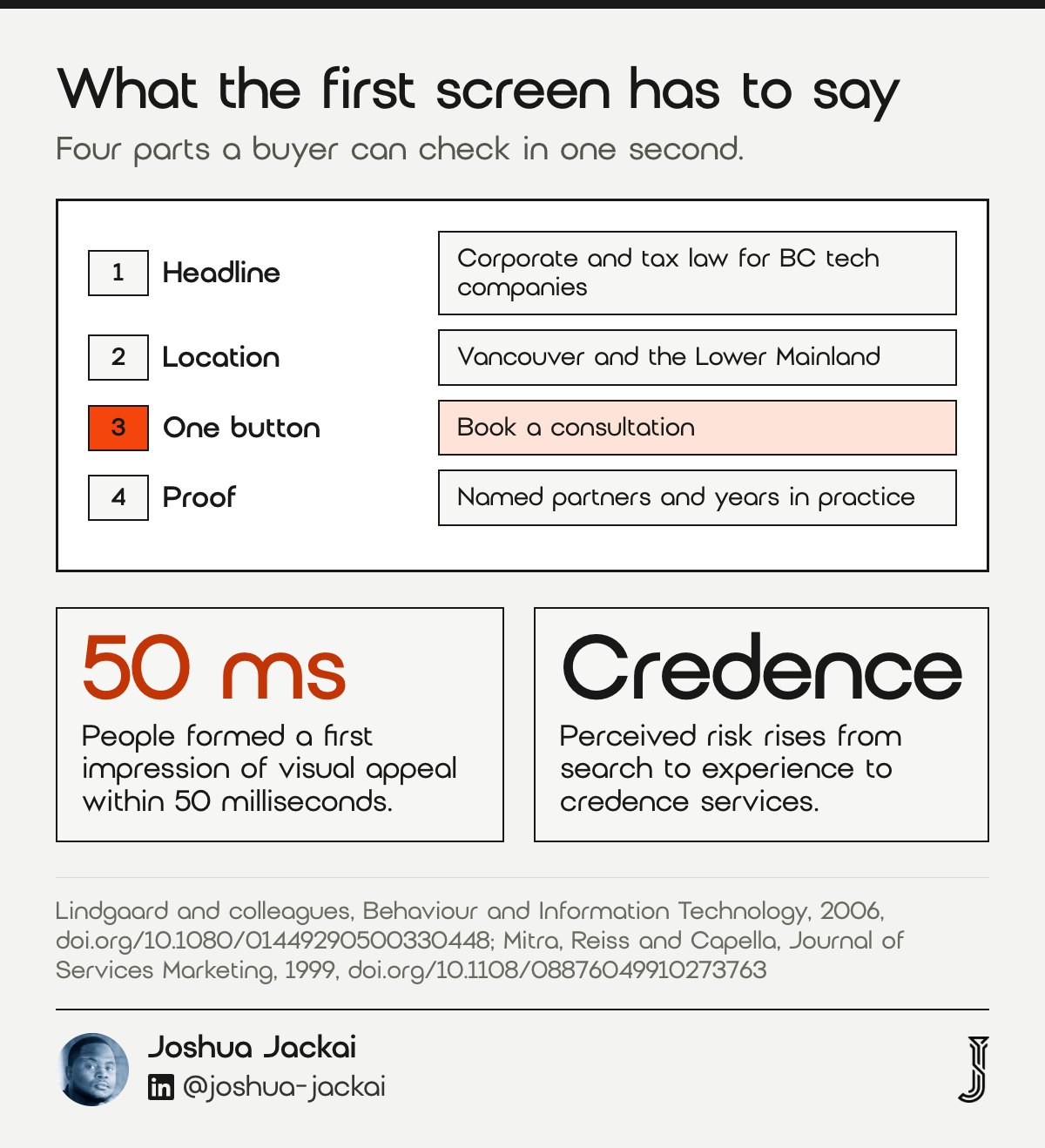
The first screen should say what the firm does, who it serves and where, in one plain sentence, with one way to start a conversation. Visitors judge fast: Lindgaard and colleagues titled their study “You have 50 milliseconds to make a good first impression”, so vague slogans lose people early.
- Headline: the service and the client type, for example “Corporate and tax law for BC tech companies”
- Location line: Vancouver, the Lower Mainland or the province you serve
- One button: book a consultation or request a quote
- Proof near the top: named partners, years in practice or a recognised client type
- Price on my table: small business site CA$4,950 (Framer) or CA$5,950 (WordPress)
Professional services are hard to judge before you buy them, and often hard to judge after. That is why the first screen carries more weight than it does for a shop. A buyer looking for a tax accountant cannot test the product. They test the signals: does this firm do my kind of work, for my kind of company, in my province?
Most firm homepages I review in Vancouver open with a line that could belong to any firm in Canada: “Trusted advisors”, “Solutions for your business”, “Experience you can count on”. None of them answer the buyer’s first question. I rewrite that line before anything else, and I keep it literal. “Employment law for Vancouver employers” beats “Your partner in workplace success” every time, because a reader can check it in one second.
Mitra, Reiss and Capella measured how risk changes across service types and found a clear pattern:
“Perceived risk increases along a continuum from search to experience to credence service purchases,” wrote Mitra, Reiss and Capella (Journal of Services Marketing, 1999).
Legal, accounting and advisory work sits at the credence end of that line. A clear first screen does not remove the risk, but it removes the extra doubt a vague page adds on top.
Data point: People formed a first impression of a web page’s visual appeal within 50 milliseconds, the finding Lindgaard and colleagues put in their title (Behaviour and Information Technology, 2006).
2. Can every claim on the website be verified?
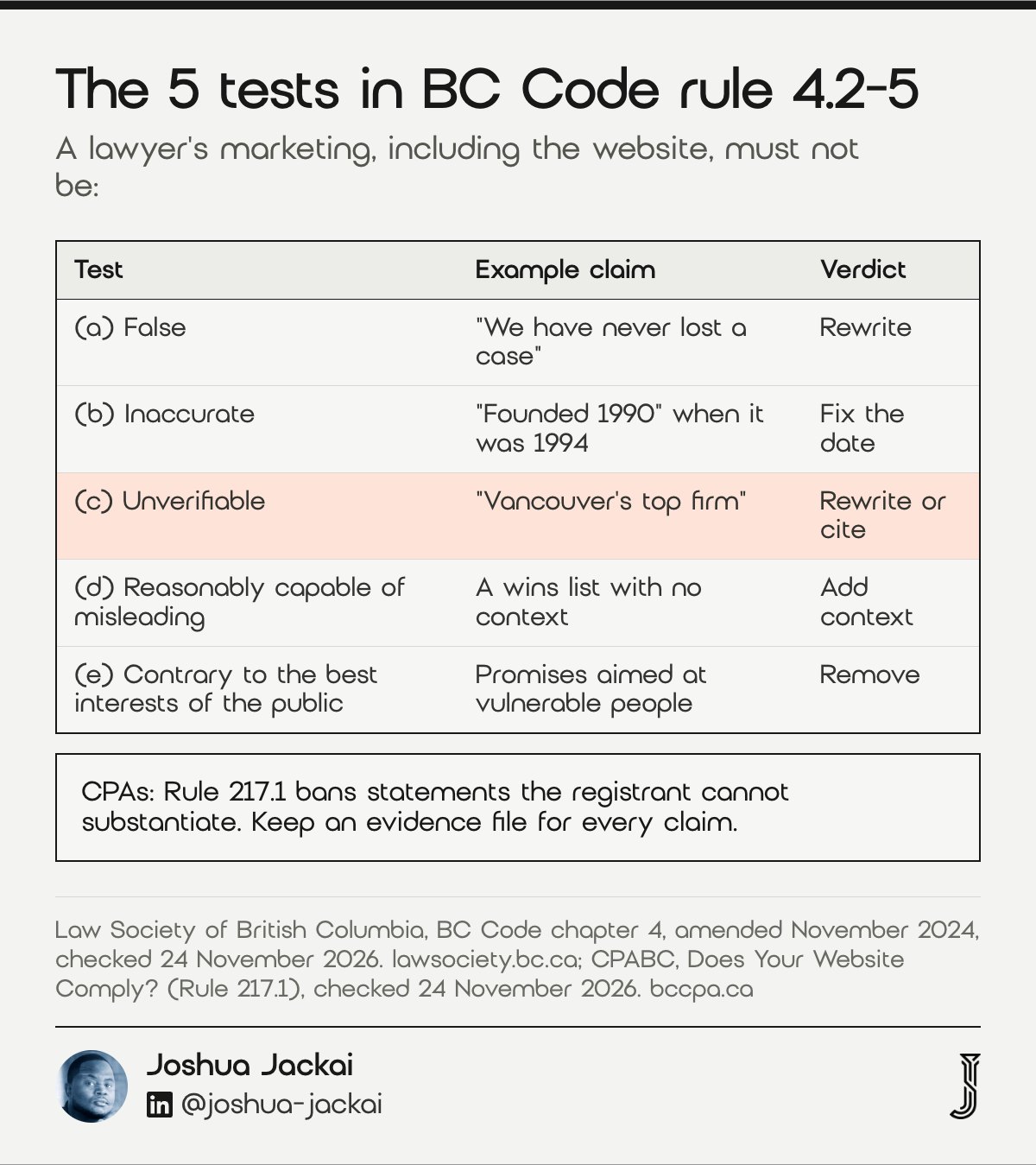
Every claim on a BC law or CPA firm’s website should be one a regulator could check against evidence. BC Code rule 4.2-5 says marketing must not be false, inaccurate, unverifiable, reasonably capable of misleading, or contrary to the best interests of the public, and rule 4.2-4 counts any promotion of legal services as marketing.
- Rule for lawyers: BC Code rule 4.2-5, five tests
- Rule for CPAs: CPABC Code Rule 217.1, no claims the registrant cannot substantiate
- Risky phrases: “the best”, “guaranteed results”, “we win every case”, “number one firm”
- Safer phrases: years in practice, matters handled, named publications, named memberships
- Who checks: the regulator, after a complaint
The BC Code is specific about what counts. Rule 4.2-4 defines a marketing activity to include “any publication or communication in the nature of an advertisement, promotional activity or material”, plus letterhead, directory listings and public appearances. A firm website is the most visible of those. Rule 4.2-5 then sets the bar:
“Any marketing activity undertaken or authorized by a lawyer must not be: (a) false, (b) inaccurate, (c) unverifiable,” the Law Society of BC stated (BC Code rule 4.2-5).
The commentary adds that marketing breaks the rule if it “is likely to create in the mind of the recipient or intended recipient an unjustified expectation about the results that the lawyer can achieve”. That line is the one I watch on results pages and case summaries. A list of wins with no context can create exactly that expectation.
For accountants, CPABC reminds firms that website content must meet Rule 217.1, which bans advertising a registrant “knows, or should know, is false or misleading or which includes a statement the contents of which the registrant cannot substantiate”. In practice I keep a short evidence file for each claim on a firm’s site: where the number came from, the date, and who signed off.
Data point: The BC Code lists 5 tests for marketing, rule 4.2-5 (a) to (e), and was amended in November 2024 (Law Society of British Columbia).
3. Can a lawyer call themselves a specialist on their website in BC?
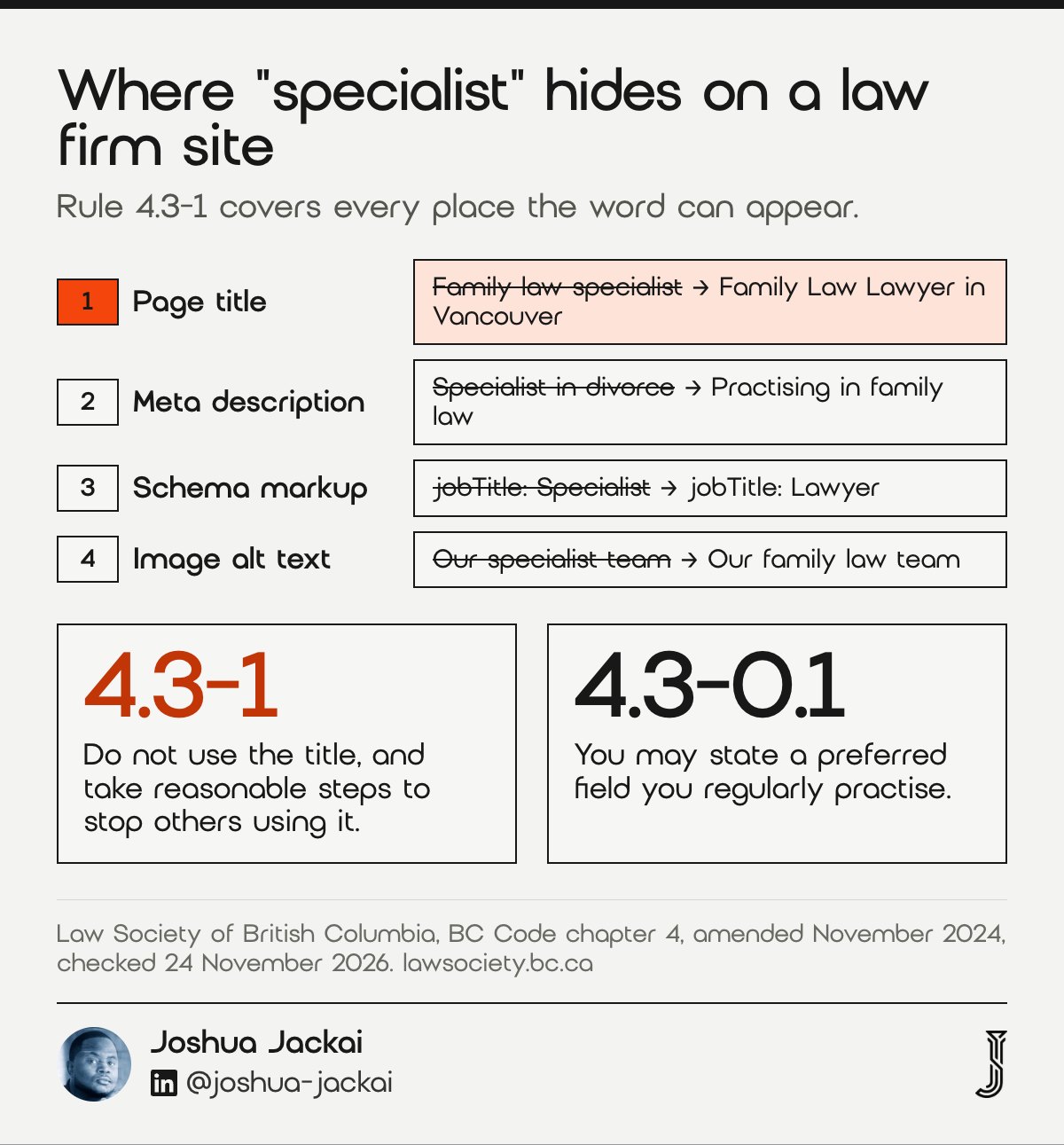
Not unless the Legal Profession Act, the Law Society Rules, the Code or the Benchers authorize it. Rule 4.3-1 bars a lawyer from using “specialist” or any similar designation suggesting a recognized special status, and requires reasonable steps to stop others using it about them. A lawyer may state a preferred practice area they regularly practise.
- Banned without authority: “specialist” and similar designations
- Allowed: a preference for fields of law the lawyer regularly practises (rule 4.3-0.1)
- Watch: directory profiles, review sites and agency-written bios
- Duty: take reasonable steps to discourage others from using the title
- Where it shows up: page titles, meta descriptions, schema markup, alt text
This is the rule web agencies break most often for law firms, usually without anyone at the firm noticing. Search engine optimization habits push toward phrases like “Vancouver family law specialist” in page titles and meta descriptions, because those phrases match what people type. The title tag is still marketing. So is the description that shows in Google, and so is a structured data field that says “specialist”.
The fix is simple and costs nothing in search terms. Rule 4.3-0.1 lets a lawyer state a preference for any field of law they regularly practise. So the page title becomes “Family Law Lawyer in Vancouver” or “Practising in Family Law, Vancouver”, and the copy names the matters the lawyer handles. People still find the page. The page just stops implying an accreditation the lawyer does not hold.
“A lawyer may state in any marketing activity a preference for practice in any one or more fields of law if the lawyer regularly practises in each field,” the Law Society of BC stated (BC Code rule 4.3-0.1).
I also check the parts of a site a lawyer never reads: image alt text, Open Graph titles used when a page is shared on LinkedIn, and the schema markup an SEO plugin writes by default.
Data point: BC Code rule 4.3-1 has 2 parts: (a) do not use the title, and (b) take all reasonable steps to discourage others from using it (Law Society of British Columbia).
4. How should a firm label each person on its team page?
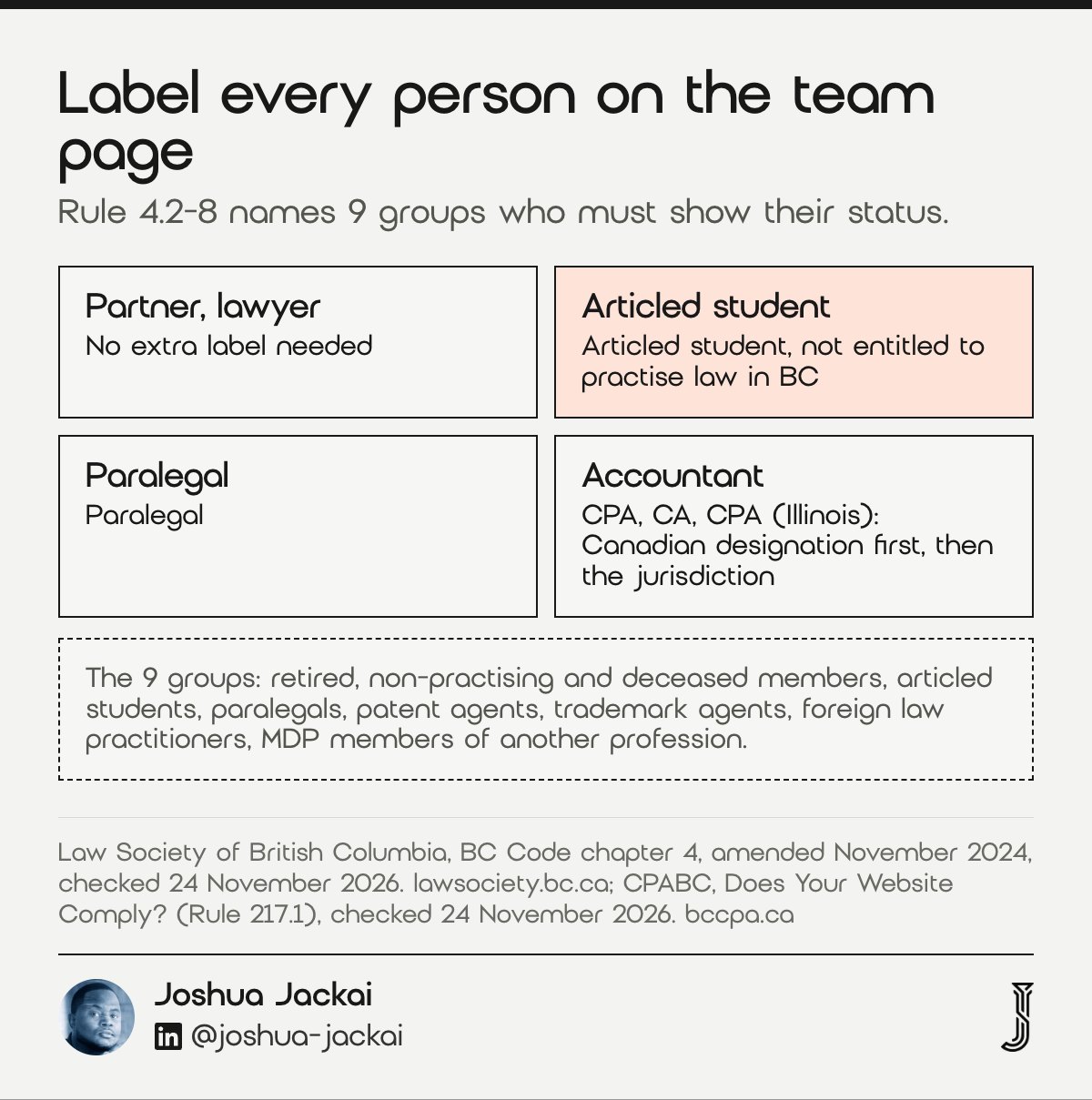
Label each person with their exact status and designation. The BC Code bars listing anyone not entitled to practise law in BC without saying so, and names 9 groups, from retired members to paralegals and patent agents. CPABC requires individual CPA designations to carry the legacy tag, such as “CPA, CA”, with foreign designations after the Canadian one.
- Law firms: mark articled students, paralegals, retired and non-practising members (rule 4.2-8)
- Patent and trademark agents: mark their status where registered
- CPA firms: firm name says “Chartered Professional Accountant(s)” with no legacy tag
- Individual CPAs: “CPA, CA”, “CPA, CGA” or “CPA, CMA”
- Foreign designations: after the Canadian CPA, with the jurisdiction, for example “CPA, CA, CPA (Illinois)”
Team pages are where good firms slip, because they change often and nobody owns them. A student who articled with the firm last year is still on the page as “Associate”. A paralegal’s bio has no title at all. A retired partner’s photo stays up because clients liked seeing it. Each of those is a listing in a marketing activity under rule 4.2-8.
The BC Code lists the people who must carry an indication of status. They are retired, non-practising and deceased members, articled students, and legal assistants or paralegals. Registered patent agents and trademark agents are on the list too. So are practitioners of foreign law with a permit, and members of another profession inside a permitted multi-disciplinary practice.
CPABC’s website guidance gives accountants equally exact wording. The firm is not “tagged” with a legacy designation; individuals are. US and other foreign designations can appear only for a CPABC member in good standing, shown after the Canadian CPA designation and with the jurisdiction.
I build team pages from a single list with a required status field, so the page cannot publish a person without one. That turns a compliance duty into a form field.
Data point: BC Code rule 4.2-8 names 9 groups, (a) to (i), who must be listed with an indication of status (Law Society of British Columbia).
5. Do your service pages match what the firm is licensed to do?
Every service page should match a licence someone at the firm holds. CPABC states that a website cannot mention “audit services” if no CPA at the firm is licensed to provide them. For lawyers, BC Code rule 4.2-7 says a lawyer who uses “notary” or “notary public” in marketing must also state their status as a lawyer.
- CPA firms: services must align with the licence categories of owners or authorized staff
- Audit services: only list them if a CPA at the firm is licensed to provide them
- CPA logo: use it only after CPABC authorizes the firm
- Lawyers acting as notaries: state lawyer status alongside “notary”
- Real estate marketing by lawyers: include the lawyer’s or firm’s name and, if a phone number is used, only the lawyer’s or firm’s number (rule 4.3-2)
Service menus grow by copy and paste. An agency borrows a list from a larger firm’s site, or a partner adds “audit” because a client asked about it once. CPABC’s guidance closes that gap in one sentence:
“A website cannot mention ‘audit services’ if no CPA at the firm is licensed to provide audit services,” CPABC stated (Does Your Website Comply?).
The same guidance says the firm must have CPABC’s authorization before it uses the CPA logo. I treat both as checklist items at kickoff, not at launch, because they change the sitemap. If the firm cannot list audit work, the services page, the navigation and the schema markup all change shape.
Law firms have smaller versions of the same issue. A lawyer who also offers notarial services and puts “notary public” on the site must say, in the same marketing, that they are a lawyer. Rule 4.3-2 adds a narrow one for lawyers who market real property for sale or lease: include the lawyer’s or firm’s name and, if a phone number is used, only the lawyer’s or firm’s number.
Data point: CPABC’s website guidance lists 5 requirements plus Rule 217.1: firm name wording, individual designation tags, foreign designation order, services that match licence categories, and authorization for the CPA logo (CPABC).
6. How do you show quality when buyers cannot judge the work?
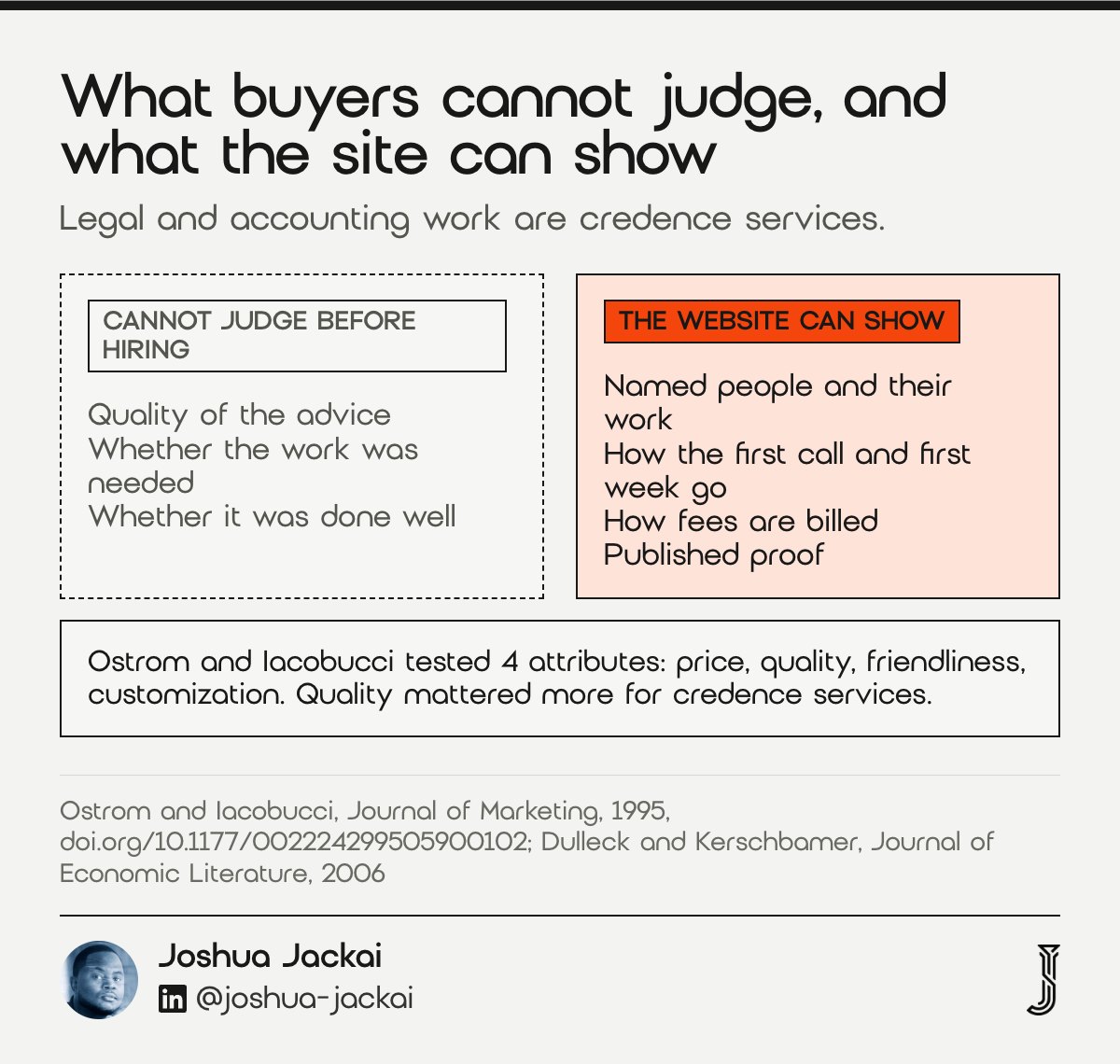
Show the people, the process and how fees work, because buyers of legal and accounting work cannot test quality before they hire. In a conjoint study, Ostrom and Iacobucci found price mattered more for less critical purchases while quality mattered more for credence services, so proof of quality outranks a low price on these sites.
- People: named partners, photos, practice history, bar or CPA status
- Process: what happens in the first call, the first week and the first invoice
- Fees: hourly, fixed or retainer, and what drives the range
- Proof: published articles, speaking, named memberships, approved case summaries
- Avoid: outcome promises and unexplained “results” lists
Economists call these credence goods: services where the expert knows more than the buyer about what is needed and whether it was done well. Darby and Karni wrote about these credence qualities in 1973, and Dulleck and Kerschbamer’s later review describes the buyer’s worry plainly:
“One worries about paying for a service that was not provided or receiving some unnecessary treatment,” wrote Uwe Dulleck and Rudolf Kerschbamer (Journal of Economic Literature, 2006).
A website cannot remove that worry, but it can shrink it. I add three sections to most firm sites that the old site did not have. A “how we work” page that walks through the first meeting and the engagement letter. A fees section that explains the billing model even when it cannot give a number. And bios that say what each person does day to day, not only where they studied.
Ostrom and Iacobucci put the trade-off in one line:
“Consumers are price sensitive for less critical purchase situations, whereas quality is more important for credence services,” wrote Amy Ostrom and Dawn Iacobucci (Journal of Marketing, 1995).
Data point: Ostrom and Iacobucci’s conjoint study tested 4 service attributes: price, level of quality, friendliness of the service personnel and degree of customization (Journal of Marketing, 1995).
7. How do you make the first contact feel safe and private?
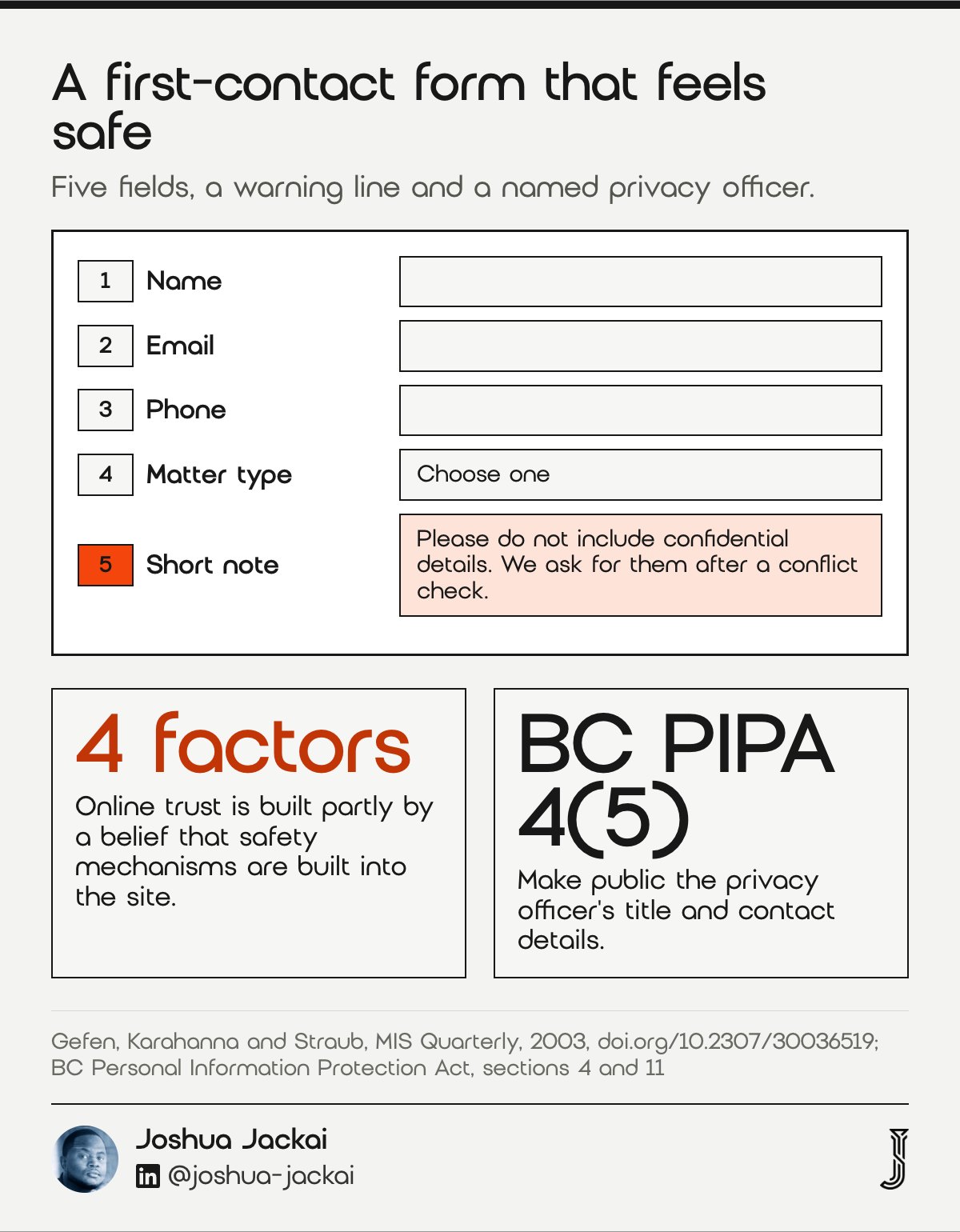
Make the first contact short, clear about what happens next and open about how personal information is handled. Gefen and colleagues found online trust is built partly by a belief that safety mechanisms are built into the site. BC’s Personal Information Protection Act requires a firm to make public the title and contact details of its privacy officer.
- Form fields: name, email, phone, matter type, a short note; no confidential details yet
- Under the button: what happens next and when you reply
- Privacy: a linked policy giving the privacy officer’s title and contact details
- Conflicts: tell people not to send confidential facts before a conflict check
- Speed: the form loads and submits on a phone over cellular data
Professional services forms ask for too much too early. A law firm intake form that invites people to “describe your situation in detail” collects confidential facts before anyone has checked for a conflict. An accounting firm form that asks for income ranges and SIN-style details on page one scares people off. I cut first-contact forms to five fields and put one line above the message box: “Please do not include confidential details. We will ask for them after a conflict check.”
Most private-sector firms in British Columbia fall under BC’s own privacy law, the Personal Information Protection Act (PIPA), rather than the federal PIPEDA. Section 4(5) says a firm must make public the position name or title of its designated privacy officer and their contact information. Section 11 limits collection to purposes a reasonable person would consider appropriate. For a firm website, that means a privacy page with the officer’s title and contact details, and a form that asks only for what the first call needs.
“Consumer trust is as important to online commerce as the widely accepted TAM use-antecedents,” wrote David Gefen, Elena Karahanna and Detmar Straub (MIS Quarterly, 2003).
Bart and colleagues found brand strength was critical for high-involvement categories such as financial services sites (6,831 consumers, 25 sites). That is the closest category in their study to an accounting or advisory firm.
Data point: Online trust was built through 4 factors, including a belief that safety mechanisms are built into the website and that the interface is typical and easy to use (Gefen, Karahanna and Straub, MIS Quarterly, 2003).
How much does professional services website design cost in Vancouver?
My fixed quotes are CA$4,950 for a 5-page small business site on Framer, CA$5,950 on WordPress, and CA$7,450 and up for a custom B2B site. These are my own prices, not a survey of other studios. A CA$995 audit is credited in full if a project starts within 30 days.
What moves the price for a law, accounting or consulting firm is mostly content, not design. A team page with 30 people and required status fields takes longer than one with 4. A practice area section with 12 pages takes longer than a single services page. Integrations add time too: a booking calendar, a client portal link, or a CRM that receives each enquiry with its source.
| Firm size and need | What you get | Price (my fixed quotes, CAD) |
|---|---|---|
| Solo or small practice | Small business site, up to 5 pages | CA$4,950 Framer or CA$5,950 WordPress |
| Growing firm | Custom B2B site with practice pages and CRM | from CA$7,450 |
| Multi-office firm | Marketing site, 8 to 15 pages | from CA$10,495 |
| Before you decide | Website audit with a written report | CA$995, credited within 30 days |
If you are comparing quotes, my guide to website redesign costs in Vancouver explains what drives the range, and the questions to ask a web designer help you compare two proposals on scope rather than price.
Compare the seven checks side by side
Use this matrix to filter the seven checks by firm type and by what each one protects. Every row comes from a rule or study cited in this guide: the BC Code, CPABC guidance, BC’s privacy act or a peer-reviewed paper. Choose your profession to hide the checks that do not apply to your firm.
Showing 7 of 7 checks.
| # | Check | Key figure | Source |
|---|---|---|---|
| 1 | Say what you do, for whom, in BC | 50 ms first impression | Lindgaard 2006; Mitra 1999 |
| 2 | Make every claim verifiable | 5 tests in rule 4.2-5 | BC Code 4.2-5; CPABC 217.1 |
| 3 | Drop “specialist” unless you hold it | Rule 4.3-1, 2 parts | BC Code 4.3-1, 4.3-0.1 |
| 4 | Label every person’s status | 9 groups in rule 4.2-8 | BC Code 4.2-8; CPABC |
| 5 | Match service pages to licences | 5 CPABC website requirements | CPABC guidance; BC Code 4.2-7 |
| 6 | Show people, process and fees | 4 service attributes tested | Ostrom 1995; Dulleck 2006 |
| 7 | Make first contact safe and private | BC PIPA s.4(5) | Gefen 2003; BC PIPA |
Score your firm’s website against the seven checks
Answer eight yes or no questions about your current site to see which checks still need work. The score is how many of the eight questions you pass, based on the rules and studies in this guide. Your answers stay in your browser, and the result is a checklist, not legal or regulatory advice.
Tick every statement that is true for your site today. Nothing is sent anywhere. This is a checklist, not legal or regulatory advice.
Professional services website questions, answered
These are the questions Vancouver firms search most before hiring a web designer, drawn from Google’s People Also Ask results for Vancouver, captured with AlsoAsked. Each answer is short and points to the check that covers it, so you can go straight to the part that matters for your firm.
How much does it cost to design a website in Canada?
It depends on pages, content and integrations. My fixed quotes are CA$4,950 for a 5-page small business site on Framer, CA$5,950 on WordPress, and CA$7,450 and up for custom B2B. A CA$995 audit is credited within 30 days. Ask any designer for a written scope before comparing prices.
Can a lawyer in BC call themselves a specialist online?
Not unless the Legal Profession Act, the Law Society Rules, the BC Code or the Benchers authorize it, under BC Code rule 4.3-1. A lawyer may state a preference for fields of law they regularly practise. Check page titles, meta descriptions and schema markup too, because they count as marketing.
Does a CPA firm need permission to use the CPA logo on its website?
Yes. CPABC’s website guidance says a public practice firm must have authorization from CPABC before using the CPA logo. The same guidance requires “Chartered Professional Accountant(s)” in the firm name or descriptive style, and services that match the licence categories of the firm’s owners or authorized staff.
How many pages does a professional services website need?
Most small firms need five: home, services or practice areas, team, how we work and fees, and contact with a privacy policy. Larger firms add one page per practice area and per office. Start with fewer, well-written pages rather than many thin ones that repeat each other.
How long does it take to build a law or accounting firm website?
My small business site takes 2 to 3 weeks, counted from the day the text and images arrive. Custom B2B sites get a window set on the first call. Content is usually the slow part, so start the team bios and the fees page early.
How I design professional services websites in Vancouver
I build fixed-quote websites for Canadian B2B firms. Professional services clients get the same process with two extra steps. I run a rules check against the firm’s code of conduct at kickoff, and I add a status field to every person in the team list. I write the first-screen sentence with a partner before I design anything.
“Every claim on a BC law or CPA firm’s website should be one a regulator could check against evidence,” said Joshua Jackai, Vancouver web designer.
You can see how I approach an advisory brand in my Advisor Websites case study, and my B2B web design service in Vancouver lists what each build includes. To see where your site stands today, start with the free AI Visibility Report, or book the CA$995 website audit, credited if a project starts within 30 days. I am a web designer, not a lawyer or an accountant, so the rules check flags issues for your firm to confirm with its regulator.
Sources
Peer reviewed
- Bart, Y., Shankar, V., Sultan, F. and Urban, G. L. (2005). Are the drivers and role of online trust the same for all web sites and consumers? A large-scale exploratory empirical study. Journal of Marketing. https://doi.org/10.1509/jmkg.2005.69.4.133
- Darby, M. R. and Karni, E. (1973). Free competition and the optimal amount of fraud. The Journal of Law and Economics. https://doi.org/10.1086/466756
- Dulleck, U. and Kerschbamer, R. (2006). On doctors, mechanics, and computer specialists: The economics of credence goods. Journal of Economic Literature. https://doi.org/10.1257/002205106776162717
- Gefen, D., Karahanna, E. and Straub, D. W. (2003). Trust and TAM in online shopping: An integrated model. MIS Quarterly. https://doi.org/10.2307/30036519
- Lindgaard, G., Fernandes, G., Dudek, C. and Brown, J. (2006). Attention web designers: You have 50 milliseconds to make a good first impression! Behaviour and Information Technology. https://doi.org/10.1080/01449290500330448
- Mitra, K., Reiss, M. C. and Capella, L. M. (1999). An examination of perceived risk, information search and behavioral intentions in search, experience and credence services. Journal of Services Marketing. https://doi.org/10.1108/08876049910273763
- Ostrom, A. and Iacobucci, D. (1995). Consumer trade-offs and the evaluation of services. Journal of Marketing. https://doi.org/10.1177/002224299505900102
Regulator and statute (not peer reviewed)
- Law Society of British Columbia, Code of Professional Conduct for British Columbia, Chapter 4, Marketing of Legal Services, rules 4.2-3 to 4.3-4, amended November 2024, checked 24 November 2026. https://www.lawsociety.bc.ca/support-and-resources-for-lawyers/act-rules-and-code/code-of-professional-conduct-for-british-columbia/chapter-4-%e2%80%93-marketing-of-legal-services/
- CPABC, Does Your Website Comply? (Public Practice Regulation guidance, last revision 1 February 2018, quoting CPABC Code of Professional Conduct Rule 217.1), checked 24 November 2026. https://bccpa.ca/news-views-kb/news-views-kb-entries/cpabc/public-practice-regulation/guidance/does-your-website-comply
- Personal Information Protection Act, S.B.C. 2003, c. 63, sections 4, 5 and 11, BC Laws, checked 24 November 2026. https://www.bclaws.gov.bc.ca/civix/document/id/complete/statreg/03063_01
First party
- Jackai Agency price table, joshuajackai.com/pricing, November 2026.