B2B Website Copywriting From Customer Research, Page by Page
How I write B2B website copy from customer research: interviews, Reddit threads and sales calls turned into service pages, an about page, proof and an FAQ.
 Joshua Jackai
14 min read
Joshua Jackai
14 min read
B2B website copywriting usually fails quietly. A head of operations at a 60-person engineering firm opens four agency sites, reads the same promise four times, and closes three tabs inside a minute. None of those pages used the words her team uses when the problem comes up in a Monday meeting. It wasn’t a design problem. It was a vocabulary problem.
This is my process for B2B website copywriting from customer research, page by page: where buyer language comes from, how much research is enough, and what changes on service pages, the about page, proof and the FAQ. The homepage headline and first screen have their own posts.
In this guide
What is B2B website copywriting, and why does it start with research?
B2B website copywriting is the writing on every page a business buyer reads before they contact you: service pages, the about page, case studies, pricing notes and the FAQ. On my projects the reader is rarely one person. It’s a founder, a marketing lead and someone holding the budget, each skimming for a different answer.
Most B2B website copywriting is written from the inside. The firm describes the service the way it delivers it. The buyer searches for it the way the problem feels. Two vocabularies, and most sites only speak the first.
On the In Communications B2B redesign work, each design brief was anchored to one buyer: their pain points, their objections, their decision criteria and the words they used for the problem. Not the client’s internal description of its product.
Pirolli and Card’s information foraging research describes how people judge a page’s value from nearby cues, which they call information scent, and adjust their search to get the most useful information for the effort (Pirolli and Card, 1999). Headings, link labels and the first line of each section are those cues. In buyer language, they hold the scent. In yours, it fades.
Where does buyer language come from?
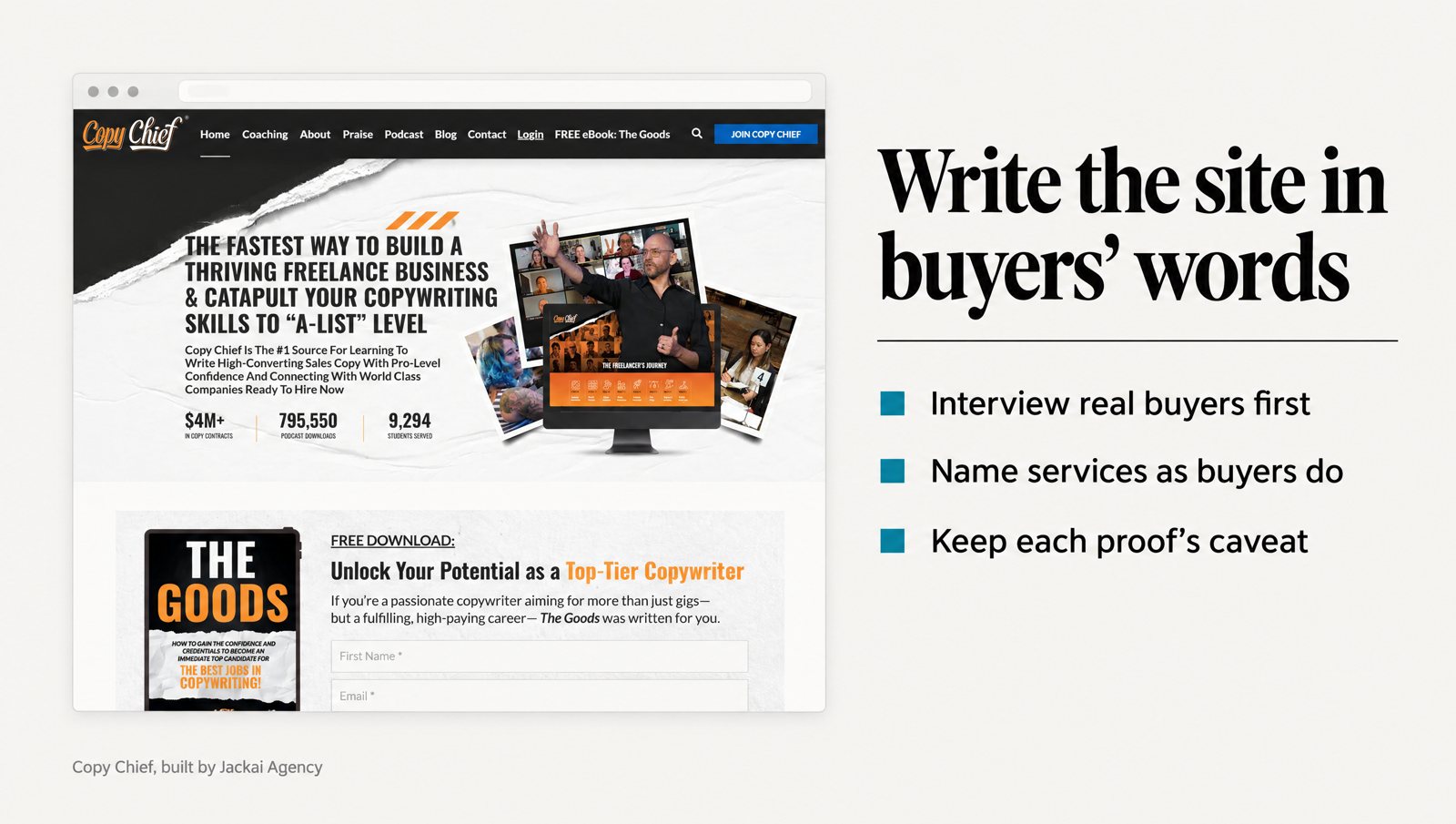
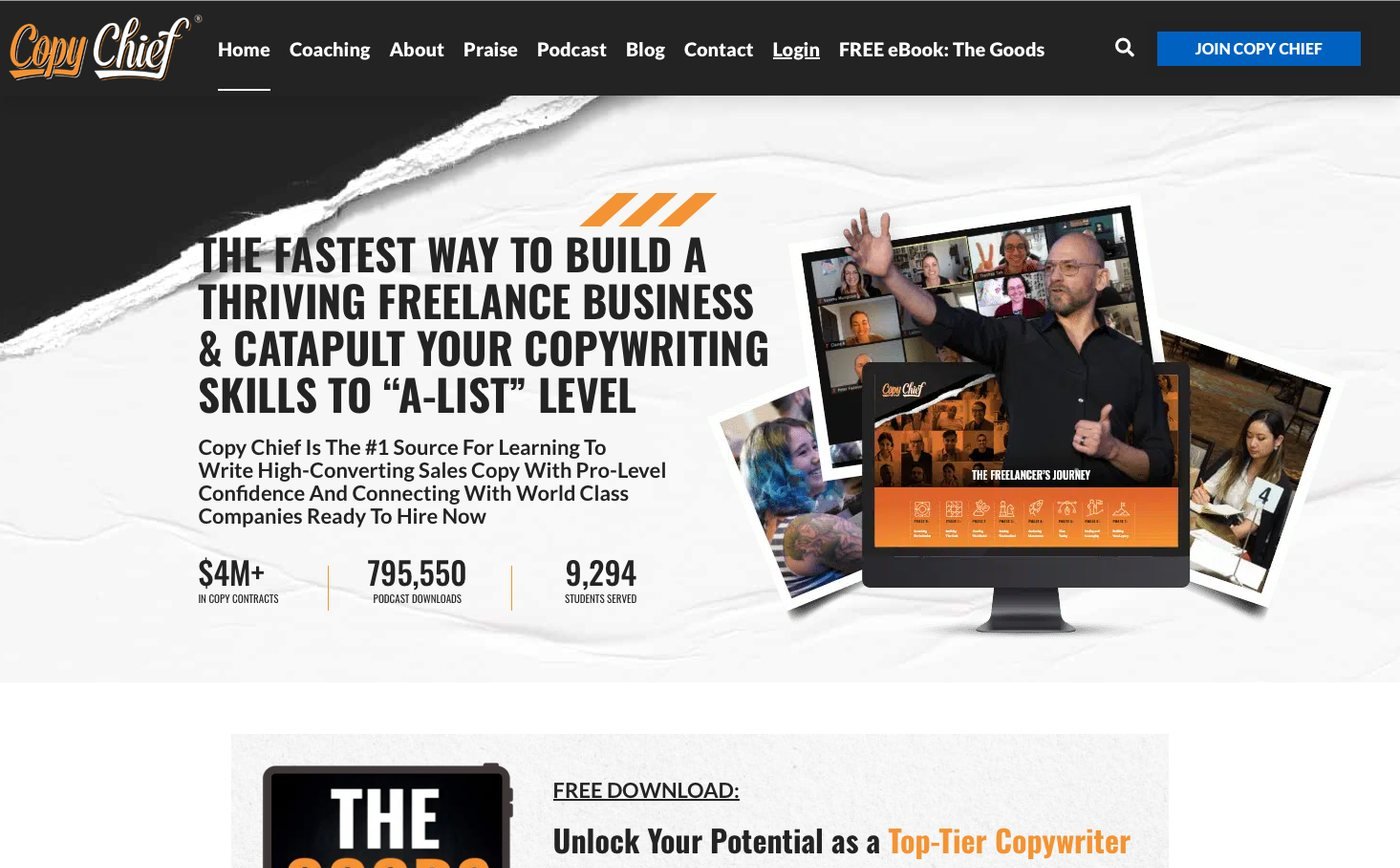
Not from a brainstorm, and not from competitor sites. Good B2B website copywriting starts where buyers describe the problem without you in the room. For Copy Chief, a membership platform for working copywriters in St. Petersburg, Florida, I combined four sources of customer research.
- Perplexity pain mining. Searches for the problems copywriters describe in public, each answer tied to its sources.
- A custom Python Reddit scraper. It pulled comments from copywriting discussions and fed them to an LLM that sorted each one into a pain or a desire.
- Coach interviews. Conversations with the program’s coaches.
- Member email outreach. Direct emails to members who had already paid.
The Reddit and Perplexity work is a fast version of what Kozinets called netnography: studying online communities as a marketing research method. He described it as quicker and cheaper than traditional ethnography, and more natural and less intrusive than focus groups or interviews (Kozinets, 2002). People in a thread aren’t performing for a researcher. They’re venting to peers.
Threads can lean toward the loudest voices, so interviews sit beside them. Threads give you raw buyer language. Interviews tell you which phrases belong to people who actually buy.
What came out was a buyer you could picture: a copywriter deciding whether to spend rent money on herself. The pages were written for her moment, not for members who had already joined.
Those pain points shaped the creative for Escape Velocity, a Meta Ads campaign with a mobile-first funnel. It returned 55.03x average return on ad spend and converted 10.1% of landing-page visitors. Cost per acquisition went from $42 to $22. Click-through rate went from 0.9% to 3.0%. I can’t split out the research’s share: the creative, the media buying and the funnel changed in the same campaign. Details are in the Copy Chief case study.
How much customer research is enough?
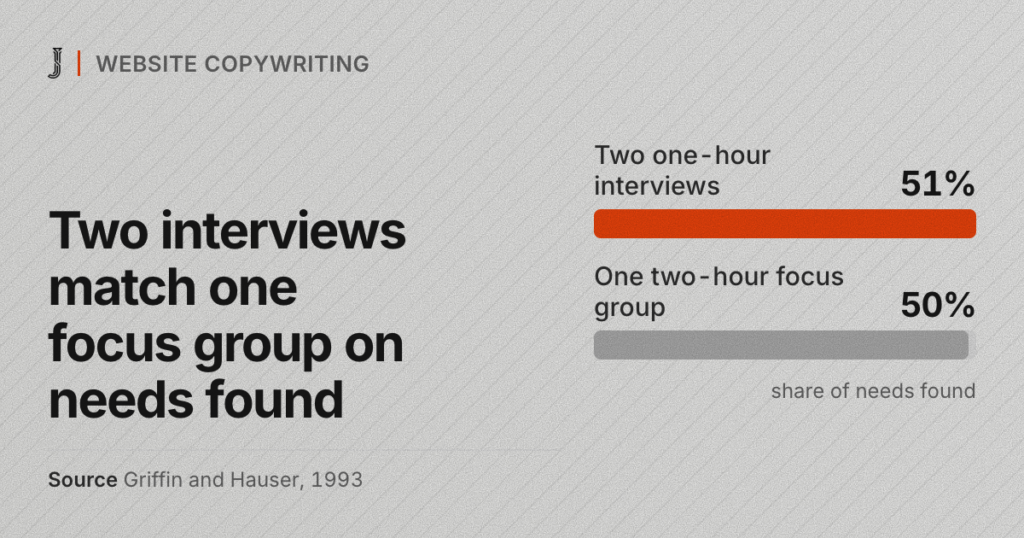
Less than most teams fear, and more than most teams do. Griffin and Hauser’s voice-of-the-customer study found that interviews with 20 to 30 customers should surface 90% or more of the needs in a fairly uniform segment. Two one-hour interviews turned up about as many needs as one two-hour focus group, 51% against 50% (Griffin and Hauser, 1993).
A later study of 60 interviews found that new themes stopped appearing within the first 12, with the outline of the main themes visible by interview six (Guest, Bunce and Johnson, 2006).
For a firm of 10 to 200 people, this is how I plan customer research:
- Six to twelve interviews per buyer type. Two different buyers means two sets of calls, not one bigger set.
- Recent buyers first. People who signed in the last six months still remember what they compared you against.
- At least two lost deals. They name the objection your service pages never answer.
- Your recorded sales calls. Free customer research that most firms never listen back to.
- Online threads last. Check whether interview phrases show up in public, in the same words.
Stop when three interviews in a row add no new phrase to your notes. One edge case: if your buyers differ a lot, say a law firm partner and an in-house operations manager, those numbers apply to each group separately.
How do you turn research notes into a message map?
A transcript is not copy. The step between them is a message map: a sheet that says which buyer phrase goes on which page, in which section. Most B2B website copywriting skips it.
Two findings from the Griffin and Hauser study shape how I build it. First, how often a need was mentioned was not a good stand-in for how much it mattered. The phrase you hear most isn’t always the one that decides the deal.
Second, when customers grouped needs themselves, the groups followed how they use the product. When the product team grouped the same needs, the groups followed how the firm builds it (Griffin and Hauser, 1993). Most service menus are built the second way, which is why buyers can’t find the page they need.
Here’s the map. Each row is a type of research note, not a made-up quote.
| What you hear in research | What it usually tells you | Where it goes on the site |
|---|---|---|
| The words a buyer used for the problem | The search phrase and the promise | Opening lines and headings on service pages |
| The outcome they wanted, in their terms | What “done” means to them | The scope section of your service pages |
| The question they asked before signing | An open objection | The FAQ, and next to the call to action |
| Why they nearly hired someone else | The risk they felt | A proof block near the decision point |
| Their job title and who else signed off | Who is reading | The about page and case study framing |
| A complaint about a past vendor | What you must not sound like | The process section, written as the opposite |
Keep buyer language verbatim in the map, even when it’s rough. You can fix grammar later. You can’t get the exact phrase back once it’s been edited into house style.
How does B2B website copywriting work on service pages?
On the sites I rebuild, service pages do most of the selling, and they’re where inside-out copy does the most damage. Written from the firm’s side, service pages list capabilities. Written from customer research, they answer the question the buyer arrived with.
This is the order I write a service page in:
- The problem, in buyer language. One sentence they’d recognize from their own week.
- What you do about it. The literal deliverable: a five-page WordPress site, a tracking setup in your CRM, a written audit.
- Who it’s for, and who it isn’t for. A line that turns away the wrong buyer saves both of you a call.
- How it runs. Steps, timeline and what you need from the client.
- A price signal. A starting price or a range, written as a number.
- One piece of proof. The closest matching case, with its caveat.
- One next step. The same wording every time it appears.
Concrete beats clever. In four experiments, Hansen and Wänke found that the same statement was judged more likely to be true in concrete language than in abstract language. The effect was tied to how vivid the concrete version felt (Hansen and Wänke, 2010). “A five-page WordPress site, two to three weeks from content” is concrete. “Scalable digital solutions” isn’t.
Plain words help for a related reason. Oppenheimer found that the more complex a text’s vocabulary, the less intelligent readers judged its author, and the effect ran through how easy the text was to process (Oppenheimer, 2006). Long words don’t make a consultancy sound senior. They do the opposite.
Then there’s “you”. Burnkrant and Unnava found that copy written to make readers relate a message to themselves made them think about it more, which raised persuasion when the arguments were strong. Stacked with other things that also make people think harder, the benefit shrank or reversed (Burnkrant and Unnava, 1995). “You” only helps when the claim behind it holds up.
The Snappy Kraken project, a HubSpot CMS build for a FinTech SaaS company that serves financial advisors, shows the pattern. On the pricing page, the differences between plans are now written in plain sentences beside each tier.
What should the about page say?
The about page is the most personal piece of B2B website copywriting, and most firms fill it with history. I write it to answer one question: can this buyer trust this firm with the work?
In a study of more than 1,400 people rating 51 website elements, Fogg and colleagues found five types of elements that raised credibility. In order of impact: real-world feel, ease of use, expertise, trustworthiness and tailoring. Commercial implications and amateurism lowered it (Fogg et al., 2001). Real-world feel covers things like a physical address, a phone number and an email address.
On the W Communications rebuild, for a Seattle communications and speaking practice, the founder’s strongest credential sat under several paragraphs of story: former Starbucks senior vice president. That line now leads the biography page. No analytics survived the rebuild, so there’s no result number, and I won’t invent one.
For a solo practice, write in the first person. A “we” paragraph about a passionate team reads like a template, and a buyer hiring a specialist wants to know who does the work. My about page lists the street address, the services, and what the practice doesn’t offer, such as logo design and social media management. That last list turns away the wrong inquiries before they reach the inbox.
How do you write proof a buyer believes?
Proof is where B2B website copywriting most often overreaches. It says nothing (“trusted by leading firms”), or it throws out a big number with no context. Use a fixed shape instead: the client and what they do, the number, the time window, what stayed the same, and the caveat.
S.T. Dupont Vancouver, a luxury retailer and authorized dealer, moved its store from Wix to WordPress and WooCommerce. Online sales grew 5x in the first 90 days, against the last 90 days the old Wix store could sell, with the same license, the same products and the same store. It’s retail, not B2B, but the shape transfers: the reader sees what stayed flat while the number moved. The S.T. Dupont case study carries it that way, with the dealer proof moved up the page.
The caveat belongs in the same sentence or the next one, never in a footnote. Copy Chief’s Membership Funnel Redesign returned 31x on ad spend with 215 paid subscriptions, and that figure belongs to the August to October 2023 campaign, not to the funnel forever. Writing it that way costs nothing and answers the buyer’s first doubt.
Arrangement matters too. When Fogg and colleagues analyzed comments from 2,684 people judging live sites, the design look came up in 46.1% of comments, followed by information structure and information focus (Fogg et al., 2003).
So put the number in the first line of each proof block. A long-term study of real browsing by Weinreich and colleagues found that people move through pages quickly, even pages with plenty of content. The authors concluded that pages should be designed for quick, partial reading (Weinreich et al., 2008). If the result sits in paragraph three, many buyers won’t reach it.
Which questions belong in the FAQ?
An FAQ that repeats the page is filler. In B2B website copywriting, the FAQ answers what the page couldn’t: the questions buyers ask on sales calls, in emails and right before they go quiet.
Pull them from recorded sales calls, pre-contract emails and the lost-deal interviews in your customer research. Write each question in buyer language, not yours. “Do I own the site?” beats “Ownership and intellectual property”.
Rank them by what stops deals, not by how often they come up. That’s the frequency trap from the Griffin and Hauser study again.
On the Snappy Kraken pricing page, the earlier version stated the price without answering why a buyer would hesitate. An unanswered objection pushes a careful buyer onto a sales call or off the page. The FAQ holds that answer when it won’t fit in the pricing table.
Write each answer so its first sentence works alone: the question as the heading, the answer first, detail after. It’s the same shape I use in my AI visibility optimization work, where each answer has to stand on its own.
What does B2B website copywriting cost, and how long does it take?
On my projects, the schedule risk is the copy, not the build. My five-page small business website runs two to three weeks from content, and the clock starts when the words exist.
B2B website copywriting built on research adds time at the front. In my experience, booking interviews takes longer than running them, so book the calls in week one and draft while the later ones happen. Write the service pages first, because every other page points to them.
These are my published build prices. Each runs on a fixed quote with two revision rounds per phase, and you own the site outright, including the domain and hosting.
- Custom B2B website, up to five pages: CA$8,950 on WordPress.
- Marketing site, 8 to 15 pages: from CA$10,495, four to six weeks.
- Website audit: CA$995, one week, if you’re not yet sure the copy is the problem.
The pricing calculator covers the build. Copy scope is easier to set on a call, once I know how much customer research you already have.
Who should write it?
| Who writes it | Works when | Watch for |
|---|---|---|
| The founder | The founder still runs sales calls and hears buyers every week | Internal vocabulary where buyer language should be |
| An in-house marketer | They can get on calls with recent buyers and lost deals | Research squeezed out by the launch date |
| A freelance copywriter | The research is done and handed over as a message map | Polished copy resting on no research |
| A designer who runs the research | The words and the page structure need to change together | Scope creep, so fix the page count first |
I sit in the last row. The page structure and the words come out of the same research, so neither gets bent to fit the other.
What would I not do?
A few things I avoid in B2B website copywriting, even when a client asks:
- Write from competitor sites. Their phrases put you on the same shelf with the same label.
- Publish an AI draft unedited. On Copy Chief, the LLM’s job was sorting Reddit comments into pains and desires. Claims stay with a person who can defend them on a sales call.
- Write one page for four audiences. W Communications had media, clients, event bookers and readers landing on one homepage. Each now has its own path.
- Run a survey instead of interviews. As customer research, a multiple-choice survey hands your own words back with checkboxes beside them.
- Ignore a regulated category’s rules. On Cubanbest, a Vancouver premium retailer that moved 638 SKUs from Wix to WooCommerce, what the copy could say came before what it should say.
Want your service pages written in your buyers’ words?
Your offer doesn’t have to change for the copy to change. Same services. Same prices. Same team. Only the words move, from yours to the buyer language your clients already use.
If you want B2B website copywriting built that way, book a 30-minute call with me. I measure your starting numbers on the call: mobile conversion rate, AI-referred traffic and lead count, before any work starts. You leave with those numbers whether or not you hire me.
Sources
Peer-reviewed research
- Burnkrant, R. E., and Unnava, H. R. (1995). Effects of Self-Referencing on Persuasion. Journal of Consumer Research, 22(1).
- Fogg, B. J., Marshall, J., Laraki, O., et al. (2001). What Makes Web Sites Credible? Proceedings of the SIGCHI Conference on Human Factors in Computing Systems, 61 to 68.
- Fogg, B. J., Soohoo, C., Danielson, D. R., et al. (2003). How Do Users Evaluate the Credibility of Web Sites? Proceedings of the 2003 Conference on Designing for User Experiences, 1 to 15.
- Griffin, A., and Hauser, J. R. (1993). The Voice of the Customer. Marketing Science, 12(1), 1 to 27.
- Guest, G., Bunce, A., and Johnson, L. (2006). How Many Interviews Are Enough? Field Methods, 18(1), 59 to 82.
- Hansen, J., and Wänke, M. (2010). Truth From Language and Truth From Fit: The Impact of Linguistic Concreteness and Level of Construal on Subjective Truth. Personality and Social Psychology Bulletin, 36(11), 1576 to 1588.
- Kozinets, R. V. (2002). The Field Behind the Screen: Using Netnography for Marketing Research in Online Communities. Journal of Marketing Research, 39(1), 61 to 72.
- Oppenheimer, D. M. (2006). Consequences of Erudite Vernacular Utilized Irrespective of Necessity: Problems With Using Long Words Needlessly. Applied Cognitive Psychology, 20(2), 139 to 156.
- Pirolli, P., and Card, S. (1999). Information Foraging. Psychological Review, 106(4), 643 to 675.
- Weinreich, H., Obendorf, H., Herder, E., and Mayer, M. (2008). Not Quite the Average: An Empirical Study of Web Use. ACM Transactions on the Web, 2(1), 1 to 31.