7 Checks for a Vancouver Brand Identity & Web Design Agency
Seven checks for hiring a brand identity and web design agency in Vancouver, from splitting brand work from website work to getting copyright in writing. Written by a web designer who does not sell logos, with that bias disclosed.
 Joshua Jackai
20 min read
Published 14 November 2026 · Last updated and fact-checked November 2026
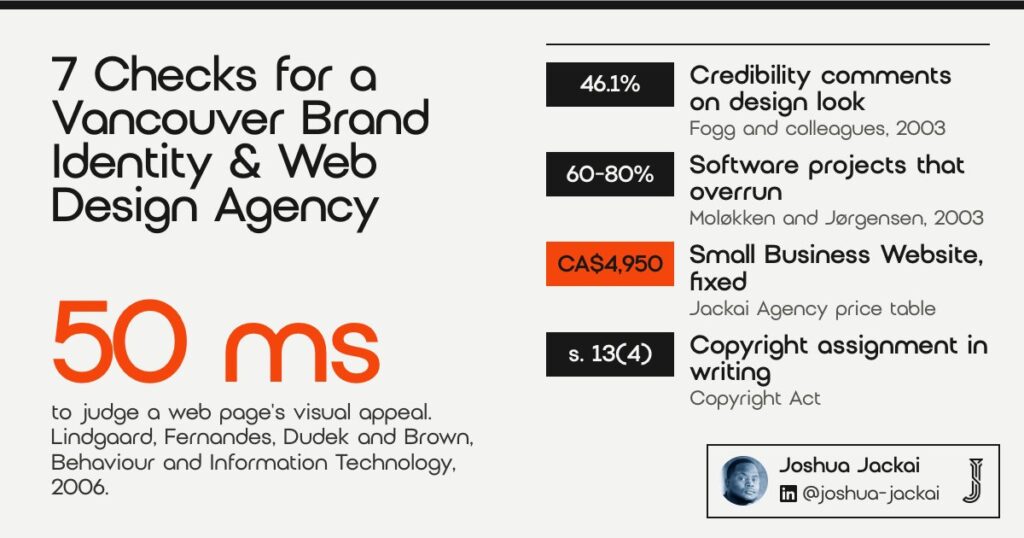
Short answer: Choosing a brand identity and web design agency in Vancouver comes down to 7 checks: split brand work from website work, decide on one agency or two, judge live sites, see the process, get a fixed quote, price it in CAD and get ownership in writing. Visitors judge a page’s look in about 50 ms (Lindgaard and colleagues, 2006).
A founder in North Vancouver is about to open a second location. The logo came from a friend in 2019. The website is a template she stopped editing two years ago. She searches for a design agency that does both, gets three quotes, and can’t compare them. One is a brand package with no website. One is a website with “logo refresh” as a line item. One is an hourly estimate.
I’m Joshua Jackai. I run Jackai Agency, a web design practice in Vancouver. I build websites. I don’t sell logo or brand identity design, so when a business asks “one agency or two?”, I’m the second agency. That’s a conflict of interest, and it’s why this guide states it before anything else. The 7 checks work the same whether you hire me, a full-service studio or two specialists.
In this guide
Key takeaways
- Visual appeal can be judged in 50 ms, and ratings at 50 ms tracked ratings at 500 ms (Lindgaard, Fernandes, Dudek and Brown, 2006).
- When 2,684 people judged live websites, the “design look” came up in 46.1% of credibility comments (Fogg and colleagues, 2003).
- Most software projects, 60% to 80%, overrun on effort or schedule (Moløkken and Jørgensen, 2003). Ask for a fixed quote.
- Under Canada’s Copyright Act, the author of a work is its first owner, and an assignment is valid only in writing (Copyright Act, s. 13).
- My Small Business Website is CA$4,950 on Framer or CA$5,950 on WordPress, and logo design isn’t part of it (Jackai Agency pricing, November 2026).
| # | Check | What to look for (source) | Red flag |
|---|---|---|---|
| 1 | Brand work vs website work | Two separate deliverable lists (Henderson and Cote, 1998) | “Branding” with no file list |
| 2 | One agency or two | A named handoff between brand and site (Reber and colleagues, 2004) | Nobody owns the handoff |
| 3 | Live sites, not mockups | Links you can open on your phone (Lindgaard and colleagues, 2006) | A portfolio of flat images only |
| 4 | Process before price | Research and structure, not only looks (Fogg and colleagues, 2003) | Design starts on day one |
| 5 | Fixed quote vs hourly | One number, a deliverables list, revision rounds (Moløkken and Jørgensen, 2003) | Hours with no cap |
| 6 | CAD cost and timeline | Price and launch window in writing (my price table) | A timeline that starts on signing, not on content |
| 7 | Ownership in writing | Signed copyright assignment for the logo and site (Copyright Act) | “You’ll have full rights” in an email only |
1. What does brand identity work include, versus a website?
Brand identity work is the system that makes a business look and sound like itself: logo, colours, type, voice and usage rules. A website is a set of pages that uses that system to win enquiries. In a study of 195 logos, 13 design traits shaped recognition (Henderson and Cote, 1998).
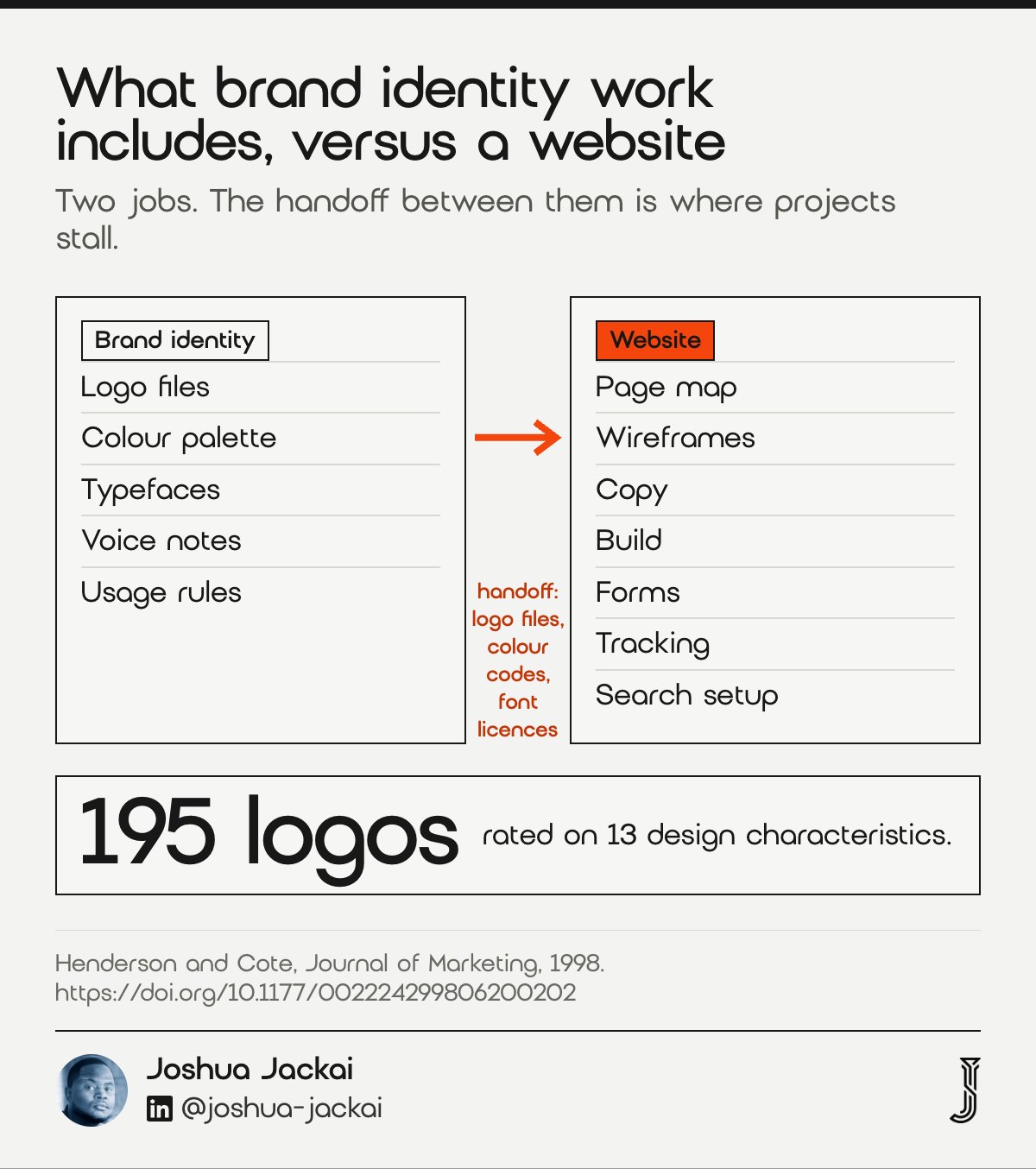
- Brand identity usually includes: logo files, colour palette, typefaces, voice notes and a usage guide
- A website usually includes: page map, copy, design, build, forms, tracking and search setup
- Where they meet: the logo files, colour codes and font licences the web team needs
- Ask for: a written list of every file you’ll receive from each
- Watch for: “branding” on a quote with no file list
A logo is a file. A brand identity is the set of rules for using it. That difference matters because a quote that says “branding” can mean anything from one logo in three colours to a full guide with voice rules and sample layouts. Ask what the files are. If the quote doesn’t name the files you’ll receive, you’re buying a mood.
The logo itself is worth getting right, and it isn’t only taste. Henderson and Cote rated 195 logos on 13 design characteristics and found that the logos people recognised accurately shared a few traits.
“should be very natural, very harmonious, and moderately elaborate”
Pamela Henderson and Joseph Cote wrote of high-recognition logos (Journal of Marketing, 1998)
A website is a different job. It starts from the brand, then answers the questions a buyer brings: what you sell, what it costs, whether you can be trusted, and how to get in touch. A strong brand on a confusing site still loses the enquiry. So split the two in your head before you compare quotes, and make each agency say which half it is pricing.
2. Should one agency do both, or should you hire two?
One agency doing both suits a business starting from scratch with one budget and one decision-maker. Two specialists suit a business that already has a brand, or needs a stronger designer for one half. Repetition and prototypical forms make things easier to process, and that ease reads as appeal (Reber, Schwarz and Winkielman, 2004).
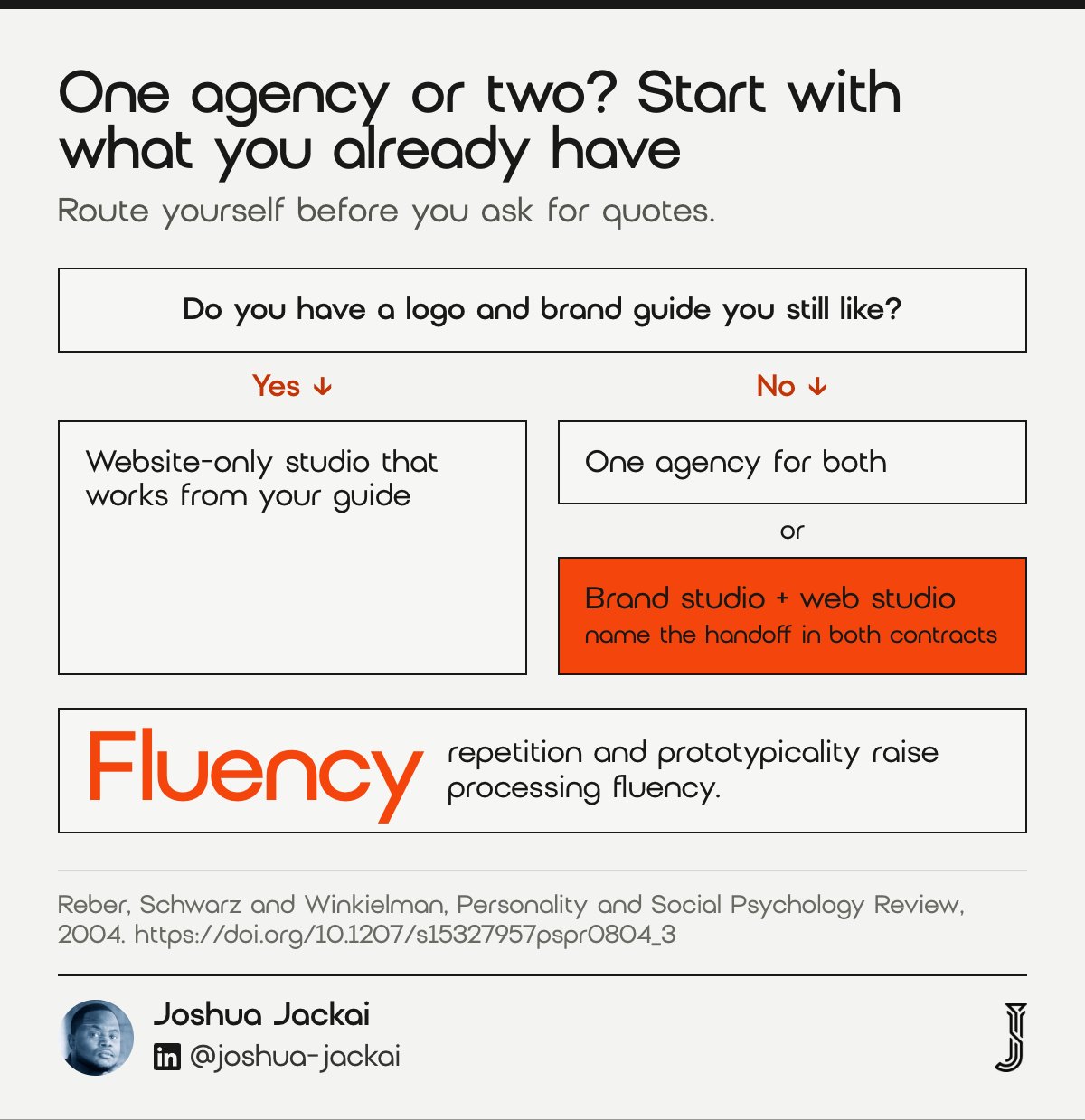
- One agency: one contract, one timeline, one team to blame
- Two specialists: each half done by someone who does only that, plus a handoff to manage
- Already have a brand: you need a website studio, not a rebrand
- The real risk: the handoff, where the brand guide and the site drift apart
- My bias: I’m the website half, so weigh what I say here
Here’s the honest version. A full-service studio isn’t automatically better or worse. What matters is whether the brand shows up the same way on every page, every form and every email. Consistency isn’t decoration. It’s what lets a returning visitor recognise you without reading.
“The more fluently perceivers can process an object, the more positive their aesthetic response.”
Rolf Reber, Norbert Schwarz and Piotr Winkielman wrote (Personality and Social Psychology Review, 2004)
Their review lists stimulus repetition and prototypicality among the things that raise fluency. On a website, repetition is the same logo, colours and type on every page. That’s the case for one team. The case for two is skill: a studio great at logos can be average at forms, and the reverse.
If you go with two, name the handoff in both contracts. The brand studio delivers the logo files, colour codes, font licences and usage guide. The web studio confirms it received them. On S.T. Dupont Vancouver, a luxury retailer, the brand already belonged to the French maison. My job was the store, built inside rules I didn’t write.
3. Does the portfolio show live sites, or only mockups?
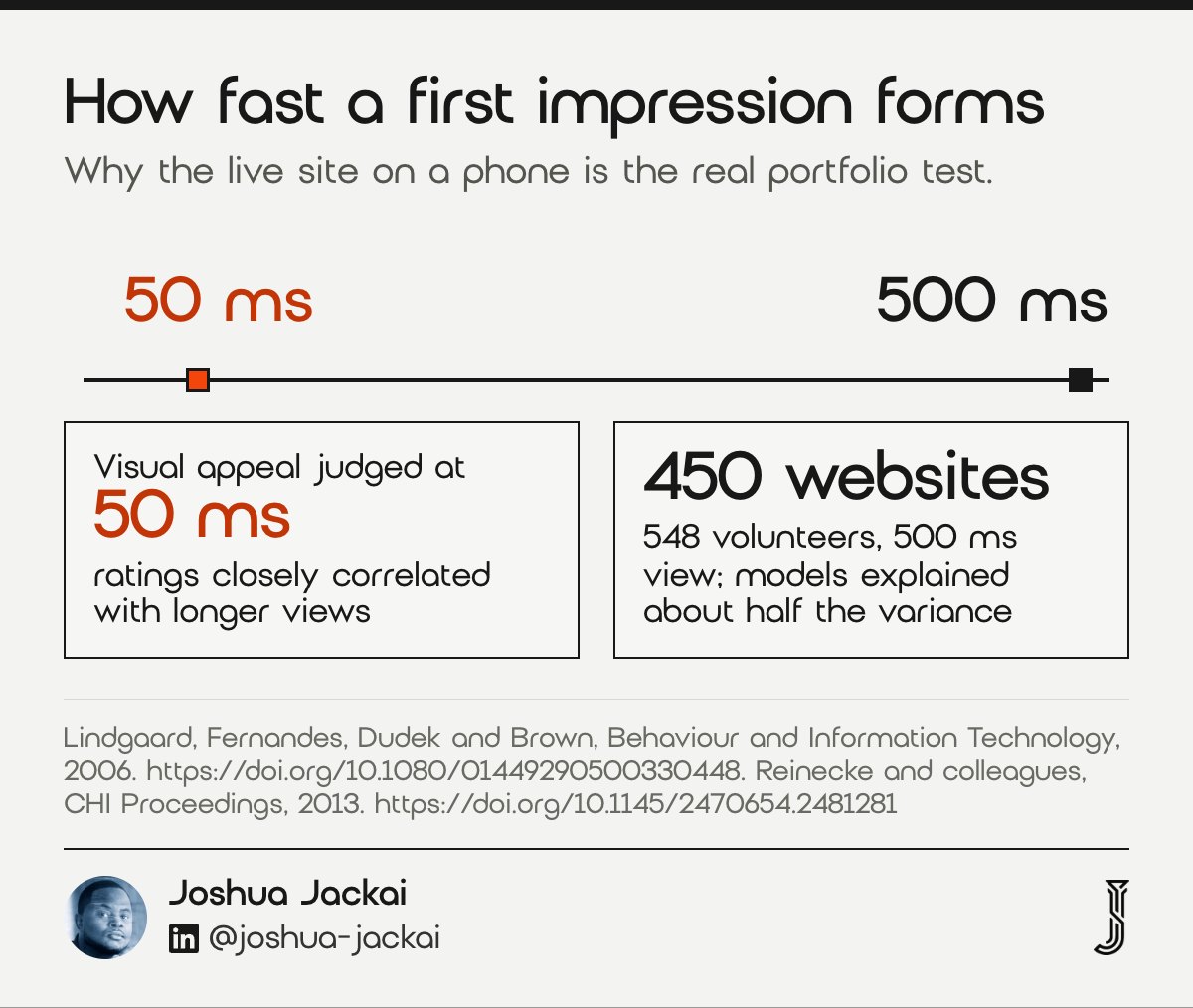
A live site is a page you can open on your own phone today. A mockup is a flat image that never met a real visitor. Judge an agency on the first. Visual appeal can be judged in 50 ms, and those snap ratings tracked longer looks (Lindgaard, Fernandes, Dudek and Brown, 2006).
- Ask for: 3 links to live sites the agency designed and built
- Open them on: your own phone, on cellular data, not office Wi-Fi
- Check: the contact form, the menu, and how fast the first screen appears
- Brand work: ask to see the logo in use on a real site, not only on a mock business card
- Watch for: a portfolio of flat images with no links
Mockups are easy to make look good. Live sites have to survive real content, real phones and real people filling in forms. That’s why I’d weight one live link over five beautiful images. Ask the agency which of the 3 sites it would show a new client first, and why. The answer tells you what it’s proud of.
The first look counts. In Lindgaard’s three studies, ratings of visual appeal at 50 ms were highly correlated with ratings at 500 ms.
“web designers have about 50 ms to make a good first impression”
Gitte Lindgaard and colleagues wrote (Behaviour and Information Technology, 2006)
The first look also leaks into later judgments. Reinecke and colleagues collected ratings of 450 websites from 548 volunteers after a 500 ms view (CHI Proceedings, 2013).
“This first impression is influential enough to later affect their opinions of a site’s usability and trustworthiness.”
Katharina Reinecke and colleagues wrote (CHI Proceedings, 2013)
So yes, looks matter. But a pretty site can still hide a broken form. In one experiment on a cash-machine interface, how good the system looked shaped what users thought of its usability after use, while its actual usability didn’t (Tractinsky, Katz and Ikar, 2000). Your visitors may not notice a weak form. Your enquiry count will.
4. Can the agency show its process before it shows a price?
A process is the written order of work: research, structure, design, build, launch and what happens after. It suits any buyer who wants to know what they’re paying for each week. Design look led 46.1% of credibility comments, followed by information structure and focus (Fogg and colleagues, 2003).
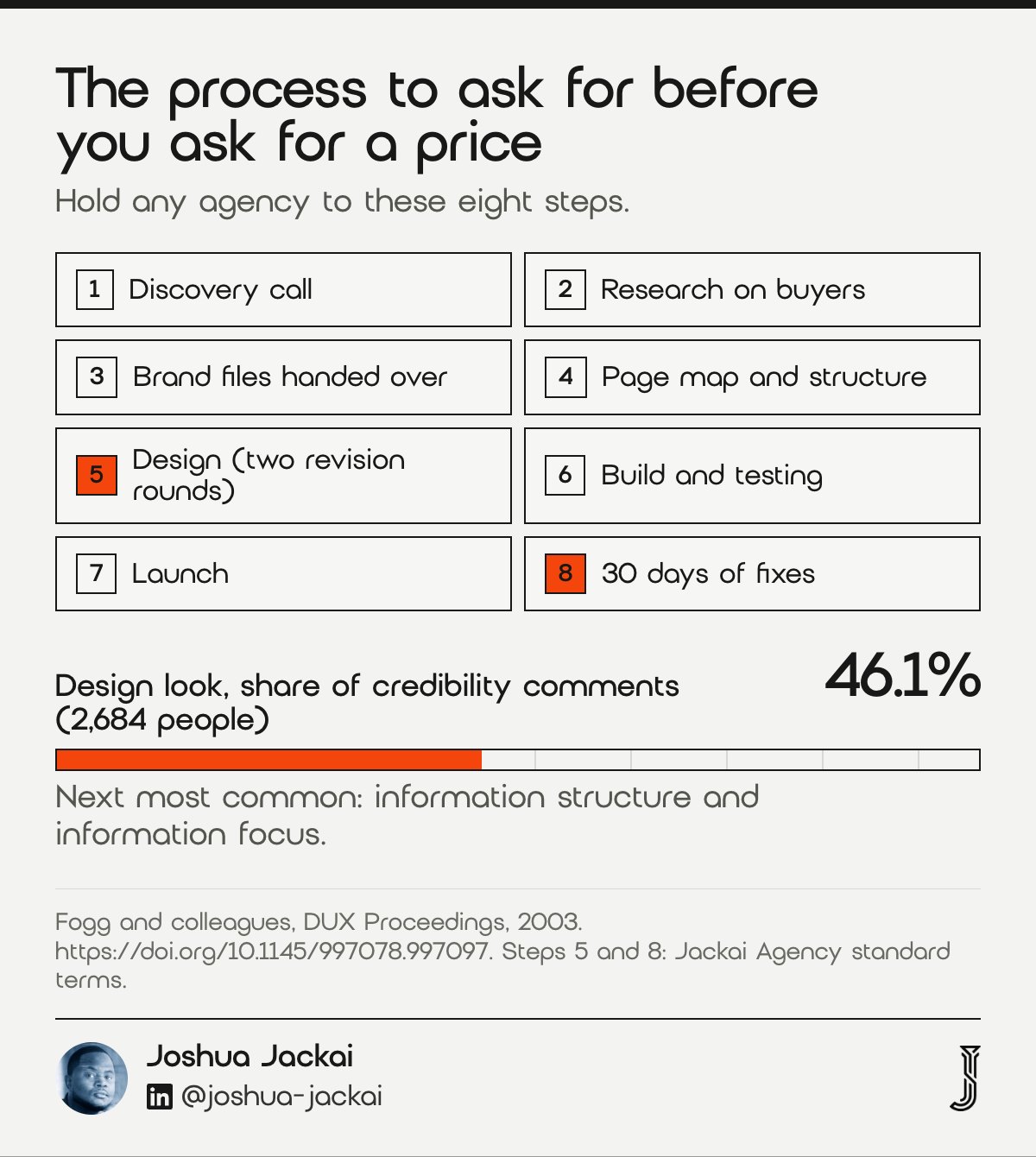
- Ask for: the phases in writing, with what you approve at the end of each
- Research: who talks to your buyers, and how
- Structure: a page map before any visual design
- Revisions: how many rounds per phase, in writing
- Watch for: visual design on day one, with no questions about your buyers
Ask an agency to walk you through its process before it quotes. A good one can do it in ten minutes without slides. A weak one jumps straight to colour palettes.
Fogg’s study is the reason I don’t let structure wait. In it, 2,684 people judged the credibility of two live websites on a similar topic. Design look came first, at 46.1% of comments.
“Next most common were comments about information structure and information focus.”
B. J. Fogg and colleagues wrote (DUX Proceedings, 2003)
So credibility isn’t only the look. It’s whether a visitor can find the thing they came for. That needs research before design. I run user and audience research before design on every project. On Rufous & Co, a Seattle design studio, I worked with the founders to reposition the business from a home-decor shop to an interior-design studio, then designed and built it on Shopify. No performance data was verified on that project, so there’s no number to quote. The positioning call came first, and the pages followed it.
For more on vetting the website half, my list of questions to ask a web designer goes deeper on platform, hosting and handover.
5. Is the quote fixed, or an hourly estimate?
A fixed quote is one price for a written list of deliverables, with set revision rounds. An hourly estimate is a guess you pay for if it’s wrong. Fixed suits most small and mid-sized businesses. Across surveys, 60% to 80% of software projects overran effort or schedule (Moløkken and Jørgensen, 2003).
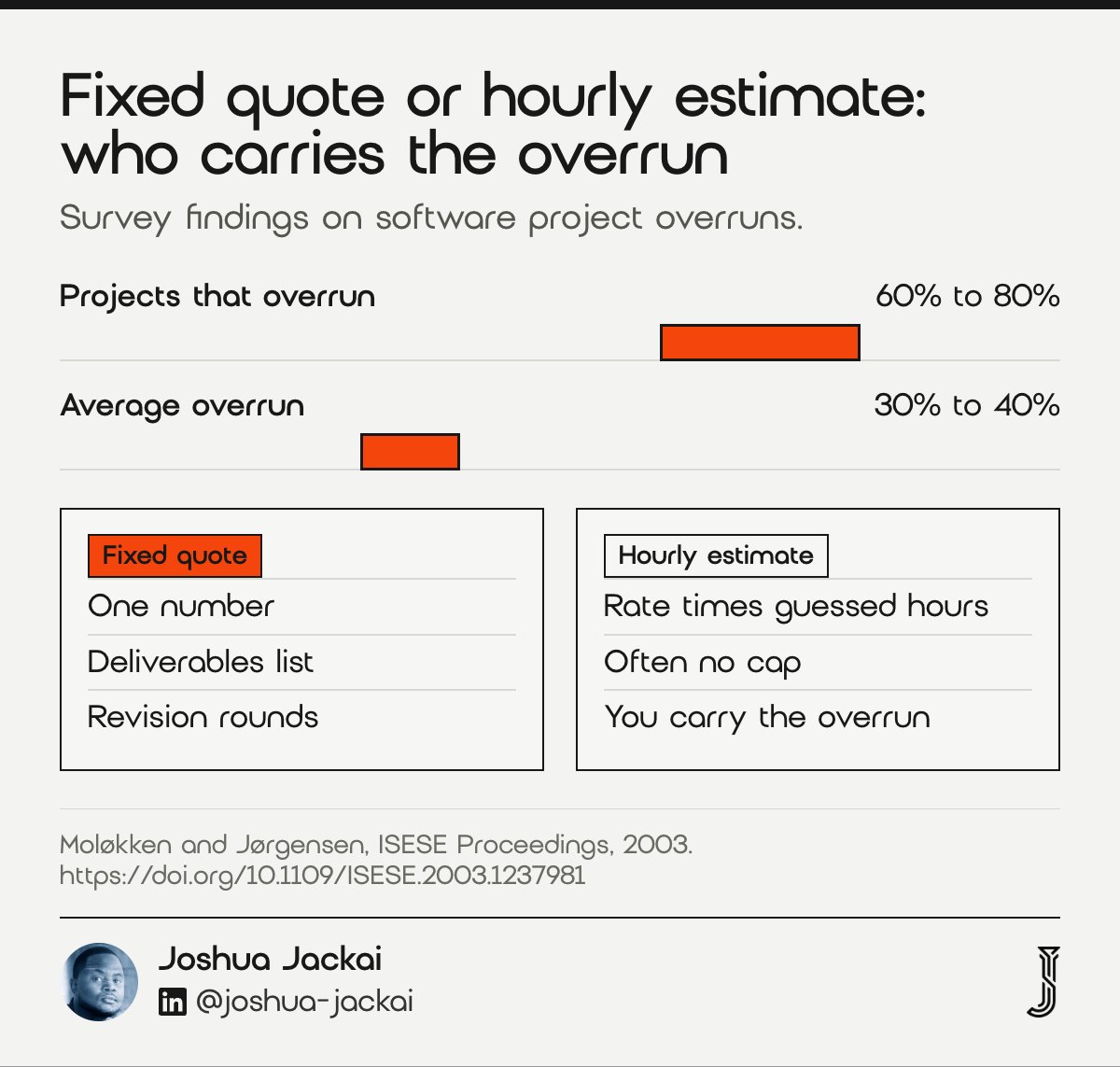
- Fixed quote: one number, a deliverables list, revision rounds and a launch window
- Hourly estimate: rate times guessed hours, often with no cap
- Who carries the overrun: the agency on a fixed quote, you on hourly
- Ask for: what happens, in writing, if you ask for something new mid-project
- Watch for: “it depends” with no range at all
Web and brand projects are smaller than most software projects, but they overrun for the same reasons: scope that grows, feedback that arrives late, and estimates made before anyone read the content.
“most projects (60-80%) encounter effort and/or schedule overruns”
K. Moløkken and M. Jørgensen wrote (ISESE Proceedings, 2003)
The same review puts the average overrun in most surveys at 30% to 40%, lower than some consultancy reports claim. That’s still a big number on a design budget. A fixed quote moves that risk to the person who wrote it, which is where it belongs.
A fixed quote isn’t a blank cheque for changes, though. It should say how many revision rounds you get and what counts as new scope. Mine are two rounds per phase. If an agency won’t fix a price for brand identity work, ask it to fix the deliverables and cap the hours. That’s a fair middle. Ask for the quote as one document: price, file list, rounds, dates and ownership on a single page you can compare against the others.
6. What does it cost in CAD, and how long does it take?
Website prices from a Vancouver studio should come as a CAD figure with a launch window. Brand identity should come as a separate quote with its own file list. My Small Business Website is CA$4,950 on Framer or CA$5,950 on WordPress, 2 to 3 weeks from content (Jackai Agency pricing, November 2026).
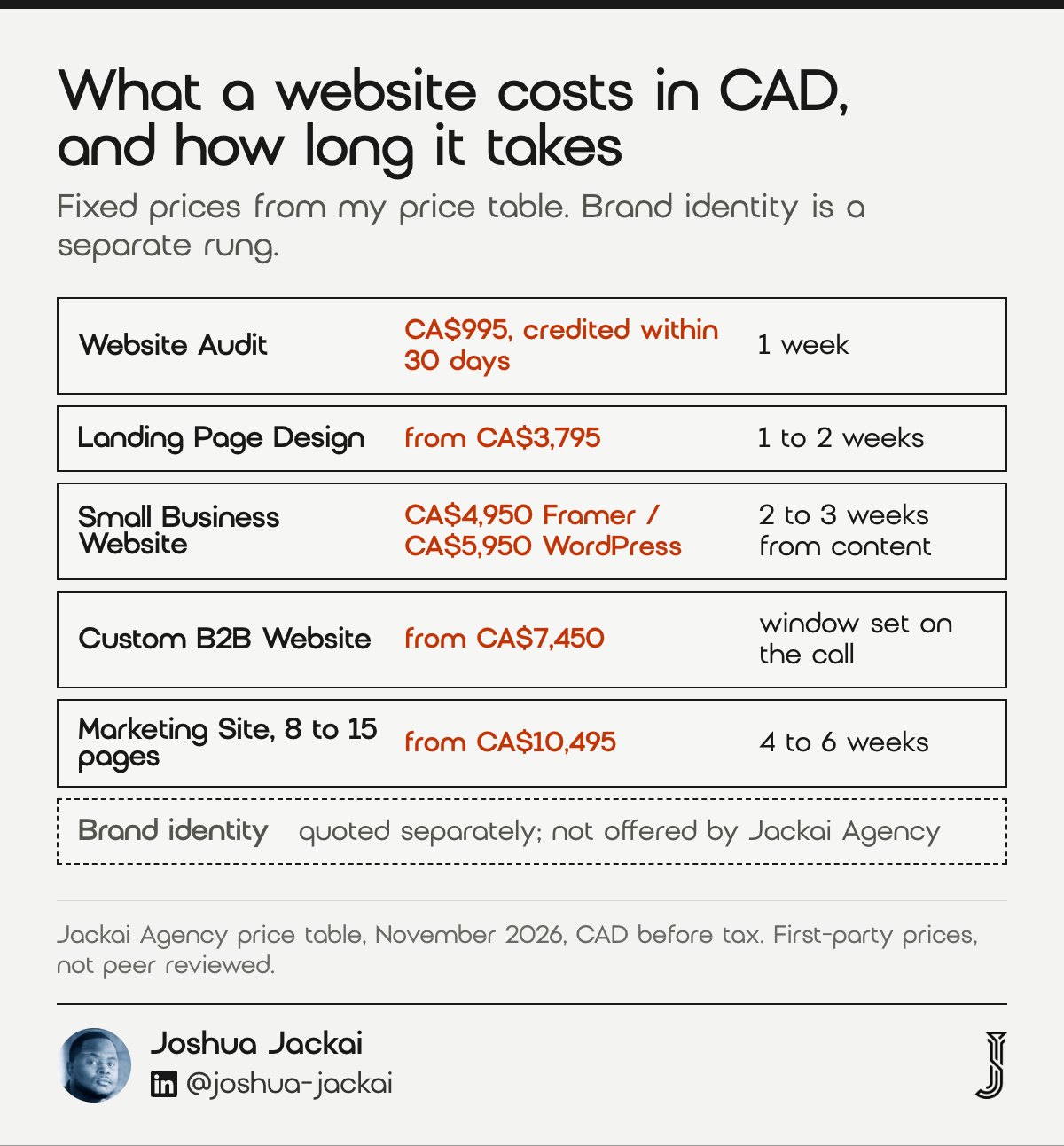
- Small Business Website, 5 pages: CA$4,950 Framer, CA$5,950 WordPress, 2 to 3 weeks from content
- Custom B2B Website, up to 5 pages: from CA$7,450 on Framer
- Marketing Site, 8 to 15 pages: from CA$10,495, 4 to 6 weeks
- Copywriting add-on, 5 pages: CA$1,325
- Brand identity: not something I sell; get a separate written quote
I’m not going to print a CAD range for brand identity work. I don’t sell it, and I haven’t found a source I’d trust that isn’t a competitor’s own page. What I can tell you is how to compare quotes: line up the file lists, the revision rounds and the ownership terms, then compare the prices.
For the website half, these are my published prices in Canadian dollars before tax. The Small Business Website is styled to your logo, colours and fonts, so it assumes you have them. If you need a custom design from scratch, that’s the Custom B2B Website, with the window set on the call. A single Landing Page Design is from CA$3,795 and takes 1 to 2 weeks. My guide to website redesign cost breaks the website numbers down further.
Timelines need one rule more than any other: the clock starts when content arrives, not when you sign. My 2 to 3 week window is counted from the day your text and images land. If a brand project runs first, the website can’t start until the logo files and colour codes exist. So sequence it: brand first, then the site, with both dates set in writing at kickoff. If you’re not sure the site needs a rebuild at all, my CA$995 Website Audit takes 1 week and is credited in full if a project starts within 30 days.
7. Will you own the logo and the website, in writing?
Ownership means a signed document transferring copyright in the logo and site files to your business. In Canada, the author of a work is the first owner of its copyright, and an assignment isn’t valid unless it’s in writing and signed (Copyright Act, s. 13).
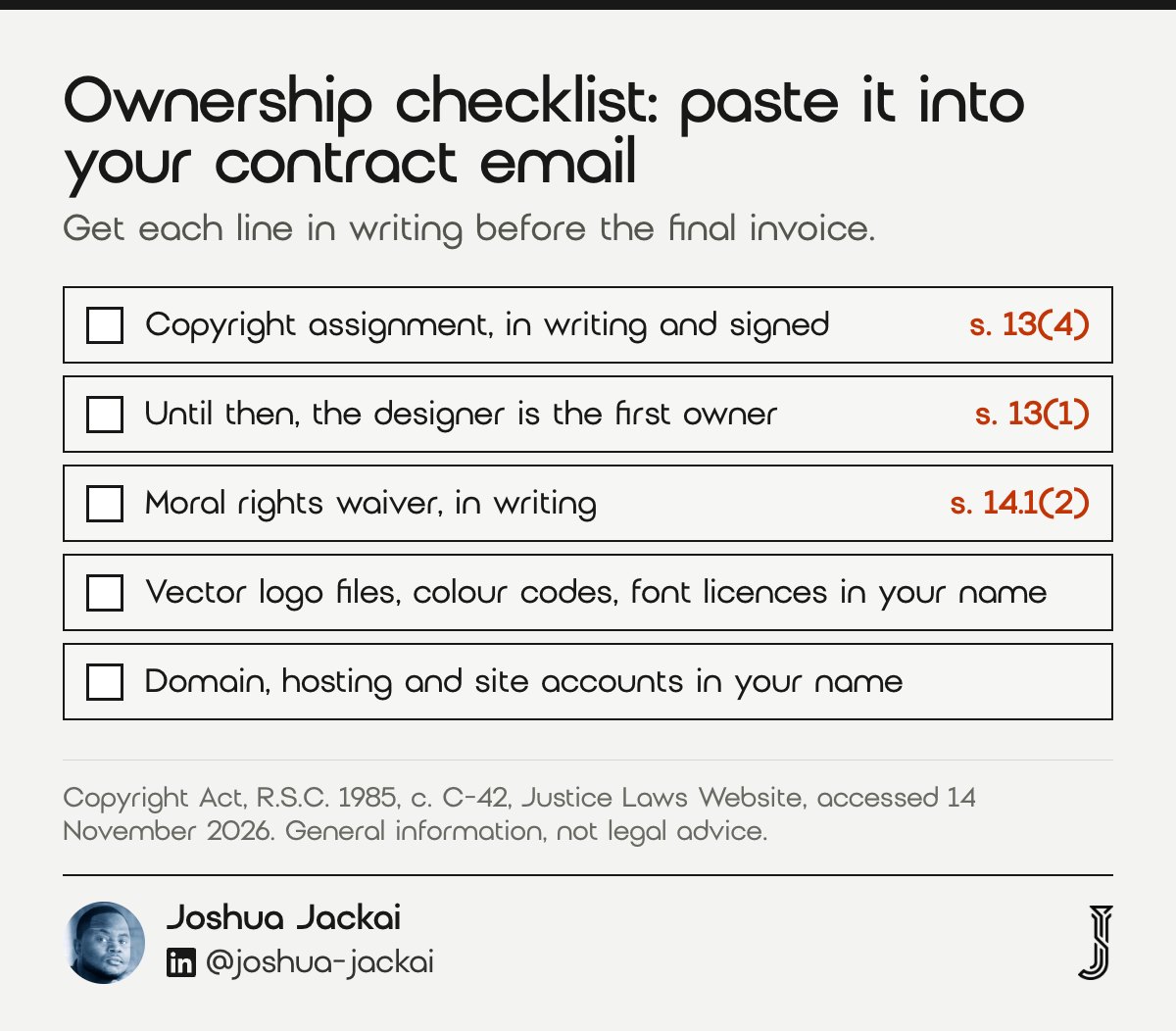
- Copyright: a signed assignment of the logo and site design to your business
- Moral rights: a written waiver, because they can’t be assigned
- Files: vector logo files, colour codes and the font licences, in your name
- Accounts: domain, hosting and the site’s admin login, in your name from day one
- Watch for: “you’ll have full rights” in an email, with nothing signed
This is the check most owners skip, and it’s the one that costs the most to fix later. Paying for a logo doesn’t by itself make it yours.
“no assignment or grant is valid unless it is in writing signed by the owner of the right”
Copyright Act of Canada, section 13(4), as stated on the Justice Laws Website
Section 13(1) says the author is the first owner. The exception in 13(3) applies to work an employee makes in the course of employment. Section 14.1(2) adds that moral rights can’t be assigned but can be waived. So ask for both: an assignment and a waiver. I’m a web designer, not a lawyer, and this isn’t legal advice. Have a lawyer read the contract if the brand is central to the business.
The website side has its own version. My standard terms say you own the site, domain and hosting, and every account is in your name from day one. Ask any agency to put the same in writing. If the domain sits in the agency’s account, you don’t control your own address.
What are the red flags when hiring a branding or web design agency?
The red flags are the same for brand studios and web studios: no live work, no written process, hourly billing with no cap, and ownership left vague. Any one of them is worth a direct question. Two or more is worth walking away. Overruns hit 60% to 80% of projects (Moløkken and Jørgensen, 2003).
- A portfolio with no live links. Flat images prove the agency can make images.
- “Branding” with no file list. You can’t compare a quote that doesn’t say what you get.
- Design before questions. If nobody asks who your buyers are, the pages will be about the agency’s taste.
- Hourly with no cap. The overrun risk is yours.
- A timeline that starts on signing. It will slip the day your content arrives late.
- The domain in their name. You’d be renting your own address.
- A guaranteed ranking or a guaranteed AI citation. Nobody controls what Google or ChatGPT returns.
“A logo is a file. A brand identity is the set of rules for using it.”
Joshua Jackai, Vancouver web designer, said
The last one deserves a word. A website can be built so search engines and AI tools can read it. Nobody can promise what they’ll show. If you want to know what ChatGPT says about your business today, my free AI Visibility Report arrives within 24 hours.
What should I ask a brand and web design agency before I sign?
Ask questions that make the agency put its answers in writing: the files, the phases, the price model, the dates and the ownership. Copy this list into an email and send the same one to every agency. A fixed quote should answer all 10, matching what Canada’s Copyright Act requires (Copyright Act, s. 13).
- Which half are you quoting: brand identity, the website, or both?
- What files will I receive, by name and format?
- Can I see 3 live sites you designed and built?
- What are the phases, and what do I approve at the end of each?
- Who talks to my customers before design starts?
- Is this a fixed quote? How many revision rounds per phase?
- What counts as new scope, and how is it priced?
- When does the timeline start: on signing or when content arrives?
- Will you assign copyright in writing and waive moral rights?
- Will the domain, hosting and site accounts be in my name?
“If the quote doesn’t name the files you’ll receive, you’re buying a mood.”
Joshua Jackai, Vancouver web designer, said
If you’re comparing website studios in particular, my Vancouver web design page lists what I include and exclude, so you can hold me to the same list.
Compare brand and web design agency setups side by side
This matrix lists 6 ways a Vancouver business can get brand identity and website work done, from one full-service agency to doing it yourself. Filter by what you already have and how you want to pay. My own studio is one row, labelled as mine, and the fixed-quote overrun figure comes from Moløkken and Jørgensen, 2003.
| Setup | Brand identity | Website | Handoff risk | Ask for | Best for |
|---|---|---|---|---|---|
| One agency for brand and website | Yes | Yes | Low: one team | One fixed quote with two file lists | Starting from scratch with one decision-maker |
| Brand studio, then a web studio | Yes | Yes | Medium: name the handoff in both contracts | Logo files, colour codes and font licences delivered to the web studio | A brand that matters enough to hire a specialist |
| Website studio working from your brand (my setup, Jackai Agency) | No | Yes | Low: brand already exists | CA$4,950 Framer or CA$5,950 WordPress, 5 pages; Custom B2B from CA$7,450 | A business with a brand it wants to keep |
| Freelance brand designer plus freelance web developer | Yes | Yes | High: you manage the handoff | Signed copyright assignment from each | A tight budget and time to manage two people |
| Logo only, then a template site you build | Logo only | You build it | Medium: no usage rules | Vector logo files and a written assignment | Testing an idea before spending on a full brand |
| Template site styled to your brand, built yourself | No | You build it | Low: brand already exists | Domain and hosting in your own name | Very small sites and owners with time to edit |
Showing 6 of 6 setups.
Jackai Agency prices from its November 2026 price table, CAD before tax. Jackai Agency does not design logos or brand identities. Handoff risk is the author’s judgement, not a measured figure.
Rows are hidden, not deleted, when a filter doesn’t match, so the full list returns when you reset the filters. The setups have no price column because there’s no sourced CAD range for brand work; ask each one for a fixed quote.
What will an hourly quote cost if the project runs over?
This calculator compares an hourly estimate with a fixed quote. Enter the hours, the rate and the fixed price you were given, then pick an overrun. Average overruns in most surveys ran 30% to 40% (Moløkken and Jørgensen, 2003), so 30% is the starting value. Default rates and hours are placeholders.
Hours, rate and fixed quote are placeholders, not quotes from any agency. The 30% overrun default is the low end of the 30% to 40% average overrun in Moløkken and Jørgensen (2003); 60% to 80% of projects in their review overran.
If an hourly quote with a realistic overrun costs more than a fixed quote for the same file list, the fixed quote is the cheaper risk, even when its headline number is higher.
Brand and web design agency questions, answered
These are the questions Vancouver owners ask Google about branding and web design agencies, answered with the sources in this guide. Website prices come from my November 2026 price table, in Canadian dollars before tax. The ownership answer quotes the Copyright Act; it’s general information, not legal advice for your contract.
Do I always own the logo if I pay someone to design it?
No. Under Canada’s Copyright Act, the designer who creates a logo is its first owner. An assignment to your business is valid only in writing and signed. Moral rights can’t be assigned but can be waived. Ask for a signed assignment and a written waiver before final payment.
How much does a branding agency cost in Vancouver?
I haven’t found a public CAD range I’d trust, and agencies price brand work by scope. Compare quotes by file list, revision rounds and ownership terms. For the website half, my Small Business Website is CA$4,950 on Framer or CA$5,950 on WordPress. I don’t sell logo or identity design.
Should brand identity come before the website?
Yes, in most cases. The website team needs the logo files, colour codes and font licences before design starts. If you’re happy with your current brand, skip the rebrand and hire a website studio that works from your guide. Set both timelines in writing at kickoff.
What does a web design agency do?
A web design agency plans, designs and builds a website: page map, copy or copy guidance, visual design, build, forms, tracking and search setup. Some also design logos and brand identities. Ask which half the quote covers, and ask for live sites rather than mockups.
How I work with your brand
I design and build websites from Vancouver for small businesses and B2B firms, on fixed quotes with two revision rounds per phase. I work from your existing logo, colours and fonts. You own the site, domain and hosting, and the Small Business Website includes 30 days of fixes after launch. Every price is on my pricing page, in CAD.
If you have a brand and need the website, start with the Small Business Website or Custom B2B Website. For a B2B firm with longer sales cycles, my B2B web design in Vancouver page covers what changes. You can also browse the case studies to judge live work, as check 3 says.
If you need a brand from scratch, hire a brand designer first, then bring me the files. I’ll confirm in writing what I received before design starts.
Book a 30-minute call and bring your logo, your site and the quotes you have.
Sources
Peer-reviewed research
- Fogg, B. J., Soohoo, C., Danielson, D. R., Marable, L., Stanford, J., and Tauber, E. R. (2003). How do users evaluate the credibility of Web sites? Proceedings of the 2003 Conference on Designing for User Experiences, 1-15.
- Henderson, P. W., and Cote, J. A. (1998). Guidelines for selecting or modifying logos. Journal of Marketing, 62(2), 14-30.
- Lindgaard, G., Fernandes, G., Dudek, C., and Brown, J. (2006). Attention web designers: You have 50 milliseconds to make a good first impression! Behaviour and Information Technology, 25(2), 115-126.
- Moløkken, K., and Jørgensen, M. (2003). A review of software surveys on software effort estimation. Proceedings of the 2003 International Symposium on Empirical Software Engineering, 223-230.
- Reber, R., Schwarz, N., and Winkielman, P. (2004). Processing fluency and aesthetic pleasure: Is beauty in the perceiver’s processing experience? Personality and Social Psychology Review, 8(4), 364-382.
- Reinecke, K., Yeh, T., Miratrix, L., Mardiko, R., Zhao, Y., Liu, J., and Gajos, K. Z. (2013). Predicting users’ first impressions of website aesthetics with a quantification of perceived visual complexity and colorfulness. Proceedings of the SIGCHI Conference on Human Factors in Computing Systems, 2049-2058.
- Tractinsky, N., Katz, A. S., and Ikar, D. (2000). What is beautiful is usable. Interacting with Computers, 13(2), 127-145.
Government, industry and first-party sources (not peer reviewed)
- Copyright Act, R.S.C. 1985, c. C-42, sections 13(1), 13(3), 13(4) and 14.1(2). Justice Laws Website, Government of Canada, accessed 14 November 2026.
- Jackai Agency price table, November 2026 (first-party prices, CAD before tax). Jackai Agency pricing
- Jackai Agency AI Visibility Report (first-party). joshuajackai.com/ai-visibility-report