How Does B2B Short-Form Video Turn Old Interviews Into Leads?
How I cut long interviews into short clips buyers can find, how often to publish them, and where each viewer should land so views can become leads.
 Joshua Jackai
14 min read
Joshua Jackai
14 min read
A chief executive has to replace her head of operations before the next board meeting. Tonight she types the exact problem into YouTube. A good answer sits 38 minutes into an interview that some executive search firm recorded and posted once, at full length. She never finds it. B2B short-form video exists for her: the same interview, cut down to the size of her question.
Not a content shortage. A doorway shortage. Most B2B firms already own hours of recorded expertise in podcast episodes, webinars and client interviews. The recordings are fine. The unit is wrong. A buyer searches for one problem, and a full episode is titled for the guest.
This post isn’t about going viral. It covers how I cut long interviews into video clips a buyer can find, how often to publish them, and which page each viewer should land on so a view has a path to becoming a lead. The numbers come from one account, Y Scouts, an executive search firm in Scottsdale, Arizona, including the quarter the publishing stopped.
In this guide
What is B2B short-form video for?
When I say B2B short-form video, I mean video clips of roughly 60 to 90 seconds, cut from recordings a firm already has, and published to YouTube Shorts, LinkedIn and Instagram. Each clip answers one question a buyer actually asks. The format is short. The expertise inside it is not.
Each piece of B2B short-form video has three jobs. It gets found by someone searching for a specific problem. It shows the expert’s judgment in their own voice, which a written page can’t fully do. And it sends the viewer to one page built to capture them. If a clip only does the first job, you get YouTube views and nothing you can follow up.
The case for cutting long recordings down is well documented outside marketing. One study tracked 6.9 million video sessions on the edX course platform. Shorter videos were much more engaging, informal talking-head videos were more engaging, and even high-quality recorded classroom lectures did not necessarily make engaging online videos (Guo, Kim and Rubin, 2014, How video production affects student engagement).
Your recorded webinar is the lecture. A clip of one consultant answering one question is the talking head.
B2B marketers describe the same shift from their side. In interviews with 15 content marketers in the US, UK and France, valuable content was described as useful, relevant, compelling and timely, and producing it meant moving from selling to helping (Holliman and Rowley, 2014, Business to business digital content marketing). A clip that answers a hiring question before anyone asks for a call is helping.
Why do long interviews miss the buyers who need them?
Y Scouts places mission-driven leaders. Its founder and principal consultants had been recording leadership interviews for years, and the interviews were good. Each episode went out once, at full length, on a channel averaging 162 YouTube views a month. A chief executive choosing who to trust with a retained search would never come across them.
Three things were failing at once, and they looked like one problem. Publishing had no calendar, so nothing built on the week before. The blog and the HubSpot CRM ran as separate systems, so a reader who did arrive had no path to a conversation. And the interview archive sat at full length, in a format buyers don’t search for.
The search problem is the one most firms miss. People looking for information behave like foragers. They adjust their path to get the most useful information for the least effort, and they judge value from nearby cues such as titles, thumbnails and first lines (Pirolli and Card, 1999, Information foraging).
A title in the usual podcast pattern, show name plus episode number, gives off almost no scent for “how to interview a COO candidate”. A 70-second clip titled with that exact phrase gives off a lot. That difference is most of what B2B short-form video adds.
It doesn’t mean long video is dead. In an analysis of more than 11,000 YouTube videos from 150 creators, medium-length and long videos were more likely to get views, likes and comments (Munaro et al., 2021, To engage or not engage?). So I keep the full episode. It just stops being the only door.
How do you pick clips from an hour-long interview?
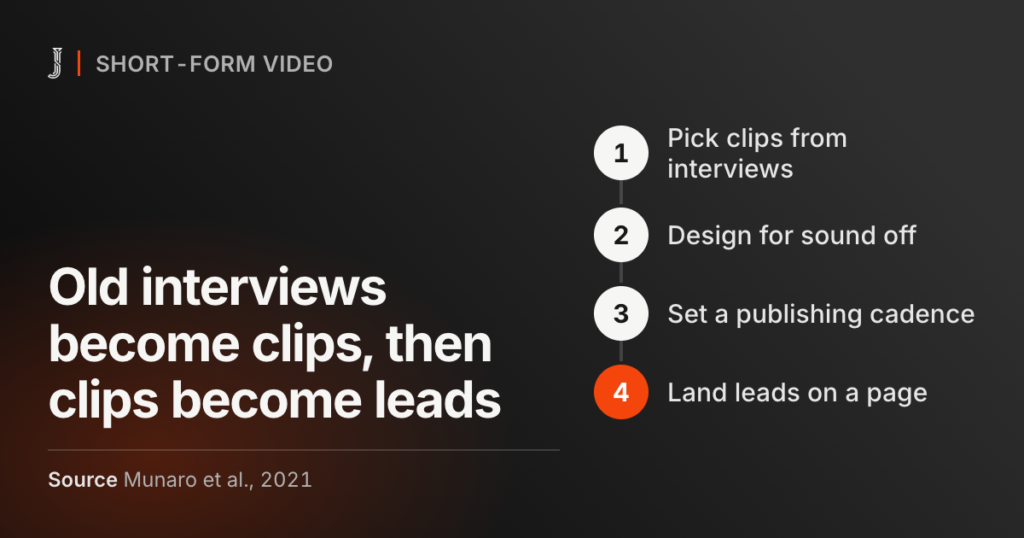
I pick video clips by starting from the buyer’s questions, not from the best moments. A moment can be funny or moving and still answer nothing a buyer would type. Good B2B short-form video comes out of this order.
- List the buyer’s questions. Pull them from sales calls, the inbox and keyword tools. On Y Scouts I used VidIQ to find the phrases executive buyers search on YouTube.
- Search the transcript. Find the places where a guest answers one of those questions in under two minutes. Descript makes the transcript searchable.
- Keep one idea per clip. If the answer needs a second point, it becomes a second clip.
- Open on the problem. The first line names the buyer’s problem in the buyer’s words. No intro, no logo sting.
- Title it with the search phrase. The title, the description and the on-screen text all use the phrase from step one.
- Decide the next step before export. Every clip points to one lead capture page. If no page fits, the clip waits.
The one-idea rule has support in learning research. A meta-analysis of 56 investigations found that people learn more when an explanation is split into meaningful segments than when it plays as one continuous unit. People with more prior knowledge remembered more when the material was split (Rey et al., 2019, A Meta-analysis of the Segmenting Effect). Executive buyers have plenty of prior knowledge. A clip is a segment they chose.
The opening matters because viewers leave fast. An eye-tracking study of internet video ads recorded the moment each viewer clicked away, and found that surprise held attention and rising joy kept people watching (Teixeira, Wedel and Pieters, 2012, Emotion-Induced Engagement in Internet Video Advertisements). Executive search isn’t a joyful topic. On Y Scouts, the reason to stay was the buyer’s own problem, said in the first line.
On that account, one hour-long interview became 12 video clips for the published reel, each captioned, branded and keyed to a search term. Riverside, Descript and CapCut carried the edit. Clip Captain and Content Pilot helped pick the moments and write titles, descriptions and thumbnails.
The tools matter less than the order. On Copy Chief, a copywriting education company in Florida, a custom GPT pipeline turned each podcast episode into short video, a blog post and an email, and editing time fell 80%. A tool can cut the edit. It can’t tell you which question a buyer is asking.
What makes a clip work with the sound off?
I assume every piece of B2B short-form video will be watched muted, because feeds autoplay quietly and buyers scroll in meetings and on trains. Video clips that depend on sound have no hook for those viewers. So captions go into the video itself, not into optional subtitles a viewer has to switch on.
The evidence for captions is broad. A review of more than 100 studies found that captions improve comprehension of, attention to and memory for video, for all viewers and not only Deaf and hard-of-hearing audiences (Gernsbacher, 2015, Video Captions Benefit Everyone). Captions are the first item on my checklist. These are the rest.
- Face on screen. Keep the speaker visible. In an eye-tracking study, viewers strongly preferred lessons that showed the instructor’s face, looked at it about 41% of the time, and recalled the content no better and no worse (Kizilcec, Papadopoulos and Sritanyaratana, 2014, Showing face in video instruction).
- Name and role. A lower third with the speaker’s name and job title in the first seconds, so a buyer knows whose judgment they’re hearing.
- Text away from the edges. Platforms crop the frame in some views and lay their own buttons and captions over the edges, so on-screen text sits in the middle band.
- Short caption lines. Three to six words per line, timed to the speech, so the eye keeps up without rereading.
- No stock footage. Generic shots of handshakes and skylines tell a buyer nothing about the expert.
The face earns the preference. The captions do the teaching.
How often should you publish B2B short-form video?
On Y Scouts, the cadence moved from one hour-long episode a week to one episode plus three short videos. The founder and her principal consultants own the content. I’m the publisher of record across WordPress and HubSpot, and a monthly editorial cycle keeps them in the loop on topics, clip selection and timing. The monthly newsletter goes out of HubSpot on the same rhythm.
Cadence matters for a reason older than YouTube. Repeated exposure to something, with nothing else added, is enough to make people feel more positive toward it (Zajonc, 1968, Attitudinal effects of mere exposure). A buyer who sees the same consultant answer three hiring questions in a month has a reason to recognize the name on the fourth.
The right number is the one you can hold for a full quarter without anyone dreading it. My service scopes 8 to 20 video clips a month from a defined set of recordings. Start at the low end if one person approves everything. A cadence that collapses in week six is worth less than a smaller one that holds, and the Y Scouts results below show why.
Batching is what makes B2B short-form video possible for a small team. One recording session, or one pass through the archive, feeds a month of video clips. Approvals happen in the monthly cycle, not clip by clip, so the expert gives one meeting instead of twenty messages.
Where should a lead land after a clip?
The weak point in most B2B short-form video is the click after it, and the answer is not the homepage. A homepage answers “who is this firm?” and the viewer arrived asking something narrower. Each clip should point to a lead capture page that continues the clip’s question and offers one useful thing in exchange for an email address.
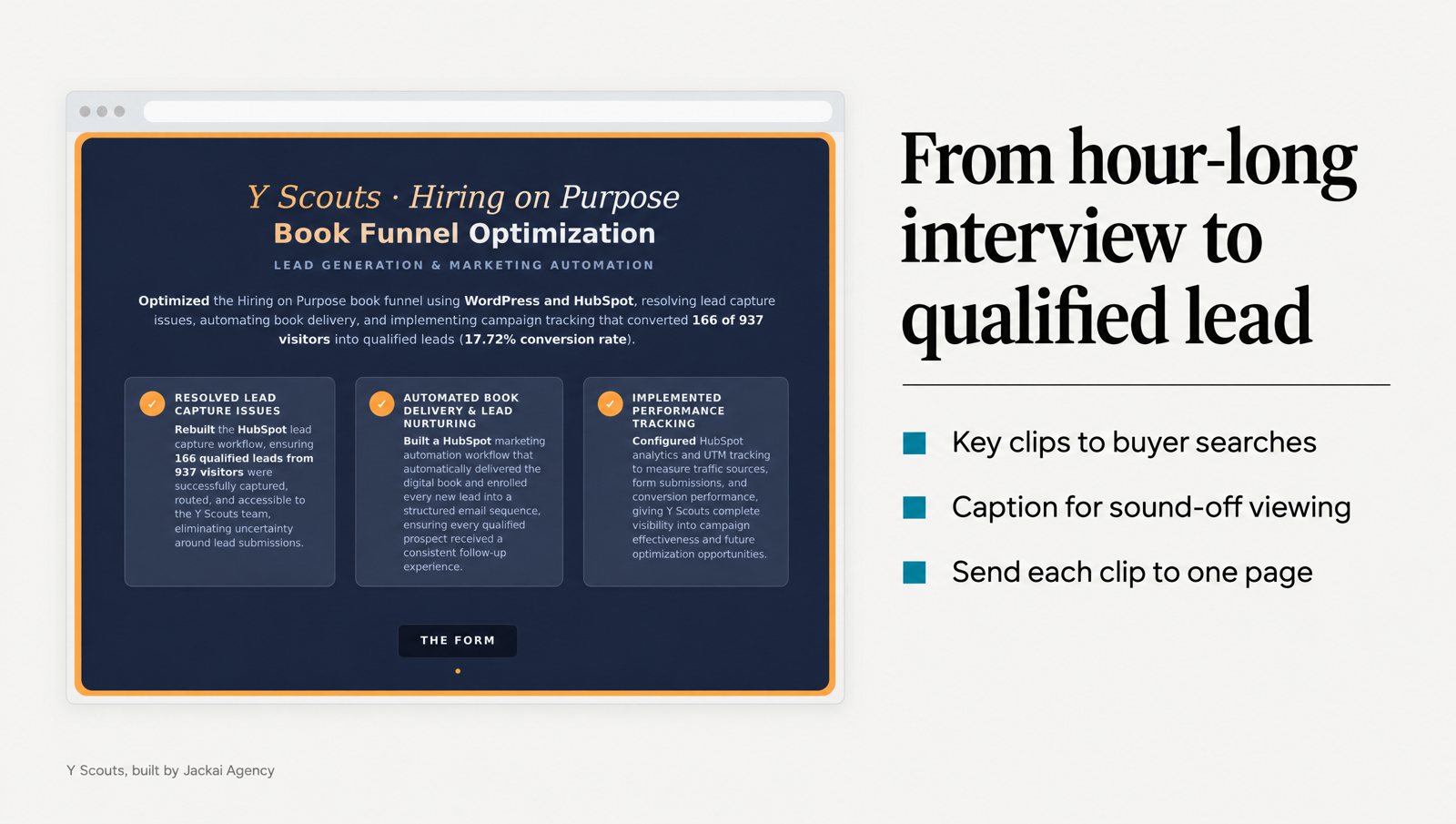
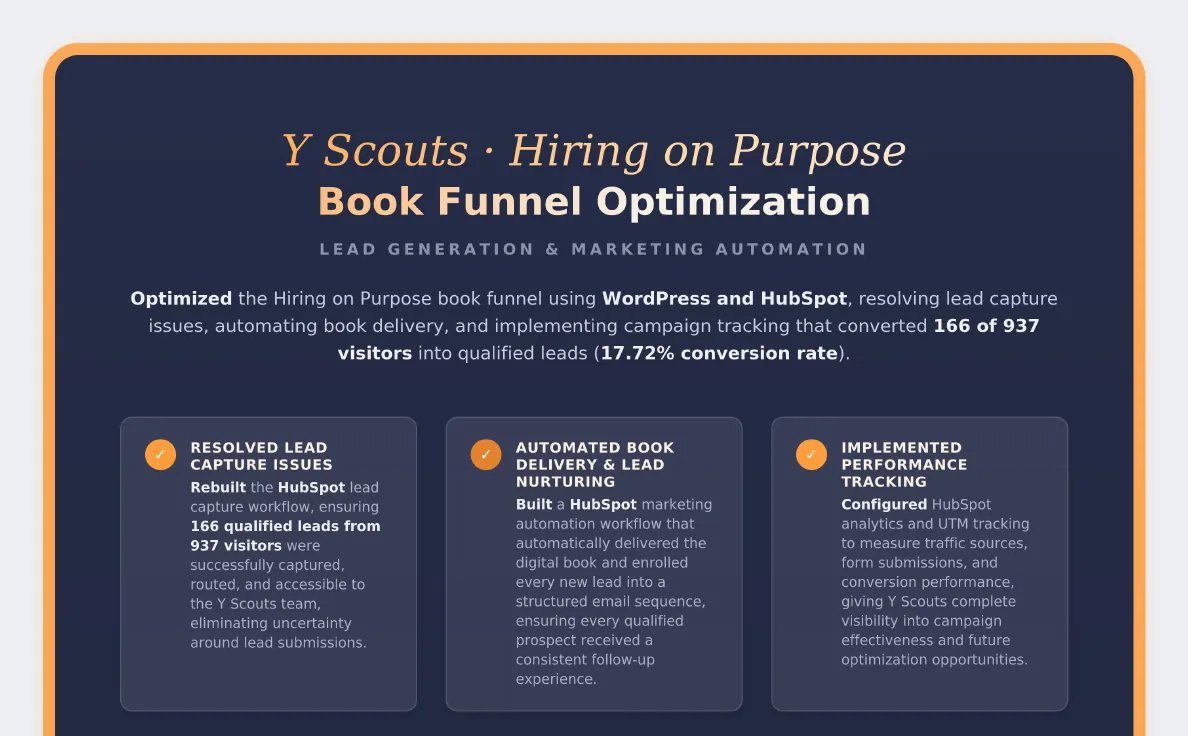
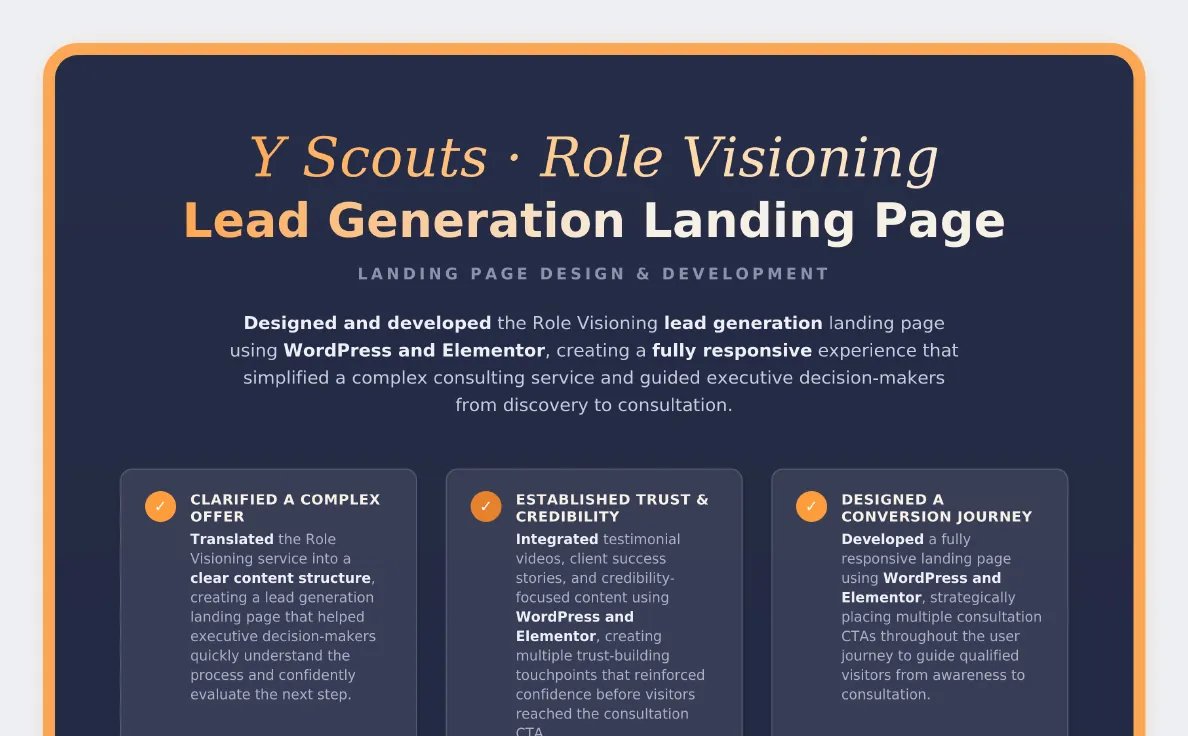
Y Scouts has three lead capture pages. Hiring on Purpose delivers a book. The Executive Interview Guide is a lead magnet with its own segmentation and nurture emails. Role Visioning introduces an AI hiring tool, with separate paths for hiring teams and executive candidates. Each one carries one argument and one next step into HubSpot.
Behind each lead capture page, the form, the delivery email, the follow-up workflow and the tracking run as one HubSpot flow, so a submission becomes a contact with a source. The Hiring on Purpose funnel converts visitors to leads at 17.7%, 166 leads from 938 visitors, read from the client’s own HubSpot dashboard.
Information scent applies after the click too. If the clip asks how to interview a COO and the lead capture page talks about “purpose-driven leadership”, the scent breaks, and foragers move on when the scent breaks (Pirolli and Card, 1999). The page headline should repeat the clip’s question, or the promise the clip ended on.
Two smaller rules apply to the link itself. Put it in the first line of the description and in a pinned comment, never in the last two seconds of the clip. And tag every link with UTM parameters, so the CRM records which clip and which platform sent each lead. My lead attribution method shows how those tags carry into the CRM.
What happened on the Y Scouts account?
Across Q3 2025, with nothing new filmed, the numbers moved like this. The full record, with the before and after video frames and the lead pages, is in the Y Scouts case study.
| Measure | Before | After |
|---|---|---|
| Video cadence | One hour-long episode a week | One episode plus three short videos |
| Monthly YouTube views | 162 | 4,565 (+2,721%) in Q3 2025 |
| Inbound marketing-qualified leads | 17 in the quarter | 30 in Q3 2025 |
| Scheduled demos | 22 | 37 in Q3 2025 |
| Monthly YouTube views after publishing paused in Q4 | 4,565 | 483 |
The B2B short-form video work contributed to those results. It didn’t cause them on its own. The blog-to-lead-gen flow, the three lead capture pages and the monthly newsletter all ran in the same quarter, and I can’t separate their shares. A marketing-qualified lead here means a contact the firm judged worth a sales conversation.
Then comes the honest part. When publishing paused in Q4, monthly YouTube views fell back to 483. Same channel. Same archive. No new clips. That drop is the clearest measure of what the cadence was worth, and it is also the warning: this is a rhythm someone has to hold, not an asset that keeps its value on its own.
Views are not placements either. A view count says a clip was found. It says nothing about whether a chief executive trusted the firm with a search. That’s why I report leads and demos beside the YouTube views, and never the views alone.
What does B2B short-form video cost, and what goes in the brief?
I quote short-form video editing as a fixed price after a call, because the cost depends on how many hours of source footage exist, how many clips a month you want and which platforms they go to. If you can’t yet tell which channel produced a lead, start with Lead Source Reporting: CA$2,600, two weeks.
If there’s no lead capture page for clips to point to, that comes before any editing. Landing Page Design starts at CA$3,795 and takes one to two weeks. Both are fixed quotes with two revision rounds per phase. You own the site, domain and hosting, and I reply within one business day. Current prices sit on my pricing page.
Whoever does the work, a clear brief saves the first month of any B2B short-form video project. This is what I ask for.
- The source library: every recording you have, its length, where the files live and who appears in it.
- Ten buyer questions: the ones your team hears on sales calls, written in the buyer’s words.
- The landing page: the lead capture page the clips will point to and what it gives away.
- One approver: the person who signs off clips, and how many days they need.
- The CRM: where a new lead lands and who follows up, by name.
- Compliance review: if your industry checks public statements before they go out, who checks and how long it takes.
- Starting numbers: monthly YouTube views, inbound leads and booked demos for the last three months, so the result has something to beat.
When would I not recommend B2B short-form video?
I’d say no to B2B short-form video, or not yet, in five situations.
- Nothing is recorded. If the firm has no interviews, webinars or talks, and nobody willing to be on camera, start with written answers to buyer questions. Clips need a source.
- Nobody can hold the cadence. The Y Scouts drop to 483 views a month is what a pause looks like. If no one owns publishing for a full quarter, wait until someone can.
- There’s no page to land on. Build the lead capture page first. Video clips with nowhere to send people produce views and nothing to follow up.
- Views are the goal. If success means YouTube views, any viral format will do, and none of it needs your expertise. I measure inbound leads and booked demos.
- The plan is a faceless channel. Stock footage and AI-generated presenters remove the one thing a B2B buyer is judging: the person whose advice they’d be paying for.
There’s one edge case. A firm whose buyers arrive almost entirely by referral may still want video clips, but as something a referrer can forward, not as a search channel. Then the landing page matters more than the keyword.
Start with the interviews you already recorded
Nothing new filmed. Same founder. Same archive. What changed at Y Scouts was the cut, the cadence and the page each viewer landed on.
If your firm has hours of recorded expertise and you can’t say what it produces, book a 30-minute call with me. I’ll measure your starting numbers on the call, and you leave with them whether or not you hire me. You can read how I run short-form video and social media management before we talk.
Sources
Peer-reviewed research
- Gernsbacher, M. A. (2015). Video Captions Benefit Everyone. Policy Insights from the Behavioral and Brain Sciences, 2(1), 195 to 202. https://doi.org/10.1177/2372732215602130
- Guo, P. J., Kim, J. and Rubin, R. (2014). How video production affects student engagement: An empirical study of MOOC videos. Proceedings of the First ACM Conference on Learning @ Scale, 41 to 50. https://doi.org/10.1145/2556325.2566239
- Holliman, G. and Rowley, J. (2014). Business to business digital content marketing: marketers’ perceptions of best practice. Journal of Research in Interactive Marketing, 8(4), 269 to 293. https://doi.org/10.1108/JRIM-02-2014-0013
- Kizilcec, R. F., Papadopoulos, K. and Sritanyaratana, L. (2014). Showing face in video instruction: Effects on information retention, visual attention, and affect. Proceedings of the SIGCHI Conference on Human Factors in Computing Systems, 2095 to 2102. https://doi.org/10.1145/2556288.2557207
- Munaro, A. C., Hübner Barcelos, R., Francisco Maffezzolli, E. C., Santos Rodrigues, J. P. and Cabrera Paraiso, E. (2021). To engage or not engage? The features of video content on YouTube affecting digital consumer engagement. Journal of Consumer Behaviour, 20(5), 1336 to 1352. https://doi.org/10.1002/cb.1939
- Pirolli, P. and Card, S. (1999). Information foraging. Psychological Review, 106(4), 643 to 675. https://doi.org/10.1037/0033-295X.106.4.643
- Rey, G. D., Beege, M., Nebel, S., Wirzberger, M., Schmitt, T. H. and Schneider, S. (2019). A Meta-analysis of the Segmenting Effect. Educational Psychology Review, 31(2), 389 to 419. https://doi.org/10.1007/s10648-018-9456-4
- Teixeira, T., Wedel, M. and Pieters, R. (2012). Emotion-Induced Engagement in Internet Video Advertisements. Journal of Marketing Research, 49(2), 144 to 159. https://doi.org/10.1509/jmr.10.0207
- Zajonc, R. B. (1968). Attitudinal effects of mere exposure. Journal of Personality and Social Psychology, 9(2, Pt. 2), 1 to 27. https://doi.org/10.1037/h0025848