
- Result
- Monthly YouTube views 162 to 4,565 (+2,721%), inbound MQLs 17 to 30, Q3 2025
- Client
- Y Scouts, a purpose-driven executive search firm
- Scope
- Content strategy and CMS management, lead-gen page design, short-form video editing and YouTube SEO
- Stack
- WordPress, HubSpot CMS, HubSpot Marketing Hub, Riverside, Descript, CapCut, VidIQ, Content Pilot
2,721% more monthly views from interviews already filmed
Content strategy, CMS management, lead-gen page design and short-form video for an executive search firm. Client: Y Scouts, a purpose-driven executive search firm placing mission-driven leaders.
A founder and her principal consultants had been recording leadership interviews for years, and the interviews were good. A chief executive deciding who to trust with a retained search would never find them, because each episode went out once, at full length, on a channel averaging 162 views a month. The blog and the HubSpot CRM ran as two separate systems, so a reader who did arrive had no path to a conversation. Nobody was publishing into either one on a schedule, and there was no team to throw at it.
The cheapest content you will ever make is the content you already made. Distribution was the whole problem.
What was actually happening?
Three things were failing at once and they looked like one. Publishing had no cadence, so nothing compounded. The pages giving away real assets (a book, an executive interview guide, an AI hiring tool) were not wired to capture the reader, and book delivery was not automated. The interview archive sat at full length where executive-search buyers do not search. Fixing any one of the three alone would have moved nothing the founder could see in her CRM.
Every figure below is a real capture of a live page or a published video frame. Each frame caps its height and scrolls inside itself, so a full-page capture can be read end to end without leaving the figure. Both frames are reachable by keyboard. Nothing here is a mockup or a drawn schematic.
1. Content strategy and CMS management: who publishes, and on what cadence?
Joshua owns the WordPress and HubSpot CMS as publisher of record. Every blog post and every new web page ships with meta titles, meta descriptions and taxonomy set before release, and every post is wired into the blog-to-lead-gen flow so it feeds the funnel instead of sitting on the site. The founder and her principal consultants own the content; a monthly editorial cycle puts them in the loop on topics, clip selection and publishing cadence, and the monthly email newsletter goes out of HubSpot Marketing Hub on the same rhythm.
- Publisher of record across a mixed WordPress and HubSpot stack, every blog post and new web page since February 2025.
- SEO metadata and taxonomy set on every piece before it goes live: meta titles, meta descriptions, categories and tags.
- A monthly editorial cycle with the founder and her principal consultants, who own the content Joshua publishes.
- The monthly newsletter sequenced and sent from HubSpot Marketing Hub, carrying the month's published work to the list.
2. Web design and lead-gen pages: what happens after the reader arrives?


UX and UI analysis, the three lead-gen surfaces
Before: what the pages cost the visitor
- The capture path was not wired. A book, an interview guide and an AI hiring tool were being given away, and the forms, delivery and follow-up behind them ran as separate pieces or not at all.
- No campaign tracking. Without UTM parameters reporting into HubSpot, the founder could not tell which channel produced a lead, so no channel decision could be made.
- Blog and CRM as two systems. A reader who arrived from a post had no next step that landed in the CRM.
After: what changed and why it works
- One funnel, not three tools. Form, delivery email, follow-up workflow and tracking run as a single HubSpot flow on every surface, so a submission becomes a contact with a source.
- Calls to action down the page. The ask repeats where attention lands rather than once at the foot, the same rule the Copy Chief funnel follows.
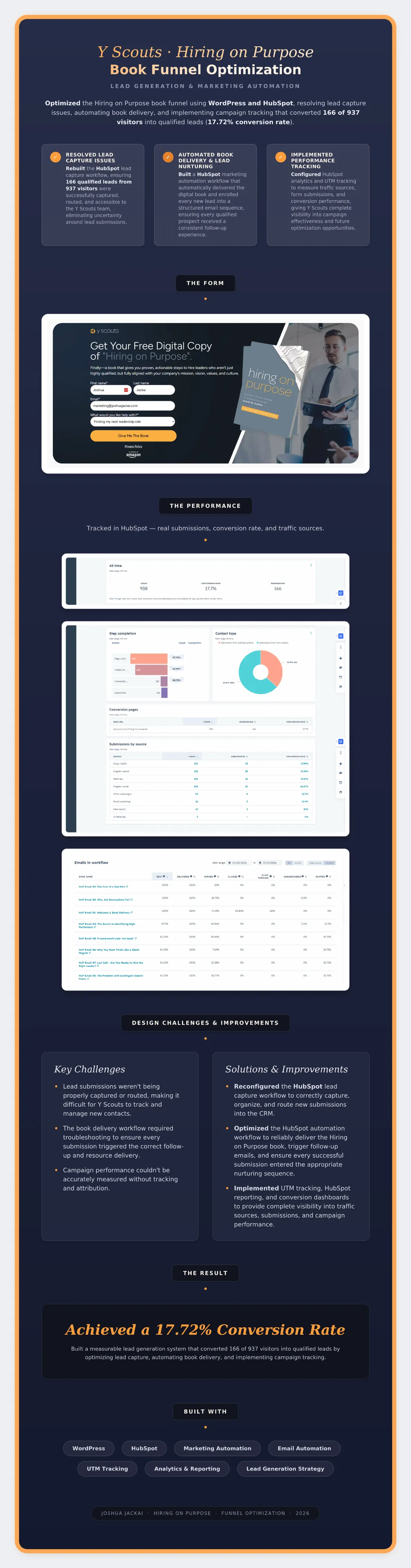
- Measured, not assumed. 17.7% visitor-to-lead on the book funnel, 166 leads from 938 visitors, read from the client's own HubSpot dashboard.
3. Short-form video editing and YouTube SEO: what does a buyer actually search for?
Editing analysis, before against after
Before: what the format cost the channel
- One hour-long episode a week. Executive-search buyers do not search for a podcast; they search for the specific hiring problem an episode answers, and a full episode never surfaces for it.
- No hook in the first seconds. A clip that opens mid-thought gives the viewer nothing to stay for.
- Nothing to read without sound. Most feed viewing is muted, so an uncaptioned clip is a silent one.
After: what changed and why it works
- One episode plus three short videos. The cadence moved from one long post a week to a library of short cuts, each keyed to a search term found in VidIQ.
- Pain-point hook first. Each cut opens on the problem the buyer already has, in their words, so the scroll stops before the argument starts.
- AI clip selection, metadata and thumbnails. Clip Captain and Content Pilot pick the moments and write the metadata; Riverside, Descript and CapCut carry the edit.
Before against after, with the measured column
| What | Before | After | Measured |
|---|---|---|---|
| Publishing cadence | Ad hoc, no calendar | Monthly editorial cycle with the founder and principal consultants | Yes, every blog post and new page since February 2025 |
| Blog to CRM | Two separate systems | Every post wired into the blog-to-lead-gen flow in HubSpot | Not measured in isolation |
| Hiring on Purpose funnel | Delivery not automated, no campaign tracking | HubSpot capture, automated delivery, UTM tracking | Yes, 17.7% visitor-to-lead, 166 of 938 |
| Video cadence | One hour-long episode a week | One episode plus three short videos | Yes, 162 to 4,565 monthly views (+2,721%), Q3 2025 |
| Inbound MQLs | 17 in the quarter | 30 in the quarter | Yes, Q3 2025 |
| Q4, publishing paused | n/a | Cadence stopped | Yes, back to 483 views a month |
What was built?
- Two content management systems run as one publishing operation: WordPress for the site and blog, HubSpot for pages, forms, workflows and the newsletter.
- 3 lead-capture pages Hiring on Purpose, Executive Interview Guide and Role Visioning, each carrying one argument and one next step into HubSpot.
- A short-form video engine over the existing interview archive: Riverside, Descript, CapCut, VidIQ keyword research, Clip Captain and Content Pilot for clip selection, metadata and thumbnails.
- 1 monthly rhythm the founder and her consultants could plan client conversations around, held by one person.
What did the engine produce?
Across Q3 2025, with nothing new filmed, monthly YouTube views rose from 162 to 4,565 (+2,721%), inbound MQLs from 17 to 30 and scheduled demos from 22 to 37. The Hiring on Purpose funnel converts visitors to leads at 17.7%, measured in the client's own HubSpot.
The honest limitation
Views are not placements. The Q3 figures belong to the quarter the cadence ran, and when publishing paused in Q4 the channel fell back to 483 views a month. That fall-off is the clearest measure of what the cadence is worth, and it is also the caveat: the engine is a rhythm someone has to hold, not an asset that keeps its value on its own.
This engagement runs as Lead Source Reporting.
Pick a time. We measure your starting numbers on the call.
Mobile conversion rate, AI-referred traffic and lead count, measured before any work starts. You leave with the window and the number, whether or not you hire me.
If the calendar does not load here, the host is blocking the frame. Open it in a new tab with the link above.
