7 Steps to Accurate Referral Attribution on Every Lead
Seven steps for Canadian B2B teams to put the real referrer on every lead: an open 'how did you hear about us' field, a self-reported property beside HubSpot's Original Traffic Source, partner links, dark social catches, weekly coding and reconciliation, and credit for the referrer. Sources checked 16 November 2026.
 Joshua Jackai
17 min read
Published 16 November 2026 · Last updated and fact-checked November 2026
Short answer: To get referral attribution on every lead, ask an open “how did you hear about us” question on every form, store the answer beside your CRM’s tracked source, give each partner a tagged link, and compare both every week. In one bank study, referred customers were worth at least 16% more, so missed referrals matter.
Referrals are the leads Canadian B2B firms value most and measure worst. A past client tells a peer about you at a Vancouver board meeting, the peer types your address into a browser, and HubSpot records the lead as Direct traffic. My website lead tracking guide for Canada covers UTM tags and hidden fields, and my GA4 lead tracking steps cover analytics setup. This guide covers the gap those tools leave: the referral and word-of-mouth leads that arrive with no click trail at all.
In this guide
Key takeaways
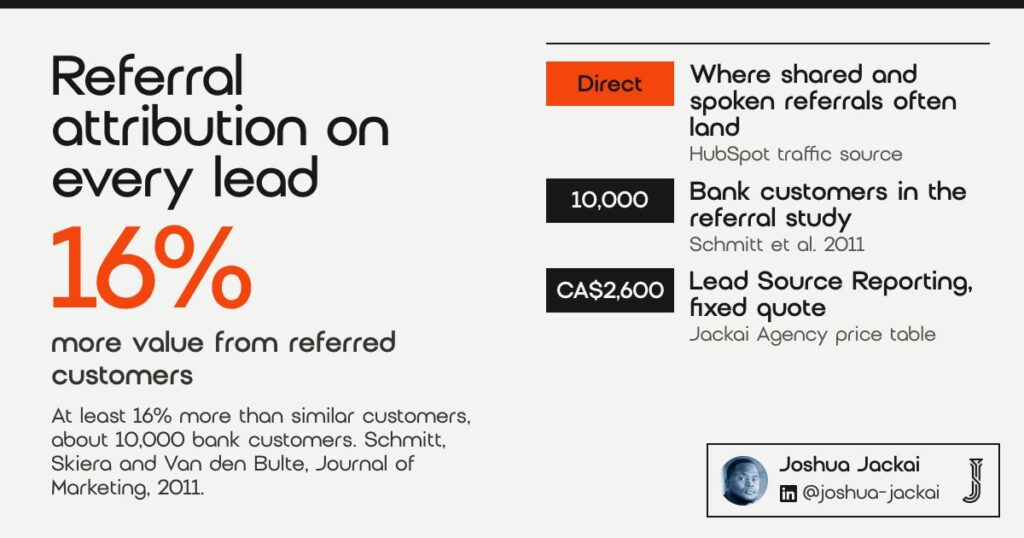
- Referred customers were worth at least 16% more than similar customers in a study of about 10,000 bank customers tracked for almost three years (Schmitt, Skiera and Van den Bulte, Journal of Marketing, 2011).
- Word-of-mouth customers added nearly twice as much long-term value as marketing-induced customers at a web hosting firm (Villanueva, Yoo and Hanssens, 2008).
- HubSpot assigns every contact one of 10 Original Traffic Source values, and a spoken referral usually lands in Direct traffic or Offline sources (HubSpot Knowledge Base, read 16 November 2026).
- A pick-list question is aided recall, which Sudman and Bradburn found reduces omissions but can increase telescoping (JASA, 1973).
- My Lead Source Reporting setup separates 7 channels, referral and AI citations included, in two weeks for CA$2,600.
| Step | What it catches | Effort | Key number |
|---|---|---|---|
| 1. Ask the open question on every form | Spoken and remembered referrals | Low | Aided recall cuts omissions, Sudman and Bradburn 1973 |
| 2. Keep the answer beside the tracked source | Direct traffic and Offline sources | Low | 10 HubSpot source values |
| 3. Give partners their own link and code | Accountant, lawyer and client referrals | Medium | Referred customers worth 16% more |
| 4. Catch dark social and AI referrals | Links shared in messages and AI apps | Medium | WOM carryover longer, Trusov 2009 |
| 5. Code answers into a short channel list | Free text that says “Google” or “a friend” | Medium | Nearly twice the long-term value |
| 6. Reconcile both sources every week | Disagreements between tool and buyer | Medium | Channel credit differs, Li and Kannan 2014 |
| 7. Credit the referrer on the deal | Who to thank and who to ask again | Low | 4 field experiments, Kumar 2010 |
1. Ask “How did you hear about us?” on every form: best for catching spoken referrals
The cheapest referral tracking is a question. Add an open text field, “How did you hear about us?”, as the last field on every form, and make it optional. Open text beats a pick list for referrals because a pick list is aided recall, which Sudman and Bradburn found reduces omissions but can increase telescoping.
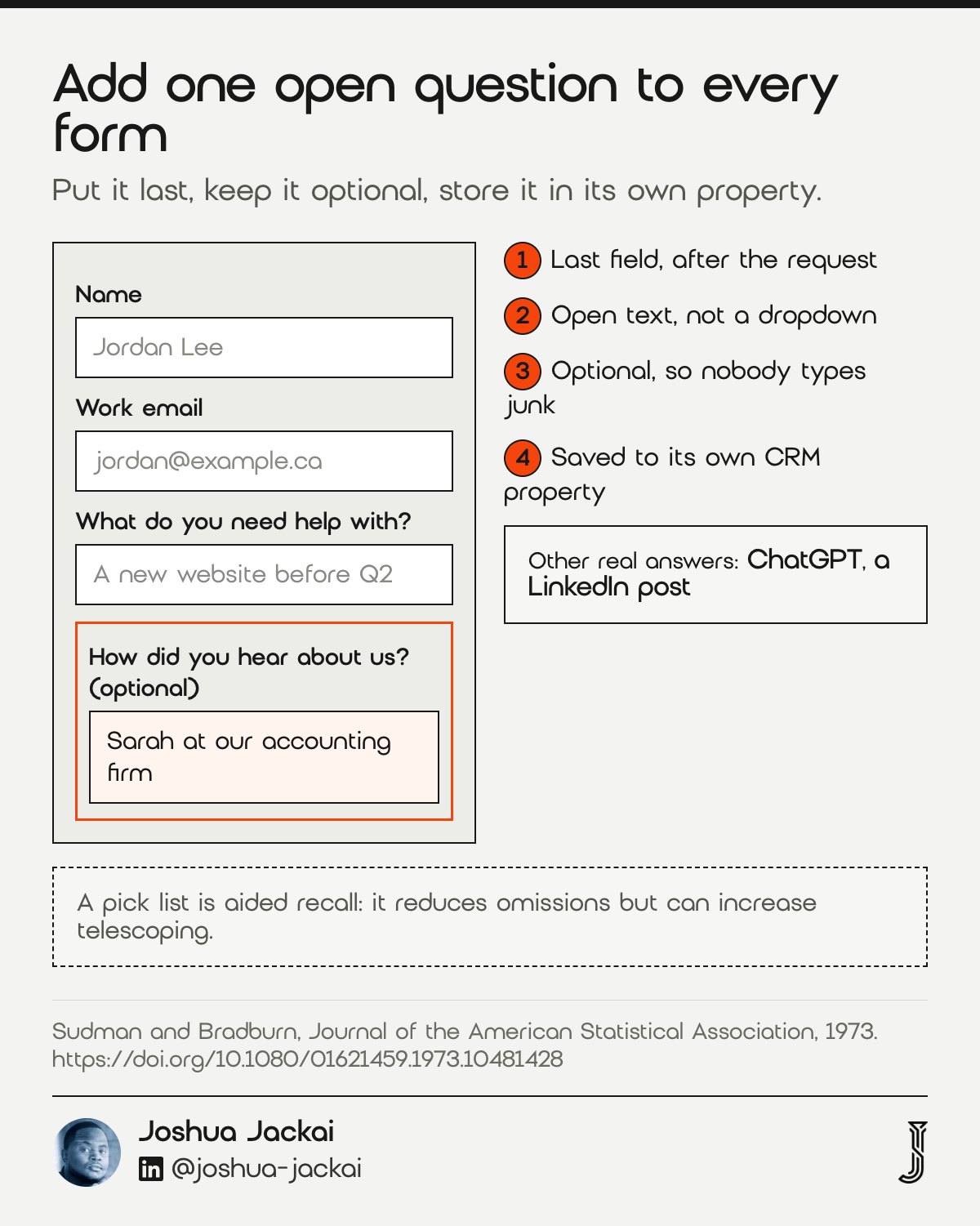
- Field label: How did you hear about us?
- Field type: single-line open text, never a required dropdown
- Position: last field, after the message box
- Optional second field: What made you reach out this week?
- Store as: its own CRM property, never in Lead Source
The wording matters more than the tool. “How did you hear about us?” asks about discovery, the first time someone met your name. “What made you reach out this week?” asks about the trigger. For referrals you want the first one, because the referral is usually the discovery and a Google search a month later is the trigger. I keep the field optional, because a required field invites junk answers. Then the format. Seymour Sudman and Norman Bradburn tested memory in surveys against records and found that aided recall, a list of options, reduces things people forget to mention but does not reduce telescoping, where an older event is remembered as recent, and may increase it. A dropdown with “Referral” as one option is aided recall. It produces a tidy chart and loses the name of the person who sent the lead. An open box gets “Mike at our accounting firm told me”, which is the line your sales team needs. Their study was about household surveys, not web forms, so treat it as a reason to test both formats on your own leads.
“Aided recall reduces omissions, but does not reduce and may even increase telescoping,” Seymour Sudman and Norman Bradburn wrote in the Journal of the American Statistical Association.
2. Keep the answer beside HubSpot’s Original Traffic Source: best for HubSpot users
Never overwrite the tracked source with the buyer’s answer. Keep both. HubSpot’s Original Traffic Source property takes one of 10 values set from the first web session it saw, and a referral that started in conversation usually lands in Direct traffic or Offline sources. Your self-reported property sits next to it.
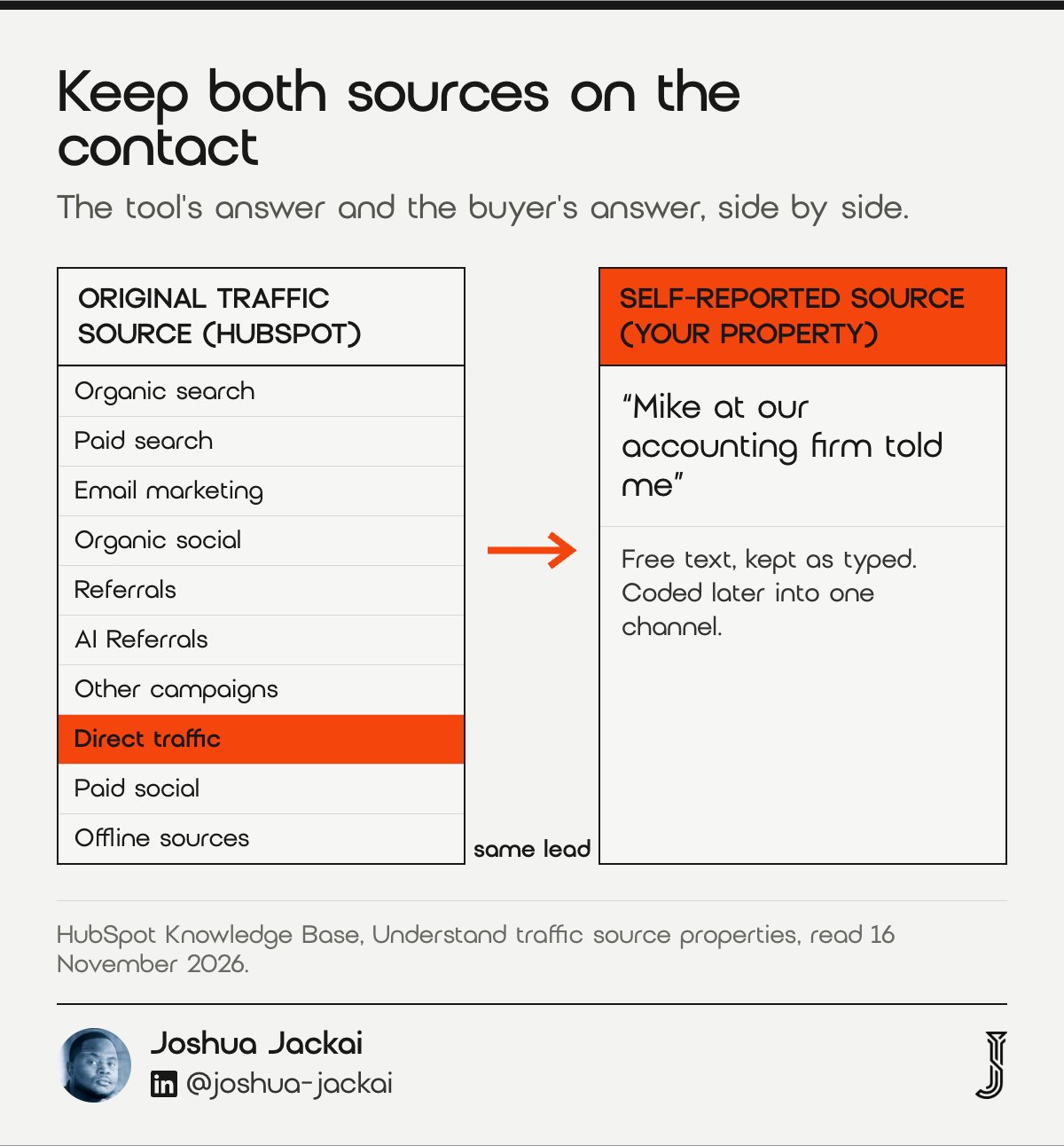
- HubSpot property: Original Traffic Source, set automatically from the first web session
- Its 10 values: Organic search, Paid search, Email marketing, Organic social, Referrals, AI Referrals, Other campaigns, Direct traffic, Paid social, Offline sources
- Your property: Self-reported source, single-line text, mapped from the form
- Second property: Self-reported channel, a dropdown you fill in step 5
- Rule: reports read both properties side by side
The confusing word is “Referrals”. In HubSpot’s traffic source list, read on 16 November 2026, Referrals means a click from another website that is not a search engine or a social network. It does not mean a person who recommended you. When a client’s colleague hears your name over lunch in Yaletown and types your URL, HubSpot sees a session with no referring site and files it as Direct traffic. When your sales rep adds that person by hand after a phone call, the record has no web session and HubSpot uses Offline sources. Both answers are correct for what HubSpot can see. Neither says “referred by Sarah”. That is why I create a separate Self-reported source property, map the form field into it, and never touch Original Traffic Source. The software tells you the last click it saw. The buyer tells you the reason they knew your name. You need both, and the gap between them is where the referrals hide. The same split works in Salesforce or Pipedrive with a custom field.
“Original Traffic Source property displays the first known web source through which a contact interacted with your business,” HubSpot stated in its Knowledge Base.
3. Give each referral partner a tagged link and a code: best for firms with accountant or agency partners
Referral partners, such as the accountant, lawyer or agency that keeps sending you work, should each get their own tagged link and a short code to mention. The link puts the partner in the tracked source and the code gets mentioned on the phone. Schmitt and colleagues found referred bank customers were worth at least 16% more.
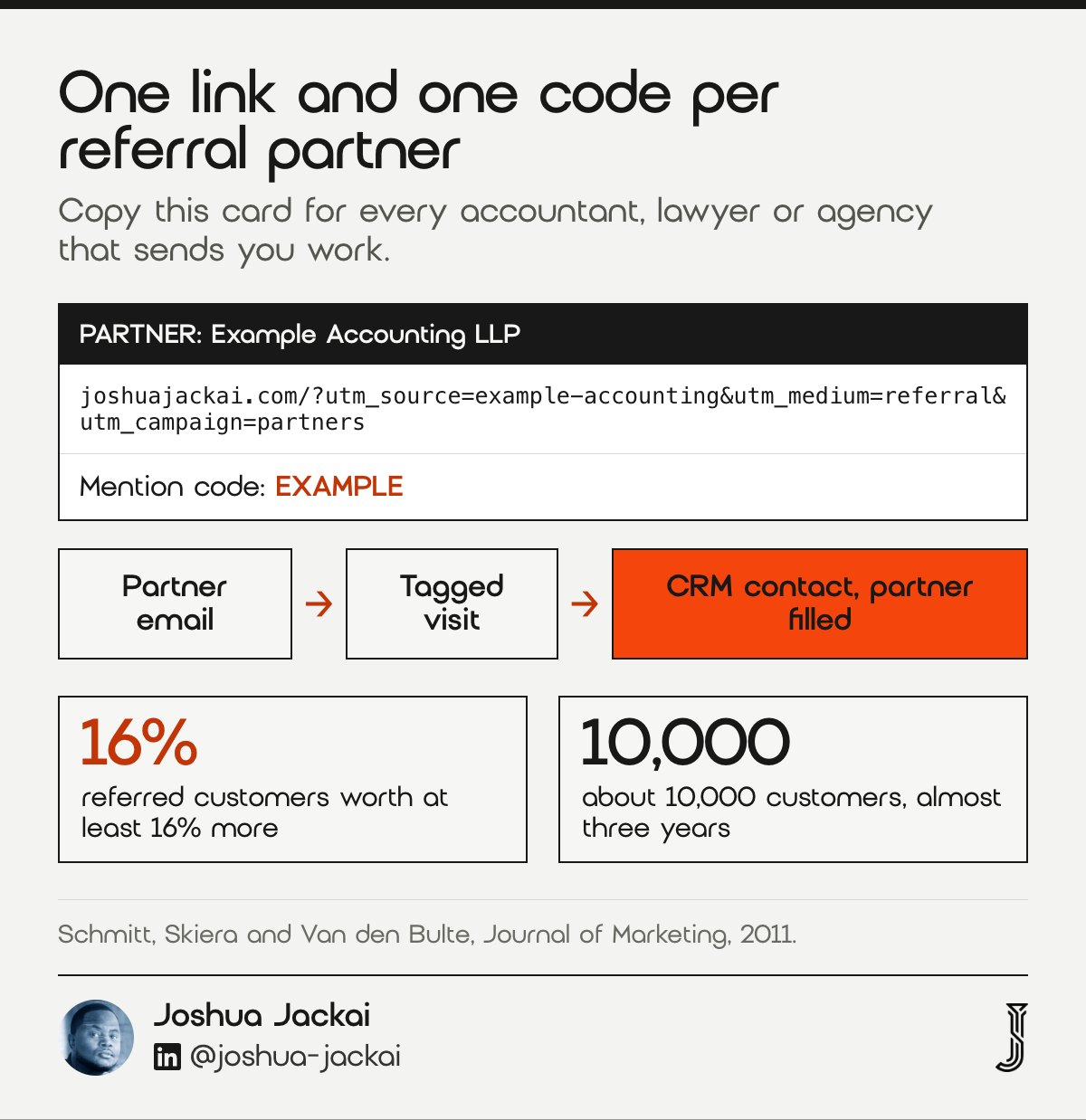
- Link pattern: ?utm_source=partner-name&utm_medium=referral&utm_campaign=partners
- Code: a short word the partner tells clients to mention
- CRM field: Referral partner, a dropdown of named partners
- Study: about 10,000 customers of a German bank, almost three years
- Result: referred customers worth at least 16% more
Partners are the referrals you can plan for. In Vancouver, B2B firms often get steady work from a few accountants, IT providers and lawyers who know their clients’ plans first. Give each one a link with UTM tags naming them as the source, and a code word their clients can say on a call. The link covers the client who clicks, the code covers the client who phones, and the open question from step 1 covers everyone else. Philipp Schmitt, Bernd Skiera and Christophe Van den Bulte tracked about 10,000 customers of a German bank for almost three years and found referred customers had a higher contribution margin and a higher retention rate, and were worth at least 16% more than similar customers. They also found the gap varied by segment, so a referral programme is worth running selectively. A bank is not a B2B studio, so I read the number as a reason to measure your own referred deals, not as a forecast. Once each partner has a link, you can tell them how many leads they sent this quarter, which is the best thank-you there is.
“The average value of a referred customer is at least 16% higher than that of a nonreferred customer with similar demographics and time of acquisition,” the authors reported in the Journal of Marketing.
4. Catch dark social and AI referrals that arrive as Direct: best for firms that get shared in messages
Dark social is a link shared in a private message, such as Slack, WhatsApp, a LinkedIn DM or email, which often arrives with no referring site. Some AI assistant apps strip the referrer too. Those visits fall into Direct traffic. Trusov and colleagues found word-of-mouth referrals carried over longer than traditional marketing.
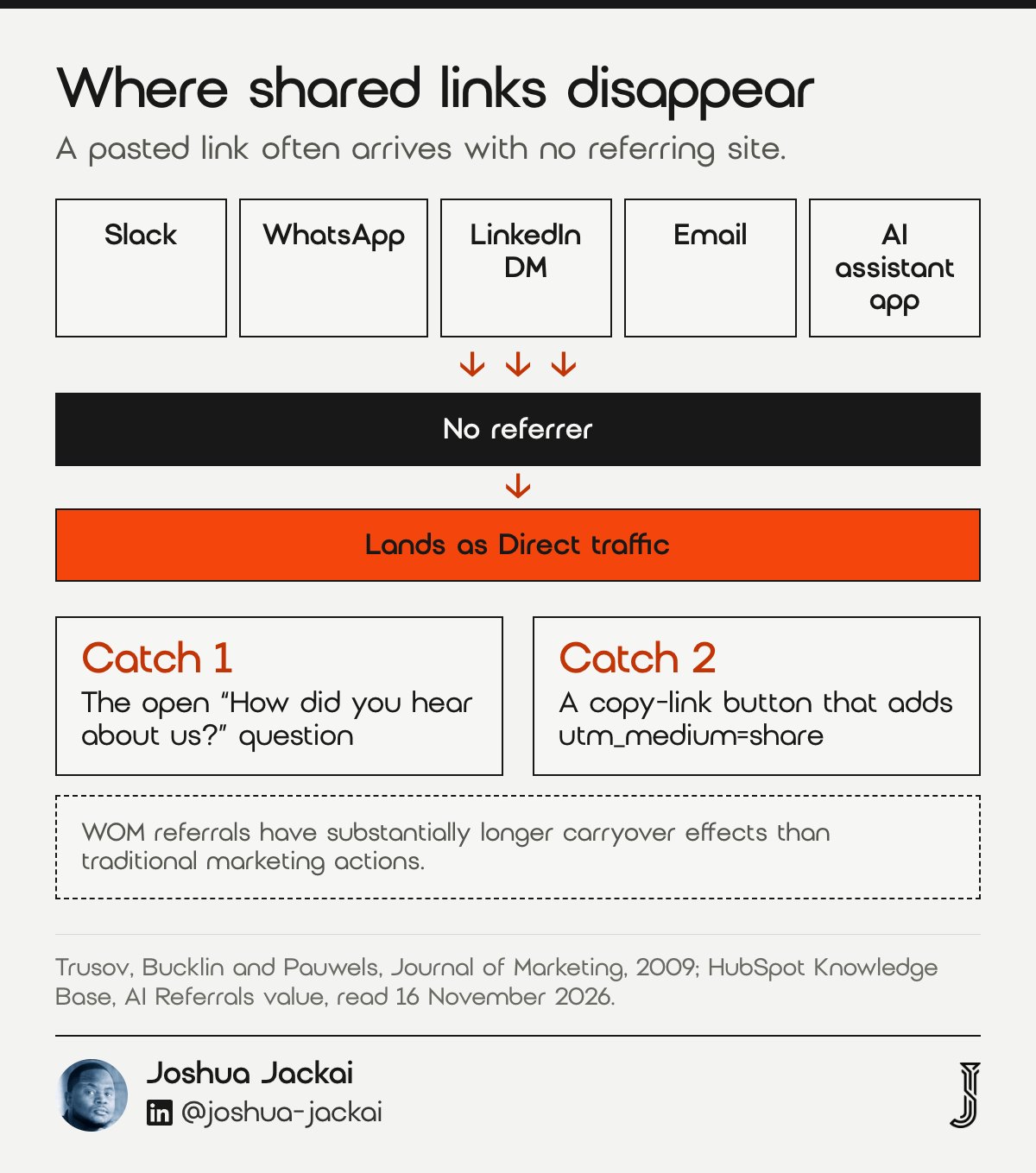
- Where it starts: Slack, WhatsApp, LinkedIn DMs, email, AI assistant apps
- How it lands: Direct traffic, no referring site
- HubSpot exception: AI Referrals when the AI site passes a referrer
- Catch 1: the open form question from step 1
- Catch 2: a “copy link” button that adds utm_medium=share
A lot of B2B word of mouth now travels as a pasted link. Someone in a client’s Slack channel asks for a web designer, a colleague pastes your URL, and the visit arrives with no referring site. HubSpot added an AI Referrals value for visits from AI tools that do pass a referrer, but a click inside a desktop or phone app often does not, and it lands in Direct traffic with the rest. You cannot see the message, so you catch it at two points. The first is the open question, which picks up “a colleague shared your site in Slack”. The second is a share or copy-link button on your case studies that adds a UTM tag, so the pasted link carries its own label. Mikhail Trusov, Randolph Bucklin and Koen Pauwels, at the University of Maryland, UCLA and Dartmouth, could measure word of mouth precisely only because the social network they studied recorded every invitation. Most B2B firms record nothing, which is why both catches matter.
“WOM referrals have substantially longer carryover effects than traditional marketing actions and produce substantially higher response elasticities,” Trusov, Bucklin and Pauwels wrote in the Journal of Marketing.
5. Code every answer into a short channel list: best for teams that report monthly
Free-text answers are honest and messy, so code each one into a short channel list once a week. Eight channels are enough: client referral, partner referral, peer or community, event or podcast, AI assistant, search, ads and other. The coding matters because word-of-mouth customers added nearly twice the long-term value of marketing-induced ones.
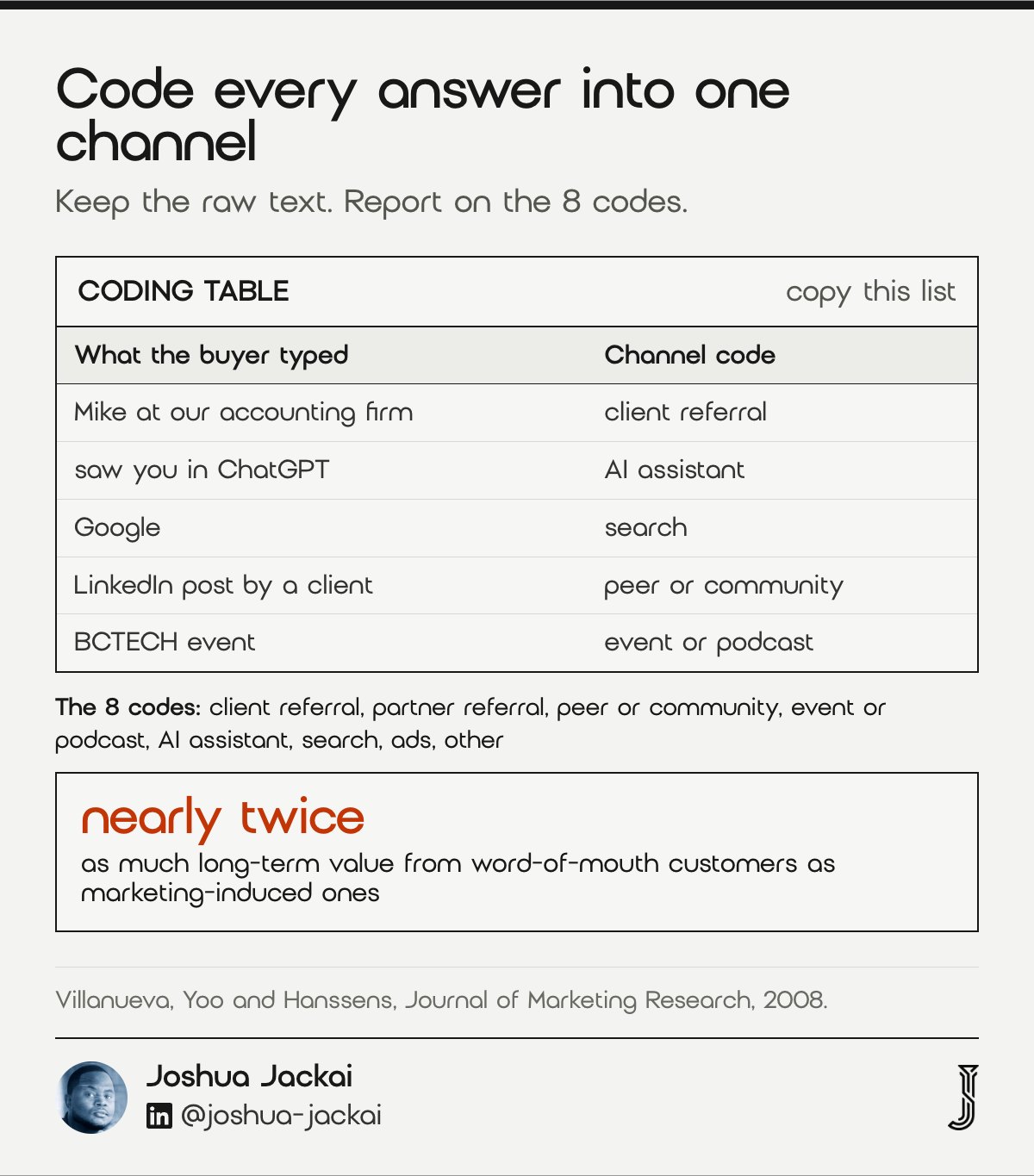
- Channels: client referral, partner referral, peer or community, event or podcast, AI assistant, search, ads, other
- Who codes: one person, every Monday, under 15 minutes for most firms
- Ambiguous answers: “Google” after a referral counts as the referral
- Blank answers: stay blank; never guess
- Study: Villanueva, Yoo and Hanssens, web hosting firm
A free-text field gives you answers like “Google”, “a friend”, “your LinkedIn” and “Mike”. You cannot chart those, so someone codes them once a week into a fixed list. I use eight channels and keep the raw answer untouched beside the code, so anyone can check the call. Two rules prevent most arguments. First, when an answer names a person, it is a referral, even if they also mention Google, because people often search a name they were given. Second, a blank stays blank. Guessing a channel for a blank answer quietly inflates whatever you already believed. Julian Villanueva, Shijin Yoo and Dominique Hanssens modelled customer acquisition at a web hosting company and found marketing-induced customers added more short-term value, while word-of-mouth customers added nearly twice as much long-term value. If your report lumps those customers into Direct, you lose the channel worth the most over time. Their firm sold hosting to small businesses, so the size of the gap in your firm is yours to measure.
“Word-of-mouth customers add nearly twice as much long-term value to the firm,” Villanueva, Yoo and Hanssens wrote in the Journal of Marketing Research.
6. Reconcile the tracked source and the buyer’s answer every week: best for EOS and L10 teams
Once both sources sit side by side, compare them every week in one table. Where HubSpot says Direct traffic and the buyer names a person, the buyer wins the referral credit. Li and Kannan found that channel credit from a proper model differed significantly from the metrics firms commonly used.
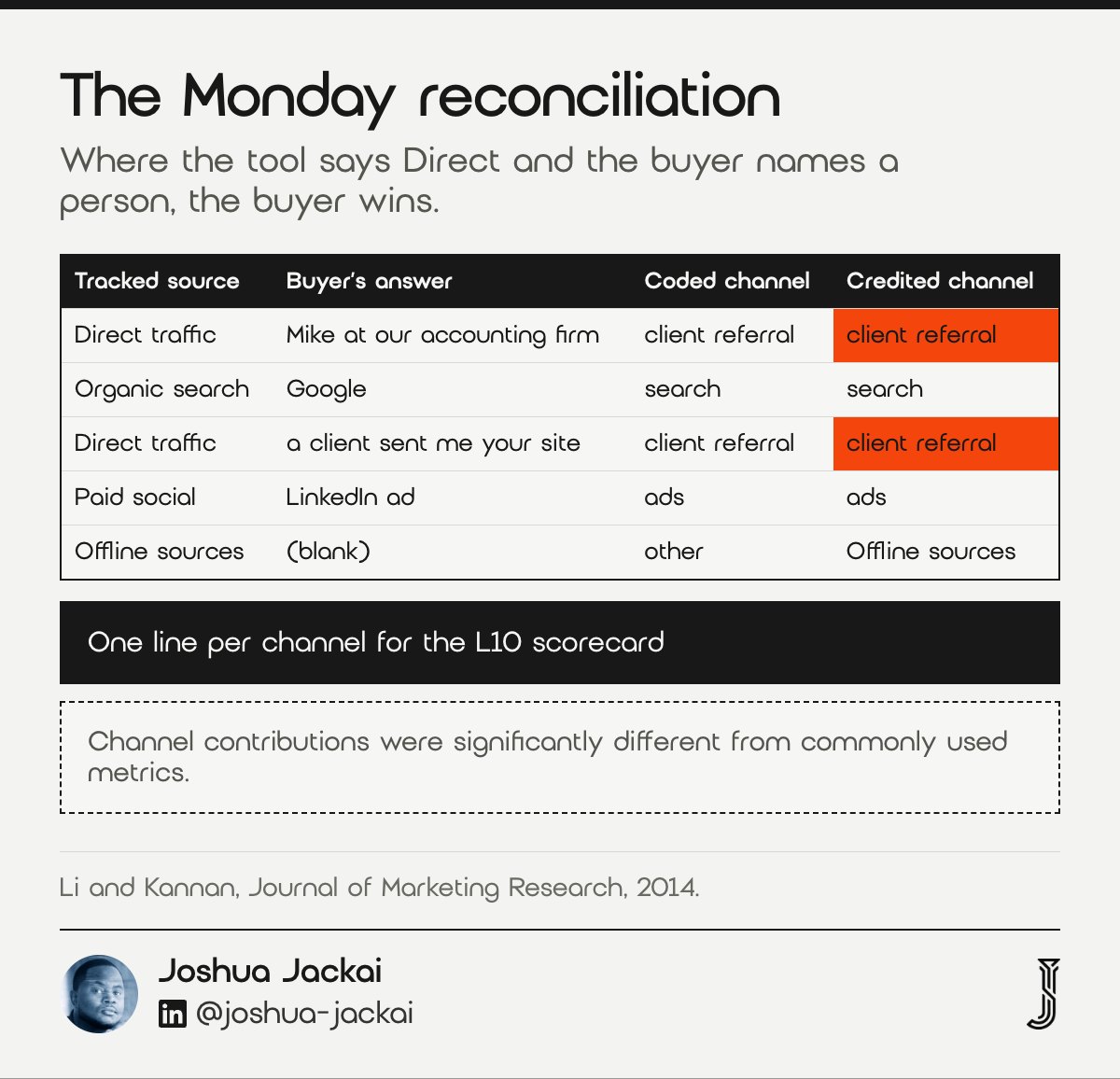
- Cadence: weekly, before the leadership meeting
- Columns: tracked source, buyer’s answer, coded channel, credited channel
- Rule: a named person beats Direct traffic and Offline sources
- Rule: a tagged partner link beats a vague answer
- Output: one line per channel for the scorecard
This is the step that turns two data sets into a decision. Each week I list new leads with four columns: what HubSpot recorded, what the buyer wrote, the coded channel and the channel that gets credit. Most rows agree. The rows that disagree are the lesson, and they usually run one way: Direct traffic or Offline sources on the left, a named person on the right. Hongshuang Li and P.K. Kannan at the University of Maryland built a model of every online touch and found each channel’s real contribution was significantly different from the credit common metrics gave it. Ron Berman at Wharton showed that last-touch credit overpays for ad exposures. Neither study looked at spoken referrals, but both show the same pattern: the source a tool records is not the same as the cause. My lead attribution case study shows the one-page weekly report I build for EOS teams, with organic, paid, referral, email, social, direct and AI citations kept apart.
“These channels’ relative contributions are significantly different from those found by other currently used metrics,” Li and Kannan wrote in the Journal of Marketing Research.
7. Credit the referrer on the deal and close the loop: best for firms that want more referrals
The last step is the one that brings the next referral. Record the referrer’s name on the deal, thank them when the deal closes, and report which clients and partners refer most. Kumar, Petersen and Leone ran 4 field experiments and found firms should manage customers by referral value as well as lifetime value.
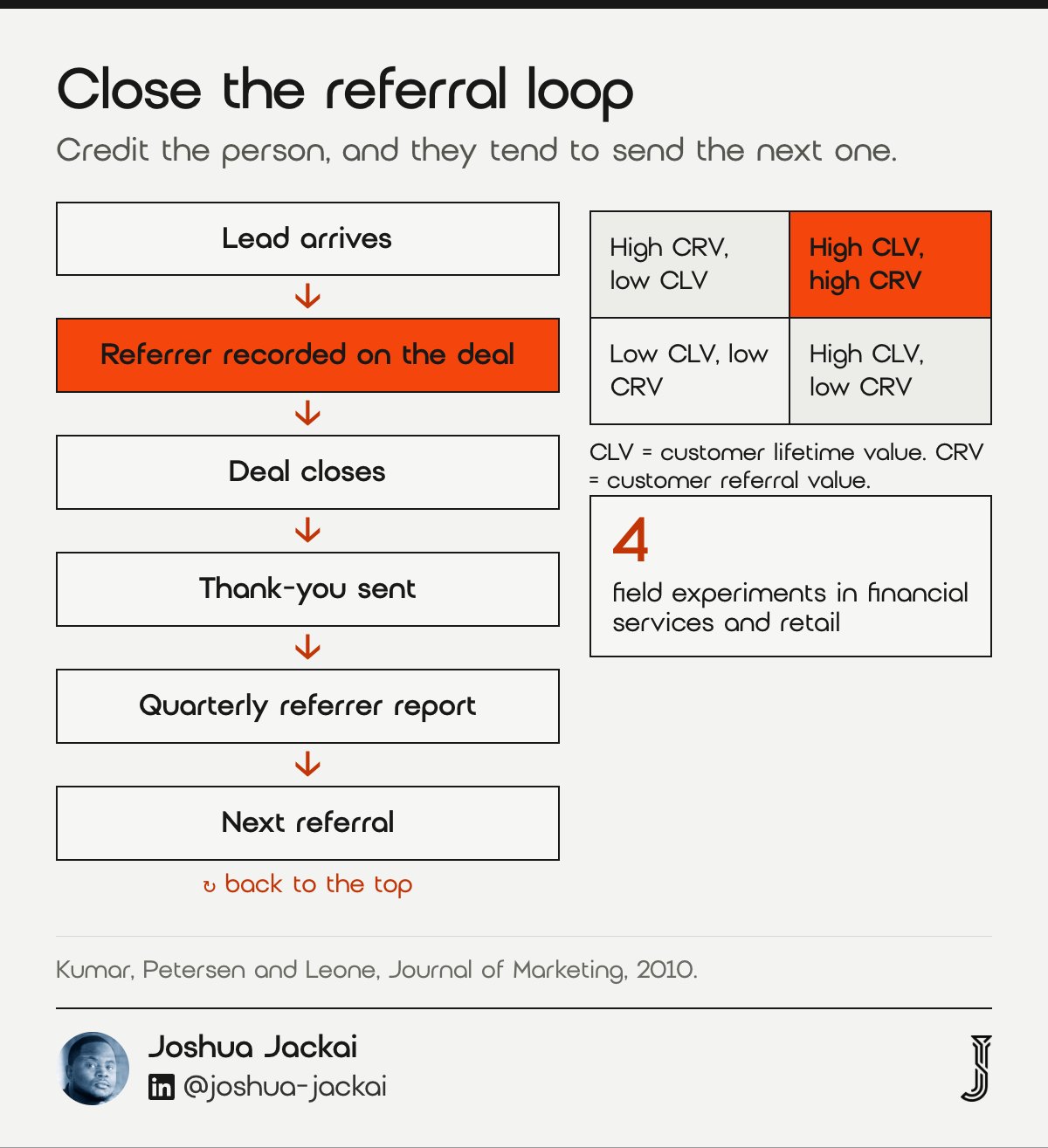
- Deal property: Referred by, a contact lookup
- Trigger: deal closed won sends a task to thank the referrer
- Report: referrers ranked by closed deals each quarter
- Study: 4 field experiments, financial services and retail
- Privacy: tell the buyer why you store the referrer’s name
A referral that nobody hears about again rarely repeats. Put a “Referred by” field on the deal that links to the referrer’s contact record, and set a task to thank them when the deal closes. Each quarter, list referrers by closed deals. V. Kumar, J. Andrew Petersen and Robert Leone built a way to compute customer referral value, ran 4 field experiments in financial services and retail, and found profitability depends on managing customers by both lifetime value and referral value. In practice, your best referrer may be a small client who has sent you three bigger ones. One Canadian detail: a referrer’s name is personal information. In BC, the Personal Information Protection Act sets notification and collection limits for private organizations, and federally the PIPEDA fair information principles apply. A short line under the form saying you use the answer to thank whoever referred them covers the purpose. This is general information, not legal advice.
“It is critical to manage customers in terms of both their CLV and CRV scores,” Kumar, Petersen and Leone wrote in the Journal of Marketing.
Compare the seven steps by what they catch
This matrix lists the seven steps with what each one catches, how much effort it takes, and its key number. Filter by the kind of lead you lose most often or by effort, and rows are hidden rather than deleted. Start with the low-effort rows: steps 1, 2 and 7 take under an hour each in HubSpot.
| Step | What it catches | Effort | Key number |
|---|---|---|---|
| 1. Ask the open question on every form | Spoken and remembered referrals | Low | Aided recall cuts omissions, Sudman and Bradburn 1973 |
| 2. Keep the answer beside the tracked source | Direct traffic and Offline sources | Low | 10 HubSpot source values |
| 3. Give partners their own link and code | Accountant, lawyer and client referrals | Medium | Referred customers worth at least 16% more |
| 4. Catch dark social and AI referrals | Links shared in messages and AI apps | Medium | Longer WOM carryover, Trusov 2009 |
| 5. Code answers into a short channel list | Free text such as “Google” or “a friend” | Medium | Nearly twice the long-term value |
| 6. Reconcile both sources every week | Disagreements between tool and buyer | Medium | Channel credit differs, Li and Kannan 2014 |
| 7. Credit the referrer on the deal | Who to thank and ask again | Low | 4 field experiments, Kumar 2010 |
Estimate how many referrals you are missing
This calculator estimates how many referral leads sit inside your Direct traffic and Offline sources counts. Enter monthly leads, the share HubSpot files as Direct or Offline, the share of those whose buyers name a person, and your average first-year deal value in CAD. The defaults are placeholders, so replace them with last quarter’s numbers.
Defaults are placeholders, not benchmarks. Replace them with last quarter’s numbers from your CRM and your form answers.
Why referral leads go missing in the first place
Referral leads go missing because attribution software records clicks and referrals start in conversation. A tool sees the visit, not the lunch, the call or the pasted link that caused it. So the fix is never one more tracking script. It is a question, a field and a weekly habit that put the buyer’s own answer next to the software’s.
I see the same four breaks on most B2B sites I audit: links that go out untagged, forms that do not pass the tags into the CRM, no record of the page the lead converted on, and no way to separate AI referral traffic from people typing the URL. Those are covered in my lead attribution case study. Referrals add a fifth: the buyer knew your name before any click happened. If your team also takes leads by phone, my guide to tracking phone calls without tracking numbers applies the same question on calls.
“The software tells you the last click it saw. The buyer tells you the reason they knew your name,” Joshua Jackai, Vancouver web designer, wrote in this guide.
Frequently asked questions
How do I track where every lead came from?
Use two sources for every lead. Let your CRM record the tracked web source automatically, and add an optional open “How did you hear about us?” field to every form, stored in its own property. Then compare the two weekly, crediting a named referrer over Direct traffic or Offline sources.
Is self-reported attribution accurate?
It is accurate about what the buyer remembers and noisy about everything else. Some answers are blank, vague or just “Google”. Memory research shows a pick list reduces forgotten answers but can shift timing, so I use open text and keep the tracked source beside it for a check.
What is the difference between HubSpot Original Traffic Source and self-reported source?
Original Traffic Source is set by HubSpot from the first web session it saw, using one of 10 values such as Direct traffic or Referrals. A self-reported source is what the buyer types in your form. The first records clicks; the second records the reason they knew your name.
Why do referral leads show as Direct traffic in HubSpot?
A referred buyer often types your address, clicks a link pasted in a private message, or opens it from an app that strips the referrer. HubSpot then sees no referring site and records Direct traffic. Contacts added by hand get Offline sources, which hides the referral too.
Should the “How did you hear about us” field be required?
I keep it optional. A required field gets more answers but more junk, such as “website” or a single letter typed to get past it. An optional open field placed last on the form gets fewer, more useful answers, and blank answers stay honest blanks in your report.
Who sets this up for you
I set up referral attribution for Canadian B2B firms from Vancouver as part of Lead Source Reporting: the form question, CRM properties, partner links, weekly coding and a one-page report built for your leadership meeting, in two weeks for CA$2,600. It works on HubSpot, Salesforce or Pipedrive.
If you want your current setup checked first, my CA$995 website audit covers every form and source property, and it is credited in full if a project starts within 30 days.
Sources
Peer reviewed
- Sudman, S. and Bradburn, N. M. (1973). Effects of time and memory factors on response in surveys. Journal of the American Statistical Association. doi.org/10.1080/01621459.1973.10481428
- Schmitt, P., Skiera, B. and Van den Bulte, C. (2011). Referral programs and customer value. Journal of Marketing. doi.org/10.1509/jm.75.1.46
- Trusov, M., Bucklin, R. E. and Pauwels, K. (2009). Effects of word-of-mouth versus traditional marketing: findings from an internet social networking site. Journal of Marketing. doi.org/10.1509/jmkg.73.5.90
- Villanueva, J., Yoo, S. and Hanssens, D. M. (2008). The impact of marketing-induced versus word-of-mouth customer acquisition on customer equity growth. Journal of Marketing Research. doi.org/10.1509/jmkr.45.1.48
- Li, H. and Kannan, P. K. (2014). Attributing conversions in a multichannel online marketing environment: an empirical model and a field experiment. Journal of Marketing Research. doi.org/10.1509/jmr.13.0050
- Berman, R. (2018). Beyond the last touch: attribution in online advertising. Marketing Science. doi.org/10.1287/mksc.2018.1104
- Kumar, V., Petersen, J. A. and Leone, R. P. (2010). Driving profitability by encouraging customer referrals: who, when, and how. Journal of Marketing. doi.org/10.1509/jmkg.74.5.001
Industry, vendor and government (not peer reviewed)
- HubSpot Knowledge Base. Understand traffic source properties, read 16 November 2026. knowledge.hubspot.com
- Province of British Columbia. Personal Information Protection Act, SBC 2003, c. 63. bclaws.gov.bc.ca
- Office of the Privacy Commissioner of Canada. PIPEDA fair information principles. priv.gc.ca