7 Ways to Track Phone Calls Without Tracking Numbers
Seven ways a Canadian firm can track phone calls while keeping its main number, ranked by what each can prove, with a calculator and the rules on recording.
 Joshua Jackai
19 min read
Published 5 November 2026 · Last updated and fact-checked November 2026
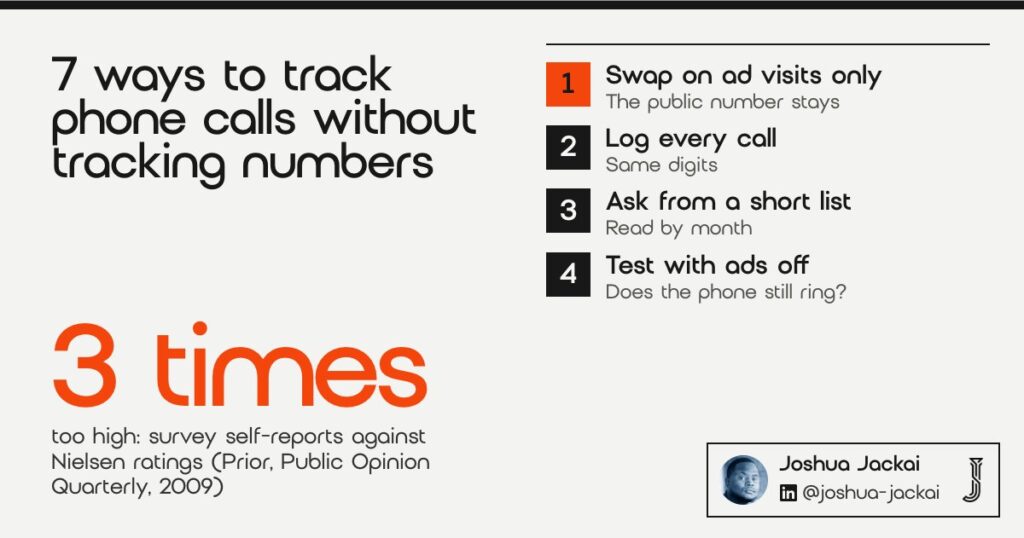
Short answer: You can track phone calls without tracking numbers on your signage or Google listing, but nothing ties one call to one click unless a number swaps somewhere. Keep the public number, swap only on ad visits, ask callers from a fixed list, and test demand with ads off. Self-reports of news viewing ran 3 times too high (Prior, 2009).
Picture an office manager at a Burnaby engineering firm picking up the phone at 10:40. The caller wants a quote. She asks how they heard about the firm. “Google, I think.” The owner has just raised the ad budget, and that one word goes into the spreadsheet as proof. Not proof. A guess, from a stranger, typed by someone with another line ringing.
Plenty of owners refuse tracking numbers for good reasons. The number is on the trucks and the proposals. Clients have it saved. Every call tracking vendor’s guide ends in the same place, which is buying numbers from that vendor. This guide ranks seven options by what each one can prove, for a Canadian B2B firm where the main number stays put.
Key takeaways
- Google forwarding numbers are listed as available in Canada, and a saved number keeps connecting for 60 days after each call.
- Survey answers overstated network news viewing by a factor of 3 on average against Nielsen (Prior, 2009), so treat “how did you hear about us” as a rough channel share.
- CallRail, a call tracking vendor, says number swapping on your own site “does not affect your NAP” (CallRail, 2025). NAP means name, address and phone.
- Across 25 large ad experiments, the median confidence interval on return ran over 100 percentage points wide (Lewis and Rao, 2015), so one quiet week proves nothing.
- Canada’s privacy regulator updated its call recording guidance on 8 October 2026, and recording for marketing has to be stated as marketing.
| # | Method | Public number changes? | What it can prove | Best for |
|---|---|---|---|---|
| 1 | Paid-only number swap | No | Which campaign drove each call | Firms spending on several ad channels |
| 2 | Google forwarding numbers | No | Which Google Ads campaign drove each call | Firms running only Google Ads |
| 3 | Port your main number | No, same digits | Every call, with no source on its own | Firms with no call log at all |
| 4 | Fixed-list source question | No | Rough channel share | Every firm, starting this week |
| 5 | Tap events matched to the call log | No | Likely source, by time window | Sites with heavy phone traffic |
| 6 | Offer word the caller quotes | No | Calls from one campaign, undercounted | Print, radio, events and direct mail |
| 7 | Ads on and off test | No | Whether ads add calls at all | Budget decisions |
In this guide
1. Paid-only number swap: best for firms spending on several ad channels
A paid-only swap shows a different number only to visitors who arrived from an ad, and only on your own website. Your Google listing, directories, trucks and proposals keep the main number. It is the one option here that names a campaign for each call, across Google, Microsoft and Meta, at a vendor’s monthly fee.
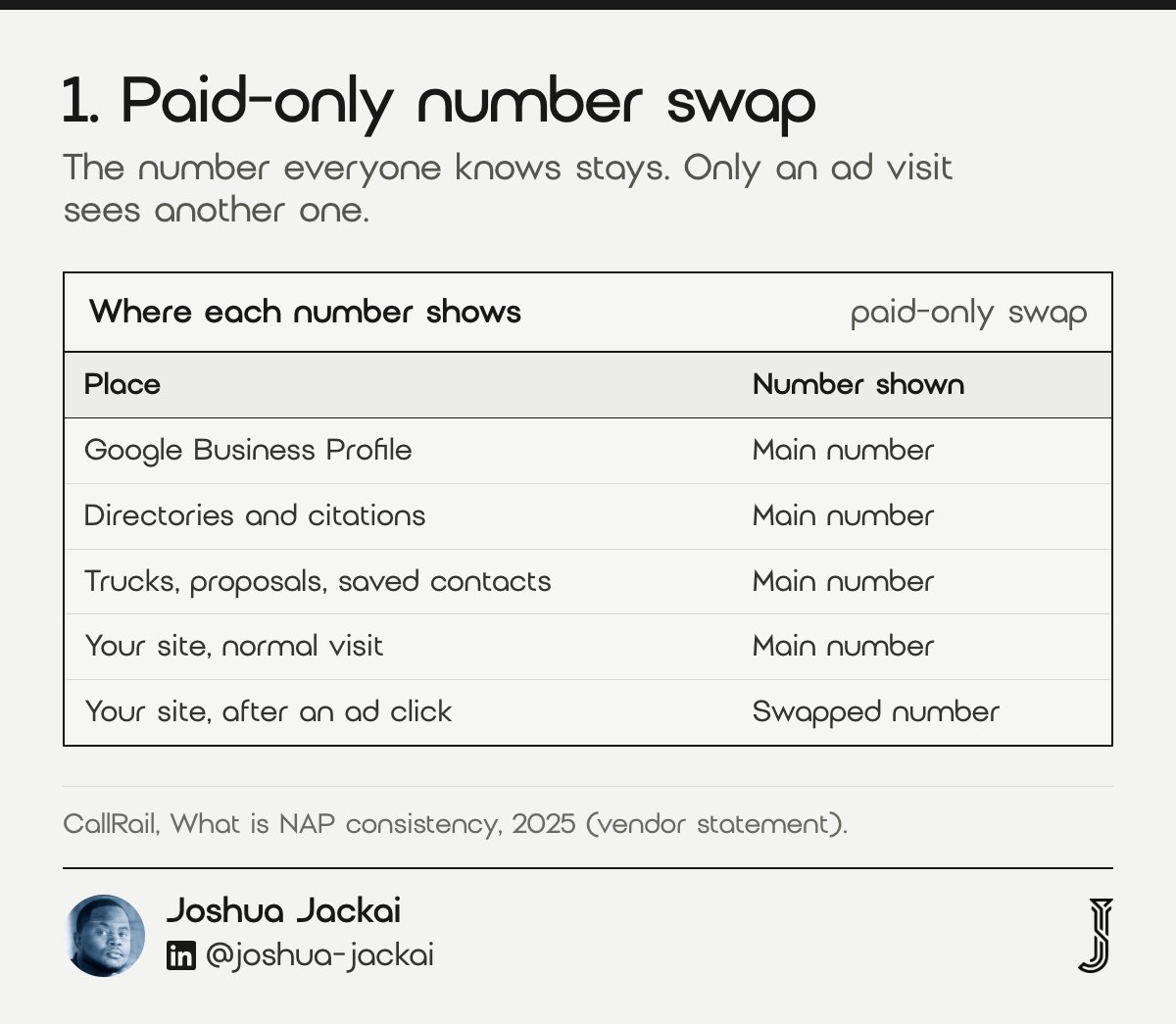
- Public number: unchanged everywhere outside the ad session
- Proves: campaign and keyword for each call
- Cost: a call tracking subscription; check the vendor’s current plan
- Setup: one script on the site, with UTM tags on every ad
- Weak spot: a client who saves the swapped number calls it later
Strictly speaking, this is a tracking number. It is on this list because the objection usually sits with the public number, and the public number never moves. An owner who says “no tracking numbers” is often picturing a fake number on the Google listing, the one thing this setup avoids.
CallRail’s own guidance says “Using DNI with website pools on your own website does not affect your NAP”, where DNI means dynamic number insertion, the script that swaps the digits (CallRail, 2025). The same post notes that Google’s crawler always sees the main line. Weigh that as a vendor statement, but the mechanism holds up: the crawler arrives without an ad click, so it gets the real number.
Set the swap condition to paid traffic only. A vendor default that swaps for every visitor adds risk and little information, because organic callers are the ones most likely to save a number for later. Keep the swapped pool small as well. A pool only has to cover the visitors on the site at the same moment, and a firm with modest traffic does not need many numbers. Ask the vendor how they size it before you pay.
2. Google forwarding numbers: best for firms running only Google Ads
A Google forwarding number sits between a Google ad and your real line, then logs duration, start time and campaign. It comes with call reporting in Google Ads, with no extra subscription. Canada is on Google’s availability list. A saved number keeps connecting for 60 days after a call, and each new call resets that window.
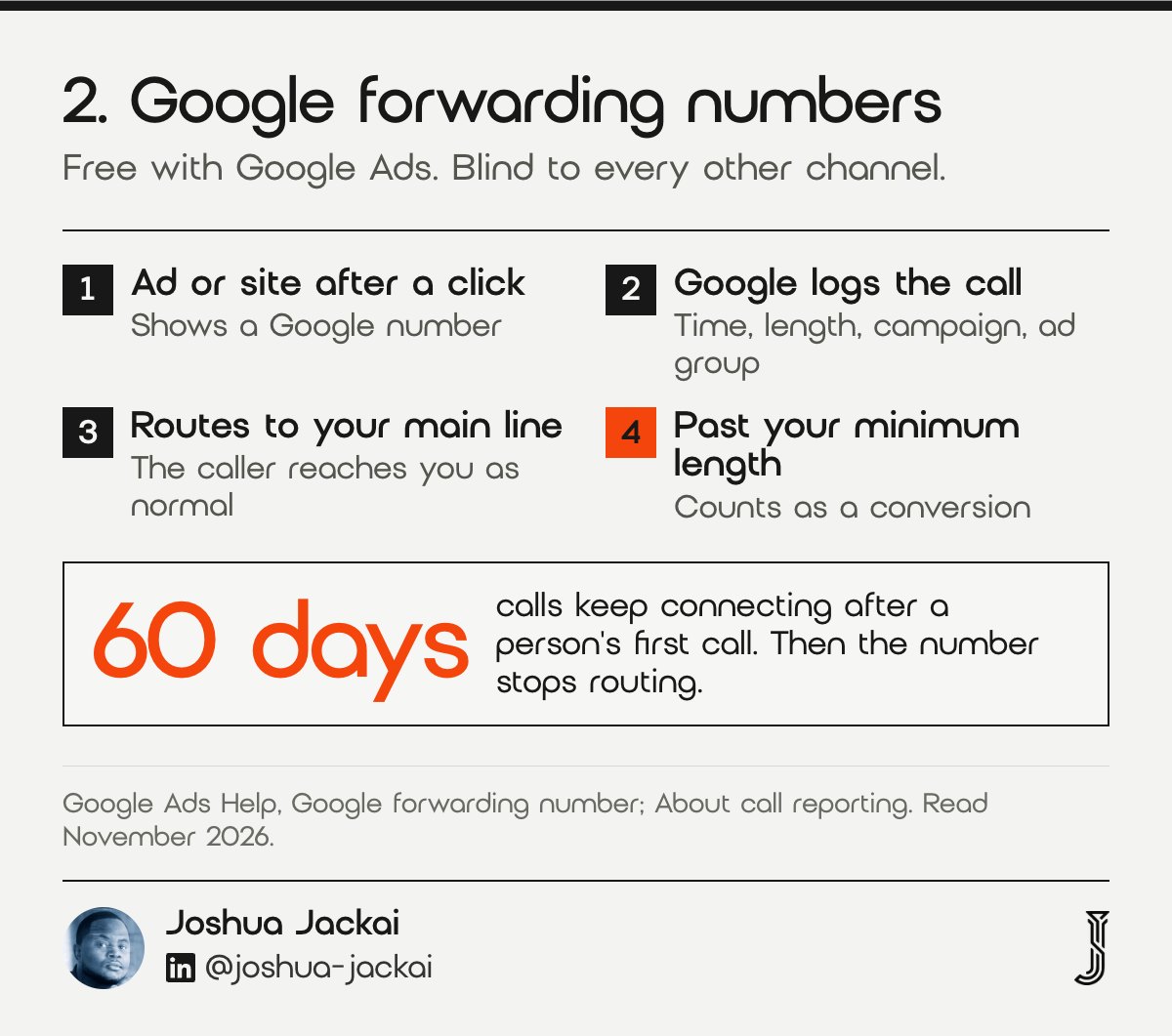
- Public number: unchanged outside Google Ads
- Proves: which campaign and ad group drove a call
- Cost: none beyond your ad spend
- Counts as a lead when: the call passes a minimum length you set
- Weak spot: Google Ads only, and the numbers belong to Google
This is where I would start for a firm with one ad channel and no appetite for another vendor. Turn on call reporting in account settings and it covers call assets, location assets and call ads. Website call conversion tracking extends it to your site, where the number swaps after an ad click.
Two limits matter. Meta, LinkedIn, organic search and email get no credit, so the report can make Google look like the only channel that rings the phone. Blake, Nosko and Tadelis ran paid search experiments at eBay and showed why that matters.
“Because search clicks and purchase intent are correlated, we show that returns from paid search are a fraction of non-experimental estimates,” wrote Thomas Blake and colleagues (Econometrica, 2015).
The second limit is the number itself. Google’s help page says the number may vary over time, and that it stops routing once the 60 days lapse with no new call. So a client who saved a forwarding number from last spring can reach a dead line. Keep the main number visible somewhere on every page, so a returning client has a line that does not expire.
3. Port your main number: best for firms with no call log at all
Porting moves your existing number into a call platform, so the digits stay the same and every call lands in a log with time, length and caller number. It gives you no source on its own. It suits a firm that cannot answer how many calls came in last month, which is the first number any method here needs.
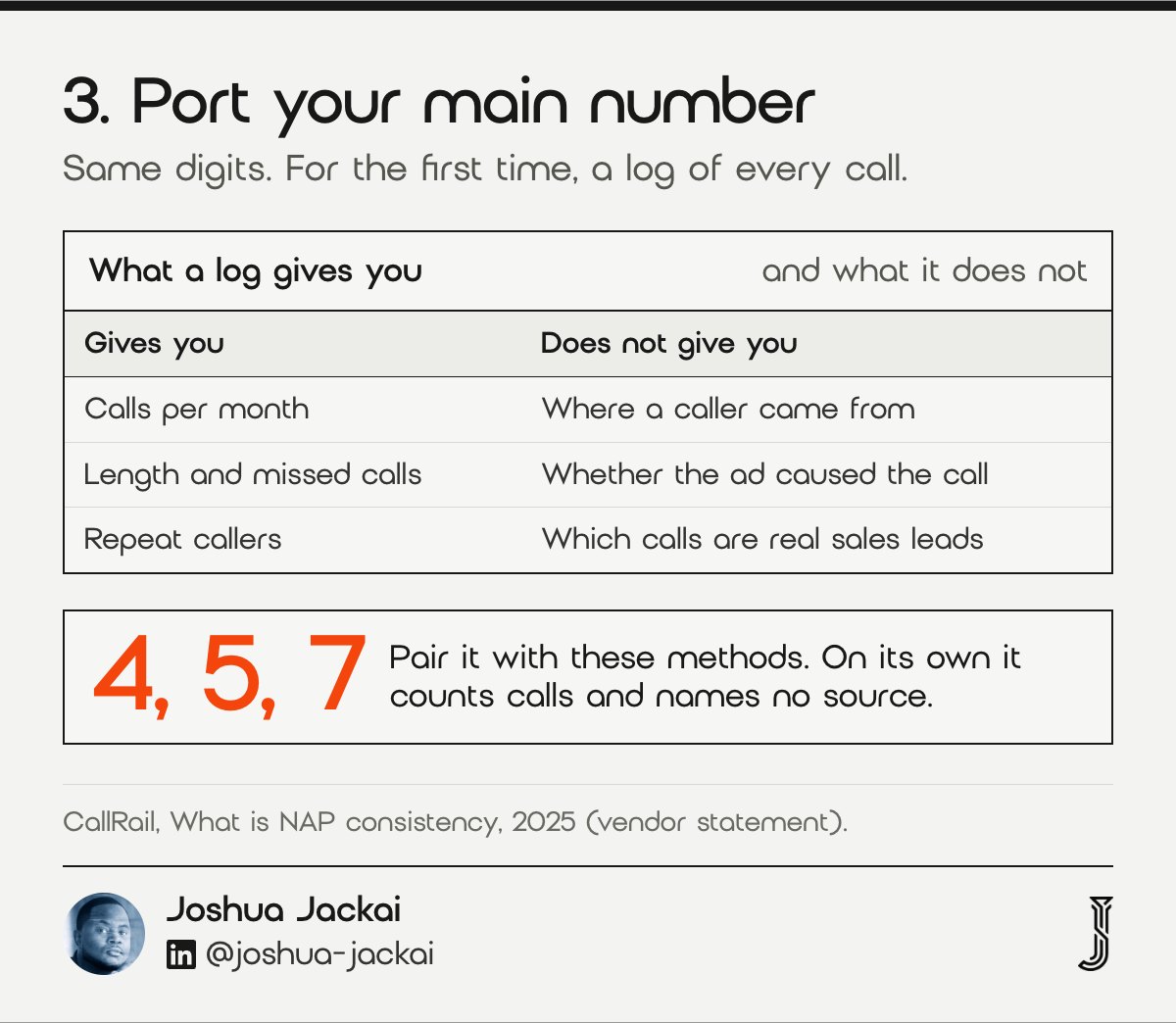
- Public number: the same digits
- Proves: call count, length, missed calls and repeat callers
- Cost: a platform subscription and a carrier transfer
- Pairs with: methods 4, 5 and 7
- Weak spot: a failed port can take your phone line down, so schedule it
“With the porting method, there’s no need to go around the web updating information on local directories,” says CallRail’s guide (CallRail, 2025). True, and also a little beside the point. Directories were never what stopped most owners. The fear is a dead line during the transfer, so ask the carrier for a date, keep the old service live until the new one rings, and avoid your busiest week.
What you get is the denominator. As an example only, a firm that logs 140 calls a month and marks 30 as sales leads has learned something an ad report cannot tell it. Sorting real leads from suppliers, wrong numbers and existing clients is the part no tool does well, and it changes the cost per lead more than the choice of platform does.
Porting also makes recording possible, and that is the moment Canadian privacy rules start to matter. Turn recording off by default. Switch it on only after you have written down the purpose in plain words, because the purpose you state limits what you may use the recording for.
4. Fixed-list source question: best for every firm, starting this week
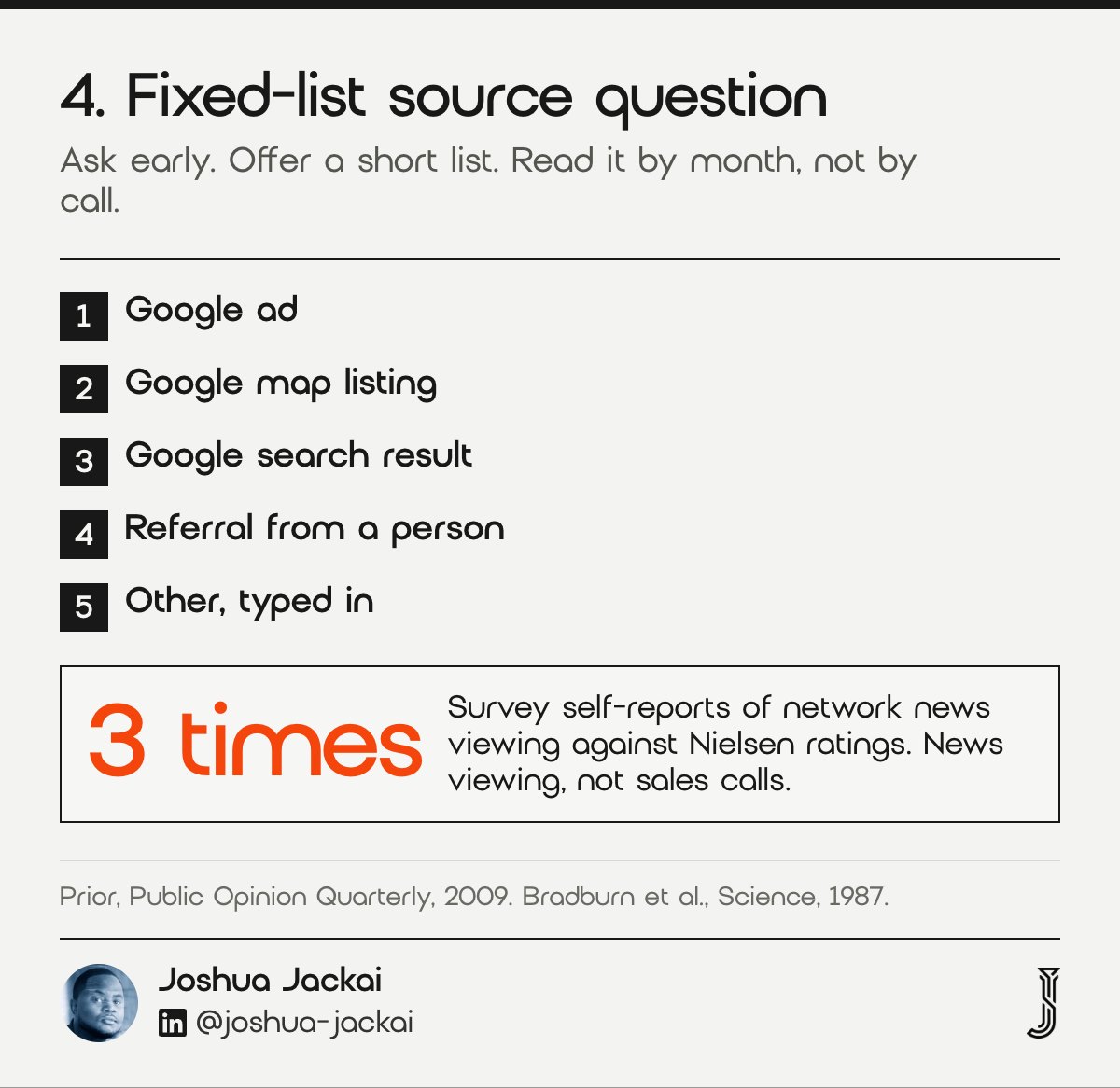
A fixed-list source question asks every new caller where they found you and records one choice from a short list in a required CRM field. It costs staff time and nothing else. It gives you a rough channel share. Treat it as direction only, because people misremember: Prior (2009) measured self-reports running 3 times too high.
- Public number: unchanged
- Proves: rough channel share, month over month
- Cost: a few seconds per call
- List length: about five choices plus “other”
- Weak spot: callers guess, and “Google” means several different things
The problem with the question is memory, and the research on it is old and consistent.
“In these situations, respondents resort to inferences that use partial information from memory to construct a numeric answer,” wrote Norman Bradburn and colleagues (Science, 1987).
The errors also lean one way, which makes them harder to average out.
“There are systematic patterns of misreporting, especially overreporting, rather than random deviations from the log files,” wrote Michael Scharkow (Communication Methods and Measures, 2016).
Neither study looked at sales calls. Prior compared survey answers about news viewing with Nielsen ratings, and Scharkow compared internet use with log files. I am applying the finding to a phone question because the mental task is the same: remember where you saw something, then say it to a stranger.
Three changes make the answer more useful. Ask in the first minute, before the quote. Split “Google” into the ad, the map listing and a search result, since callers can usually tell you what they clicked. Read the field by month, not by call. A shift from 20% to 35% for referrals tells you something even when any single answer may be wrong. The percentages here are example arithmetic, not a benchmark.
5. Tap events matched to the call log: best for sites with heavy phone traffic
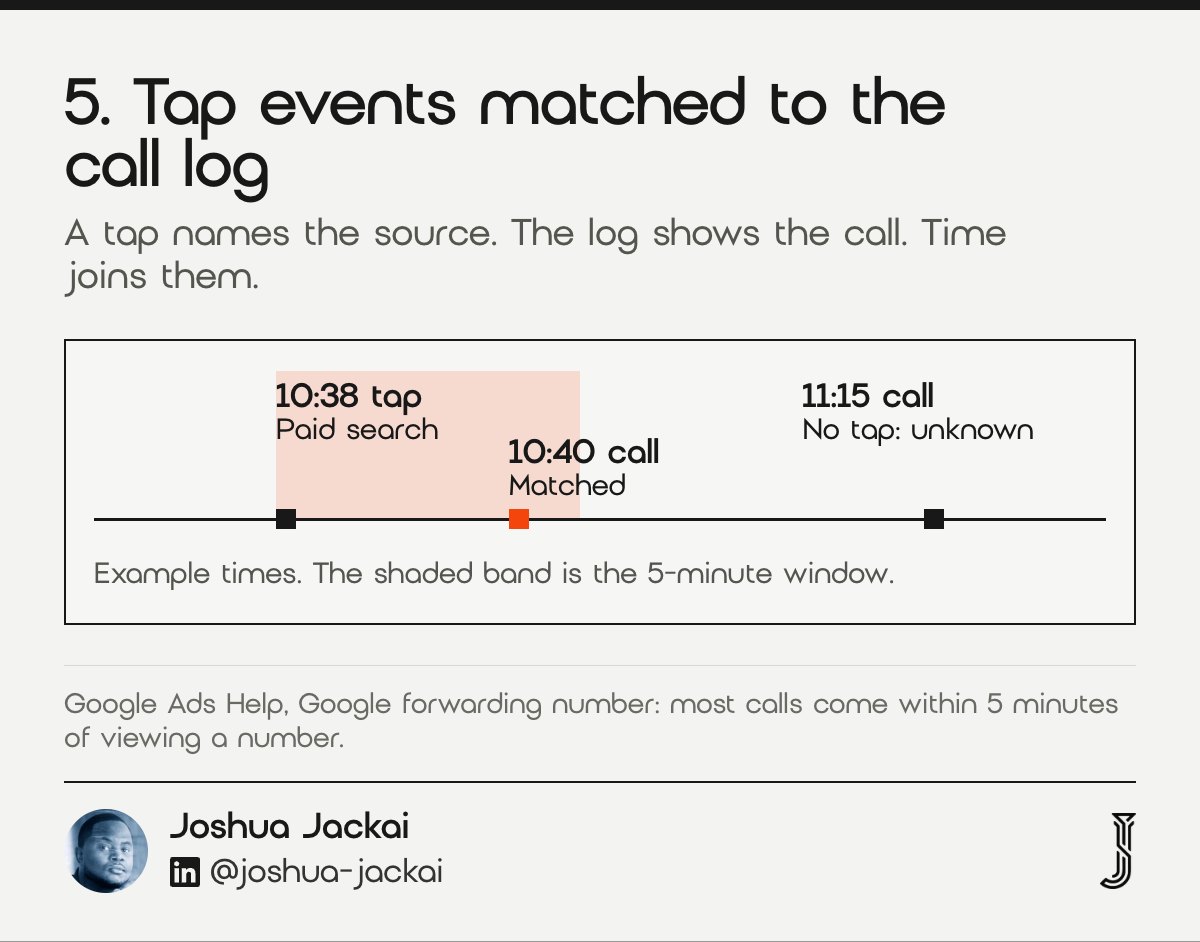
Tap matching records every tap on a phone link in analytics, with the visitor’s source, then lines those taps up against your call log by time. Nothing on the page changes. The match is only probable. Google’s help page says “the vast majority of calls happen within 5 minutes” of viewing a forwarding number, and I apply that window here.
- Public number: unchanged
- Proves: likely source for calls that started on the site
- Cost: an analytics event and an hour or two of setup
- Window: about 5 minutes, per Google’s timing note
- Weak spot: desktop readers dial by hand, so no tap gets logged
This uses what Google’s forwarding number page reports about timing, without the forwarding number. On a phone link, the tap fires an event in Google Analytics 4 with the session source. Your log from method 3 holds the call time. Export both once a month and match them in a spreadsheet: any call within 5 minutes after a tap gets that tap’s source, and everything else stays marked unknown.
Leave it marked unknown. The temptation is to spread those calls across channels in proportion, which puts false precision on the part you did not measure. A tap is also not a call. Some people tap, see the dialler and back out, so the tap count alone overstates demand. That is why I would never report it without the log beside it. Calls that started from a printed proposal or a saved contact will never match, and that is correct, because no website session produced them.
B2B buying crosses channels anyway, which is the other reason to report this as likely, not exact.
“We find evidence of many cross-channel effects, in particular, off-line marketing effects on online funnel metrics and online funnel metrics on off-line purchases,” wrote Thorsten Wiesel and colleagues (Marketing Science, 2010).
That study followed Inofec, a small business-to-business firm, so the setting is closer to a Canadian B2B firm than most ad research. For more on the analytics half of this setup, see my guide to GA4 lead tracking.
6. Offer word the caller quotes: best for print, radio, events and direct mail
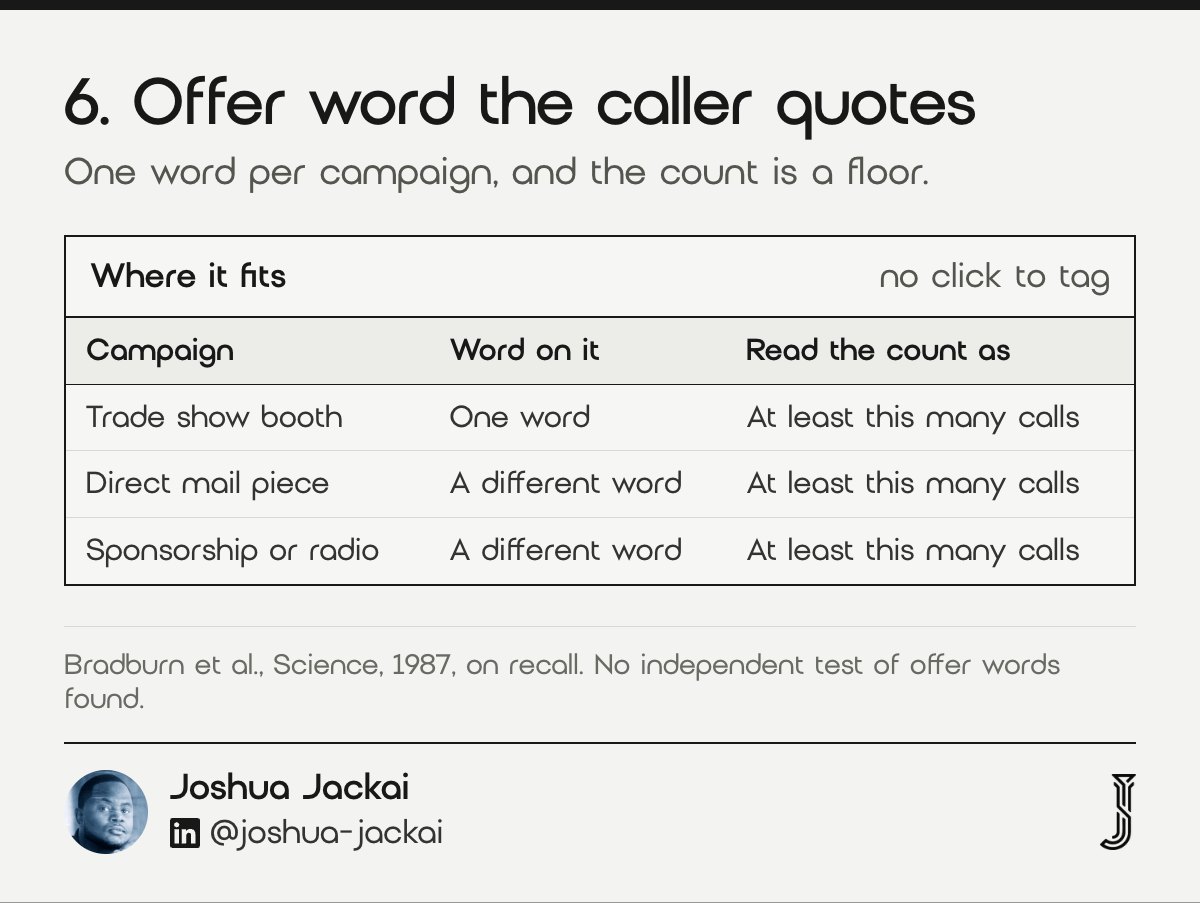
An offer word is a phrase printed on one campaign that a caller must say to claim something: a free site review, a priority slot, a printed guide. It needs no technology and works where no click exists. It undercounts by design, since only people who remember the word and want the offer will say it.
- Public number: unchanged
- Proves: at least this many calls came from this campaign
- Cost: the offer itself
- One word per campaign: a trade show booth and a mailer never share one
- Weak spot: the count is a floor, never a total
This is the oldest method on the list, and it still covers the one gap the others leave. A conference booth, a sponsorship or a mailer has no click to tag, so methods 1, 2 and 5 cannot see it. Read the count as a floor. Twelve people quoting the word means at least twelve calls, and possibly many more who rang without mentioning it.
Memory limits this method too. Bradburn, Rips and Shevell (1987) showed people struggle to recall specific past events when asked, so a word seen 3 weeks ago may be gone by the time someone dials. Keep the word short and easy to spell over a phone line, and keep the offer worth the small effort of saying it. An offer nobody wants produces a count of zero and tells you nothing about the campaign. Words tend to outlive their campaigns as well, so put an end date in the printed copy. Log every word in the same CRM field as method 4, as its own choice, so the two sets of numbers stay in one report.
This method suits low-volume, high-value B2B work, where a dozen conversations may justify a sponsorship. It is a poor fit for high-volume consumer lines, where staff will not ask and callers will not say it. I would run it alongside the source question, never in place of it, because the source question covers every other caller.
7. Ads on and off test: best for budget decisions
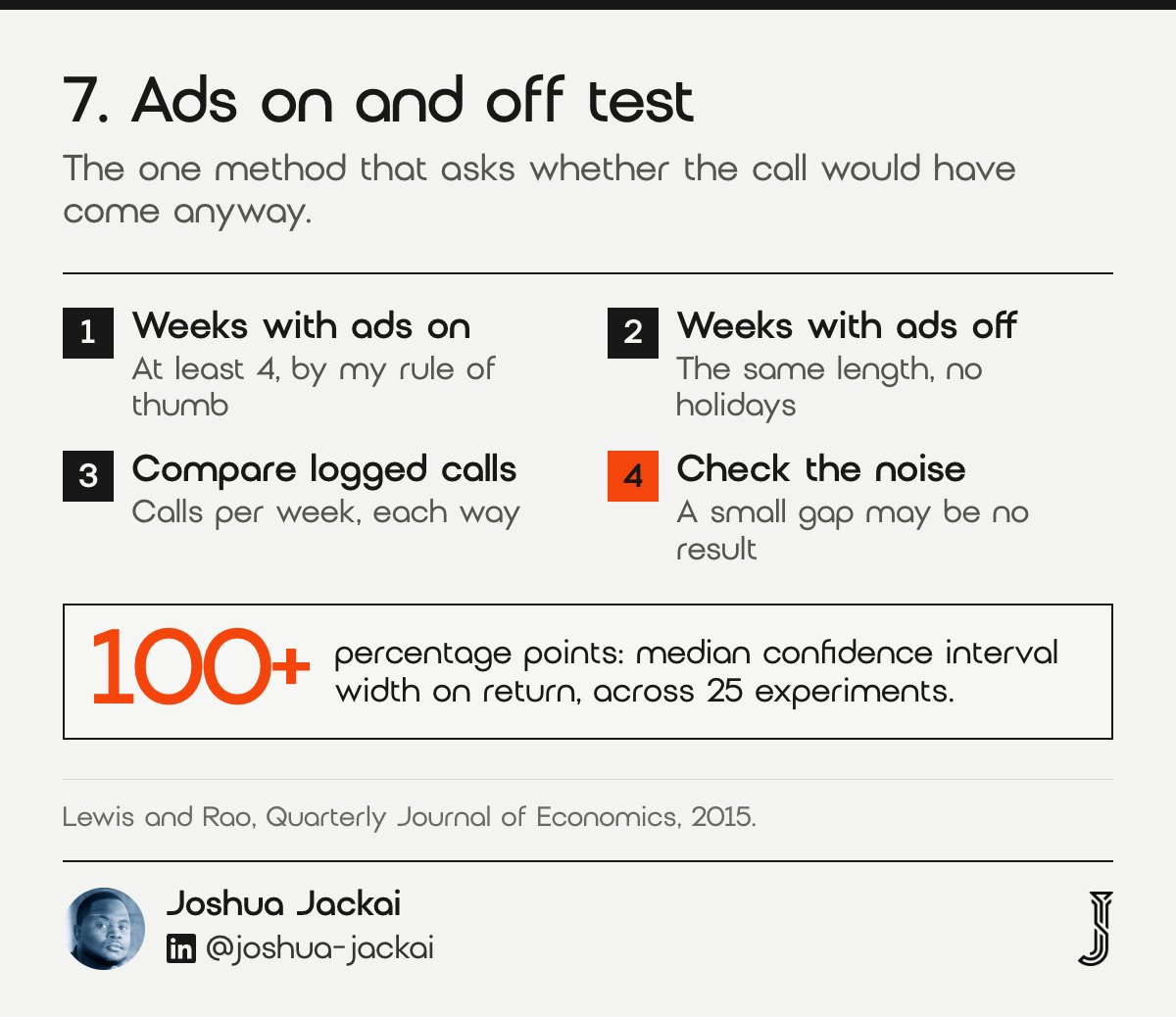
An on and off test runs ads in some weeks or regions and pauses them in others, then compares logged calls. It is the only method here that asks whether ads add calls, not which channel gets credit. It needs a call log and patience. Lewis and Rao (2015) found over 100 percentage points of median uncertainty on return.
- Public number: unchanged
- Proves: extra calls that happened because ads ran
- Cost: the sales you might lose while ads are paused
- Run it: at least 4 weeks each way, avoiding holidays
- Weak spot: seasons and small counts blur the result
Every other method on this list tells you who gets credit for a call. None of them tells you whether the call would have come anyway. A firm’s own name in search is the clearest case: Blake, Nosko and Tadelis found brand keyword ads had no measurable short-term benefit at eBay. eBay is not a Canadian engineering firm, and your brand terms may behave differently. That is the reason to test instead of assuming.
“Observational methods often fail to accurately recover the treatment effects generated from randomized advertising experiments on Facebook,” wrote Brett Gordon and colleagues (Marketing Science, 2019).
Be honest about what a small firm can see. Lewis and Rao (2015) needed millions of customers and still found noisy answers. A firm logging 30 calls a week can detect a big effect and will miss a small one. That is still useful. If pausing ads for a month changes nothing you can see, you have grounds to cut the budget or rebuild the campaign. Pause only the part you doubt, such as brand search, and leave the rest running so the test costs less.
“The median confidence interval on return on investment is over 100 percentage points wide,” wrote Randall Lewis and Justin Rao (The Quarterly Journal of Economics, 2015).
Compare the seven methods
The matrix sets all seven methods against what each can prove, what it costs and whether staff have to do anything on the call. Filter by the question you need answered. In the table, “campaign” means a named ad campaign, “channel” means a broad source such as search or referral, and “lift” means extra calls.
| Method | Proves | Staff effort on the call | Cost type | Evidence |
|---|---|---|---|---|
| Paid-only number swap | Campaign, per call | None | Vendor subscription | CallRail, 2025 (vendor) |
| Google forwarding numbers | Google Ads campaign, per call | None | None beyond ad spend | Google Ads Help (vendor) |
| Port your main number | Call count and length, no source | None | Platform subscription | CallRail, 2025 (vendor) |
| Fixed-list source question | Rough channel share | A few seconds per call | Staff time | Prior, 2009; Bradburn et al., 1987; Scharkow, 2016 |
| Tap events matched to the call log | Likely source, by time window | None | Setup hours and monthly matching | Google Ads Help (vendor); Wiesel et al., 2010 |
| Offer word the caller quotes | A floor for one campaign | Listen for the word and log it | The offer | No independent test found |
| Ads on and off test | Extra calls caused by ads | None | Possible lost sales while paused | Lewis and Rao, 2015; Blake et al., 2015; Gordon et al., 2019 |
None of the seven changes the number on your Google listing, signage or proposals.
Calculate your ads on and off result
The calculator compares calls per week with ads on and off, then gives extra calls, cost per extra call and cost per extra client. It uses only your numbers, plus a standard count-data check for noise. Defaults are placeholders. Change every one before you read the result, because they describe no real firm.
Defaults are placeholders, not benchmarks. Enter your own numbers.
The noise check treats weekly calls as simple counts and flags any difference smaller than about two standard errors. It is a rough screen, not a formal study, and it does not correct for seasons.
What Canadian rules say about recording calls for marketing
Canadian call recording rules turn on consent and purpose. The Criminal Code allows interception with one party’s consent, but PIPEDA, the federal private sector privacy law, asks more of a business. You must tell callers you are recording and why, and a marketing purpose has to be stated as marketing.
The floor comes from section 184 of the Criminal Code, which does not apply to a person with the consent, express or implied, of one party to the call. Privacy law sits on top of that, and that is where most firms trip. In the Office of the Privacy Commissioner’s words:
“The organization must inform the customer that they are recording a call, clearly state the purpose of the recording and obtain consent,” wrote the Office of the Privacy Commissioner of Canada (Recording of Customer Telephone Calls).
The sentence after that is the one marketers need, because the usual line on hold no longer covers them.
“An organization should not state that it is recording the conversation for security or quality assurance purposes if the recording will be used for marketing,” wrote the Office of the Privacy Commissioner of Canada (Recording of Customer Telephone Calls).
So “for quality and training” does not stretch to reviewing calls to judge which ads work. If lead review is the plan, say so in the greeting. The same guidance says callers must get a choice about being recorded when recording is not integral to the service, such as continuing unrecorded. Implied consent usually holds when someone stays on the line knowing what is happening and why. Voiceprints may need express consent.
The Commissioner’s guidance is written for businesses under PIPEDA and described as best practice for others. Alberta, British Columbia and Quebec have their own private sector laws deemed substantially similar, and which law applies is decided case by case. A BC firm’s answer may run through the Personal Information Protection Act. I am a web designer, not a lawyer. Have counsel read your greeting before you switch recording on.
The simplest fix is to not record. Methods 1, 2, 4, 5, 6 and 7 all work with recording off, and a call log holds far less personal information than a voice file.
Questions about tracking phone calls without tracking numbers
These are the questions owners and marketing leads ask when a call tracking pitch meets a firm that refuses to change its number. Each answer stands on its own, with the Canadian position where it differs. Where the evidence comes from a vendor, the answer says so, because independent testing on this topic is thin.
Can you track phone calls without call tracking numbers?
Partly. You can log every call, ask callers where they found you, match website taps to call times and test ads on and off. None of those ties one call to one click. That link needs a number that swaps somewhere, even if only for ad visitors.
Do call tracking numbers hurt local SEO?
They can if different numbers appear across directories and listings. CallRail, a vendor, advises against unique numbers per directory and says swapping on your own site leaves NAP untouched. I found no independent study measuring ranking effects, so keep the main number on listings and swap only on paid sessions.
Is “how did you hear about us” accurate enough?
For channel share by month, yes. For single calls, no. Self-reports overstated news viewing by a factor of 3 in Prior’s 2009 study, which did not test calls. Use a short fixed list, ask early, split Google into ads, maps and search, and read trends instead of individual answers.
Do I need consent to track calls in Canada?
Only if you record. Logging that a call happened differs from recording its content. To record, PIPEDA guidance says tell the caller you are recording, state the purpose and obtain consent. If recordings serve marketing, say marketing. BC, Alberta and Quebec have their own laws.
How long should an ads on and off test run?
Run at least 4 weeks each way, my rule of thumb and not a published figure, and avoid holidays. Longer is better at low call volume, since few calls can only reveal large effects. Pause the spend you doubt most, such as brand search.
How I set this up for Canadian firms
I would start with a log and a source field, because neither touches the public number, then add the paid-only swap if ads justify it. Lead source reporting with me is CA$2,600, two weeks from kickoff, on the Jackai Agency price table, November 2026. It covers forms, source tracking and your CRM.
I do not have a published client study on phone attribution, so nothing above rests on a result of mine. Phone setups vary by carrier and by firm, and I scope the call part on the first conversation. The lead source reporting service page lists what is included, and the website lead tracking guide for Canada covers the form side.
If you want a second opinion first, the CA$995 website audit looks at how leads reach you now, and the fee is credited if a project starts within 30 days.
Sources
Peer-reviewed
- Blake, T., Nosko, C. and Tadelis, S. (2015). Consumer Heterogeneity and Paid Search Effectiveness: A Large-Scale Field Experiment. Econometrica. doi.org/10.3982/ECTA12423
- Bradburn, N. M., Rips, L. J. and Shevell, S. K. (1987). Answering Autobiographical Questions: The Impact of Memory and Inference on Surveys. Science. doi.org/10.1126/science.3563494
- Gordon, B. R., Zettelmeyer, F., Bhargava, N. and Chapsky, D. (2019). A Comparison of Approaches to Advertising Measurement: Evidence from Big Field Experiments at Facebook. Marketing Science. doi.org/10.1287/mksc.2018.1135
- Lewis, R. A. and Rao, J. M. (2015). The Unfavorable Economics of Measuring the Returns to Advertising. The Quarterly Journal of Economics. doi.org/10.1093/qje/qjv023
- Prior, M. (2009). The Immensely Inflated News Audience: Assessing Bias in Self-Reported News Exposure. Public Opinion Quarterly. doi.org/10.1093/poq/nfp002
- Scharkow, M. (2016). The Accuracy of Self-Reported Internet Use: A Validation Study Using Client Log Data. Communication Methods and Measures. doi.org/10.1080/19312458.2015.1118446
- Wiesel, T., Pauwels, K. H. and Arts, J. W. C. (2010). Marketing’s Profit Impact: Quantifying Online and Off-line Funnel Progression. Marketing Science. doi.org/10.1287/mksc.1100.0612
Government, industry and vendor
- Office of the Privacy Commissioner of Canada. Recording of Customer Telephone Calls, read November 2026.
- Office of the Privacy Commissioner of Canada. News release on call recording guidance, 8 October 2026.
- Office of the Privacy Commissioner of Canada. Provincial laws that may apply instead of PIPEDA, read November 2026.
- BC Laws. Personal Information Protection Act, read November 2026.
- Justice Canada. Criminal Code, section 184, read November 2026.
- Google Ads Help (vendor). Google forwarding number, About call reporting and website call conversions, read November 2026.
- CallRail (vendor). What is NAP consistency?, 1 October 2025.
- Jackai Agency price table, November 2026 (first-party).