How Does a Service Business Get Recommended by ChatGPT?
What decides whether ChatGPT names your firm when a buyer asks who to hire, which parts you control, and how to check where you stand today.
 Joshua Jackai
14 min read
Joshua Jackai
14 min read
A finance director in Seattle has a contract dispute and a board meeting on Thursday. She opens ChatGPT and asks which commercial litigation firms work with software companies her size. Three names come back. Yours is not one of them. Being recommended by ChatGPT is not a ranking you buy or a setting you switch on. It comes from what the model learned, what it finds when it searches, and what other people have written about you.
She will not scroll to a second page. There is no second page. She opens two of the three websites, reads for a minute, and books a call. The firm that was not named never learns the decision happened.
This post covers what decides who gets named, which parts you control, and how to check where you stand. I do this work for B2B and professional-service firms at Jackai Agency in Vancouver, and the honest version starts with a limit: nobody can promise you a place in the answer.
In this guide
What does it mean to be recommended by ChatGPT?
A recommendation answer is a short list of named businesses given in reply to a buying question, such as who to hire for a job or which firm suits a company like yours. ChatGPT and other AI assistants build that list in one of two ways, and each way needs different work from you.
The first is memory: a language model stores facts from the text it was trained on and can recall them when asked (Petroni et al., 2019). The catch is popularity, because models recall well-known names far better than less-known ones (Mallen et al., 2023).
A test of 16 public models found the same weak spot for “tail” entities that few people write about, which is where a typical 40-person firm sits (Sun et al., 2024).
The second way is search: when ChatGPT runs a live web search, it reads pages and writes an answer with links to its sources. Retrieval helps most with exactly the less-known names that memory handles badly (Mallen et al., 2023). This is the path you can work on this quarter, because it depends on pages that exist today.
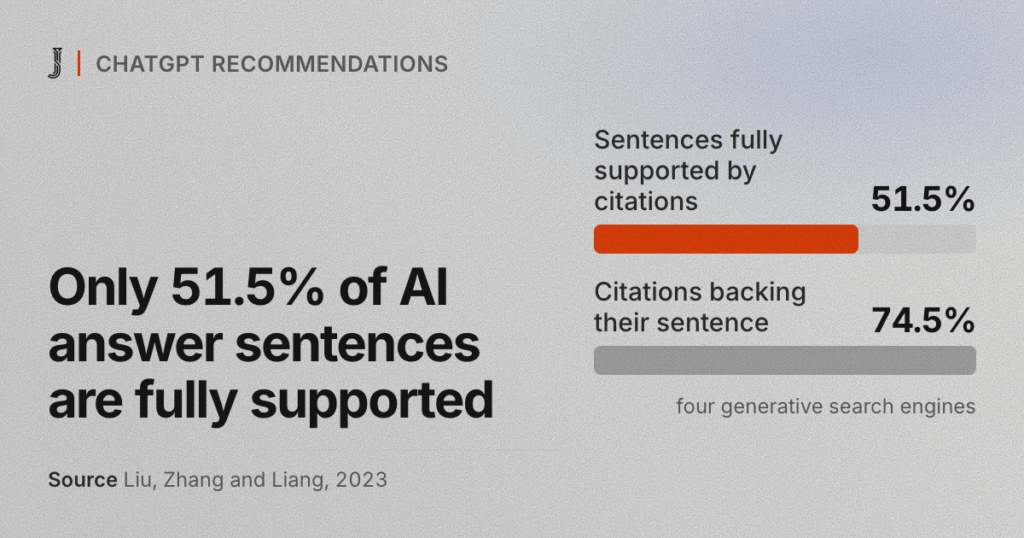
Search answers have flaws too. In an audit of four generative search engines, only 51.5% of generated sentences were fully supported by their citations, and 74.5% of citations backed the sentence they were attached to (Liu, Zhang and Liang, 2023). Being recommended by ChatGPT with the wrong service attached is a real risk, and I cover it below.

Why does ChatGPT name a competitor instead of you?
It is rarely the quality of the work, because AI assistants never saw the work. They saw text about it, and your competitor has more of that text, in more places, saying plainer things.
In my own testing, the firms recommended by ChatGPT for a category usually share three traits. They have more brand mentions, meaning other sites name them next to their service and city. Their own pages say what they do, for whom and where, in the first lines, and they have profiles on the directories and review sites the engines cite for that category. That is a pattern from my client work, not a published study.
The research backs one piece of it. When language models choose between web pages that disagree, they lean heavily on how relevant a page is to the question and largely ignore what people find persuasive, such as references or a neutral tone (Wan, Wallace and Klein, 2024). A plain page about litigation for software companies in Seattle matches the finance director’s question, and a polished About page does not.
Then there is chance: a study of ChatGPT on 829 coding problems found the same prompt often returned different code, and setting the randomness control to zero reduced the variation without removing it (Ouyang et al., 2025). That test was code, not recommendations, but the lesson carries over: one screenshot proves very little.
What can you control, and what can you not?
Split the problem in two before you spend anything on being recommended by ChatGPT. The top half of this table is work you can schedule. The bottom half is weather.
| Factor | Your control | What to do about it |
|---|---|---|
| Facts on your own website | Full | State service, buyer, location and credential near the top of each service page |
| Structured data | Full | Schema.org markup for the business, services and people, matching the page text |
| Directory and profile listings | Most | Claim them, fill every field, keep the name and service list identical |
| Third-party reviews | Partial | Ask every finished client; never write or buy them |
| Brand mentions in press, podcasts and associations | Partial | Pitch, speak and contribute; nobody has to write about you |
| What the model learned in training | None | Wait; release cycles belong to the vendor |
| Whether ChatGPT searches for a question | None | Prepare for both paths |
| The wording and order of one answer | None | Measure many runs, not one |
| Which competitors appear beside you | None | Track them; do not copy them |
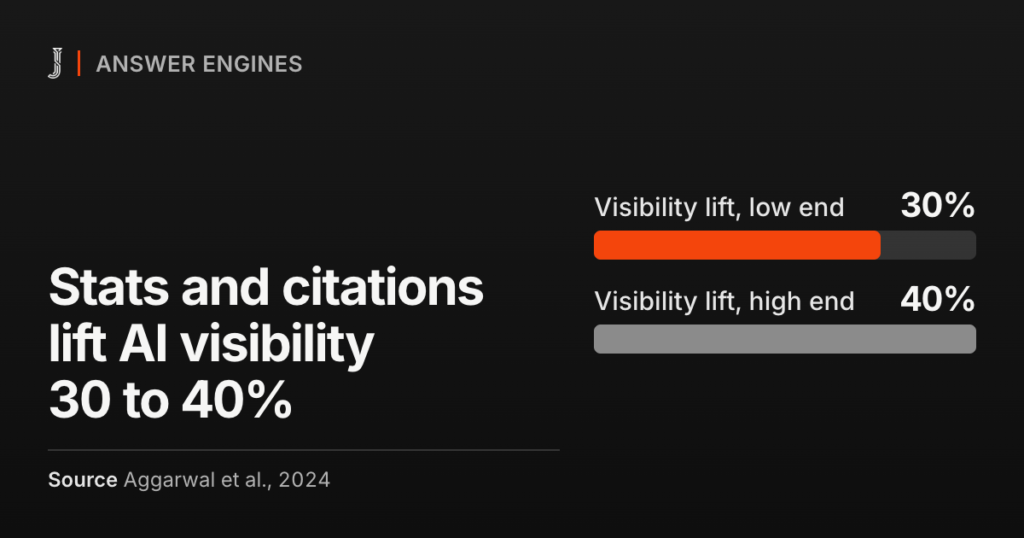
The researchers who named generative engine optimization put it bluntly: content creators have “little to no control” over when and how their content is shown (Aggarwal et al., 2024). Their tests still found visibility gains of up to 40% from changing the content itself, and the gains varied by subject. The levers are small and the effect is real, but nobody gets a guarantee.
On structured data: Bing, Google and Yahoo created Schema.org in 2011, later joined by Yandex, as one shared vocabulary for describing people, places, products and offers in a form machines read (Guha, Brickley and Macbeth, 2016). It does not make a claim true, but it makes a true claim easier to read.

Is your own site giving AI assistants facts they can use?
Start with the part you own. Most service sites I audit are written for a reader who already knows the firm, and AI assistants are not that reader: they arrive with a question and leave with whatever they can lift from the page.
W Communications, a Seattle strategic communications and speaking practice on WordPress, is the clearest example from my own work. Four audiences arrived at one homepage: media, clients, event bookers and readers. All four got the same opening paragraph, and the proof sat below the fold.
The case study names the problem in one line. Nothing on the site was structured so that a producer, or a machine answering a question about the practice, could lift a fact out of it and use it without asking a person first. The strongest credential, former Starbucks senior vice president, sat under several paragraphs of narrative. The topics of expertise were implied in prose, never listed.
The rebuild ran to 8 pages across those 4 audiences, each with its own path from the homepage. The biography page now leads with the credential, and the expertise page has one topic per section, each quotable on its own.
Here is the constraint. No analytics survived the rebuild, so the W Communications case study carries no number, and I will not claim the practice is now recommended by ChatGPT. What changed is narrower and easier to check: the facts exist in a form a producer or a machine can use.
Run the same test on your main service page: open it on a phone and look only at the first screen. Can a stranger copy these five facts without scrolling?
- What you do, in the words a buyer would use.
- Who it is for, by industry, company size or situation.
- Where you work, including cities you serve remotely.
- Why you are safe, meaning the one credential or result that carries the most weight.
- How to reach someone, with a person’s name, not only a form.
If any of the five is missing, that is the first fix, and it costs an afternoon of writing.
How do brand mentions on other sites change the answer?
Brand mentions are pages you do not own that name your firm, and they matter on both paths. Memory comes from training text, and names few pages discuss are recalled worst (Mallen et al., 2023; Sun et al., 2024). In search mode, the engine pulls pages that match the question, so a trade article on SaaS finance leads in Calgary that names you is a closer match than your homepage.
Not all brand mentions help equally. “Thanks to our friends at [your firm]” tells an engine almost nothing. “[Your firm], a Vancouver employment law practice for tech companies, led the session” gives it a name, a service, a buyer and a city. When you have a say in how you are described, ask for the second version.
Places a professional-service firm can earn brand mentions without paying:
- Association member directories, filled in completely.
- Client partner pages that list outside firms.
- Podcast show notes, which usually name the guest’s firm and role.
- Conference speaker pages, which describe your expertise in someone else’s words.
- Trade publication articles, written by you or quoting you.
Use one form of the firm name everywhere. “Smith and Partners”, “Smith & Partners LLP” and “Smith Partners” look like one firm to you, but to a system matching text they can look like three. That rule comes from my own projects, not from a study.
This is the slow lever: a mention published this month may take a long time to reach a model’s memory, and some never will. Keep earning brand mentions anyway, because the same pages send calls from people who read them, whether or not you end up recommended by ChatGPT.
Do third-party reviews affect whether you get recommended by ChatGPT?
Third-party reviews move human buyers first. In the classic study of online book reviews, better reviews led to higher relative sales on that site, and review length showed that customers read the text, not only the stars (Chevalier and Mayzlin, 2006). Books are not consulting work, but the reading habit carries over.
For AI assistants, the evidence is thinner: when I record answers to “who should I hire” questions, the cited sources often include directory and profile listings, the same places reviews live, not only the firms’ own sites. That is an observation from my work, not a published finding, and it is why my six-week engagement includes preparing the listings the engines cite most in a client’s category.
What makes third-party reviews useful to readers and machines is the text inside them. “Great to work with!” gives an engine nothing to match. A review that says what you did, for what kind of company, and what changed gives it a service, a buyer and an outcome.
- Ask at the handover, while the result is fresh.
- Send one direct link to the review form.
- Suggest what to mention: the service, their industry and one thing that changed. Never write it for them.
- Pick two platforms, your Google Business Profile and the one directory your buyers use most.
- Reply to every review in plain words that restate the service you delivered.
Third-party reviews alone will not get a firm recommended by ChatGPT. They do say, in words you did not write, what your own site can only claim.

How do you check whether you are recommended by ChatGPT?
Do not trust a single screenshot, yours or a vendor’s. Whether you are recommended by ChatGPT can change between runs, so build a small test you can repeat next month and compare like with like.
- Write 10 to 15 buyer questions from sales calls and enquiry emails, not from your keyword list. Mix category plus city, problem-first questions and “alternatives to” a named competitor.
- Use a clean session, such as a temporary chat, so past conversations do not tilt the answer.
- Run each question three times and note which names appear every time and which come and go.
- Record the answer word for word: who was named, in what order, which sources were cited, and what was said about you.
- Click the citations and check that each one says what the answer claims.
- Date the file and repeat it monthly with the same questions.
Repeat the set in the other AI assistants your buyers use, which usually means Claude and Google’s AI Overviews. A firm named in one engine and missing from another can point you to a source one engine found and the other did not.
What if ChatGPT gets your firm wrong?
Sometimes AI assistants name you with an old address, a service you dropped, or facts from a firm with a similar name, and the citation gaps in the Liu study mean you should expect it now and then. Being recommended by ChatGPT for the wrong thing still costs you. Click the cited source, fix the stale profile or old page it points to, and re-run the question next month.
Can you see AI referrals in your analytics?
Without setup, a visit sent by AI assistants can land in your analytics as “direct”, next to people who typed your URL. My lead attribution method fixes four links in the chain: tag every link you control, carry those tags through the form into the CRM, record the page each lead converted on, and separate AI referral traffic from direct.
AI tools that pass a referrer get their own channel, and those that do not are inferred from the landing page and session pattern, then reported as probable rather than certain. Setting it up takes about two weeks and needs no design change.
For the full order I run this in, from the baseline to the week-six re-test, see my nine AI visibility optimization steps. If you are comparing agencies that sell this as GEO or AEO, my seven checks for a GEO or AEO agency list what to ask.
What does this cost, and how long before anything moves?
You can do most of this in-house: the question test takes an afternoon a month, the site facts take a few days, and third-party reviews and brand mentions take steady effort over months. If you want help, these are Jackai Agency prices in US dollars, with Canadian dollars beside them, from the Jackai Agency pricing page.
| Offer | Time | Price |
|---|---|---|
| AI Visibility Report | 24 hours | Free |
| Lead Source Reporting | 2 weeks | CA$2,600 |
| AI Visibility Optimization, GEO and AEO | 6 weeks | CA$4,775 |
None of these buys being recommended by ChatGPT; they buy the work and an honest measure of it. The AI Visibility Optimization engagement runs on your existing site: a baseline of what each engine says, structured data, rewritten service pages, FAQ content, an llms.txt file, the directory listings, and the same questions re-run at week six.
On timing, I only promise what I control. Site changes can be live within days, but when AI assistants pick them up is not up to me or you. What I can promise is a fair comparison: week six against week one, same questions, same engines.
What I would not do to get recommended by ChatGPT
Some tactics sold under this label do more harm than good, and these are the ones I turn down.
- Buying or writing third-party reviews. In a study of Yelp, about 16% of restaurant reviews were filtered as suspicious, and businesses with weak reputations were more likely to fake them (Luca and Zervas, 2016). A filtered review helps nobody, and a caught one costs trust you cannot buy back.
- Hiding instructions for AI. White text that tells AI assistants to recommend your firm is indirect prompt injection, the method security researchers used to manipulate tools like Bing Chat (Greshake et al., 2023). I will not put a client’s name on an attack technique.
- Paying for “best of” lists that exist only to be scraped. If no human would read the list, you are betting the engines are fooled.
- Rewriting the whole site first. Record what the engines say today, or you will never know what worked.
- Copying the competitor who gets named. Their page answers their buyer. Yours has to answer yours.
Every shortcut on that list tries to make an engine believe something the rest of the web does not say. The work that lasts makes the web say true things about you, in more places, in words a buyer would use.
Find out what ChatGPT says about your firm today
Nothing about your firm has to change first. Same site. Same services. Same prices. Before you spend a dollar on getting recommended by ChatGPT, see the answer your buyer already sees.
The free AI Visibility Report runs your buyers’ questions through ChatGPT, Claude and Google AI Overviews and comes back in 24 hours, date stamped. It names the competitors recommended in your place, lists what the engines could not find on your site as pages, and gives the three fixes I would make first. Send the website and a work email. There is no sales call unless you book one.
Sources
Peer-reviewed research
- Aggarwal, P., et al. (2024). GEO: Generative Engine Optimization. Proceedings of ACM SIGKDD 2024. https://doi.org/10.1145/3637528.3671900
- Chevalier, J. and Mayzlin, D. (2006). The Effect of Word of Mouth on Sales: Online Book Reviews. Journal of Marketing Research. https://doi.org/10.1509/jmkr.43.3.345
- Greshake, K., et al. (2023). Not What You’ve Signed Up For: Compromising Real-World LLM-Integrated Applications with Indirect Prompt Injection. Proceedings of ACM AISec 2023. https://doi.org/10.1145/3605764.3623985
- Guha, R., Brickley, D. and Macbeth, S. (2016). Schema.org. Communications of the ACM. https://doi.org/10.1145/2844544
- Liu, N., Zhang, T. and Liang, P. (2023). Evaluating Verifiability in Generative Search Engines. Findings of EMNLP 2023. https://doi.org/10.18653/v1/2023.findings-emnlp.467
- Luca, M. and Zervas, G. (2016). Fake It Till You Make It: Reputation, Competition, and Yelp Review Fraud. Management Science. https://doi.org/10.1287/mnsc.2015.2304
- Mallen, A., et al. (2023). When Not to Trust Language Models: Investigating Effectiveness of Parametric and Non-Parametric Memories. Proceedings of ACL 2023. https://doi.org/10.18653/v1/2023.acl-long.546
- Ouyang, S., et al. (2025). An Empirical Study of the Non-Determinism of ChatGPT in Code Generation. ACM Transactions on Software Engineering and Methodology. https://doi.org/10.1145/3697010
- Petroni, F., et al. (2019). Language Models as Knowledge Bases? Proceedings of EMNLP-IJCNLP 2019. https://doi.org/10.18653/v1/D19-1250
- Sun, K., et al. (2024). Head-to-Tail: How Knowledgeable are Large Language Models (LLMs)? A.K.A. Will LLMs Replace Knowledge Graphs? Proceedings of NAACL-HLT 2024. https://doi.org/10.18653/v1/2024.naacl-long.18
- Wan, A., Wallace, E. and Klein, D. (2024). What Evidence Do Language Models Find Convincing? Proceedings of ACL 2024. https://doi.org/10.18653/v1/2024.acl-long.403