7 GEO Agency vs AEO Agency Checks: 2026 Field Guide
Seven checks to run on any GEO agency or AEO agency proposal, with the research behind each one and what a fair price covers in Canada.
 Joshua Jackai
16 min read
Joshua Jackai
16 min read
Published 13 October 2026 · Last updated and fact-checked October 2026
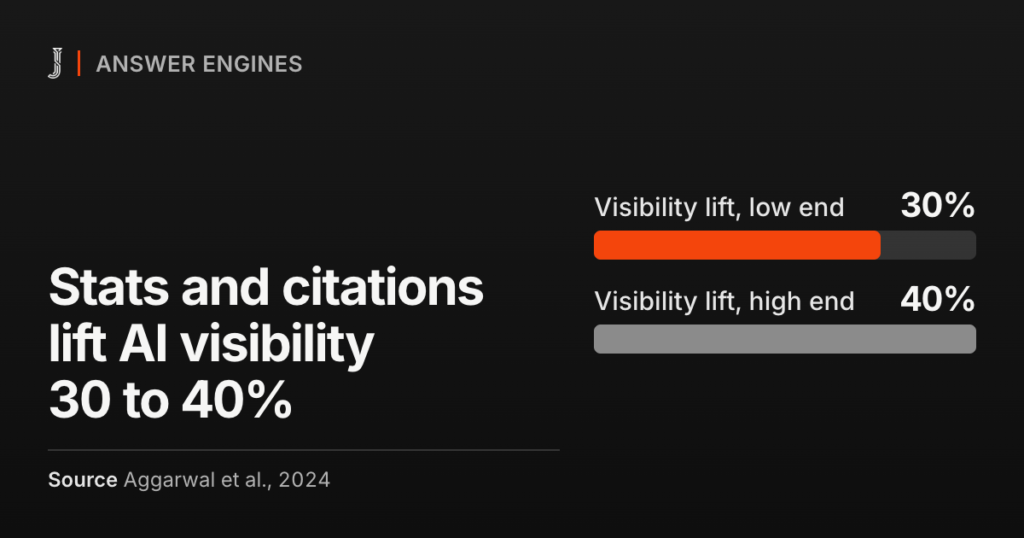
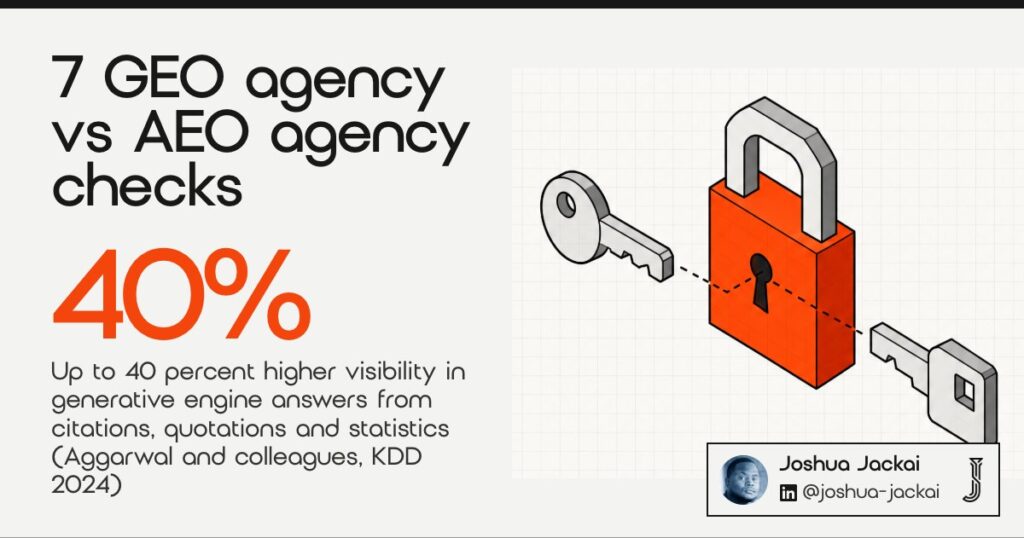
Short answer: A GEO agency and an AEO agency sell mostly the same work under two labels, so judge the proposal, not the name. Google says AI Overviews need no special optimizations beyond SEO basics, and a 2024 study found citations, quotations and statistics lifted visibility in AI answers by up to 40 percent. Seven checks separate real scope from rebrand.
I am Joshua Jackai, a Vancouver web designer, and I build and measure this work for Canadian B2B firms through Jackai Agency. This guide is the checklist I would use if I were the buyer reading a GEO agency or AEO agency proposal: what the labels mean, what can be measured, and what a fair price covers.
In this guide
Key takeaways
- GEO comes from a research paper by Princeton and IIT Delhi researchers, first posted in 2023 and published at KDD 2024; AEO is an older practitioner term, and vendor articles draw the line between them in different places (Aggarwal and colleagues, KDD 2024).
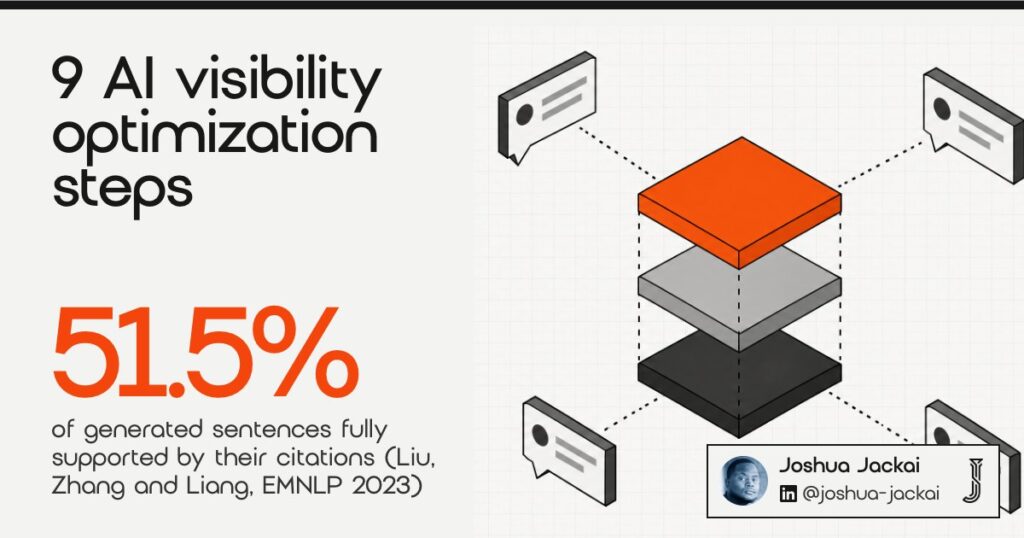
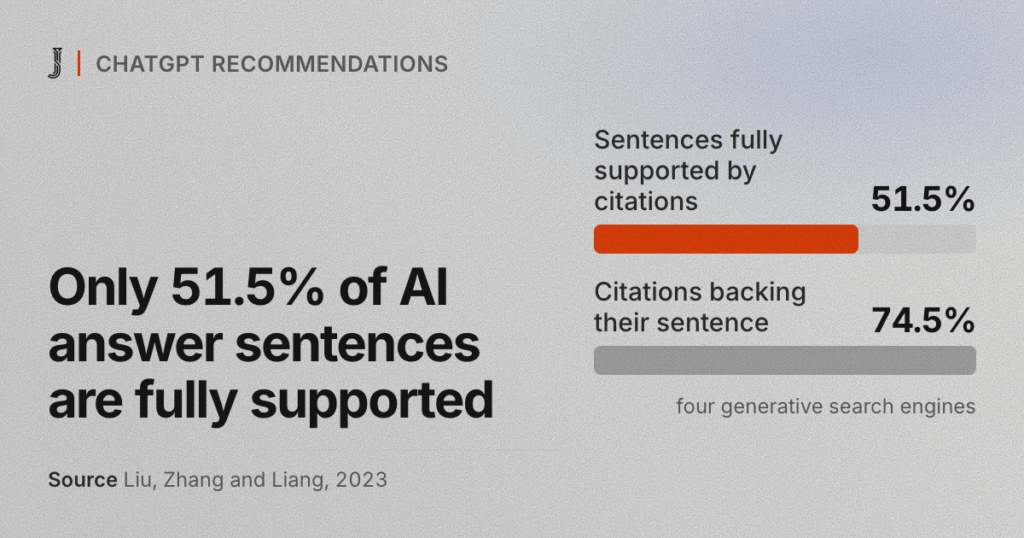
- In a hand audit of four generative search engines, only 51.5 percent of generated sentences were fully supported by their citations (Liu, Zhang and Liang, EMNLP 2023).
- Language models know less about less popular entities, and retrieval closes much of that gap across 14,000 PopQA questions (Mallen and colleagues, ACL 2023).
- OpenAI says sites opted out of OAI-SearchBot are not shown in ChatGPT search answers (OpenAI crawler documentation).
- Google says there is no special schema or AI text file needed to appear in AI Overviews (Google Search Central, updated 10 December 2025).
| Check | What to ask the agency | Usually filed under | Evidence behind it |
|---|---|---|---|
| 1. Definitions | What do GEO and AEO mean in your proposal? | Both | Vendor writing disagrees |
| 2. Engines | Which engines will you measure, one by one? | Both | Peer reviewed (ACL 2023) |
| 3. Access | Can each search crawler read my pages? | Both | Vendor documentation |
| 4. Evidence | Will every claim carry a source? | GEO | Peer reviewed (KDD 2024) |
| 5. Openings | Will each page lead with its answer? | AEO | Peer reviewed (TACL 2024) |
| 6. Facts | Do my listings and mentions agree? | Both | Peer reviewed (ACL 2023) |
| 7. Reporting | Will you re-test the same questions? | Both | Peer reviewed (EMNLP 2023) |
1. Ask what each label means: best for catching a swapped name
GEO is the label a research paper, first posted in 2023, gave to improving visibility inside generated answers. AEO is an older practitioner label for earning direct answers. Vendor articles split the two in different places, so the name tells you little. Ask for the agency’s definitions in writing, with the deliverables it files under each.
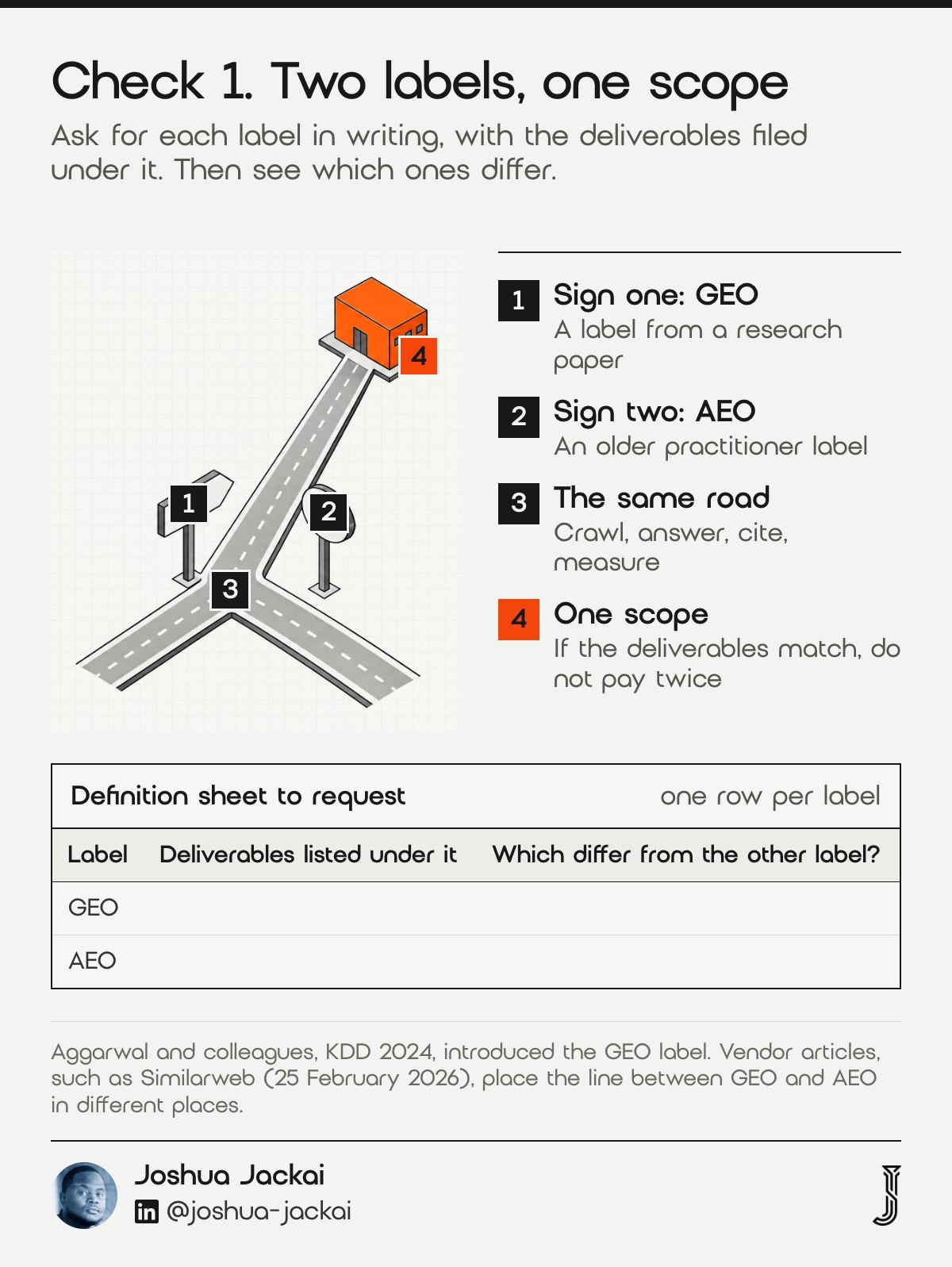
- GEO origin: Aggarwal and colleagues, KDD 2024, from Princeton University and IIT Delhi
- AEO origin: a practitioner term; I found no single founding paper
- Common vendor split: AEO for extractable answers, GEO for citations inside longer generated answers
- My reading: one body of work with a different emphasis
- What to request: a deliverable list under each label
Pranjal Aggarwal and colleagues introduced Generative Engine Optimization as a way for content creators to improve visibility in generative engine responses, tested on a benchmark called GEO-bench (KDD, 2024). That is the origin of the GEO label. It is a research framework, not a service category, which is why two agencies can sell it as two different things.
Vendor writing on the split is not consistent either. Similarweb’s February 2026 article treats AEO as snippet-level work and GEO as the broader job of being cited in generated answers, then describes both as layers on top of SEO. Similarweb sells AI visibility tracking, so I read it as one vendor’s map, not a standard (Similarweb, 25 February 2026).
My own reading is plainer. The steps overlap: crawlers must read the page, the page must state its answer, the facts must be consistent and someone must measure the result. Google says as much for its own products.
“The best practices for SEO remain relevant for AI features in Google Search,” stated Google Search Central.
So when a proposal lists AEO and GEO as two separate retainers, I ask which tasks differ. If the answer is “the name of the report”, I would not pay twice.
2. Ask which engines they will measure: best for knowing what an edit can change
An AI answer comes from retrieved pages, from what the model memorized in training, or from both. Retrieval responds to edits on your site. Memory does not. A proposal should say which engines it measures and which of the two memories each answer used. ChatGPT search, Perplexity and Google AI Overviews all retrieve pages.
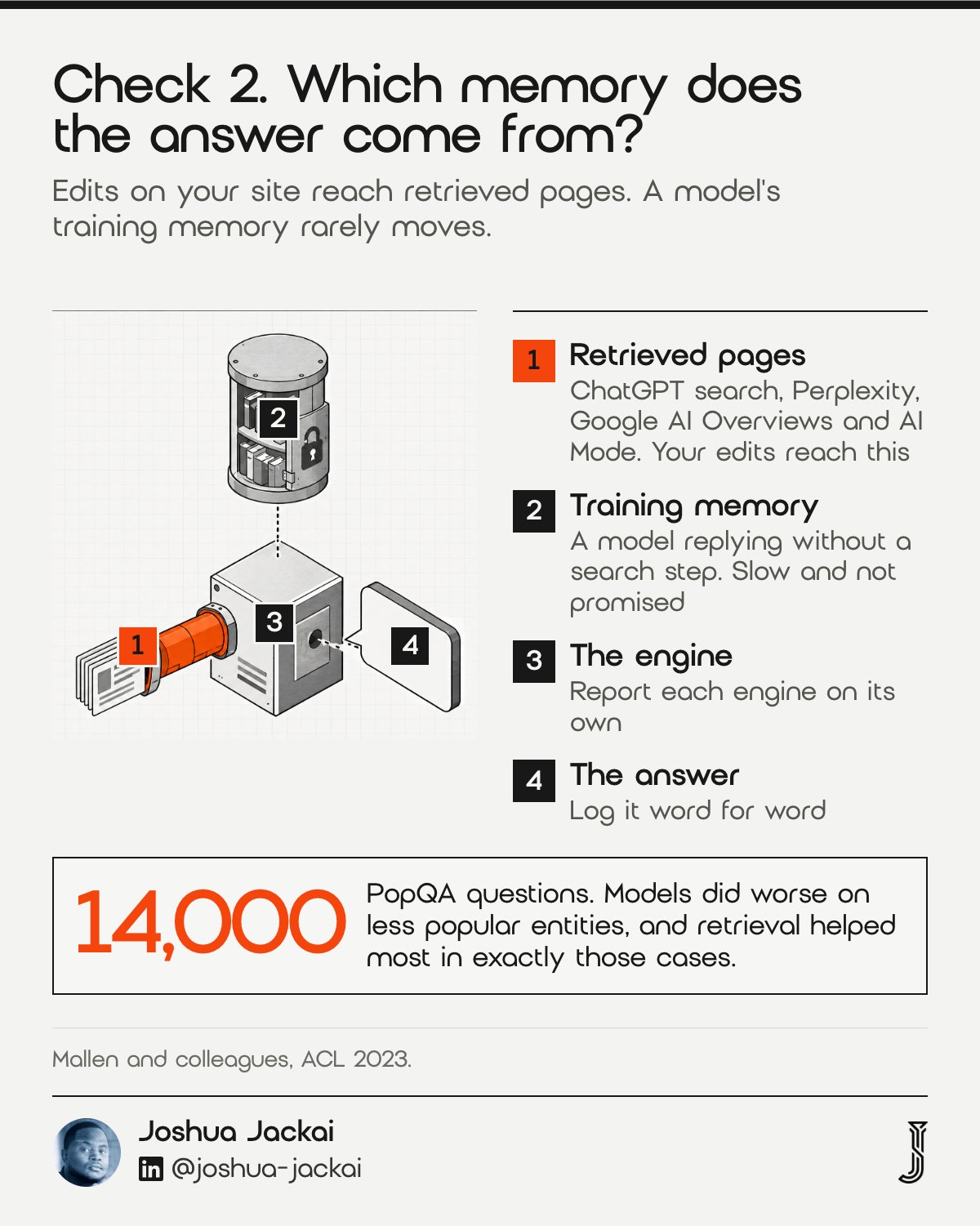
- Retrieval-fed answers: ChatGPT search, Perplexity, Google AI Overviews and AI Mode
- Memory-only answers: a chat model replying without a search step
- What your edits reach: the retrieval side, within days to weeks of a crawl
- What they rarely reach: the model’s training memory
- Ask for: results reported per engine, never blended
Alex Mallen and colleagues compared a language model’s own memory with retrieved documents on 14,000 PopQA questions about people, places and things of different fame. Models did worse on less popular entities, and adding retrieved text helped most in exactly those cases (ACL, 2023).
“We find that LMs struggle with less popular factual knowledge, and that retrieval augmentation helps significantly in these cases,” wrote Alex Mallen and colleagues.
A 30-person Vancouver firm is a long-tail entity. A model will not remember it well, so whether an engine names the firm depends on what it retrieves that day. That is the useful split for a buyer. Work on retrievable pages shows up in answers that search. Work aimed at a model’s memory, such as getting mentioned in places that end up in training data, is slow and cannot be promised.
This is also where honest agencies and loud ones part. A loud one promises that your firm will be named by a model with no search step, because that sounds bigger. An honest one tells you the memory side moves slowly, if at all, and spends the budget on the pages an engine fetches today. I measure the two sides separately in the baseline, so a gain in a searching engine is never credited to memory, and a miss in a memory-only answer is never blamed on the pages.
I put this question to every agency, myself included: which of these answers can your work change, and how will you tell?
3. Check crawler access first: best for sites behind a firewall or security plugin
An engine cannot cite a page it cannot fetch. Crawler access means each search bot can reach your pages and receives a normal page, not an error or a challenge. It is the cheapest fix in this list and the one most often skipped, because the block is rarely where people look.
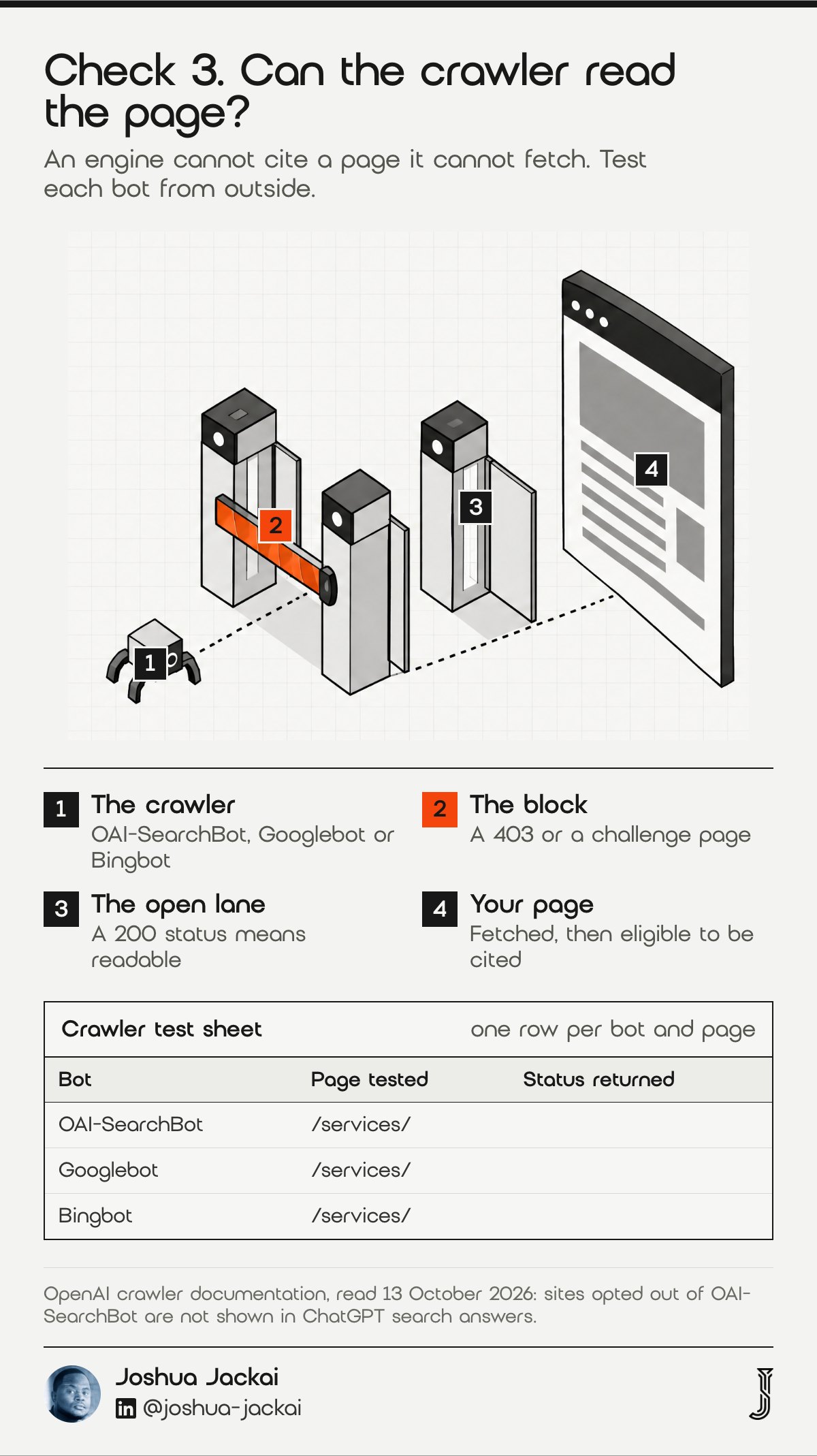
- OpenAI: allow OAI-SearchBot in robots.txt for ChatGPT search
- Google: Googlebot serves search and AI Overviews
- Microsoft: Bingbot feeds Bing and Copilot
- Where blocks hide: CDN bot rules, firewalls, security plugins
- Training is separate: GPTBot and OAI-SearchBot are independent settings
OpenAI states it plainly: “Sites that are opted out of OAI-SearchBot will not be shown in ChatGPT search answers, though can still appear as navigational links” (OpenAI crawler documentation, read 13 October 2026). The same page says each robots setting is independent, so a firm can opt out of training and still appear in ChatGPT search.
In the sites I have checked, the block sat outside robots.txt more often than inside it: a Cloudflare bot rule switched on during a spam wave, a security plugin that rejects agents it does not know, a staging password left on a subdomain. I test from outside by requesting the page with each crawler’s user agent and reading the status code.
A page an engine cannot fetch cannot be cited, whatever it says.
“A page an engine cannot fetch cannot be cited, whatever it says,” stated Joshua Jackai, Vancouver web designer.
Any GEO agency or AEO agency that does not check this before writing new content is spending your budget on pages nobody can read.
4. Demand evidence on the page: best for pages that make claims
Cited evidence is a number, a named study or a verbatim quote that an engine can repeat with a source attached. It matters most on pages full of adjectives. The GEO paper found that adding citations, quotations and statistics improved visibility in generated answers by up to 40 percent in a lab setting.
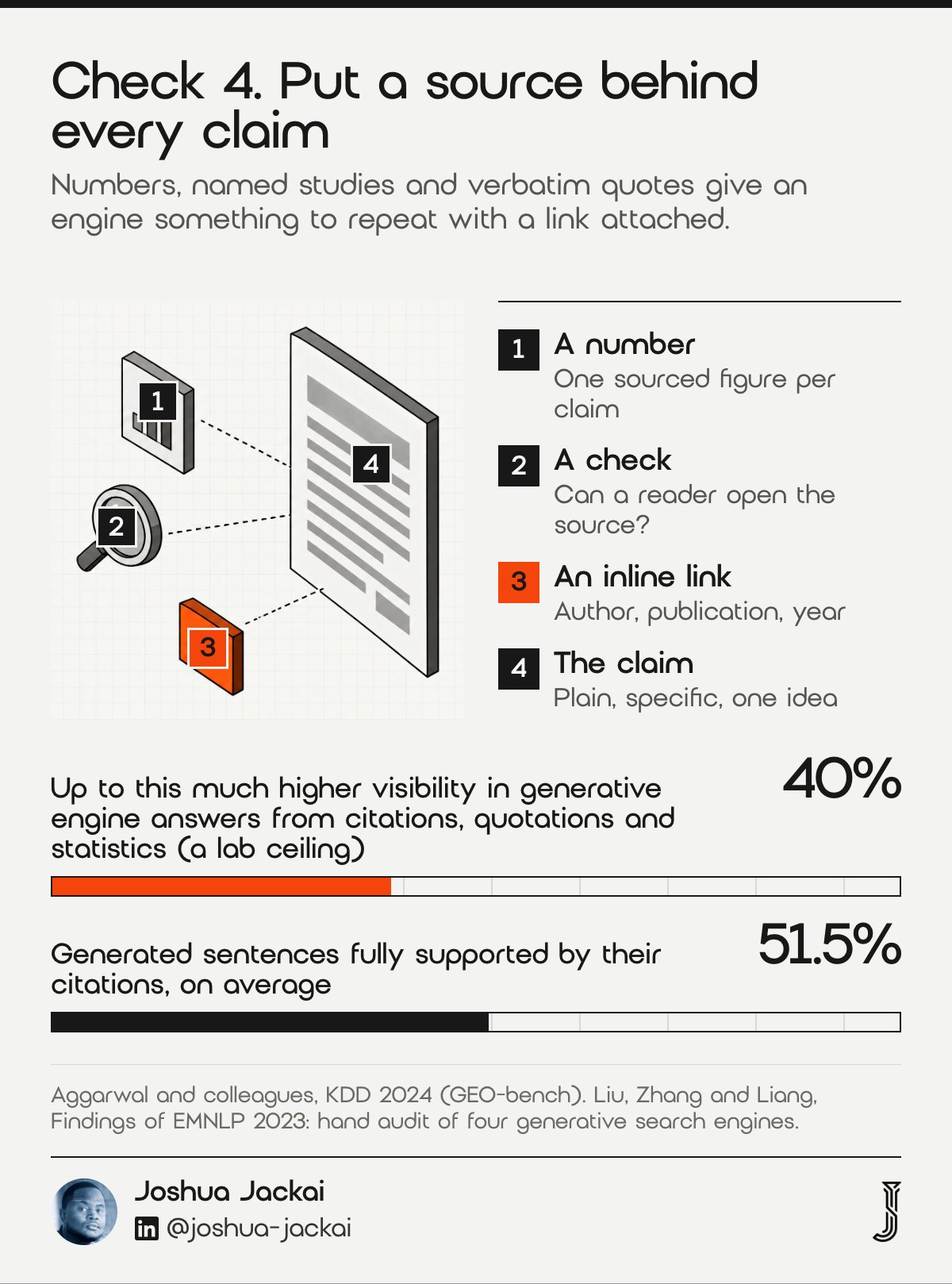
- Numbers: one sourced figure per claim that matters
- Sources: linked inline with author, publication and year
- Quotes: verbatim from a real person or paper, never invented
- Client results: the client named and the period stated
- Ask for: an edit log showing which claims gained a source
Aggarwal and colleagues tested several ways of rewriting source pages across a set of queries. In their abstract they write:
“We demonstrate that GEO can boost visibility by up to 40% in generative engine responses,” wrote Aggarwal and colleagues.
The figure is a ceiling from a benchmark the authors built, and the gains varied by domain (KDD, 2024). I read it as a ranking of which edits are worth the effort, not as a forecast for your site. No agency can honestly turn it into a guaranteed percentage.
There is a second reason to put evidence on the page. Generated answers are often wrong about their own sources. Nelson Liu, Tianyi Zhang and Percy Liang audited four generative search engines by hand and found that on average only 51.5 percent of generated sentences were fully supported by their citations (Findings of EMNLP, 2023).
My rule when I write for clients is simple. Every number I publish has a source a reader can open. An engine that repeats a made-up figure damages the firm it names.
“Every number I publish has a source a reader can open,” stated Joshua Jackai, Vancouver web designer.
5. Rewrite the opening of each page: best for long service pages
Answer-first writing opens a page with its main claim: who the firm serves, what it does and where. It suits service pages that begin with a slogan or a story. Liu and colleagues found language models used information best at the start or end of a long input.
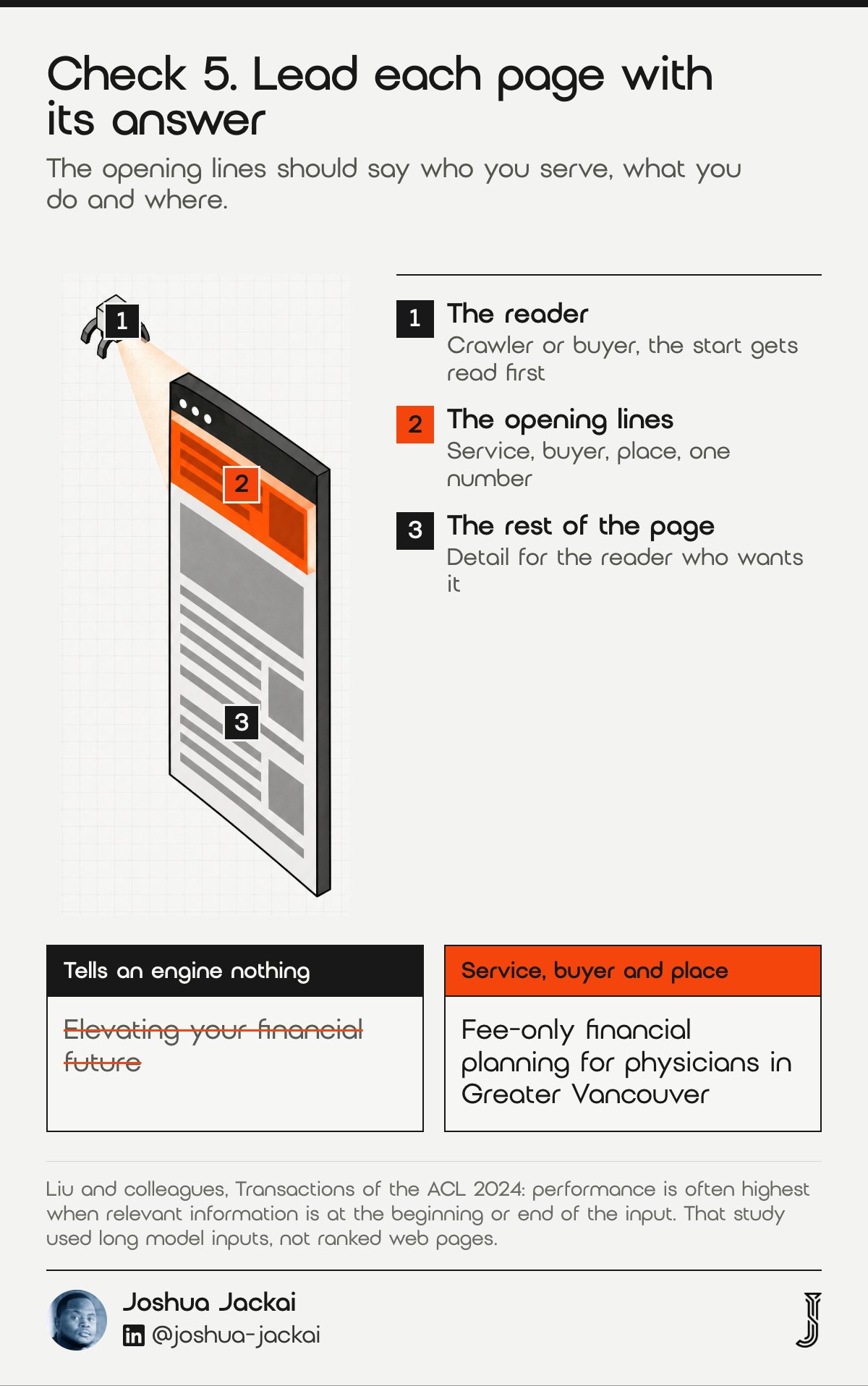
- First sentence: the service and who it is for
- Second sentence: one number or named proof
- Headings: the questions buyers type
- Typical length: 40 to 60 words before the first heading, my practice and not a studied figure
- Ask for: before and after openings for your five busiest pages
Nelson Liu and colleagues tested models on multi-document question answering and key-value retrieval. In their abstract they report:
“Performance is often highest when relevant information occurs at the beginning or end of the input context,” wrote Nelson Liu and colleagues.
That study used long inputs fed to a model, not live web pages ranked by a search engine, so I treat it as direction rather than proof (Transactions of the ACL, 2024).
Here is the fix in practice. “Elevating your financial future” tells an engine nothing. “Fee-only financial planning for physicians in Greater Vancouver” gives the service, the buyer and the place in eight words. This work is closest to what people call AEO, since it targets the passage an engine lifts as a direct answer, but I do it on every project and never bill it separately.
If an agency’s plan for step five is to add an FAQ block to every page, push back. An FAQ that repeats the paragraph before it adds length and nothing an engine can use.
6. Fix the facts and the outside mentions: best for firms with old listings
Entity consistency means your name, services, location and founders read the same on your site, Google Business Profile, LinkedIn and every directory. Outside mentions are other sites describing you in the same words. Both give a retrieval system agreeing evidence about a small firm it knows little about.
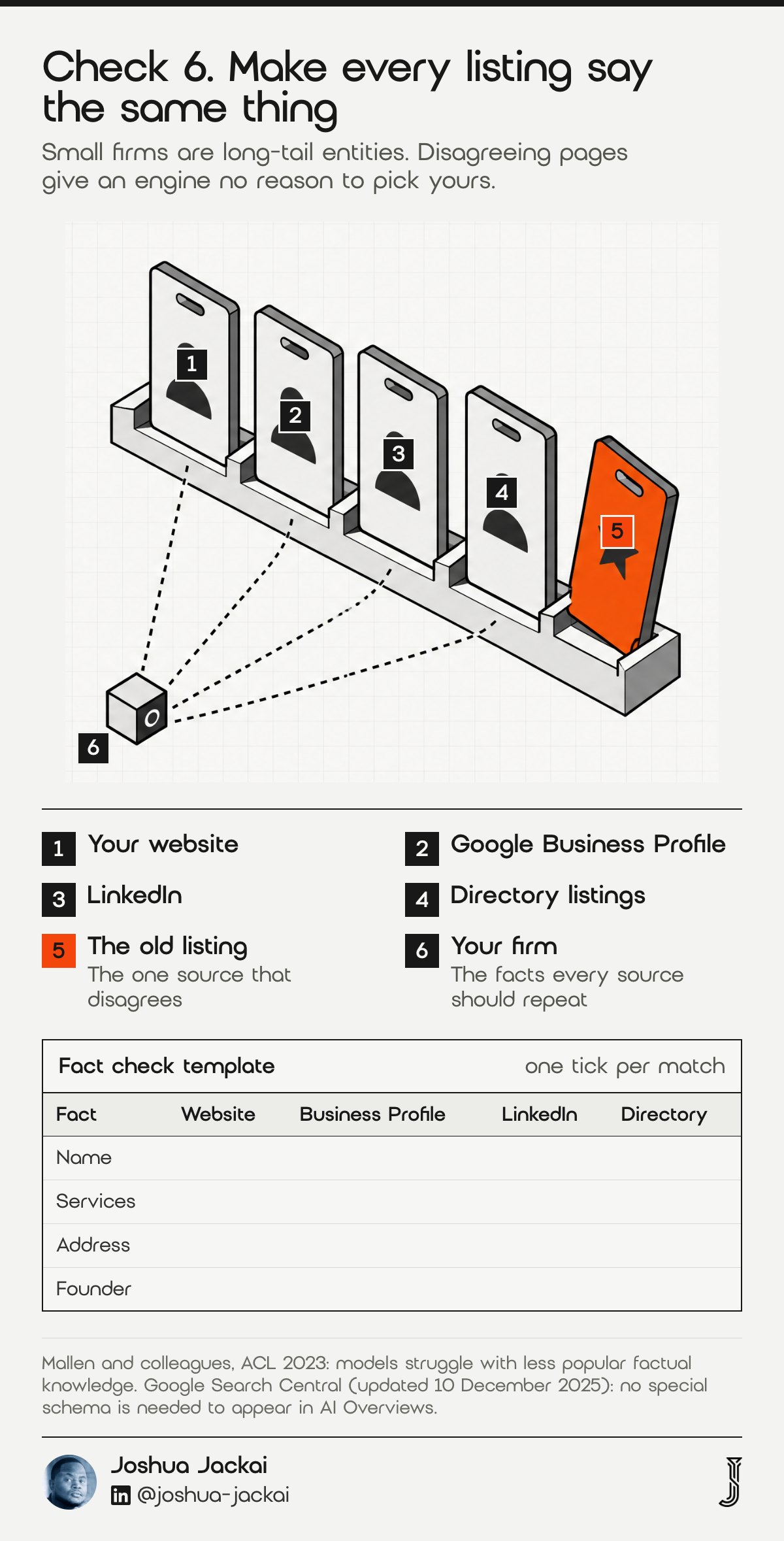
- Name and address: one form, written identically everywhere
- Services: the same short list on every profile
- People: founder titles that match LinkedIn
- Mentions: directories, associations and reviews the engines already cite
- Markup: helpful for consistency, not a requirement
The Mallen study from step two is the reason this matters for small firms: models struggle most with less popular entities, so the retrieved pages carry the answer. If three of those pages disagree about what the firm does, an engine has no reason to pick yours.
Google is direct that markup is not a shortcut.
“There are no additional requirements to appear in AI Overviews or AI Mode, nor other special optimizations necessary,” stated Google Search Central.
So I add Organization and Person markup to repeat facts in a machine-readable form, and I tell clients it is housekeeping, not a ranking trick. The bigger wins are older and duller: a directory that still shows a name from before a rebrand, or a LinkedIn page listing a service dropped two years ago (Google Search Central, updated 10 December 2025).
For outside mentions I start from the baseline: which domains does each engine cite for your category? A complete listing on one cited Vancouver directory can be worth more than a new post on your own site. Brin and Page built Google’s original ranking on links from other pages, a database of at least 24 million of them (Computer Networks and ISDN Systems, 1998). That paper covers links, not AI answers, so which sites an engine cites I read from each baseline, not from a study.
7. Insist on per-engine reporting and a re-test: best for proving the work
A report that blends every engine into one visibility score hides which edit moved which answer. A fair report lists the same questions, run on the same engines, before and after the work, with the page each engine cited. It should show wins, no-change rows and any answer that got worse.
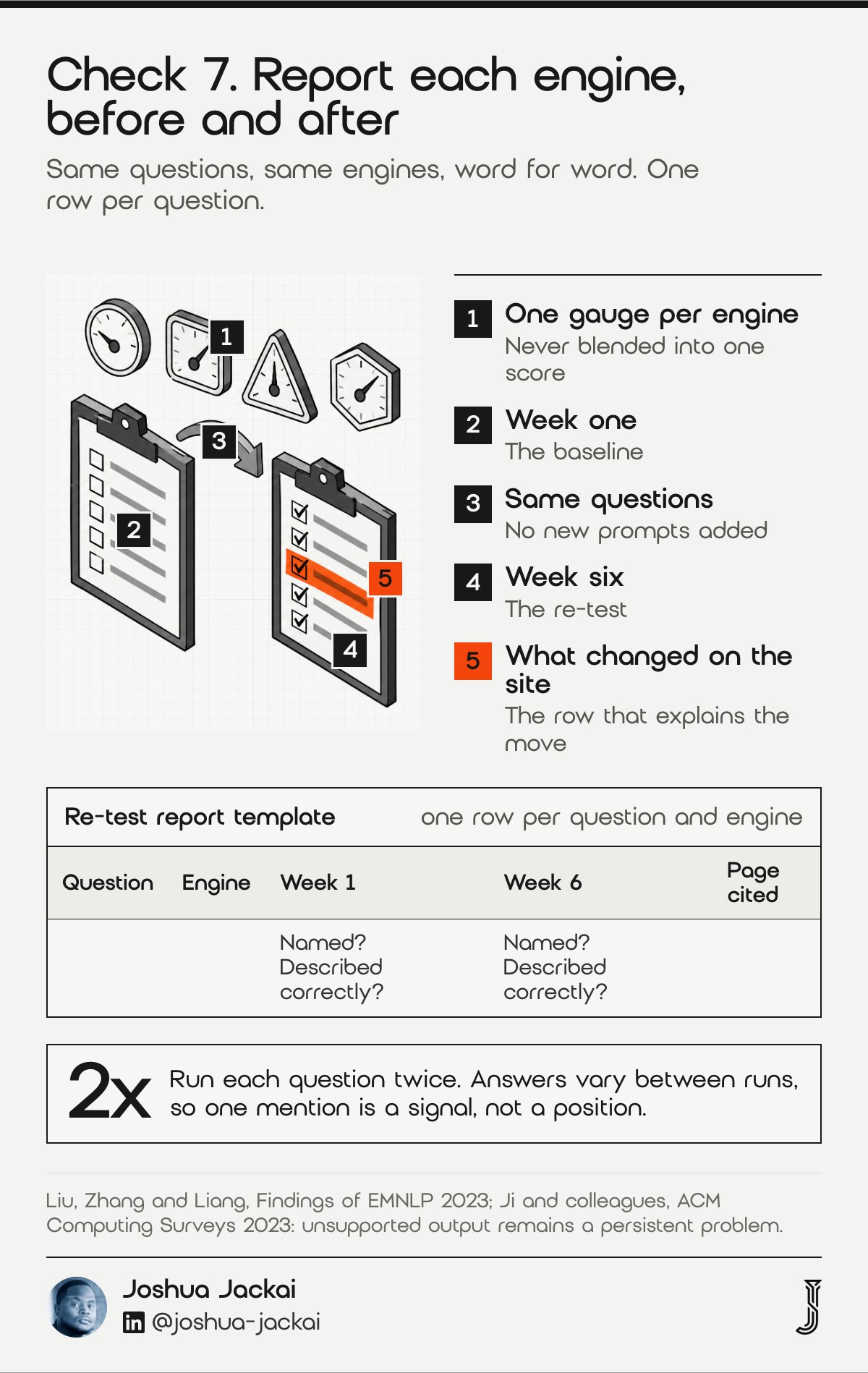
- Questions: 20 to 40 in buyer wording, fixed at the start
- Engines: ChatGPT, Perplexity, Claude, Google AI Overviews and AI Mode
- Columns: week one, week six, what changed on the site
- Runs: each question twice, because answers vary between runs
- Repeat: quarterly, since engines change
Liu, Zhang and Liang describe responses from the engines they audited as fluent but frequently containing unsupported statements and inaccurate citations (Findings of EMNLP, 2023). Ziwei Ji and colleagues reviewed hallucination across many generation tasks and treat unsupported output as a persistent problem (ACM Computing Surveys, 2023).
That is why I record answers word for word. An engine can name a firm and describe the wrong service, or cite a page that says nothing about it. A bare “mentioned: yes” hides both. I also log each question twice. One mention in one run is a signal, not a position.
“One mention in one run is a signal, not a position,” stated Joshua Jackai, Vancouver web designer.
If this check is the only one a proposal fails, ask for the reporting template before you sign. It tells you more than the sales deck does. A template with a week-one column and a week-six column, one row per question, and a free-text field for what changed on the site is enough. A dashboard with a single score and a trend line is not, because it cannot show you which page an engine cited or whether it described you correctly. Ask what happens when an answer gets worse, too. Occasionally one does, because a competitor published something better, and an agency that only reports wins is reporting selectively.
Compare the seven checks and size your test set
Use the filters to see which checks sit with which owner, then enter your own numbers to size the question set you will log. The defaults are placeholders, not benchmarks. A test set that is too small hides the swings between runs, so count before you commit to a reporting plan.
| Check | Owner | Effort | Start this week | Label |
|---|---|---|---|---|
| 1. Ask what each label means | Founder or marketing lead | Low | Yes | Both |
| 2. Ask which engines they measure | Marketing lead | Low | Yes | Both |
| 3. Check crawler access first | Developer or IT | Low | Yes | Both |
| 4. Demand evidence on the page | Writer | Medium | No | GEO |
| 5. Rewrite the opening of each page | Writer or designer | Medium | Yes | AEO |
| 6. Fix the facts and the outside mentions | Marketing lead | Medium | Yes | Both |
| 7. Insist on per-engine reporting | Marketing lead | Low | No | Both |
Showing 7 of 7 checks.
Test set size calculator. Enter your own plan. The defaults are placeholders, not benchmarks.
Frequently asked questions about GEO and AEO agencies
Buyers ask the same five questions in the same order: what the labels mean, how they relate to SEO, how results are measured, whether the work pays and what it costs in Canada. Each answer here is short and ties back to the seven checks.
Is AEO the same as GEO?
Not exactly, but the work overlaps heavily. AEO usually means earning direct, extractable answers; GEO usually means being cited inside longer generated answers. Vendors disagree on the boundary, so ask any agency for its own definitions and the deliverables under each before you compare prices.
Is AEO the same as SEO?
No, but it sits on top of it. Google says the best practices for SEO remain relevant for AI features, and a page must be indexed and eligible to show in Search first. AEO and GEO add answer-first writing, evidence, consistent facts and per-engine measurement.
How is AEO measured?
You fix a list of buyer questions, run them on each engine and record whether your company is named, how it is described and which page is cited. Repeat after the changes. I log each question twice because answers vary between runs, and I never blend engines into one score.
Is AEO worth it for a small B2B firm?
It is worth it when buyers ask AI tools for recommendations in your category and the baseline shows you missing. Start with the free AI Visibility Report. Crawler access and answer-first openings cost little, so do those whatever you decide on the rest.
How much does GEO or AEO work cost in Canada?
My fixed quote for a GEO project is CA$4,775, and my website audit is CA$995, credited in full if a project starts within 30 days. Those are my prices as of October 2026, in Canadian dollars. Other agencies quote differently, so compare scope line by line.
How I run GEO and AEO work for Vancouver B2B firms
I run both labels as one project: a baseline, a crawler check, answer-first rewrites, evidence on the page, consistent listings and a week-six re-test. The two service pages are generative engine optimization and answer engine optimization. For the full nine-step order of work, read my AI visibility optimization steps, and for the ChatGPT-specific version, how to get recommended by ChatGPT.
You can see what the engines say about your company today with the free AI Visibility Report, or book the CA$995 website audit. The report names three fixes, and you keep them whether or not we work together.
Sources
Peer-reviewed research
- Aggarwal, P., Murahari, V., Rajpurohit, T., Kalyan, A., Narasimhan, K. and Deshpande, A. (2024). GEO: Generative Engine Optimization. Proceedings of the 30th ACM SIGKDD Conference on Knowledge Discovery and Data Mining. doi.org/10.1145/3637528.3671900
- Liu, N. F., Zhang, T. and Liang, P. (2023). Evaluating Verifiability in Generative Search Engines. Findings of the Association for Computational Linguistics: EMNLP 2023. doi.org/10.18653/v1/2023.findings-emnlp.467
- Liu, N. F., Lin, K., Hewitt, J., Paranjape, A., Bevilacqua, M., Petroni, F. and Liang, P. (2024). Lost in the Middle: How Language Models Use Long Contexts. Transactions of the Association for Computational Linguistics. doi.org/10.1162/tacl_a_00638
- Mallen, A., Asai, A., Zhong, V., Das, R., Khashabi, D. and Hajishirzi, H. (2023). When Not to Trust Language Models: Investigating Effectiveness of Parametric and Non-Parametric Memories. Proceedings of the 61st Annual Meeting of the Association for Computational Linguistics. doi.org/10.18653/v1/2023.acl-long.546
- Ji, Z., Lee, N., Frieske, R., Yu, T. and others (2023). Survey of Hallucination in Natural Language Generation. ACM Computing Surveys. doi.org/10.1145/3571730
- Brin, S. and Page, L. (1998). The anatomy of a large-scale hypertextual Web search engine. Computer Networks and ISDN Systems. doi.org/10.1016/S0169-7552(98)00110-X
Industry and vendor sources (not peer reviewed)
- OpenAI, Overview of OpenAI Crawlers, read 13 October 2026.
- Google Search Central, AI features and your website, last updated 10 December 2025.
- Similarweb, AEO vs. GEO: What’s the Difference, 25 February 2026. A vendor that sells AI visibility tracking.
- Jackai Agency price table, October 2026 (first-party prices).