What Is Generative Engine Optimization, and What Should You Change?
What generative engine optimization is, how it differs from SEO, the seven changes I make on a B2B site, and the three numbers I use to measure it.
 Joshua Jackai
14 min read
Joshua Jackai
14 min read
Generative engine optimization (GEO) is the work of getting your company named in the answer when a buyer asks ChatGPT, Claude, Perplexity or Google’s AI Overviews a question, and quoted closely enough that a link back to your site follows.
A head of operations at a 60-person engineering firm types “who should rebuild our HubSpot website” into ChatGPT. The answer names three firms. Your firm ranks on page one of Google for that exact search. It is not in the answer.
Same site. Same rankings. Different answer. This post covers what generative engine optimization is, how it differs from SEO, what I change on a B2B website so AI search tools can use it, and how I measure whether any of it worked. I run Jackai Agency from Vancouver, where I build B2B sites mostly on WordPress, so what follows is the version I would ship.
In this guide
What is generative engine optimization?
The term comes from a paper by Pranjal Aggarwal and five co-authors, first posted in 2023 and published in 2024 in the proceedings of KDD, a peer-reviewed data mining conference (Aggarwal et al., 2024). They describe a generative engine as a system that fetches sources for a question and then has a language model write one answer from them, with citations. Its examples were Bing Chat, Google’s Search Generative Experience (now AI Overviews) and Perplexity.
The idea behind generative engine optimization was simple. A search engine gives you a place on a list. A generative engine gives you a share of one answer, or nothing. So they measured visibility inside the answer: how many words of the response came from your page, weighted by how early those words appeared. They called it position-adjusted word count.
ChatGPT citations and Perplexity source links are the visible end of that share, and the link is where AI referral traffic comes from. I find that a useful way to set the goal: you are not trying to rank, you are trying to be the source the answer is built from, with your name attached.
Answer engine optimization (AEO) is the close cousin: formatting a single page so a clean answer can be lifted from it. I treat the two as one job with two layers. GEO decides whether an engine uses your site at all. AEO decides how cleanly it can quote a given page. On my AI Visibility Optimization service they are one six-week engagement.
How is generative engine optimization different from SEO?
GEO sits on top of SEO, not in place of it. In the paper’s test setup, the engine read only the top five Google results for each query before it wrote anything. Real AI search tools retrieve in their own ways, but the rule holds: a page the engine never fetches cannot be quoted. Rankings still decide who gets into the pool.
What changes is what wins once you are in the pool. Keyword stuffing, the oldest SEO habit, gave little to no lift in the engine the authors built. On Perplexity it did 10% worse than leaving the page alone. Adding citations to credible sources did the opposite, and the gains landed where SEO helps least.
For the site ranked fifth in search results, citing sources raised its share of the answer by 115.1%. The same change on the top-ranked site cut its share by 30.3%. Same page, same rank, a bigger slice of the answer. That is the part of generative engine optimization that interests me most for smaller B2B firms: once your page is in the pool, the model reads your words, not your backlink count.
| SEO | GEO | |
|---|---|---|
| What you win | A position on a results page | Words and a citation inside an AI search answer |
| Who reads first | A person scanning ten links | A language model reading a handful of sources |
| What moves it | Relevance, links, page speed, crawl health | Relevance first, then quotable facts with numbers and named sources |
| What fails | Thin or slow pages | Vague claims, facts that conflict across sites, keyword stuffing |
| How you measure | Rank, clicks, Search Console | Recorded answers, AI referral traffic, leads by source |
What does the research say actually works?
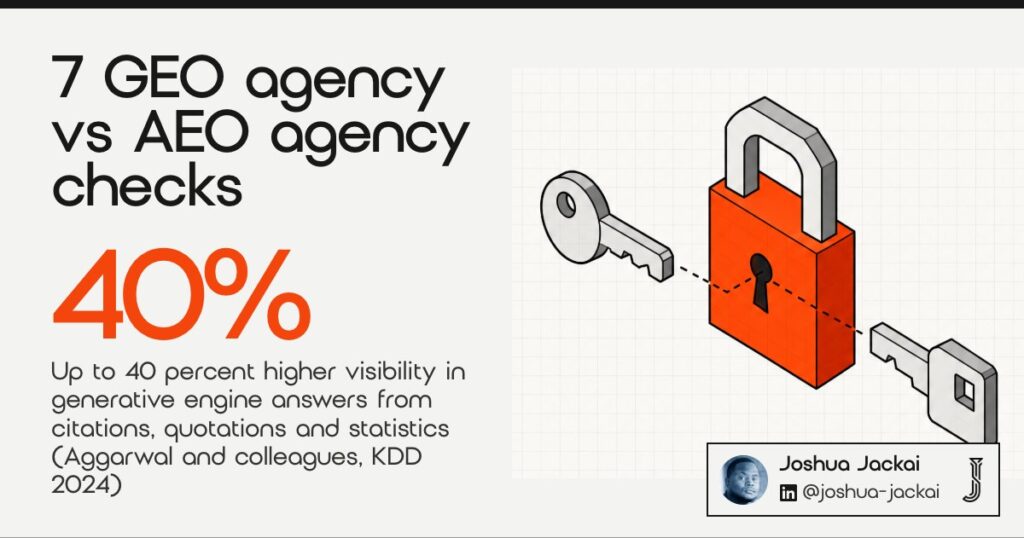
The KDD paper on generative engine optimization tested nine rewrites on a benchmark of 10,000 queries. The three best were adding citations to credible sources, adding quotations, and adding statistics in place of vague description. Each raised a page’s position-adjusted word count by 30 to 40% over the unchanged page, and its subjective impression score by 15 to 30%.
Two quieter changes also worked: making the text more fluent, or simply easier to read, gave gains of 15 to 30%. One change did not: rewriting a page in a more persuasive, authoritative tone gave no significant improvement. The engines were not impressed by confidence.
A second study adds a check. When language models weigh conflicting web pages, they lean heavily on how relevant each page is to the question. They largely ignore things people value, such as scientific references or a neutral tone (Wan, Wallace and Klein, 2024). That does not cancel the citation result. It tells you the order: relevance to the buyer’s actual question comes first, and sources help a relevant page, not an off-topic one.
Position inside the text matters too. When researchers moved the key passage around inside a long input, language models used it best at the start or the end, and noticeably worse in the middle (Liu et al., 2024). I cannot prove every engine reads a web page that way, but it is one more reason to put the answer first.
Now the limits: the KDD tests ran on an engine built on GPT-3.5 and on Perplexity, a live AI search engine, as both stood when the paper was written, and engines have changed since. The numbers are shares of an answer, not traffic and not leads. I use the paper as a direction for what to write, not as a forecast for any one site.
What should a B2B website change for AI search?
Most generative engine optimization work is editing, not building. These are the changes I make, in order, on a site that already exists.
- Let the crawlers in. Check robots.txt, the security plugin and the CDN firewall for rules that block the crawlers AI search tools publish, such as OpenAI’s GPTBot and OAI-SearchBot, PerplexityBot and ClaudeBot. A rule like that can be switched on without anyone in marketing knowing. If the crawler is blocked, there is no answer to appear in and no AI referral traffic to count. I check it first because it is the cheapest fix there is.
- Write one facts block. Company name, what you sell, who it is for, where you work, a starting price. Use the same words on the About page, the footer, LinkedIn and every directory profile. My own About page has a table called “The facts, in one place” for exactly this. When your site and your profiles describe you three ways, the engine picks one, and you do not get to choose which.
- Turn claims into numbers with a cause. “We grow organic traffic” gives an engine nothing to lift. Compare: Advisor Websites, a Vancouver SaaS platform for financial advisors, saw +58% organic traffic and +28% MQL conversion from the replay library and opt-in templates. That sentence names who, what moved and why. It can be quoted whole.
- Keep the caveat in the sentence. On Snappy Kraken, a FinTech SaaS for financial advisors, the redesign influenced 7 figures of ARR, influenced and not attributed, because sales, pricing and product moved in the same period. If the caveat sits two paragraphs later, a machine that lifts one sentence lifts the claim without it.
- Cite your sources on the page. When a service page makes a claim about buyer behavior, the study goes in the same paragraph, linked. It is one of the three changes with the biggest gains in the KDD paper, and it keeps me honest.
- Answer first on every service page. The first line answers the one buyer question the page exists for. Everything after it backs that answer up.
- Mark up the facts. Add Schema.org structured data for the organization, each service and each offer. It does not make an engine cite you, but it removes the guessing about what you sell and what it costs.
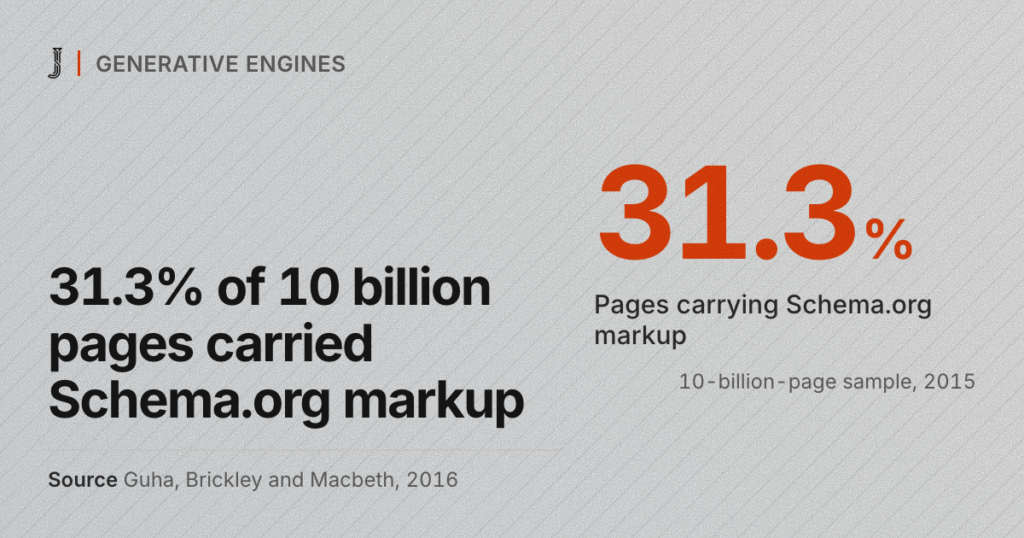
Schema.org is a shared vocabulary that Bing, Google and Yahoo created in 2011, with Yandex joining later, so one set of markup could be read by all of them. By 2015, 31.3% of pages in a 10-billion-page sample carried it (Guha, Brickley and Macbeth, 2016). It is old and dull, which is what you want from a standard.
I also add an llms.txt file, a plain-text summary of the business at the site root. It takes about an hour, and I would not pay anyone for it on its own: I know of no study showing it changes what an engine says.
Engines also check you against other sites: directories, reviews, articles that mention you. The facts block above should match every one of them, word for word where you control the wording.
What I would not do
Some generative engine optimization advice in circulation is SEO spam with a new label. These are the moves I turn down, even when a client asks.
- Hide instructions for the AI. A 2024 study showed that hidden text written to steer the language model could push low-ranked products up in conversational search results, and the attack carried over to Perplexity (Pfrommer et al., 2024). It is the same trick as hidden keyword text in the early 2000s. I expect it to end the same way, and I will not put a client’s name on it.
- Stuff the keyword. The KDD paper found little to no gain in its own engine, and a 10% loss on Perplexity.
- Publish 200 AI-written pages. Part of the KDD impression score is how unique a source’s material is. A page that repeats what ten others say gives the engine no reason to pick it.
- Buy a guarantee. Nobody controls what ChatGPT says, so nobody can sell you ChatGPT citations. My own offers page says it plainly: no citation or ranking is guaranteed. Anyone who promises one is selling the promise.
- Rewrite everything louder. The authoritative-tone rewrite gave no significant gain. Plain and specific beats confident and vague.
How do you measure generative engine optimization?
Generative engine optimization gets measured with three numbers, each from a different place. Any one of them alone will mislead you.
1. What the answers say
Write down 10 to 20 questions your buyers actually type. Run each one several times in each AI search tool, record the answers word for word, and date them. On my offers page I show one real check from 3 October 2026. The question was “Who is the best web design agency in Vancouver?” Three agencies were each named in 3 of 3 ChatGPT answers. The names are hidden, because the count is the point.
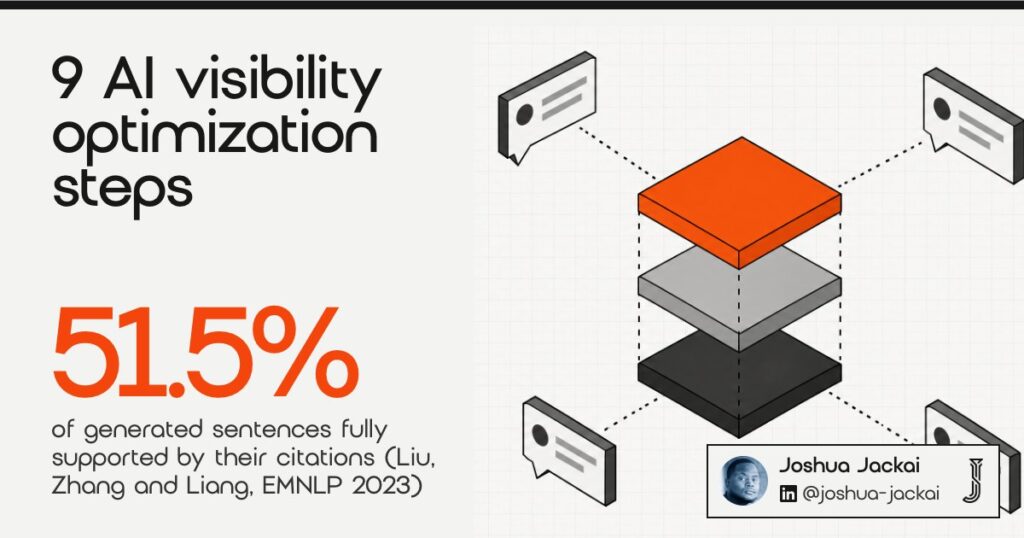
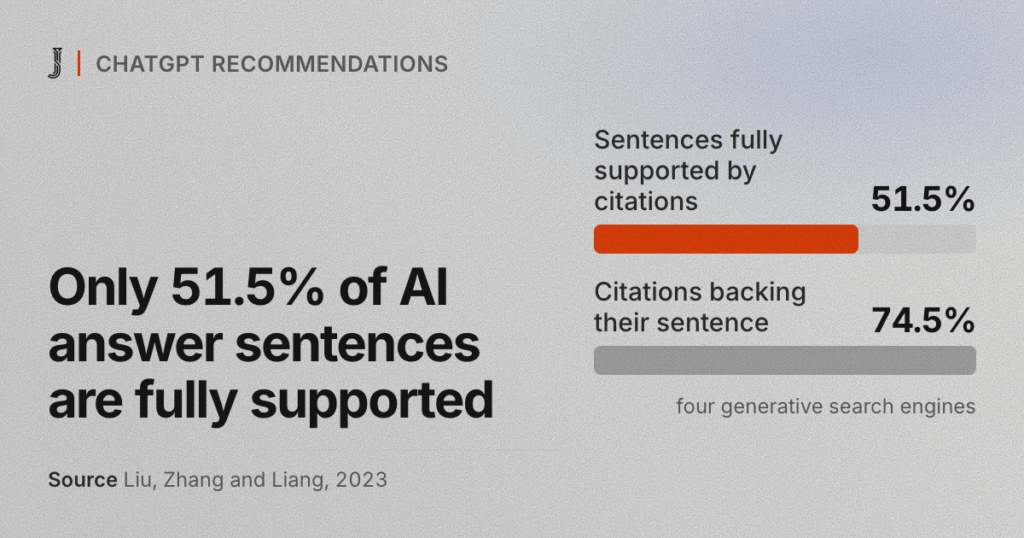
Read what each answer says about you, not only whether you are linked. A 2023 audit of four generative search engines (Bing Chat, NeevaAI, Perplexity and YouChat) found only 51.5% of generated sentences were fully supported by their citations, and only 74.5% of citations supported the sentence beside them (Liu, Zhang and Liang, 2023).
That audit did not cover ChatGPT, but I check ChatGPT citations for the same failure: a link to your page beside a sentence your page never said. Track that as a fix, not a win. Count linked citations apart from mentions without a link. A mention can put you on the shortlist, but only a link sends a visit you can measure.
2. AI referral traffic, split out of direct
Without a rule for it, AI referral traffic either lands in the direct bucket, next to people typing your URL, or hides among ordinary referral sites. The method on my lead attribution case study splits it out. AI tools that pass a referrer are matched and given their own channel. Visits that arrive with no referrer are inferred from the landing page and session pattern, and reported as probable rather than certain. Either way, they stop counting as direct.
Expect AI referral traffic to undercount. The research firm Forrester reported in January 2026 that 61% of business buyers use private AI tools provided by their own company. Research done behind a firewall may never send a referrer at all. That is why the recorded answers matter even when the traffic line looks flat.
3. Leads with a source attached
Hidden fields on every form carry the original source, the referring site and the landing page into the CRM with the lead. The weekly report then gives AI its own row, so ChatGPT citations and Claude referrals sit next to organic, paid and email. On the case study the cells are empty on purpose: client figures from attribution engagements are not published, so the page shows the format, not a result.
If you can only wire up one of the three, wire up this one. Recorded answers tell you whether you are named. AI referral traffic tells you whether anyone clicked. Leads with a source tell you whether it paid.

How long does generative engine optimization take, and what does it cost?
My AI Visibility Optimization engagement takes six weeks and costs CA$4,775, on the website you already have. Here is what it includes.
- A dated baseline of what each engine says about you, across your buyer questions.
- Schema.org markup for the organization, every service and every offer.
- Service pages rewritten so each answers one buyer question in its first line.
- FAQ content matching real buyer queries, marked up as FAQPage.
- An llms.txt file at the site root.
- A citation package of the directory and profile listings the engines cite in your category.
- A week-six comparison: the same questions, run again against the same baseline.
On timing, be realistic. Engines that search the web live can use a changed page once they crawl it again. What a model learned in training changes only when the model is retrained. So a six-week window mostly shows the live-search side. AI search answers also shift from week to week with nothing changed on your side, which is why every baseline is dated.
Every quote is fixed before work starts, with two revision rounds per phase, and you own the site, domain and hosting. If you cannot yet tell where leads come from, Lead Source Reporting separates AI referral traffic from direct, takes two weeks and costs CA$2,600. Without it, you will not know whether generative engine optimization paid off.
When should a B2B firm hold off?
Forrester reported in January 2026 that 94% of business buyers now use AI somewhere in their buying process. So the question is rarely whether buyers use these tools. It is what to fix first.
| Your situation | Start with | Why |
|---|---|---|
| You do not know if AI search tools name you | Free AI Visibility Report, 24 hours | A dated baseline before anyone spends money |
| You rank in Google, but competitors get named in AI search answers | AI Visibility Optimization, CA$4,775, six weeks | The site is found but not quoted |
| You cannot say where last quarter’s leads came from | Lead Source Reporting, CA$2,600, two weeks | Without it, you cannot tell whether GEO worked |
| Your site cannot say what you do in one sentence | Website Audit, CA$995, credited in full against a build (current terms on the offers page) | The fix is the site, not the markup |
| You are named and want to stay named | AI Referral Retainer, CA$1,870 a month, 90-day minimum | Answers change with nothing changed on your side, so someone re-runs the questions |
One edge case matters in professional services: your best proof may be under NDA. An engine can only quote what is public. In that case, publish the method instead of the result. My lead attribution page does exactly that.
The other edge case is a site with no clear service pages at all. No amount of generative engine optimization helps a page that does not exist. Fix the structure first, then mark it up.
Find out what AI search says about you today
Not a redesign. Not a ranking report. Before you spend anything on generative engine optimization, get a dated record of what ChatGPT, Claude and Google AI Overviews say when your buyers ask. Same site, same rankings, one new baseline.
Send me the website and a work email, and I will send back the free AI Visibility Report in 24 hours: the questions, the answers, who gets named in your place, what the engines could not find on your site, and three fixes in order. No sales call unless you book one.
Sources
Peer-reviewed research
- Aggarwal, P., Murahari, V., Rajpurohit, T., Kalyan, A., Narasimhan, K. and Deshpande, A. (2024). GEO: Generative Engine Optimization. Proceedings of the 30th ACM SIGKDD Conference on Knowledge Discovery and Data Mining. https://doi.org/10.1145/3637528.3671900
- Liu, N., Zhang, T. and Liang, P. (2023). Evaluating Verifiability in Generative Search Engines. Findings of the Association for Computational Linguistics: EMNLP 2023. https://doi.org/10.18653/v1/2023.findings-emnlp.467
- Wan, A., Wallace, E. and Klein, D. (2024). What Evidence Do Language Models Find Convincing? Proceedings of the 62nd Annual Meeting of the Association for Computational Linguistics. https://doi.org/10.18653/v1/2024.acl-long.403
- Liu, N. F., Lin, K., Hewitt, J., Paranjape, A., Bevilacqua, M., Petroni, F. and Liang, P. (2024). Lost in the Middle: How Language Models Use Long Contexts. Transactions of the Association for Computational Linguistics. https://doi.org/10.1162/tacl_a_00638
- Pfrommer, S., Bai, Y., Gautam, T. and Sojoudi, S. (2024). Ranking Manipulation for Conversational Search Engines. Proceedings of the 2024 Conference on Empirical Methods in Natural Language Processing. https://doi.org/10.18653/v1/2024.emnlp-main.534
Industry and vendor data (not peer reviewed)
- Guha, R. V., Brickley, D. and Macbeth, S. (2016). Schema.org: Evolution of Structured Data on the Web. Communications of the ACM, practice article by engineers from the companies behind Schema.org. https://doi.org/10.1145/2844544
- Buten, J. (22 January 2026). B2B Buyers Make Zero-Click Number One. Forrester blog, reporting Forrester’s Buyers’ Journey Survey.