9 AI Visibility Optimization Steps: 2026 Field Guide
The nine steps I use to get Canadian B2B firms named in ChatGPT, Perplexity and Google AI answers, with the research behind each one.
 Joshua Jackai
19 min read
Joshua Jackai
19 min read
Published 13 October 2026 · Last updated and fact-checked October 2026
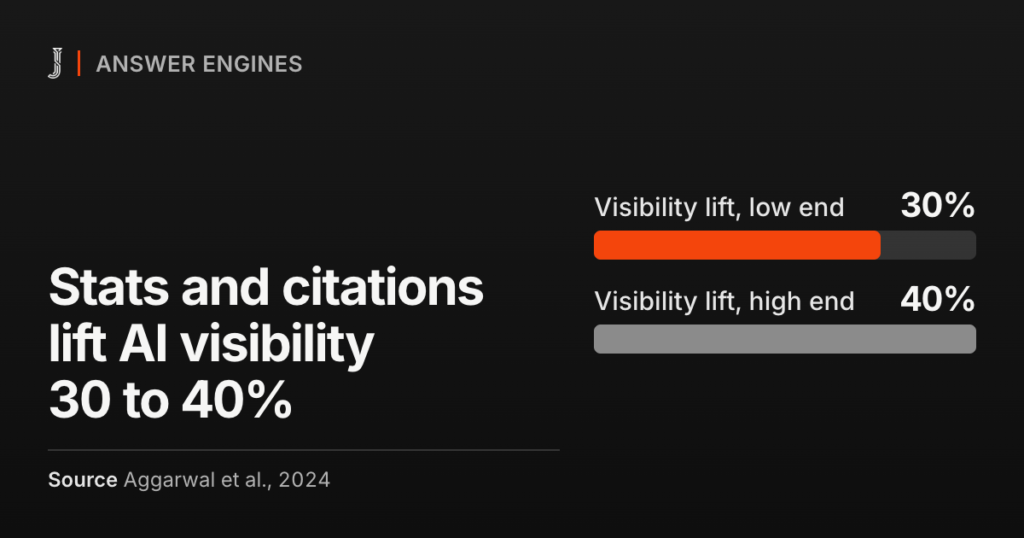
Short answer: AI visibility optimization is getting ChatGPT, Perplexity and Google’s AI answers to name your company when a buyer asks for a recommendation. It runs in nine steps, from a baseline to a week-six re-test. In a 2024 lab test, adding citations, quotations and statistics lifted visibility in AI answers by up to 40 percent. Results vary by site.
AI visibility optimization is the practice of making a company easy for AI answer engines to find, read, trust and name. I am Joshua Jackai, a Vancouver web designer, and I run this work for Canadian B2B firms through Jackai Agency. This guide is the order I run it in, with the research behind each step and the parts nobody can promise you.
In this guide
Key takeaways
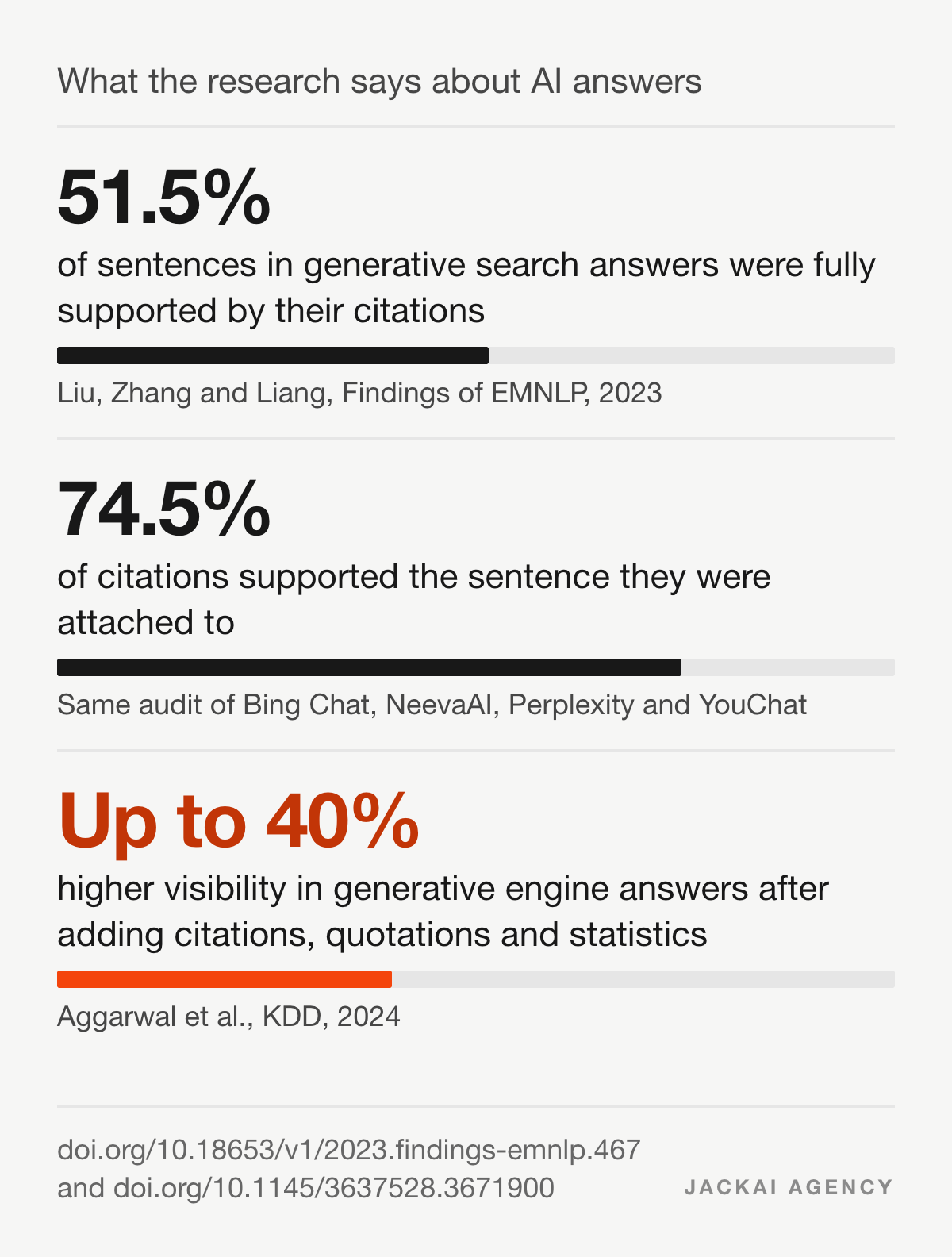
- In a 2024 KDD paper, Aggarwal and colleagues showed adding citations, quotations and statistics raised visibility in generative engine answers by up to 40 percent (KDD 2024).
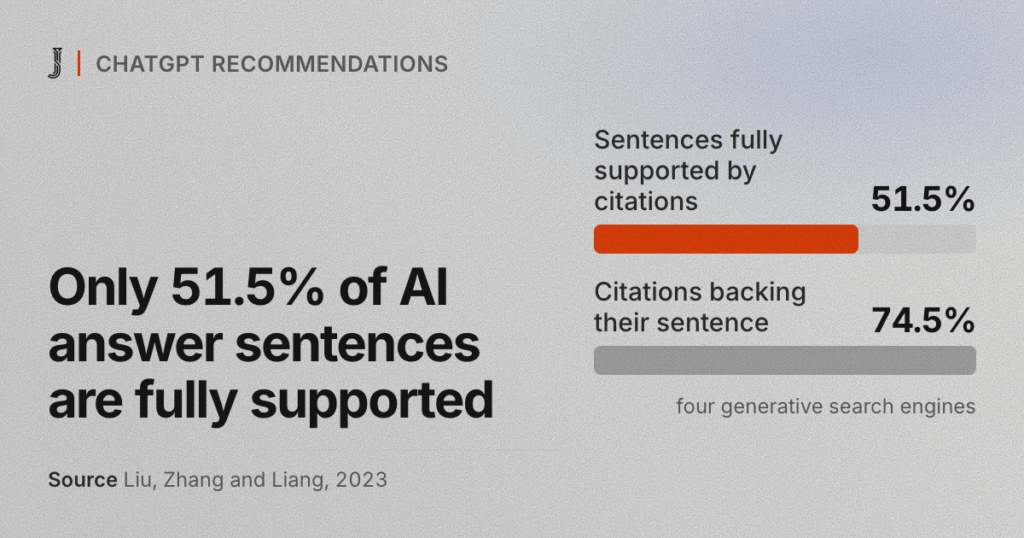
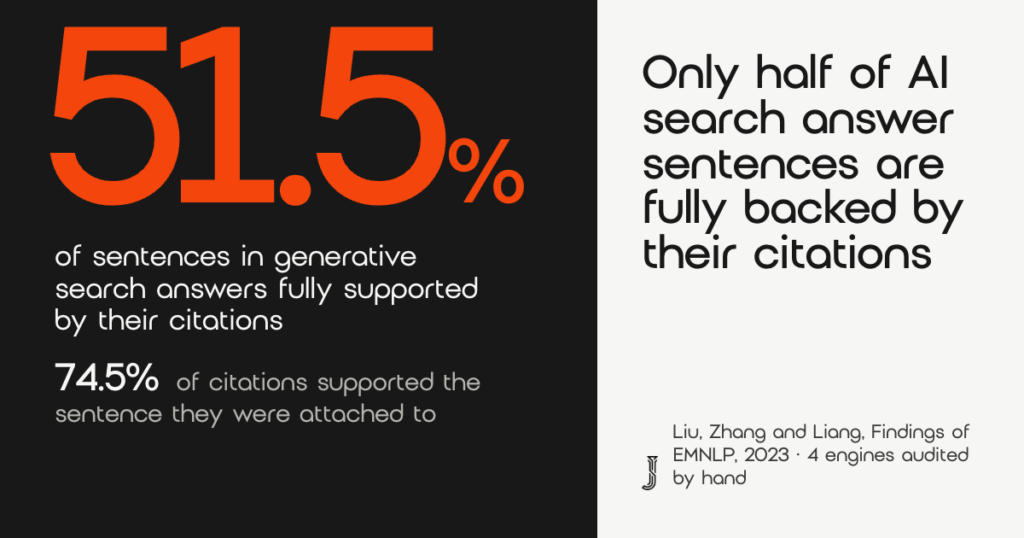
- An audit of four generative search engines found only 51.5 percent of their sentences were fully supported by citations (Liu, Zhang and Liang, EMNLP 2023).
- Language models answered questions about less popular entities worse, and retrieval closed much of the gap, across 14,000 PopQA questions (Mallen and colleagues, ACL 2023).
- OpenAI says sites that block OAI-SearchBot “will not be shown in ChatGPT search answers” (OpenAI crawler documentation).
- Google says there is no special schema or AI text file needed to appear in AI Overviews (Google Search Central).
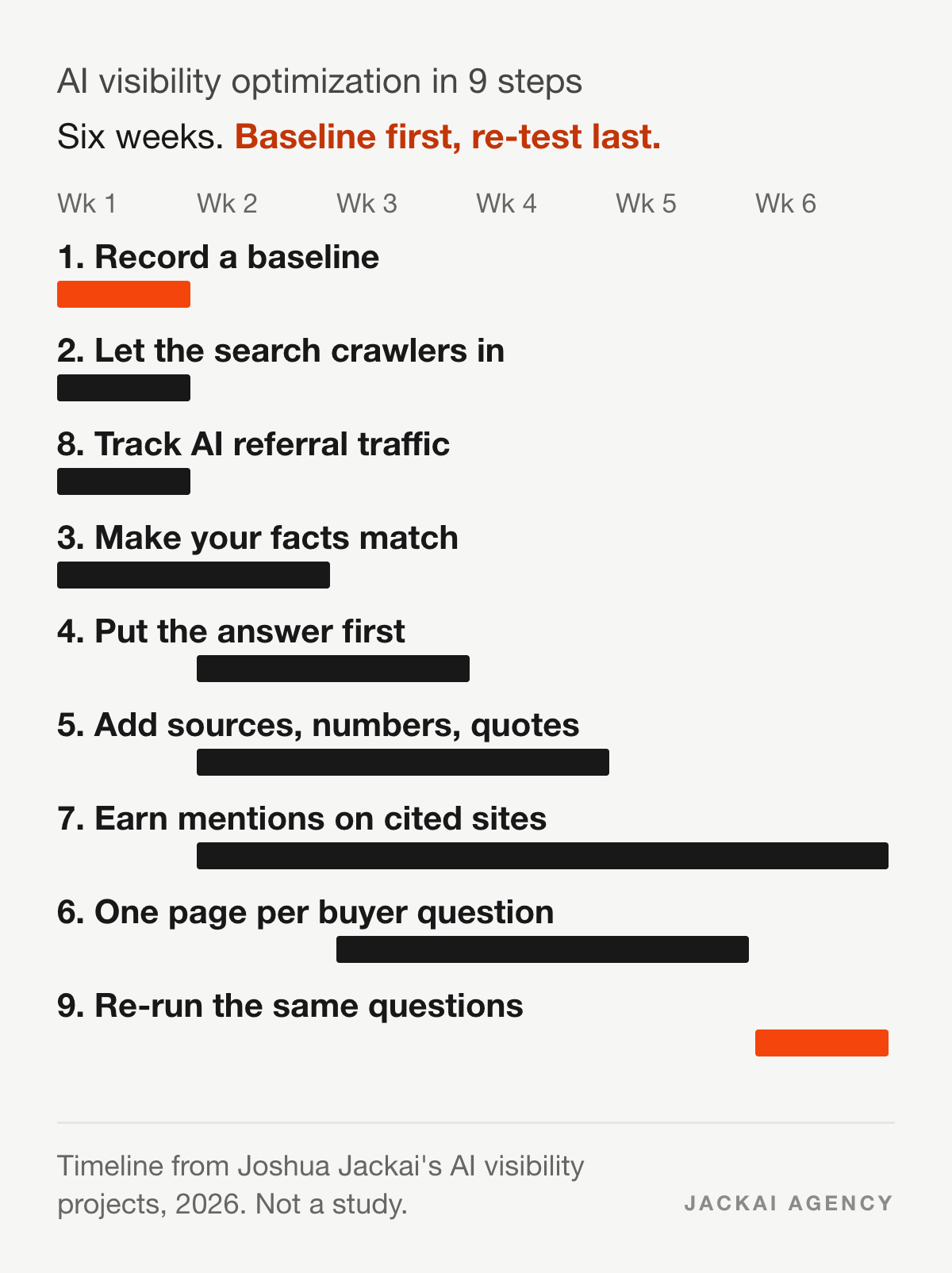
| Step | What changes | Time on my projects |
|---|---|---|
| 1. Record a baseline | You know what each engine says today | Week 1 |
| 2. Let the search crawlers in | OAI-SearchBot, Bingbot and Googlebot can read the site | Week 1 |
| 3. Make your facts match everywhere | One name, one service list, one address | Weeks 1 to 2 |
| 4. Put the answer first on each page | The first lines state who you serve and what you do | Weeks 2 to 3 |
| 5. Add sources, numbers and quotes | Pages carry facts an engine can cite | Weeks 2 to 4 |
| 6. One page per buyer question | Each question has a page that answers it | Weeks 3 to 5 |
| 7. Earn mentions on cited sites | Other sites describe you the same way | Weeks 2 to 6 |
| 8. Track AI referral traffic | Leads from AI answers show as their own source | Week 1 |
| 9. Re-run the same questions | Week six is compared with week one | Week 6 |
1. Record a baseline: best for knowing where you start
A baseline is a written record of what ChatGPT, Perplexity, Claude and Google’s AI answers say about your company today, across the questions your buyers ask. Every B2B firm needs one before changing anything. An EMNLP 2023 audit found only 74.5 percent of citations in generative search answers supported the sentence they were attached to.
- What to record: The question, the engine, the date, every company named, every source cited
- How many questions: 20 to 40, written the way a buyer would type them
- Engines: ChatGPT, Perplexity, Claude, Google AI Overviews and AI Mode
- Output: A spreadsheet you can re-run in week six
Nelson Liu, Tianyi Zhang and Percy Liang audited Bing Chat, NeevaAI, Perplexity and YouChat by hand. On average, 51.5 percent of generated sentences were fully supported by their citations, and 74.5 percent of citations supported their sentence (Findings of EMNLP, 2023).
“Responses from existing generative search engines are fluent and appear informative, but frequently contain unsupported statements and inaccurate citations,” wrote Nelson Liu, Tianyi Zhang and Percy Liang (Findings of EMNLP, 2023).
That is why I record answers verbatim instead of trusting my memory of them. An engine can name you and describe the wrong service. It can cite a page that says nothing about you. Both count as problems to fix.
I write the questions from real buyer language first. For this post I pulled four Vancouver AlsoAsked exports on AI visibility and getting recommended by ChatGPT. They returned 221 unique questions, and many were off topic: jobs, Einstein, making money with AI. The useful ones read like “How do I get ChatGPT to recommend my business?” and “How do I get my business listed on ChatGPT?” Those become baseline prompts, along with “best B2B web designer in Vancouver” style questions for the client’s own category.
Answers change between runs, so I run each question twice and note both. One mention in one run is a signal, not a position.
2. Let the search crawlers in: best for sites that block bots by default
Crawler access decides whether an AI search tool can read your pages at all. It matters most for sites behind a firewall rule, a bot-blocking plugin or a CDN setting that rejects unknown agents. OpenAI states that sites opted out of OAI-SearchBot are not shown in ChatGPT search answers, which makes this a one-line fix with a large effect.
- OpenAI: Allow OAI-SearchBot in robots.txt for ChatGPT search
- Google: Googlebot covers AI Overviews and AI Mode
- Microsoft: Allow Bingbot for Bing search
- Check: robots.txt, the CDN bot rules, the firewall and any security plugin
OpenAI’s crawler documentation is direct about it. It recommends “allowing OAI-SearchBot in your site’s robots.txt file” and says opted-out sites will not appear in ChatGPT search answers (OpenAI, crawler documentation, read 13 October 2026).
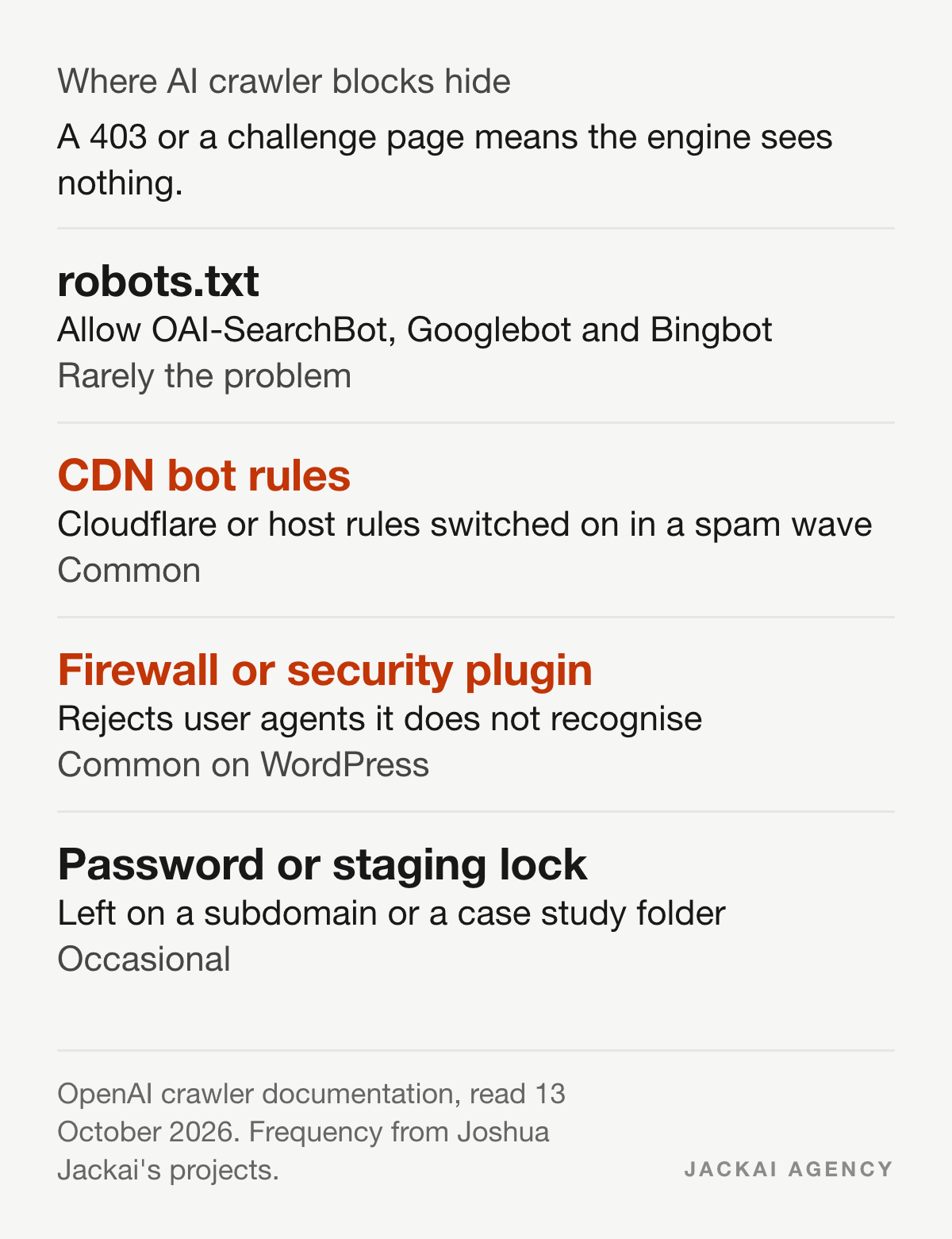
The robots.txt file is the place most people look, and it is rarely the problem. In the sites I have checked, the block has sat outside robots.txt more often than inside it: a Cloudflare bot rule switched on during a spam wave, a WordPress security plugin that rejects agents it does not recognise, or a staging password left on a subdomain that hosts the case studies.
I test it from outside. I request the page with each crawler’s user agent and read the status code. A 403 or a challenge page means the engine sees nothing. Training crawlers are a separate decision. Blocking GPTBot, the training crawler, does not block OAI-SearchBot, so a firm can opt out of training and still appear in ChatGPT search. I talk that choice through with each client instead of making it for them.
“A 403 or a challenge page means the engine sees nothing,” stated Joshua Jackai, Vancouver web designer.
3. Make your facts match everywhere: best for firms with several listings
Entity consistency means your company name, services, location and founders read the same on your site, your Google Business Profile, LinkedIn and every directory. It suits firms with older listings, a rename or a move. Mallen and colleagues found language models know less about less popular entities across 14,000 PopQA questions, so a small firm needs clear, matching facts.
- Name: One legal or trading name, used the same way everywhere
- Services: The same short list on the site, the profile and directories
- Location: One address and service area, written identically
- People: Founder names and titles that match LinkedIn
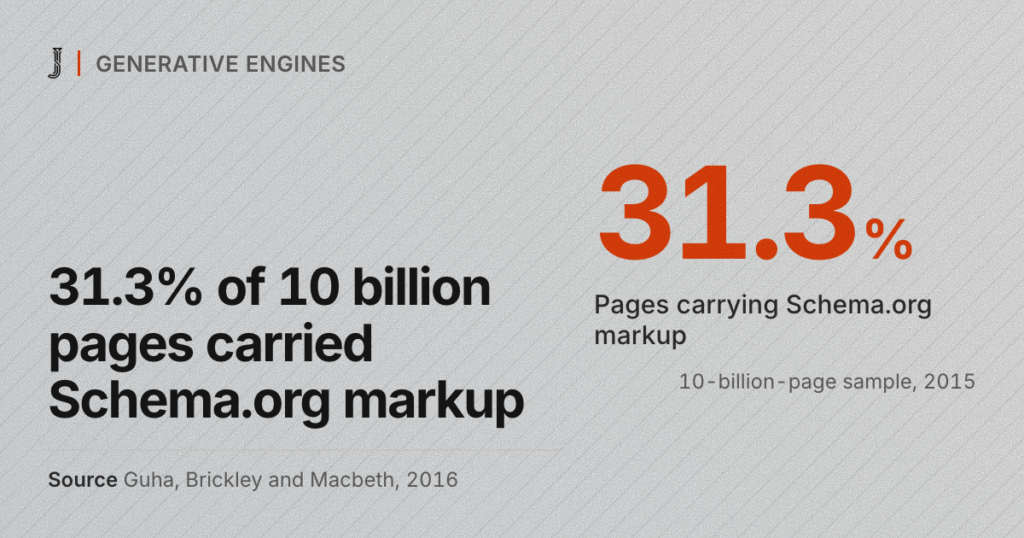
- Markup: Organization and Person structured data that repeats the same facts
Alex Mallen and colleagues tested language models on PopQA, 14,000 questions about entities ranging from famous to obscure. Accuracy fell for less popular entities, and adding retrieved documents helped most in exactly those cases (ACL, 2023).
“We find that LMs struggle with less popular factual knowledge, and that retrieval augmentation helps significantly in these cases,” wrote Alex Mallen and colleagues (ACL, 2023).
A Vancouver accounting firm with 30 staff is a long-tail entity to a language model. The model will not remember it well, so what it says depends on what it retrieves. If the retrieved pages disagree about the firm’s name or services, the answer gets vague or skips the firm.
Structured data helps by repeating facts in a machine-readable form. I add Organization, Person and Service markup on every project. Google is clear that it is not a requirement for AI Overviews, so I treat markup as a consistency layer, not a ranking trick. The bigger win is usually older: a directory listing that still shows a name from before a rebrand, or a LinkedIn page with a service the firm dropped two years ago. I fix those first, because an engine reading three versions of the truth has no reason to pick yours.
4. Put the answer first on each page: best for long service pages
Answer-first writing puts the page’s main claim in its opening lines: who the firm serves, what it does and where. It suits service pages that open with a slogan or a story. Liu and colleagues found in 2024 that language models used information best when it sat at the start or end of a long input.
- First sentence: What the service is and who it is for
- Second sentence: One number or named proof
- Headings: Written as the questions buyers type
- Length: 40 to 60 words before the first heading, my practice rather than a studied figure
Nelson Liu and colleagues tested models on multi-document question answering and found accuracy dropped when the relevant passage moved to the middle of the input (Transactions of the ACL, 2024).
“Performance is often highest when relevant information occurs at the beginning or end of the input context,” wrote Nelson Liu and colleagues (Transactions of the ACL, 2024).
That study tested models reading long inputs, not web pages ranked by a search engine, so I treat it as direction rather than proof. It matches what I see in baselines, though. When an engine describes a firm, it tends to lift the opening claim of the page it retrieved.
The fix is plain. “Elevating your financial future” tells an engine nothing. “Fee-only financial planning for physicians in Greater Vancouver” tells it the service, the buyer and the place in eight words. I rewrite the first two sentences of every service page that way before I touch anything else on it. The same rule applies to case studies. The client, the problem and the result go in the opening lines, and the story of the project comes after them for the readers who want it.
5. Add sources, numbers and quotes: best for pages that make claims
Citable content gives an engine a fact it can repeat with a source attached: a number, a named study, a quote from a real person. It suits pages that make claims with no support. In the GEO study, the methods that added citations, quotations and statistics raised visibility in generative engine answers by up to 40 percent.
- Numbers: One sourced figure per claim that matters
- Sources: Linked inline, with author, publication and year
- Quotes: Verbatim, from a real person or paper, never invented
- Proof: Client results with the client named and the period stated
Pranjal Aggarwal and colleagues at Princeton University and IIT Delhi built GEO-bench, a large set of queries across domains, and tested several ways of editing source pages. Adding citations, quotations and statistics did best, and the gains varied by domain (KDD, 2024).
“We demonstrate that GEO can boost visibility by up to 40% in generative engine responses,” wrote Pranjal Aggarwal and colleagues (KDD, 2024).
The study measured visibility inside generative engine answers it ran itself, so the 40 percent is a ceiling from a lab, not a promise for your site. I read it as a ranking of which edits are worth the effort, and as a reason to put the evidence on the page instead of in a sales deck.
The rule I hold to is the boring one. Every number on a page I publish has a source a reader can open. If a client has a result, I name the client and the period. If they do not, the page says what we did, not what it earned. An engine that cites a made-up number is a liability for the firm it names.
“Every number on a page I publish has a source a reader can open,” stated Joshua Jackai, Vancouver web designer.
6. One page per buyer question: best for firms with several services
A question page answers one buying question in depth: what it costs, how long it takes, how it works, who it suits. It suits firms whose services sit on one crowded page. Pirolli and Card’s information foraging research from 1999 shows people follow the cues that match what they are looking for and leave when those cues fade.
- Source of questions: Sales calls, AlsoAsked, Search Console, the baseline
- One job: One question, one answer up top, detail below
- FAQ: Only questions the page has not already answered
- Links: To the matching service page and case study
Peter Pirolli and Stuart Card described people searching for information the way animals forage for food: they follow “information scent” and abandon a path when it weakens (Psychological Review, 1999). That study describes human readers. Applying it to retrieval systems, which pull the passage that best matches a question, is my reasoning, not a finding.
A single “Services” page that lists six offers gives every buyer and every engine a weak match. A page titled “How much does a WordPress rebuild cost in Canada?” that answers in its first line gives both a strong one. That is why my own site has separate pages for generative engine optimization, answer engine optimization and getting recommended by ChatGPT instead of one AI page.
“One mention in one run is a signal, not a position,” stated Joshua Jackai, Vancouver web designer.
I keep FAQ sections short and new. If an FAQ answer repeats a paragraph above it, I delete the question. Engines and readers both skip repetition. The questions that survive usually come from sales calls, not keyword tools: what happens to our rankings, who owns the content, what if the engine still ignores us. Those are the ones I answer on the page.
7. Earn mentions on the sites engines cite: best for firms with few reviews
Third-party mentions describe your firm on sites you do not control: directories, associations, review platforms, podcasts and local press. Engines weigh what other sites say about you, so a full listing on a directory they already cite can beat another post on your own site. Brin and Page built Google in 1998 on links from other pages.
- Where to look: The sources each engine cited in your baseline
- Directories: Clutch, industry associations, chambers of commerce
- Reviews: Google Business Profile reviews that mention the service by name
- Wording: Ask partners to describe you with your own service list
Sergey Brin and Lawrence Page described a search engine that ranked pages by the links pointing at them, built on a database of at least 24 million pages (Computer Networks and ISDN Systems, 1998). That paper covers link-based ranking, not AI answers. Which sites an engine cites, I read from each baseline rather than from a study.
Your baseline tells you where to start. If Perplexity keeps citing one Vancouver directory for “B2B web design” questions, a complete, accurate listing there is worth more than another blog post. I note every cited domain in the baseline and rank them by how often they appear.
Reviews help when they name the work. “Great to work with” does little. “Rebuilt our WordPress site and kept our rankings” gives an engine a service and an outcome. I never write reviews for clients or suggest wording beyond asking them to say what we did. Bought or scripted reviews break Google’s rules and put the whole listing at risk.
8. Track AI referral traffic: best for firms that report leads by source
AI referral tracking separates visits and leads that arrive from ChatGPT, Perplexity, Copilot and Gemini from the rest of your traffic. It suits any firm that reports pipeline by source. Without it, AI visits often land in “direct”, so you cannot tie leads to the answers that produced them. I track four engines on every project.
- Analytics: A channel group for chatgpt.com, perplexity.ai, copilot.microsoft.com and gemini.google.com
- Forms: A hidden field that carries the referrer and landing page into the CRM
- CRM: “AI answer” as its own lead source value
- Report: AI-sourced leads and deals, monthly
I set this up in week one, before the content changes, so the before and after numbers come from the same setup. My lead attribution method puts UTM parameters on every link, carries the tags into the CRM through the form, records the landing page and separates AI referral traffic from direct.
Some AI traffic arrives with no referrer at all. Apps strip it, and some people copy a link and paste it. So I also add “How did you hear about us?” to the contact form with “ChatGPT or another AI tool” as an option. Self-reported source and tracked source rarely match exactly, and the gap is useful information.
This is also where the work proves its value or does not. If a firm is named in more answers by week six but no AI-sourced lead appears in three months, I say so in the report. Visibility that never turns into a conversation is a finding, not a win, and it usually points back to the service page or the form.
9. Re-run the same questions: best for proving what changed
A re-test runs the exact baseline questions through the same engines after the changes and compares the answers line by line. Every engagement needs one. Ji and colleagues’ 2023 survey in ACM Computing Surveys documents how language models still produce unsupported content, so I compare what each engine says, not only whether it names you.
- Same questions: Word for word, no new prompts added
- Same engines: ChatGPT, Perplexity, Claude, Google AI answers
- What to compare: Named or not, described correctly or not, which page cited
- When: Week six, then quarterly
Ziwei Ji and colleagues reviewed hallucination across summarisation, dialogue, question answering and other generation tasks, and treat unsupported output as a persistent problem rather than a solved one (ACM Computing Surveys, 2023).
My report has three columns per question: week one, week six, and what changed on the site that could explain it. Some answers improve. Some do not move. Occasionally one gets worse because a competitor published something better. I report all three, with the page each engine cited, so the next round of edits goes where it can make a difference.
The engines also change. A model update can shift answers across every question in a week, for every firm in the category. That is why a single re-test is a snapshot, and why I recommend running the set quarterly once the work is done.
“A single re-test is a snapshot,” stated Joshua Jackai, Vancouver web designer.
I also keep the screenshots. When a client asks in six months why an answer changed, the dated record shows what each engine said and which page it cited at the time. Without it, everyone argues from memory, and memory flatters whoever is speaking. A shared folder with one screenshot per question per engine takes an afternoon to build and saves that argument later.
Compare the nine steps by effort and owner
The matrix sorts the nine steps by who usually owns them and how much effort they take, so a marketing lead can split the work between their team, IT and an outside designer. Filter by owner or effort; rows are hidden, not deleted. Time estimates come from my projects, not from a study.
| Step | Owner | Effort | Start this week |
|---|---|---|---|
| 1. Record a baseline | Marketing | Low | Yes |
| 2. Let the search crawlers in | IT or developer | Low | Yes |
| 3. Make your facts match everywhere | Marketing | Medium | Yes |
| 4. Put the answer first on each page | Writer or designer | Medium | Yes |
| 5. Add sources, numbers and quotes | Writer | Medium | No |
| 6. One page per buyer question | Writer and developer | High | No |
| 7. Earn mentions on cited sites | Marketing and founder | High | No |
| 8. Track AI referral traffic | Developer and marketing | Low | Yes |
| 9. Re-run the same questions | Marketing | Low | No |
Showing 9 of 9 steps.
AI answer share calculator. Enter counts from your own baseline. The defaults are placeholders.
Work out your AI answer share
AI answer share is the percentage of your baseline answers that name your firm. The calculator takes three numbers from your own baseline and returns your share, your top competitor’s share and the gap between them. The default values are placeholders; replace them with your own counts.
The formula is simple: answers naming you divided by answers checked, times 100. If you check 40 answers and 6 name you while 15 name a competitor, your share is 15 percent and theirs is 37.5 percent. Track the same number at week six.
Questions buyers ask about AI visibility
These are the questions from the Vancouver AlsoAsked exports that the nine steps do not already answer. Each answer is short and states what I know, what the vendors say and what nobody can promise. Prices are in Canadian dollars from my October 2026 price table.
Can you pay ChatGPT to recommend your business?
No, not inside the answer. TechInformed reports OpenAI began testing ads for free and Go users in the US in early 2026 and that OpenAI says ads sit below answers and do not influence them (TechInformed, 2026). Being named in the answer itself still depends on what the engine finds.
Is SEO dead now with AI?
No. Google says “all existing SEO fundamentals continue to be worthwhile” for AI Overviews and AI Mode (Google Search Central). ChatGPT search also reads the web through crawlers. Pages that rank, load and answer clearly are the pages engines retrieve, so SEO is the floor of this work.
How much does AI visibility optimization cost in Canada?
As of October 2026, Jackai Agency’s AI Visibility Optimization engagement is CA$4,775 for six weeks on your existing site, covering the baseline, structured data, service page rewrites, FAQ content and a week-six comparison. The free AI Visibility Report comes first. A CA$995 audit suits firms needing site fixes.
How do I get recommended by ChatGPT?
ChatGPT names a company when its search crawler can read the site, the company’s facts match across the web, and each page opens with the service, buyer and place. Nobody can pay for a place inside the answer. Steps 2, 3 and 4 cover it.
How do I check my AI visibility?
Write 20 to 40 questions your buyers ask, run each through ChatGPT, Perplexity, Claude and Google, and record who gets named and which pages are cited. Run each twice, because answers vary. Paid tracking tools automate this, but a spreadsheet works for the first baseline.
How I run AI visibility optimization for Vancouver firms
I run all nine steps as one six-week engagement for Canadian B2B firms, on the website they already have. It costs CA$4,775 and starts with a recorded baseline and ends with the same questions re-run. Firms that want to see where they stand first can start with the free report.
The AI Visibility Optimization service covers steps one to six, eight and nine, and gives you the list for step seven. The free AI Visibility Report runs your buyer questions through the engines within 24 hours and names the three fixes I would make first. If your site also needs a rebuild, the CA$995 website audit is credited in full against the project.
Sources
Peer-reviewed research
- Aggarwal, P., Murahari, V., Rajpurohit, T., Kalyan, A., Narasimhan, K. and Deshpande, A. (2024). GEO: Generative Engine Optimization. Proceedings of the 30th ACM SIGKDD Conference on Knowledge Discovery and Data Mining. https://doi.org/10.1145/3637528.3671900
- Brin, S. and Page, L. (1998). The anatomy of a large-scale hypertextual Web search engine. Computer Networks and ISDN Systems. https://doi.org/10.1016/S0169-7552(98)00110-X
- Ji, Z., Lee, N., Frieske, R., Yu, T. and colleagues (2023). Survey of hallucination in natural language generation. ACM Computing Surveys. https://doi.org/10.1145/3571730
- Liu, N. F., Lin, K., Hewitt, J., Paranjape, A., Bevilacqua, M., Petroni, F. and Liang, P. (2024). Lost in the middle: How language models use long contexts. Transactions of the Association for Computational Linguistics. https://doi.org/10.1162/tacl_a_00638
- Liu, N. F., Zhang, T. and Liang, P. (2023). Evaluating verifiability in generative search engines. Findings of the Association for Computational Linguistics: EMNLP 2023. https://doi.org/10.18653/v1/2023.findings-emnlp.467
- Mallen, A., Asai, A., Zhong, V., Das, R., Khashabi, D. and Hajishirzi, H. (2023). When not to trust language models: Investigating effectiveness of parametric and non-parametric memories. Proceedings of the 61st Annual Meeting of the ACL. https://doi.org/10.18653/v1/2023.acl-long.546
- Pirolli, P. and Card, S. (1999). Information foraging. Psychological Review. https://doi.org/10.1037/0033-295X.106.4.643
Industry and vendor sources (not peer reviewed)
- Google Search Central. AI features and your website. Read 13 October 2026. https://developers.google.com/search/docs/appearance/ai-features
- OpenAI. Overview of OpenAI crawlers. Read 13 October 2026. https://developers.openai.com/api/docs/bots
- TechInformed. OpenAI begins testing ads in ChatGPT in the US. 2026. https://techinformed.com/openai-begins-testing-ads-in-chatgpt-in-the-us/
- AlsoAsked. Vancouver, British Columbia exports for four AI visibility seeds, pulled October 2026 (first-party research).