Answer Engine Optimization: How to Write Pages AI Can Quote
How to write pages that Google AI Overviews, ChatGPT and Perplexity can quote: answer-first sections, question headings, honest markup and FAQs with new facts.
 Joshua Jackai
14 min read
Joshua Jackai
14 min read
A marketing lead at a 60-person accounting firm asks Google how long a website migration takes. The AI answer loads before any link does, and it quotes a competitor. Not because the competitor is faster. Because their page answered in its first sentence, and yours answered in paragraph four. That gap is what answer engine optimization fixes, one page at a time.
An answer engine is any system that answers a question directly instead of handing over ten links: Google AI Overviews, ChatGPT search, Perplexity and Claude. Each one lifts a short passage, writes an answer around it, and sometimes names the source. This post covers the sections, headings, markup and FAQ blocks on a single page.
I rebuild service pages this way for B2B and professional-service firms at Jackai Agency in Vancouver. How AI search picks sources across the whole web is a separate subject.
In this guide
What is answer engine optimization, at the level of one page?
Answer engine optimization is the practice of writing and marking up each section of a page so a machine can lift one passage, understand it without the rest of the page, and credit it to you. The unit that competes is not the page. It is a heading plus the paragraph under it.
That follows from how these systems find text. Open-domain question-answering systems first retrieve candidate passages, then build the answer from those (Karpukhin et al., 2020). A page with one strong passage can be quoted. A page with good information spread thinly across six paragraphs often cannot.
Answer engine optimization does not replace search basics. Google’s documentation says there are no extra requirements to appear in AI Overviews: the page has to be indexed and eligible to show with a snippet, like any other result (Google Search Central, updated December 2025). What changes is the writing inside each section.
So it is not a new kind of page. It is a stricter way of writing the page you already have.
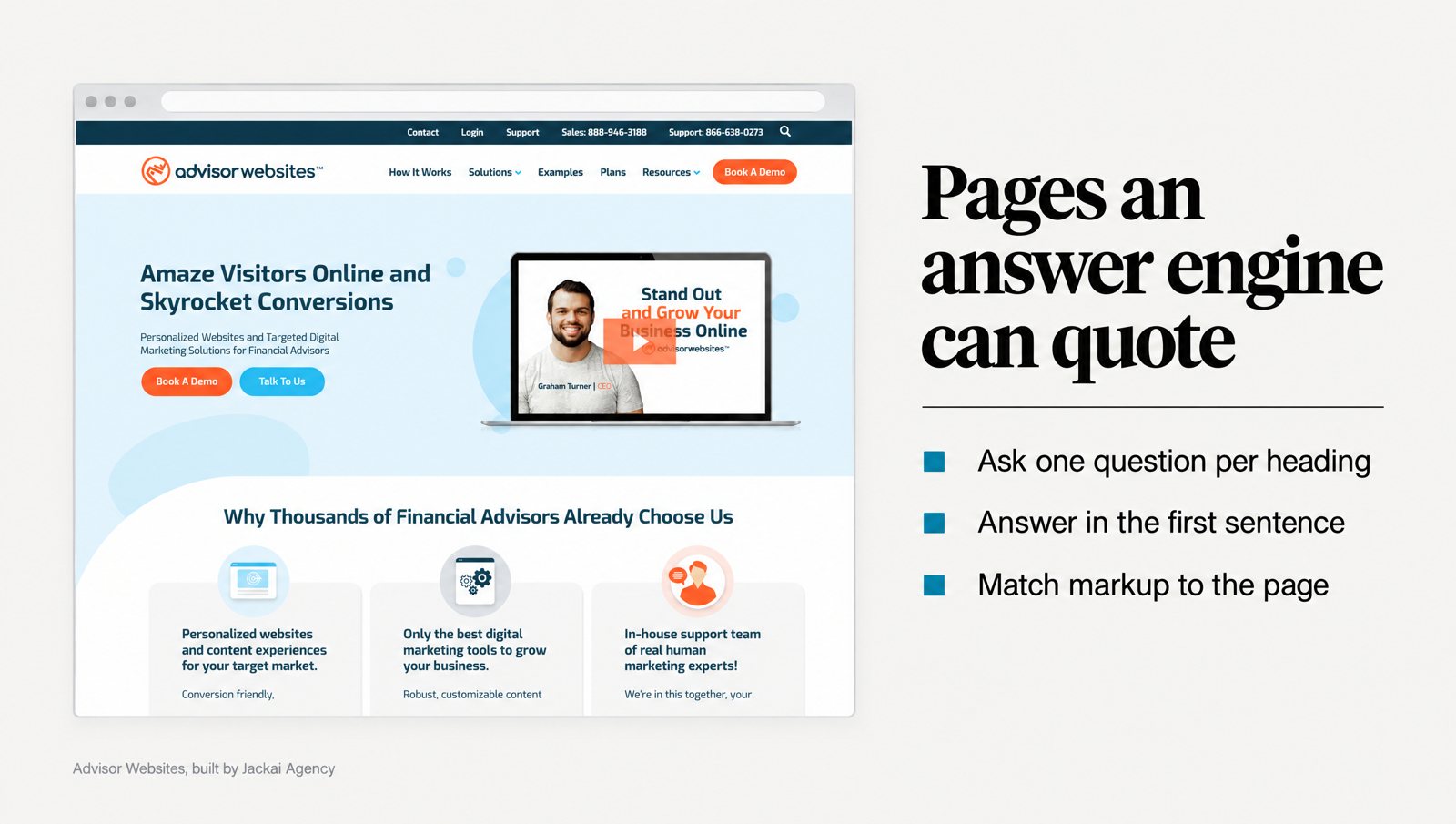
Why should every section answer its heading in the first sentence?
Because both kinds of reader decide from the top of each section. People judge the value of information from nearby cues, such as a heading or a first line, and spend their time where the payoff looks highest (Pirolli and Card, 1999).
Language models show a related pattern: on long inputs, they used relevant information best at the start or the end and worse in the middle (Liu et al., 2024). That study tested model inputs, not web pages, so this part is my inference: an answer in sentence one is a safer bet than one in paragraph three.
A typical services page answers “How long does a website take?” like this:
Every project is different. We start with discovery, and timelines depend on many factors, including scope and content readiness.
Nothing in that can be quoted, because nothing in it is an answer. The rewrite for Jackai Agency’s own page reads:
A five-page small business website from Jackai Agency takes two to three weeks from the day the content is ready. It costs CA$4,950 on Framer or CA$5,950 on WordPress, on a fixed quote.
That passage survives being lifted. It names the business, the scope, the time, the condition and the price. This is the first rule of answer engine optimization, and most pages break it in the opening line.
- Answer, then support. The first sentence answers the heading in full. The next two or three give the condition, the number or the exception.
- Name the subject. Write the business or service name instead of “we” or “this service”. A lifted passage loses the page around it, so a pronoun points at nothing.
- Put the number in the answer. A price, a timeline or a count says more than any adjective.
- Keep the answer block short. I aim for 40 to 60 words. That is my working limit, not a published rule.
How do you build question-led pages from what buyers actually ask?
Question-led pages start from a list of real questions, not from a sitemap. Each question gets its own H2 in the buyer’s words, and the section under it answers that question and nothing else. For answer engine optimization, the question list matters more than the copy, because a page cannot be quoted for a question it never asks.
One wrinkle: buyers rarely type full questions. A 2015 study of queries sent to a major search engine found that about one query in ten carried a direct question, yet only a small share were typed as questions (White, Richardson and Yih, 2015). People type “hubspot migration cost” and mean “how much will this cost us?” So I write the heading as the question and make sure the answer sentence also holds the plain keyword form.
Where the questions come from, in the order I check them:
- Sales calls and emails. What prospects asked before the proposal went out. No tool has this list.
- Search Console. The queries the page already shows for, filtered for words like how, what, cost and vs.
- Procurement questions. Who owns the site, what the contract covers, what happens if the vendor disappears.
- The engines themselves. Run your buyers’ questions through ChatGPT, Claude and Google AI Overviews and note which competitors get named.
Then order the sections the way a buyer decides: what it is, who it is for, what it costs, how long it takes, what can go wrong, what happens next.
Not every heading needs a question mark. A statement works when it names the thing being asked, like “Website migration with no redesign: CA$2,500”. Question-led pages go wrong when every heading becomes a question nobody types, or when one H2 stacks three questions and answers none of them well.
What changed on the Advisor Websites and Snappy Kraken pages?
Two projects for financial-advisor SaaS companies show the idea in practice. Both came down to question-led pages: each buyer question got a page, or a sentence, that could stand alone.
Advisor Websites, a Vancouver SaaS platform that builds websites for financial advisors, ran webinars that stopped earning the day after they aired. The recordings lived in email and expired with the invitation, so an advisor who came back later found a registration page for an event already over.
The rebuild gave each replay a page of its own: a title, a plain-language summary at the top, the recording and one next action, built as a template the marketing team could fill. Each page got a stable address that search and answer engines can find and cite. The result was +58% organic traffic and +28% MQL conversion, both from the replay library and opt-in templates.
The webinars already existed as recordings. What they lacked was a page. One honest limit: neither number is an AI citation count. They are organic traffic and lead conversion, and I do not report them as anything else.
Snappy Kraken, a B2B FinTech SaaS selling marketing systems to financial advisors, had a different gap. Its pricing page carried the most traffic and the least design: three columns, nine rows of feature names, and no sentence for an advisor who had to justify the number to a partner.
The rebuilt page states plan differences in plain sentences, answers the main objection beside the price, and gives each screen one action. It went from Figma to production on HubSpot CMS in 3 weeks, and the work influenced 7 figures of ARR. That figure is influenced, not attributed: sales, pricing and product all moved in the same period.
The answer engine optimization lesson from both is the same. A tick in a table cannot be quoted. A sentence that says what changes between two plans can. And because the Snappy Kraken team edits its own design system, the answers can stay current when prices change.
Which structured data matters for answer engine optimization?
Structured data exists because machines reading plain HTML had to guess. Before shared vocabularies, services like web search built custom extractors to pull facts out of page layouts, and those scrapers broke whenever a site changed its design (Guha, Brickley and Macbeth, 2016). Schema.org markup states the facts directly.
On a B2B service site, five kinds of markup do most of the work:
| Page | Schema.org type | What it tells a machine |
|---|---|---|
| Home or about page | Organization, Person | Who the business is, where it is, who runs it |
| Service page | Service, Offer | What is sold, for how much, in which area |
| Blog post or guide | Article, with Person as author | Who wrote it and when it last changed |
| Every page below the home page | BreadcrumbList | Where the page sits in the site |
| FAQ block | FAQPage | Which answer belongs to which question |
Two cautions apply. First, FAQPage markup no longer earns a visual result for most sites. Since August 2023, Google shows FAQ rich results only for well-known government and health websites, and says unused markup causes no problems but has no visible effect. I still add it, because it takes minutes and labels each question and answer for any machine. I do not sell it as a ranking lever.
Second, markup has to match what the page shows. Google’s structured data guidelines say not to mark up content that readers cannot see. If the JSON-LD says CA$4,775 and the page says “contact us for pricing”, the site is telling two stories.
Nobody outside the engines knows how much weight ChatGPT or Perplexity give to markup. My view is narrower: structured data confirms a passage. It does not replace one.
How do you write an FAQ block that adds new information?
Most FAQ blocks repeat the page above them in question form. In answer engine optimization, an FAQ earns its place only with facts the page does not already hold. In a series of instruction experiments, adding explanatory material that seemed useful but was not essential made learning worse, even when it was well placed (Chandler and Sweller, 1991). For a buyer, a repeated answer is reading time with nothing in it. For an engine, as I see it, it is a duplicate passage.
My test is simple: delete the FAQ block and reread the page. If no fact is lost, the FAQ was only restating, and it should go.
New information comes from objections and edge cases. My own terms are a good example: none of them belong in a service description, and procurement asks every one.
- Who owns the site after launch? You do: the site, the domain and the hosting.
- How many rounds of changes are included? Two revision rounds per phase, on a fixed quote.
- How fast will I hear back? Within one business day.
- Do I need a new website first? No. AI Visibility Optimization runs on the site you already have.
I keep a block to four to eight questions, marked up with FAQPage structured data. Each answer opens with yes, no or the number, then one sentence of condition. If an answer needs more than about 80 words, it has earned its own H2 higher up the page.

How do you rewrite one service page, step by step?
This is the answer engine optimization order I work in on a single page, assuming it already says roughly the right things in the wrong places.
- Record the baseline. Run the page’s five to ten buyer questions through ChatGPT, Claude and Google AI Overviews. Save the answers word for word with the date, because they change week to week.
- Map one question to one H2. Order them the way the buyer decides. Cut any section that answers a question nobody asked.
- Rewrite every first sentence. Each one answers its heading in full, names the business or service, and carries the number.
- Add one proof line per claim. A named client, the number and its caveat, linked to the case study.
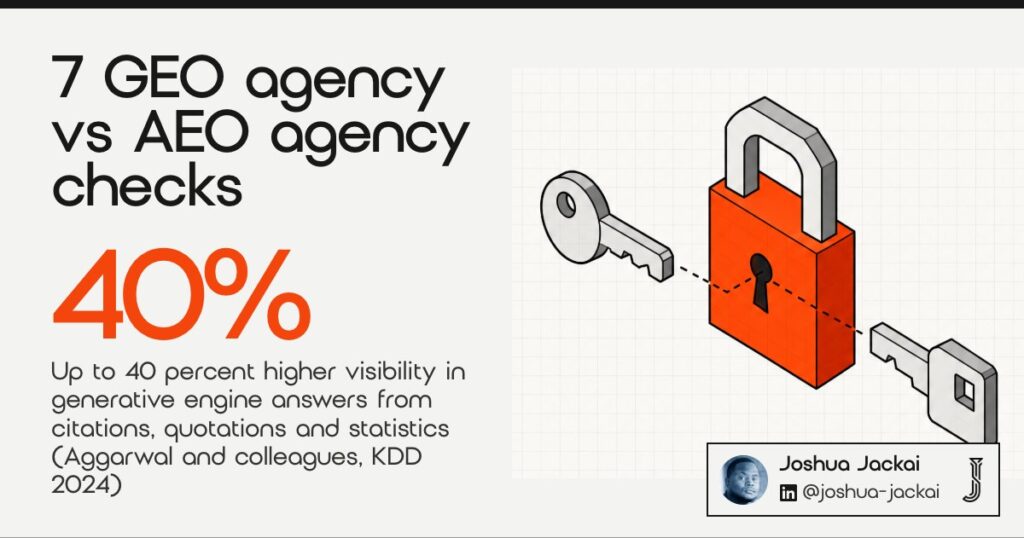
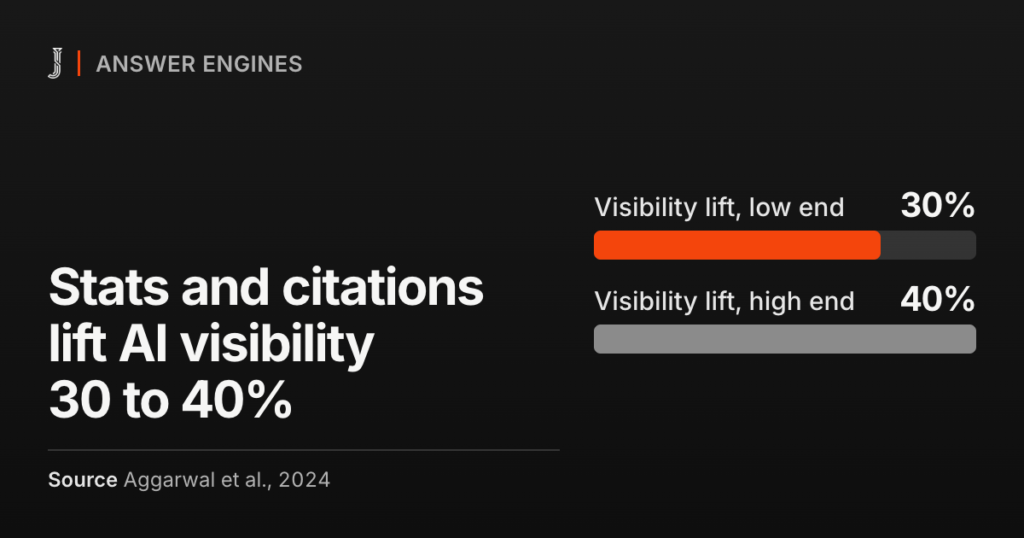
- Add facts an answer can use. In a 2024 study, adding statistics, quotations and cited sources to page text raised visibility in generative engine answers by 30 to 40%, while keyword stuffing performed poorly (Aggarwal et al., 2024).
- Write the FAQ from objections only. Then run the delete test.
- Add structured data that matches the visible text. Then validate it.
- Run the lift test. Copy the first paragraph of each section into a blank document. If it no longer says who, what and how much, or it leans on “we” and “this”, rewrite it.
Here is step 3 on a pricing question. The heading reads “How much does AI visibility work cost?” The first sentence reads: “AI Visibility Optimization at Jackai Agency costs CA$4,775 and takes six weeks on the site you already have.” A buyer who reads only that line has the answer.
Step 8 catches the most problems, because phrases like “as mentioned above” and “our approach” do not survive outside the page. Question-led pages pass because each section was written to stand alone.
Where does answer engine optimization stop working?
It stops where the answer stops needing you. When AI Overviews or a chat answer settles the question, many people never click. A 2009 study of abandoned searches called this good abandonment: the need was met on the results page, more often on mobile than on desktop (Li, Huffman and Tokuda, 2009). If your quoted passage never says your name, you gave the answer away and kept nothing.
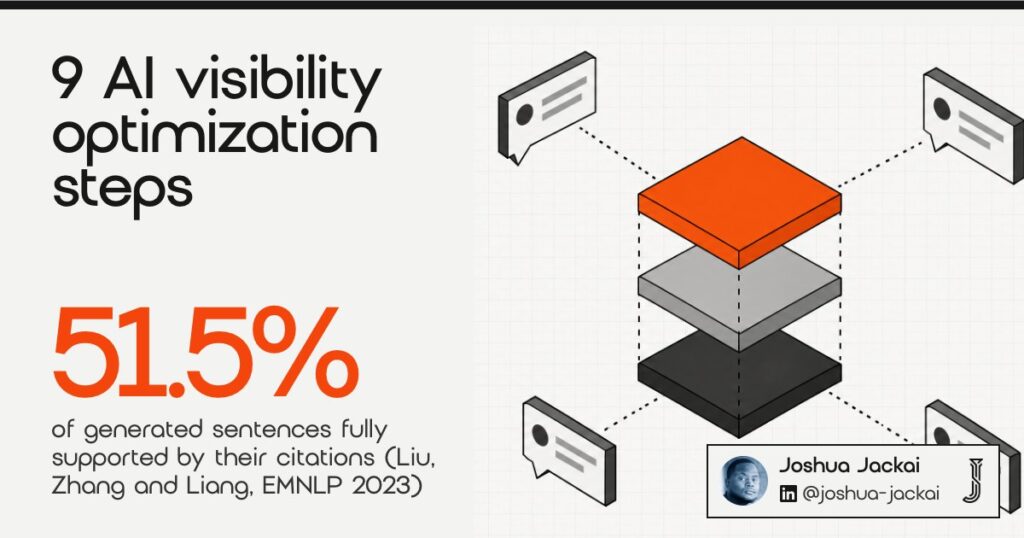
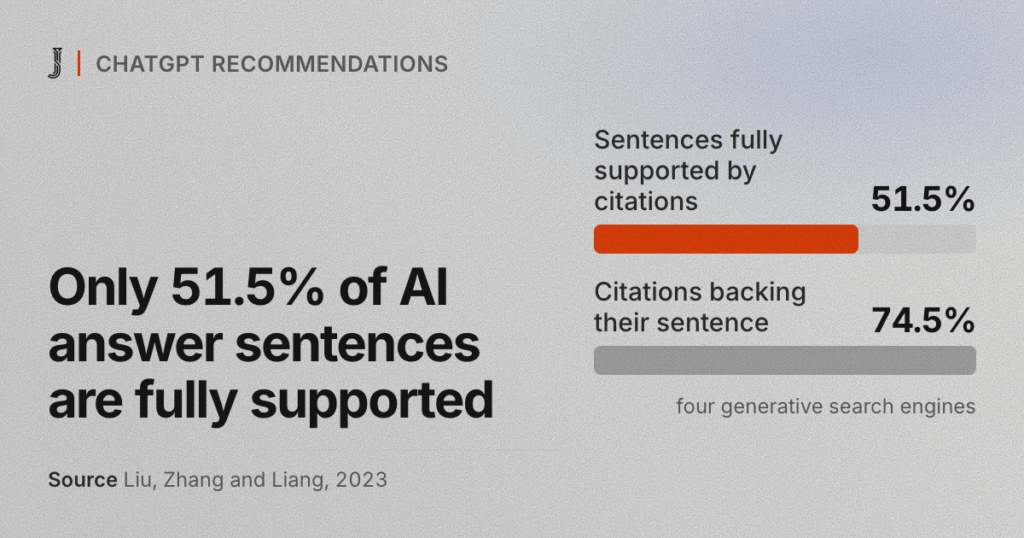
It also stops where engines misread you. An audit of four generative search engines found only 51.5% of generated sentences were fully supported by their citations, and only 74.5% of citations supported the sentence they were attached to (Liu, Zhang and Liang, 2023). You can be cited for something you never said, which is a reason to check the answers, not a reason to stop.
What I would not do:
- Write 30 FAQs for every long-tail query. It buries the eight that matter.
- Mark up anything the page does not show. It breaks Google’s guidelines.
- Chase questions buyers do not ask before buying. “What is a website?” brings students, not budgets.
- Turn a case study into a Q&A list. A story needs its order. Answer-first sections belong on service, pricing and comparison pages.
- Promise citations. Nobody can guarantee that ChatGPT or Google will quote a page, and I do not.
When answer engine optimization work stalls on a page, this table is where I start:
| What you see | What it usually means | First fix |
|---|---|---|
| The page ranks on page one but never shows up in AI Overviews | The answer sits below an intro paragraph | Move the answer into the first sentence of each section |
| Engines name a competitor for your core service question | No page answers that question directly | Write one section, or one page, for that question |
| An engine quotes an old price or service | An outdated page, PDF or markup is still live | Update or redirect it, then check the markup matches |
| Engines describe you vaguely, as “a design agency” | No passage states who you are, where, and for whom | An about passage with name, city and service, plus Organization structured data |
| The FAQ block earns nothing | It repeats the page | Rewrite it from objections, or delete it |
How do you check whether the changes worked?
Measure answer engine optimization per page, not per brand, with three checks.
- The same questions, the same engines. Six weeks later, rerun the baseline set in ChatGPT, Claude and Google AI Overviews. Note which answers now quote the page, which still name a competitor, and which got your facts wrong.
- Search Console for that URL. Queries, impressions and clicks, before and after. On question-led pages, look at question-form queries on their own.
- Leads that name their source. If AI referral traffic lands in the direct bucket, a citation is invisible. The lead attribution method separates it out as its own line.
On cost and time: the AI Visibility Optimization engagement covers GEO and AEO in six weeks for CA$4,775, on your existing site. It includes the week-one baseline, structured data, answer-first service pages, FAQ content and a week-six comparison. No ranking or citation is guaranteed. Every other price is on the pricing page.
If you would rather do answer engine optimization in-house, the eight steps above are the whole method. It needs no special software, only someone willing to rewrite first sentences until each one stands alone.
Which of your pages already answers the question?
Answer engine optimization does not need your services to change. Same offer. Same prices. Same site. What changes is whether the first sentence under each heading answers it.
The quickest way to see where you stand is the free AI Visibility Report. Send one URL and a work email. Within 24 hours you get a dated one-page report: what ChatGPT, Claude and Google AI Overviews say about your company, which competitors they name instead, what they could not find on your site, and three fixes in priority order. No sales call unless you book one.
Sources
Peer-reviewed research
- Aggarwal, P. et al. (2024). GEO: Generative Engine Optimization. Proceedings of ACM SIGKDD 2024, 5-16.
- Chandler, P. and Sweller, J. (1991). Cognitive load theory and the format of instruction. Cognition and Instruction, 8(4), 293-332.
- Guha, R. V., Brickley, D. and Macbeth, S. (2016). Schema.org: evolution of structured data on the web. Communications of the ACM, 59(2), 44-51.
- Karpukhin, V. et al. (2020). Dense passage retrieval for open-domain question answering. Proceedings of EMNLP 2020, 6769-6781.
- Li, J., Huffman, S. and Tokuda, A. (2009). Good abandonment in mobile and PC internet search. Proceedings of ACM SIGIR 2009, 43-50.
- Liu, N. F. et al. (2024). Lost in the middle: how language models use long contexts. Transactions of the Association for Computational Linguistics, 12, 157-173.
- Liu, N., Zhang, T. and Liang, P. (2023). Evaluating verifiability in generative search engines. Findings of the Association for Computational Linguistics: EMNLP 2023, 7001-7025.
- Pirolli, P. and Card, S. (1999). Information foraging. Psychological Review, 106(4), 643-675.
- White, R. W., Richardson, M. and Yih, W. (2015). Questions vs. queries in informational search tasks. Proceedings of WWW 2015 (Companion), 135-136.
Industry and vendor data (not peer reviewed)
- Google Search Central Blog (8 August 2023). Changes to HowTo and FAQ rich results.
- Google Search Central (updated 10 December 2025). AI features and your website.
- Google Search Central (updated 10 July 2026). General structured data guidelines.