7 Custom GPT for Marketing Steps: Complete 2026 Guide
A custom GPT for marketing in 7 steps, from OpenAI's retirement dates and five short files to four guardrails and an editing-time test, with a step filter and a savings calculator.
 Joshua Jackai
20 min read
Joshua Jackai
20 min read
Published 7 October 2026 · Last updated and fact-checked 25 October 2026
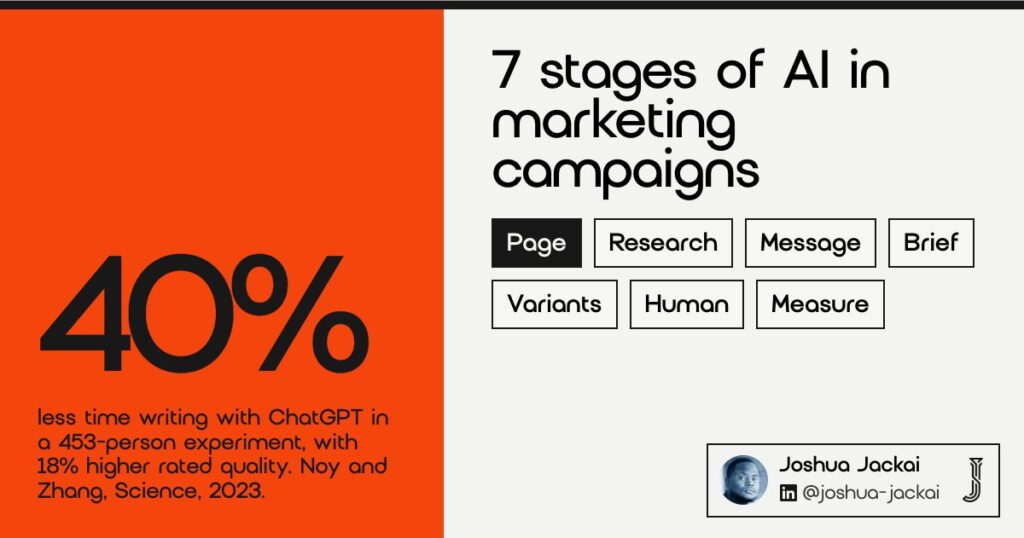
Short answer: A custom GPT for marketing works in 7 steps: check the plan and retirement dates, pick drafting jobs, load five short files, write instructions with examples, add four guardrails, test on shipped work, then measure editing time. In a 453-person experiment, ChatGPT cut writing time by 40% (Noy and Zhang, Science, 2023).
Picture a marketing coordinator with a 50-minute podcast episode, a blog that hasn’t moved in three weeks, and an email due Friday. She pastes the transcript into ChatGPT and gets back a post that sounds like every other post on the internet. A custom GPT for marketing fixes that only if someone writes down the voice, the facts and the review step before the first run.
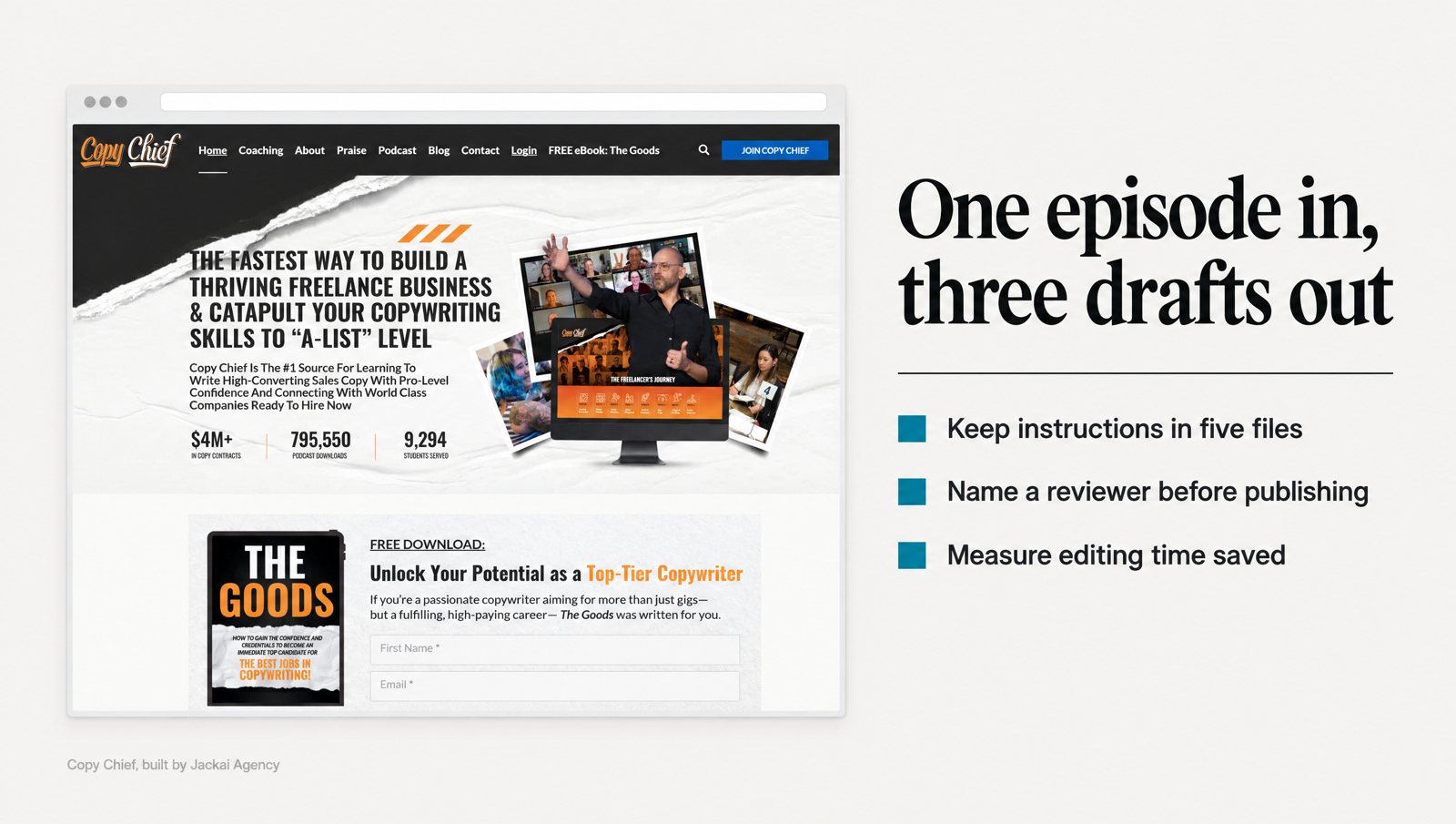
I built that kind of setup for Copy Chief, a membership platform for working copywriters in St. Petersburg, Florida. The Copy Chief custom GPT content pipeline turned each podcast episode into short-form video captions and clip picks, a blog post and an email for the copywriting team. By Jackai Agency’s own client data, editing time fell 80% and YouTube viewers grew 527% month over month. Those are first-party figures, not independently audited, and only the 80% measures the step the GPT did; the 527% belongs to the whole content pipeline. The input was the podcast the team was already publishing, about four episodes a month.
I am Joshua Jackai, a web designer in Vancouver, and I run Jackai Agency. This guide is not about clever prompts. It is the brief behind a custom GPT for marketing: what to feed it, which guardrails to write, and where it saves editing time. It also covers a change many teams have missed. OpenAI plans to retire custom GPTs on December 11, 2026 and replace them with ChatGPT plugins, and the brief is the part that survives. I sell AI marketing systems, so weigh my advice the way you would weigh any vendor’s.
In this guide
Key takeaways
- Custom GPTs are scheduled to retire on December 11, 2026, so write the spec as a plain document you own before you build anything inside ChatGPT.
- Give the GPT drafting jobs where the source exists. A 106-experiment meta-analysis found losses in decision tasks and gains in content creation (Vaccaro, Almaatouq and Malone, 2024).
- Five short files are easier to keep accurate than a 60-page brand book: voice guide, approved examples, fact sheet, claims list and format templates.
- These are the four guardrails I use: facts from one sheet, instructions treated as public, tools switched off, and a named reviewer.
- At Copy Chief, editing time fell 80%. Measure the same number: minutes from “draft received” to “approved to publish”.
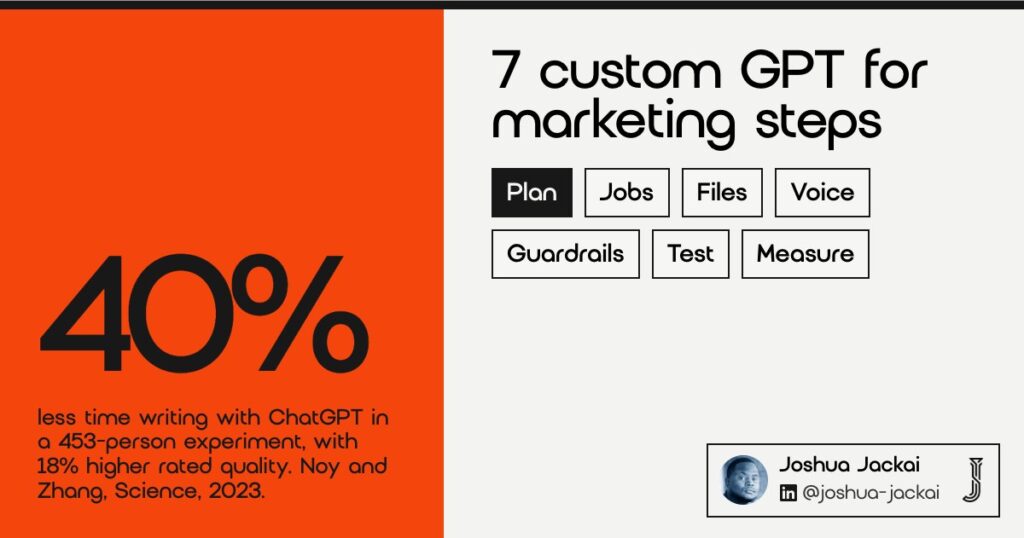
| Step | What it settles | You hold at the end | Time (my estimate) |
|---|---|---|---|
| 1. Check the plan | Whether to build inside ChatGPT at all | A dated spec outside the tool | 1 day |
| 2. Pick the jobs | What the GPT drafts and what people decide | A job list with a yes or no each | 1 day |
| 3. Load five files | What the GPT knows | Five plain text files | 3 days |
| 4. Write instructions | How the GPT behaves | A seven-part brief with examples | 2 days |
| 5. Add guardrails | What can go wrong | Four rules and a review checklist | 1 day |
| 6. Test | Whether it is ready | A pass or fail sheet for five episodes | 1 week |
| 7. Measure | Whether it saved time | Editing minutes per asset | 2 weeks |
What is a custom GPT for marketing, and what is it not?
A custom GPT is a saved version of ChatGPT that starts every chat with the same setup: standing instructions, up to 20 reference files, a recommended model and switched-on tools. It is not a writer with judgment or a strategy. It is a fixed brief that runs the same way every time someone opens it, which is its whole value.
The setup has two kinds of input, and weak GPTs I have reviewed often mix them up. Instructions tell it how to behave: the steps, the format, the rules. Knowledge files give it material to draw from: past posts, a fact sheet, a voice guide. OpenAI’s help center draws the same line.
Anyone on your team who opens it starts from that setup instead of a blank box. The fifth person to use it gets the same brand voice rules, the same fact sheet and the same output format as the first. Treat those instructions and files as a document your team owns, part of your content pipeline, not settings inside a tool.
1. Check whether you can still build a custom GPT for marketing
Check your plan and OpenAI’s dates before you build, because the clock is running. Custom GPTs are scheduled to retire on December 11, 2026, and the part that moves to the replacement is your brand voice rules and files. So write the brief as a plain document you own, then paste it wherever your team works.
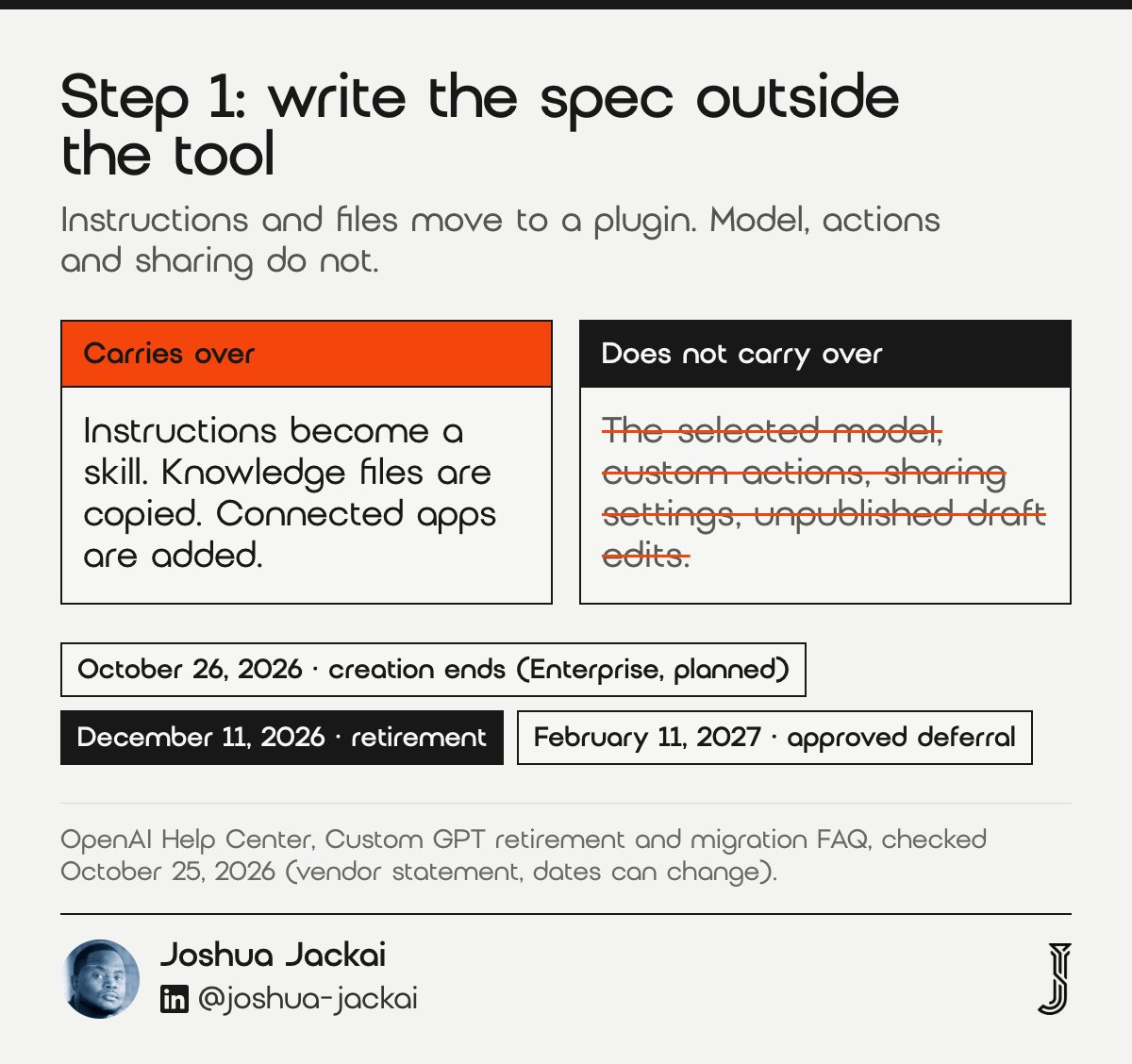
- Retirement date: December 11, 2026, or February 11, 2027 for Enterprise workspaces with an approved deferral
- Creation: new GPTs were no longer available on personal accounts when I checked on October 4, 2026; in affected Enterprise workspaces, the notice checked on October 25, 2026 plans to end creation on October 26, 2026
- What carries over: instructions become a skill, knowledge files are copied, connected apps are added
- What does not: the selected model, custom actions, sharing settings and unpublished draft edits
On October 25, 2026, OpenAI’s help center said the change affects all ChatGPT plans, that existing GPTs stay usable until the retirement date, and that the replacement is a plugin started from Migrate to plugin in My GPTs. It also says the dates can change, so check the notice in your own account before you plan around any of them. After you migrate, the original GPT becomes read-only, and the plugin starts private (OpenAI Help Center, Custom GPT retirement and migration FAQ, checked October 25, 2026).
The two rows that carry over, instructions and files, are the two that matter most to a content team, because they hold your voice and your facts. If you already run a GPT, save a few familiar prompts so you can compare old and new answers, and include one hard case. Your existing conversations remain accessible after retirement, according to the same FAQ, but the GPT page does not.
| What you built in the GPT | What happens when you migrate |
|---|---|
| Instructions | Become a skill inside the new plugin |
| Knowledge files | Copied into the plugin’s reference files |
| Connected apps | Added to the plugin as apps |
| Selected model | Does not carry over |
| Custom actions (API connections) | Do not transfer; you rebuild them |
| Sharing settings | Do not carry over; the plugin starts private |
| Unpublished draft edits | Do not transfer; migration uses the latest published version |
2. Pick the first jobs: drafts go to the GPT, decisions stay with people
Start a custom GPT for marketing on jobs where the source already exists and the output is a draft that a person checks. Turning a recorded episode into a blog draft is that kind of job. Choosing next quarter’s topics is not, because that is a judgment about your buyers.
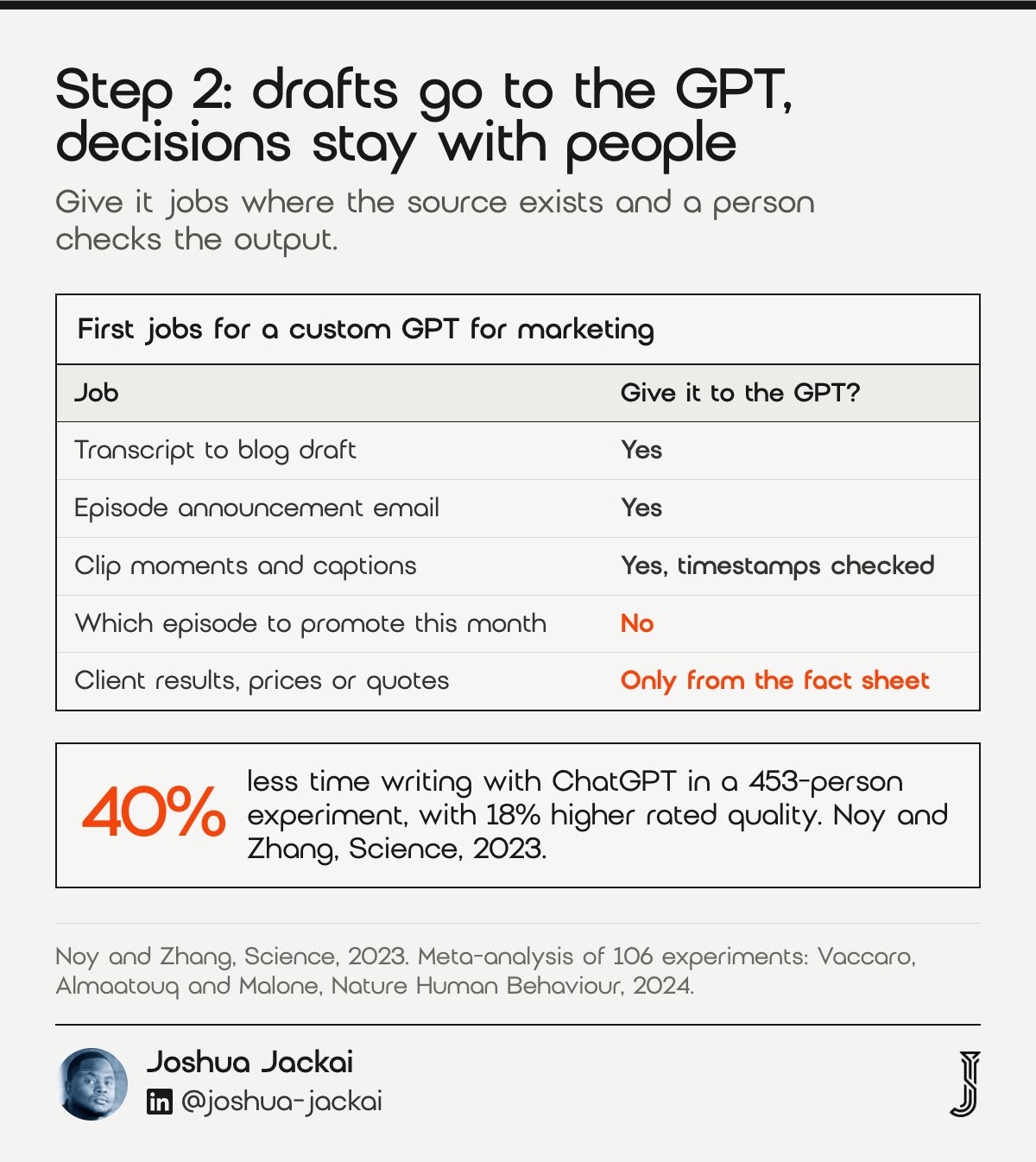
- Best first job: transcript to blog draft, with an editor checking the draft
- Second job: episode announcement email from a template with brand voice rules
- Draft, then a person confirms: clip moments and captions from a transcript, because the GPT sees text, not video, so a person checks every timestamp
- Never unaided: client results, prices or quotes, which come only from the fact sheet
In a preregistered experiment, Noy and Zhang gave 453 college-educated professionals writing tasks matched to their occupations. The group with ChatGPT took 40% less time and produced work rated 18% higher in quality. Writing a draft from known material is where these tools earn their keep.
“ChatGPT substantially raised productivity: The average time taken decreased by 40% and output quality rose by 18%,” wrote Noy and Zhang in Science, 2023.
Decisions are different. A meta-analysis of 106 experiments found that people working with AI did worse, on average, than the better of the two working alone. The losses showed up in tasks that involved making decisions, and the gains were larger in tasks that involved creating content (Vaccaro, Almaatouq and Malone, Nature Human Behaviour, 2024). So give the GPT the drafting and keep the choosing with people.
At Copy Chief the shape was one input and three outputs: an episode in, short-form video, a blog post and an email out. I would start any team there. One source, three formats, one reviewer is a content pipeline a small team can actually check. Ten outputs per episode sounds efficient and can leave a small team with more drafts than it can check.
“One source, three formats, one reviewer is a content pipeline a small team can actually check,” wrote Joshua Jackai, Vancouver web designer.
| Job | Give it to the GPT? | Why |
|---|---|---|
| Transcript to blog draft | Yes | The source exists; an editor checks the draft |
| Episode announcement email | Yes | Short, repeatable format with a template and voice rules |
| Clip moments and captions | Yes, with timestamps checked | A person confirms each cut |
| Which episode to promote this month | No | That is a judgment about your buyers |
| Client results, prices or quotes | Only pasted from the fact sheet | Invented numbers are the error I least want to publish |

3. Feed it five short files, one job each
OpenAI allows up to 20 knowledge files, each up to 512 MB, and you do not need anywhere near that. Start a custom GPT for marketing with five short plain text files, each with one job: a voice guide, approved examples, a fact sheet, a claims list and format templates.
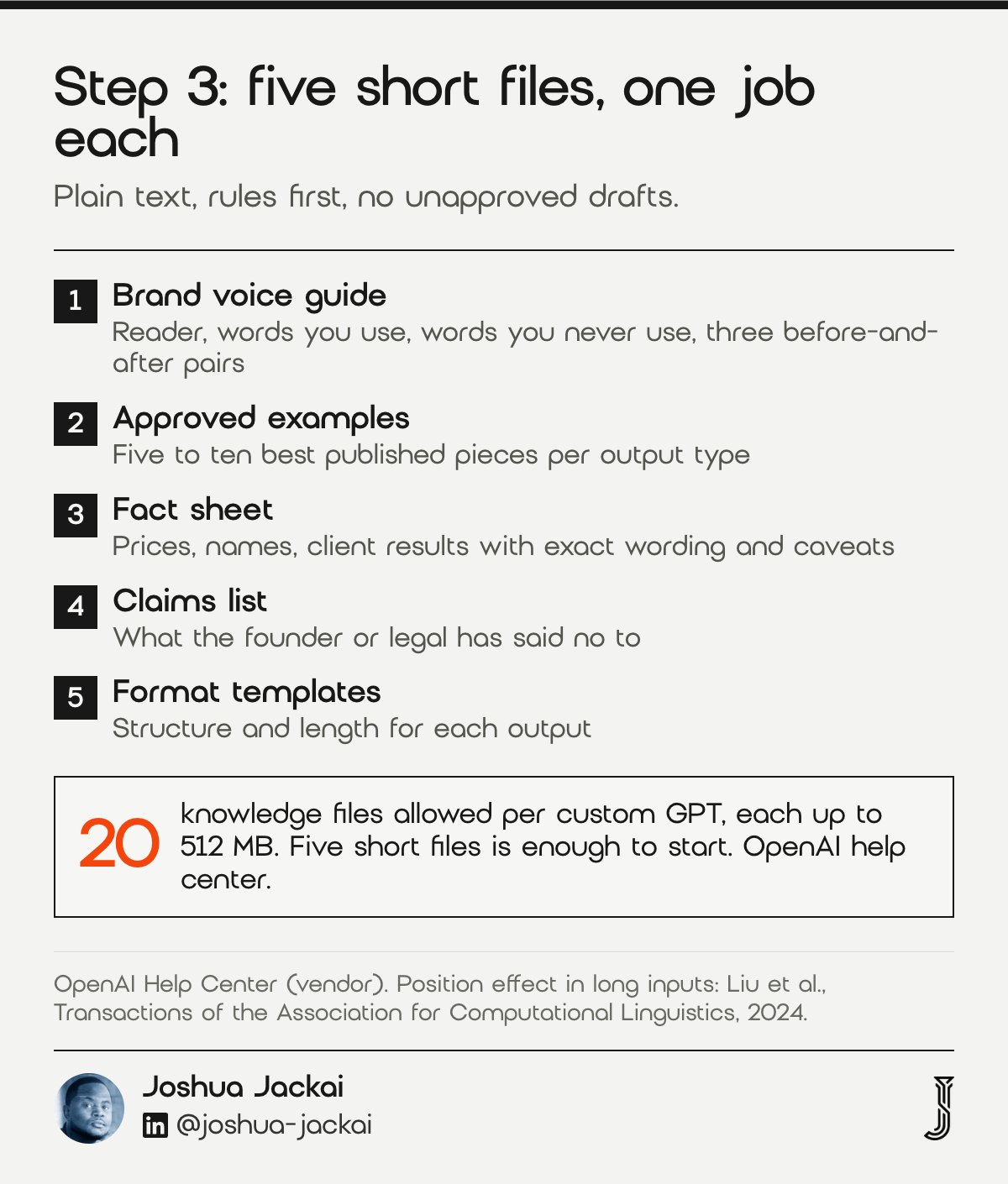
- Brand voice guide: one page covering who reads your content, what they already know, the words you use, the words you never use, and three before-and-after pairs from your own edits
- Approved examples: five to ten of your best published pieces for each output type, so the model sees your blog posts, emails and captions, not the internet’s average
- Fact sheet: services, published prices, team names and client results, each with the exact approved wording and any caveat that has to travel with it
- Claims list: things the founder or legal has said no to, written as plain rules
- Format templates: the structure and length for each output, such as blog sections, email length and caption limits
The transcript itself goes into the chat on each run, not into the knowledge files. Knowledge is for what stays the same. The episode is what moves through the content pipeline each week.
Short files also help the model. Liu and colleagues tested how language models use long inputs and found they do best when the relevant information sits at the start or the end.
“performance can degrade significantly when changing the position of relevant information,” wrote Liu and colleagues in the Transactions of the Association for Computational Linguistics, 2024.
“Knowledge is for what stays the same,” wrote Joshua Jackai, Vancouver web designer.
Liu tested long inputs, not knowledge-file retrieval, so I apply the result to the instructions text: a 60-page brand book is a long middle, and you are unlikely to need all 20 files. So put the rules that matter most at the top of the instructions, and repeat the most important one at the end, since the instructions sit in the prompt itself. OpenAI also recommends text-forward files, because complex layouts are harder for the GPT to use. If your voice guide lives in a designed PDF, paste the words into a plain text file. Leave out unapproved drafts, which teach it the habits you are editing away, and competitor copy, which teaches it to sound like the competitor.
4. Write instructions that hold a brand voice
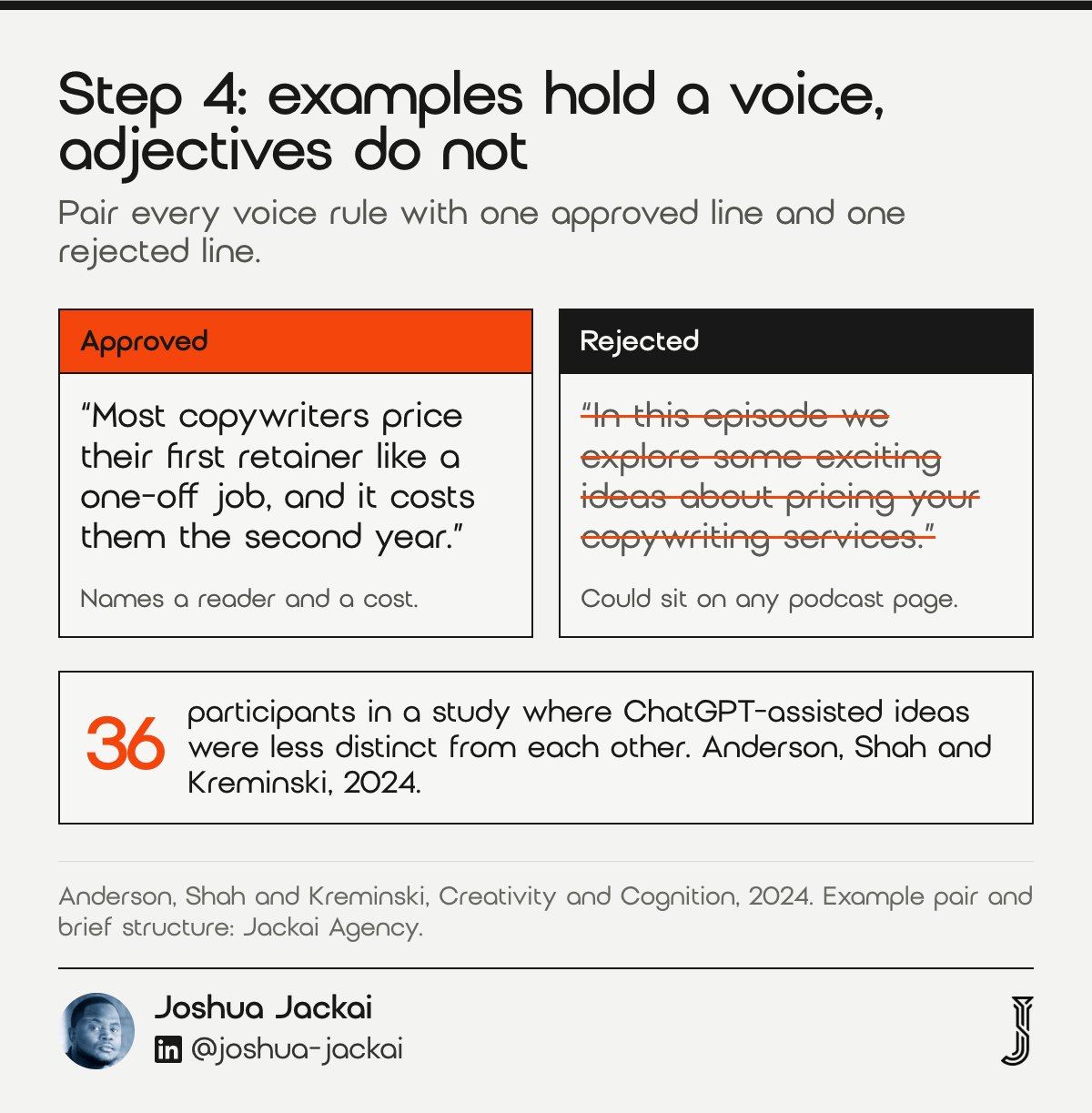
Left to its defaults, a language model drifts toward the middle, and adjectives do not fix that. What holds a brand voice in a custom GPT for marketing is examples: real sentences your team approved, next to sentences you rejected and why. Build the instructions from parts that each answer a question the model would guess at.
- Reader and input: who reads this output, what they already know, and what arrives each run, such as a transcript and an episode title
- Steps: written as “when this arrives, do this”, in order
- Output format: sections, word counts and headings for each deliverable
- Voice rules: each rule with one approved sentence and one rejected sentence
- Claims rule: numbers and names come only from the fact sheet; anything else gets marked [CHECK]
- When unsure: ask one question instead of filling the gap
In a 36-person study, people who generated ideas with ChatGPT produced ideas that were less distinct from each other than people using another tool. They also felt less responsible for the ideas they produced (Anderson, Shah and Kreminski, Creativity and Cognition, 2024). My reading: for a brand, less distinct means you sound like everyone else who used the same tool that week. “Friendly but professional” describes a great many company pages.
OpenAI’s help center recommends the same approach: explicit steps, concrete instructions over long lists of prohibitions, and short examples of acceptable and unacceptable outputs. Most teams skip the examples, and the examples are what carry a brand voice.
Here is one rule pair. The approved line names a reader and a cost. The rejected line could sit on any podcast page. Approved: “Most copywriters price their first retainer like a one-off job, and it costs them the second year.” Rejected: “In this episode we explore some exciting ideas about pricing your copywriting services.”
5. Add four guardrails and a one-screen review checklist
These are the four guardrails I use when a small team runs a custom GPT for marketing, and each one exists because of a specific way these tools fail. Facts come only from the fact sheet, the instructions are treated as public, unused tools are switched off, and a named person reviews before anything publishes.
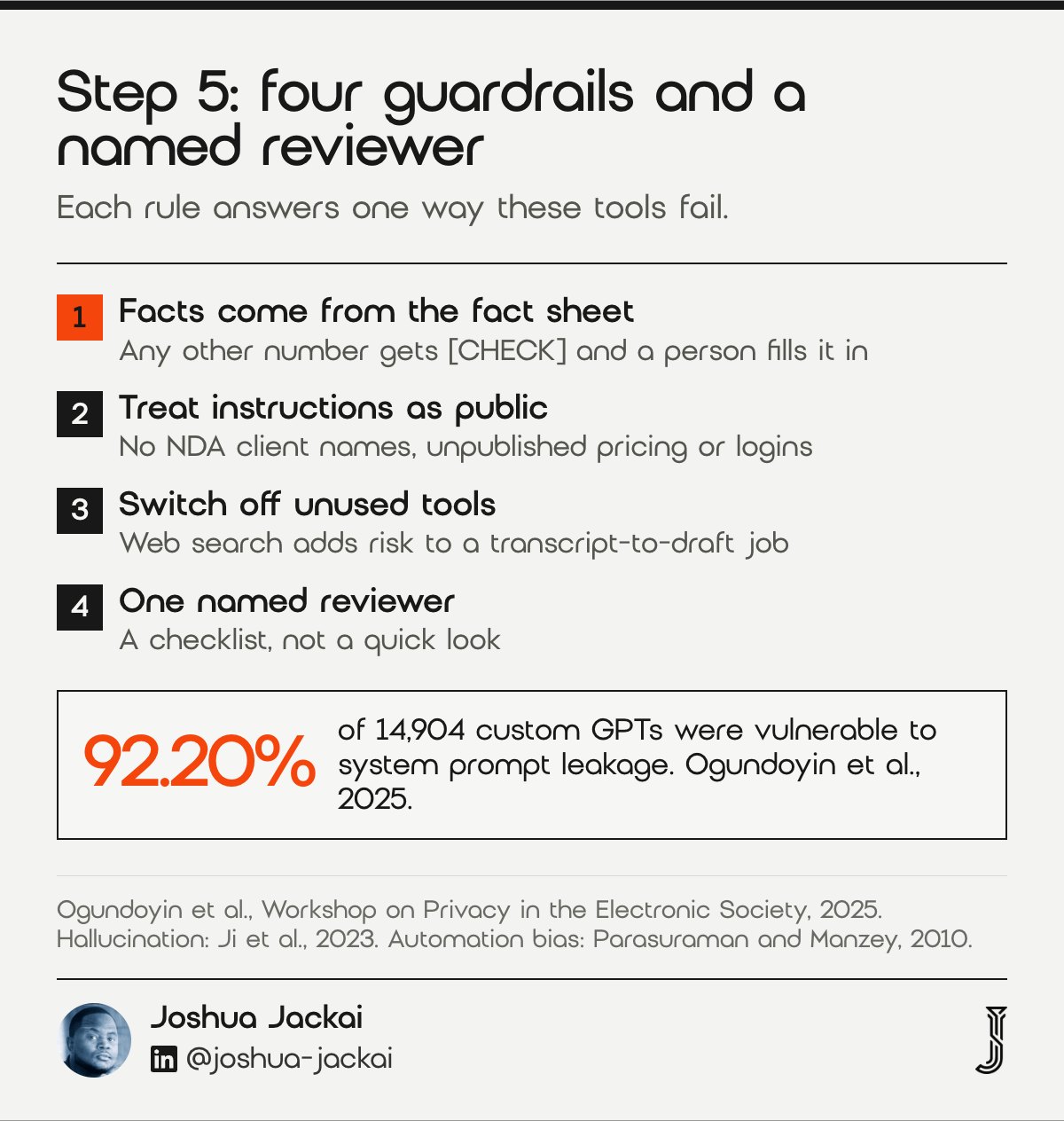
- Facts: any number not in the fact sheet gets [CHECK] and a person fills it in
- Privacy: no client names under NDA, unpublished pricing or logins in the setup
- Tools: web search, image generation and connected apps off unless the job needs them
- Review: one named person signs off, using a checklist rather than a quick look
Language generation models are prone to producing fluent text that the source does not support, which researchers call hallucination (Ji et al., ACM Computing Surveys, 2023). In marketing, for example, it can look like a made-up statistic, a quote nobody said or a price from two years ago.
A study of 14,904 custom GPTs found 92.20% of them vulnerable to system prompt leakage (Ogundoyin et al., Workshop on Privacy in the Electronic Society, 2025). The Ogundoyin study covered 14,904 GPTs, which suggests leakage is common among published GPTs. If a user can talk your GPT into reciting its setup, then confidential material does not belong in it. Content an assistant pulls in, such as a web page, can also carry hidden instructions, which Greshake and colleagues demonstrated against real systems (ACM Workshop on Artificial Intelligence and Security, 2023). If the job is transcript to blog draft, web search adds risk without helping.
People also trust automated output more than they should. A review of the research on automation bias found that experts do it as well as novices, and that training or instructions do not prevent it (Parasuraman and Manzey, Human Factors, 2010). “Have a quick look” is not a review. A checklist is, and mine fits on one screen:
- Every number matches the fact sheet, word for word, with its caveat
- Every name is spelled the way the person spells it
- Every [CHECK] has been filled or the sentence has been cut
- Every link opens the page it claims to
- The opening line still sounds like your brand voice when read aloud
“Have a quick look” is not a review, wrote Joshua Jackai, Vancouver web designer.

6. Test the custom GPT before the team relies on it
Build the test set from work you already shipped. Take five past episodes and the blog posts, emails and captions you published from them, run each episode through the GPT, and compare its drafts to what you approved. Score each draft pass or fail on four things: facts, brand voice, format and length.
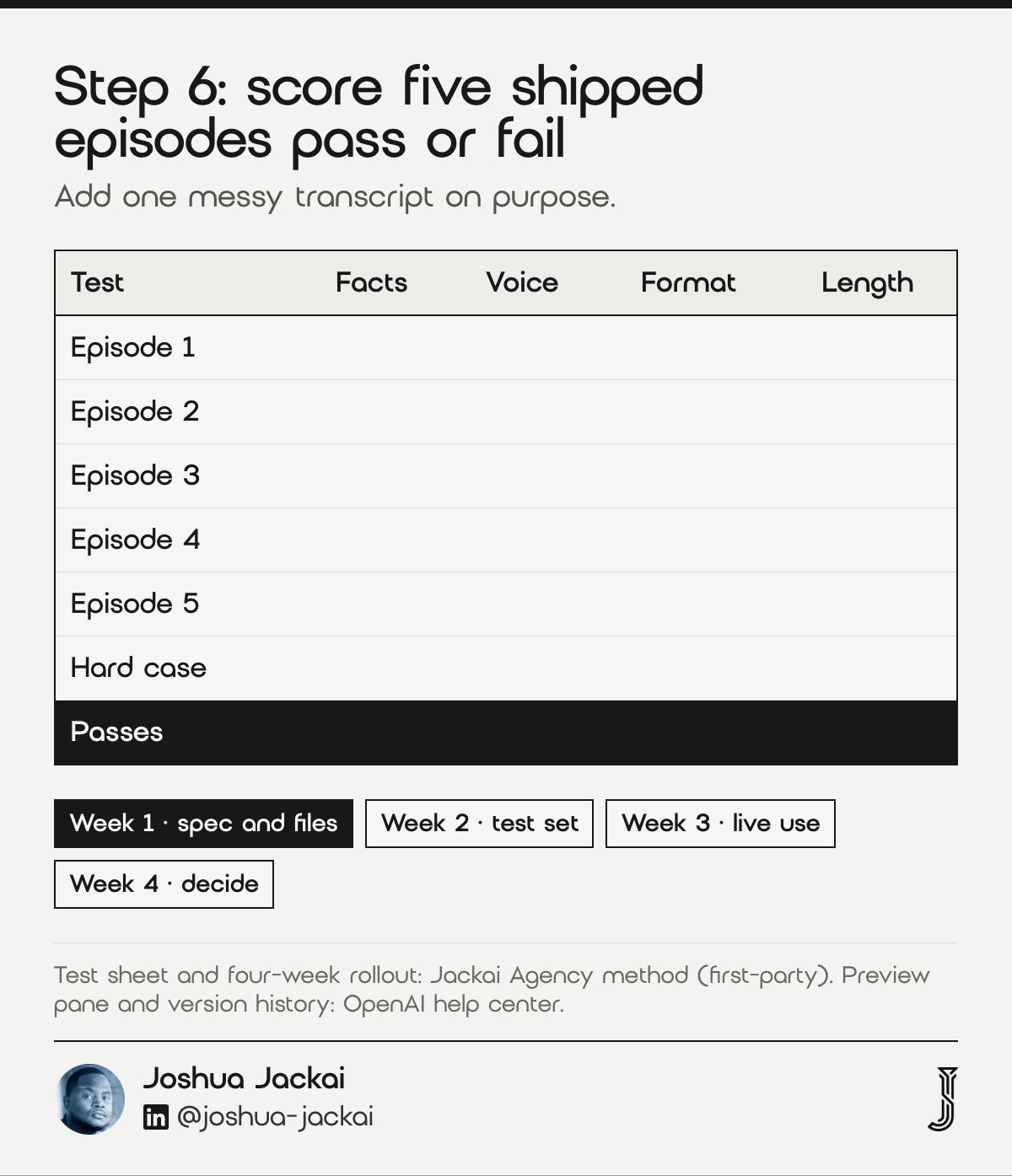
- Week 1: write the spec and gather the five files
- Week 2: run the test set and fix the instructions until all five episodes pass
- Week 3: one person uses it on live work and logs editing time per asset
- Week 4: compare editing time against the baseline and decide to keep it, change it or drop it
My reasoning: the Noy and Zhang study used 453 professionals on occupation-specific tasks, so a test set built from your own shipped work is the closest match. Add one hard case on purpose. A messy transcript with crosstalk works, or a guest who makes a claim you cannot verify. A GPT that handles your clean episodes and invents a number on the messy one is not ready.
OpenAI’s builder has a Preview pane for this, and version history lets you roll back a bad change. Its help center says tighter instructions and added examples often fix problems faster than new features. That matches what I see: most failures are missing examples, not missing tools.
Give one person ownership of the spec. Every change gets a date and a one-line reason in the document. When the tool changes underneath you, as custom GPTs are about to, that changelog is how you rebuild the same content pipeline somewhere else. The container is replaceable. The spec is not. The retirement notice also suggests testing a harder case after you migrate, since a migrated plugin may respond differently (OpenAI Help Center, checked October 25, 2026).
“The container is replaceable. The spec is not,” wrote Joshua Jackai, Vancouver web designer.
7. Measure editing time, not time to first draft
On the Copy Chief custom GPT content pipeline, editing time fell 80% and YouTube viewers grew 527% month over month. The 80% is the number the GPT owns, because it measures the step the GPT did. The 527% belongs to the whole content pipeline, so I would not promise it to anyone.
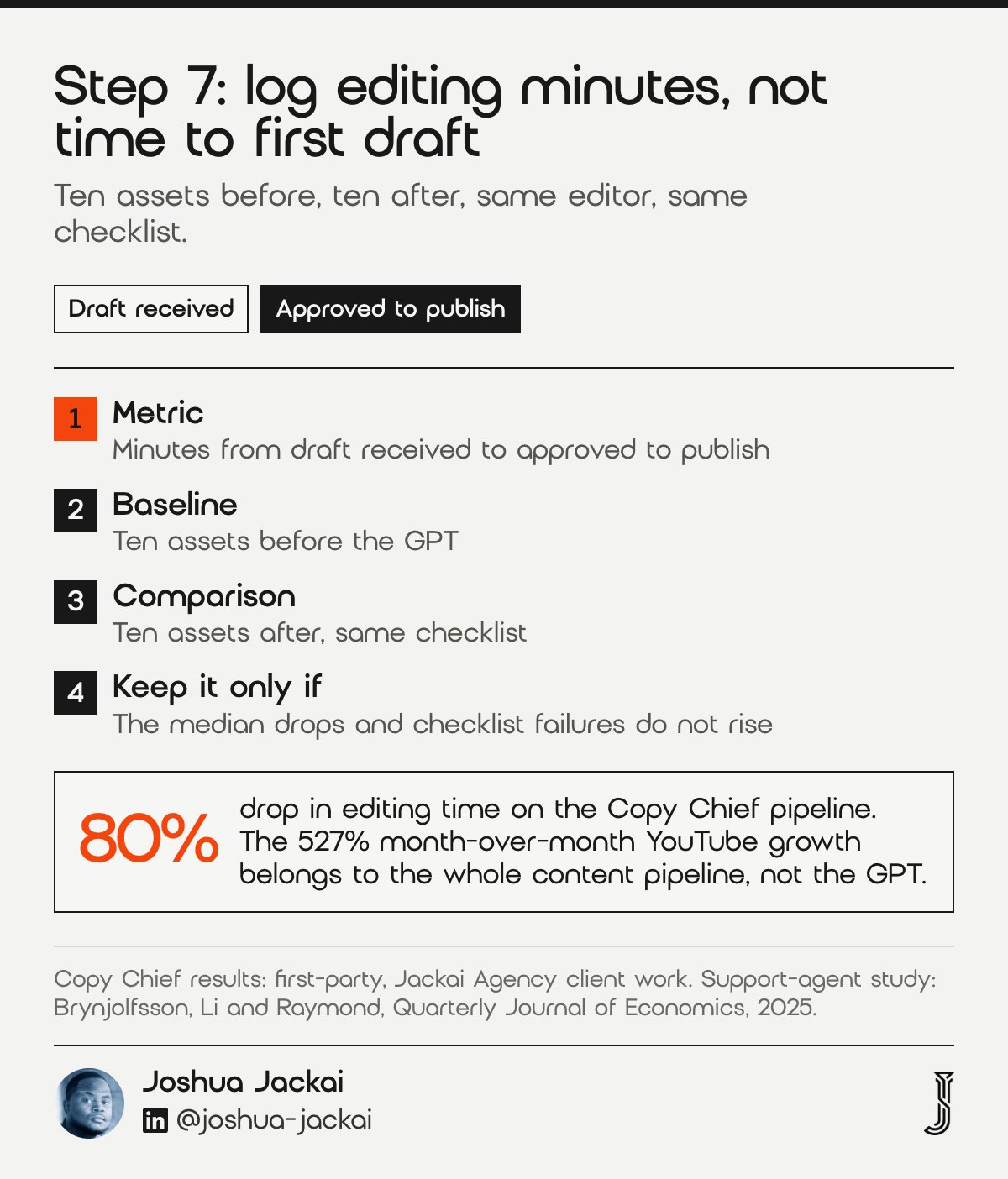
- Metric: minutes from “draft received” to “approved to publish”
- Baseline: ten assets before the GPT, logged by the same editor
- Comparison: ten assets after, with the same checklist
- Decision rule: keep it only if the median editing time drops and the checklist failures do not rise
The research also says who gains most. A study of 5,172 customer support agents found AI assistance raised issues resolved per hour by 15% on average. Less experienced agents improved in both speed and quality.
“the most experienced and highest-skilled workers see small gains in speed and small declines in quality,” wrote Brynjolfsson, Li and Raymond in the Quarterly Journal of Economics, 2025.
Support work is not marketing, and the Vaccaro report pooled 106 experiments without studying marketing teams, so treat this as a pattern to check in your own step 6 test. On a small marketing team, the coordinator drafts with the GPT and gains the most, and your best writer edits those drafts rather than starting from them. The saving shows up as editing time: drafts that reach your editor already follow the format, the voice and the fact sheet, so there is less to fix.
It does not save time in the first two weeks, while you write the spec and test it. Picking topics, approving claims, anything in a regulated category and any reply to a real prospect stay slow on purpose, because each of those is a decision. Do not measure time to first draft either.
“A draft that takes 30 seconds to generate and 90 minutes to fix is not a saving,” wrote Joshua Jackai, Vancouver web designer.
Which of the 7 steps should your team do first?
Filter the seven steps by the problem you have today and by how long each takes. The answer for most teams is step 1 and step 3, because a dated spec and five clean files make every later step cheaper. The time column is my estimate from client work, not a benchmark.
| Step | Problem it fixes | Time (my estimate) | You hold |
|---|---|---|---|
| 1. Check the plan | Building on a retiring tool | 1 day | A dated spec outside the tool |
| 2. Pick the jobs | Handing decisions to the GPT | 1 day | A yes or no for each job |
| 3. Load five files | Generic output, invented facts | 3 days | Five plain text files |
| 4. Write instructions | Voice drift | 2 days | A seven-part brief with examples |
| 5. Add guardrails | Leaks, errors, unchecked publishing | 1 day | Four rules and a checklist |
| 6. Test | Launching an unproven GPT | 1 week | A pass or fail sheet |
| 7. Measure | No evidence of savings | 2 weeks | Editing minutes per asset |
How much editing time could a custom GPT for marketing save?
Use the calculator to turn your own editing minutes into hours per month. Every default is a placeholder, not a benchmark, and the saving percentage is the number your own test in step 7 should replace. For reference, Copy Chief logged an 80% drop in editing time on its podcast pipeline.
Hours saved per month equals assets per month, times editing minutes per asset, times your measured saving percentage, divided by 60.
Editing hours a month the GPT could free up. Defaults are placeholders, not benchmarks.
Custom GPT for marketing questions answered
These are the questions marketers ask most often when they consider a custom GPT for content. Each answer assumes the planned December 11, 2026 retirement and the plugin replacement described in step 1, and each one reflects the Copy Chief build and my own testing.
When should marketers use custom GPTs?
Use one for repeatable drafting where the source material already exists, such as turning a transcript into a blog draft or an announcement email. Skip it for choosing topics, setting prices or approving claims. A 106-experiment meta-analysis found losses in decision tasks and gains in content creation.
Can a custom GPT write content for marketing in my brand voice?
Yes, if you give it approved examples and rejected examples with reasons, not adjectives. A voice guide of one page, five to ten published pieces per output type and a fact sheet is enough to start. A named editor still checks every draft before it publishes.
What should a B2B marketing custom GPT never contain?
Leave out client names under NDA, unpublished pricing, logins and anything confidential. A study of 14,904 custom GPTs found 92.20% vulnerable to system prompt leakage, so treat the instructions and files as public (Ogundoyin et al., 2025). Competitor copy and unapproved drafts also teach the wrong habits.
What replaces custom GPTs after December 11, 2026?
OpenAI says plugins replace custom GPTs and bring instructions, reference files and connected apps together. Instructions become a skill and files are copied, but the model, custom actions and sharing settings do not carry over. Keep your spec in a document you own (OpenAI Help Center, October 25, 2026).
How do you build a custom GPT for marketing?
Write the brief first. Check OpenAI’s retirement dates, pick drafting jobs where a source exists, load five short files, write instructions with approved and rejected examples, add four guardrails, test on five shipped episodes, then measure editing minutes per asset.
Want a second opinion on your content pipeline?
If your team records podcasts, webinars or interviews and editing is the bottleneck, that is the work I do on AI marketing systems at Jackai Agency. The Copy Chief setup is written up in the Copy Chief case study, and the short-form side is on the social media management and short-form video page.
Bring one recent episode and the posts it produced. On a 30-minute call I will map where your editing time goes and which step a custom GPT for marketing, or its replacement, should take first. Book a call.
Sources
Peer-reviewed research
- Anderson, B. R., Shah, J. H., and Kreminski, M. (2024). Homogenization Effects of Large Language Models on Human Creative Ideation. Creativity and Cognition (C&C ’24), 413 to 425. DOI: 10.1145/3635636.3656204
- Brynjolfsson, E., Li, D., and Raymond, L. (2025). Generative AI at Work. The Quarterly Journal of Economics, 140(2), 889 to 942. DOI: 10.1093/qje/qjae044
- Greshake, K., et al. (2023). Not What You’ve Signed Up For: Compromising Real-World LLM-Integrated Applications with Indirect Prompt Injection. Proceedings of the 16th ACM Workshop on Artificial Intelligence and Security, 79 to 90. DOI: 10.1145/3605764.3623985
- Ji, Z., et al. (2023). Survey of Hallucination in Natural Language Generation. ACM Computing Surveys, 55(12), 1 to 38. DOI: 10.1145/3571730
- Liu, N. F., et al. (2024). Lost in the Middle: How Language Models Use Long Contexts. Transactions of the Association for Computational Linguistics, 12, 157 to 173. DOI: 10.1162/tacl_a_00638
- Noy, S., and Zhang, W. (2023). Experimental evidence on the productivity effects of generative artificial intelligence. Science, 381(6654), 187 to 192. DOI: 10.1126/science.adh2586
- Ogundoyin, S. O., et al. (2025). Unsafe by Design? A First Look at Security and Privacy Risks in OpenAI’s Custom GPT Ecosystem. Proceedings of the 24th Workshop on Privacy in the Electronic Society, 147 to 161. DOI: 10.1145/3733802.3764054
- Parasuraman, R., and Manzey, D. H. (2010). Complacency and Bias in Human Use of Automation: An Attentional Integration. Human Factors, 52(3), 381 to 410. DOI: 10.1177/0018720810376055
- Vaccaro, M., Almaatouq, A., and Malone, T. (2024). When combinations of humans and AI are useful: A systematic review and meta-analysis. Nature Human Behaviour, 8(12), 2293 to 2303. DOI: 10.1038/s41562-024-02024-1
Industry and vendor data (not peer reviewed)
- OpenAI Help Center (2026). Creating and editing GPTs; Custom GPT retirement and migration FAQ. Retirement and migration dates checked October 25, 2026; the personal-account creation notice was checked October 4, 2026. Plans, dates and features are vendor statements and can change. help.openai.com
- Copy Chief results (80% less editing time, 527% month-over-month YouTube viewer growth): first-party, Jackai Agency client work for Copy Chief.