7 Proven Must-Haves for a Cleantech Website in Vancouver
Seven must-haves for a cleantech website in Vancouver: a problem-first homepage, environmental claims backed the way Canada's Competition Act now asks, a proof library, a page for each buyer, technical pages with named engineers, pages AI tools can quote and a lead form that keeps its source. Sources checked 17 November 2026.
 Joshua Jackai
17 min read

Published 17 November 2026 · Last updated and fact-checked November 2026
Short answer: A cleantech website in Vancouver needs seven things to win B2B buyers: a problem-first homepage, environmental claims backed the way Canada’s Competition Act now requires, a proof library, a path for each person on the buying committee, technical pages engineers can use, pages AI answer engines can quote, and a lead form that records where every lead came from.
Most BC cleantech companies I talk to have strong technology and a website written for a grant panel. The homepage talks about the planet. The buyer, a plant manager in Surrey or a procurement lead at a utility, wants to know what the system does, what it costs to run, who has already installed it and whether the numbers will survive a review. Since June 2024 there is a legal reason to fix this too, because Canada’s Competition Act now asks for proof behind environmental claims. This guide covers what a cleantech website should include for Canadian B2B buyers. If you are comparing agencies, my B2B web design service in Vancouver explains how I build these sites.
In this guide
Key takeaways
- People rate a web page’s visual appeal in about 50 milliseconds, and those snap ratings match their slower ones (Lindgaard and colleagues, Behaviour and Information Technology, 2006).
- Canada’s Competition Bureau issued final guidelines on 5 June 2025: product claims need adequate and proper testing, and business claims need substantiation under an internationally recognized methodology (Competition Bureau Canada, 2025).
- In a study of 2,684 people judging live websites, design look came up in 46.1% of credibility comments, ahead of information structure and focus (Fogg and colleagues, 2003).
- Industrial buying centres differed reliably between capital equipment and service purchases across 31 firms (Johnston and Bonoma, Journal of Marketing, 1981).
- Among 148 professional purchasers, salesperson expertise had the strongest effect on satisfaction and loyalty with green products (Gelderman and colleagues, Business Strategy and the Environment, 2021).
| Must-have | What it does for the buyer | Effort | Key number |
|---|---|---|---|
| 1. Problem-first homepage | Shows fit in the first screen | Medium | 50 ms first impression |
| 2. Claims that pass the Competition Act | Removes legal and trust risk | Medium | Up to $10 million penalty |
| 3. A proof library | Lets a reviewer check your numbers | High | 46.1% of comments on design look |
| 4. A path for each buyer | Gives engineers, finance and procurement their page | Medium | 31 firms studied |
| 5. Technical pages with named experts | Answers the engineer without a call | Medium | 148 professional purchasers |
| 6. Pages AI answer engines can quote | Gets you named in ChatGPT and AI Overviews | Medium | Up to 40% visibility gain |
| 7. A lead form that keeps its source | Shows which channel brings pilots | Low | Referred customers worth 16% more |
1. Lead with the buyer’s problem on the homepage: best for first impressions
A cleantech homepage should say, in the first screen, which operational problem you solve, for whom, and with what measured result. Buyers judge a page in a fraction of a second, so a vague climate mission line costs you the reader before the proof loads.

- Headline: the problem and the buyer, in plain words
- Subhead: the measured result from a real pilot or install
- Proof strip: three named results, each linked to its source
- Two buttons: one for a call, one for the data
- Avoid: planet imagery with no product in it
Here is the test I run with every cleantech client in Vancouver. Cover the logo and read the first screen aloud. If a plant manager could not say what you sell, the headline is a mission statement. “Cutting industrial heat waste for BC food processors” beats “Accelerating the energy transition” because the reader can place themselves in it. Gitte Lindgaard and colleagues at Carleton University showed people a set of homepages for 500 milliseconds and then for 50 milliseconds, and the visual appeal ratings were highly correlated between the two. The first screen gets judged before anyone reads a word, so it has to carry the product, not stock wind turbines. Their study measured appeal, not purchase, so I treat it as a rule for the first screen and test the rest with real buyers. In practice that means one strong product image or diagram, a headline under twelve words and the first result above the fold.
“Visual appeal can be assessed within 50 ms, suggesting that web designers have about 50 ms to make a good first impression,” Lindgaard, Fernandes, Dudek and Brown wrote in Behaviour and Information Technology.
2. Back every environmental claim the way the Competition Act asks: best for any firm selling a green benefit
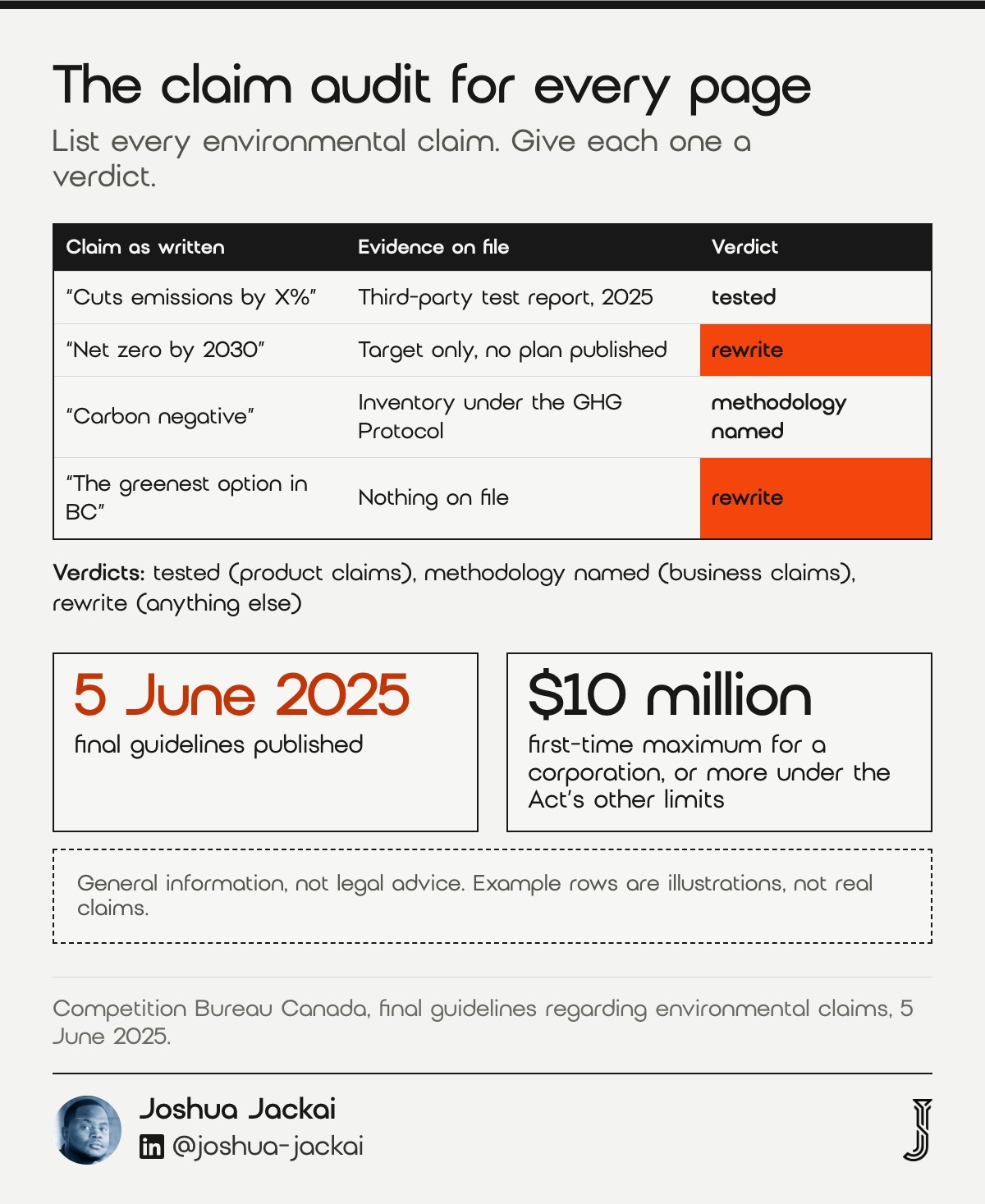
Every environmental claim on a Canadian cleantech site now needs evidence behind it. Product benefit claims need adequate and proper testing, and claims about the business need substantiation under an internationally recognized methodology, so the website has to show its sources, not just state results.
- Product claims: link each one to the test report behind it
- Business claims: name the methodology, such as the GHG Protocol
- Net-zero claims: show the target year and the plan, or cut the line
- Owner: one named person signs off on every claim
- Review: recheck the claims page every quarter
The rule changed in June 2024, when amendments to the Competition Act added the two greenwashing provisions. The Competition Bureau’s final guidelines, published 5 June 2025, describe how the Bureau reads them. Its release states that a corporation’s first-time maximum penalty is the greater of $10 million and three times the benefit from the deceptive conduct, or 3% of annual worldwide gross revenue when that benefit cannot be worked out. For a website this becomes a simple audit. I list every claim on the site, from the hero line to the PDF case studies, and mark each one tested, methodology named or rewrite. Most BC cleantech sites I review have two or three lines in the third column, usually a percentage with no study behind it. Magali Delmas and Vanessa Burbano at UCLA describe how greenwashing erodes confidence well beyond the firm that does it. This is general information, not legal advice; have a lawyer review net-zero and carbon claims.
“The skyrocketing incidence of greenwashing can have profound negative effects on consumer and investor confidence in green products,” Delmas and Burbano wrote in the California Management Review.
3. Build a proof library a reviewer can check: best for firms with pilots or installs
A proof library is one section of the site that holds every pilot result, install, test report and third-party verification, each with the date, the site and the method. It lets a reviewer check your numbers without asking, which is how a deal survives a technical or finance review.
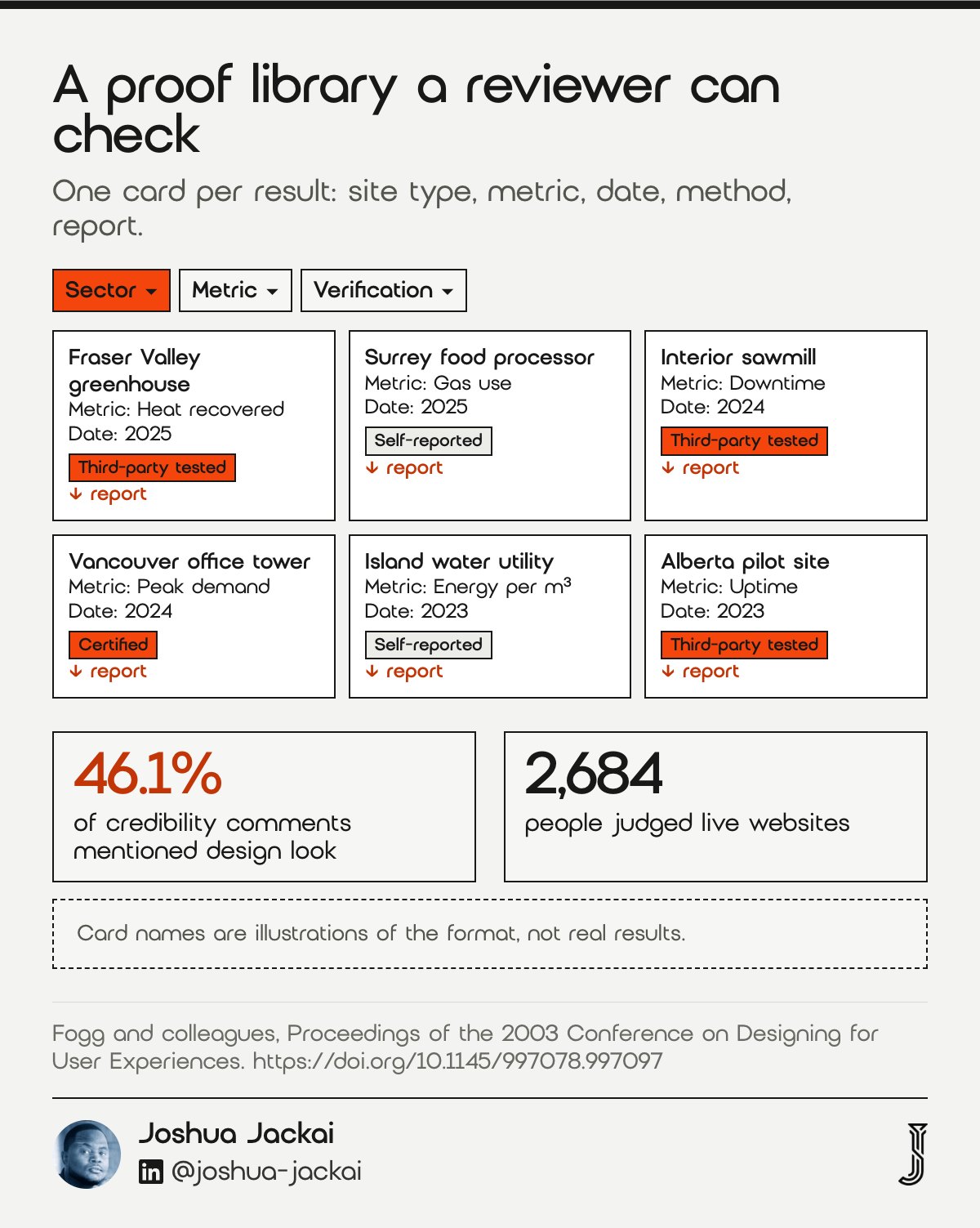
- One card per result: site type, metric, date, method
- Verification tag: self-reported, third-party tested or certified
- Download: the report itself, ungated where the client allows
- Context: what conditions the result held under
- Link: each homepage claim points to its card
Cleantech buyers are sceptical for good reason, so a single “results” paragraph does not carry much weight. I build the proof library as a CMS collection, so adding a new pilot takes five minutes and every card has the same fields. Where a client cannot be named, the card names the sector and province, such as “Fraser Valley greenhouse operator”. B.J. Fogg and colleagues at Stanford collected comments from 2,684 people judging the credibility of live websites. Design look was mentioned in 46.1% of comments, and the next most common topics were information structure and information focus. A proof library helps on all three: a consistent card looks maintained, a filter is structure, and one result per card is focus. Their participants were members of the public, not B2B buyers, so read it as a floor for credibility rather than a model of procurement. When a client has only one or two pilots, I still build the library, because an empty structure with two honest cards beats a results page padded with adjectives.
“We found that the ‘design look’ of the site was mentioned most frequently, being present in 46.1% of the comments,” Fogg and colleagues wrote in the Proceedings of the 2003 Conference on Designing for User Experiences.
4. Give each member of the buying committee a page: best for capital equipment and long sales cycles
A cleantech purchase is usually made by a group, not one person, so the website needs a clear page for each role. Engineers want specifications, finance wants payback and operating cost, procurement wants terms and certifications, and operations wants installation and support details.
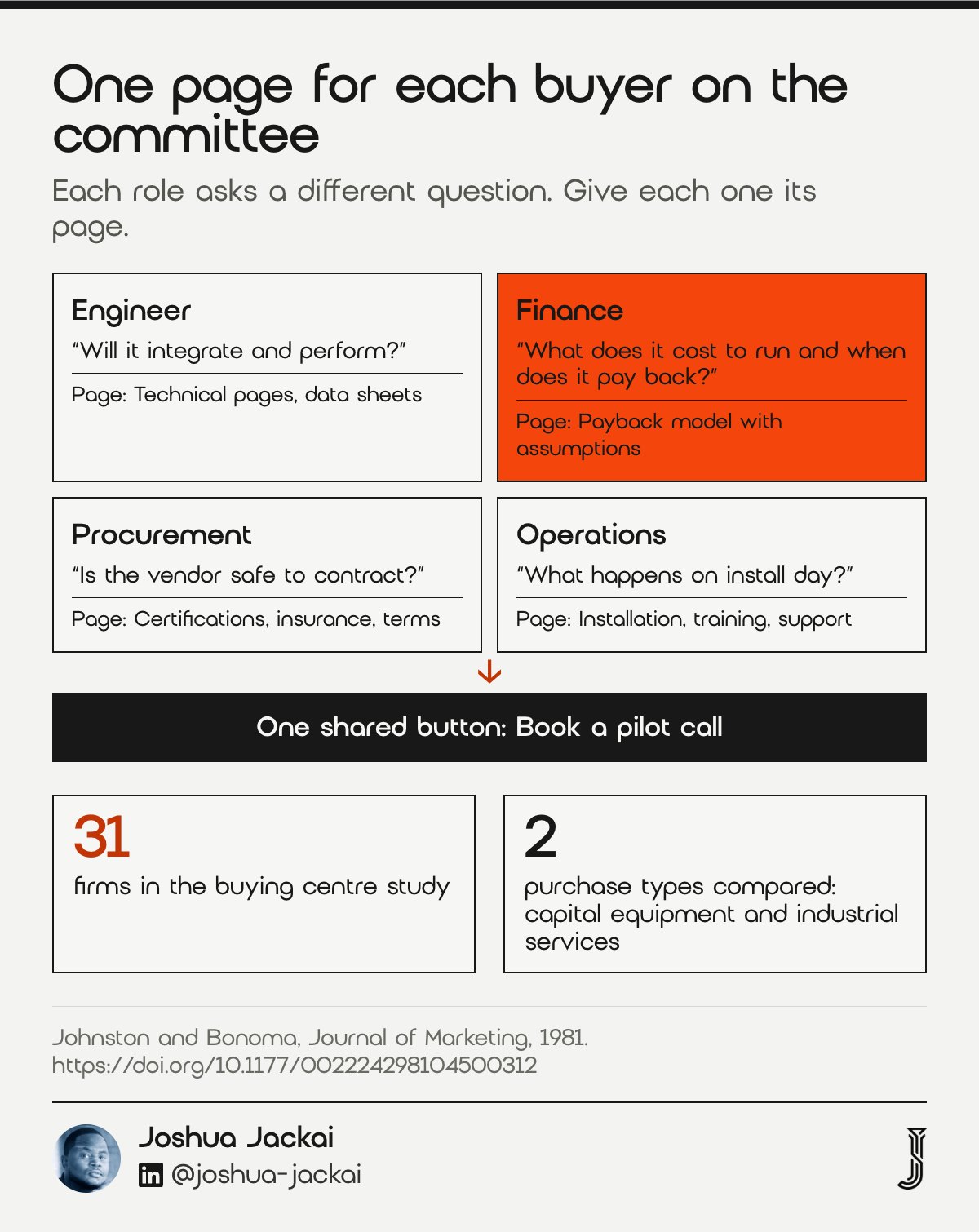
- Engineer: specifications, integration, data sheets
- Finance: payback model, operating cost, incentives to check
- Procurement: certifications, insurance, contract terms, references
- Operations: installation steps, downtime, training, support hours
- Navigation: a “For your role” menu that links all four
Wesley Johnston and Thomas Bonoma studied the buying centre, the group that makes an industrial purchase, across 31 firms. They found the group’s make-up and interaction differed reliably between capital equipment and industrial services. For a cleantech company selling hardware with a service contract, that means at least two different committees, often with different people. I map the roles in the discovery call, then write one page per role with the questions that role asks. The finance page is where most BC sites are thin. A payback table with the assumptions shown, the electricity or gas rate used, and a note to check current CleanBC and federal incentive programs directly does more than a slogan about savings. I never publish a specific rebate amount, because program terms change and the buyer will check. Procurement gets the same treatment: a plain list of certifications, insurance and standard terms, with the person who answers contract questions named on the page. When each role finds its own page, your sales calls start with fewer basic questions and more about the pilot itself.
“Organizational structure and purchase situation attributes correlated in generally expected directions with the dimensions of the buying group,” Johnston and Bonoma wrote in the Journal of Marketing.
5. Publish technical pages with named experts: best for selling to engineers
Technical pages should answer an engineer’s questions without a sales call: specifications, operating ranges, integration requirements and test standards, written or reviewed by a named engineer on your team. A face and a credential beside the specs make the page trustworthy and give the buyer someone to ask.
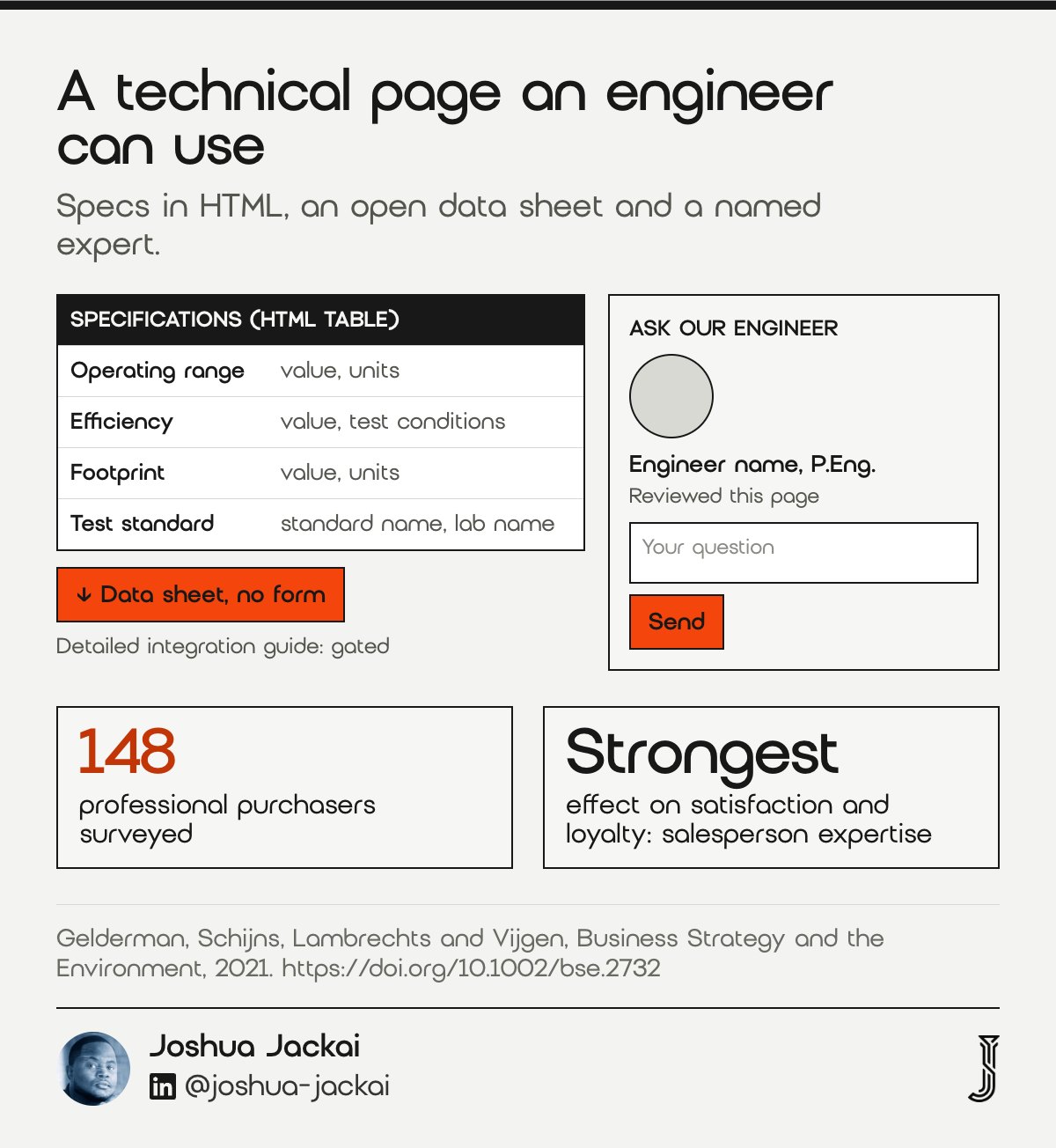
- Spec table: HTML, not only a PDF, so it can be searched and quoted
- Data sheet: one click to download, no form for the basic version
- Test standard: name the standard and the lab
- Author: a named engineer with their credential
- Ask our engineer: a short form routed to that person
Gating every PDF behind a form is the most common mistake I see on cleantech sites. The engineer who needs the data sheet is often the person who decides whether you get shortlisted, and a form at that point loses them. I leave the basic data sheet open and gate only the detailed integration guide. Cees Gelderman and colleagues surveyed 148 Dutch professional purchasers buying green cleaning products. Product quality, price and corporate image mattered, but salesperson expertise had the strongest effect on satisfaction and loyalty. Your website cannot be a salesperson, but it can show the expert: a named engineer, their credential and a way to ask them a question. The study covered one industry in the Netherlands, so I treat it as direction, not a forecast for BC hardware. Spec tables also belong in HTML for a practical reason: an engineer searching for an operating range lands on the page, and an AI tool can quote a table row but rarely a scanned PDF. I add the test standard and the lab name to each row so the number can be checked. When the product has several models, one comparison table with every model beats a separate PDF per model.
“The most notable and strong impact on satisfaction and loyalty was found for the salesperson expertise,” Gelderman, Schijns, Lambrechts and Vijgen wrote in Business Strategy and the Environment.
6. Write pages AI answer engines can quote: best for firms buyers research in ChatGPT
AI answer engines such as ChatGPT, Perplexity and Google AI Overviews quote pages that state facts plainly, cite sources and answer one question per section. A cleantech site written that way can be named when a buyer asks an AI for vendors in BC.

- One question per section: written as the buyer types it
- Answer first: 40 to 60 words, then the detail
- Numbers with sources: every figure linked to where it came from
- Plain HTML: key facts not locked in images or PDFs
- Entity facts: company name, location and products stated the same way everywhere
Procurement leads and founders now ask AI tools for shortlists, and the tool can only name you if it can read and trust your pages. Pranjal Aggarwal and colleagues at IIT Delhi and Princeton built a benchmark of queries and tested ways of rewriting content for generative engines. They report that these methods can raise visibility in generative engine responses by up to 40%. Their tests were on a research benchmark, not live commercial queries, and the engines have changed since, so I treat the number as proof that writing style matters, not as a promise. On a cleantech site the work is mostly structural: put each claim from the proof library in plain text, add a question-led FAQ to each product page and keep the company description identical across the site, LinkedIn and directories. My free AI Visibility Report shows whether ChatGPT names you for your category today. I run the same check for BC clients before and after launch, so the change is measured against the questions their buyers actually ask.
“GEO can boost visibility by up to 40% in generative engine responses,” Aggarwal, Murahari, Rajpurohit, Kalyan, Narasimhan and Deshpande wrote in the Proceedings of KDD 2024.
7. Use a lead form that keeps its source: best for firms that rely on referrals and programs
A cleantech lead form should ask for the project, not just contact details, and record where the lead came from, including referrals from partners, accelerators and programs. That lets you see which channel brings pilot inquiries, not just which one brings visits.
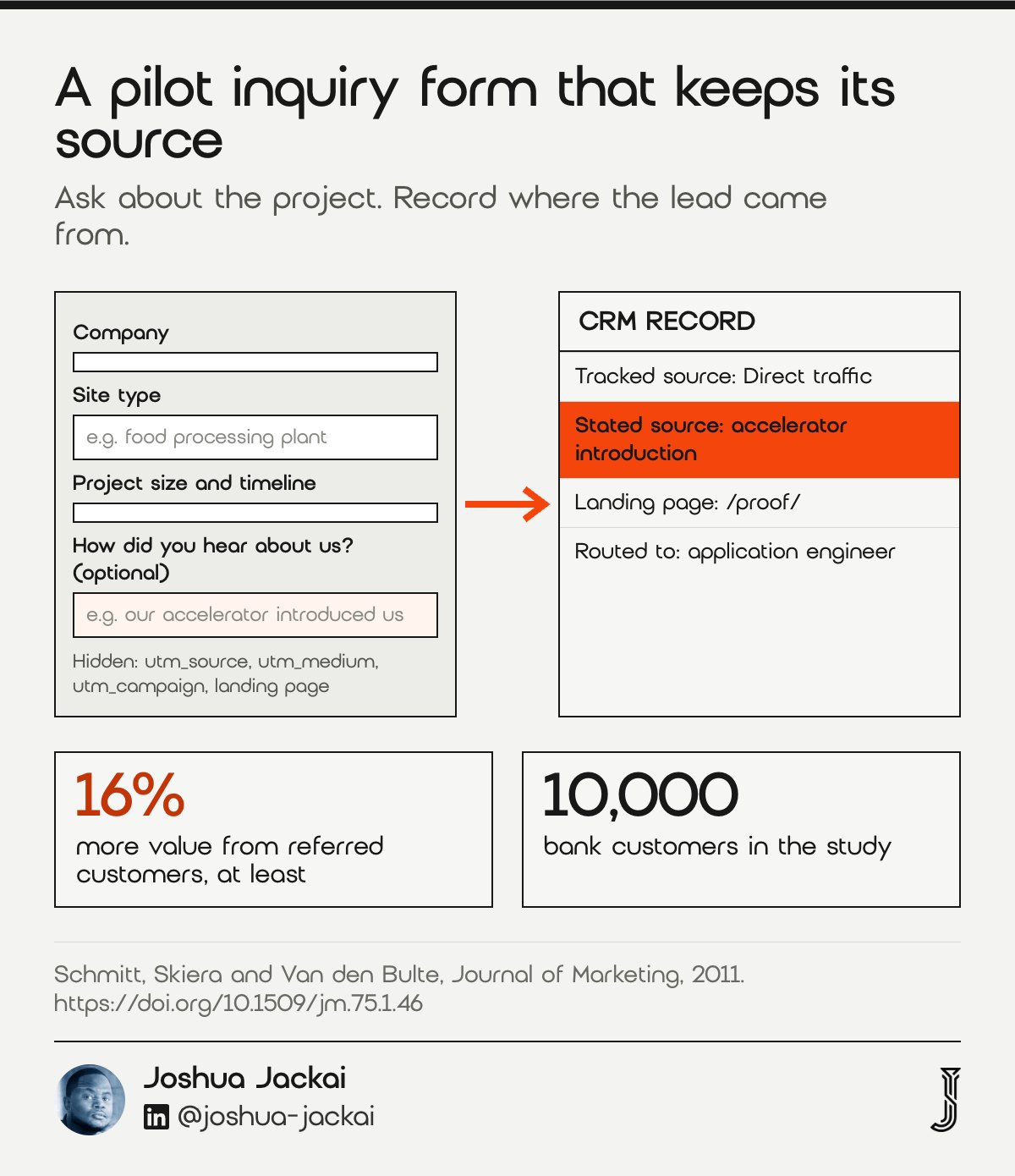
- Project fields: site type, size and timeline, kept short
- Source field: an optional open “How did you hear about us?”
- Hidden fields: UTM source, medium, campaign and landing page
- CRM: both the tracked and the stated source on the record
- Routing: pilot inquiries go to the right engineer or rep
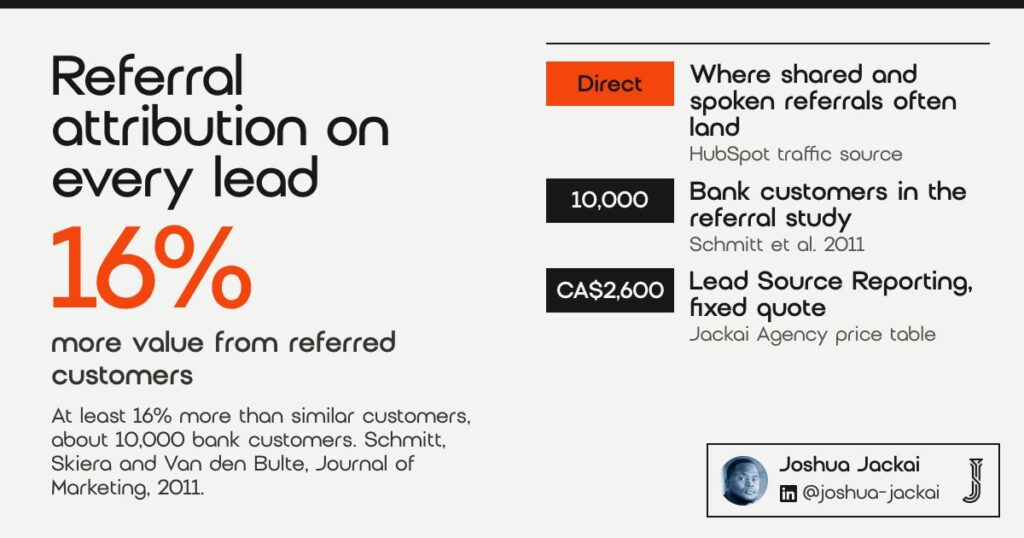
BC cleantech deals often start with an introduction from an accelerator, an industry association, a utility program or another client. Those leads usually show up as Direct traffic, because the link was shared in an email or typed in after a meeting. An optional open field fixes most of that, and my guide to referral attribution on every lead covers the setup. Philipp Schmitt, Bernd Skiera and Christophe Van den Bulte followed about 10,000 bank customers and found referred customers were worth at least 16% more than similar customers who were not referred. Their data came from a bank, not cleantech, but the point carries: referrals are worth knowing about, and a form that loses them hides your best channel. I also add hidden fields for the UTM tags and the landing page, so links from newsletters, LinkedIn posts and partner emails keep their source when the form is sent. Then both answers, the tracked one and the buyer’s own, sit on the same CRM record, and a weekly look tells you whether pilots come from the accelerator, the trade show or a client who spoke well of you. That one change usually answers the question a board asks first: where should next quarter’s marketing money go?
“The average value of a referred customer is at least 16% higher than that of a nonreferred customer with similar demographics and time of acquisition,” Schmitt, Skiera and Van den Bulte wrote in the Journal of Marketing.
Compare the seven must-haves by buyer and effort
This matrix lists the seven must-haves with the buyer each one serves, the effort it takes and its key number. Filter by the buyer you lose most often or by effort; rows are hidden, not deleted. Start with the low-effort row, the lead form, then fix the claims page before any redesign.
| Must-have | Who it serves | Effort | Key number |
|---|---|---|---|
| 1. Problem-first homepage | Everyone | Medium | 50 ms first impression |
| 2. Claims that pass the Competition Act | Procurement and legal | Medium | Up to $10 million penalty |
| 3. A proof library | Engineers and finance | High | 46.1% of comments on design look |
| 4. A path for each buyer | Everyone | Medium | 31 firms studied |
| 5. Technical pages with named experts | Engineers | Medium | 148 professional purchasers |
| 6. Pages AI answer engines can quote | Founders and procurement researching vendors | Medium | Up to 40% visibility gain |
| 7. A lead form that keeps its source | Your own sales team | Low | Referred customers worth 16% more |
Score your cleantech website in two minutes
This checklist scores your current site against the seven must-haves. Tick each one your site already has, and it returns a score out of 7 with the next fix to make. It uses no benchmarks or averages, only your own answers, so it works for a seed-stage startup and a scale-up alike.
What a cleantech website costs in Vancouver
A custom B2B website from me starts at CA$7,450, fixed quote, and covers the homepage, role pages, a proof library collection and a tracked lead form. The price depends on the number of product pages, whether the proof library needs a filter, and whether the site moves from another platform.
Two smaller starting points exist. My CA$995 website audit checks every claim, form and source property on your current site against this list, and it is credited in full if a project starts within 30 days. If the site is sound but AI tools never name you, AI visibility work on its own is CA$4,775. Lead source reporting on its own is CA$2,600. You can price a full build in the quote calculator.
"If a plant manager cannot tell what you sell from the first screen, the claims page and the proof library never get read," Joshua Jackai, Vancouver web designer, wrote in this guide.
Frequently asked questions
What should a cleantech company website include?
It should include a problem-first homepage, environmental claims with evidence behind them, a proof library of pilots and tests, a page for each buyer role, technical pages with a named expert, question-led content AI tools can quote, and a lead form that records the source of every inquiry.
Do Canadian greenwashing rules apply to a company website?
Yes. The Competition Act covers representations made to the public, and a website is one. Since June 2024, environmental benefit claims need adequate and proper testing or substantiation. The Competition Bureau published final guidelines on 5 June 2025. This is general information; ask a lawyer about specific claims.
Should cleantech data sheets be gated behind a form?
I leave the basic data sheet ungated and gate only the detailed integration or design guide. Engineers often decide the shortlist, and a form in front of a basic specification loses them. Track downloads with analytics events instead, so you still see interest without blocking it.
How long does a cleantech website redesign take?
Most of the B2B sites I build take six to ten weeks. Writing claims and gathering pilot data usually take longer than design, so start the claim audit and proof library in the first week while the wireframes are drawn. A larger product catalogue adds time.
Should a cleantech startup hire a cleantech agency or a B2B web designer?
Hire whoever can show B2B sites that turn technical proof into leads. Sector knowledge helps, but the work is mostly buyer roles, evidence pages and lead tracking. Ask any agency to show a proof library and a claims process they have built before.
Sources
Peer reviewed
- Lindgaard, G., Fernandes, G., Dudek, C. and Brown, J. (2006). Attention web designers: You have 50 milliseconds to make a good first impression! Behaviour and Information Technology. https://doi.org/10.1080/01449290500330448
- Delmas, M. A. and Burbano, V. C. (2011). The drivers of greenwashing. California Management Review. https://doi.org/10.1525/cmr.2011.54.1.64
- Fogg, B. J., Soohoo, C., Danielson, D. R., Marable, L., Stanford, J. and Tauber, E. R. (2003). How do users evaluate the credibility of Web sites? Proceedings of the 2003 Conference on Designing for User Experiences. https://doi.org/10.1145/997078.997097
- Johnston, W. J. and Bonoma, T. V. (1981). The buying center: structure and interaction patterns. Journal of Marketing. https://doi.org/10.1177/002224298104500312
- Gelderman, C. J., Schijns, J., Lambrechts, W. and Vijgen, S. (2021). Green marketing as an environmental practice: The impact on green satisfaction and green loyalty in a business-to-business context. Business Strategy and the Environment. https://doi.org/10.1002/bse.2732
- Aggarwal, P., Murahari, V., Rajpurohit, T., Kalyan, A., Narasimhan, K. and Deshpande, A. (2024). GEO: Generative Engine Optimization. Proceedings of KDD 2024. https://doi.org/10.1145/3637528.3671900
- Schmitt, P., Skiera, B. and Van den Bulte, C. (2011). Referral programs and customer value. Journal of Marketing. https://doi.org/10.1509/jm.75.1.46
Government and industry
- Competition Bureau Canada (5 June 2025). Competition Bureau issues final guidelines regarding environmental claims. Government source, read 17 November 2026. https://www.canada.ca/en/competition-bureau/news/2025/06/competition-bureau-issues-final-guidelines-regarding-environmental-claims.html
- Prices are from Jackai Agency's own price table (CAD), November 2026.