7 AI in Marketing Campaigns Stages: Complete 2026 Guide
Seven stages for using AI in marketing campaigns, from buyer research and the campaign brief to variants and measurement, with Copy Chief results, a stage filter and an hours calculator.
 Joshua Jackai
21 min read
Published 7 October 2026 · Last updated and fact-checked 27 October 2026
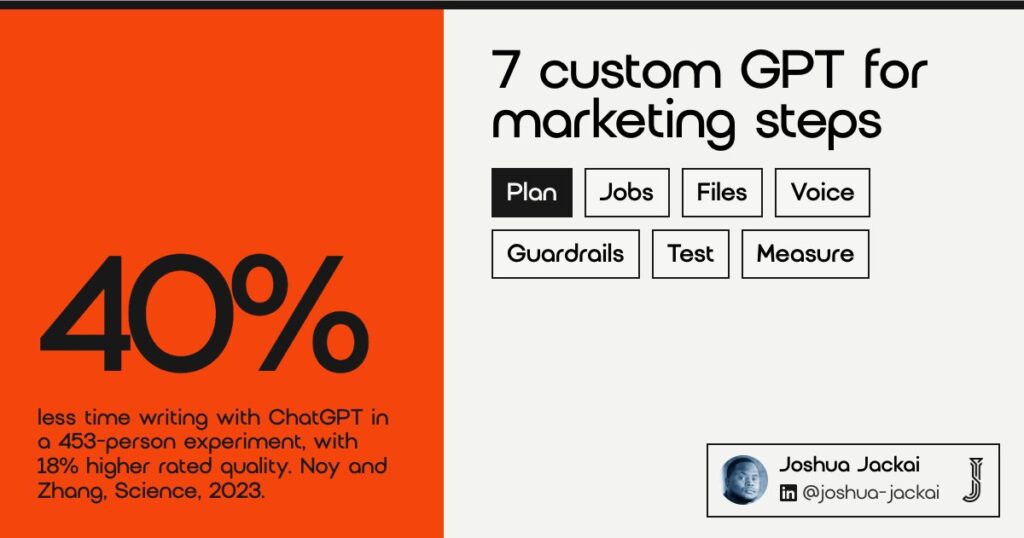
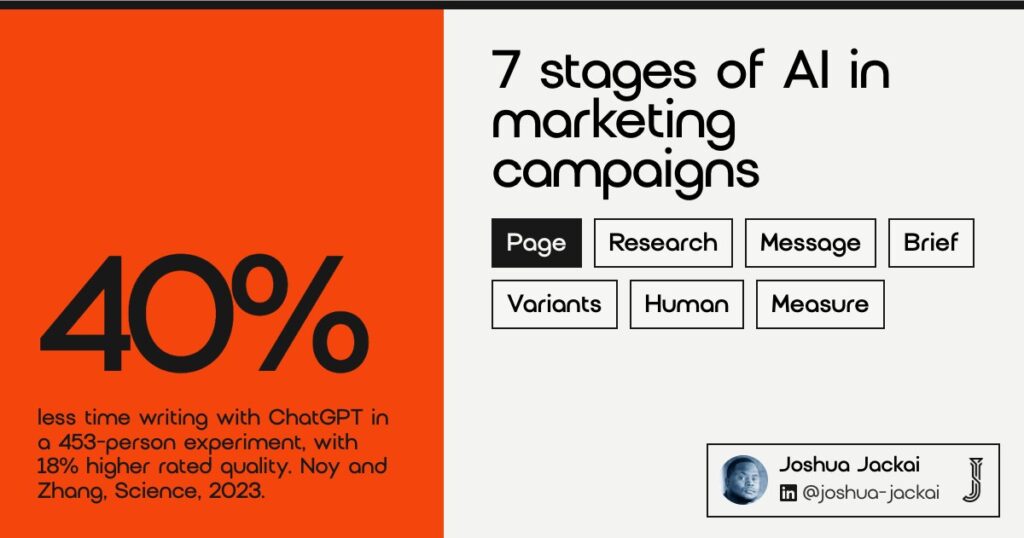
Short answer: AI in marketing campaigns pays off in seven stages: skip the generated page, research from real buyer words, turn pains into messages, write the brief, cut AI variants by hand, keep six jobs human, and measure the result. In a 453-person experiment, ChatGPT cut writing time by 40% (Noy and Zhang, Science, 2023).
Most teams using AI in marketing campaigns point it at the cheapest job in the campaign. They ask a model for a landing page or a set of ads, and something comes back that looks finished. Looks is carrying that whole sentence. The page doesn’t know who is buying, what they’ve already tried, or which option is open in the next tab.
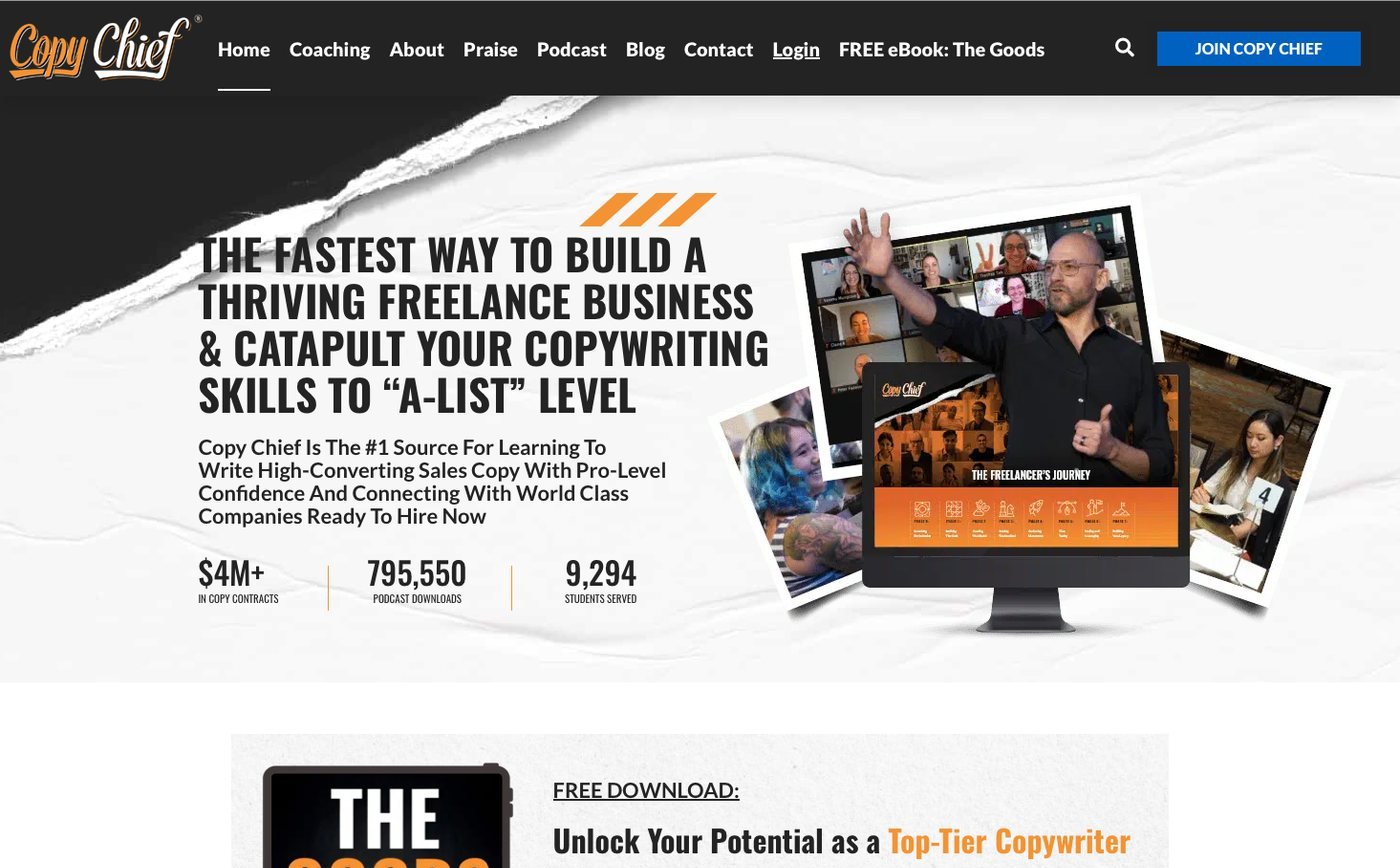
On Copy Chief’s Escape Velocity campaign, I gave AI a different job. Copy Chief is a membership platform for working copywriters, based in St. Petersburg, Florida. Escape Velocity was a Meta Ads campaign sending traffic to a mobile-first funnel. AI did the research. People made the calls. Escape Velocity returned 55.03x average return on ad spend, and its cost per acquisition fell from $42 to $22. Those are Jackai Agency client figures, not independently audited.
I am Joshua Jackai, a web designer in Vancouver, and I run Jackai Agency. This guide is the map I use for AI in marketing campaigns on client work: which stages get a model, which stay with a person, and how to tell them apart. I sell AI marketing systems, so weigh my advice the way you would weigh any vendor’s.
In this guide
Key takeaways
- Point AI at reading and sorting buyer comments first. A study of 36 participants found ChatGPT-assisted ideas were less distinct from one another, so a generated page tends to look like everyone else’s.
- Research comes from things buyers wrote. Models standing in for 3,200 human participants misportrayed and flattened the groups they represented.
- Escape Velocity returned 55.03x on ad spend after the research stage came first; the 0.9% to 3.0% click-through gain came with it.
- The brief is the prompt. Eight lines, each with a named owner, make AI drafts much closer to usable.
- Judge the campaign on the result named before launch. Copy Chief’s Membership Funnel Redesign returned 31x once it was judged on paid subscriptions.
| Stage | What AI does | What a person decides | Time (my estimate) |
|---|---|---|---|
| 1. Skip the generated page | Nothing yet | What the page must say | 1 day |
| 2. Research from buyer words | Reads and sorts comments | Which findings hold up | 1 week |
| 3. Turn pains into messages | Groups pains, phrases them | Which pain leads | 2 days |
| 4. Write the campaign brief | Drafts it from notes | The promise, offer and proof | 2 days |
| 5. Make and cut variants | Writes 20 versions | Which 3 or 4 get tested | 2 days |
| 6. Keep six jobs human | Nothing | Offer, proof, budget, approval | Ongoing |
| 7. Measure the result | Summarizes exports | What counts as a win | 4 weeks |
Where does AI in marketing campaigns actually help?
AI in marketing campaigns helps most where the work is reading and sorting at volume, or turning out first drafts. It helps least where the work is judgment about one buyer, one offer and the budget behind it. Most campaigns mix the two, so the useful question isn’t “should we use AI?” It’s “which stage is this?”
Here’s how I split a campaign into seven stages, and who does the work at each one.
| Campaign stage | What AI does well | What stays with a person |
|---|---|---|
| Segment choice | Lists possible segments from your customer data | Picking the one segment to serve first |
| Customer research | Reads and sorts thousands of reviews and forum comments | Checking each finding against a source and a real conversation |
| Ad creative research | Groups the confirmed pains and phrases them in the buyer’s words | Choosing which pain the campaign leads with |
| Campaign brief | Drafts the document from your research notes | Signing off the promise, the offer and the proof |
| Variants | Writes 20 versions of a headline or hook in minutes | Cutting them to the few worth paying to test |
| Build | First drafts of page sections and follow-up emails | Final copy, design decisions and compliance checks |
| Media buying and reporting | Summarizes platform exports | Moving budget and deciding what counts as a result |
Read the table top to bottom and a pattern shows up. The strongest uses of AI in marketing campaigns sit early, in research and drafting. The stages where money moves (the budget, the offer, what the page promises) stay with someone who will answer for the result.
1. Skip the generated landing page: it is the wrong first job
The most common use of AI in marketing campaigns is the weakest one. A generated page is an average of every page like it, because a language model predicts the most likely next word, and most likely means most common. Start with research instead and keep the page for later.
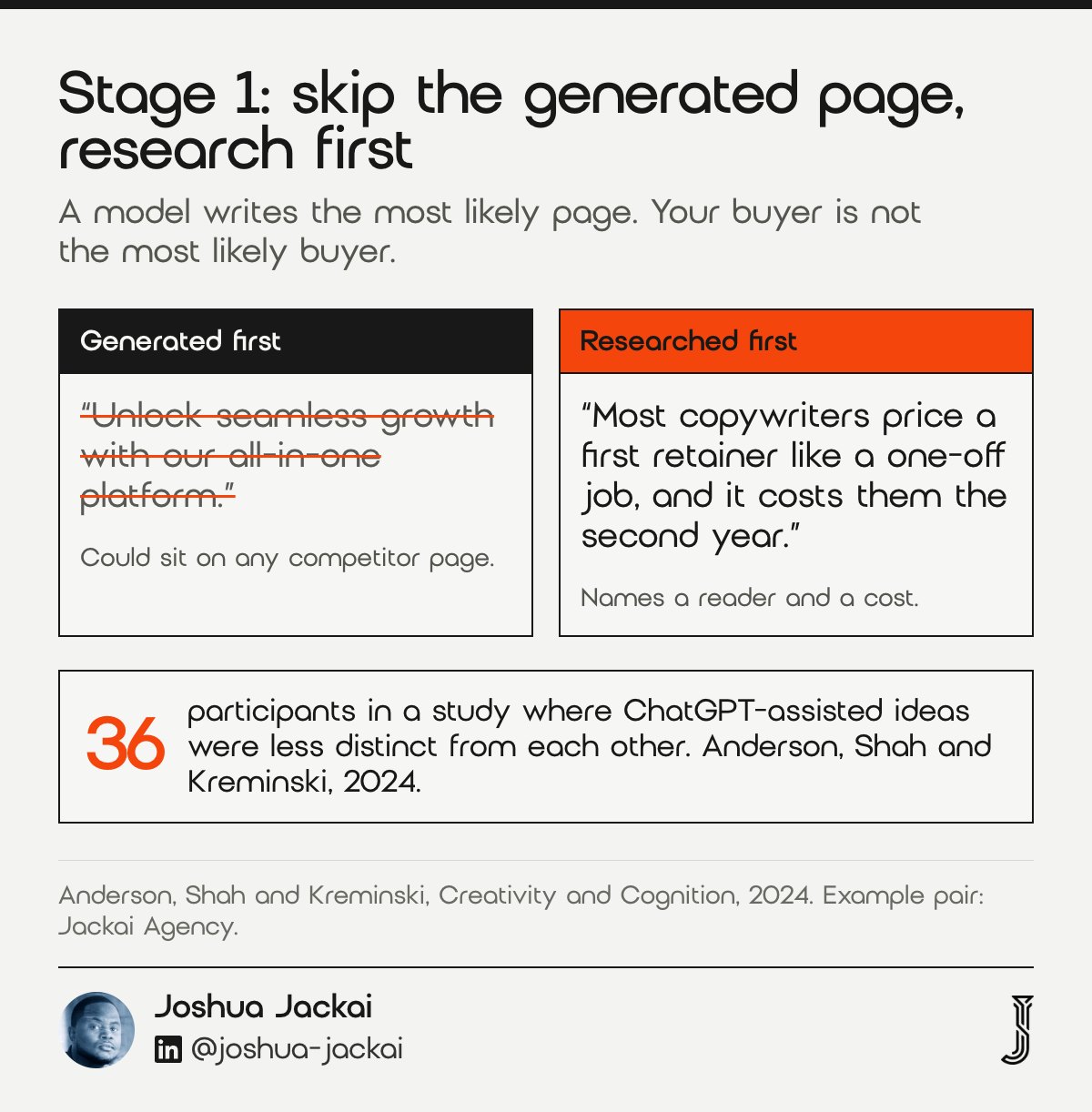
- Job it gets: none yet; research comes first
- Why: a one-line prompt hides the buyer’s stage and frustration
- Evidence: 36-person study on idea sameness (Anderson et al., 2024)
- Time: about 1 day to agree what the page must say
That isn’t an insult to the model. It’s how the model works. Averages rarely convert, because the buyer isn’t average. Picture a working copywriter deciding whether to spend rent money on a course. She’s at a specific stage, carrying a specific frustration, comparing the offer against something she already knows. A model can’t see any of that from a one-line prompt, so it fills the gap with plausible copy.
Plausible copy is the most expensive kind. It passes the internal review, then fails quietly once it’s live.
“Plausible copy is the most expensive kind,” wrote Joshua Jackai, Vancouver web designer.
The sameness is measurable. In a study with 36 participants, people who brainstormed with ChatGPT produced ideas that were less distinct from one another than people using a different tool (Anderson, Shah and Kreminski, 2024). If your competitors prompt the same model with the same request, you all get the same page.
On Escape Velocity, the page design was never the constraint. Knowing what the page had to say was the constraint. So that’s where the AI went.
2. Research from what buyers wrote, not from what the model imagines
Customer research is where AI in marketing campaigns pays off first, if you start narrower than feels comfortable. Pick one stage, one pain and one kind of buyer you can picture. Then point the model at comments, reviews and emails that real buyers wrote, and check every finding against a source.
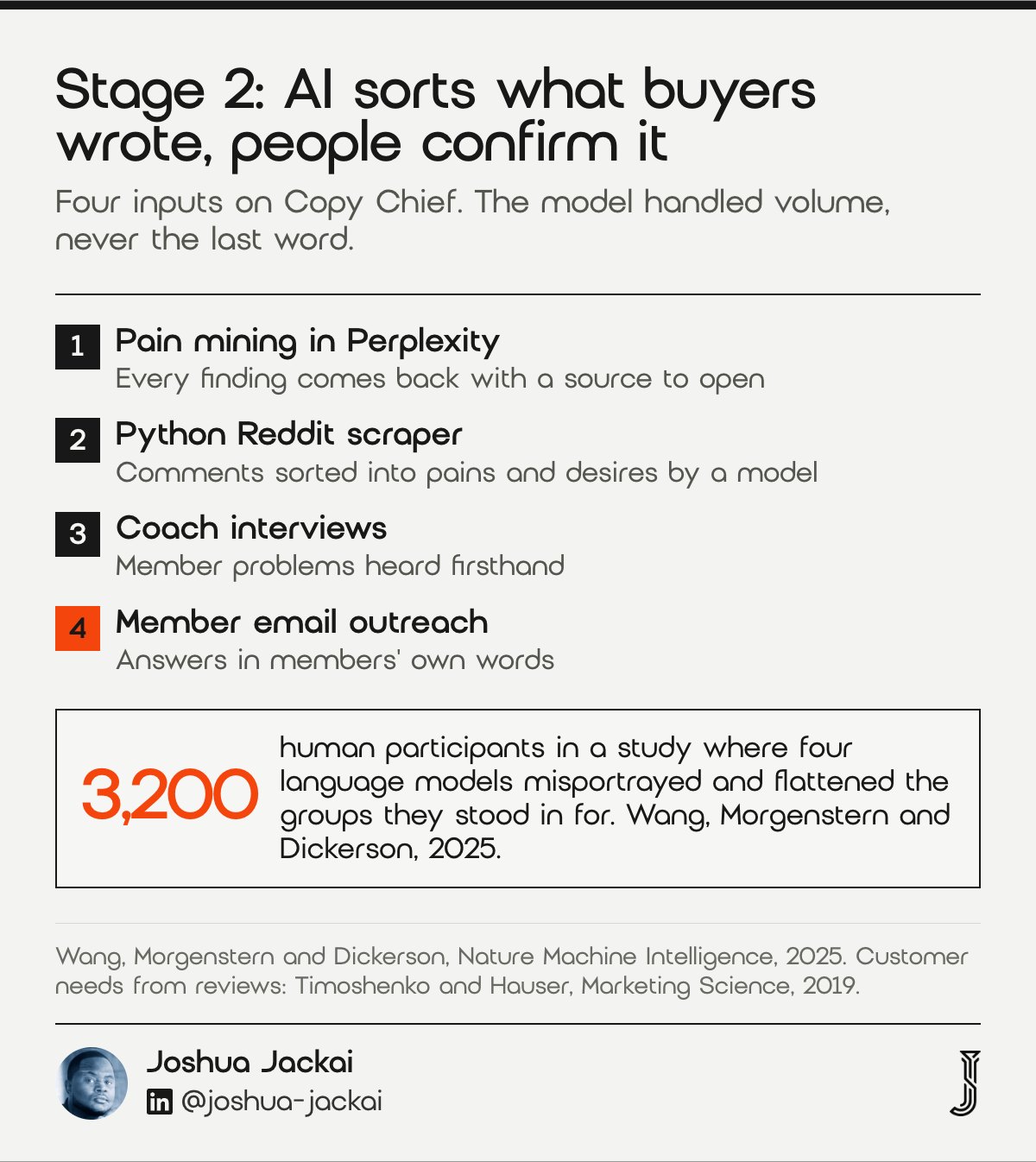
- Inputs: reviews, forum comments, interviews, member emails
- AI’s job: read, sort and count by pain or desire
- Person’s job: open the source and confirm each finding
- Evidence: 3,200-participant study on synthetic respondents (Wang et al., 2025)
- Time: about 1 week
Not “B2B companies.” Not “copywriters.” Research aimed at a broad label returns broad answers, and broad answers produce the same generic page you’d have got from the model anyway.
Then send the research outward, not inward. Asking a model what your buyers worry about is asking it to guess. Goli and Singh tested GPT-3.5 and GPT-4 as stand-in survey respondents. The models were less patient than real people when choosing between rewards, and the authors warn that asking the model directly can mislead, though it helps with ideas worth testing (Goli and Singh, 2024).
“Large language models that replace human participants can harmfully misportray and flatten identity groups,” wrote Wang, Morgenstern and Dickerson in the title of their Nature Machine Intelligence paper, 2025.
A synthetic buyer persona is a guess with a name on it. What does work is reading what real buyers wrote.
“propose and test a machine-learning approach for identifying customer needs more efficiently,” wrote Timoshenko and Hauser in Marketing Science, 2019.
In that study, Timoshenko and Hauser compared customer needs found in online product reviews with needs found by professional interviewers. The reviews were at least as valuable a source, and machine learning made the review faster by filtering out repetitive and empty content (Timoshenko and Hauser, 2019).
On Copy Chief, my customer research ran on four inputs:
- Pain mining in Perplexity. I used its research feature because each finding comes back with a source attached, so I can open the thread and read it myself.
- A custom Python Reddit scraper. It pulled comments and fed them to a language model, which sorted each one into pains and desires.
- Coach interviews. The coaches hear member problems firsthand, in a way no scraper does.
- Member email outreach. Members answered in their own words, which is the raw material for headlines.
The model handled the volume. It never had the last word. A pain that showed up in the scraped comments but nowhere in the interviews or emails got a question mark, not a headline. Language models can write fluent text that their sources don’t support, which researchers call hallucination (Ji et al., 2023). So every finding has to point back to something a person actually wrote or said.
“Five real problems, each traceable to a source, beat fifty invented ones,” wrote Joshua Jackai, Vancouver web designer.
3. Turn each confirmed pain into one message
Ad creative research is the step between customer research and the ad itself. Each confirmed pain becomes one headline, written as close to the buyer’s own words as you can get. That headline goes on the ad, at the top of the landing page and in the follow-up email, so one research pass feeds three places.
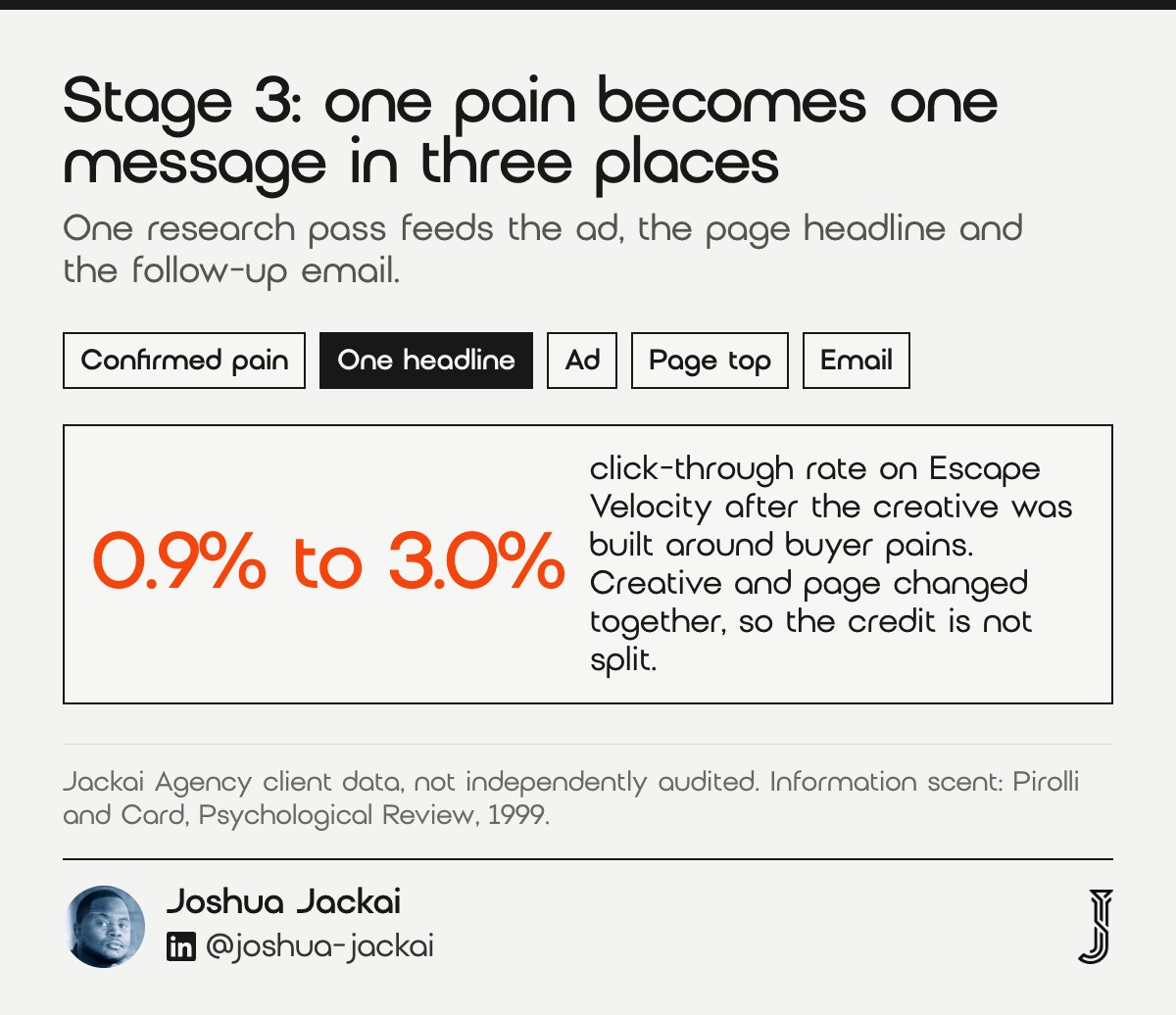
- Input: confirmed pains with their source quotes
- AI’s job: group pains, count how often each appears, phrase each four ways using only quoted words
- Person’s job: choose the one pain the campaign leads with
- Result on Escape Velocity: click-through rate 0.9% to 3.0%
- Time: about 2 days
Most teams skip this step, because the pains feel obvious once written down. They aren’t obvious until you’ve chosen one to lead with.
The match between ad and page isn’t decoration. People judge where to go next from the cues in front of them, which Pirolli and Card called information scent (Pirolli and Card, 1999). When the ad promises one thing and the page opens on another, the scent breaks.
AI’s part in ad creative research is the middle step. I give it the confirmed pains with their source quotes and ask for groupings, how often each pain appears, and four ways to phrase each one using only words from the quotes. Without that last limit, the model drifts back toward the phrasing it has seen on every other ad.
On Escape Velocity, the static and animated Meta creative was split into top-of-funnel and bottom-of-funnel sets, each built around the buyer’s pain points. Escape Velocity’s click-through rate went from 0.9% to 3.0%, and its landing page converted at 10.1%. One honest limit: the creative and the landing page changed in the same campaign, so I can’t tell you how much of the 55.03x return belongs to each.
That research-first approach is how I run paid social creative and media buying for clients.
4. Write the campaign brief and give every line an owner
A campaign brief is the document the ad writer, the page builder and the media buyer all work from. AI is good at drafting it from research notes, because that’s a summarizing job. It is not good at deciding what goes in it. A vague brief gets a different guess from each reader.
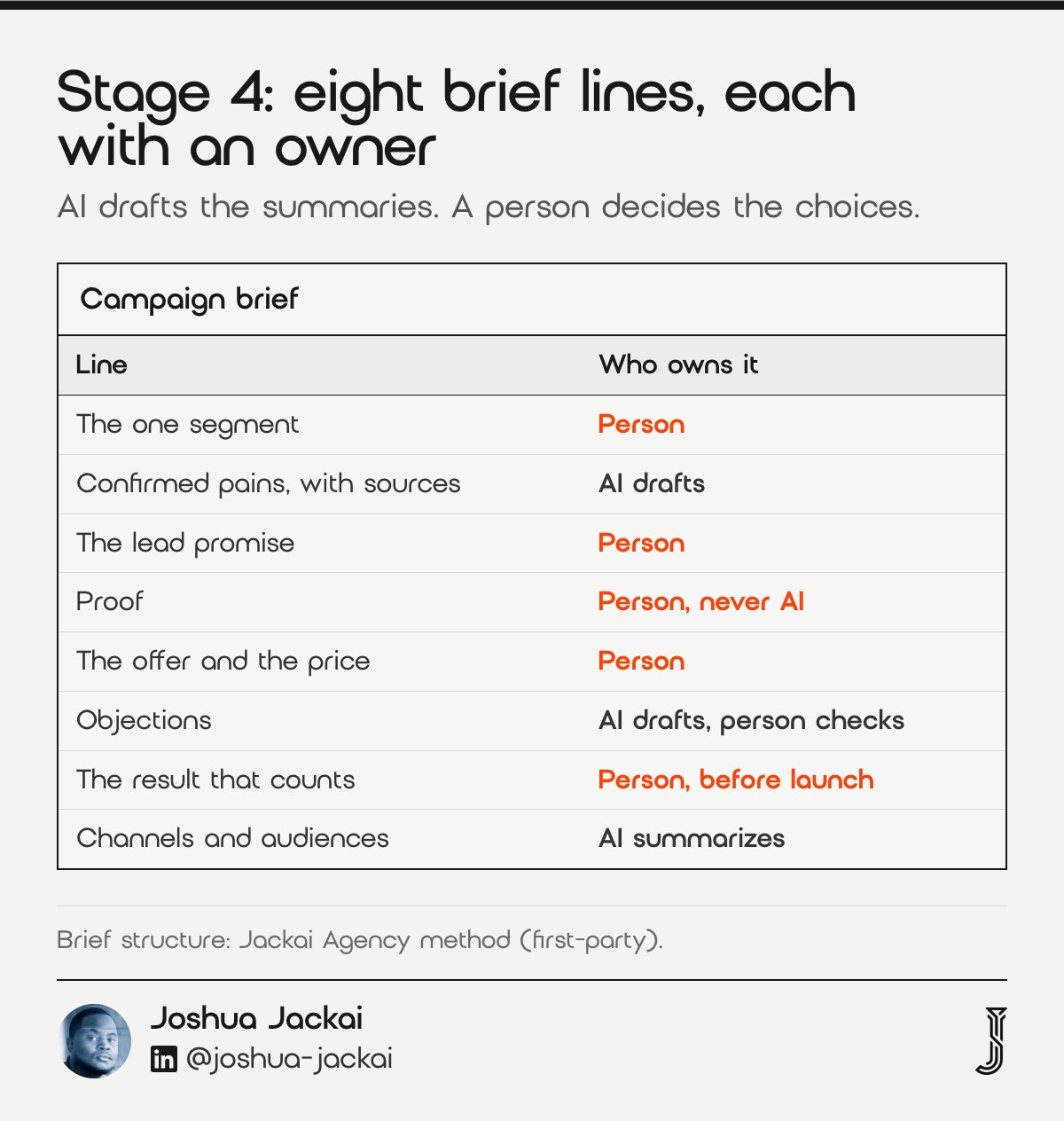
- Lines: 8, from the one segment to channels and audiences
- AI drafts: confirmed pains, objections, channel summaries
- A person decides: segment, lead promise, offer and price, result that counts
- Proof rule: only results the client can stand behind, caveat attached
- Time: about 2 days
Here’s the brief I use, with who owns each line:
- The one segment. One sentence naming the buyer and their stage. A person decides; AI can tidy the wording.
- Confirmed pains, with sources. Three to five, each linked to where it came from: a comment, an interview or a member email. AI drafts this from the research file.
- The lead promise. The single pain the campaign opens with, chosen during ad creative research. A person decides.
- Proof. Only results the client can stand behind, with the caveat attached. AI never supplies a number.
- The offer and the price. A person decides.
- Objections. What stops the buyer, in their words. AI drafts; a person checks.
- The result that counts. Purchases, booked calls or paid subscriptions, not likes. Decided before launch.
- Channels and audiences. Where the ads run and to whom. AI can summarize past platform data.
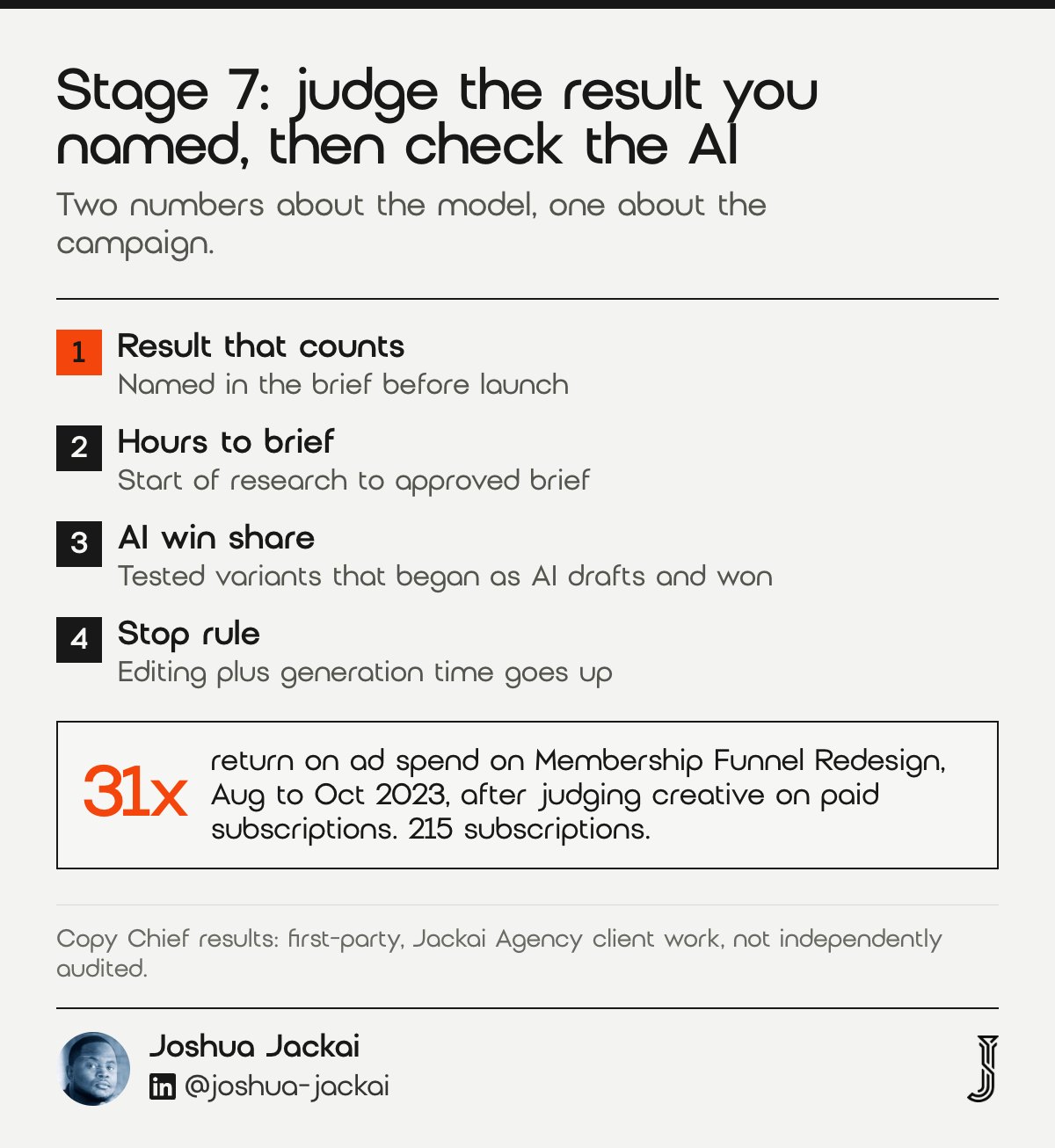
“The result that counts” is the line campaigns get wrong most often. On Copy Chief’s Membership Funnel Redesign, creative had been judged on engagement instead of subscriptions, so the best-performing ads were the ones least likely to sell. Rebuilt around paid subscriptions, the Membership Funnel Redesign returned 31x on ad spend with 215 paid subscriptions from August to October 2023. It ran to a deadline, so 31x belongs to those three months, not to the funnel forever.
In my experience, a model given a one-page campaign brief with sourced pains writes much closer drafts than a model given a product name and a tone word. The brief is the prompt. Copy Chief’s Membership Funnel Redesign case study shows what a brief with a named result produced, and it is the model for how I now start every campaign: write the result first, then the pains, then the promise. A brief this short fits on one screen, which is also why the people who write ads, build pages and buy media can all read it in the same five minutes and agree on what the campaign is for.
“The brief is the prompt,” wrote Joshua Jackai, Vancouver web designer.
5. Make 20 variants with AI, then cut to three or four by hand
Variants are where AI in marketing campaigns saves real hours. Ask for 20 versions of one element at a time, each tied to one pain, then cut by hand to the three or four worth paying to test. The drafting is cheap. The choosing is the skilled part, and it stays with you.
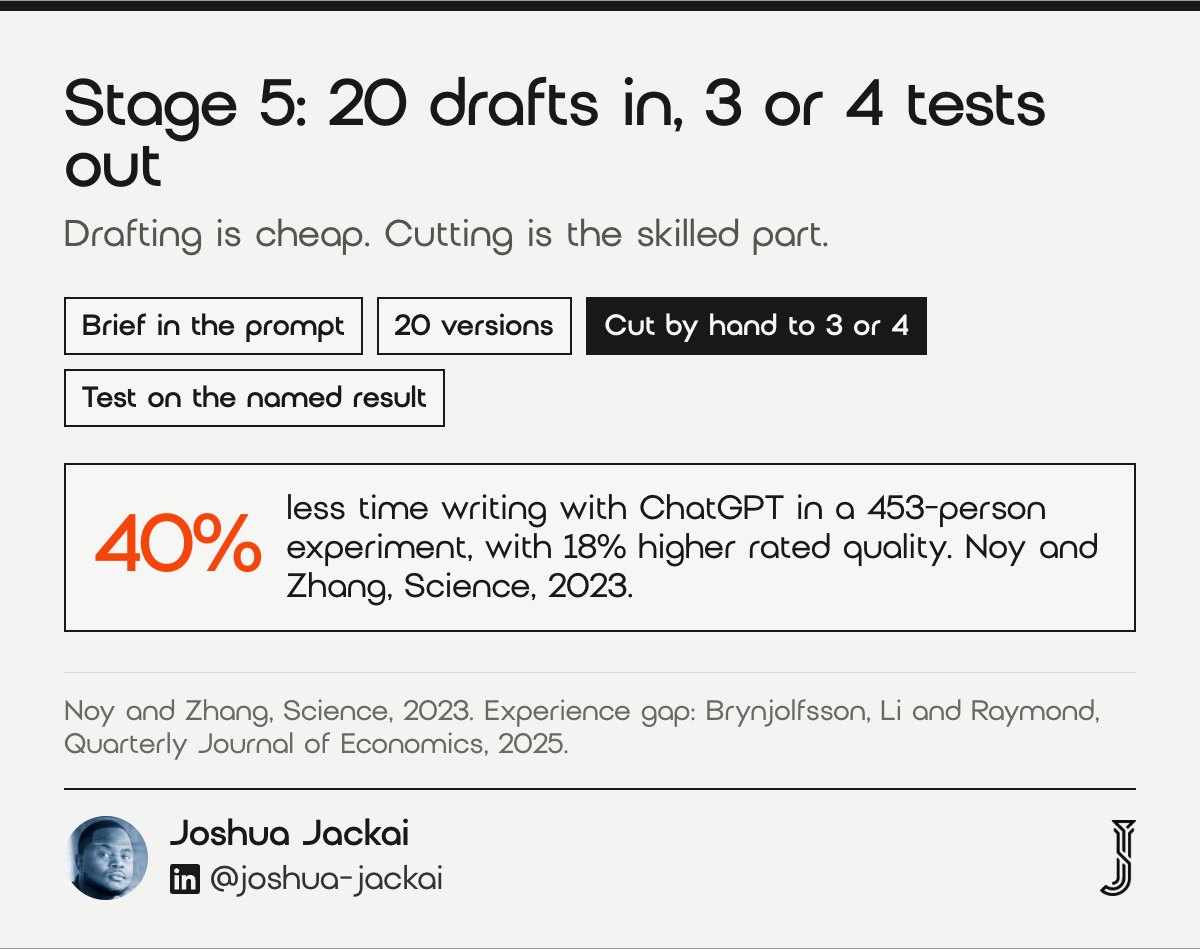
- Ask for: 20 versions of one element, tied to one pain
- Cut to: 3 or 4, deleting any line a competitor could run unchanged
- Test on: the result the brief named, with real budget
- Evidence: 453 professionals, 40% less time, 18% higher rated quality (Noy and Zhang, 2023)
- Time: about 2 days
“The average time taken decreased by 40% and output quality rose by 18%,” wrote Noy and Zhang in Science, 2023.
That was a preregistered experiment with 453 college-educated professionals on writing tasks. Headlines, hooks, subject lines and short ad text are that kind of task. Tailored versions help too. Across four studies with 1,788 participants, messages ChatGPT matched to a reader’s psychological profile were more persuasive than generic ones (Matz et al., 2024). In a B2B campaign, that usually means one version per role in the buying group: the owner, the finance lead and the person who’ll use the thing daily.
More tailoring isn’t automatically better, though. In a field experiment at an online travel firm, retargeted ads showing the exact product a visitor had viewed did worse on average than generic brand ads, until the visitor’s preferences had narrowed (Lambrecht and Tucker, 2013). Specific copy suits buyers close to deciding. Early buyers respond to the broader promise.
Here’s how I run variants. Paste the whole campaign brief into the prompt, not just the product name. Ask for one element at a time. Cut by hand. Then test the few against each other, judged on the result the brief named.
The gains aren’t even across people. In a study of 5,172 customer-support agents, an AI assistant raised productivity by 15% on average, but the most experienced agents saw small drops in quality (Brynjolfsson, Li and Raymond, 2025). That matches what I see: a senior marketer’s hours are better spent cutting and choosing than drafting.
“the most experienced and highest-skilled workers see small gains in speed and small declines in quality,” wrote Brynjolfsson, Li and Raymond in the Quarterly Journal of Economics, 2025.
The lesson for a campaign team is who does which half. Setting that production side up as a repeatable system is what my AI marketing systems work covers.
6. Keep six jobs away from AI on every client campaign
Some jobs carry risk, and some give the model nothing to work from. On client campaigns I keep six away from it: the offer, any proof, standing in for the buyer, regulated claims, moving budget and final approval. A person whose name is on the result owns each one.
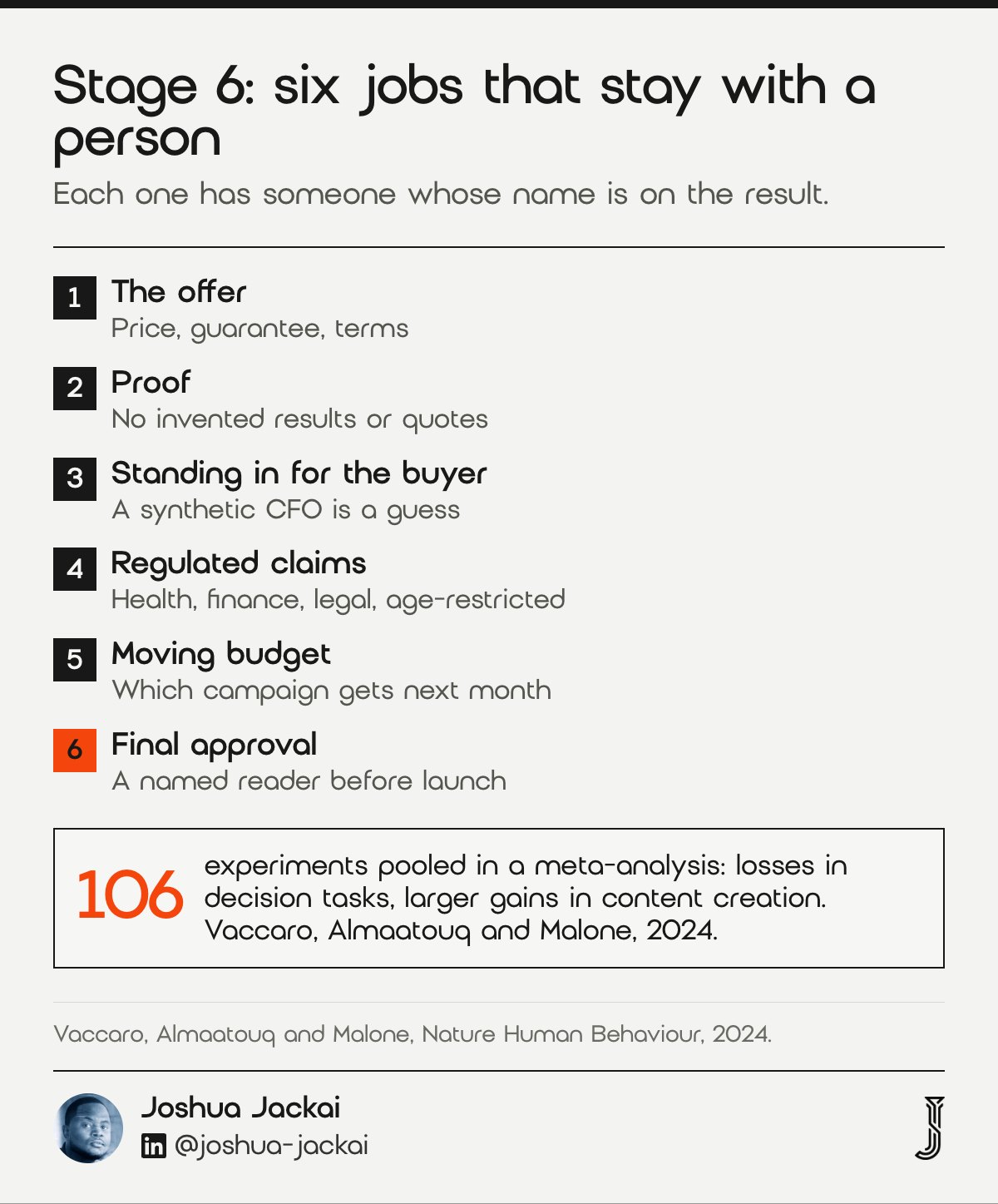
- Offer: price, guarantee and payment terms, because margins are not in the prompt
- Proof: AI never writes a result, a testimonial or a statistic
- Buyer stand-ins: a synthetic CFO gives confident answers with nothing behind them
- Regulated claims: health, finance, legal and age-restricted lines need a person who knows the rules
- Budget and approval: a model can summarize ad sets; a person decides next month’s money
Choosing the offer is a business decision with margins attached, and a model doesn’t know your margins. Inventing proof is the fastest way to lose a client: if a number isn’t in the client’s own reporting, it doesn’t go in the ad. Standing in for the buyer is the failure the Goli and Singh and Wang studies in stages 2 and 3 describe, and the mismatch they report is why I treat a model’s answer about a CFO as a guess.
There’s also a quieter failure. Using AI in marketing campaigns to make more of the wrong thing, faster, is the most common misuse I see. A meta-analysis of 106 experiments found people working with AI did worse, on average, than the better of the two working alone, and the losses showed up in decision tasks while the gains were larger in content creation (Vaccaro, Almaatouq and Malone, Nature Human Behaviour, 2024). If the segment is too broad or the offer is weak, 20 polished variants just spend the budget sooner. Fix the campaign brief first.
The same goes for the build. Page structure, the order of proof and the form fields are design decisions, and the gap between the click and the checkout is where money leaks. That’s the part of funnel development I don’t hand over.
7. Measure the result you named, plus two numbers about the AI
You can’t measure the value of AI in marketing campaigns if you can’t measure the campaign. Before launch, tag every ad link, carry the tags into the CRM and record the landing page each lead arrived on. Then compare an AI-assisted variant against a human-written one, changing only the copy.
- Before launch: UTM tag on every ad link; tags carried into the CRM
- Test design: change only the copy, judge on the result the brief named
- AI number 1: hours from start of research to an approved brief
- AI number 2: share of tested variants that started as AI drafts and won
- Time: about 4 weeks for a clean read
That’s the lead attribution method I set up on client sites. If you change the research, the creative and the page all at once, as Escape Velocity did, you get a better campaign but no clean answer about which part did the work.
On the AI side, I track the two numbers above, once at the end of each campaign. If the first drops and the second holds up, the model is earning its place. If time drops but nothing AI-drafted ever wins a test, it’s producing volume, not results.
“A draft that takes 30 seconds to generate and 90 minutes to fix is not a saving,” wrote Joshua Jackai, Vancouver web designer.
A draft that takes 30 seconds to generate and 90 minutes to fix is not a saving. Count the editing time with the generation time, and stop using the model on that stage if the combined total goes up. The same discipline applies to the campaign itself: write down the result before launch, read it at a fixed date, and resist reading anything else into the first week of data, because early numbers move around more than they should.
Which of the 7 stages should you do first?
Start with the stage that matches your problem. If campaigns launch with no clear message, begin at stage 2 or 3. If drafts arrive fast but results stay flat, begin at stage 4. If you can’t tell what worked, begin at stage 7. Filter the table to find yours.
| Stage | Problem it fixes | Time (my estimate) | You hold |
|---|---|---|---|
| 1. Skip the generated page | Generic copy that fits any competitor | 1 day | One sentence on what the page must say |
| 2. Research from buyer words | Guessing what buyers worry about | 1 week | Five to ten sourced pains |
| 3. Turn pains into messages | Ads and pages that do not match | 2 days | One headline per pain |
| 4. Write the campaign brief | Each reader guessing differently | 2 days | An eight-line brief with owners |
| 5. Make and cut variants | Volume without results | 2 days | Three or four variants to test |
| 6. Keep six jobs human | Invented proof, wrong offer | 1 day to set the rule | A named owner for each job |
| 7. Measure the result | No clean read on what worked | 4 weeks | One result and two AI numbers |
How many hours could AI free up in your campaign?
Hours saved depend on how many assets your team drafts and how long each takes today. The calculator multiplies your own numbers by a saving you choose. The defaults are placeholders, not benchmarks; replace the percentage with your own result from stage 7 after one campaign.
Drafting hours a month AI could free up. Defaults are placeholders, not benchmarks.
What does an AI-assisted campaign cost, and how long does it take?
The tools are the cheap part of AI in marketing campaigns. Most of the cost is the hours spent on customer research, the campaign brief and the build, and those hours don’t shrink much because a model drafted some copy. What shrinks is the sorting and drafting in between.
On Copy Chief’s World of Financial Copy promotion, the funnel (ClickFunnels, ThriveCart and Keap) was built and launched in one week, and the World of Financial Copy funnel took 56 orders at a 4% conversion rate. Copy Chief’s Crossroads Summit event funnel launched in 14 days, and Crossroads Summit returned 10x on event ticket sales. In my experience the build is rarely the slow part. Agreeing on the message is.
These fixed quotes usually apply to a campaign like this:
- Landing Page Design: from CA$3,795, 1 to 2 weeks.
- Lead Source Reporting: CA$2,600, 2 weeks, so every lead arrives tagged with its campaign and ad.
- Paid social creative and media buying: a fixed quote after a call, because spend and scope vary too much to list.
Every quote is fixed before work starts, with two revision rounds per phase. The full list is on my pricing page and calculator, and the Copy Chief case study shows the funnel work in detail.
AI in marketing campaigns questions answered
Where does AI in marketing campaigns actually help?
AI helps most with reading and sorting buyer comments at volume and with first drafts of headlines, hooks and emails. It helps least with choosing the offer, the budget or the proof. In a 453-person experiment, ChatGPT cut writing time by 40% (Noy and Zhang, 2023).
Can AI replace customer research for a campaign?
No. A study with 3,200 human participants and four language models found the models misportrayed and flattened the groups they stood in for. Use AI to sort what real buyers wrote, then confirm each finding against a source or a conversation with a person.
What should a campaign brief include when AI helps write it?
Eight lines: the one segment, confirmed pains with sources, the lead promise, proof, the offer and price, objections, the result that counts, and channels. AI can draft the pains, objections and channel summary. A person decides the segment, promise, offer and result.
How do you know if AI is paying off in a campaign?
Track two numbers: hours from the start of research to an approved brief, and the share of tested variants that began as AI drafts and won. Judge the variants on the result the brief named, such as paid subscriptions, not clicks or likes.
Want a second opinion on your next campaign brief?
Not a pitch. A 30-minute call. Bring the campaign you’re planning, or the one that’s live and flat, and I’ll tell you which stages I’d hand to AI, which I’d keep, and what I’d check first. When AI in marketing campaigns has meant faster drafts and the same results, the gap is usually upstream, in the customer research.
Book a 30-minute call with me.
Sources
Peer-reviewed research
- Anderson, B. R., Shah, J. H., and Kreminski, M. (2024). Homogenization effects of large language models on human creative ideation. Creativity and Cognition (C&C ’24), ACM, 413-425. https://doi.org/10.1145/3635636.3656204
- Brynjolfsson, E., Li, D., and Raymond, L. (2025). Generative AI at work. The Quarterly Journal of Economics, 140(2), 889-942. https://doi.org/10.1093/qje/qjae044
- Goli, A., and Singh, A. (2024). Frontiers: Can large language models capture human preferences? Marketing Science, 43(4), 709-722. https://doi.org/10.1287/mksc.2023.0306
- Ji, Z., Lee, N., Frieske, R., Yu, T., Su, D., Xu, Y., Ishii, E., Bang, Y., Madotto, A., and Fung, P. (2023). Survey of hallucination in natural language generation. ACM Computing Surveys, 55(12), 1-38. https://doi.org/10.1145/3571730
- Lambrecht, A., and Tucker, C. (2013). When does retargeting work? Information specificity in online advertising. Journal of Marketing Research, 50(5), 561-576. https://doi.org/10.1509/jmr.11.0503
- Matz, S. C., Teeny, J. D., Vaid, S. S., Peters, H., Harari, G. M., and Cerf, M. (2024). The potential of generative AI for personalized persuasion at scale. Scientific Reports, 14, 4692. https://doi.org/10.1038/s41598-024-53755-0
- Noy, S., and Zhang, W. (2023). Experimental evidence on the productivity effects of generative artificial intelligence. Science, 381(6654), 187-192. https://doi.org/10.1126/science.adh2586
- Pirolli, P., and Card, S. (1999). Information foraging. Psychological Review, 106(4), 643-675. https://doi.org/10.1037/0033-295X.106.4.643
- Timoshenko, A., and Hauser, J. R. (2019). Identifying customer needs from user-generated content. Marketing Science, 38(1), 1-20. https://doi.org/10.1287/mksc.2018.1123
- Vaccaro, M., Almaatouq, A., and Malone, T. (2024). When combinations of humans and AI are useful: A systematic review and meta-analysis. Nature Human Behaviour, 8(12), 2293-2303. https://doi.org/10.1038/s41562-024-02024-1
- Wang, A., Morgenstern, J., and Dickerson, J. P. (2025). Large language models that replace human participants can harmfully misportray and flatten identity groups. Nature Machine Intelligence, 7(3), 400-411. https://doi.org/10.1038/s42256-025-00986-z
Industry and vendor sources
- Copy Chief campaign results (Escape Velocity, Membership Funnel Redesign, World of Financial Copy, Crossroads Summit): first-party figures from Jackai Agency client work, not independently audited, as reported in the Copy Chief case study.
- Competitor word counts for this topic were measured on 27 October 2026 across five published guides (Leadpages, Interview Kickstart, Creately, Grammarly, Shopify).