7 Hard Facts: Does ChatGPT Recommend Canadian Businesses?
ChatGPT named 44% of the Canadian main-street businesses Clixera tested, and few firms show up on ChatGPT, Gemini and Claude alike. I put the Canadian audits side by side, split being named from being described correctly, and give a prompt check you can run from Canada.
 Joshua Jackai
20 min read
Published 11 November 2026 · Last updated and fact-checked November 2026
Short answer: Sometimes, and not reliably. In one Canadian test, ChatGPT named 44% of independent main-street businesses (Clixera via MobileSyrup, 2026). This post puts three Canadian audits side by side, separates being named from being described correctly, adds the US-skew research, and gives a prompt check you can run from Canada.
A sales director at a 40-person Calgary engineering firm (a composite, not a client) types a question into ChatGPT: which Canadian firms should we shortlist for a plant upgrade? Four names come back. Two are American. Her own firm, which ranks on page one of Google for the same service, isn’t there.
That’s not a Google problem. It’s a different test, and most Canadian owners have never seen the numbers for it.
On 11 November 2026 I read the pages that rank for “does chatgpt recommend canadian businesses”. Page one is a news story, a few agency press releases and US vendor blogs. Each reports one study. None puts the Canadian audits next to each other with their sample, engines, dates and sponsors, and none separates “named in a recommendation” from “described correctly once named”. If you want to know how Canadians use AI to choose a business, read my survey roundup on how Canadians use AI to find businesses. This post is about what the engines say back.
Key takeaways
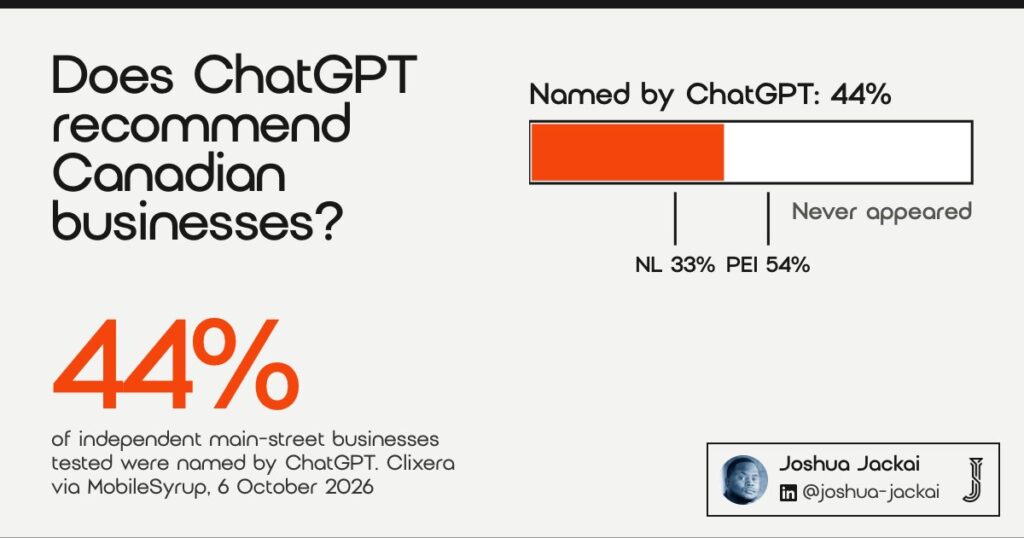
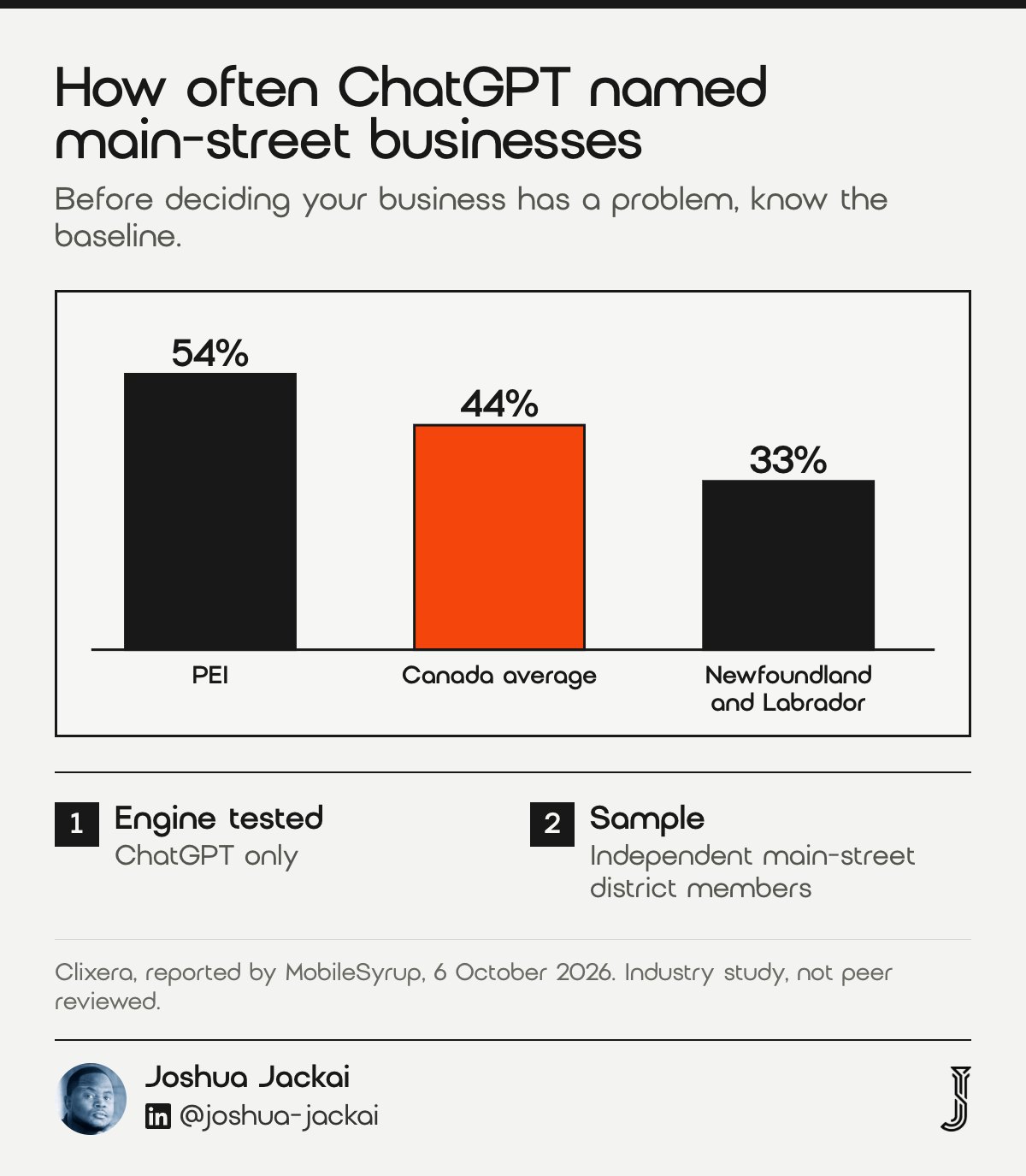
- Clixera found ChatGPT named 44% of independent main-street businesses it tested across Canada, with a range from 54% in PEI to 33% in Newfoundland and Labrador (MobileSyrup, 2026).
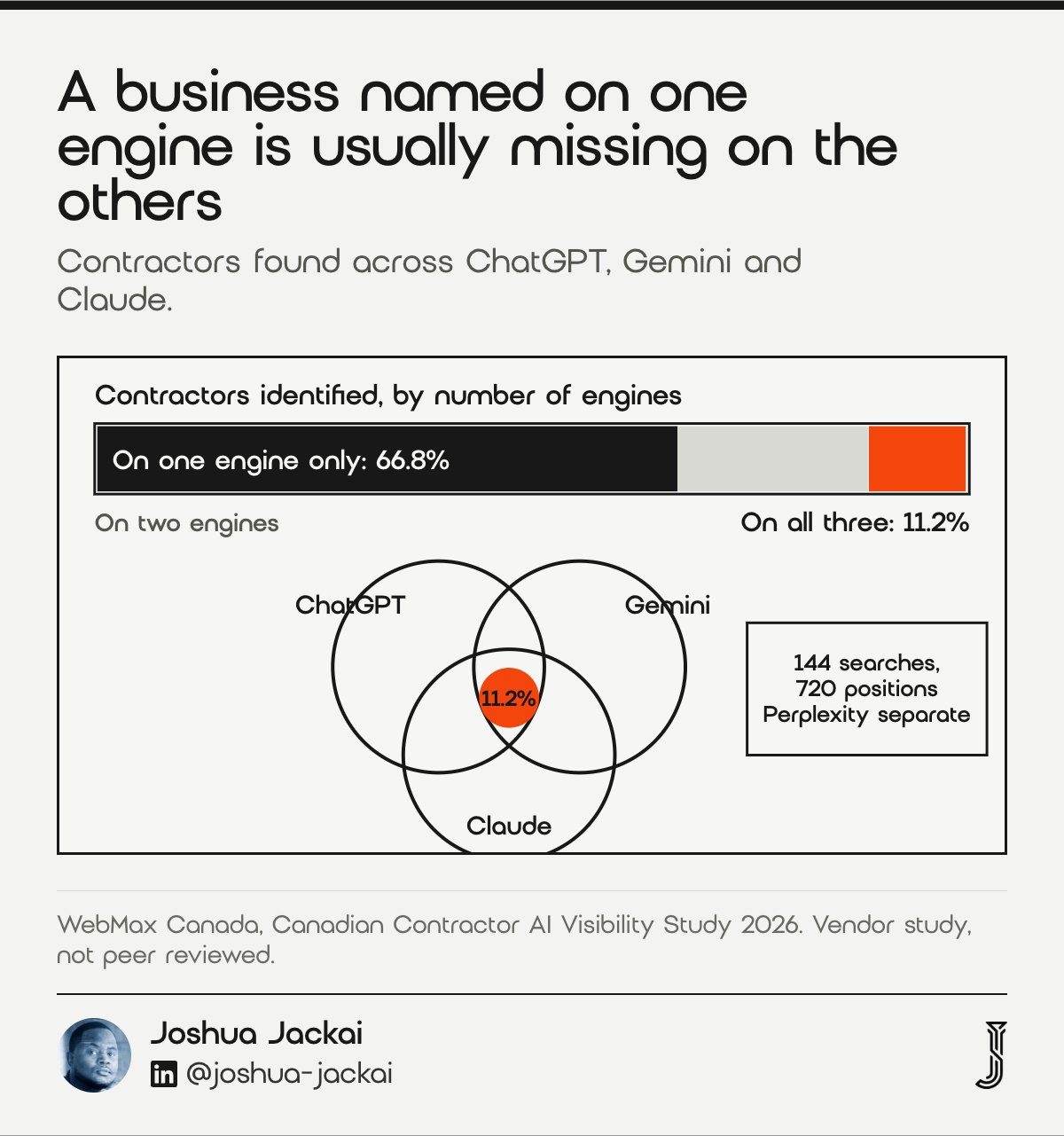
- WebMax Canada found 66.8% of contractors appeared on only one of ChatGPT, Gemini and Claude, and 11.2% on all three (WebMax Canada, 2026).
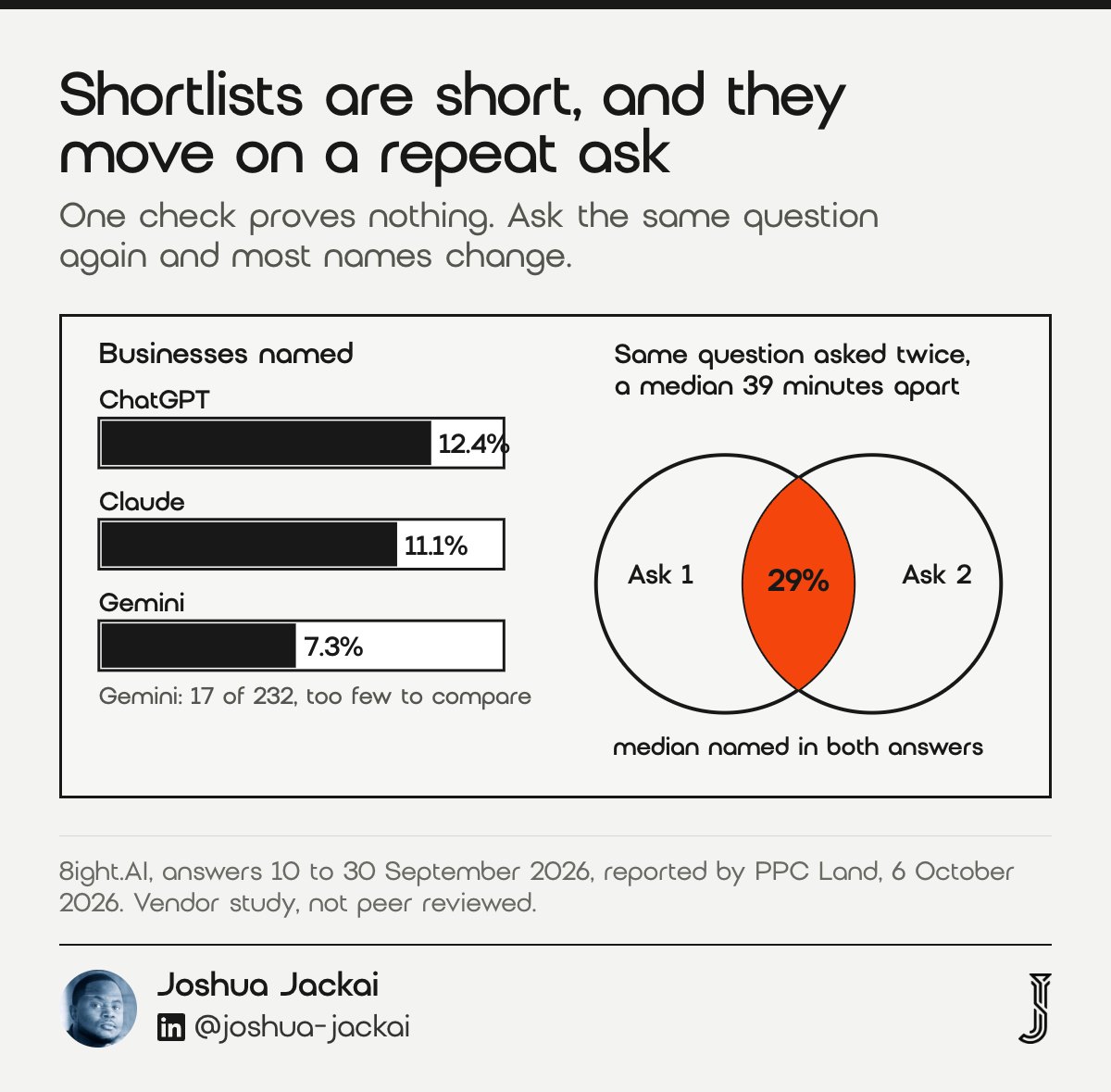
- Asked the same question twice, a median 39 minutes apart, ChatGPT repeated a median 29% of the businesses it had named (8ight.AI via PPC Land, 2026).
- In a 2026 preprint, US-built Gemini and GPT showed “marked favouritism toward American entities” (Rienecker et al., arXiv, 2026).
- My free AI Visibility Report runs this check in 24 hours. My GEO and AEO service is CA$4,775 over six weeks.
In this guide
| # | Fact | What it means for a Canadian owner | Evidence type |
|---|---|---|---|
| 1 | ChatGPT named 44% of tested main-street businesses | Being left out is common, not personal | Industry study, reported by MobileSyrup |
| 2 | Few businesses appear on all three big engines | Check each engine on its own | Vendor study (WebMax Canada) |
| 3 | Shortlists are short and change on a repeat ask | One check proves nothing | Vendor study (8ight.AI), peer reviewed |
| 4 | Reviews and source pages shape who gets named | Fix what the engines read | Vendor study (8ight.AI) |
| 5 | Named is not the same as described correctly | Test what it says about you | Peer reviewed |
| 6 | US-built models lean toward American entities | Canadian B2B firms start behind | Preprint and peer reviewed |
| 7 | A prompt check you can repeat from Canada | Measure before you pay anyone | Method, with my CAD prices |
1. ChatGPT named 44% of tested main-street businesses: best for owners asking how often it names Canadian firms
How often does ChatGPT name Canadian businesses? In Clixera’s test of thousands of independent main-street businesses, it named 44% on average. This fact suits local owners who want a baseline before they panic. Clixera, an Ottawa analytics firm, found more than half never appeared (MobileSyrup, 2026).
- Who ran it: Clixera, an Ottawa analytics firm
- Sample: thousands of businesses from main-street district member directories
- Engine: ChatGPT only
- Average named: 44%
- Range: 54% in PEI, 33% in Newfoundland and Labrador
- Reported: MobileSyrup, 6 October 2026
The sample matters more than the headline. Clixera pulled businesses from the public member lists of main-street business districts in almost every province, then asked ChatGPT where to eat, shop or who to hire. That’s a fair test of a bakery or a salon. It says little about a Vancouver SaaS firm or a Toronto engineering consultancy, because nobody asked ChatGPT about those categories.
What came back instead is telling. MobileSyrup reports that bigger chains and non-member businesses tended to fill the answers, such as Canadian Tire for auto repair in Ontario. Salons, clinics and gyms did best, and shops did worst.
So the answer to “why isn’t ChatGPT recommending my business?” often starts here: the engine prefers names it already sees everywhere. That isn’t a judgement on your work. It’s a measure of how often your name appears in the places the engine reads.
I couldn’t read Clixera’s own study page, so I rely on MobileSyrup’s report. Treat 44% as one test of one engine in 2026, not a national constant.
“More than half of the independent main-street businesses we tested across Canada never appeared when consumers asked ChatGPT (OpenAI) where to eat, shop or who to hire,” wrote Clixera, as quoted by MobileSyrup (MobileSyrup, 2026).
2. Few businesses appear on all three big engines: best for owners comparing ChatGPT, Gemini and Claude
Being named by ChatGPT doesn’t mean Gemini or Claude will name you too. This fact suits owners who checked one engine and stopped. WebMax Canada found 66.8% of contractors it identified appeared on only one of the three engines, and just 11.2% appeared on all three (WebMax Canada, 2026).
- Who ran it: WebMax Canada, a Victoria web and AI visibility firm
- Engines: ChatGPT, Gemini and Claude
- Perplexity: reviewed separately, not in the main figures
- Size: 144 recommendation searches, 720 recommendation positions
- On one engine only: 66.8%
- On all three: 11.2%
WebMax ran consumer-style contractor questions across selected Canadian cities and trades. It’s a small, manual study, and WebMax sells AI visibility work through SpottableAI, which it says on the page. Read it as observation, which is how WebMax describes it too.
The finding is still useful because it’s about overlap. Two thirds of the contractors that showed up anywhere showed up in one engine only. A plumber named by Gemini might be invisible in ChatGPT, and the reverse.
8ight.AI, an Etobicoke firm, found the same pattern with a different method. When ChatGPT and Claude answered the same question at the same moment, 294 businesses were named by at least one of them, and only 81 (28%) by both (PPC Land, 2026).
On the Perplexity question: WebMax kept Perplexity out of its main results because its format differs, and 8ight.AI didn’t test it. None of the Canadian audits I read publishes a Perplexity naming rate. So “ChatGPT vs Gemini vs Perplexity” has no Canadian answer yet. Test each one yourself.
“Being searchable is not always the same as being selectable,” wrote WebMax Canada (Canadian Contractor AI Visibility Study, 2026).
3. Shortlists are short and change on a repeat ask: best for anyone who checked once
A chatbot answer is a short list, and it moves. This fact suits owners who saw their name once, or didn’t, and drew a conclusion. In 8ight.AI’s test, ChatGPT named 369 of 2,975 businesses it answered for (12.4%), Claude 11.1% and Gemini 7.3% (PPC Land, 2026).
- Who ran it: 8ight.AI, Etobicoke, Ontario, sells AI visibility services
- Places: 49, of them 17 in the Greater Toronto Area
- Businesses checked: 2,976, of them 749 in the Greater Toronto Area
- Engines: ChatGPT and Claude through their APIs with web search on, plus 20 Gemini answers
- Answers collected: 10 to 30 September 2026
- Repeat overlap: median 29% of named businesses appeared in both answers
The 12.4% figure looks brutal, and 8ight.AI warns against reading it that way. ChatGPT returns a median of at least five names while Google Maps returns a long list, so most businesses in any town will miss the cut on any one answer.
The repeat test is the part every owner should remember. 8ight.AI asked ChatGPT the same question twice in 267 trade and place pairs, a median 39 minutes apart. A median 29% of the businesses named in either answer appeared in both. For 9% of pairs the two answers shared nothing.
Peer-reviewed research saw this long before chatbots had web search. Elazar and colleagues tested whether language models gave the same factual answer to reworded versions of one question, and found they often didn’t (Elazar et al., TACL, 2021).
So one screenshot of ChatGPT naming you, or skipping you, is one sample. Run each question several times, on different days, before you decide anything.
“the consistency of all PLMs we experiment with is poor,” wrote Yanai Elazar and colleagues (Transactions of the Association for Computational Linguistics, 2021).
4. Reviews and source pages shape who gets named: best for owners deciding what to fix first
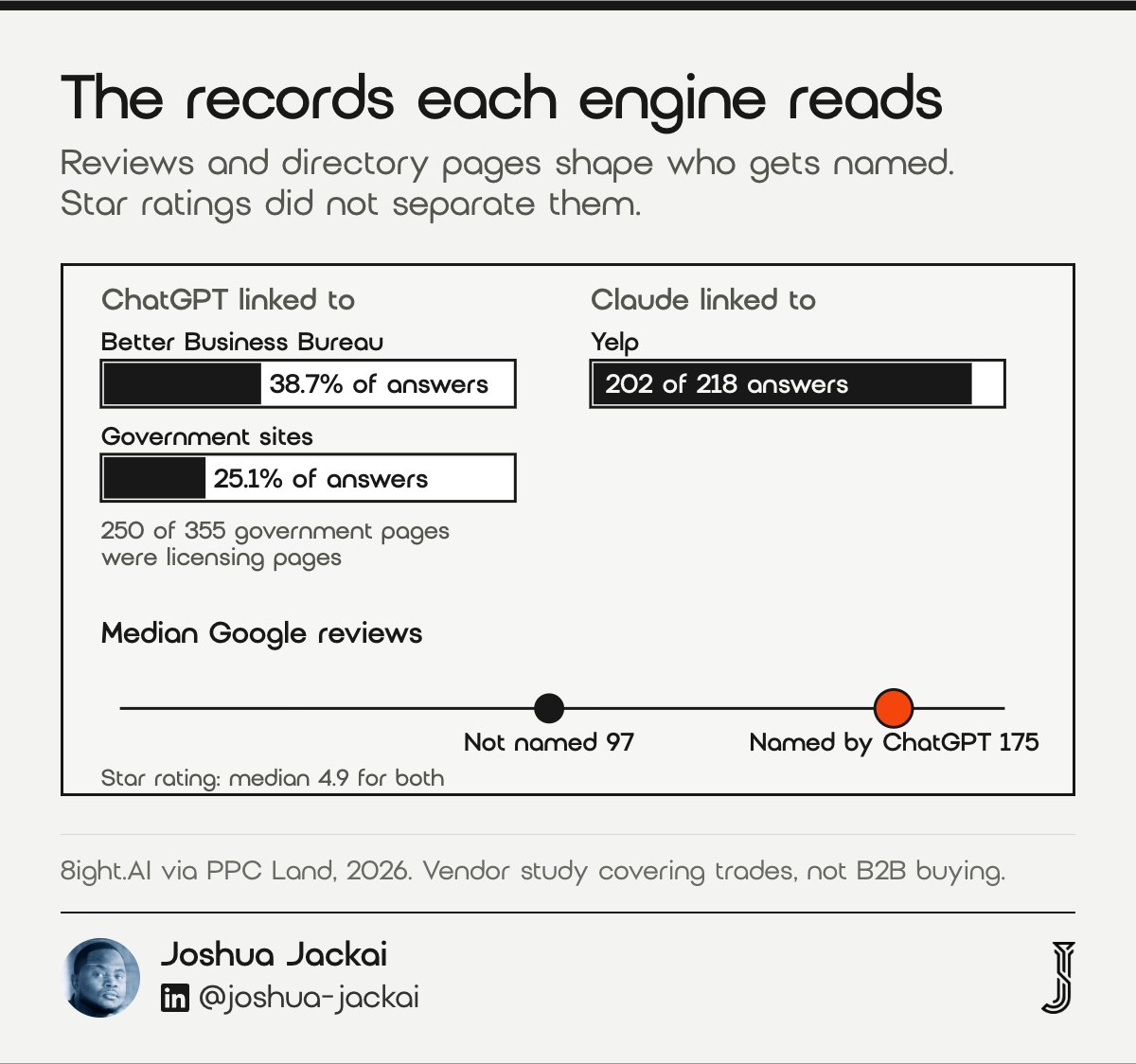
The engines name businesses they can read about on other sites. This fact suits owners choosing where to spend their first hours. In 8ight.AI’s study, businesses ChatGPT named had a median of 175 Google reviews, against 97 for those it skipped, while star ratings showed no pattern (PPC Land, 2026).
- Review count: median 175 for named businesses, 97 for the rest
- Star rating: median 4.9 for named and unnamed alike
- ChatGPT sources: Better Business Bureau in 38.7% of answers, government sites in 25.1%
- Claude sources: Yelp in 202 of 218 answers
- Licensing pages: 250 of 355 government pages ChatGPT cited
The two engines read different places. Claude leaned on Yelp. ChatGPT leaned on the Better Business Bureau and on government pages, and in 250 of 355 cases that government page was a licensing board, a licence look-up or a list of registered contractors.
For a Canadian firm, that points to boring, fixable records: your listing with the provincial licensing body or professional association, your Better Business Bureau profile, and review sites with real text. An old business name on a registry page is the kind of error ChatGPT may repeat.
One caution for B2B readers. The 8ight.AI study covered trades. It contains nothing on restaurants, retail, law or business-to-business buying, in the study’s own description. Review counts may matter less for a firm that sells six-figure contracts. Industry directories, association member lists and trade press probably play the same role, but no Canadian audit I found has measured that.
8ight.AI also says its data “shows where the engines read, not what moves them”. It didn’t test whether fixing a profile changes an answer. Neither have I, at scale.
The most-reviewed business in a place was still “left out about three times in four,” wrote 8ight.AI, as reported by PPC Land (PPC Land, 2026).
5. Named is not the same as described correctly: best for owners who already show up
Being named and being described correctly are two different tests, and a business can pass one and fail the other. This fact suits firms that appear but worry about what’s said. In a peer-reviewed test of biographies, ChatGPT reached only 58% on FActScore, the share of its facts supported by a source (Min et al., EMNLP, 2023).
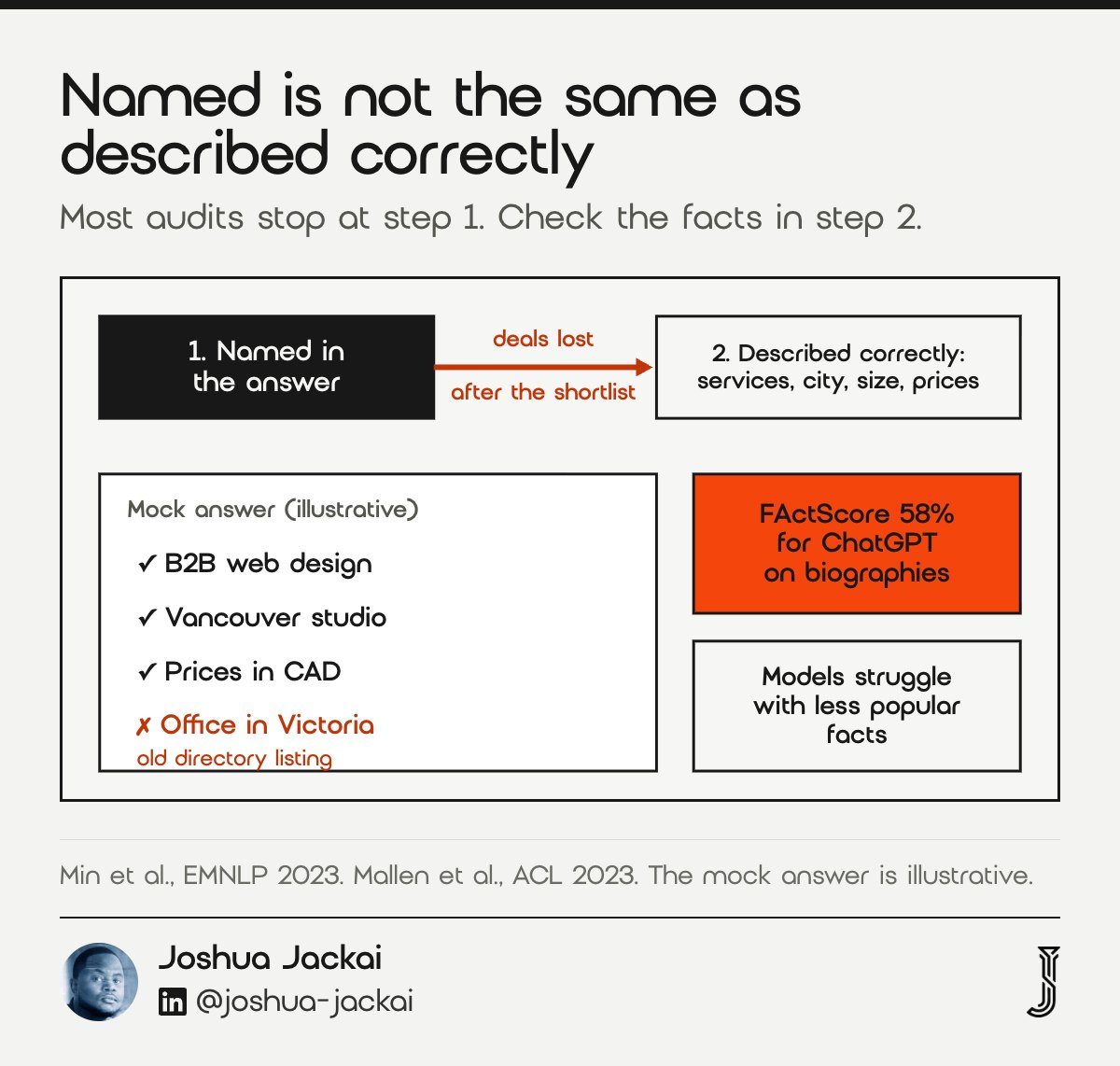
- Test 1, named: does the engine list you when a buyer asks
- Test 2, described: are your services, city, size and prices right
- ChatGPT FActScore on biographies: 58%
- Less popular entities: more errors (Mallen et al., 2023)
- What to record: each wrong fact and the page it seems to come from
Most audits stop at the first test. WebMax noted “uneven clarity” in how businesses were described, with service, location and business details varying between responses. That’s the second test, and it’s the one that loses a deal after the shortlist.
The research explains why smaller firms get it worse. Mallen and colleagues found language models struggle with less popular facts, and that adding retrieved documents helps a lot in those cases (Mallen et al., ACL, 2023). A 15-person Kelowna firm is a long-tail entity. The engine has seen little about it, so it fills gaps.
Min’s team measured biographies, not companies, and 2023 models, not today’s. Use 58% as a sign of the problem’s shape, not as a rate for your business.
The practical test is simple. Ask each engine what your company does, where it works, who it serves and what it charges. Compare every claim with your own site. If the engine is wrong, check whether an old directory listing, a former address or an outdated page says the same wrong thing.
“We find that LMs struggle with less popular factual knowledge,” wrote Alex Mallen and colleagues (ACL, 2023).
6. US-built models lean toward American entities: best for Canadian B2B firms competing with US vendors
The biggest engines were built in the United States, and research finds they favour American names. This fact suits Canadian B2B firms whose buyers also see US vendors. The ChoiceEval preprint tested Gemini, GPT and DeepSeek on more than 2,000 questions across 10 topics and found the US-built models favoured American entities (Rienecker et al., arXiv, 2026).
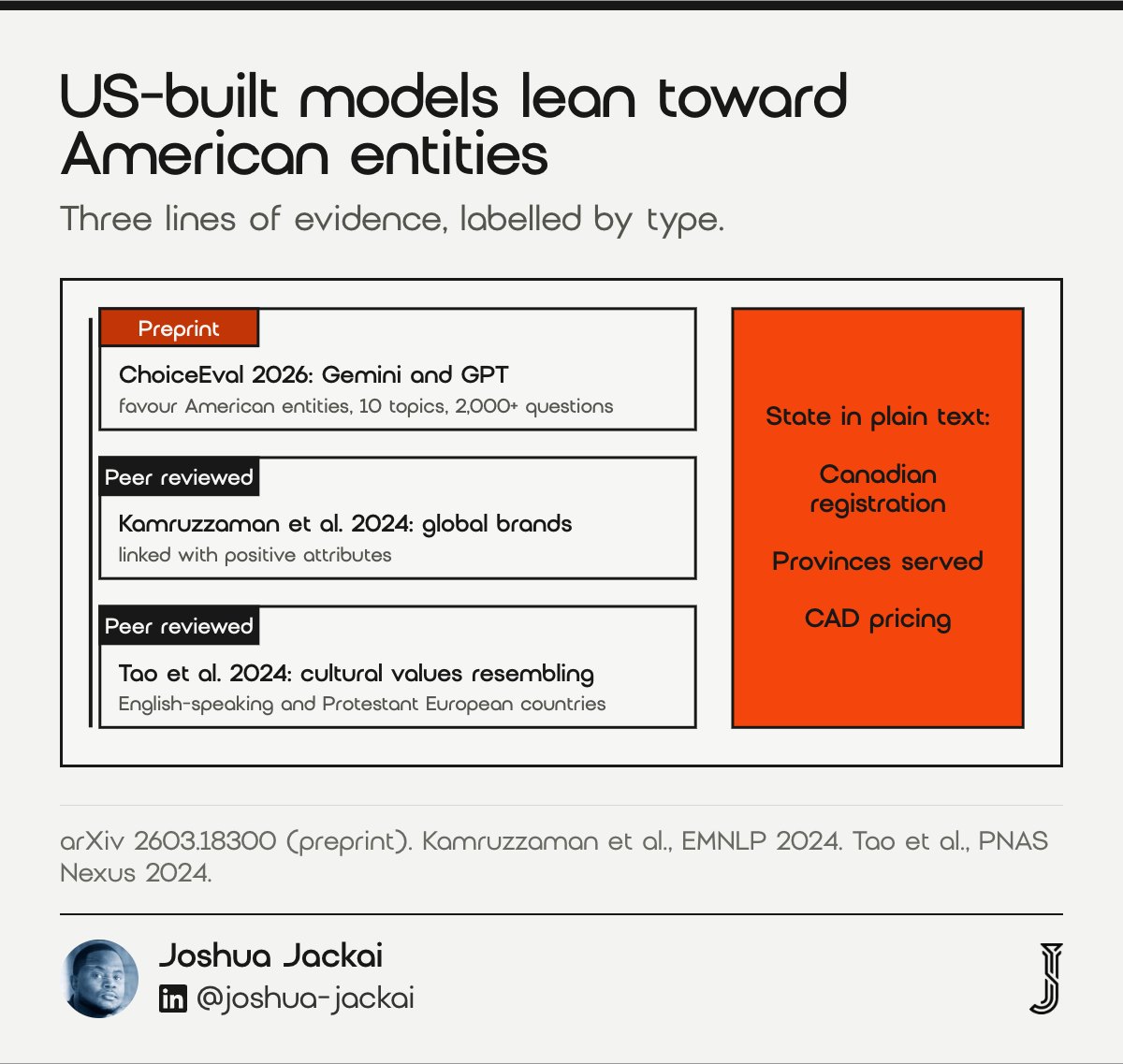
- ChoiceEval (preprint): Gemini and GPT favour American entities
- Sample: 10 topics, more than 2,000 questions
- Brand bias: global brands tied to positive attributes (Kamruzzaman et al., 2024)
- Cultural values: resemble English-speaking and Protestant European countries (Tao et al., 2024)
- Geopolitics: models over-amplify favouritism (Faisal and Anastasopoulos, 2023)
ChoiceEval is a preprint, so it hasn’t been through peer review. Its topics are consumer ones, such as running shoes and hotel chains. It doesn’t test a Canadian accounting firm against a US one. It does show a pattern that held across user personas.
Peer-reviewed work points the same way. Kamruzzaman, Nguyen and Kim found models linked global brands with positive attributes more than local ones (Kamruzzaman et al., EMNLP, 2024). They also found a country-of-origin effect that can boost local brands in some contexts, which is the useful part for Canadian firms.
Tao and colleagues at Cornell found GPT models carry cultural values close to English-speaking and Protestant European countries (Tao et al., PNAS Nexus, 2024). Canada sits close to that profile, so my reading is that the risk for a Canadian firm isn’t foreign values. It’s losing to the American option inside a shared language.
For a Canadian B2B seller, the response is to make Canadian facts explicit: where you’re registered, which provinces you serve, CAD pricing, Canadian data residency if you offer it, and Canadian clients you can name.
“Biased models may perpetuate societal inequalities, unfairly favoring established global brands while marginalizing local ones,” wrote Mahammed Kamruzzaman and colleagues (EMNLP, 2024).
“All models exhibit cultural values resembling English-speaking and Protestant European countries,” wrote Yan Tao and colleagues at Cornell University (PNAS Nexus, 2024).
7. A prompt check you can repeat from Canada: best for owners who want a number before they pay anyone
You can run a fair version of these audits yourself in about an hour. This check suits any Canadian owner who wants a baseline. Five prompts, three runs each, on four engines gives 60 answers. Research by Aggarwal and colleagues found content changes can raise visibility in generative engine answers by up to 40% (Aggarwal et al., KDD, 2024).
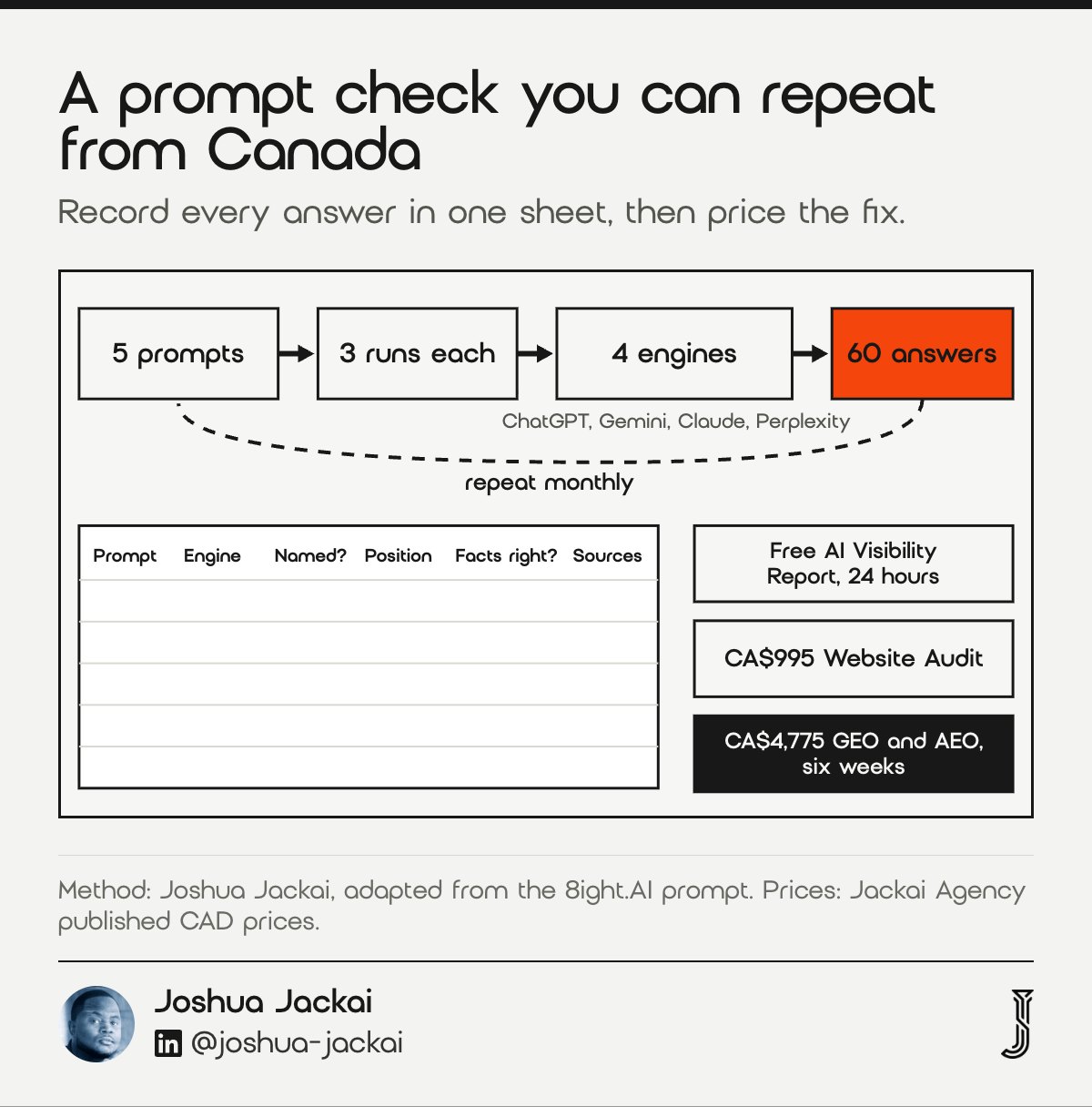
- Prompts: 5, written the way your buyer asks
- Runs: 3 per prompt, on different days
- Engines: ChatGPT, Gemini, Claude and Perplexity, each in a fresh chat
- Record: named or not, position, facts right or wrong, sources linked
- Repeat: monthly, same prompts, same wording
Write the prompts the way a buyer would. 8ight.AI used one fixed line: “Who is the best {trade} in {city}? Name specific businesses.” For B2B, try “Which Canadian {service} firms should a {job title} in {city} shortlist?” Add one prompt that names your company and asks what it does, where it works and what it costs. That’s your accuracy test.
Run from a Canadian connection, put the city in the prompt, and use a fresh or signed-out chat, so your history doesn’t steer the answer. Paste each answer into a sheet. The calculator further down this guide turns your counts into named and accuracy rates.
If the numbers are poor, fixes cost money, and I’ll give mine plainly. My AI Visibility Report is free and runs your buyers’ questions through ChatGPT, Claude and Google AI Overviews within 24 hours. A Website Audit is CA$995, credited if a project starts within 30 days. My GEO and AEO service is CA$4,775 over six weeks. For the step-by-step version you can do in-house, read my guide on how to get recommended by ChatGPT.
“Being named and being described correctly are two different tests, and a business can pass one and fail the other,” wrote Joshua Jackai, Vancouver web designer.
How I compared the Canadian audits
I read each audit at its own source on 11 November 2026 and kept only figures I found there word for word. The table lists the three Canadian audits I could read, plus the preprint on US skew. Two other Canadian studies are left out because I couldn’t read them at the source.
| Audit | Sponsor | Date | Sample | Engines | Measures |
|---|---|---|---|---|---|
| Clixera main-street test | Clixera, Ottawa analytics firm | Reported 6 October 2026 | Thousands of main-street district members | ChatGPT | Named |
| Canadian Contractor AI Visibility Study | WebMax Canada, sells AI visibility work | 2026, page read 11 November 2026 | 144 searches, 720 positions | ChatGPT, Gemini, Claude | Named, overlap, clarity |
| Ask an AI for a roofer | 8ight.AI, sells AI visibility work | Answers 10 to 30 September 2026 | 2,976 businesses, 749 in the Greater Toronto Area | ChatGPT, Claude, some Gemini | Named, overlap, sources, repeats |
| ChoiceEval | Academic authors, preprint | March 2026 | 2,000+ questions, 10 topics | Gemini, GPT, DeepSeek | Preference for American entities |
Two vendors in this table sell AI visibility services, and so do I. Read every number here, mine included, with that in mind.
“These patterns persist across user personas, suggesting systematic rather than incidental effects,” wrote Jasmine Rienecker and colleagues (arXiv preprint, 2026).
The studies don’t measure the same thing, so I don’t average them. Clixera asks how often one engine names a set of known businesses. WebMax asks whether the same business appears across engines. 8ight.AI asks what each engine reads and how stable its lists are. Only the 8ight.AI study published its matching rules and failure log.
What’s missing for a Canadian B2B owner is plain. No audit I read tests B2B buying questions, French-language prompts or Perplexity naming rates.
Filter the audits by engine and by what they measure
The matrix lists every audit in this post with its sponsor, sample, engines and the one figure I trust from it. Filter by the engine you care about, or by whether the audit measures being named, being described correctly or US skew. Rows hide rather than disappear, so the full set is always one click away.
Showing 6 of 6 sources
Canadian AI recommendation audits and the research behind them, side by side
| Source and sponsor | Date | Sample | Engines | Figure I use |
|---|---|---|---|---|
| Clixera main-street test, Ottawa analytics firm, reported by MobileSyrup | Reported 6 October 2026 | Thousands of main-street district members across Canada | ChatGPT | 44% named on average (PEI 54%, Newfoundland and Labrador 33%) |
| Canadian Contractor AI Visibility Study, WebMax Canada, sells AI visibility work | 2026 | 144 searches, 720 positions | ChatGPT, Gemini, Claude (Perplexity reviewed separately) | 66.8% on one engine only, 11.2% on all three |
| Ask an AI for a roofer, 8ight.AI, sells AI visibility work, reported by PPC Land | Answers 10 to 30 September 2026 | 2,976 businesses, 749 in the Greater Toronto Area | ChatGPT, Claude, 20 Gemini answers | ChatGPT named 12.4%, Claude 11.1%; repeat overlap median 29% |
| ChoiceEval, Rienecker and colleagues, arXiv preprint | March 2026 | More than 2,000 questions, 10 topics | Gemini, GPT, DeepSeek | Gemini and GPT favour American entities |
| FActScore, Min and colleagues, EMNLP | 2023 | Biographies of people | InstructGPT, ChatGPT, PerplexityAI and others | ChatGPT reached 58% of facts supported |
| ParaRel, Elazar and colleagues, Transactions of the Association for Computational Linguistics | 2021 | 328 paraphrases for 38 relations | Pretrained language models of the time | Consistency across reworded questions was poor |
Score your own prompt check
Enter how many prompts you ran, how many times each, and how often each engine named you. The calculator gives a named rate per engine, an overall rate and an accuracy rate for the answers that named you. Its thresholds and the CAD prices it suggests are my judgement and my published prices, not research findings.
What I could not verify
Two figures that circulate in Canadian coverage didn’t make it into this post. Each rests on a page I couldn’t read at its source on 11 November 2026, so I left them out rather than repeat a number second hand. Neither changes the direction of the evidence above.
Snap SEO, an Edmonton agency, published a press release on how often ChatGPT named local Edmonton businesses. The page that hosts it returned an error each time I tried, so I couldn’t confirm the figure or the method.
WebMax Canada also published an accuracy study of 16 businesses. Its press release sits on a host that no longer resolves, and WebMax’s own site has no page for it. That study would have been the only Canadian test of “described correctly once named”, which is why fact 5 leans on peer-reviewed research instead.
Questions Canadian owners ask about ChatGPT recommendations
These are the questions owners ask once they notice ChatGPT skipping them. They cover customers who found you through AI, the gap between Google rankings and ChatGPT, US bias, which engine matters and what to do first. Each answer adds something the facts above don’t cover.
Anyone had a customer say they found you through ChatGPT instead of Google?
Most firms can’t answer because nobody asks. Add “ChatGPT or another AI assistant” as an option in your form’s “How did you hear about us?” field, and check referral traffic from chatgpt.com in Google Analytics 4. Track it for 90 days before you judge whether the channel matters.
Has anyone else noticed their business is invisible on ChatGPT even though they rank well on Google?
Yes. Ranking on Google and being named in a chatbot shortlist are separate tests. ChatGPT returns a median of at least five names, and 8ight.AI found it leaned on review sites, the Better Business Bureau and licensing pages. Strong Google rankings help, but they don’t guarantee a mention.
How do I get my local business to show up when people ask Google AI or ChatGPT?
Start with records the engines read: licensing and association listings, the Better Business Bureau, review sites with real text, and a service page stating what you do and where. My guide on getting recommended by ChatGPT covers the steps. Re-run your prompt check monthly to see what moved.
Does AI favour American companies over Canadian ones?
The evidence leans yes. A 2026 preprint found US-built Gemini and GPT favoured American entities, and peer-reviewed work found models linked global brands with positive attributes. No study has tested Canadian B2B firms against US rivals directly. State your Canadian registration, provinces served and CAD pricing in plain text.
Is ChatGPT, Gemini or Perplexity better for Canadian business visibility?
No Canadian audit answers that yet. WebMax compared ChatGPT, Gemini and Claude but reviewed Perplexity separately, and 8ight.AI got too few Gemini answers to compare (17 of 232 named, 7.3%). Your buyers use different engines, so check all four and treat each as its own channel.
How I check this for Canadian firms
I’m a Vancouver web designer, and I run Jackai Agency on my own. If you want the check done for you, start with the free AI Visibility Report, delivered in 24 hours. It runs your buyers’ questions through ChatGPT, Claude and Google AI Overviews and records what each says about your company.
If the report shows a gap, my GEO and AEO service is CA$4,775 over six weeks. A custom B2B website starts at CA$7,450, and the version with 90 days of AI referral care is CA$10,050. I won’t promise you’ll be named. Nobody can, and the audits above show why.
Sources
Peer-reviewed research
- Aggarwal, P., Murahari, V., Rajpurohit, T., Kalyan, A., and Narasimhan, K. (2024). GEO: Generative Engine Optimization. Proceedings of the 30th ACM SIGKDD Conference on Knowledge Discovery and Data Mining, 5-16.
- Elazar, Y., Kassner, N., Ravfogel, S., Ravichander, A., Hovy, E., Schütze, H., and Goldberg, Y. (2021). Measuring and Improving Consistency in Pretrained Language Models. Transactions of the Association for Computational Linguistics, 9, 1012-1031.
- Faisal, F., and Anastasopoulos, A. (2023). Geographic and Geopolitical Biases of Language Models. Proceedings of the 3rd Workshop on Multi-lingual Representation Learning (MRL), 139-163.
- Kamruzzaman, M., Nguyen, H. M., and Kim, G. L. (2024). Global is Good, Local is Bad?: Understanding Brand Bias in LLMs. Proceedings of the 2024 Conference on Empirical Methods in Natural Language Processing, 12695-12702.
- Mallen, A., Asai, A., Zhong, V., Das, R., Khashabi, D., and Hajishirzi, H. (2023). When Not to Trust Language Models: Investigating Effectiveness of Parametric and Non-Parametric Memories. Proceedings of the 61st Annual Meeting of the Association for Computational Linguistics, 9802-9822.
- Min, S., Krishna, K., Lyu, X., Lewis, M., Yih, W., Koh, P. W., Iyyer, M., Zettlemoyer, L., and Hajishirzi, H. (2023). FActScore: Fine-grained Atomic Evaluation of Factual Precision in Long Form Text Generation. Proceedings of the 2023 Conference on Empirical Methods in Natural Language Processing, 12076-12100.
- Tao, Y., Viberg, O., Baker, R. S., and Kizilcec, R. F. (2024). Cultural bias and cultural alignment of large language models. PNAS Nexus, 3(9).
Preprints, industry and vendor sources (not peer reviewed)
- Rienecker, J., Mpofu, K., Goel, N., Datta, S., Zhao, J., Danielsson, O., and Thorsen, F. (2026). Auditing Preferences for Brands and Cultures in LLMs. arXiv preprint 2603.18300, submitted 18 March 2026, read 11 November 2026.
- MobileSyrup (news report on a Clixera industry study). ChatGPT regularly ignores small Canadian businesses in searches: report, 6 October 2026, read 11 November 2026.
- WebMax Canada (vendor study, sells AI visibility services). Canadian Contractor AI Visibility Study 2026, read 11 November 2026.
- PPC Land (news report on an 8ight.AI vendor study, which sells AI visibility services). ChatGPT names 3.4% of tested local firms with under 25 reviews, 8ight finds, 6 October 2026, read 11 November 2026.
- Jackai Agency price table, first-party prices in CAD, read 11 November 2026. AI Visibility Report and GEO and AEO service.