7 Statistics on How Many Canadians Use AI to Find a Business
Seven published figures on how Canadians use AI to search and buy, sorted by what each one measured, with a filterable matrix and a calculator for your own leads.
 Joshua Jackai
16 min read
Published 8 November 2026 · Last updated and fact-checked November 2026
Short answer: No public survey I could find measures how many Canadians use AI to find a business. The closest figures: 18% turn to AI first for online information (Leger, 2026), 39% used generative AI for a purchase decision (National Bank and Leger, 2026), and 10.0% name AI recommendations the biggest factor in choosing a local business (Little Dragon Media, 2026).
A managing partner at a Burnaby accounting firm (a composite, not a client) hears a new client say ChatGPT suggested the firm. Then the partner goes looking for the number: what share of Canadians find a firm that way? The search returns 71.7%, 45%, 39%, 18% and 10.0%. All five are published figures, though I could confirm the 45% only through secondary reports. None of them answers the question.
That isn’t a research failure on the partner’s part. The surveys were asked different questions, of different people, in different countries. Some were paid for by companies that sell the thing being measured, and a figure I kept meeting in Canadian agency posts comes from American respondents.
So I read the seven sources that keep getting cited and sorted them by what each one measured. Survey numbers below come from each publisher’s own release unless I say otherwise. Where a number can’t carry the claim people hang on it, I say so.
“No public survey I could find measures how many Canadians use AI to find a business,” wrote Joshua Jackai, Vancouver web designer.
In this guide
Key takeaways
- 79% of Canadians use AI tools, but 18% turn to AI first when searching for information online (Leger, 2026).
- 63.6% of 1,500 Canadians still trust Google most for answers, against 20.6% for AI tools (Little Dragon Media via Pollfish, 2026).
- British Columbia sits at 34% for using generative AI on a purchase decision, under the 39% national figure (National Bank and Leger, 2026).
- The widely repeated 45% comes from BrightLocal’s panel of 1,002 US adults, and I found no Canadian cut.
- Your own intake form can answer this for your firm. Add one line to it and use the calculator further down this guide.
| # | Survey | What it measured | Figure | Who was asked |
|---|---|---|---|---|
| 1 | Leger AI Index | Turn to AI first for online information | 18% | 1,511 Canadians, 16+ |
| 2 | Little Dragon Media | AI biggest factor in choosing a local business | 10.0% | 1,500 people in Canada |
| 3 | National Bank and Leger | Generative AI for a purchase decision, past 12 months | 39% | 1,518 Canadians, 18+ |
| 4 | Omnisend and Cint | Gen AI for shopping tasks | 56% | 1,046 Canadian consumers |
| 5 | BrightLocal | AI for local business recommendations | 45% | 1,002 US adults |
| 6 | Statistics Canada | Businesses using AI in their own work | 19.2% | Canadian businesses |
| 7 | G2 | Software research starts in an AI chatbot | 51% | 1,076 software buyers |
1. Leger AI Index: best for how Canadians search first
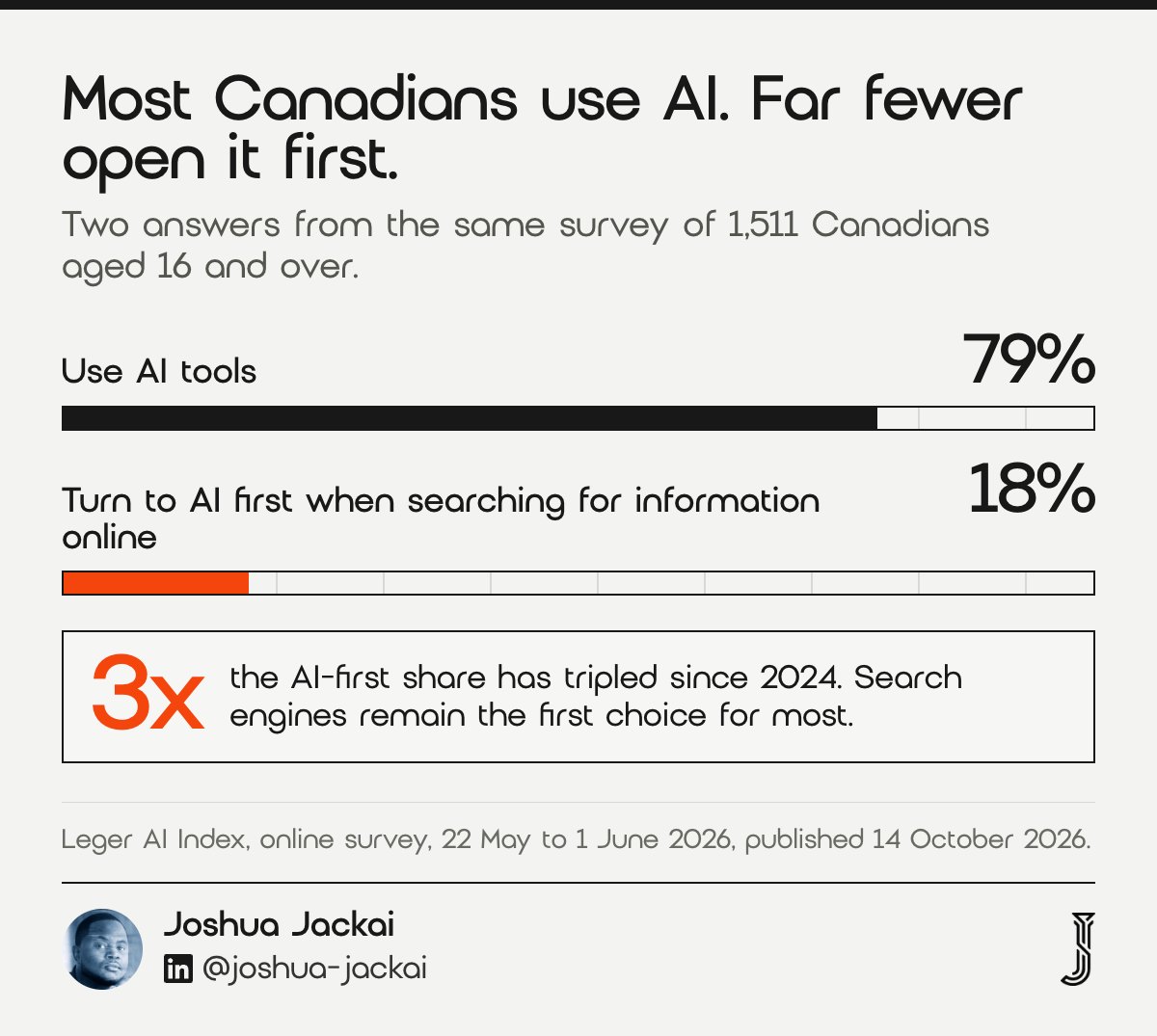
The Leger AI Index is the strongest general Canadian number, and it suits anyone asking how search habits are shifting. Of 1,511 Canadians aged 16 and over, 79% use AI tools and 18% turn to AI first when searching for information online (Leger, 2026). It says nothing about finding a business.
- Asked: 1,511 Canadians aged 16 and over
- In the field: 22 May to 1 June 2026
- Paid for by: Leger, its own index
- Measures: AI use, and which tool people open first
- Does not measure: looking for a business or vendor
The gap between 79% and 18% is the most useful thing on this list. Most Canadians have used the tools. Far fewer open them first. Leger says the AI-first share has tripled since 2024, while search engines remain the first choice for most people, so the direction is clear even though the level is modest.
“18% of Canadians say they turn to AI first when searching for information online,” wrote Leger (Leger AI Index, 2026).
Among Canadians who use AI, 46% say it has influenced them to buy, choose or avoid a product or service. People often quote that 46% as though it covers all Canadians. It doesn’t. The base is AI users, and my rough arithmetic (79% times 46%) puts it near 36% of everyone, which sits close to National Bank’s 39%. The questions differ in wording and timeframe, so the match may be coincidence. This is my multiplication, not Leger’s finding. “Information online” also covers recipes, health questions and homework. A person looking for an accountant may behave differently from a person looking up a word, and no one has published the split.
2. Little Dragon Media via Pollfish: best for trust against Google
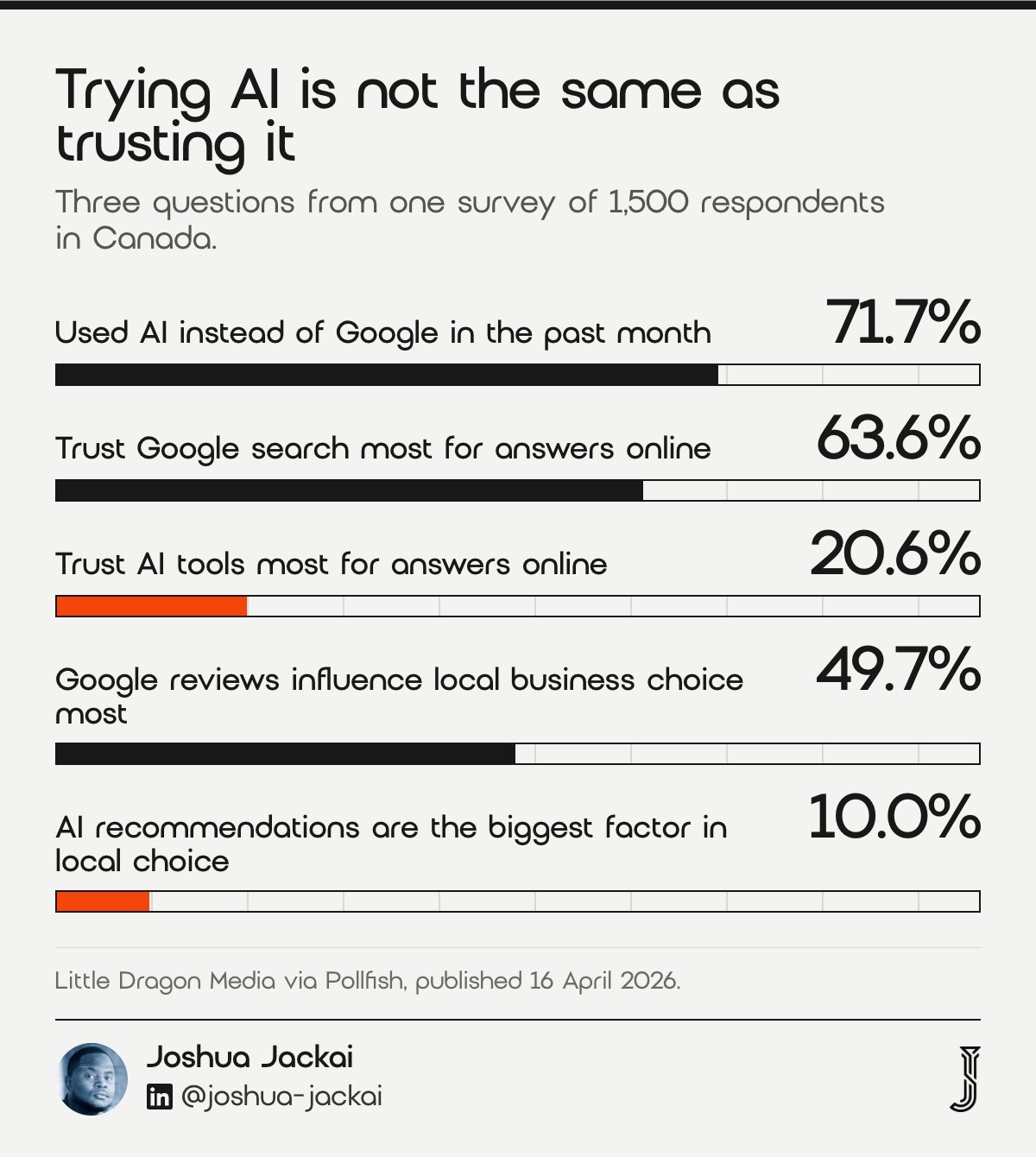
The Little Dragon Media survey, run through Pollfish, is the only Canadian source I found that asks about choosing a local business by name. It suits anyone weighing AI against reviews. Of 1,500 respondents, 10.0% said AI recommendations are the biggest factor in choosing a local business, while 49.7% named Google reviews (Little Dragon Media via Pollfish, 2026).
- Asked: 1,500 respondents in Canada
- Published: 16 April 2026
- Method: online survey run through Pollfish
- Paid for by: Little Dragon Media
- Field dates: not stated in the release
Most posts lift the 71.7% who used AI instead of Google in the past month, with 33.9% doing so frequently and 37.8% occasionally. Read the next line in the same release: 63.6% still trust Google most for answers online, and 20.6% trust AI tools most. People are trying the new thing and keeping the old one as the reference.
“Only 10.0% say AI recommendations are the biggest factor in choosing a local business,” reported Little Dragon Media (PRNewswire via MarTech Cube, 2026).
Why does 71.7% here sit so far above Leger’s 18%? The questions differ: once in a month against first choice. The sampling matters too. Both are online samples rather than random draws of the population, and Cornesse and colleagues note that inferences from nonprobability samples depend on statistical models for their validity (Cornesse et al., 2020). Opt-in online panels reach people willing to answer surveys, which may skew results. I treat 71.7% as a ceiling for casual use, not as a measure of how people find a firm. The 49.7% for Google reviews is the number I’d put in front of a local owner first.
3. National Bank and Leger: best for purchases and BC
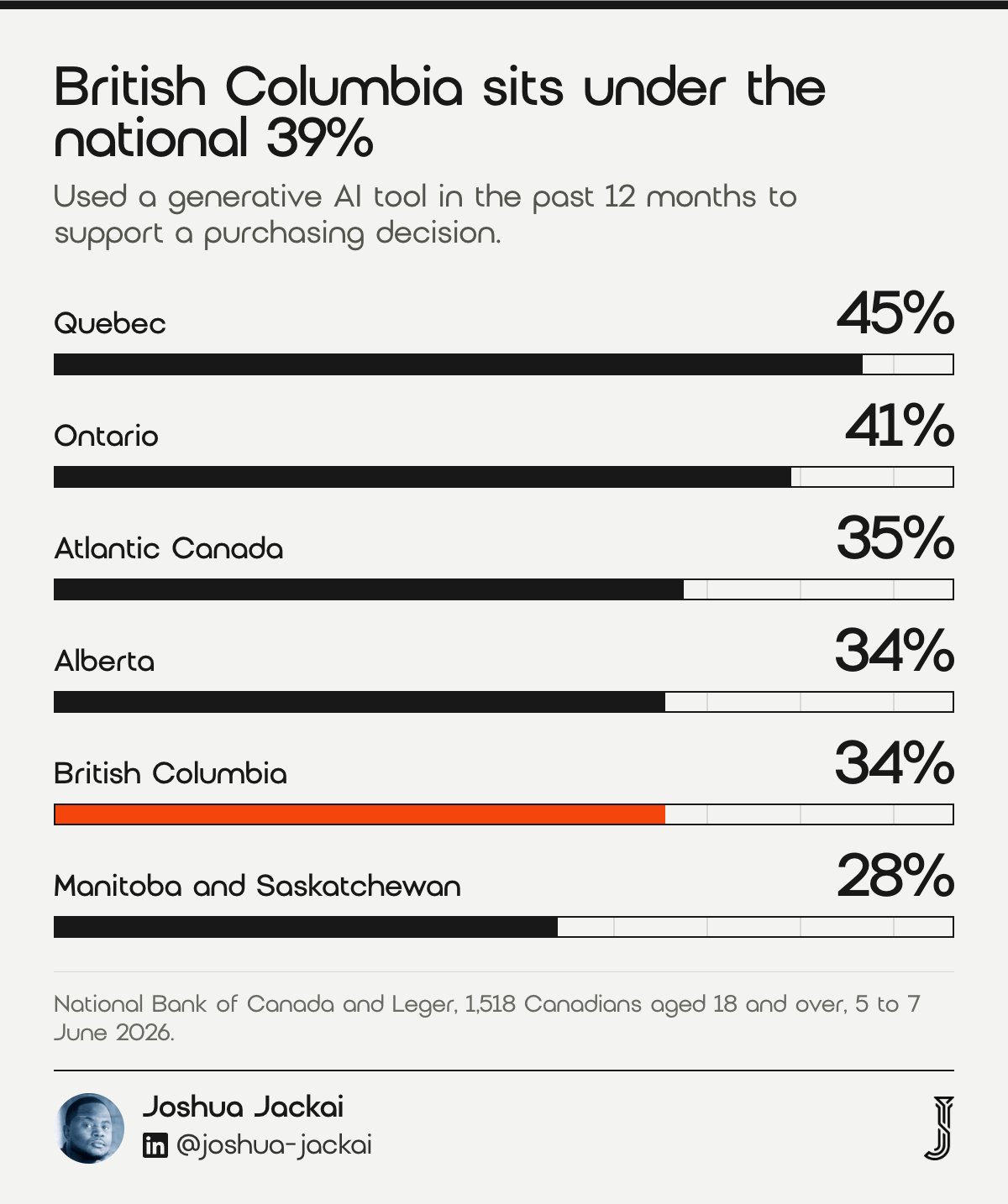
The National Bank and Leger survey is the best Canadian source for buying behaviour, and it’s the only one here with a provincial split. It suits anyone selling to BC consumers. Of 1,518 Canadians aged 18 and over, 39% used a generative AI tool in the past 12 months to support a purchasing decision (National Bank and Leger, 2026).
- Asked: 1,518 Canadians aged 18 and over
- In the field: 5 to 7 June 2026
- Paid for by: National Bank of Canada
- Method: Leger web panel, weighted
- British Columbia: 34%, under the 39% national figure
If you sell in Vancouver, use the 34%, not the 39%. Quebec leads at 45%, Ontario sits at 41%, Atlantic Canada at 35%, Alberta at 34%, and Manitoba and Saskatchewan at 28%. A 34% figure means about one British Columbian in three used a generative AI tool at least once in a year on some purchase.
“39% of Canadians say they have used a generative AI tool in the past 12 months,” reported National Bank of Canada (National Bank press release, 2026).
“Support a purchasing decision” is broad. It may mean comparing two vacuums. The release says AI users most often turn to it for health and wellness questions (36%), food and recipes (32%) and purchasing products or services (31%), so buying is one use among several. Nothing in it separates a $40 toaster from a $40,000 website. For B2B firms this is context, not evidence. A partner hiring a law firm carries more risk than a shopper comparing toasters, and I’d expect different behaviour, though nobody has measured it in Canada. Quote this figure for consumer brands, and say “a purchase”, never “a business”.
4. Omnisend and Cint: best for online shopping only
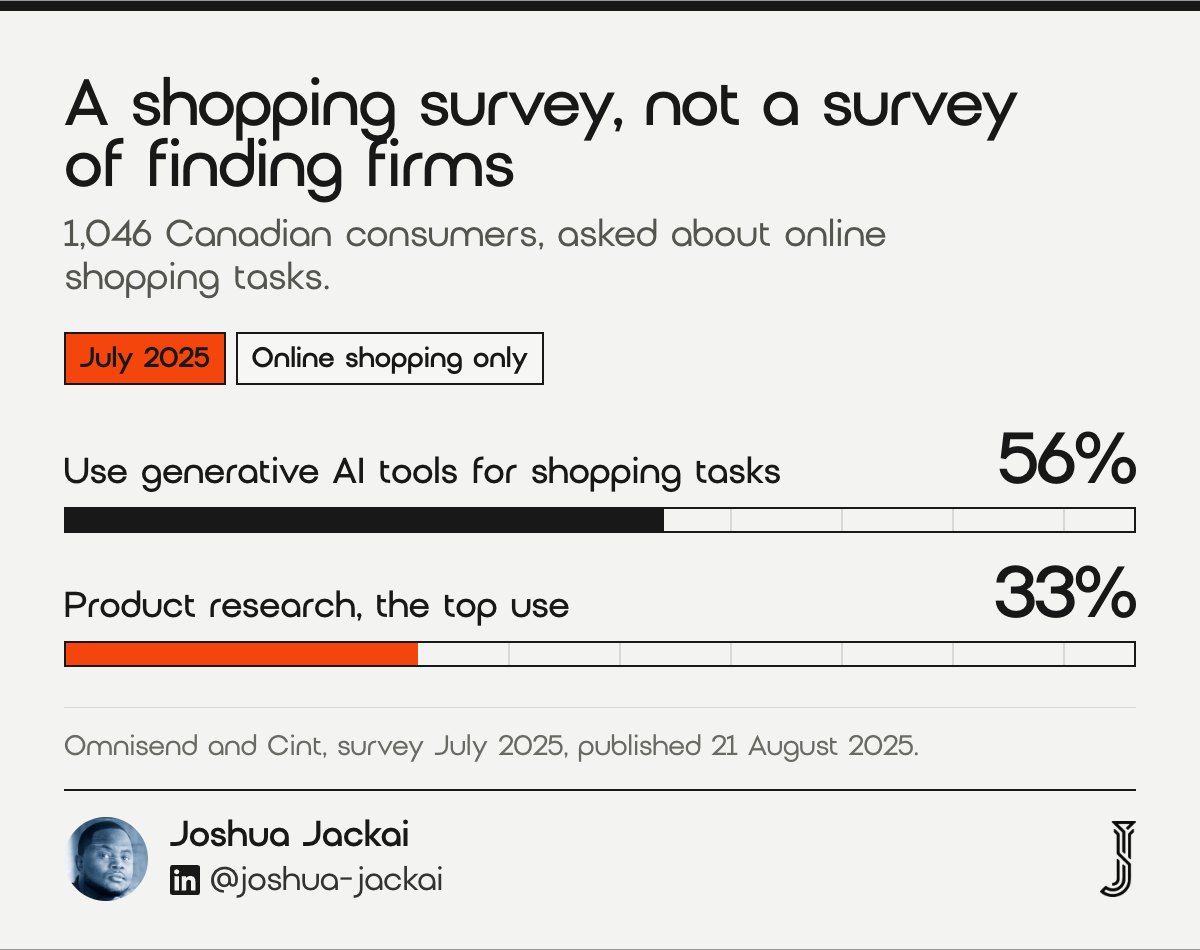
This is a retail survey that often gets stretched to cover everyone. It suits ecommerce owners and nobody else. Of 1,046 Canadian consumers surveyed in July 2025, 56% said they use generative AI tools for shopping tasks, and product research was the top use at 33% (Omnisend, 2025).
- Asked: 1,046 Canadian consumers
- In the field: July 2025
- Paid for by: Omnisend, an ecommerce marketing vendor
- Run by: Cint
- Age of data: the oldest survey here
Two things limit this one. It’s more than a year old, in a category where Leger reports the AI-first share tripled in two years. And its question covers shopping online, which is a narrower act than choosing a provider.
“56% of respondents already use Gen AI tools for various shopping tasks,” reported Omnisend (Omnisend press release, 2025).
I’d also be careful with its headline. The title says 26% say ChatGPT beats Google for product research, but the body text uses 26% for personalized recommendations, and the release refers to “Aussies” in what it describes as a Canadian survey. The sample size and firm are stated, so I keep it on the list, but I wouldn’t lead with any figure from it. If you run a Canadian online store, the 33% product-research number is the part worth keeping. Service firms can leave this survey out of the discussion. Any Canadian agency post that leads with 56% is talking about carts and checkouts, whatever the sentence around it implies, and the July 2025 date should be stated beside it.
5. BrightLocal: best for spotting the American number
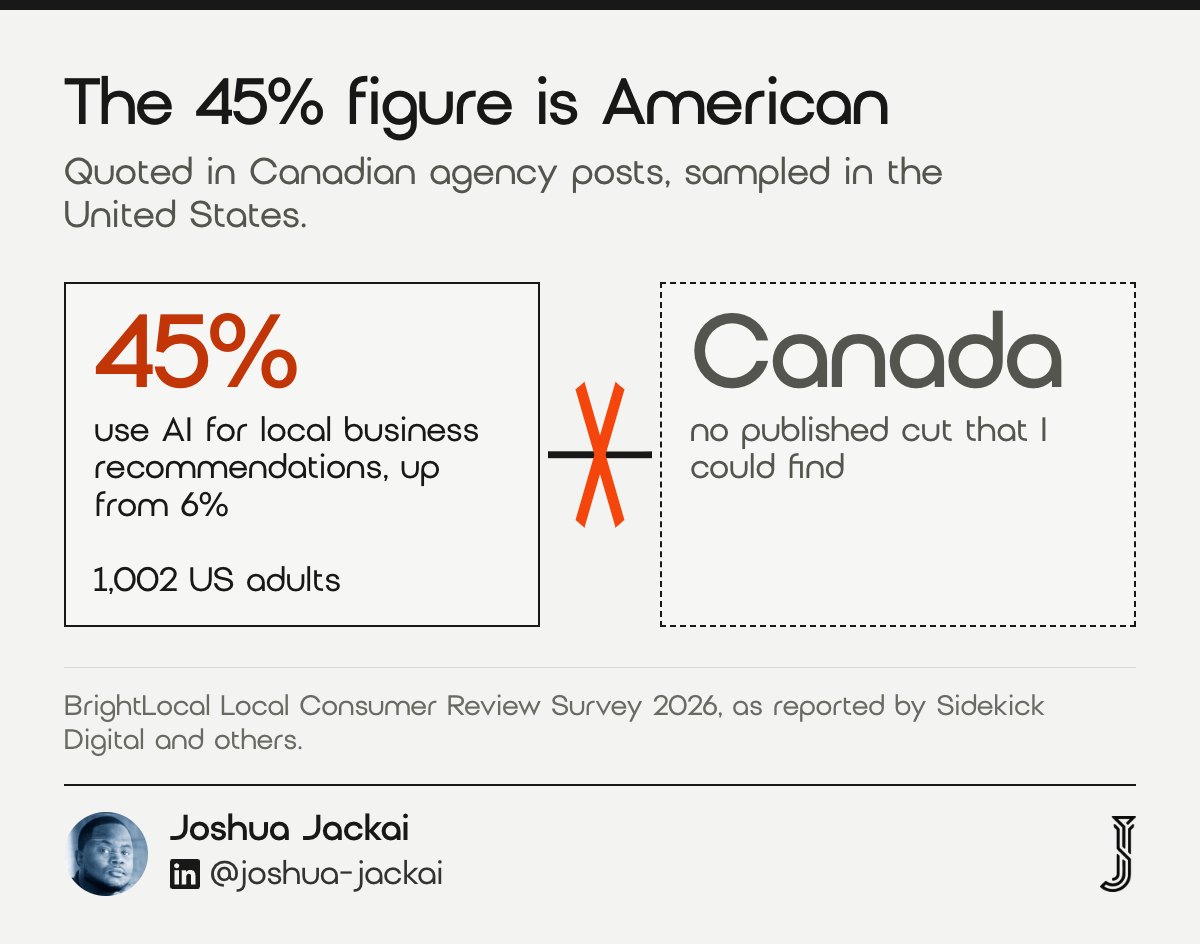
The 45% figure is the one I kept running into in Canadian agency posts, and it isn’t Canadian. It suits anyone checking a claim before repeating it. BrightLocal’s 2026 consumer survey covered 1,002 US adults, and secondary reports put AI use for local business recommendations at 45%, up from 6% a year earlier (Sidekick Digital, 2026).
- Asked: 1,002 US adults
- Published: 11 February 2026
- Paid for by: BrightLocal, a local SEO software vendor
- Canadian cut: none I could find
- My access: the figure came from reports of the survey
I couldn’t read the 45% on BrightLocal’s own page, which only mentions the rise of AI recommendations in its summary. The figure comes from several reports of the survey, so check the BrightLocal survey yourself before you put it in a deck, and if you use it, write “US adults” beside it.
Experiments give a reason not to assume every search moves to AI at the same rate. Kim and Priluck compared product search through AI chatbots and search engines and found a preference for search engines, driven by familiarity (Kim and Priluck, 2025).
“Consumers prefer search engines over AI chatbots and are more willing to self-disclose their personal information to search engines,” wrote Soyoung Kim and Randi Priluck (Journal of Theoretical and Applied Electronic Commerce Research, 2025).
A jump from 6% to 45% in one year also deserves suspicion on its own terms. Questions can change between waves, and “have you ever used” climbs faster than “do you usually use”. A Canadian firm quoting the 45% is quoting another country’s habit, from a vendor that sells local visibility. If you’ve seen it in a pitch for your own site, ask which question was asked and who was surveyed.
6. Statistics Canada: best for what businesses do, not buyers
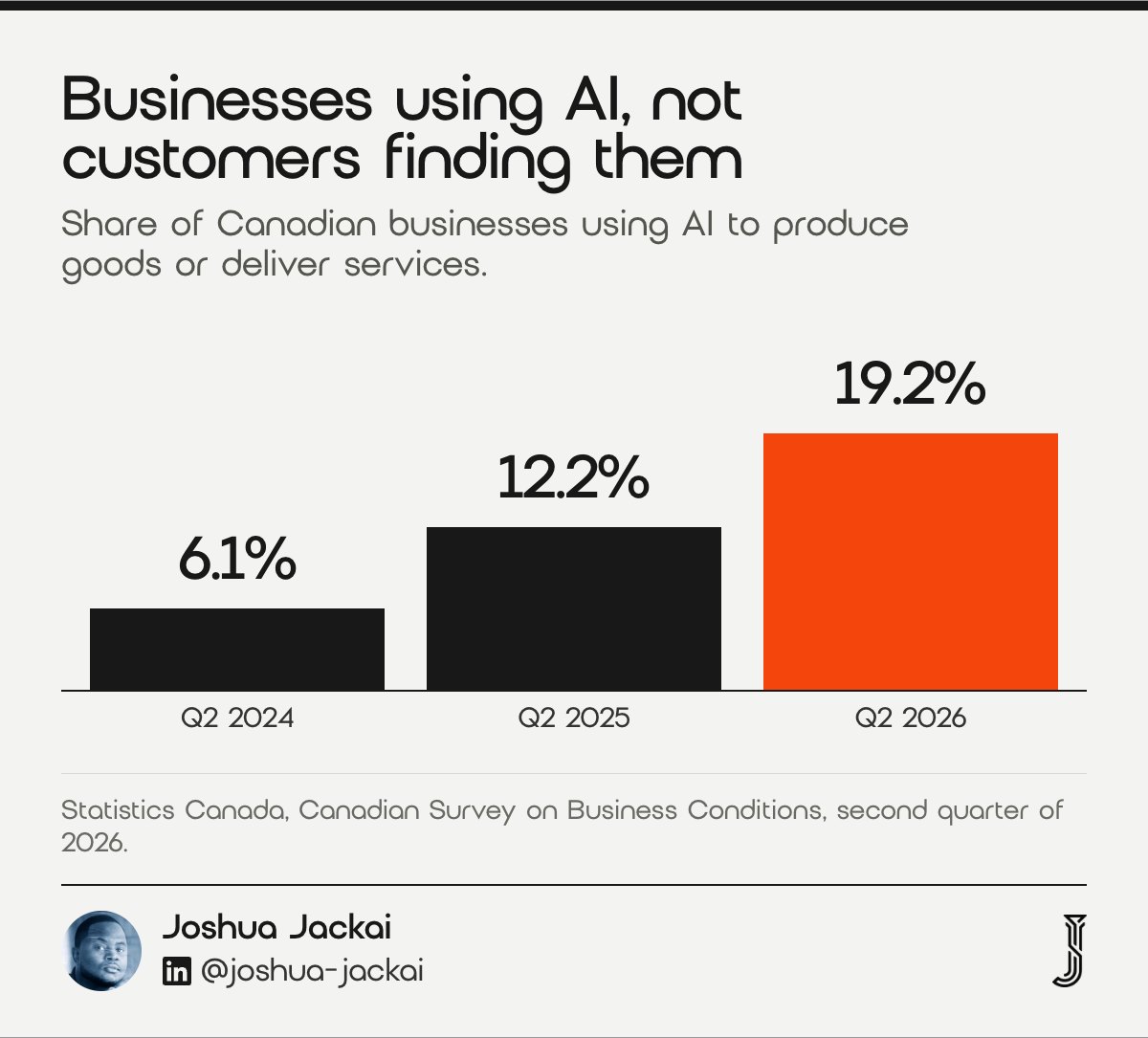
Statistics Canada’s figure gets quoted in AI search posts, and it measures the wrong side of the transaction. It suits anyone sizing business adoption. In the second quarter of 2026, 19.2% of businesses reported using AI to produce goods or deliver services over the previous 12 months (Statistics Canada, 2026).
- Asked: Canadian businesses
- Collected: 1 April to 6 May 2026
- Paid for by: Government of Canada
- Measures: businesses using AI in their own output
- Does not measure: how customers find those businesses
This is the most trustworthy survey on the list and the least relevant to the question. The trend is real: Statistics Canada reports 6.1% in the second quarter of 2024, 12.2% a year later and 19.2% now. Marketing automation using AI was reported by 19.8% of the businesses that use AI, which shows firms using AI to market, not customers using it to choose them.
“In the second quarter, nearly one-fifth (19.2%) of businesses reported using artificial intelligence (AI),” wrote Statistics Canada (The Daily, 2026).
The nearest thing I found to a Canadian B2B signal sits in a Bank of Canada article. In its December 2025 Business Leaders’ Pulse, more than two-thirds of business leaders personally used AI tools in a typical work week (Bank of Canada, 2026). Those leaders are the people who hire consultants and web designers. But using AI in a work week isn’t the same as using it to pick a vendor, and the article doesn’t ask about that. A leader drafting emails with an assistant on Tuesday may still ask two peers for a lawyer on Wednesday, which is exactly the part nobody has counted.
7. G2: best for software buyers, not Canadian ones
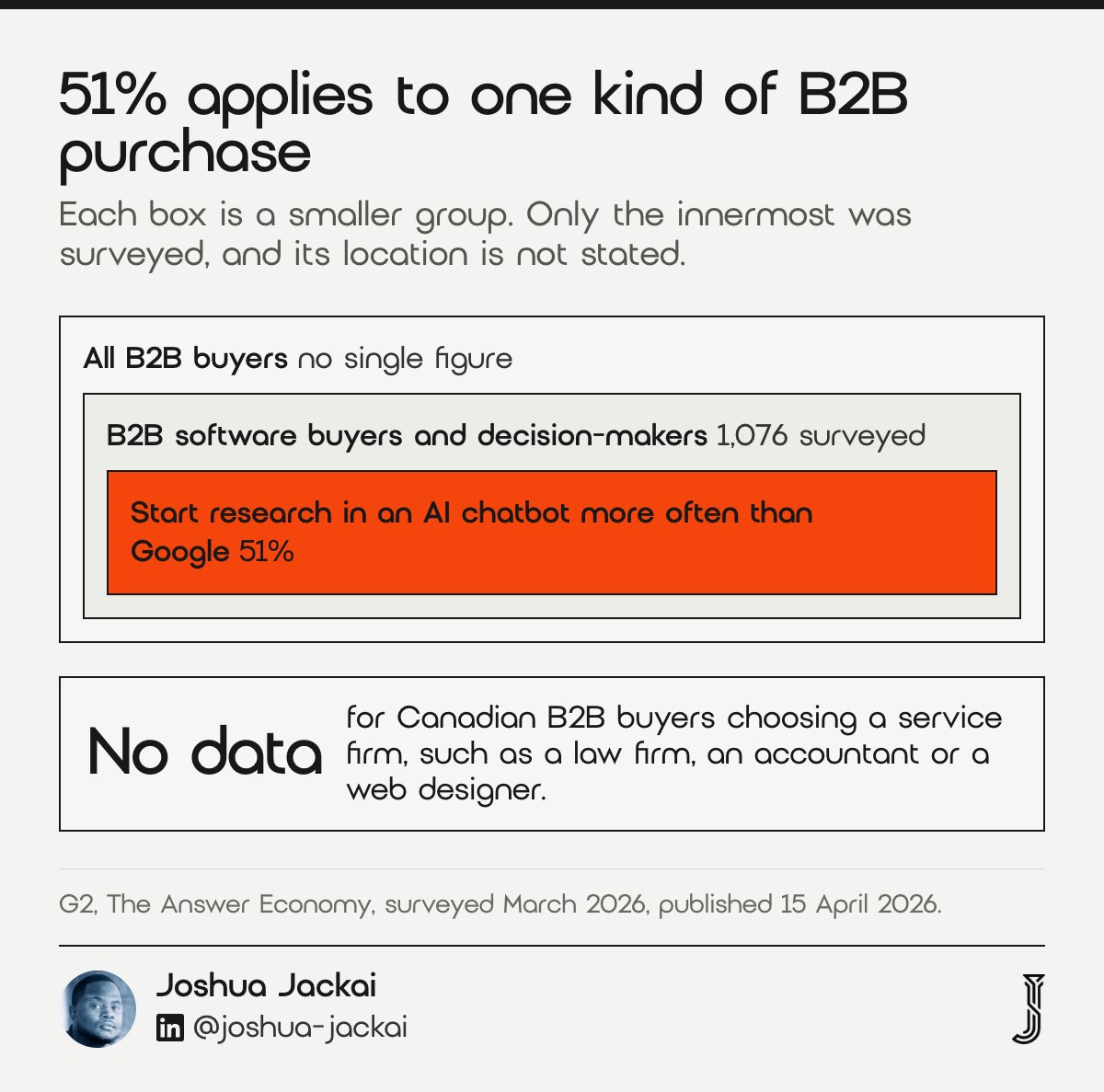
G2’s survey is the strongest B2B number I can point to, and it covers one kind of purchase. It suits SaaS firms. Of 1,076 B2B software buyers and decision-makers surveyed in March 2026, 51% start research with an AI chatbot more often than with Google (G2, 2026). The release doesn’t say where respondents live.
- Asked: 1,076 B2B software buyers and decision-makers
- In the field: March 2026
- Paid for by: G2, a software review marketplace
- Geography: not stated in the release
- Does not cover: services such as law, accounting or web design
Software buyers are close to the most AI-comfortable group you could ask, and G2’s business depends on software research being a subject people care about. So I read 51% as the high end for B2B. A chief financial officer choosing an audit firm in Kelowna isn’t in that sample.
“Half of B2B software buyers (51%) now start their research with an AI chatbot more often than with Google,” wrote G2 (The Answer Economy, 2026).
If AI answers do reach your buyers, whether you appear in them is partly within your control. Aggarwal and colleagues tested content changes against generative engines and reported gains of up to 40% in visibility (Aggarwal et al., 2024). They measured appearance in answers, not leads. That difference matters. A firm can be cited and still get no calls, and nobody in the seven surveys above can tell you how often that happens in Canada. Your own intake data can. The two numbers worth keeping apart are how often an engine names you and how many people then contact you because of it, and only the second one pays an invoice.
What does each figure actually measure, side by side?
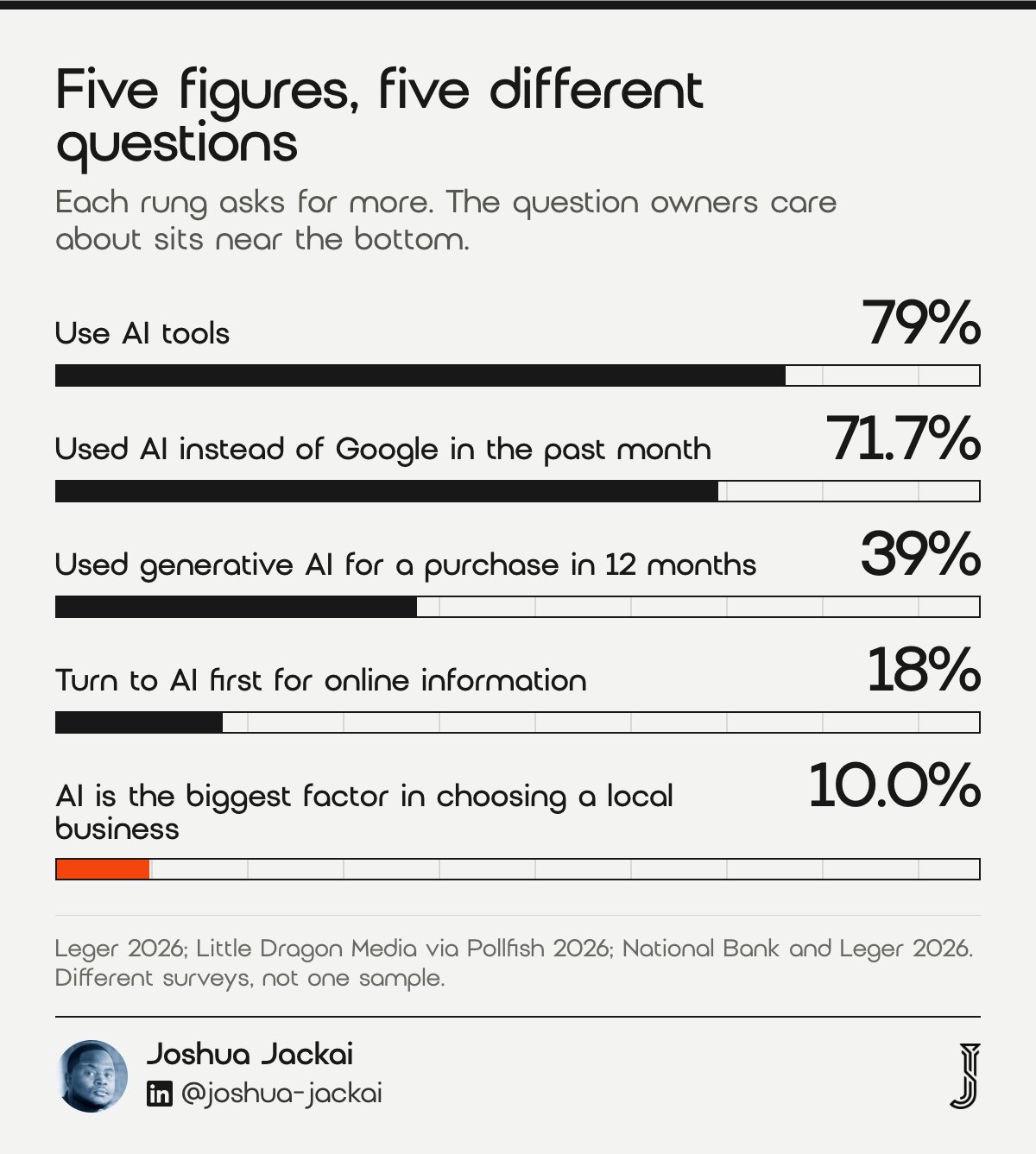
These figures run from loose to strict: using AI at all, then in place of Google, for a purchase, opening it first, and calling it the deciding factor. The share drops at each rung, from 79% to 10.0%, though each rung comes from a different survey and population, so the steps are not a single funnel.
| Metric | Value | Source |
|---|---|---|
| Canadians who use AI tools | 79% | Leger, 2026 |
| Used AI instead of Google, past month | 71.7% | Little Dragon Media, 2026 |
| Used generative AI for a purchase, past 12 months | 39% | National Bank and Leger, 2026 |
| Same measure, British Columbia | 34% | National Bank and Leger, 2026 |
| Turn to AI first for online information | 18% | Leger, 2026 |
| AI is the biggest factor in choosing a local business | 10.0% | Little Dragon Media, 2026 |
| Businesses using AI in their own output | 19.2% | Statistics Canada, 2026 |
Which figure fits your claim? Filter them
This matrix sorts every figure by who was asked and what was measured, with a line on what you can honestly say with it. Filter by population to see what’s actually Canadian, or by measure to find the closest thing to your claim. If no row fits what you want to say, the honest move is not to say it.
| Figure | Who was asked | Measure | What you can honestly say | Source |
|---|---|---|---|---|
| 79% | Canadians | Any AI use | Most Canadians use AI tools | Leger, 2026 |
| 71.7% | Canadians | Instead of Google | Most respondents tried AI in place of Google in a month | Little Dragon Media, 2026 |
| 18% | Canadians | AI first | About 1 in 5 open AI first for online information | Leger, 2026 |
| 39% | Canadians | Purchase support | Over a third used it on a purchase in 12 months | National Bank and Leger, 2026 |
| 34% | Canadians (BC) | Purchase support | About 1 in 3 British Columbians did the same | National Bank and Leger, 2026 |
| 56% | Canadians | Purchase support | Online shopping tasks only, July 2025 | Omnisend and Cint, 2025 |
| 10.0% | Canadians | Local choice | AI is rarely the biggest factor in choosing a local business | Little Dragon Media, 2026 |
| 45% | US adults | Local choice | US adults only, as reported | BrightLocal, 2026 |
| 19.2% | Canadian businesses | Business use | Firms using AI in their output, not customers finding them | Statistics Canada, 2026 |
| 51% | Software buyers | Vendor research | Software buyers only, geography not stated | G2, 2026 |
How many of your leads came through AI? Check your own
Your intake form can answer the question these surveys can’t. Add one line asking how the person first heard about you, with an AI assistant as an option, then enter your counts here. The calculator gives your rate with a 95% Wilson interval, so a small sample shows up as a wide range instead of false precision.
People misremember their own digital behaviour, so treat even your own form as an estimate. A pre-registered meta-analysis of 106 effect sizes found that self-reported media use correlates only moderately with logged use (Parry et al., 2021). Every survey in this guide relies on self-report, and so does your form. A named answer on a form is still better than a borrowed percentage.
Methodology: what I read and what it can’t tell you
I ran this research on 8 November 2026 and read each publisher’s own release wherever it was available. I searched Canadian polling firms, government statistics and trade press, then sorted every figure by population and question wording. BrightLocal’s 45% and its 1,002 sample come from reports of that survey, because the figures weren’t readable on its own page.
What these sources can’t do: none asks Canadians whether they used AI to find a specific business or vendor. None samples Canadian B2B buyers. Polling firms often publish toplines without question wording, so I’m comparing summaries. An eMarketer chart on AI use instead of Google search in Canada by age returned an access error, so it isn’t included. I commissioned no survey, and I can’t tell you the true number. The Leger, National Bank and Little Dragon Media releases I read state no margin of error.
Questions about Canadians using AI to find businesses, answered
These are the questions owners and marketing leads ask once they’ve seen a statistic quoted in a pitch. They cover what you can honestly claim, what to do about AI answers, and whether reviews still count. Each answer is short enough to use with a client, and the survey behind it is named above.
How many Canadians use ChatGPT instead of Google?
It depends on the question. 71.7% of 1,500 respondents used AI instead of Google in the past month, in Little Dragon Media’s 2026 survey. Only 18% of 1,511 Canadians turn to AI first for online information, in Leger’s 2026 AI Index. I would quote the 18%.
Do Canadians trust AI recommendations for local businesses?
Mostly not yet. In Little Dragon Media’s 2026 survey of 1,500 people in Canada, 63.6% trusted Google search most for answers online and 20.6% trusted AI tools most. Google reviews were the biggest local-choice factor for 49.7%, while AI recommendations were the biggest factor for 10.0%.
Is the 45% AI local search statistic Canadian?
No. The 45% who reportedly use AI for local business recommendations comes from BrightLocal’s 2026 survey of 1,002 US adults, and I found no Canadian breakdown. Write “US adults” beside it. The closest Canadian measure is the 10.0% who call AI recommendations their biggest factor.
Should a small Canadian business invest in AI visibility now?
Fix what buyers already use first: Google reviews, a clear website and search presence. Then check what ChatGPT says about you, since it costs nothing. Spend more only once your intake form shows leads naming an AI assistant, because no Canadian survey can make that call for you.
What I’d do with this if it were my firm
I’d stop quoting other people’s percentages and start counting my own. One intake question, an AI option on it and three months of answers will tell you more than the seven surveys combined, because your answers come from your actual buyers and not from someone looking up a recipe.
To see what the engines say about you today, I run a free AI Visibility Report with a 24-hour turnaround. If the report shows you’re missing from answers your buyers would ask, AI Visibility Optimization is CA$4,775 on a fixed quote. The steps I follow are published, so you can run them yourself if you’d rather.
Sources
Peer-reviewed research
- Aggarwal, P., et al. (2024). GEO: Generative Engine Optimization. Proceedings of KDD 2024, ACM.
- Cornesse, C., et al. (2020). A review of conceptual approaches and empirical evidence on probability and nonprobability sample survey research. Journal of Survey Statistics and Methodology, 8(1).
- Kim, S., and Priluck, R. (2025). Consumer responses to generative AI chatbots versus search engines for product evaluation. Journal of Theoretical and Applied Electronic Commerce Research, 20(2).
- Parry, D. A., et al. (2021). A systematic review and meta-analysis of discrepancies between logged and self-reported digital media use. Nature Human Behaviour, 5.
Government, polling and industry data (not peer reviewed)
- Bank of Canada (August 2026). Canadian businesses’ use of AI: What the evidence shows.
- BrightLocal (February 2026). Local Consumer Review Survey 2026. Figures read through Sidekick Digital’s summary.
- G2 (April 2026). In the Answer Economy, Don’t Win the Click, Win the Answer.
- Leger (October 2026). Nearly 1 in 5 Canadians Now Turn to AI First for Online Information.
- Little Dragon Media via Pollfish (April 2026). 63.6% of Canadians Still Trust Google Search More Than AI. PRNewswire release.
- National Bank of Canada and Leger (June 2026). AI is becoming a factor in purchasing decisions.
- Omnisend and Cint (August 2025). Over half of Canadians now use Gen AI tools for online shopping.
- Statistics Canada (June 2026). Analysis on artificial intelligence use by businesses in Canada, second quarter of 2026, and The Daily, 27 May 2026.