7 Checks: Should You Switch From .ca to .com?
Seven checks for a Canadian firm thinking of moving a working .ca to .com, from counting leads to the redirect map, using Google's documentation and the nearest peer-reviewed research.
 Joshua Jackai
18 min read
Published 9 November 2026 · Last updated and fact-checked November 2026
Short answer: Keep your .ca if most of your leads are Canadian. Switch to .com only with a real US sales plan and a budget for a ranking dip. Google says a ccTLD “can only target a single country”. If you do move, keep the old .ca redirecting for at least 1 year.
A founder of a 14-person software firm in Burnaby (a composite, not a client) signs a first customer in Seattle. A week later someone on the board asks why the website still ends in .ca. The domain has eleven years of links behind it. It also brings in nearly every lead the firm gets.
Should you switch from .ca to .com? That question isn’t really about a domain. It’s about whether the firm is moving, expanding or just feeling self-conscious, and those three need different answers.
On 9 November 2026 I ran a word search across 5 pages that come up for this question. None of the 5 mentions Google’s Change of Address tool or a 301 redirect, and only one uses the word “redirect” at all. They compare the two endings for a new site. Almost nobody covers the harder case: a .ca that already ranks.
I also found no peer-reviewed study that tests whether a .ca or a .com ranks better or earns more trust from buyers. Where the research runs out, I rely on Google’s own documentation and say so.
Key takeaways
- Google lists “can only target a single country” as the cost of a country domain such as .ca, and calls .com generic.
- Search Console’s country targeting setting is gone, so a .com can’t be pointed at the US from a settings screen (Google, 2022).
- Google says to keep redirects “generally at least 1 year” after a move and to expect ranking fluctuation.
- In one study of 1,929 people, readers assumed a URL led to the organization named in it (Albakry et al., 2020). It did not test domain endings.
- A US-facing folder on one domain, or a second site with hreflang, can reach Americans without giving up the .ca.
In this guide
| # | Check | What decides it | Evidence type |
|---|---|---|---|
| 1 | Where do your leads come from? | Your last 50 leads by country | Your own data |
| 2 | Does a .ca cap your US reach? | Whether you need US search traffic | Google docs |
| 3 | Do US buyers mind a .ca? | Proof a US buyer can check | Peer reviewed, indirect |
| 4 | Is the reason search or status? | Who raised the question | Peer reviewed, indirect |
| 5 | One site or two? | Whether US content will differ | Google docs |
| 6 | Can you afford the dip? | Lead value and runway | Google docs and your data |
| 7 | Do you have the move plan? | Redirect map and Search Console access | Google docs and CIRA |
1. Where do your leads come from today?
Start with your last 50 leads, not the domain. This check suits any owner who hasn’t counted yet. Google calls a country domain “a strong signal” of the intended country, so if 45 of those 50 are Canadian, that signal is working for you and a switch buys you little.
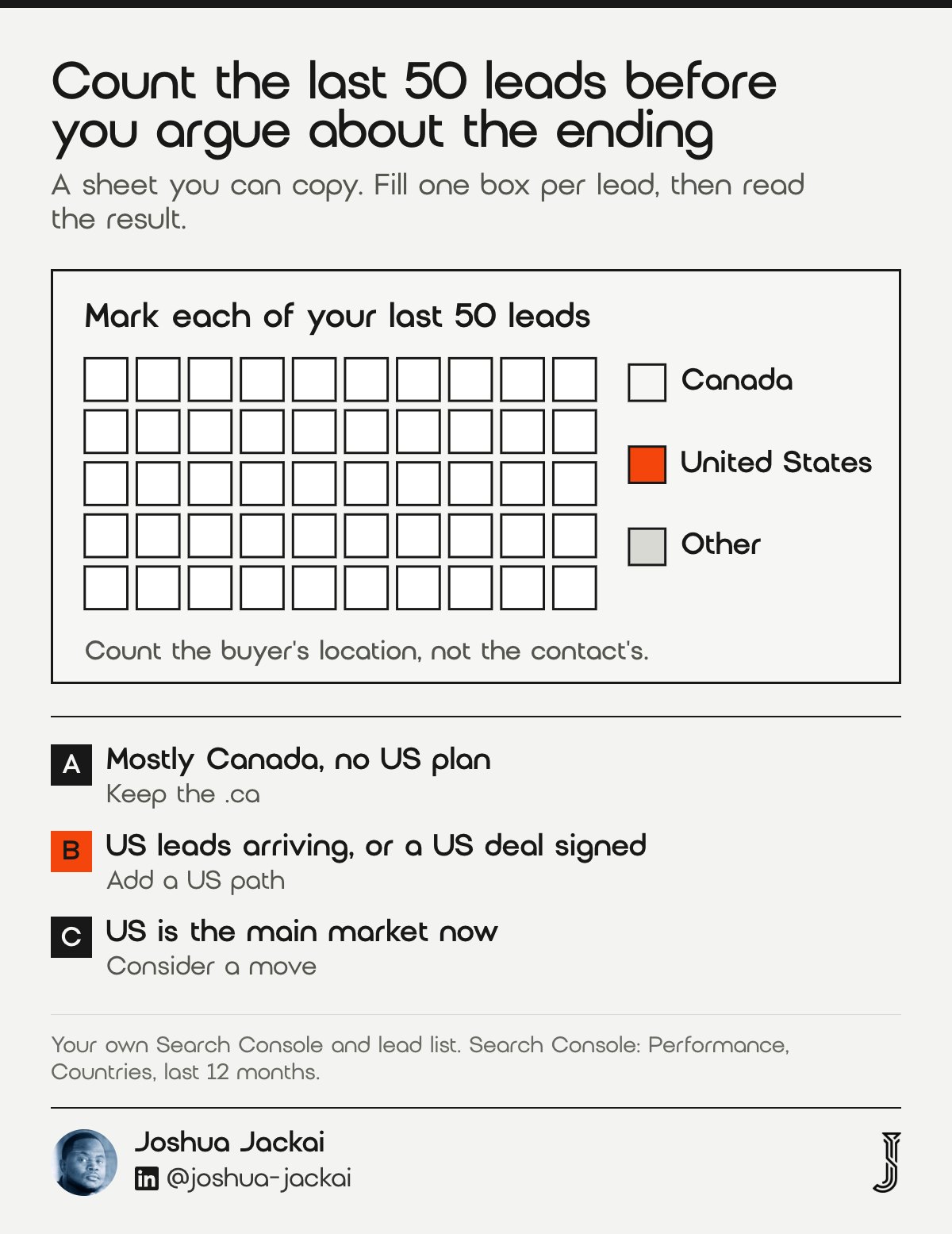
- Pull: Search Console, Performance, Countries, last 12 months
- Add: your last 50 leads, sorted by where the buyer sits
- Keep .ca if: the US share is small and no US sales plan exists
- Keep looking if: US leads already arrive, or a US contract is signed
- Do not count: US impressions with no clicks or leads
Search Console shows where searchers are. Your lead list shows who pays. Those two can disagree, and the lead list wins. A software firm can collect thousands of US impressions for a how-to article and never get a US demo request from it.
I’d count by the buyer’s location, not the contact’s. A Toronto procurement lead buying for a Chicago parent is a US sale. A US consultant researching on behalf of a Calgary client isn’t.
Then write down the plan in one sentence. Which US buyer, in which state, reached through what, by when? If nobody at the firm can finish that sentence, there’s no case for touching the domain this year. Fixing what brings Canadian leads in will pay sooner.
There’s one more number worth finding before anyone argues about endings: how many of your best inbound links point at the .ca. Those links are the thing a move puts at risk, and a domain that has collected them for a decade is worth more than its ending suggests.
“These are tied to a specific country,” and “provide a strong signal to both users and search engines that your site is explicitly intended for a certain country,” wrote Google (Search Central).
2. Does a .ca actually cap your US reach?
Probably, for generic US searches, though Google publishes no size for the effect. This check suits firms with a real US plan. Google’s table lists “can only target a single country” as the drawback of a ccTLD, and it says geotargeting can lift rankings in one country “at the expense of results in other locales or languages”.
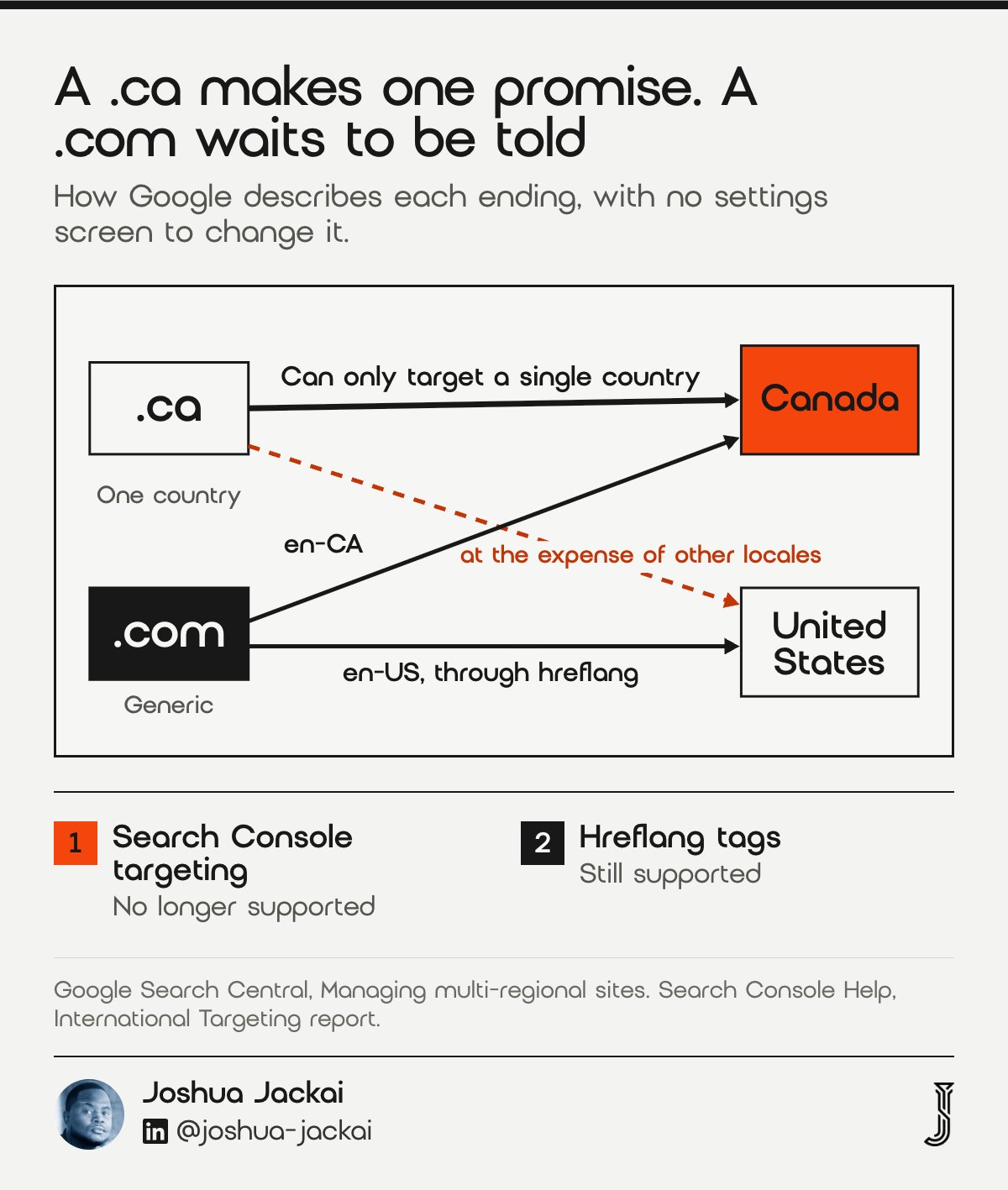
- .ca: tied to one country, a clear signal for Canada
- .com: generic, not tied to a location
- Search Console setting: removed, per Google in 2022
- Still supported: hreflang tags
- Other signals: local address, phone number, currency, links from local sites
The part older advice gets wrong is the settings screen. Some of it still tells you to pick a country in Search Console. Google says that targeting “is no longer supported”. With a .com you tell Google about regions through hreflang and through the page itself: the phone number, the address, the currency.
So a .ca is not a penalty. It’s a promise to Google about where you do business, and that promise is what you’d be giving up. A .ca can still appear for an American who searches your firm’s name. In my judgement it will have a harder time on a generic US query against firms that signal US intent.
The closest academic work is dated. Murphy and Scharl found that most Fortune Global 500 companies used .com rather than a local country domain, and reported a visibility gap favouring .com companies (Murphy and Scharl, 2007). They flagged a possible bias towards English content, and that sample of 500 giants tells you little about a 14-person firm in Burnaby.
“This can improve your page rankings in the target country, but at the expense of results in other locales or languages,” wrote Google (Search Central).
3. Do US buyers actually mind a .ca?
No study I found tests whether US buyers distrust a .ca, so nobody can answer yes or no from evidence. This check suits firms selling across the border on trust. One study of 1,929 people found readers lean on the organization name in a URL, though it did not test domain endings.
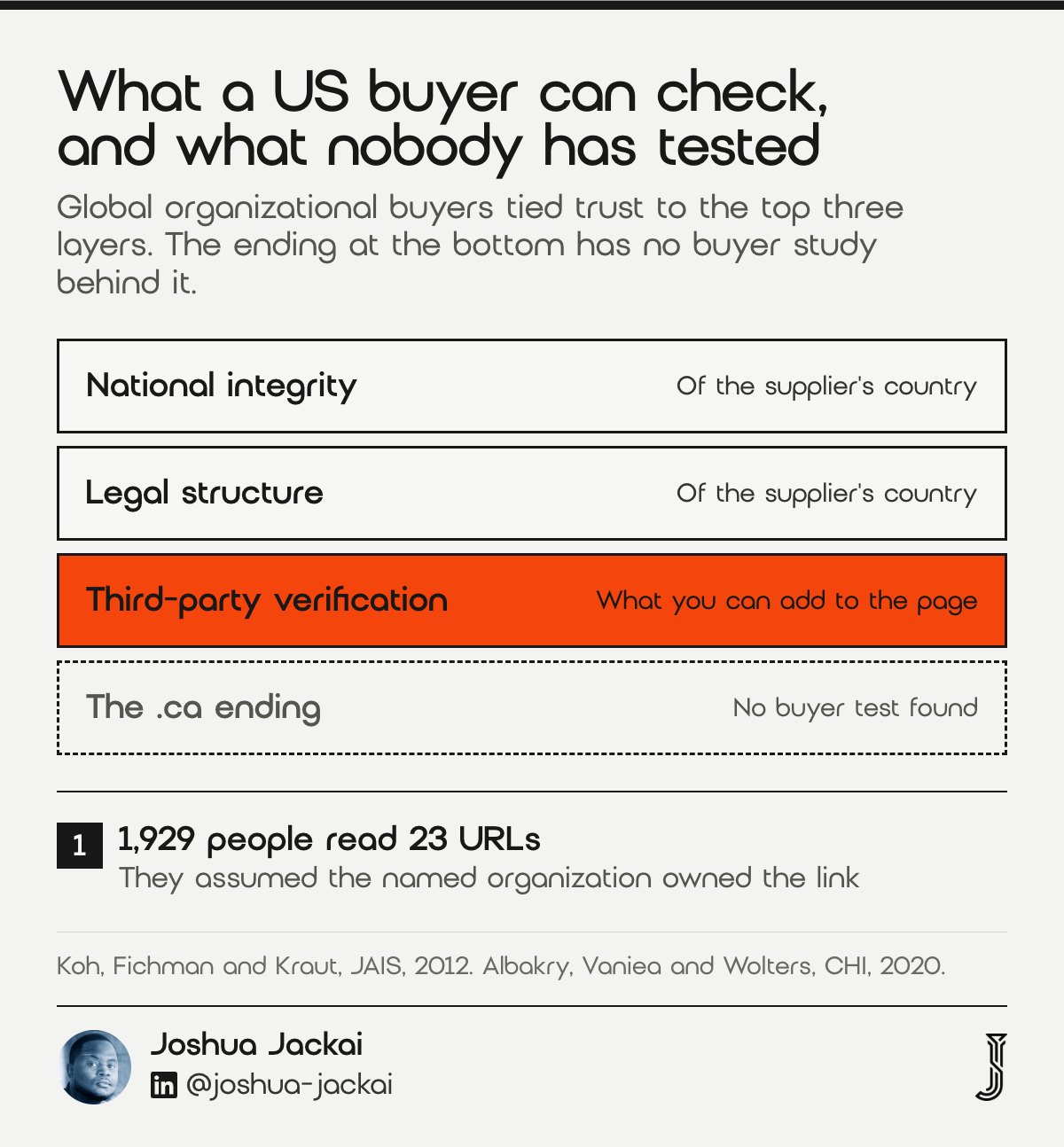
- Direct evidence on .ca trust: none found
- Closest survey: 50 .ro registrants, owners rather than buyers
- URL reading: 1,929 people, 23 URLs
- B2B trust study: global organizational buyers, third-party verification mattered
- What to add: a US phone number, USD pricing, named US proof
The nearest study on a country ending surveyed 50 Romanian registrants and reported that they saw .ro as useful for branding and trust (Tanase et al., 2025). Those are people who bought the domain. Asking them whether it builds trust is like asking a new car owner whether the car was a good buy.
What buyers do weigh is better documented. Koh, Fichman and Kraut surveyed global organizational buyers and tied trust to perceptions of the supplier’s country and to third-party verification. I’d expect Canada to do well on national integrity and legal structure, so a Canadian ending may not hurt with a procurement lead who knows where Canada is. I can’t prove that from their data, which didn’t test domains.
A US buyer checking you out sees your client names, your address and whether anyone they recognize has vouched for you. Put those on the first screen before you spend money on the ending. A .com with no American proof on it still reads as a stranger’s website.
Albakry and colleagues tested URL reading, not trust in endings, so it’s a hint rather than proof. It’s still a useful one: people tend to read the name and skip the structure around it.
“Participants were strongly biased towards answering that the URL would lead to the website of the organization whose name appeared in the URL,” wrote Sara Albakry and colleagues (CHI, 2020).
“A survey of global organizational buyers finds that perceptions of national integrity, legal structure, and supplier verifications are all positively related to buyers’ trust,” wrote Koh and colleagues (JAIS, 2012).
4. Is the reason search, or is it status?
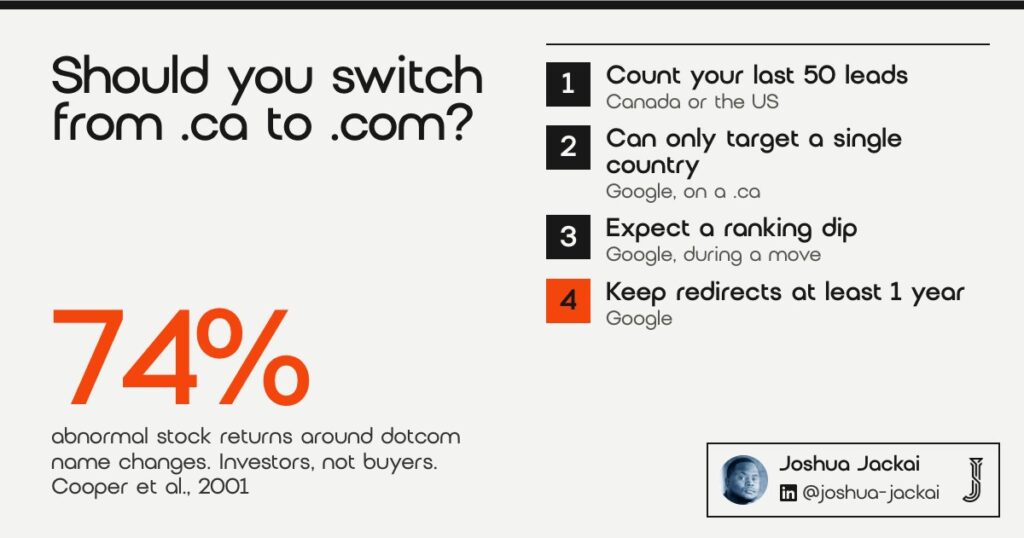
It’s a status question if the reason is how the domain looks, not a named US revenue plan. This check suits leadership teams where a .com just feels bigger. Cooper and colleagues measured abnormal returns of about 74% for investors around dotcom name changes, which shows how much a name can move perception.
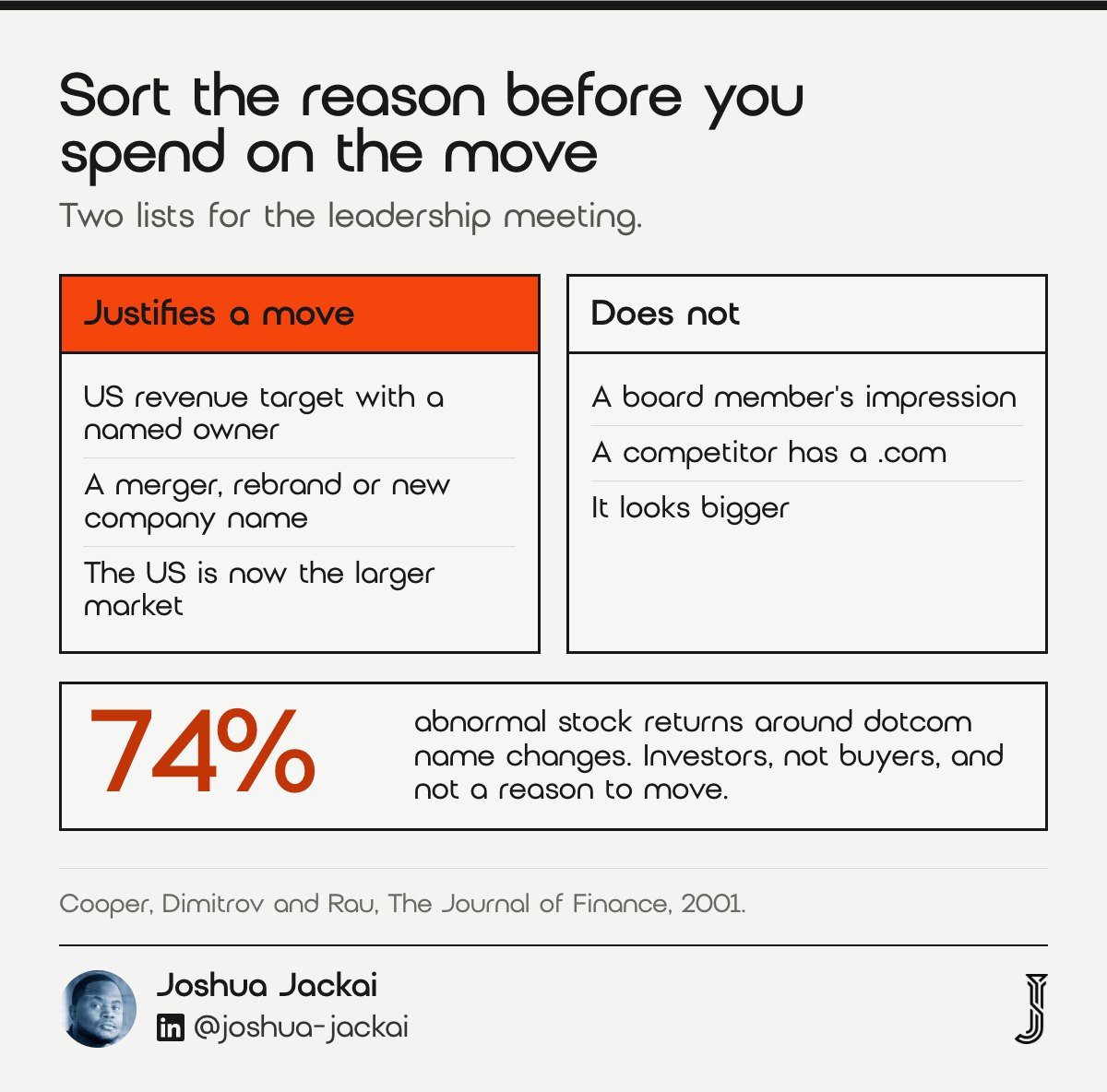
- Good reason: US revenue target with a named owner
- Good reason: a merger, rebrand or new company name
- Weak reason: a board member’s impression
- Weak reason: a competitor has a .com
- Before deciding: confirm you can actually buy the matching .com
That 74% figure from the 2001 study comes from the dotcom years, and from investors, not customers. I’m not using it to argue a .com helps you sell. It’s a warning. People have a long record of paying for the look of a domain, and the firms in that study got a bump whether or not they had anything to do with the Internet.
If the honest reason is status, a cheaper fix exists. Buy the .com if it’s available, point it at your .ca, and let the board stop asking. Nobody loses a ranking.
Check who owns the matching .com before the meeting. If someone else holds it, a move means a different name, and a different name is a rebrand with a redirect attached. I’d also confirm your firm owns the .ca you already have. Some don’t, and getting a .ca back from a web designer comes first if the registration sits in someone else’s account.
One honest case for moving is a business that has outgrown the country. If the firm now sells mainly to Americans and Canada is the smaller market, the .ca is describing a company that no longer exists.
“A mere association with the Internet seems enough to provide a firm with a large and permanent value increase,” wrote Michael Cooper and colleagues (Journal of Finance, 2001).
5. Should you run one site or two?
Run two sites only if the US version says something different. If the copy would be near-identical, use one .com with /ca/ and /us/ folders, and label every version with hreflang so Google doesn’t have to guess. This check suits firms that want Canadian and US buyers at once.
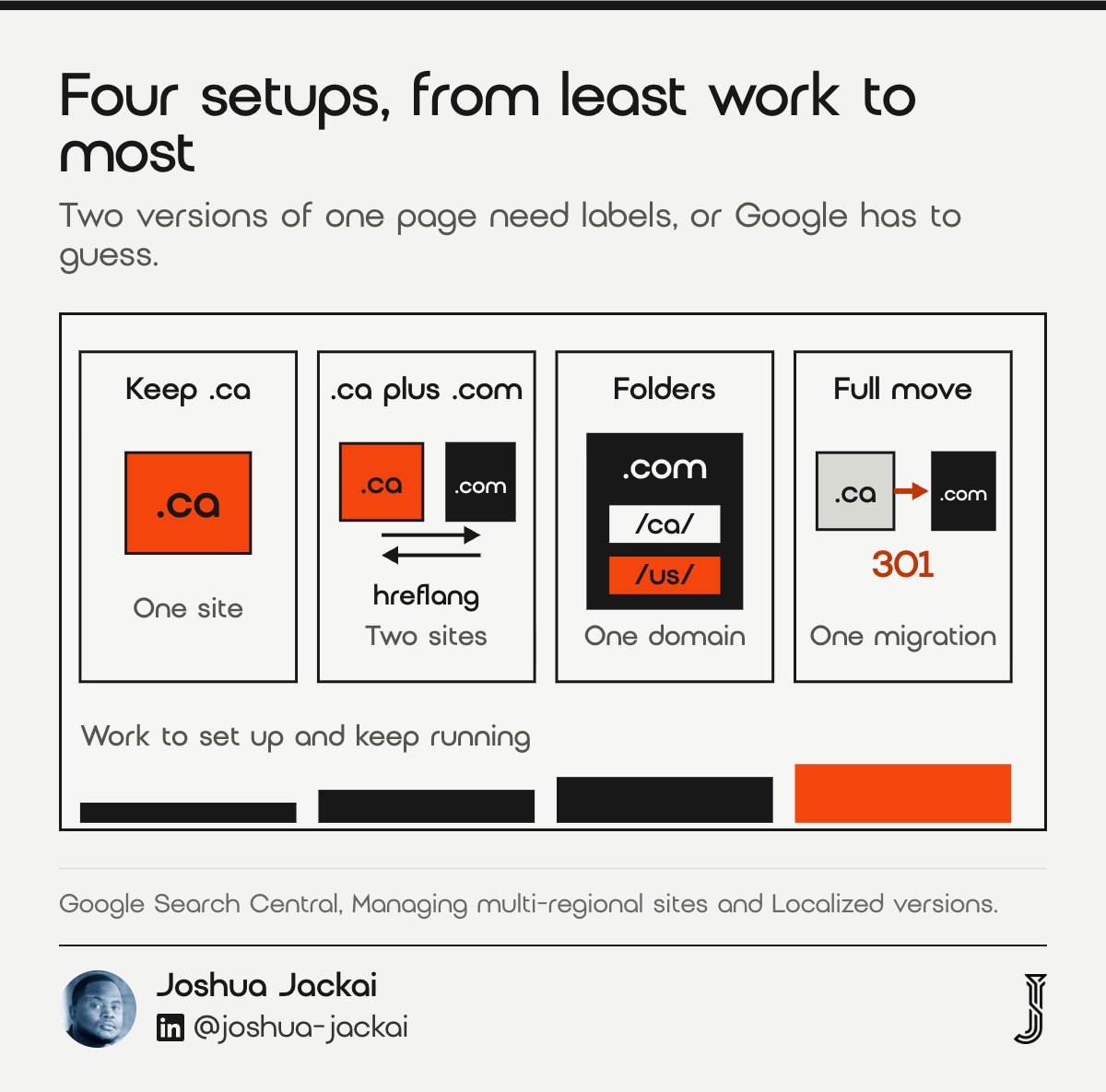
- Keep .ca, add /us/ pages: simplest, but still one country signal
- .ca plus .com with hreflang: two sites to maintain
- One .com with /ca/ and /us/: low maintenance, per Google’s table
- Full move to .com: one domain, one migration
- Hreflang rule: each version must list itself and the others
Will a .com and a .ca of the same website compete? They can. With identical English copy and no labels, Google has to guess which to show, and it may show the wrong one in each country.
Hreflang is how you stop that guess. The en-CA page and the en-US page each name both versions, and Google shows each searcher the right one. Google’s own localized versions guide says each version “must list itself as well as all other language versions”.
A second site is only worth it if the US version says something different. Prices in USD, American clients, US compliance language, US spelling. Two near-copies double your maintenance for a labelling job.
I’d pick folders on one .com for a firm moving to the US anyway, and a .ca plus a .com for a firm staying Canadian that wants one American landing zone. Don’t use automatic redirection by location. Google warns that it can stop people and crawlers from seeing all your versions.
6. Can you afford the ranking dip?
Plan for a temporary ranking dip and price it first. This check suits any firm whose pipeline depends on organic search. Google’s guide says to “expect temporary fluctuation in site ranking during the move”, and a site with 1 domain and many pages can take a few weeks or more to settle (Google).
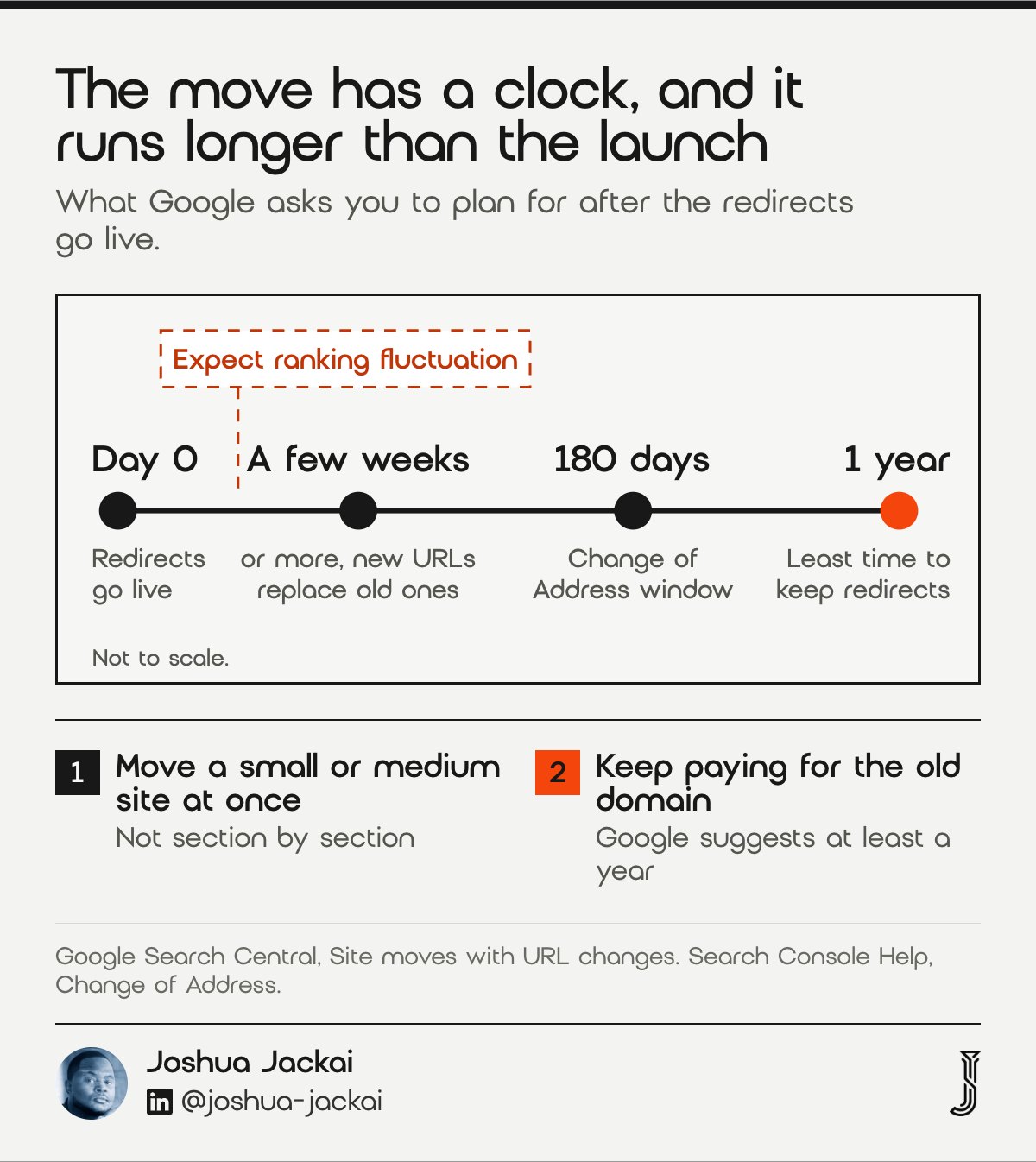
- Expect: ranking fluctuation while Google recrawls
- Duration: a few weeks or more for a medium site
- Change of Address window: 180 days
- Redirects: at least 1 year, longer is better
- My migration-only price: CA$2,500, redirect mapping and Search Console checks
Rank changes cost more than they appear to, because clicks don’t spread evenly. In an eye-tracking experiment with college students, Pan and colleagues found people favoured higher positions even when the abstracts were less relevant. Joachims and colleagues reached the related conclusion that “clicks are informative but biased” (Joachims et al., 2005). Both studies show higher positions draw more clicks, but neither measures what a position change costs, so price the dip from your own click data.
So work out what a slow quarter costs in leads, using your own numbers. If your firm closes four deals a year from organic search and a deal funds a salary, three soft months are a board-level risk. If organic brings in the odd enquiry, the dip barely registers.
Time it. Don’t move in your busiest quarter, in the same month as a redesign, or the week before a launch. Google suggests moving a small or medium site all at once rather than in sections, which keeps the dip to a single window you can plan around.
The calculator further down this guide turns those numbers into a payback period.
“Their decisions were strongly biased towards links higher in position even if the abstracts themselves were less relevant,” wrote Bing Pan and colleagues (Journal of Computer-Mediated Communication, 2007).
“Expect temporary fluctuation in site ranking during the move,” wrote Google (Search Central).
7. Do you have the move plan written down?
If you’ve decided to go, the plan is a list, and most of the risk is in the first three lines. This check suits firms moving this year. You need a page-by-page redirect map, ownership of both properties in Search Console, and at least 1 year of redirects kept live afterwards (Google).
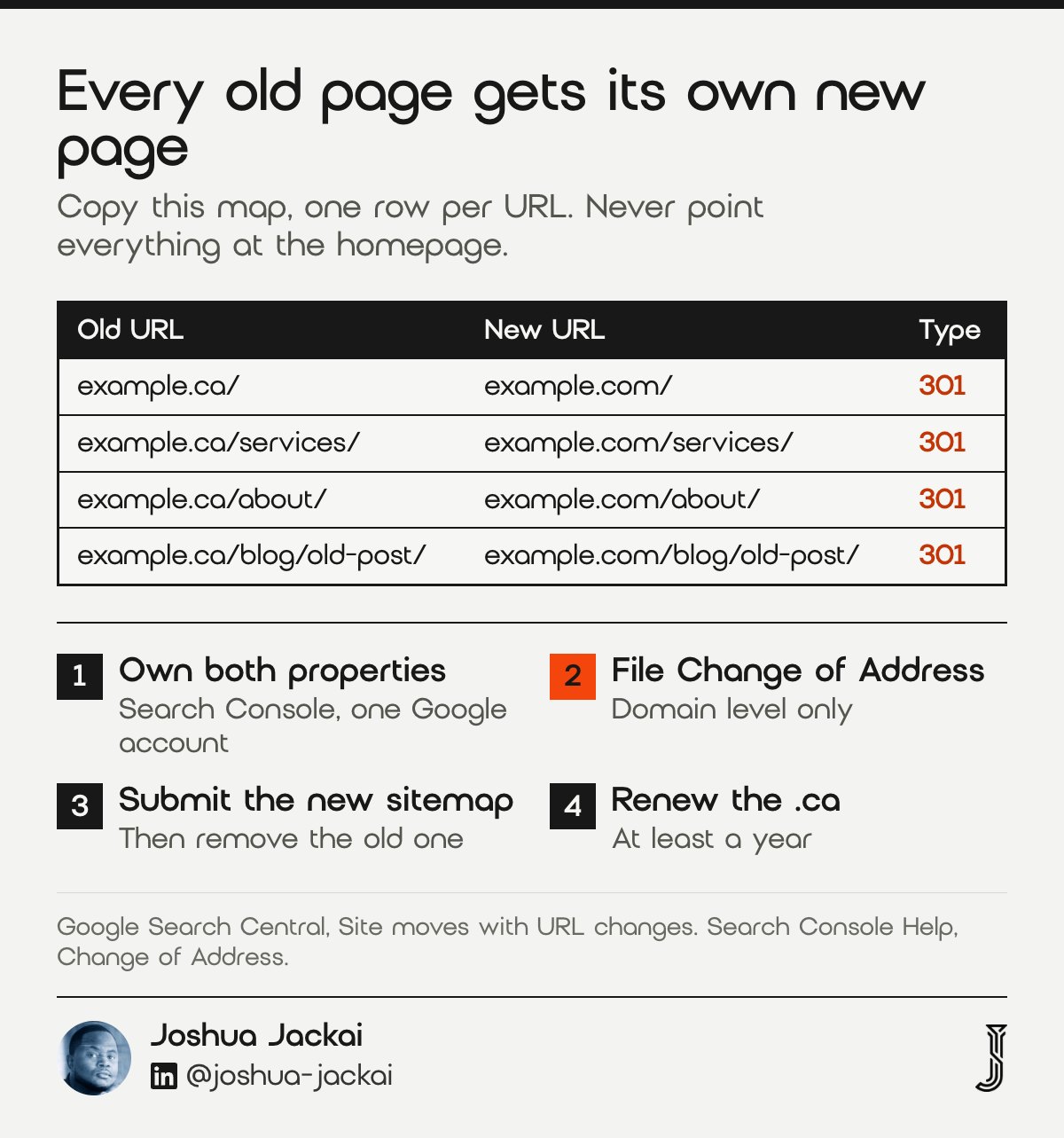
- Redirect: every old URL to its exact new URL, 301, server side
- Search Console: own both domains under one Google account
- Tool: file Change of Address, at the domain level only
- Sitemap: submit the new one, then remove the old one
- Keep paying: renew the .ca for at least a year
Map each old page to its true new page, not all 50 or 500 of them to the homepage. Then redirect the whole domain in one go and file Change of Address, which requires you to be an owner of both properties and works at domain level. Maintain the redirects for at least 180 days, which is Google’s minimum on that help page. The site-move guide says “generally at least 1 year”, so I plan on the year.
Renew the .ca, even after the move. Google recommends continuing to pay for the old domain so nobody else can buy it and misuse it. Your .ca also remains subject to CIRA’s Canadian Presence Requirements. A corporation under the laws of Canada or a province or territory qualifies, and that matters if the firm later reorganizes into a US parent.
Leave email for last. Move the website and test it first, then move mailboxes on their own schedule, with the old addresses forwarding. A missed reply costs more than a missed page, and it’s the part of the job that gets forgotten until a client asks why their invoice bounced.
The mechanics overlap with a rebuild, so my guide to rebuilding WordPress without losing SEO covers the redirect work in more depth.
“Keep the redirects for as long as possible, generally at least 1 year,” wrote Google (Search Central).
Which setup fits your firm? Filter the options
Five setups cover nearly every firm I’d expect to ask this question, from staying put to moving everything. Filter by your plan and the effort you can carry, and each row shows the trade you’d accept. The risk column is my judgement from Google’s documentation, not a measured figure, so treat it as a starting point.
Showing 5 of 5 setups
| Setup | Plan | Effort | Risk to Canadian rankings | The trade you accept |
|---|---|---|---|---|
| Keep .ca only | Staying Canadian | Low | None | Weak reach on generic US searches |
| Keep .ca, buy the .com and redirect it to the .ca | Staying or testing | Low | None | The .com does nothing for US search |
| Keep .ca, add a .com with hreflang | Testing the US | Medium | Low if labelled | Two sites to keep up, and US content has to differ |
| One .com with /ca/ and /us/ folders | Testing or moving | High | Medium, it is a migration | Giving up the .ca signal for one domain to run |
| Move everything to .com with 301 redirects | Moving to the US market | High | Medium, it is a migration | A ranking dip now, in exchange for one US-ready domain |
How long until a move pays for itself?
Put your own numbers in and this calculator estimates how long a domain move takes to recover its cost. The dip and duration are placeholders until you replace them, because Google publishes no percentage and I found no study that does. The CA$2,500 default is my published migration-only price, so change it if you’re quoting elsewhere.
What I could not find, and what it means for you
I searched for peer-reviewed work on whether a .ca or a .com ranks or converts better and found none that tests it directly. Search Central documentation describes how Google treats domains, but it doesn’t publish the size of any effect. So no source here tells you how much US traffic a switch would add to your firm.
The research I cite is the nearest available: URL reading, country and supplier trust, dotcom naming, position in search results. Each one was run for another purpose, and I’ve said so where I used it. The competing-page word search on 9 November 2026 covered 5 pages and raw page text, so a mention placed in a script or image wouldn’t count.
Search Console and your lead list are the evidence that will decide this for your firm. If you can, test demand with a US landing page on your current domain before changing anything. It costs far less than a move, and it answers the question you’re actually asking.
Questions about moving from .ca to .com, answered
These are the questions owners and marketing leads ask when a .ca has started to feel small. They cover ranking in the US, running both domains and what happens to the old address. Each answer is short enough to forward to a partner, and the Google document behind each one is linked in the checks.
Should I be switching from .ca to .com?
Only if US buyers are a real sales plan with a named owner. If most of your leads are Canadian, the .ca gives Google a clear country signal, and a move risks rankings you already hold. Test American demand first with a US landing page on your current domain.
Is there a good way to migrate from .ca to .com?
Yes. Map every old URL to its exact new URL, use server-side 301 redirects, verify both domains in Search Console under one Google account, then file Change of Address. Keep redirects live for at least 1 year, and keep renewing the .ca so nobody else can buy it.
If I have a .com and .ca version of the same website, will they compete?
They can, if the copy is near-identical and unlabelled, because Google must guess which to show. Add hreflang tags so the en-CA and en-US pages each name both versions. Change the prices, proof and spelling too, or two copies only double your maintenance work.
Should a Canadian company use .ca or .com for US and Canadian customers?
If Canada is your main market and the US is a test, keep the .ca and add a US landing page or a linked .com. If the US will become your main market, one .com with Canadian and American folders is simpler to run and to maintain over time.
Will moving to .com hurt my Google rankings in Canada?
Expect some fluctuation. Google says rankings can move while it recrawls, and a medium site can take a few weeks or more to settle. You also give up the country signal of a .ca, so add a Canadian address, phone number and local links to the new site.
Who sets up a switch from .ca to .com
A switch from .ca to .com comes down to a redirect map, Search Console steps and checks afterwards. I do that as a fixed-price Website Migration, no redesign, from CA$2,500. If you aren’t sure whether to move, start with the CA$995 Website Audit, which covers where your leads come from and is credited if a project starts within 30 days.
Not every firm should pay me to do this. If your Search Console shows little American interest and no US buyer has asked for you, the right spend is zero. Buy the .com if it’s cheap, point it at the .ca, and put your attention on the site that’s already bringing you work.
Sources
Peer-reviewed research
- Albakry, S., Vaniea, K., and Wolters, M. K. (2020). What is this URL’s Destination? Empirical Evaluation of Users’ URL Reading. Proceedings of CHI 2020, ACM.
- Cooper, M. J., Dimitrov, O., and Rau, P. R. (2001). A Rose.com by Any Other Name. The Journal of Finance, 56(6), 2371-2388.
- Joachims, T., Granka, L., Pan, B., Hembrooke, H., and Gay, G. (2005). Accurately interpreting clickthrough data as implicit feedback. Proceedings of SIGIR 2005, ACM.
- Koh, T., Fichman, M., and Kraut, R. (2012). Trust Across Borders: Buyer-Supplier Trust in Global Business-to-Business E-Commerce. Journal of the Association for Information Systems, 13(11), 886-922.
- Murphy, J., and Scharl, A. (2007). An investigation of global versus local online branding. International Marketing Review, 24(3), 297-312.
- Pan, B., Hembrooke, H., Joachims, T., Lorigo, L., Gay, G., and Granka, L. (2007). In Google We Trust: Users’ Decisions on Rank, Position, and Relevance. Journal of Computer-Mediated Communication, 12(3), 801-823.
- Tanase, I., Barbu, L. N., and Rusu, G. (2025). The Role of .ro Domains in Strengthening Digital Identity and Local Branding in Romania. Ovidius University Annals, Economic Sciences Series, 24(2), 312-316.
Platform, registry and vendor documentation (not peer reviewed)
- Google Search Central. Managing multi-regional and multilingual sites, read 9 November 2026.
- Google Search Central. Site moves with URL changes, read 9 November 2026.
- Google Search Central. Localized versions of your pages, read 9 November 2026.
- Google Search Console Help. The International Targeting report is deprecated, read 9 November 2026.
- Google Search Console Help. Change of Address tool, read 9 November 2026.
- CIRA. Canadian Presence Requirements for Registrants, read 9 November 2026.
- Jackai Agency price table, published 3 October 2026 (first-party prices). Jackai Agency pricing.