8 Proven Checks to Hire a Web Development Company in Canada
Eight checks before you hire a web development company in Canada: what the firm builds, team size, portfolio, a fixed quote tied to a written scope, a contract plus check-ins, written ownership of the code under the Copyright Act, AODA and CASL compliance, and lead tracking after launch. Sources checked 17 November 2026.
 Joshua Jackai
20 min read
Published 17 November 2026 · Last updated and fact-checked November 2026
Short answer: To choose a web development company in Canada, run 8 checks: what the company actually builds, team size, its portfolio, a fixed quote tied to a written scope, a contract plus a working relationship, written ownership of the code and design, Canadian compliance such as Ontario’s accessibility rule (AODA) and the anti-spam law (CASL), and lead tracking after launch.
Most guides on this topic list the same advice: look at the portfolio, read the reviews, compare prices. That advice is fine, but it skips the parts that cost Canadian buyers money later. Who owns the code when the project ends. Whether the quote moves when the scope moves. Whether the site meets Ontario’s accessibility rule or Canada’s anti-spam law. I run Jackai Agency, a small Vancouver web design and development company that builds B2B websites for Canadian companies, and these are the questions I see buyers forget until something breaks. This guide covers what a web development company does, how it compares with a freelancer, and the eight checks I would run before signing with anyone, including me. If you want to see how I work first, start at my homepage.
In this guide
Key takeaways
- IT project cost overruns follow a power-law distribution with a fat tail of extreme overruns, in a sample of 5,392 IT projects (Flyvbjerg and colleagues, Journal of Management Information Systems, 2022).
- In 93 offshore software projects, requirement uncertainty, team size and resource shortage explained which contract type was chosen, and contract choice shaped project profit (Gopal and colleagues, Management Science, 2003).
- Formal contracts and relational governance worked as complements, not substitutes, in information service exchanges (Poppo and Zenger, Strategic Management Journal, 2002).
- Under Canada’s Copyright Act, the author of a work is the first owner of the copyright, and an assignment is valid only in writing signed by the owner (Copyright Act, sections 13(1) and 13(4)).
- Since 1 January 2021, Ontario businesses and non-profits with 50 or more employees must make public websites meet WCAG 2.0 Level AA (Government of Ontario).
| Check | What it protects | Effort | Key number |
|---|---|---|---|
| 1. Know what a web development company does | Hiring the right kind of firm | Low | 46.1% of credibility comments on design look |
| 2. Match the team size to the project | Budget and speed | Low | 93 projects studied |
| 3. Judge the portfolio the way buyers will | The first impression your site makes | Low | 50 ms to judge visual appeal |
| 4. Get a fixed quote tied to a written scope | Budget | Medium | 5,392 IT projects studied |
| 5. Sign a clear contract and build the relationship | Delivery when things change | Medium | Contracts and relationships are complements |
| 6. Put ownership of code and design in writing | Your right to move the site | Low | Assignment valid only in writing |
| 7. Check Canadian compliance | Legal risk | Medium | Up to $10,000,000 CASL penalty |
| 8. Ask how leads and AI answers get measured | Return on the build | Medium | Up to 40% visibility gain |
1. Know what a web development company does: best for buyers writing their first brief
A web development company plans, designs, builds and launches websites and web applications, then often hosts and maintains them. Some firms only write code from someone else’s design. Others, like mine, do strategy, design and development in one team. Ask which kind you are talking to before you compare quotes.
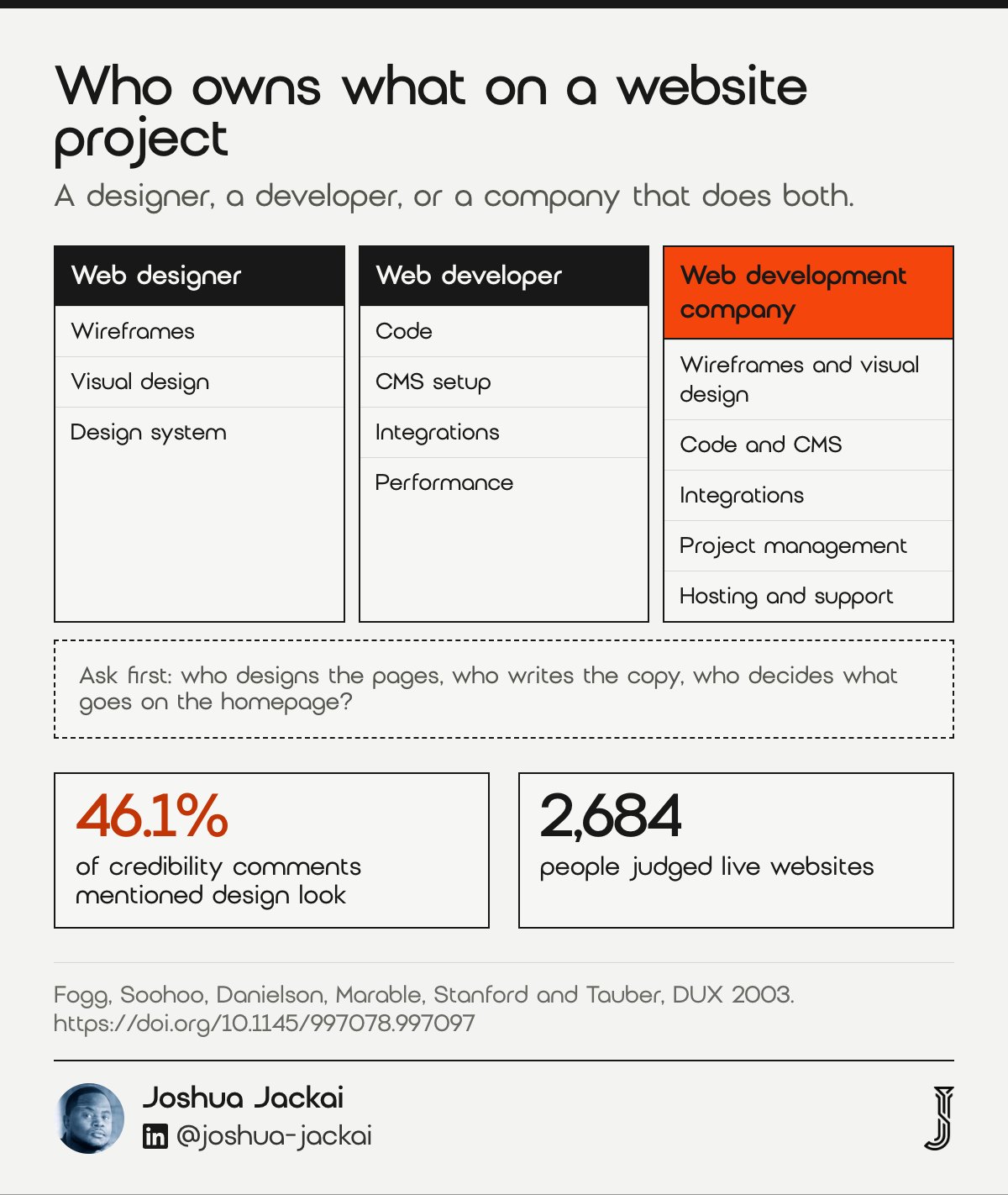
- Designer: wireframes, layout, type, colour and the visual system
- Developer: code, CMS setup, integrations and performance
- Web development company: both, plus project management, hosting and support
- Ask: who writes the copy, and who owns the brief
- Watch for: a code-only shop quoting a redesign it cannot design
The word “development” makes some buyers think the job is mostly code. It rarely is. Most of what decides whether a B2B website brings in leads happens before the first line of code: what the site says, who it speaks to, and how it looks. B. J. Fogg and colleagues at Stanford University asked 2,684 people to judge the credibility of live websites, and the design look of the site came up in 46.1% of their comments, more than any other factor. A development-only firm can build exactly what it is handed and still ship a site visitors do not trust. The same study found information design and structure came second, at 28.5% of comments, according to Fogg and colleagues (2003).
A web development company should answer three questions in the first call. Who designs the pages? Who writes the copy? Who decides what goes on the homepage? If the answer to all three is “you do”, you are hiring a builder, and you need a designer and a writer as well. That can work, but price it as three jobs, not one. The study measured what people said about credibility, not what they bought, so I treat it as a signal about where trust starts.
“We found that the ‘design look’ of the site was mentioned most frequently, being present in 46.1% of the comments,” Fogg and colleagues wrote in the Proceedings of the 2003 Conference on Designing for User Experiences.
2. Web development company vs freelancer: match the team size to the project, best for deciding between a freelancer, a studio and an agency
Pick the smallest team that can cover design, development and support for your project. A freelancer suits a small, well-defined site. A studio or small company suits a custom B2B site. A larger agency suits multi-team builds with many integrations. Team size changes cost and pace, so match it to scope, not to prestige.
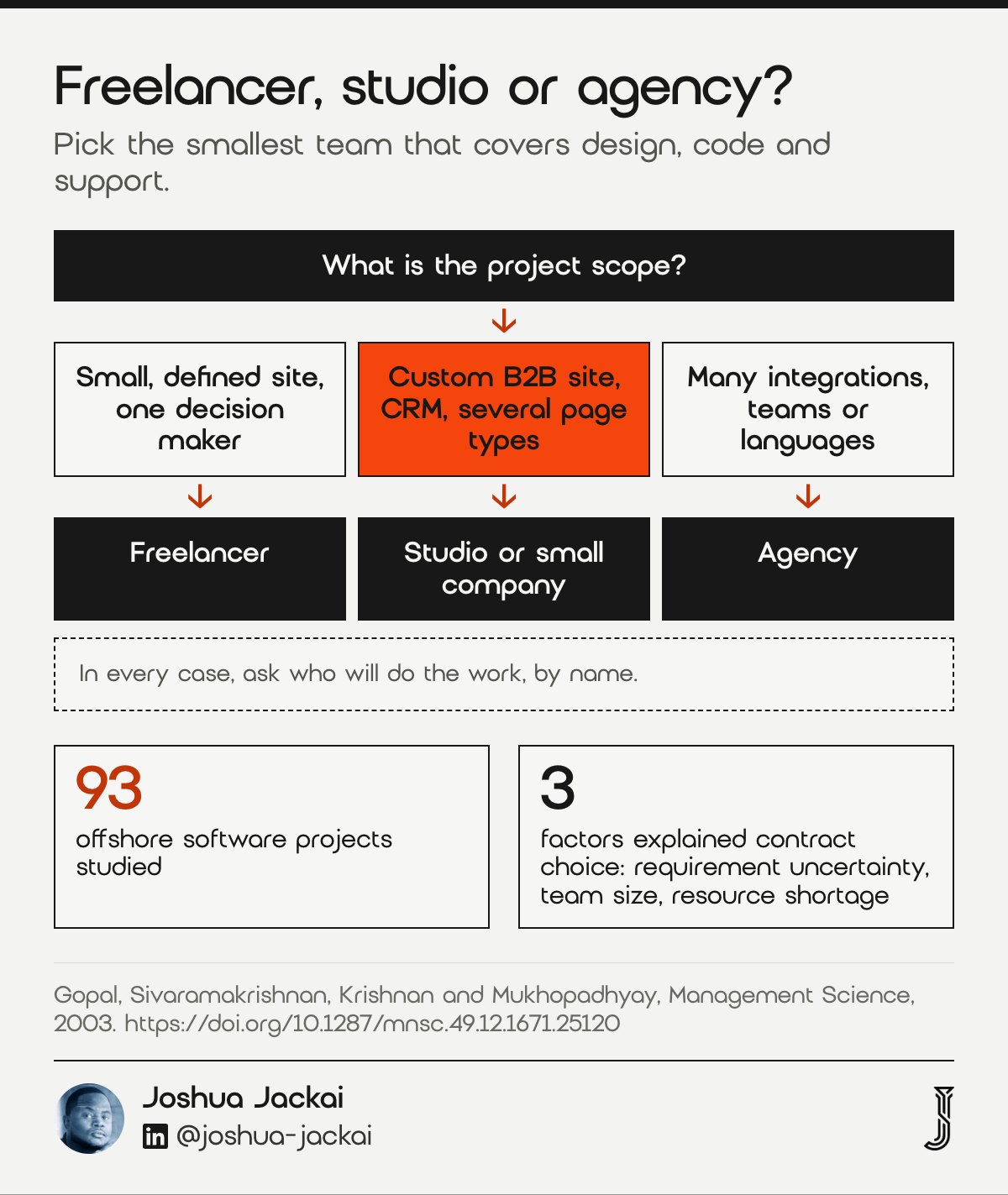
- Freelancer: one person, lowest overhead, single point of failure
- Studio or small company: two to ten people, one lead you talk to
- Agency: account managers and specialists, more process and cost
- Ask: who exactly will work on my project, by name
- Watch for: a senior pitch team that hands you to juniors
The “web development company vs freelancer” question comes up in almost every first call I take. My answer is that it depends less on the label and more on the people who will do the work. Anandasivam Gopal of the University of Maryland and colleagues studied 93 offshore software projects and found that requirement uncertainty, project team size and resource shortage significantly explained which contract the client and vendor chose. They also found that project duration and team size affected project profits across those 93 projects, according to the Management Science study.
A bigger team is a cost driver, and the vendor prices it in. A freelancer can be the right call for a five-page site with clear content. For a B2B site with a CRM, gated content and several buyer types, a single person often runs out of hours or skills, and the project stalls. I work as a small company with a fixed core team, and I tell people when their project is small enough for a freelancer. For the questions to ask any of them, see my list of questions to ask a web designer.
“We also provide evidence to show that project duration and team size affect project profits,” Gopal, Sivaramakrishnan, Krishnan and Mukhopadhyay wrote in Management Science.
3. Judge the portfolio the way your buyers will: best for spotting work that converts
Look at live sites from the portfolio, not screenshots, and judge each one in the first few seconds the way your own buyers will. Then ask what each site was built to do and what changed after launch. A good company can show you the brief, the result and the site still running.
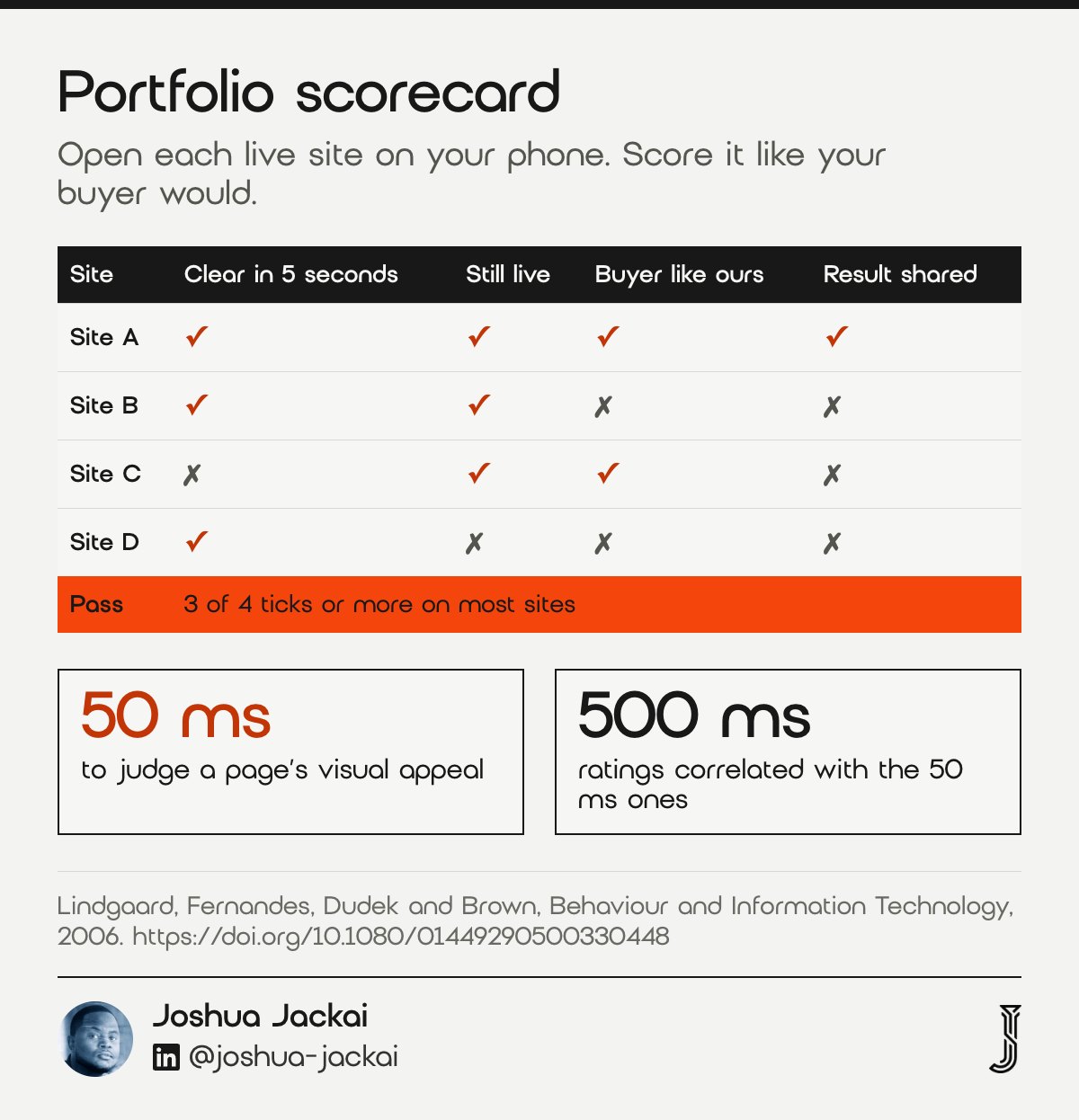
- Open the live site: check it loads fast on your phone
- Five-second test: can you tell what the client sells?
- Similar buyer: at least one site sold to people like yours
- Result: a lead, sales or speed change, with the method named
- Watch for: template sites that all look the same
Your buyers will judge your new site fast, so judge the company’s work the same way. Gitte Lindgaard and colleagues at Carleton University in Ottawa showed people homepages for 500 milliseconds and then for 50 milliseconds, and the visual appeal ratings were highly correlated between the two. That means the first impression forms before anyone reads the copy. When I review a portfolio for a client, I open each site on my phone, give it five seconds, and write down what I think the company sells. If I am wrong more than once, the agency designs for itself, not for the client’s buyer. Then I ask for one result per site. Not “the client loved it”, but a measurable change, such as more demo requests, a faster page or fewer support emails, with how it was measured. Their study measured appeal, not sales, so the five-second test only filters the shortlist; the result question does the rest. My own B2B web design work in Vancouver is set up so you can run this test on it.
“Visual appeal can be assessed within 50 ms, suggesting that web designers have about 50 ms to make a good first impression,” Lindgaard, Fernandes, Dudek and Brown wrote in Behaviour and Information Technology.
4. Get a fixed quote tied to a written scope: best for buyers with a set budget
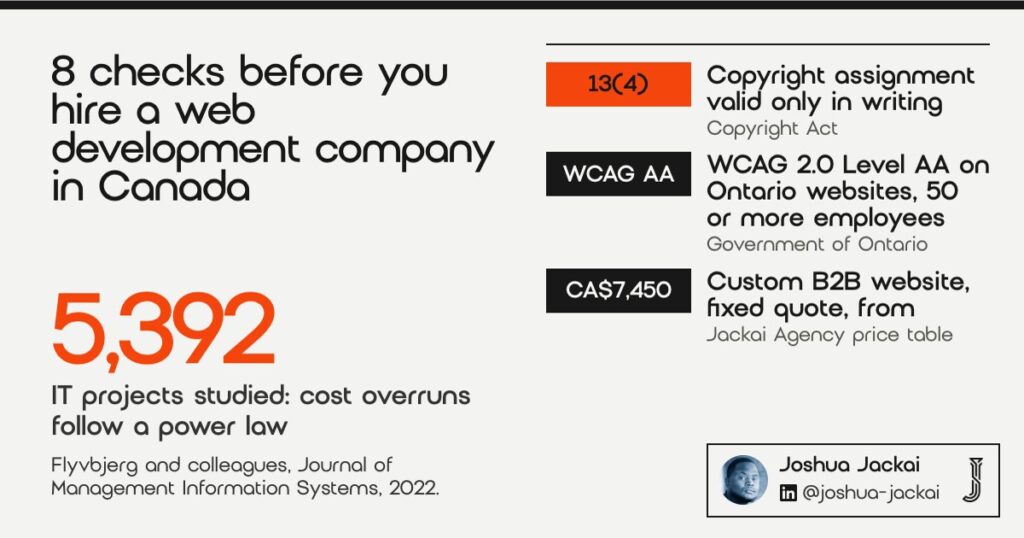
Ask for a fixed quote that lists every page, template, integration and revision round, plus a written process for changes. In a sample of 5,392 IT projects, cost overruns followed a power law with a fat tail of extreme overruns, so the scope document protects you more than the headline price does.
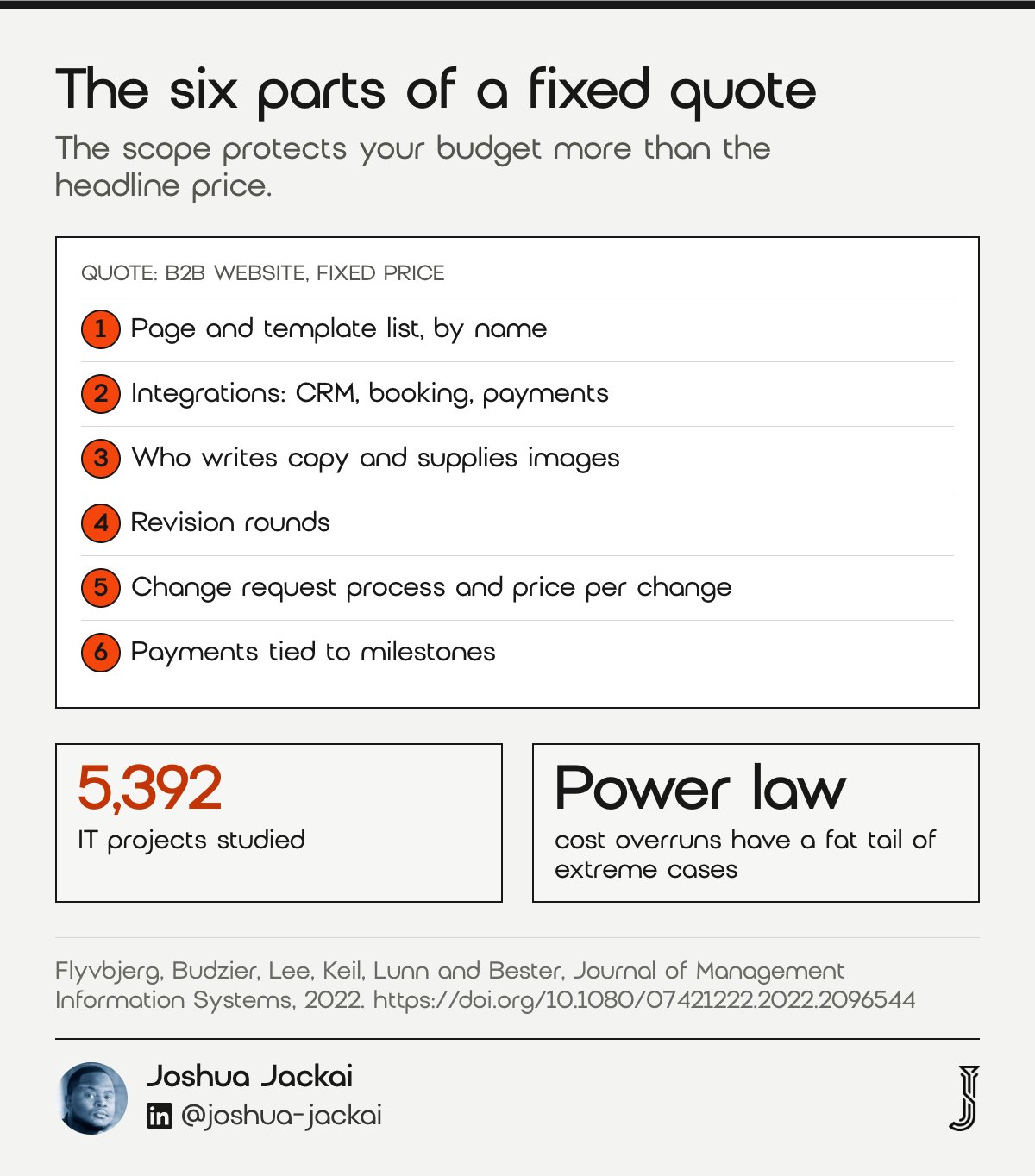
- Pages and templates: listed by name, not “up to 10 pages”
- Integrations: CRM, booking, payments, each named
- Content: who writes copy and supplies images
- Changes: a written process and a price per change
- Payments: tied to milestones, not dates
Budgets on web projects rarely blow up because of the first quote. They blow up because something nobody priced turns out to be connected to everything else. Bent Flyvbjerg, Alexander Budzier and colleagues analysed 5,392 IT projects and found cost overruns follow a power-law distribution: many projects run a little over, and a fat tail runs over by extreme amounts. In that study of 5,392 projects, Flyvbjerg and colleagues (2022) warned that managers who assume a normal distribution grossly underestimate how often extreme overruns happen. Their explanation was interdependence between components, where a problem in one part sets off a chain reaction in others. On a website that looks like a CRM integration that breaks the form, which breaks lead routing, which delays launch. The Gopal study above found that requirement uncertainty helped explain which contract type was chosen. So if a company will only quote hourly, ask what about the scope is still unclear, and fix the brief before you sign. I quote fixed prices because I scope first. If the scope is not clear enough to fix, I sell a short paid audit first rather than guess.
“Extreme IT project cost overruns will occur and that the prevalence of these will be grossly underestimated if managers assume that overruns follow a normal or near-normal distribution,” Flyvbjerg and colleagues wrote in the Journal of Management Information Systems.
5. Sign a clear contract and build the working relationship: best for projects longer than a month
Use both a detailed contract and a working relationship with regular check-ins. Research on information service deals found that the two work together: firms with more customised contracts also built stronger relationships, and that pairing was linked to better exchange performance. Do not treat trust as a reason to skip the paperwork.
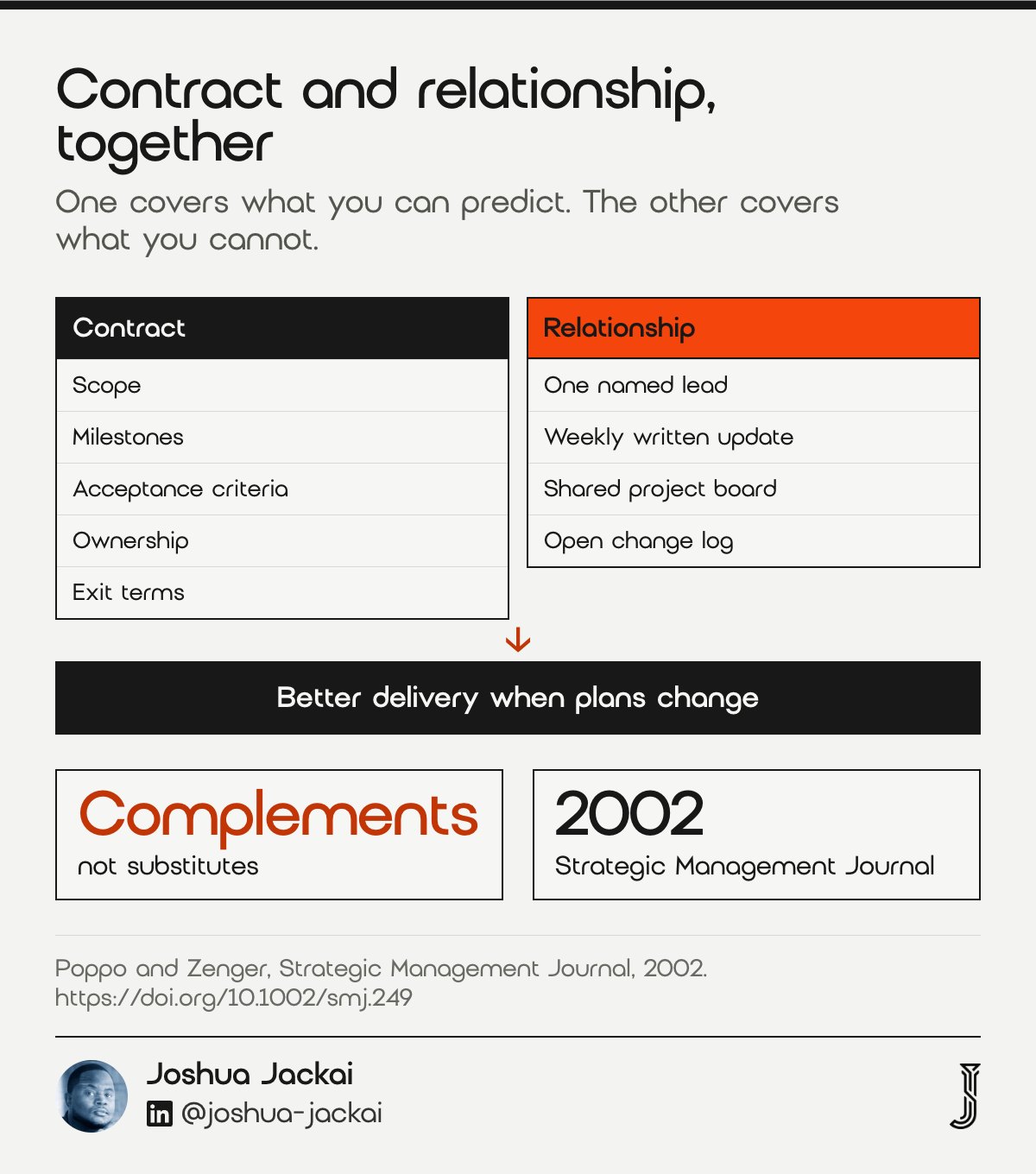
- Contract: scope, milestones, acceptance criteria and exit terms
- Named lead: one person who answers your questions
- Cadence: a weekly call or written update
- Shared board: tasks and changes visible to both sides
- Watch for: “we don’t need a contract, we trust each other”
A common view is that a long contract signals distrust and a good relationship makes paperwork unnecessary. Laura Poppo of Virginia Tech and Todd Zenger of Washington University in St. Louis tested that idea on information service exchanges and found the opposite. Formal contracts and relational governance worked as complements, and managers who wrote more customised contracts also had higher levels of relational governance. That pairing was linked to better exchange performance in the 2002 Strategic Management Journal study. On a website build, the contract handles the things you can predict: scope, milestones, ownership and what happens if either side walks away. The relationship handles the things you cannot, like a product launch that moves or a CEO who wants a new homepage idea in week four. I send a short written update every week and keep a change log both sides can see. When a company resists either half, a contract with exit terms or a regular check-in, I would keep looking.
“We develop and test an alternative perspective: that formal contracts and relational governance function as complements,” Poppo and Zenger wrote in the Strategic Management Journal.
6. Put ownership of the code and design in writing: best for anyone who may switch providers later
In Canada, the person who creates the work owns the copyright first, and a transfer is valid only in writing and signed. Unless your contract assigns the code, design and content to you, the web development company may still own them. Also ask for a waiver of moral rights, since those cannot be assigned.
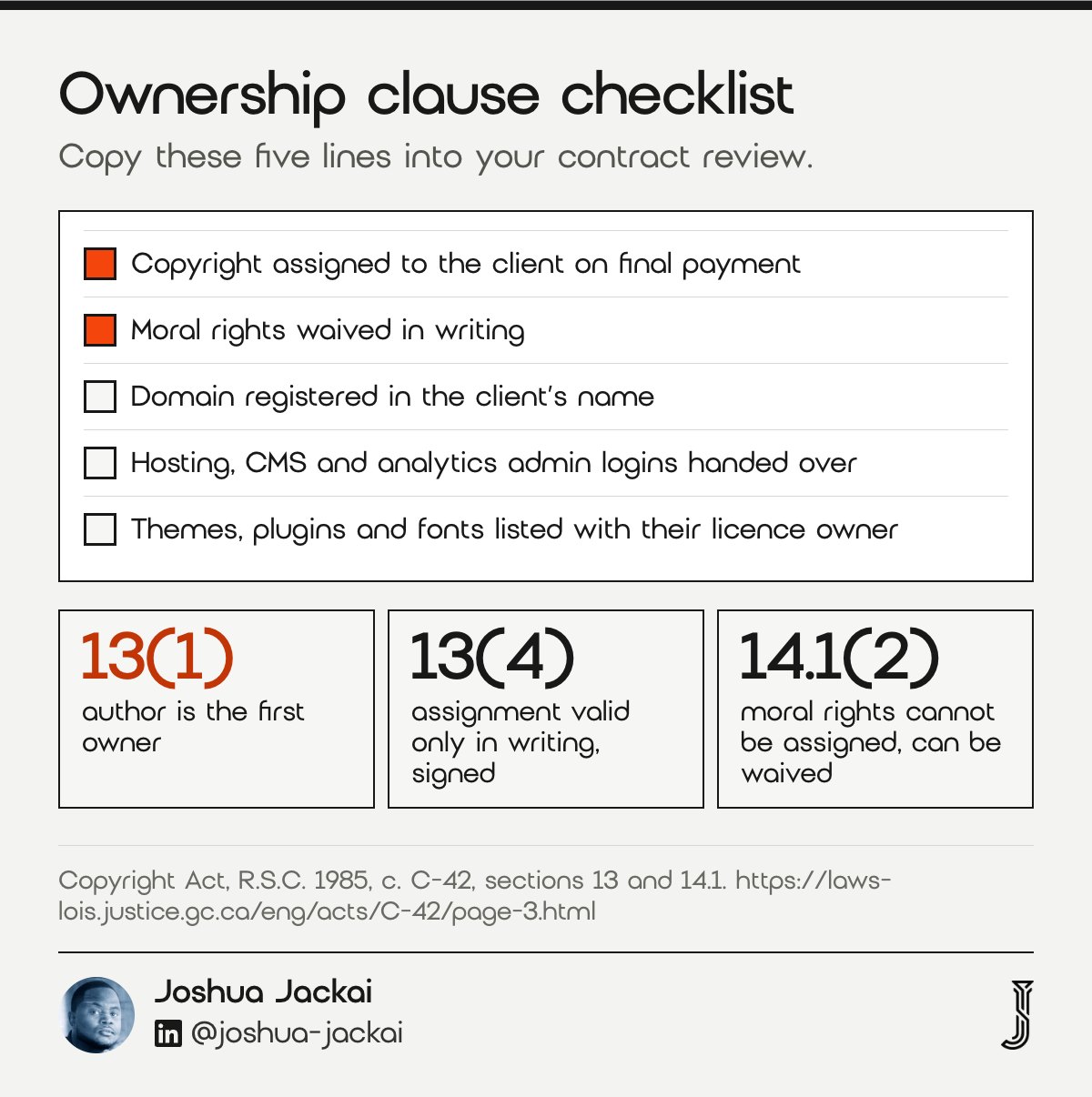
- Copyright: assigned to you in writing on final payment
- Moral rights: waived in writing, since they cannot be assigned
- Domain: registered in your company’s name
- Logins: admin access to hosting, CMS and analytics
- Licences: themes, plugins and fonts listed with their owner
This is the check Canadian buyers skip most, and it costs the most to fix. Section 13(1) of the Copyright Act says the author of a work is the first owner of the copyright. The employment exception covers staff, not outside contractors, so a web development company you hire usually starts as the owner of the code and design it creates. Section 13(4) says no assignment is valid unless it is in writing and signed by the owner. And section 14.1 adds moral rights, which may not be assigned but may be waived. In practice I have seen businesses try to move their site to a new provider and find the old one controls the domain, the hosting and the theme licence. My contracts assign copyright on final payment and register the domain in the client’s name from day one. I wrote a longer guide on who owns your website in Canada. This is general information, not legal advice; have a lawyer read your contract.
“No assignment or grant is valid unless it is in writing signed by the owner of the right in respect of which the assignment or grant is made, or by the owner’s duly authorized agent,” the Copyright Act, section 13(4), has long stated.
7. Check Canadian compliance before launch: best for firms selling in Ontario or emailing Canadian leads
A web development company should know the Canadian rules your site must follow. Ontario requires WCAG 2.0 Level AA on public websites for organisations with 50 or more employees. Canada’s anti-spam law covers the email consent your forms collect. Privacy law also applies to what your forms and analytics record, so ask a lawyer what your privacy policy must say.
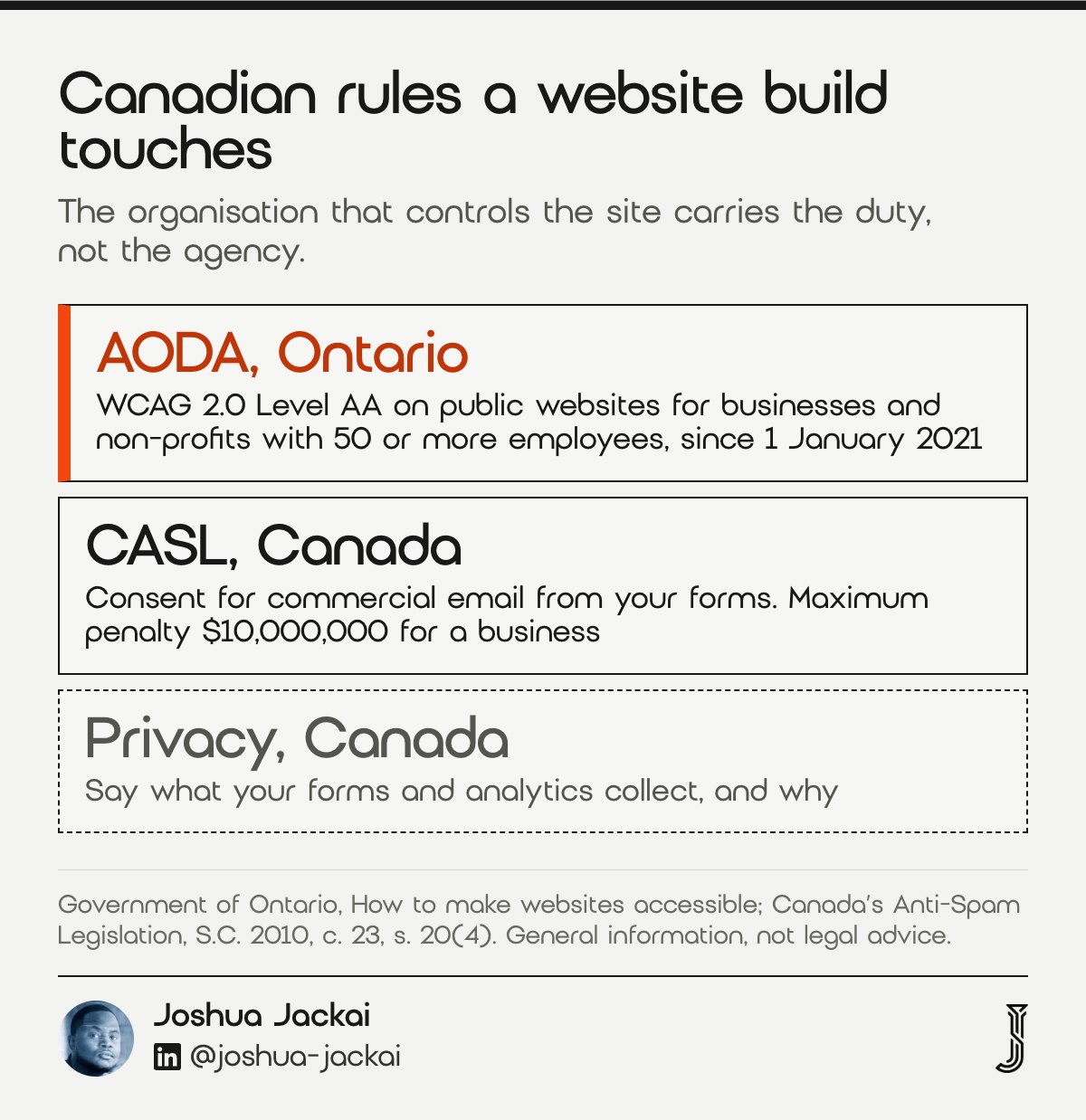
- Accessibility: WCAG 2.0 Level AA for Ontario organisations with 50 or more employees
- Email consent: an unticked opt-in box on forms that add people to a list
- Privacy: a privacy policy that names what forms and analytics collect
- Quebec: ask a lawyer whether French-language rules apply if you sell to Quebec customers
- Ask: how do you test accessibility before launch?
Compliance is easy to leave off a quote, so ask for it by name before you sign. The Government of Ontario says that as of 1 January 2021, businesses and non-profits with 50 or more employees must make all public websites accessible, meeting WCAG 2.0 Level AA, and the organisation that controls the website, directly or through a contract, must meet the requirement. That means the obligation stays with you even if the agency built the site, and the Ontario guidance applies it to web content posted after 1 January 2012. On email, section 20(4) of Canada’s Anti-Spam Legislation sets the maximum penalty at $10,000,000 for a business. So a contact form that quietly subscribes everyone to a newsletter is a real risk. I build to WCAG 2.0 Level AA on every site, including for clients outside Ontario, because buyers across Canada use the same sites. This is general information; ask a lawyer about your own obligations.
“The organization that controls the website (either directly or through a contractual relationship) must meet the accessibility requirements,” the Government of Ontario stated in its AODA guidance.
8. Ask how leads and AI answers get measured after launch: best for B2B firms that need the site to pay for itself
Ask how the company will show, after launch, where each lead came from and whether AI answer engines name your business. A site that looks good but cannot tell you which channel brought a sale is hard to justify. Ask for the tracking setup in the quote.
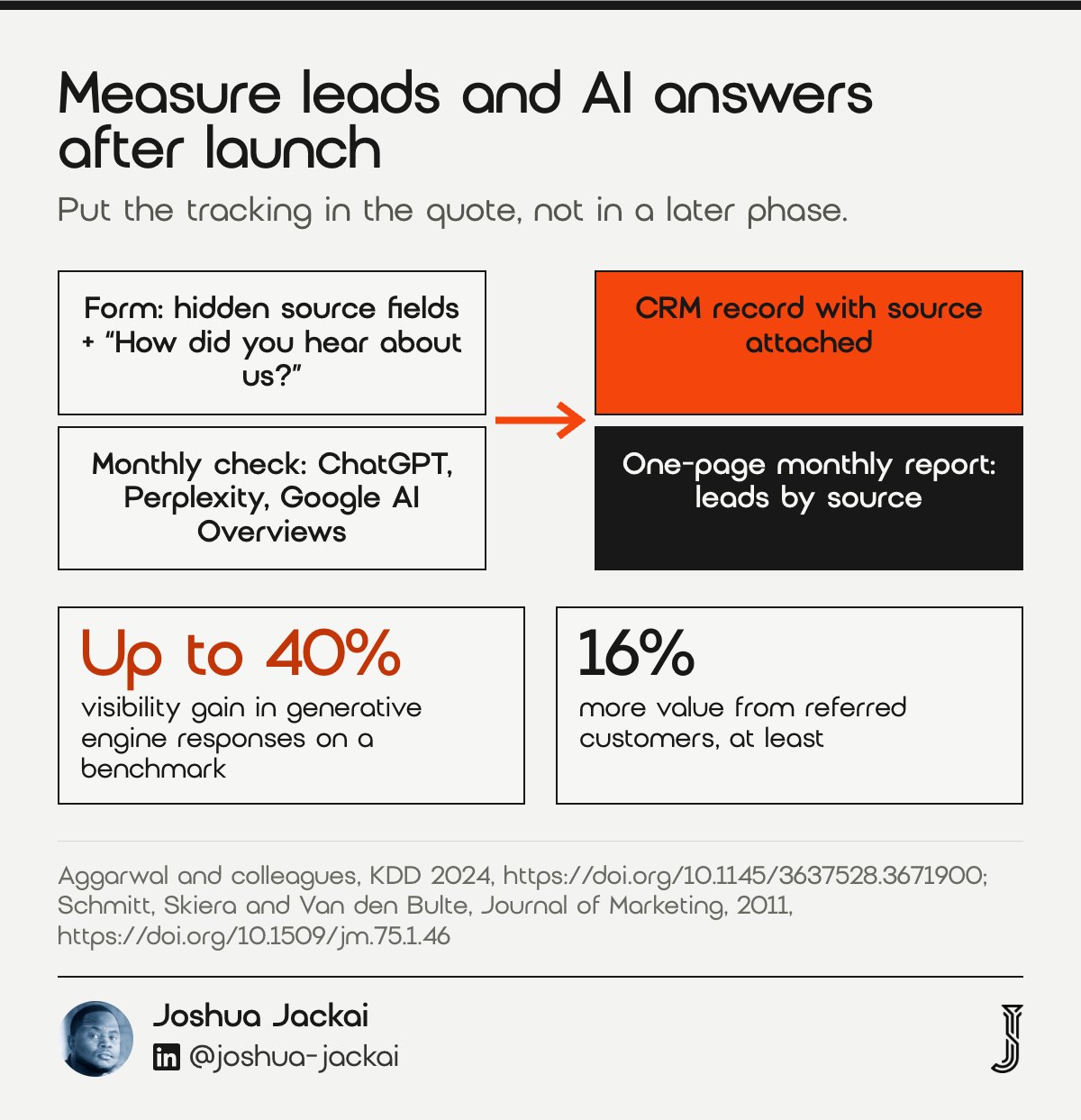
- Form fields: hidden source fields plus a “how did you hear about us” question
- CRM: every lead lands with its source attached
- AI answers: a monthly check of whether ChatGPT and Perplexity name you
- Report: one page a month, leads by source
- Watch for: “Google Analytics is installed” as the whole answer
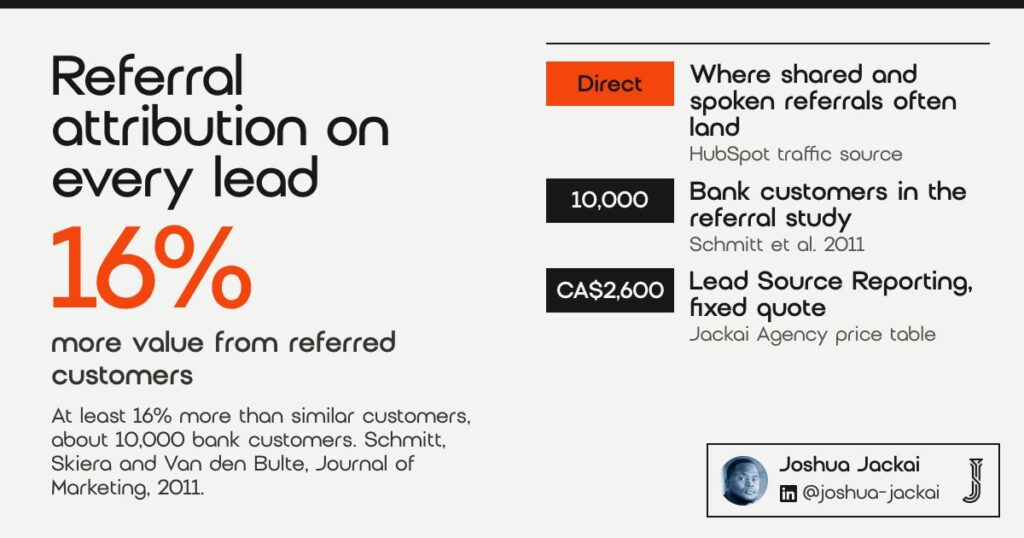
Most web development quotes stop at launch. The questions a founder asks six months later are about results: which channel brings leads, and whether the new site shows up when buyers ask ChatGPT for a provider. Pranjal Aggarwal and colleagues tested methods for getting content cited by generative engines and found they could raise visibility by up to 40% in generative engine responses on their benchmark. That was a research benchmark, not live ChatGPT, so I treat it as evidence that page structure matters, not as a promise. On leads, Philipp Schmitt, Bernd Skiera and Christophe Van den Bulte found referred bank customers were worth at least 16% more than similar customers from other channels. If your form cannot tell a referral from a Google visit, you will not see that difference. I build both into every B2B site; my guides on referral attribution and AI visibility show the setup.
“GEO can boost visibility by up to 40% in generative engine responses,” Aggarwal, Murahari, Rajpurohit, Kalyan, Narasimhan and Deshpande wrote in the Proceedings of KDD 2024.
Compare the eight checks by risk and effort
This matrix lists the eight checks with the risk each one protects you from, the effort it takes and its key number. Filter by the risk you worry about most or by effort; rows are hidden, not deleted. Start with the low-effort checks, then do the quote and contract checks before you sign anything.
| Check | What it protects | Effort | Key number |
|---|---|---|---|
| 1. Know what a web development company does | Hiring the right kind of firm | Low | 46.1% of credibility comments on design look |
| 2. Match the team size to the project | Budget and speed | Low | 93 projects studied |
| 3. Judge the portfolio the way buyers will | The first impression your site makes | Low | 50 ms to judge visual appeal |
| 4. Get a fixed quote tied to a written scope | Budget | Medium | 5,392 IT projects studied |
| 5. Sign a clear contract and build the relationship | Delivery when things change | Medium | Contracts and relationships are complements |
| 6. Put ownership of code and design in writing | Your right to move the site | Low | Assignment valid only in writing |
| 7. Check Canadian compliance | Legal risk | Medium | Up to $10,000,000 CASL penalty |
| 8. Ask how leads and AI answers get measured | Return on the build | Medium | Up to 40% visibility gain |
Score a web development company in two minutes
This checklist scores one company against the eight checks. Tick each one the company has passed, and it returns a score out of 8 with the next question to ask. It uses only your answers, no benchmarks, so you can run it on two or three shortlisted companies and compare.
What a web development company costs in Canada
From me, a small business website is CA$4,950 or CA$5,950 depending on scope, and a custom B2B website starts at CA$7,450, all fixed quotes. The price moves with the number of page templates, integrations such as a CRM, and whether the site moves from another platform.
Other starting points: a landing page starts at CA$3,795, a migration on its own is CA$2,500, lead source reporting is CA$2,600 and AI visibility work is CA$4,775. My CA$995 website audit checks your current site against these eight checks and is credited in full if a project starts within 30 days. You can price a full build in my quote calculator. Other companies price differently, so run check 4 on every quote: pages and templates listed by name, integrations named, revision rounds counted and a price per change. Compare what each quote includes, not just the total. If you are weighing Vancouver agencies in particular, my guide on how to choose a web design agency in Vancouver covers that shortlist.
"If a company will not put the scope, the ownership and the tracking in writing, the price on the quote is not the price you will pay," Joshua Jackai, Vancouver web designer, wrote in this guide.
Frequently asked questions
How do I choose a web development company in Canada?
Run eight checks before you sign: what the company builds, team size, portfolio, a fixed quote tied to a written scope, a contract plus check-ins, written ownership of the code and design, AODA and CASL compliance, and how leads are tracked after launch. Ownership is the check buyers skip most.
What does a web development company do?
A web development company plans, designs, builds and launches websites and web applications. Most also set up the CMS, connect tools such as a CRM, host the site and maintain it. Some only write code from another firm's design, so ask whether design and copy are included before comparing quotes.
Web development company vs freelancer: which is better?
A freelancer suits a small site with clear content and one decision maker, and a web development company suits a custom B2B site with integrations and several page types, because more than one person covers design, code and support. Either way, ask who will do the work, by name.
How much does a web development company cost in Canada?
My fixed quotes start at CA$4,950 for a small business website and CA$7,450 for a custom B2B website. Other companies price by the hour or by project, so prices vary widely. Compare the scope, integrations, revision rounds and ownership terms in each quote, not only the total.
Do I own my website if a company builds it?
Not automatically. Under Canada's Copyright Act, the author of a work is the first owner, and an assignment is valid only in writing and signed. Make sure your contract assigns copyright to you, waives moral rights and puts the domain in your name. Ask a lawyer about your contract.
Sources
Peer reviewed
- Flyvbjerg, B., Budzier, A., Lee, J. S., Keil, M., Lunn, D. and Bester, D. W. (2022). The empirical reality of IT project cost overruns: Discovering a power-law distribution. Journal of Management Information Systems. https://doi.org/10.1080/07421222.2022.2096544
- Gopal, A., Sivaramakrishnan, K., Krishnan, M. S. and Mukhopadhyay, T. (2003). Contracts in offshore software development: An empirical analysis. Management Science. https://doi.org/10.1287/mnsc.49.12.1671.25120
- Poppo, L. and Zenger, T. (2002). Do formal contracts and relational governance function as substitutes or complements? Strategic Management Journal. https://doi.org/10.1002/smj.249
- Lindgaard, G., Fernandes, G., Dudek, C. and Brown, J. (2006). Attention web designers: You have 50 milliseconds to make a good first impression! Behaviour and Information Technology. https://doi.org/10.1080/01449290500330448
- Fogg, B. J., Soohoo, C., Danielson, D. R., Marable, L., Stanford, J. and Tauber, E. R. (2003). How do users evaluate the credibility of Web sites? Proceedings of the 2003 Conference on Designing for User Experiences. https://doi.org/10.1145/997078.997097
- Aggarwal, P., Murahari, V., Rajpurohit, T., Kalyan, A., Narasimhan, K. and Deshpande, A. (2024). GEO: Generative Engine Optimization. Proceedings of KDD 2024. https://doi.org/10.1145/3637528.3671900
- Schmitt, P., Skiera, B. and Van den Bulte, C. (2011). Referral programs and customer value. Journal of Marketing. https://doi.org/10.1509/jm.75.1.46
Government and legal sources (not peer reviewed)
- Government of Canada, Justice Laws Website. Copyright Act, R.S.C. 1985, c. C-42, sections 13 and 14.1. https://laws-lois.justice.gc.ca/eng/acts/C-42/page-3.html (checked 17 November 2026)
- Government of Canada, Justice Laws Website. Canada's Anti-Spam Legislation, S.C. 2010, c. 23, section 20(4). https://laws-lois.justice.gc.ca/eng/acts/E-1.6/page-3.html (checked 17 November 2026)
- Government of Ontario. How to make websites accessible. https://www.ontario.ca/page/how-make-websites-accessible (checked 17 November 2026)
First-party
- Jackai Agency price table, CAD, November 2026: https://joshuajackai.com/pricing/