7 Stats on How Many Canadian Small Businesses Have a Website
About three in four Canadian small businesses have a website: 74.7% of firms with 5 to 19 employees in 2023, per Statistics Canada. Micro firms sit at 45.0%. Here is the data by size, industry and reason, and why older figures say 41% or 59%.
 Joshua Jackai
19 min read
Published 12 November 2026 · Last updated and fact-checked November 2026
Short answer: About three in four. In 2023, 74.7% of Canadian small businesses with 5 to 19 employees had a company website, according to Statistics Canada table 22-10-0120-01. The smallest firms are different: only 45.0% of micro businesses with 0 to 4 employees had one, and 39.8% had no web presence at all.
Ask how many Canadian small businesses have a website and the internet hands you 41.1%, 46%, 59% and 74.7%. All four are published. Three of them are more than a decade old, and they were asked of different groups of businesses.
So I went to the source. Statistics Canada runs the Survey of Digital Technology and Internet Use (SDTIU) every two years, and it splits the answer by firm size. I downloaded the full tables on 12 November 2026 and pulled the exact values. Every number in this guide comes from those tables unless I say otherwise, and older figures carry their year.
“Three of them are more than a decade old, and they were asked of different groups of businesses,” wrote Joshua Jackai, Vancouver web designer.
In this guide
Key takeaways
- 74.7% of Canadian small businesses (5 to 19 employees) had a company website in 2023, up from 74.0% in 2019 (Statistics Canada, 2024).
- Only 45.0% of micro businesses (0 to 4 employees) had a website in 2023, and 39.8% had no web presence of any kind.
- Social media grew faster: 60.4% of small firms had accounts in 2023, against 55.4% in 2019.
- Among small firms with no web presence, 67.9% said it is not needed for their kind of business (Statistics Canada table 22-10-0121-01).
- Construction (59.9%) and transportation (55.5%) trail professional services (86.4%) on company websites.
- The 41.1% (CIRA, 2014) and 59% (GoDaddy, 2015) figures still circulate, but neither describes 2026.
| # | Statistic | Figure | Who it covers | Year |
|---|---|---|---|---|
| 1 | Small firms with a company website | 74.7% | 5 to 19 employees | 2023 |
| 2 | Micro firms with a company website | 45.0% | 0 to 4 employees | 2023 |
| 3 | Small firms on social media | 60.4% | 5 to 19 employees | 2023 |
| 4 | Medium and large firms with a website | 89.9% and 95.6% | 20+ employees | 2023 |
| 5 | Lowest industry: transportation | 55.5% | All sizes except micro | 2023 |
| 6 | Small firms with no web presence that say they do not need one | 67.9% | 5 to 19 employees, no web presence | 2023 |
| 7 | Older “commonly claimed” figures | 41.1% to 59% | Mixed definitions | 2013 to 2015 |
1. Small businesses with a website: best for the headline answer
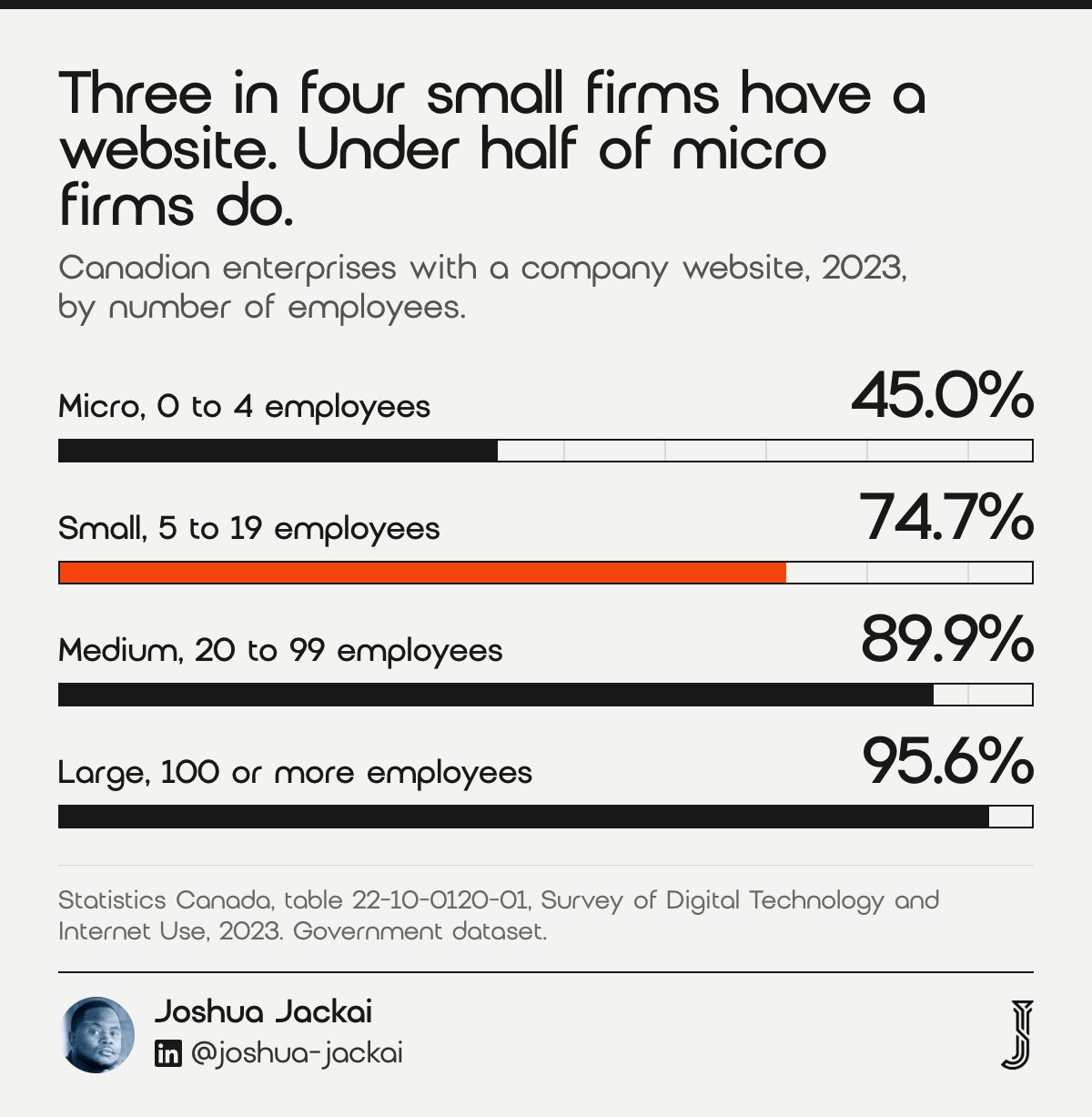
The best current answer for Canada is 74.7%. That is the share of small enterprises, defined by Statistics Canada as 5 to 19 employees, that had a company website in 2023 (Statistics Canada, table 22-10-0120-01). It suits anyone who wants one number with a government source behind it.
- Figure: 74.7% had a company website
- Who: private sector enterprises with 5 to 19 employees
- Survey: Survey of Digital Technology and Internet Use, reference year 2023
- Released: 17 September 2024
- Quality grade: A, the best StatCan grade
This is the number I would quote, with one caution. “Small” here does not mean every business under 100 employees, which is how Innovation, Science and Economic Development Canada often defines a small business. Statistics Canada splits that range into small (5 to 19) and medium (20 to 99), and it reports micro firms (0 to 4) separately. So a headline that says “75% of small businesses” is accurate for the 5 to 19 band only.
The survey also asks about the website as one type of web presence among several. A company website is the firm’s own site. A Facebook page, a listing on a marketplace or an app store entry counts as a different type. That is why the 2021 release said 89% of businesses had at least one type of web presence while 78% had a company website (Statistics Canada, The Daily, 2022). Some secondary posts read the 78% as a share of firms that were online. It is a share of all businesses in the survey, micro firms excluded.
Data point: the 2023 total for all enterprises, micro excluded, was 77.9% with a company website.
2. Micro businesses with a website: best for sole operators and tiny teams
Micro businesses are where the website gap really sits. In 2023, only 45.0% of Canadian firms with 0 to 4 employees had a company website, and 39.8% had no web presence at all (Statistics Canada, 2024). This figure fits trades, solo consultants and home-based firms.
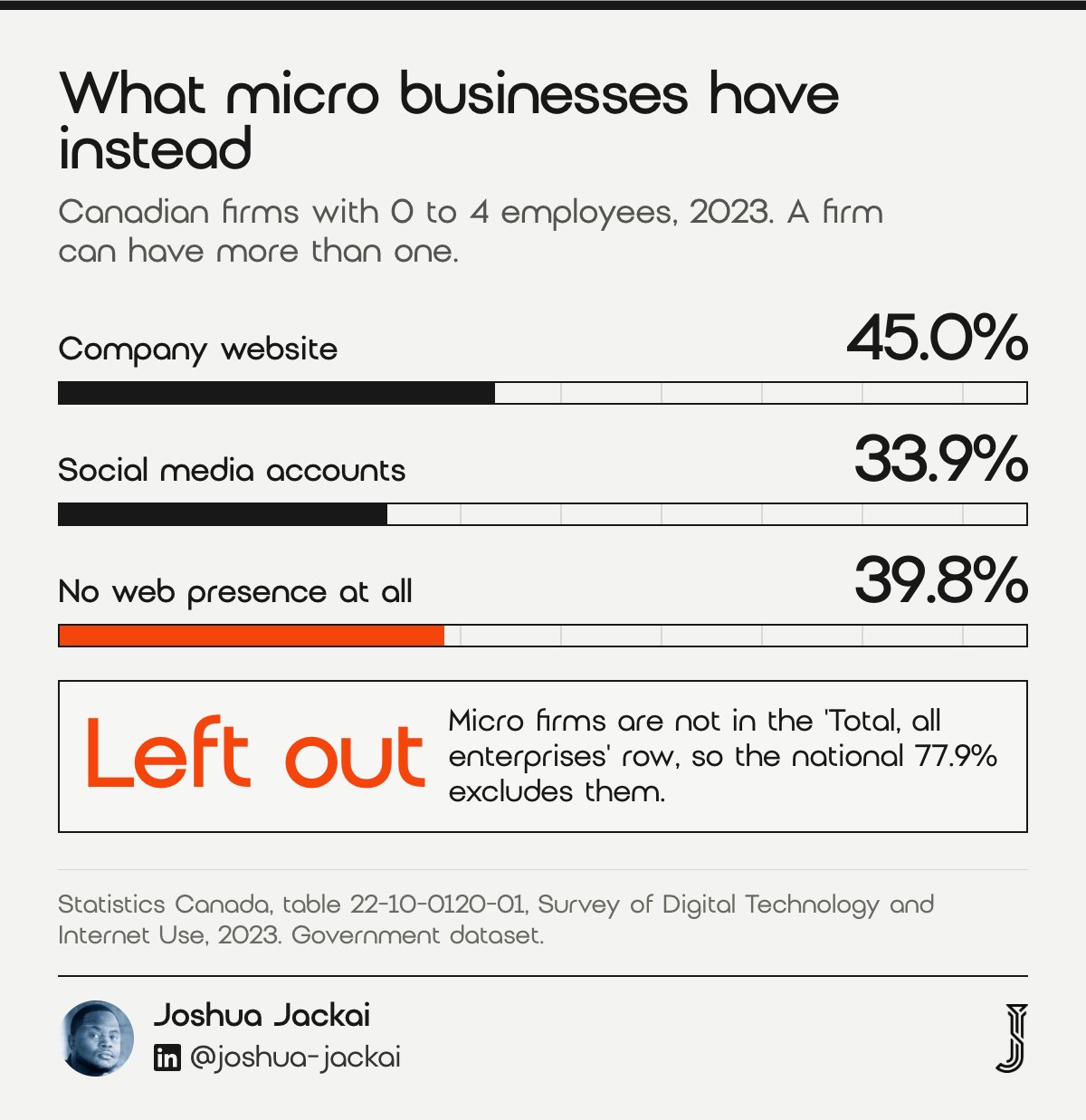
- Company website: 45.0%
- Social media accounts: 33.9%
- No web presence: 39.8%
- Who: enterprises with 0 to 4 employees
- First measured: 2023, the first SDTIU cycle with a micro row
The micro row is new. The 2019 and 2021 tables did not publish it, and the “Total, all enterprises” line still leaves micro firms out. That one footnote explains a lot of the confusion. A national total near 78% sounds like nearly everyone, yet the group least likely to have a site is not in it.
Micro firms make up most Canadian businesses by count, so the number a sole operator meets in a conversation is closer to 45% than to 75%. If you run a two-person bookkeeping practice in Surrey and wonder whether you are behind, the honest comparison is your own size band.
The 39.8% with no web presence also matters. These firms have no site, no social account, no marketplace listing and no paid ads. Some will be fine. A plumber with a full book from referrals may not need any of it. I come back to the reasons in item 6.
“Perceived benefits, perceived compatibility, perceived risks, perceived costs, and innovativeness were found to be the significant determinants of decision to adopt EC,” wrote Morteza Ghobakhloo and Sai Hong Tang (Journal of Small Business and Enterprise Development, 2013).
3. Website growth against social media: best for the trend line
The share of small Canadian firms with a website barely moved between 2019 and 2023: 74.0%, then 74.5%, then 74.7%. Social media accounts rose from 55.4% to 60.4% over the same three surveys (Statistics Canada, 2024). This suits anyone asking whether websites are fading.
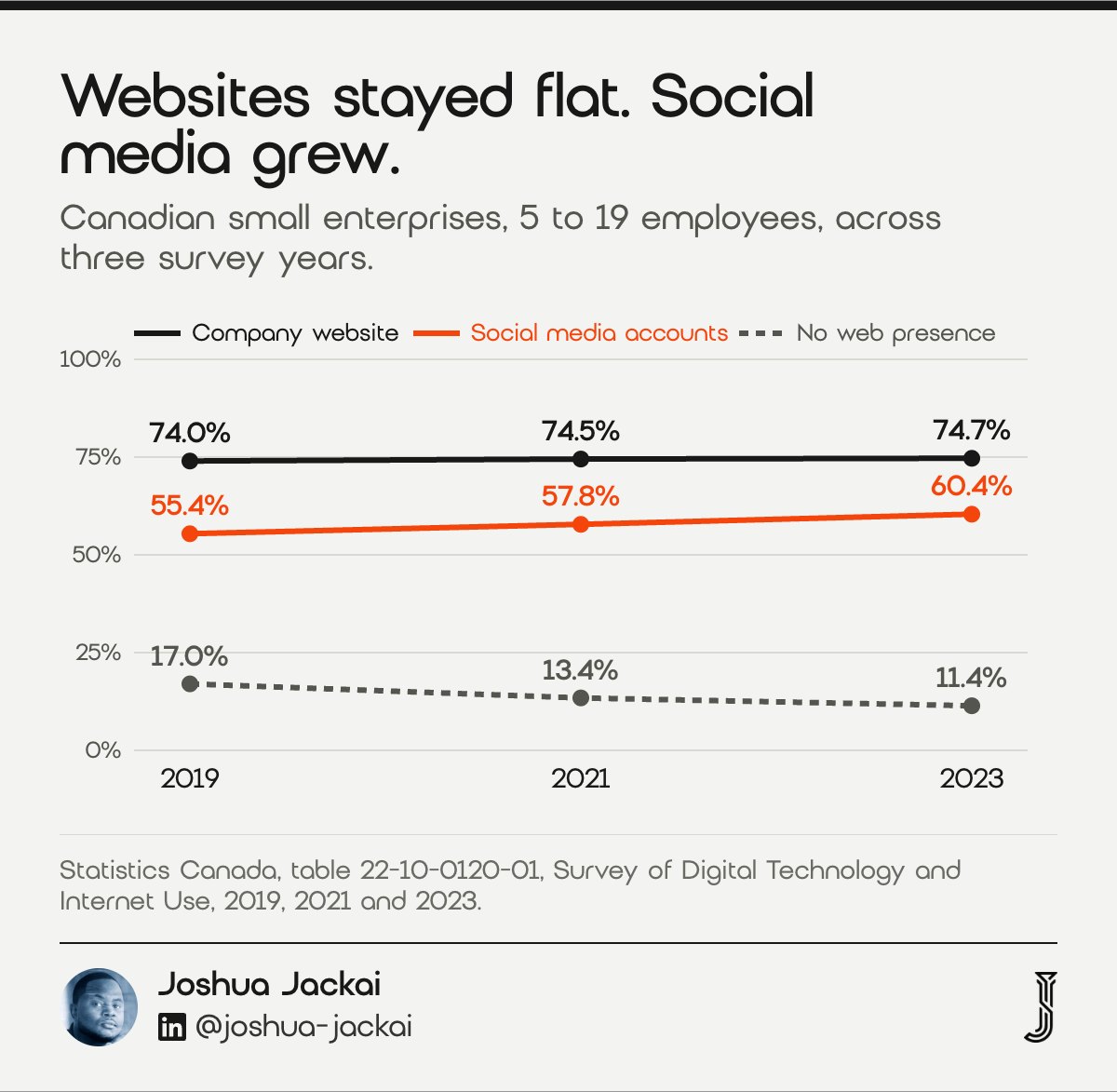
- Website, small firms: 74.0% (2019), 74.5% (2021), 74.7% (2023)
- Social media, small firms: 55.4%, 57.8%, 60.4%
- No web presence, small firms: 17.0%, 13.4%, 11.4%
- Pattern: new web presence came from social, not websites
Two readings fit the data. The first is that websites have hit a ceiling for this size band. Firms that wanted one built one years ago, and the rest have decided against it. The second is that newer firms go straight to Instagram or a Google listing and never get to a site.
The table cannot tell those apart, because it counts shares and does not follow the same firms over time. What it does show is that the share of small firms with no web presence fell from 17.0% to 11.4% in four years. Those firms went online somewhere. Almost none of that movement shows up as new websites.
For a small owner this cuts both ways. A website is no longer a mark of a modern business, because three in four peers had one before 2019. It is closer to a baseline. Not having one now puts a firm with the 25% who do not, and that group is shrinking more slowly than the group with no web presence at all.
Data point: in 2023, 17.3% of small firms sold or listed through other third-party websites, apps or marketplaces, and 15.2% used email marketing.
4. Medium and large firms: best for sizing up bigger competitors
The bigger the firm, the more certain the website. In 2023, 89.9% of medium enterprises (20 to 99 employees) and 95.6% of large enterprises (100 or more) had a company website, while only 3.8% and 1.8% had no web presence (Statistics Canada, 2024). This suits small firms bidding against larger ones.
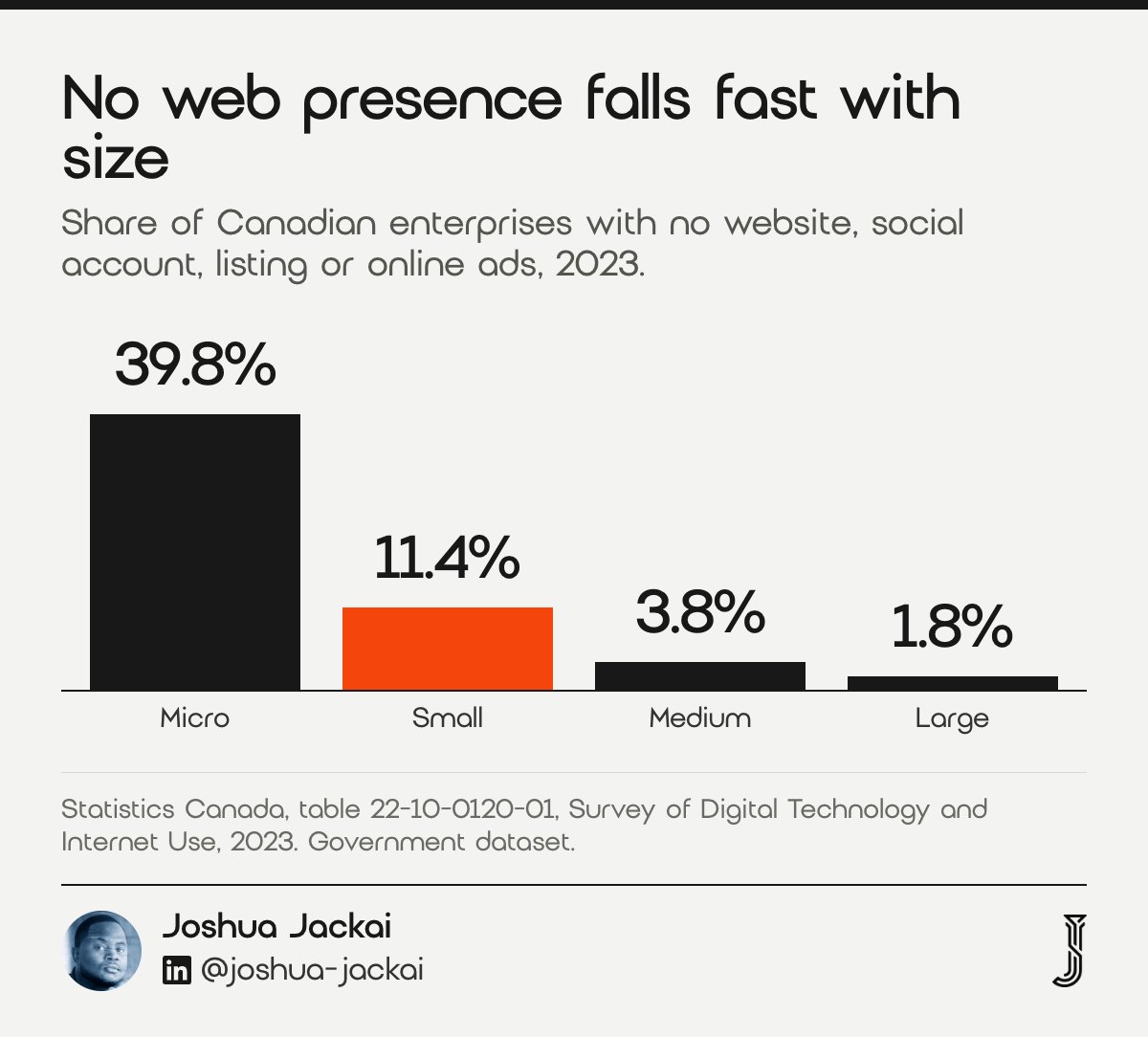
- Medium, company website: 89.9%
- Large, company website: 95.6%
- Small, company website: 74.7%
- Micro, company website: 45.0%
- Manufacturing exception: medium runs to 499 employees in NAICS 31-33
The gap from micro to large is about 50 points. That is the shape every older survey found too. The 2014 CIRA Internet Factbook, an industry report from the .ca registry, put small and medium businesses at 41.1% against 91.8% for large firms (CIRA via Newswire, 2014). The levels have moved since then. The ladder has not.
Why it matters to a small B2B firm: when a buyer shortlists three suppliers, the medium and large ones will almost all have a site. A 12-person engineering consultancy without one is not compared on price or skill. It drops out at the research step. The same holds for local service firms quoting against a regional chain, where the chain’s site answers the buyer’s first questions before anyone picks up the phone. Large firms are also far ahead on other channels. 82.1% of large enterprises had social media accounts in 2023, against 60.4% of small ones.
“Whilst website adoption within UK SMEs is widespread, the number offering e-commerce activities is declining or static,” wrote Kathryn Houghton and Heidi Winklhofer (International Small Business Journal, 2004).
5. Websites by industry: best for benchmarking your sector
Industry changes the answer more than most owners expect. In 2023, 86.4% of professional, scientific and technical services firms had a company website, against 59.9% in construction and 55.5% in transportation and warehousing (Statistics Canada, 2024). These figures cover all sizes except micro, so read them as a sector benchmark.
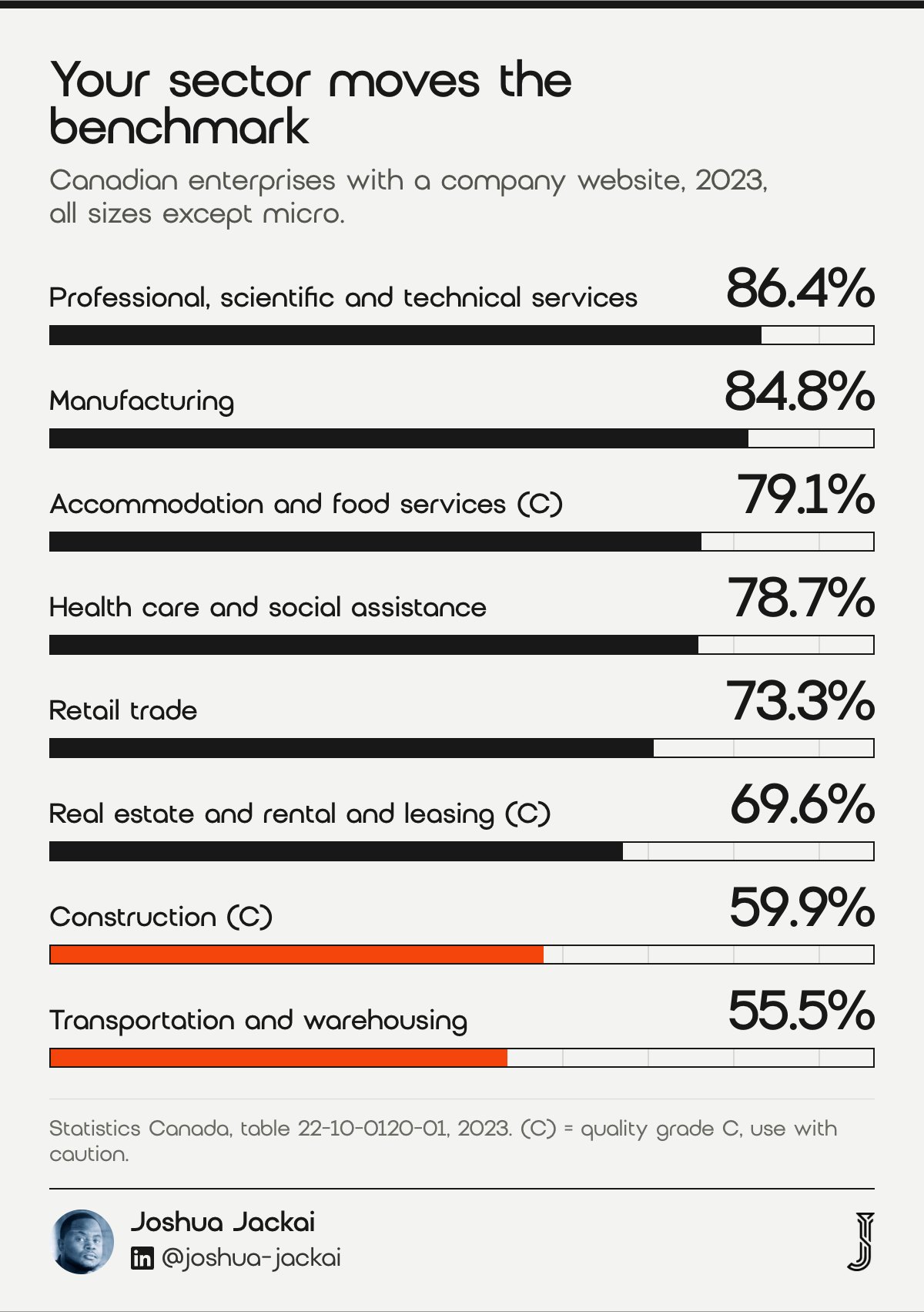
- Professional, scientific and technical services: 86.4%
- Manufacturing: 84.8%
- Retail trade: 73.3%
- Real estate and rental and leasing: 69.6%
- Construction: 59.9%
- Transportation and warehousing: 55.5%
The public table splits industry and firm size, but not both at once for every cell, so I used the all-enterprises row for each sector. That means a small accounting firm should read 86.4% as a ceiling. Its true peer figure is probably a little lower, because larger firms pull the sector total up.
Some cells carry a C quality grade, which Statistics Canada flags for caution. Construction, real estate and accommodation and food are among them. I kept them in because the direction is consistent with the A and B graded rows.
The pattern matches what I see in Vancouver. In professional services, the website is often the first piece of proof a buyer checks, so firms without one stand out. In construction and trucking, work arrives through contractor networks, tenders and repeat clients, and the site matters less to the first contact. That is a reason to check your own sector before you decide you are behind. Being at 74.7% in a sector that sits at 86.4% is a different position from being there in one at 55.5%.
Data point: health care and social assistance sat at 78.7%, and manufacturing at 84.8%.
6. Reasons small firms have no web presence: best for the “do I need one” question
Most small firms without any web presence say they simply do not need one. In 2023, 67.9% of Canadian small businesses with no web presence gave “not required given the nature of this business” as a reason; 16.0% cited a lack of technical skill and 11.6% said set-up costs were too high (Statistics Canada, table 22-10-0121-01).
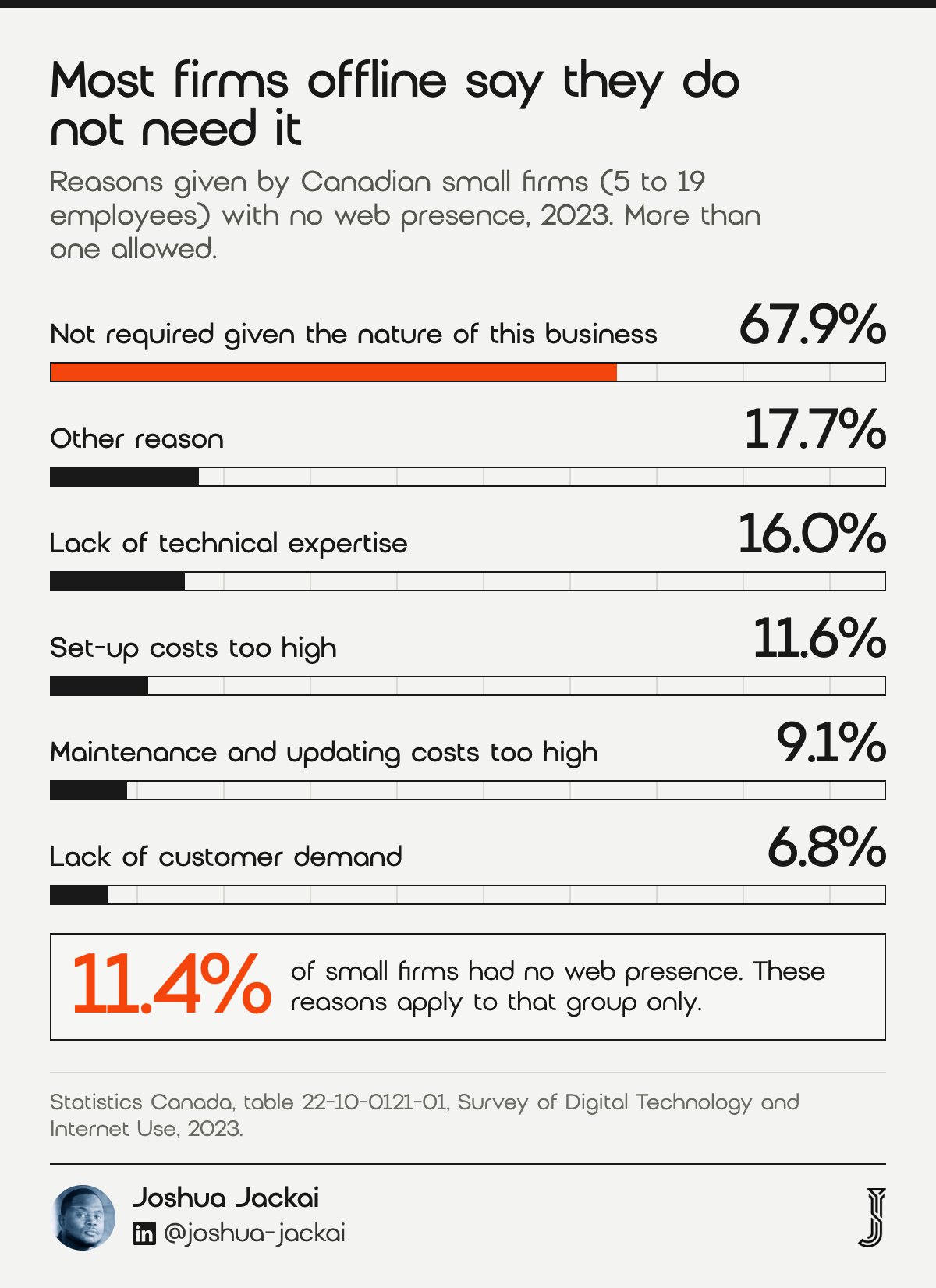
- Not required for this business: 67.9% (micro: 79.1%)
- Lack of technical expertise: 16.0% (micro: 7.9%)
- Set-up costs too high: 11.6% (micro: 9.9%)
- Maintenance and updating costs too high: 9.1% (micro: 7.5%)
- Lack of customer demand: 6.8% (micro: 4.8%)
- Base: only firms with no web presence; more than one reason allowed
Read the base carefully. These shares apply to the 11.4% of small firms with no web presence, not to all small firms. Roughly, 67.9% of 11.4% is under 8% of small businesses saying a web presence is not needed. That is my arithmetic, not a Statistics Canada figure.
Cost and skill come up less often than people assume. Set-up cost was cited by 11.6% of small firms without a web presence, and the 2019 skills figure was 18.0% against 16.0% in 2023. The peer-reviewed work points the same way. Small firm adoption studies keep finding that the owner’s view of benefit drives the decision more than the price tag does. Simmons, Armstrong and Durkin reviewed the field and found it hard to pin down.
“The extant literature relating to small business website adoption is fragmented and fails to provide an understanding of what determines adoption,” wrote Geoff Simmons, Gillian Armstrong and Mark Durkin (International Small Business Journal, 2008).
Earlier work by James Thong in the Journal of Management Information Systems (1999) and by Mehrtens, Cragg and Mills in Information & Management (2001) also put the owner’s perceived benefit and knowledge at the centre. MacGregor and Vrazalic built a barrier model for small business e-commerce in the Journal of Small Business and Enterprise Development (2005). None of these studies used Canadian samples, so treat them as context.
7. The older figures still quoted: best for spotting stale numbers
Most numbers on the first page of results for this question are commonly claimed figures from 2013 to 2015. The CIRA Internet Factbook (2014) put small and medium businesses with a website at 41.1%, an RBC poll (2013) said 46%, and a GoDaddy-commissioned survey (2015) said 59% of firms under five employees had none (canadiansinternet.com, 2015).
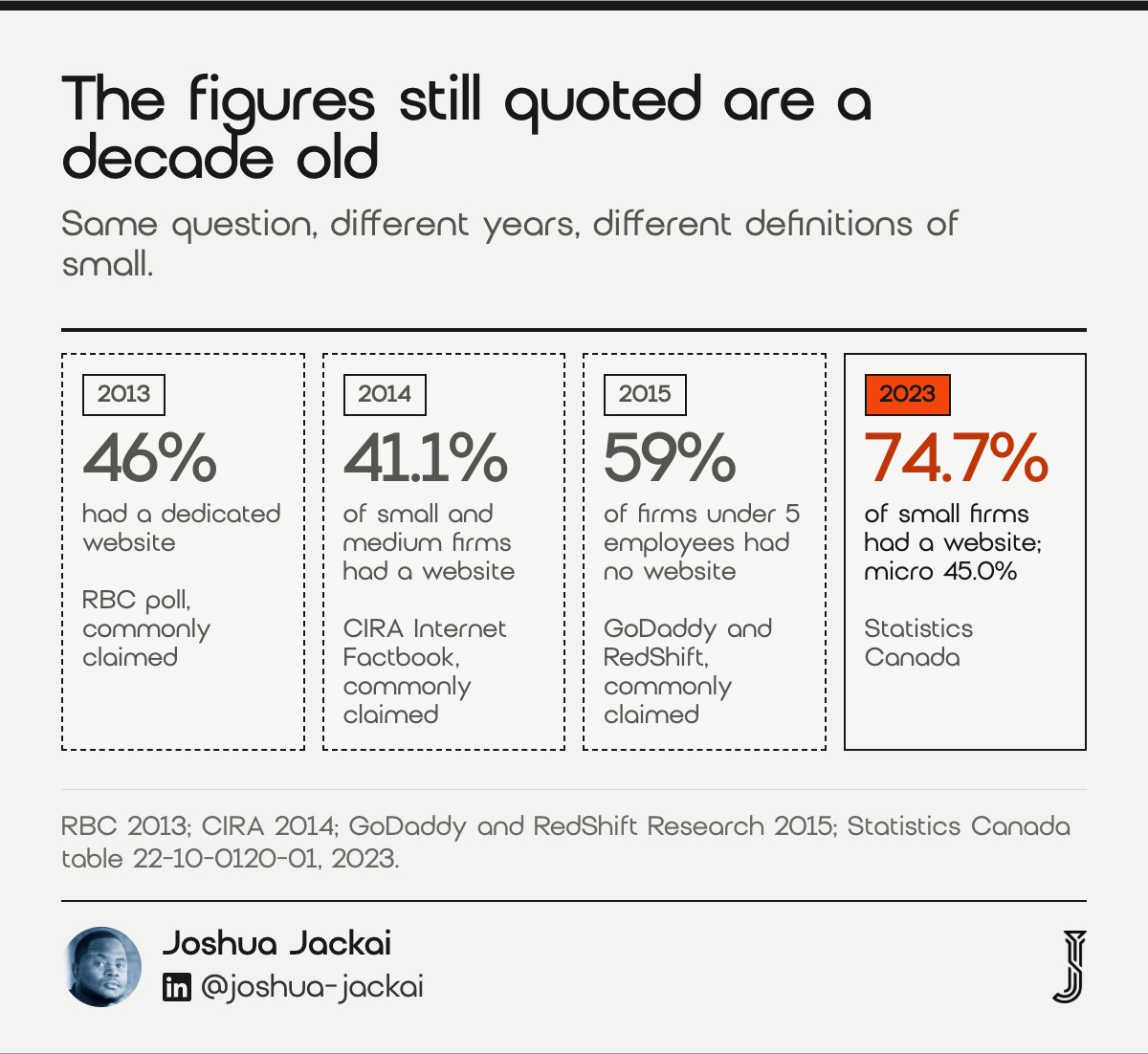
- CIRA Internet Factbook, 2014: 41.1% of small and medium businesses had a website (industry report)
- RBC poll, 2013: 46% had a dedicated website (bank poll, not peer reviewed)
- GoDaddy and RedShift Research, 2015: 59% of firms under five employees had no website (vendor survey, not peer reviewed)
- Not Canadian: a 17% figure credited to Network Solutions and a 27% US figure
Why does the published range run so wide? Four things move it.
First, the definition of small. CIRA grouped small and medium firms together, GoDaddy surveyed firms under five employees, and Statistics Canada reports 0 to 4 and 5 to 19 as separate rows. Second, web presence versus a website. A Facebook page counts as presence but not as a company site. Third, the year. The 2013 to 2015 numbers predate the 2020 rush online. Fourth, the country. Some figures that turn up in Canadian posts came from American samples.
Read side by side, the old and new numbers are not far apart once you match the group. GoDaddy’s 59% without a website among firms under five employees in 2015 sits near today’s micro figure, where 45.0% have a website. The fair conclusion is that micro firms were and still are the gap. So when you see one of the old figures in a 2026 article, check the year and the group before you repeat it.
“Firms that wanted one built one years ago, and the rest have decided against it,” wrote Joshua Jackai, Vancouver web designer.
How do the seven figures compare side by side?
The seven figures answer different questions, so this matrix sets each one against who was asked, the year and the source type. Statistics Canada rows are government datasets with quality grades. The 2013 to 2015 rows are industry, bank and vendor releases, labelled commonly claimed because they keep being repeated without their year.
| Metric | Value | Source |
|---|---|---|
| Small firms (5 to 19) with a company website, 2023 | 74.7% | Statistics Canada 22-10-0120-01 |
| Micro firms (0 to 4) with a company website, 2023 | 45.0% | Statistics Canada 22-10-0120-01 |
| Micro firms with no web presence, 2023 | 39.8% | Statistics Canada 22-10-0120-01 |
| Small firms with social media accounts, 2023 | 60.4% | Statistics Canada 22-10-0120-01 |
| Medium firms with a company website, 2023 | 89.9% | Statistics Canada 22-10-0120-01 |
| Large firms with a company website, 2023 | 95.6% | Statistics Canada 22-10-0120-01 |
| Small firms without web presence saying it is not required, 2023 | 67.9% | Statistics Canada 22-10-0121-01 |
| Quebec businesses present on the web, 2023 | 73.9% | Institut de la statistique du Québec |
| SMEs with a website, 2014 (commonly claimed) | 41.1% | CIRA Internet Factbook |
| Firms under five employees without a website, 2015 (commonly claimed) | 59% | GoDaddy and RedShift Research |
The Quebec figure comes from a separate provincial survey, the Enquête sur le numérique dans les entreprises 2023 by the Institut de la statistique du Québec, and it counts web presence, not websites. I could not confirm its size universe, so I would not compare it directly with the national rows.
Which benchmark fits your business? Filter and check
The filter and checker in this section use only the Statistics Canada values quoted in this guide. Pick your firm size and sector to see the matching figure, then tick what your business already has. Nothing you enter is stored or sent anywhere. Default selections are placeholders, not a recommendation.
Comparison matrix
| Value | Firm size | Measure | Industry | Year | Source |
|---|---|---|---|---|---|
| 74.7% | Small (5 to 19) | Company website | All industries | 2023 | StatCan 22-10-0120-01 |
| 45.0% | Micro (0 to 4) | Company website | All industries | 2023 | StatCan 22-10-0120-01 |
| 89.9% | Medium (20 to 99) | Company website | All industries | 2023 | StatCan 22-10-0120-01 |
| 95.6% | Large (100+) | Company website | All industries | 2023 | StatCan 22-10-0120-01 |
| 60.4% | Small (5 to 19) | Social media | All industries | 2023 | StatCan 22-10-0120-01 |
| 33.9% | Micro (0 to 4) | Social media | All industries | 2023 | StatCan 22-10-0120-01 |
| 11.4% | Small (5 to 19) | No web presence | All industries | 2023 | StatCan 22-10-0120-01 |
| 39.8% | Micro (0 to 4) | No web presence | All industries | 2023 | StatCan 22-10-0120-01 |
| 86.4% | All sizes except micro | Company website | Professional services | 2023 | StatCan 22-10-0120-01 |
| 84.8% | All sizes except micro | Company website | Manufacturing | 2023 | StatCan 22-10-0120-01 |
| 79.1% | All sizes except micro | Company website | Accommodation and food | 2023 | StatCan 22-10-0120-01 (grade C) |
| 78.7% | All sizes except micro | Company website | Health care | 2023 | StatCan 22-10-0120-01 |
| 73.3% | All sizes except micro | Company website | Retail trade | 2023 | StatCan 22-10-0120-01 |
| 69.6% | All sizes except micro | Company website | Real estate | 2023 | StatCan 22-10-0120-01 (grade C) |
| 59.9% | All sizes except micro | Company website | Construction | 2023 | StatCan 22-10-0120-01 (grade C) |
| 55.5% | All sizes except micro | Company website | Transportation | 2023 | StatCan 22-10-0120-01 |
| 41.1% | Small and medium | Company website | All industries | 2014 | CIRA Factbook (commonly claimed) |
| 59% | Under 5 employees | No website | All industries | 2015 | GoDaddy and RedShift (commonly claimed) |
Industry rows cover all sizes except micro. 2014 and 2015 rows are commonly claimed figures from older releases.
Benchmark checker
Placeholder defaults. Uses only Statistics Canada 2023 values. Nothing is stored or sent.
The checker answers one narrow question: how does your web presence compare with Canadian firms of your size? It does not tell you whether a website will pay for itself. No public dataset measures the share of leads that Canadian small firms get from their site. Your own intake form can, if you add a “how did you find us?” line.
Methodology: what I pulled and what it cannot tell you
I downloaded Statistics Canada tables 22-10-0120-01 and 22-10-0121-01 as full CSV files on 12 November 2026. Both cover reference years 2019, 2021 and 2023 and were last released on 17 September 2024. I checked older CIRA, RBC and GoDaddy figures against their releases and read eight peer-reviewed papers through Crossref.
Source freshness: the national tables are from 2023, the newest SDTIU cycle published. The next cycle (reference year 2025) had not been released when I checked. The 2021 Daily is from 2022. The CIRA, RBC and GoDaddy figures are from 2013 to 2015 and are labelled commonly claimed. The peer-reviewed papers run from 1999 to 2013, and none of them sampled Canadian firms.
What the tables do not measure:
- Sole proprietors as a group. Micro means 0 to 4 employees, so a solo consultant and a four-person shop share one row.
- B2B against B2C. There is no split by who the firm sells to.
- Leads from the website. No Canadian dataset I found reports the share of small firm leads or sales that start on the firm’s site.
- Website quality. The 2021 release said 59% of businesses with a website had a site set up for mobile devices, but the 2023 table does not repeat it.
- Provinces for small firms. The public tables are national only.
Where I did my own arithmetic, such as the share of all small firms saying a web presence is not required, I say so in the text.
Questions about Canadian small business websites, answered
Can a small business grow in 2026 without a website?
Yes, some do. In 2023, 11.4% of Canadian small firms had no web presence and 67.9% of those said they did not need one, per Statistics Canada. Growth then depends on referrals, tenders or repeat clients. If buyers research suppliers online first, missing a site removes you from that shortlist.
What is the cheapest, lowest-maintenance way to set up a website?
Start with one page: what you do, where, proof and a contact method. A free Google Business Profile covers maps and hours. Hosted builders cost the least to run but you maintain them. A fixed-quote build costs more upfront and less in owner time. Maintenance worried 9.1% of small non-adopters.
What percentage of Canadian businesses have a website?
In 2023, 77.9% of Canadian enterprises with five or more employees had a company website, according to Statistics Canada table 22-10-0120-01. By size, it was 74.7% of small, 89.9% of medium and 95.6% of large firms. Micro firms with 0 to 4 employees were lower, at 45.0%.
Why do some Canadian small businesses not have a website?
Among Canadian small firms with no web presence in 2023, 67.9% said it was not required for their business. Another 16.0% cited a lack of technical skill, 11.6% said set-up costs were too high and 9.1% pointed to maintenance costs, per Statistics Canada table 22-10-0121-01.
How I build a small business website that stays cheap to run
For a small Canadian firm, the useful question is not whether three in four peers have a website. It is whether your buyers look you up before they call. That is also where AI search now shows up, and I covered how far that has gone in how Canadians use AI to find businesses.
I build fixed-quote small business sites from CA$4,950, with a plan the owner can edit without me. The prices sit on my pricing page, with a quote calculator. If you already have a site and wonder whether it is doing its job, my CA$995 website audit checks it and is credited if a project starts within 30 days. Or start with the free AI Visibility Report.
The research behind adoption keeps returning to one point, made by Jones, Hecker and Holland after following five small firms online.
“A lack of vision and prior knowledge produced sub-optimal adoption outcomes,” wrote Colin Jones, Rob Hecker and Peter Holland (Journal of Small Business and Enterprise Development, 2003).
Peltier, Zhao and Schibrowsky found the same thing from a different angle in a model of small retailers.
“All the tested variables affect the adoption of technology by small businesses directly and/or indirectly through mediating variables,” wrote James Peltier, Yushan Zhao and John Schibrowsky (International Small Business Journal, 2012).
In plain terms, the owner’s own goals decide whether a site earns its keep. So I start every build by asking where your last ten clients came from.
Sources
Peer-reviewed research
- Simmons, G., Armstrong, G. A. and Durkin, M. G. (2008). A conceptualization of the determinants of small business website adoption. International Small Business Journal, 26(3), 351-389. https://doi.org/10.1177/0266242608088743
- Ghobakhloo, M. and Tang, S. H. (2013). The role of owner/manager in adoption of electronic commerce in small businesses. Journal of Small Business and Enterprise Development, 20(4), 754-787. https://doi.org/10.1108/jsbed-12-2011-0037
- Jones, C., Hecker, R. and Holland, P. (2003). Small firm Internet adoption: opportunities forgone, a journey not begun. Journal of Small Business and Enterprise Development, 10(3), 287-297. https://doi.org/10.1108/14626000310489763
- Peltier, J. W., Zhao, Y. and Schibrowsky, J. A. (2012). Technology adoption by small businesses. International Small Business Journal, 30(4), 406-431. https://doi.org/10.1177/0266242610365512
- Houghton, K. A. and Winklhofer, H. (2004). The effect of website and e-commerce adoption on the relationship between SMEs and their export intermediaries. International Small Business Journal, 22(4), 369-388. https://doi.org/10.1177/0266242604044305
- Thong, J. Y. L. (1999). An integrated model of information systems adoption in small businesses. Journal of Management Information Systems, 15(4). https://doi.org/10.1080/07421222.1999.11518227
- Mehrtens, J., Cragg, P. B. and Mills, A. M. (2001). A model of Internet adoption by SMEs. Information & Management, 39(3). https://doi.org/10.1016/S0378-7206(01)00086-6
- MacGregor, R. C. and Vrazalic, L. (2005). A basic model of electronic commerce adoption barriers. Journal of Small Business and Enterprise Development, 12(4), 510-527. https://doi.org/10.1108/14626000510628199
Government and industry data (not peer reviewed)
- Statistics Canada. Table 22-10-0120-01, Types of web presence by industry and size of enterprise. Survey of Digital Technology and Internet Use, 2019, 2021, 2023; released 17 September 2024. Government dataset. https://www150.statcan.gc.ca/t1/tbl1/en/tv.action?pid=2210012001
- Statistics Canada. Table 22-10-0121-01, Reasons for not having a web presence by industry and size of enterprise. Released 17 September 2024. Government dataset. https://www150.statcan.gc.ca/t1/tbl1/en/tv.action?pid=2210012101
- Statistics Canada. Digital technology and Internet use, 2021. The Daily, 13 September 2022. Government release. https://www150.statcan.gc.ca/n1/daily-quotidien/220913/dq220913b-eng.htm
- Gouvernement du Québec, digital dashboard, citing the Institut de la statistique du Québec, Enquête sur le numérique dans les entreprises 2023. Government page. https://www.quebec.ca/gouvernement/ministeres-organismes/economie/publications/tableau-bord-numerique/processus-affaires-quebec
- CIRA Internet Factbook 2014, via Newswire. Industry report, commonly claimed. https://newswire.ca/news-releases/canadian-small-business-lagging-in-online-presence-internet-factbook-513943701.html
- RBC small business poll, 2013, via Newswire. Bank poll, not peer reviewed. https://newswire.ca/news-releases/the-internet-remains-uncharted-territory-for-canadian-businesses-rbc-poll-511997921.html
- GoDaddy and RedShift Research survey, reported 20 September 2015. Vendor survey, not peer reviewed. https://canadiansinternet.com/most-canadian-micro-businesses-dont-have-a-website-statistics-infographic/