7 Website Redesign Cost Vancouver Tiers: Complete 2026 Guide
What a website redesign costs in Vancouver, in Canadian dollars: seven tiers from audit to ecommerce, how long each takes and how often to redesign.
 Joshua Jackai
16 min read
Published 19 October 2026 · Last updated and fact-checked October 2026
Short answer: A website redesign in Vancouver runs from CA$995 for an audit to CA$15,995 or more for ecommerce, and most B2B sites land between CA$4,950 and CA$10,495. One Vancouver agency guide puts a 6 to 12 page small business site at CAD 4,000 to 10,000 over 4 to 8 weeks (Purrweb). Scope sets the price, not the platform.
When a Vancouver owner asks me what a redesign costs, the honest first answer is another question: which of seven jobs do you mean? An audit, a platform move with no new design, a five page site, a custom B2B build, a rebuild with migration, a larger marketing site and an online store are all called a redesign, and they are priced as different projects. On 19 October 2026 I searched this question and found general Canadian cost guides and agency directories, but I did not find a page that sets one local price table beside a timeline and a rule for how often to redesign. This guide does that, with my own CAD prices, one industry benchmark and five peer-reviewed studies.
In this guide
Key takeaways
- A redesign is seven different jobs, from a CA$995 audit to ecommerce from CA$15,995 (Jackai Agency price table, October 2026).
- A Vancouver agency guide puts agency rates at CAD 100 to 220 an hour and hosting plus light maintenance at CAD 70 to 200 a month (Purrweb).
- People judge a homepage in about 50 ms, so the first screen is worth the budget (Lindgaard and colleagues, 2006).
- Participants predicted their own completion times too optimistically across academic and nonacademic tasks, so add a buffer to any quoted timeline (Buehler, Griffin and Ross, 1994).
- Four or five test participants find about 80% of usability problems, which makes a small audit a cheap first step (Virzi, 1992).
- A 450 website study with 548 volunteers found first impressions of appeal can be predicted from colourfulness and visual complexity (Reinecke and colleagues, 2013).
| Tier | What it covers | Price (CAD) | Time |
|---|---|---|---|
| 1. Audit first | Teardown and ranked fix list | CA$995, credited | 1 week |
| 2. Migration, no redesign | Platform move, redirects, Search Console checks | CA$2,500 | Set on the call |
| 3. Small Business Website | 5 pages | CA$4,950 Framer, CA$5,950 WordPress | 2 to 3 weeks from content |
| 4. Custom B2B website | Up to 5 pages, custom design | From CA$7,450 | Set on the call |
| 5. Rebuild with migration | 5 pages plus platform move | From CA$9,200 | Set on the call |
| 6. Marketing site | 8 to 15 pages | From CA$10,495 | 4 to 6 weeks |
| 7. Ecommerce | Store redesign or build | From CA$9,350 | 3 to 10 weeks |
1. Website audit first: best for not knowing whether you need a redesign
A website audit is a one week teardown that ranks what is broken before you spend on a rebuild. It costs CA$995 and the full amount is credited to the project if you proceed within 30 days. Choose it when leads dropped and you cannot say whether the cause is design, speed, tracking or the offer.
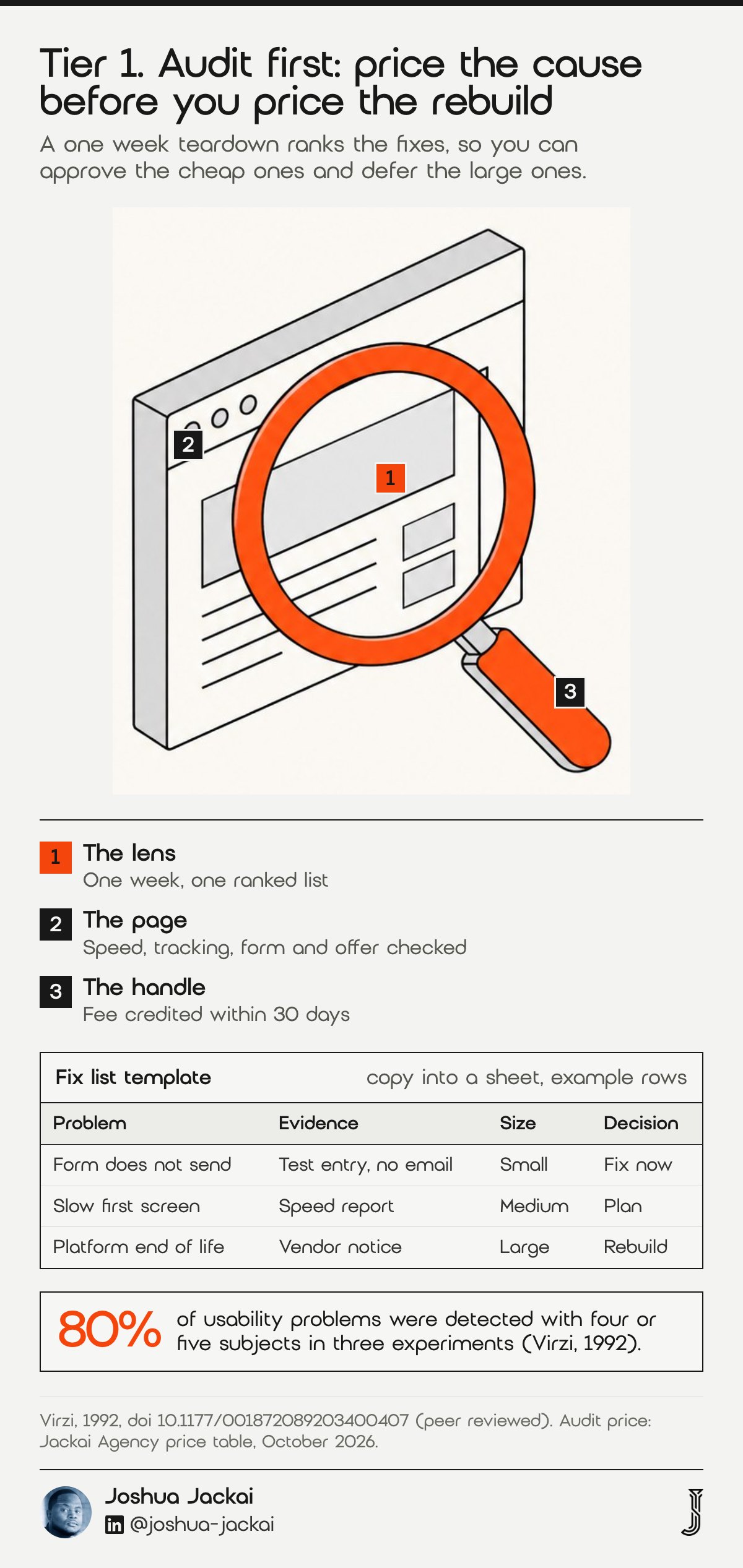
- Price: CA$995, credited if you proceed within 30 days
- Time: 1 week
- You get: a ranked fix list, not a redesign
- Best when: the site is under four years old and the cause is unknown
- Skip it if: the platform is end of life or the brand has changed completely
A redesign is expensive partly because it is irreversible, so I would rather spend a small amount learning what is wrong first. The research on usability testing supports the small scale. In three experiments, Virzi found that four or five subjects were enough to detect about 80% of the usability problems (Virzi, 1992). That finding does not mean five testers find everything. It means the first few sessions are the cheapest and most useful ones, and an audit is the same idea applied to a live site. In my work, audits more often end in a smaller project than the owner expected, because the problem turns out to be a form, a slow page or missing source tracking rather than the whole design. Sometimes the answer is still a rebuild, and then the audit fee comes off the price. I also keep the audit short on purpose. A one week limit forces a ranked list of fixes with a price beside each, so you can approve the cheap ones and defer the expensive ones. If you hire someone else for the rebuild, you still own the list and can hand it to them.
“80% of the usability problems are detected with four or five subjects,” Virzi wrote in Human Factors, 1992.
2. Migration without a redesign: best for a platform you have outgrown
A migration without a redesign moves your existing pages to a new platform and keeps the design as it is. It costs CA$2,500 and covers redirect mapping and Search Console checks before and after. It suits an owner whose site looks fine but sits on a platform that is slow, expensive or hard to edit.
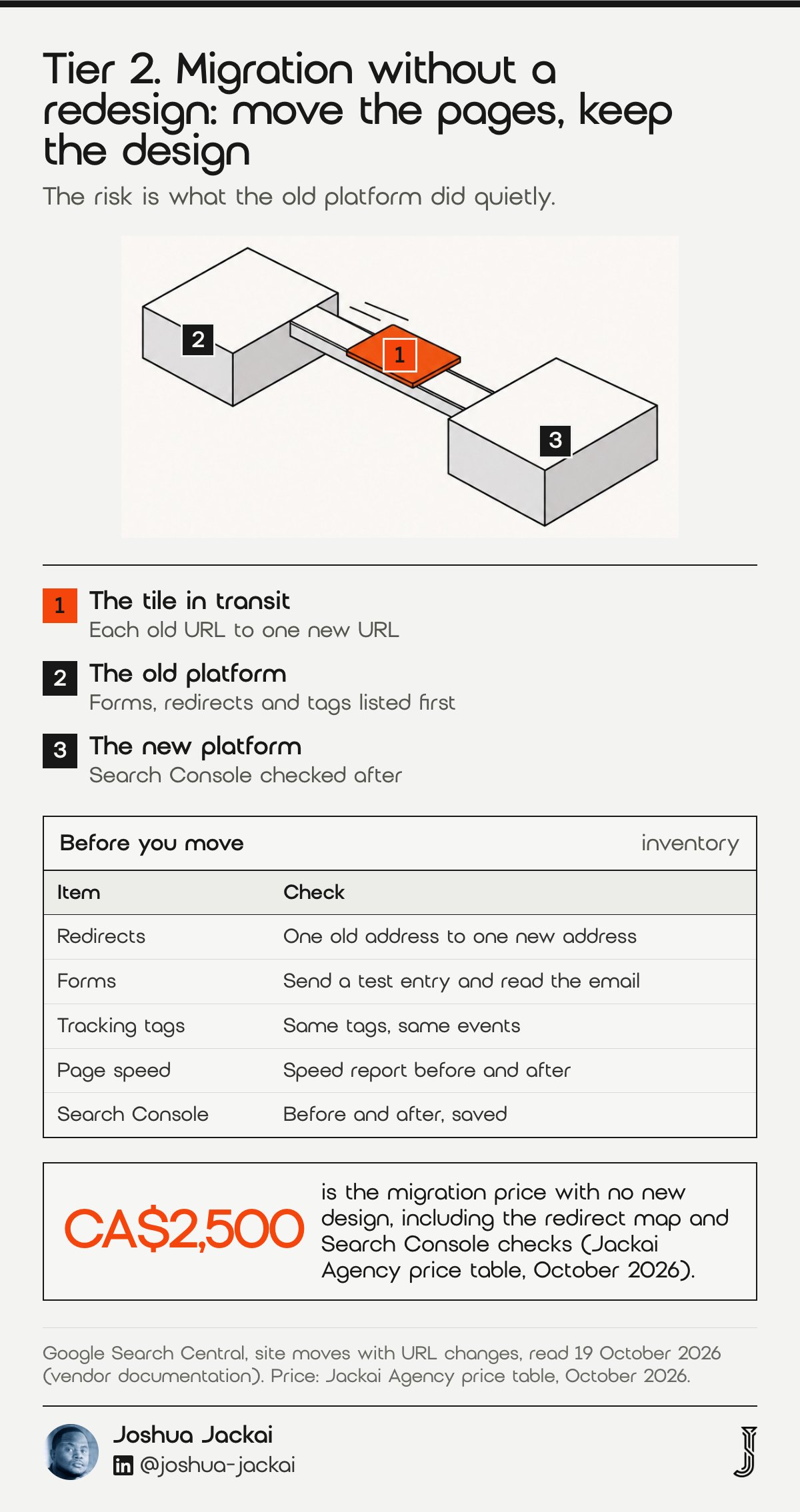
- Price: CA$2,500
- Includes: redirect mapping, Search Console before and after
- Does not include: new design or new copy
- Best when: the design is recent and the platform is the problem
- Risk: lost rankings if old URLs are not redirected
Owners often say redesign when they mean migration. The two have different risks. A redesign changes what people see, and a migration changes where the pages live, which is what search engines care about. Google documents the steps for moving a site with URL changes, and the core of it is a one to one redirect from each old address to its new one (Google Search Central). I treat the redirect map as the product, because a clean map keeps the pages that already rank. A realistic migration also checks what the old platform did quietly, such as forms that send email, redirects someone added years ago, tracking tags and page speed settings. I list these before moving anything, because the failures owners notice first are a form that stopped sending and a page that now returns an error. If you also want new design, move to tier 5, where the migration is part of the rebuild price.
“I treat the redirect map as the product, because a clean map keeps the pages that already rank,” Joshua Jackai wrote above.
3. Small Business Website, five pages: best for a clear brochure site on a budget
The Small Business Website is a five page site built from tested sections and styled to your brand. It costs CA$4,950 on Framer or CA$5,950 on WordPress, and it goes live in 2 to 3 weeks from the day your text and images arrive. Extra pages are CA$425 each, up to seven in total.
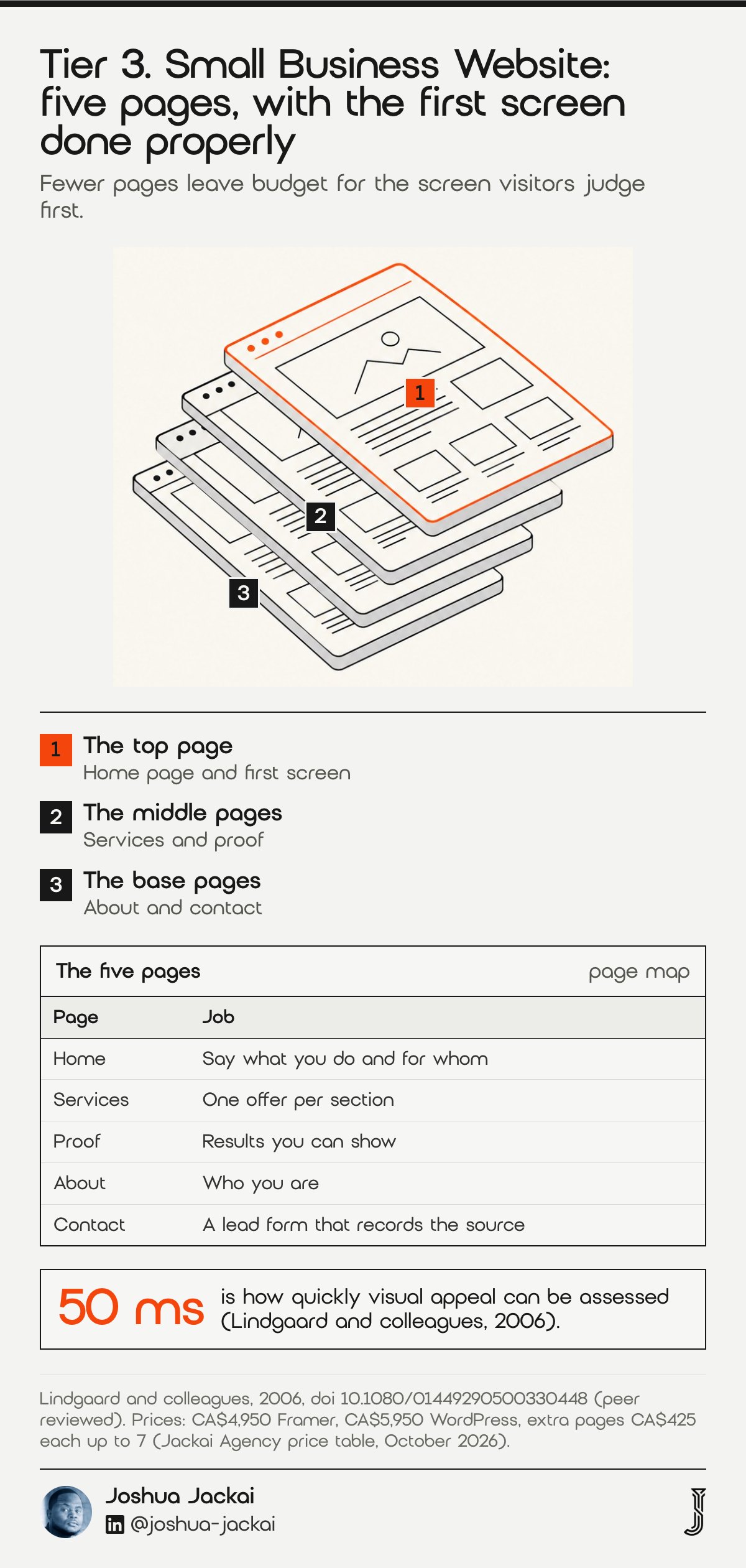
- Price: CA$4,950 Framer, CA$5,950 WordPress
- Time: 2 to 3 weeks from content
- Includes: a lead form that records the source, local search setup, 30 days of fixes
- Content: you supply the text and images
- Extra pages: CA$425 each, up to 7
Most of what this tier saves is not design time. It saves decisions, because the sections already exist and the page map is short. For comparison, one Vancouver agency guide lists 6 to 12 page small business sites at CAD 4,000 to 10,000 over 4 to 8 weeks (Purrweb, industry source, read 19 October 2026). My price sits in the lower part of that band for fewer pages. The first screen matters most here. Lindgaard and colleagues found that visual appeal can be assessed within 50 ms (Lindgaard and colleagues, 2006). A five page site gives you the budget to get that one screen right instead of spreading effort over thirty pages. The lower price also depends on you. If the text and photos arrive late, the weeks count from the day they land, so the quickest way to save money is to write the page text before the build starts, even in rough form.
“visual appeal can be assessed within 50 ms, suggesting that web designers have about 50 ms to make a good first impression,” Lindgaard and colleagues wrote in Behaviour & Information Technology, 2006.
4. Custom B2B website: best for a company that sells on trust and proof
A custom B2B website is a designed site of up to five pages, built around your proof, your buyer and your lead tracking. It starts at CA$7,450 on Framer. WordPress is CA$8,950, Shopify CA$9,350 and HubSpot CA$9,700. The timeline is set on the call, after scope is fixed.
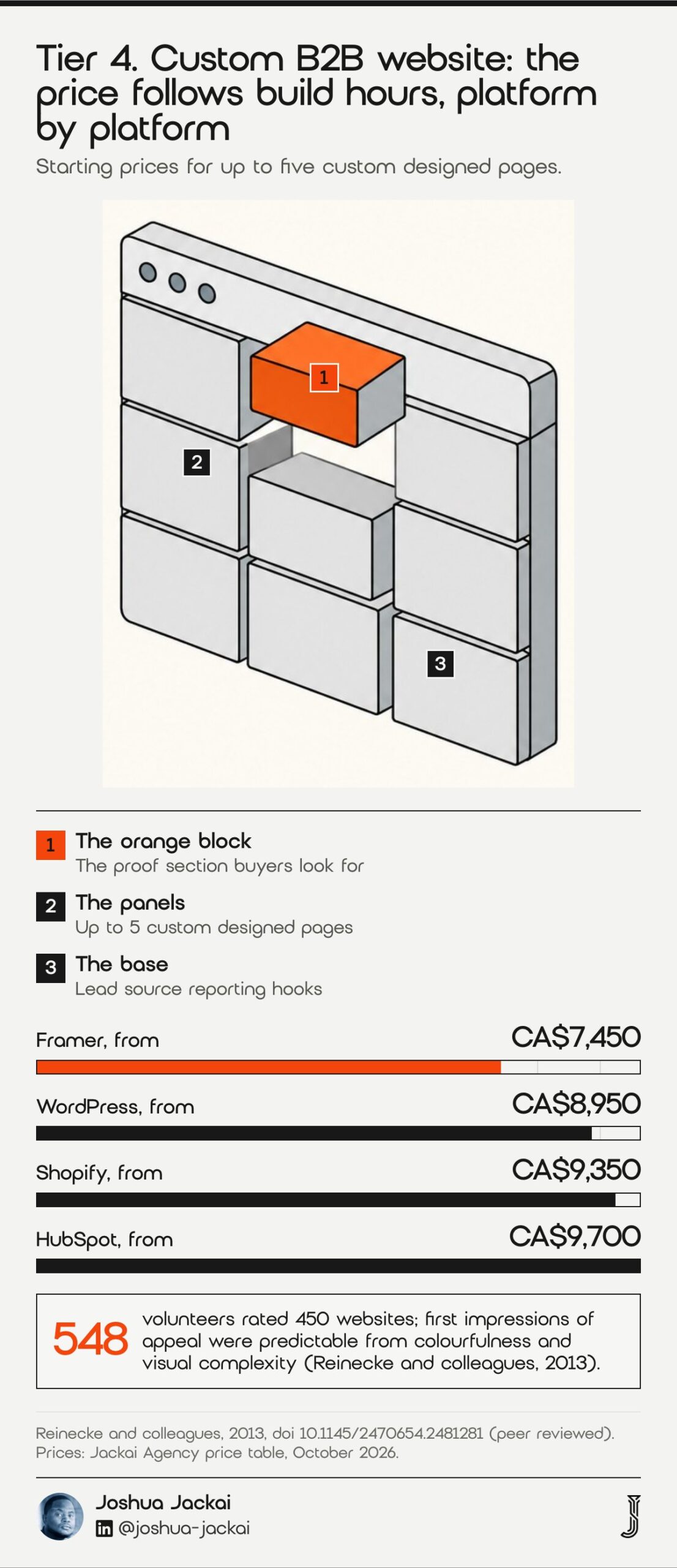
- Price: from CA$7,450 Framer; WordPress CA$8,950; Shopify CA$9,350; HubSpot CA$9,700
- Pages: up to 5 custom designed
- Includes: AI-ready structure, accessibility checks, lead source reporting hooks
- Best when: buyers compare you with two or three competitors
- Window: set in writing on the call
The price difference between platforms is hours, not taste. WordPress and HubSpot take more build time than Framer, which is why they cost more. What you buy at this tier is judgment about what to show and in which order. Reinecke and colleagues collected ratings from 548 volunteers on 450 websites and found that first impressions of appeal can be predicted from perceived colourfulness and visual complexity (Reinecke and colleagues, 2013). They also note that this impression later affects opinions of usability and trustworthiness. A B2B buyer reading a proposal is making the same quick judgment about your company, so restraint in colour and layout pays for itself. I ask for your best proof before I design anything: named results, client names you can show, and the objections buyers raise on sales calls. Pages built around that material need fewer revision rounds, which keeps the quote close to the figure in the table. For a related cost question, see why web design quotes vary so much.
“Users make lasting judgments about a website’s appeal within a split second of seeing it for the first time,” Reinecke and colleagues wrote in CHI 2013.
5. Rebuild with migration: best for a new design on a new platform
A rebuild with migration changes the design and the platform at once for a five page site. It starts at CA$9,200. WordPress to Shopify is CA$11,500, to HubSpot CA$11,950, and Framer to WordPress CA$11,050. The window is set on the call because the content move decides the length.
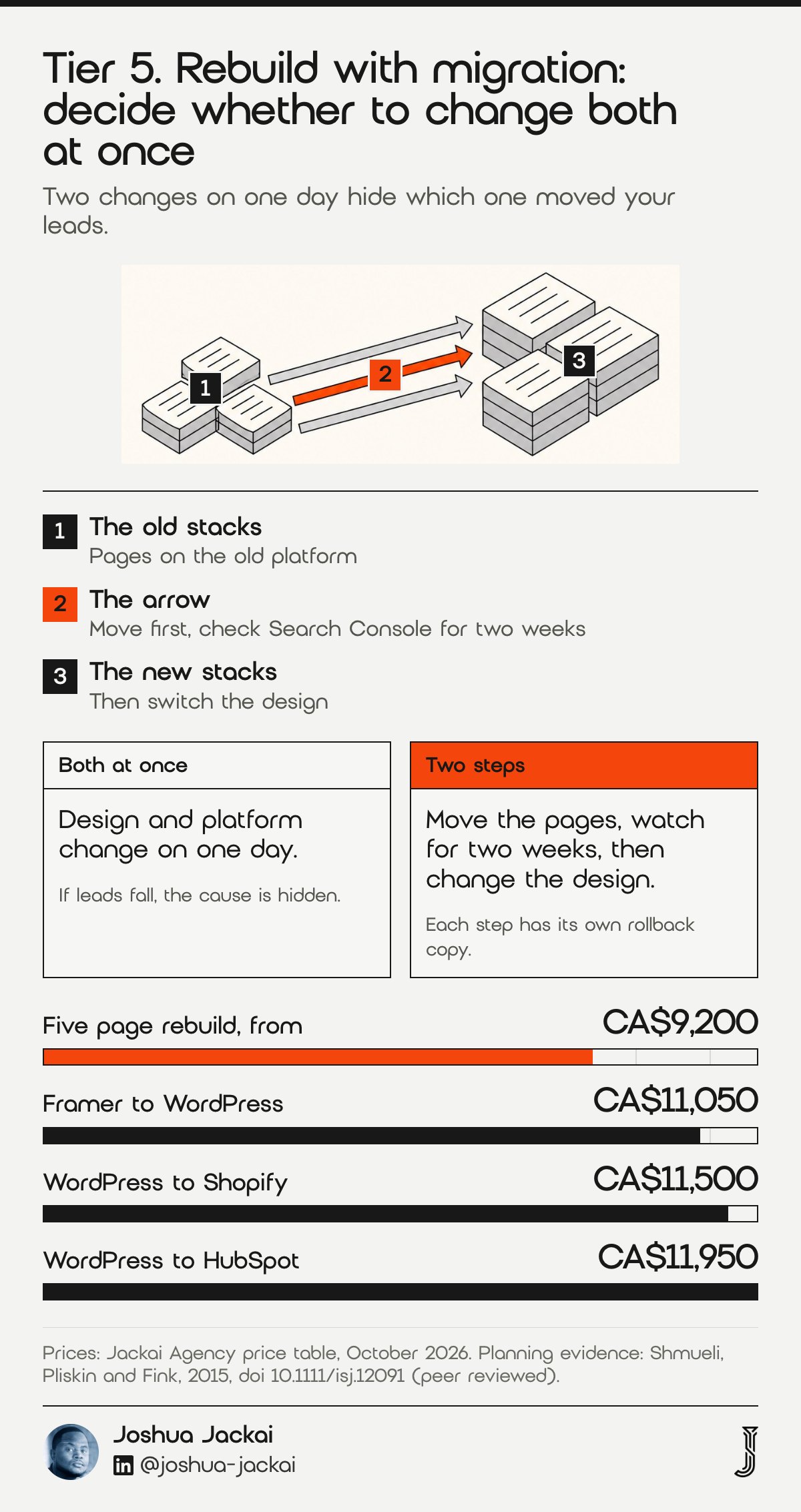
- Price: from CA$9,200; WordPress to Shopify CA$11,500; HubSpot CA$11,950; Framer to WordPress CA$11,050
- Pages: 5, new design
- Includes: redirect map, Search Console before and after, rebuild
- Best when: the platform and the look both stopped working
- Risk: doing two changes at once hides which one moved your leads
I charge more here than for a design only project because the two jobs add risk to each other. If leads fall after launch, you want to know whether the cause was the design or the move, and doing both at once makes that harder to see. I record Search Console before and after so the answer is on paper. If your leads are steady and only one thing is broken, I would split the work into tier 2 and tier 3 and spread the cost. When a client wants both changes, I split the launch into two steps where I can: move the pages first, check Search Console for two weeks, then switch the design. The price rises a little for the extra step, but you learn which change affected your leads, which is worth more than the saving. Each step gets its own launch note and its own rollback copy.
“If leads fall after launch, you want to know whether the cause was the design or the move, and doing both at once makes that harder to see,” Joshua Jackai wrote above. For the platform choices, my page on the WordPress rebuild without losing SEO walks through what to keep.
6. Marketing site, 8 to 15 pages: best for several services, audiences or locations
A marketing site covers 8 to 15 pages for companies with several services or audiences. It starts at CA$10,495 and takes 4 to 6 weeks. The price rises with the number of unique page designs, the content you need written and the integrations you want.
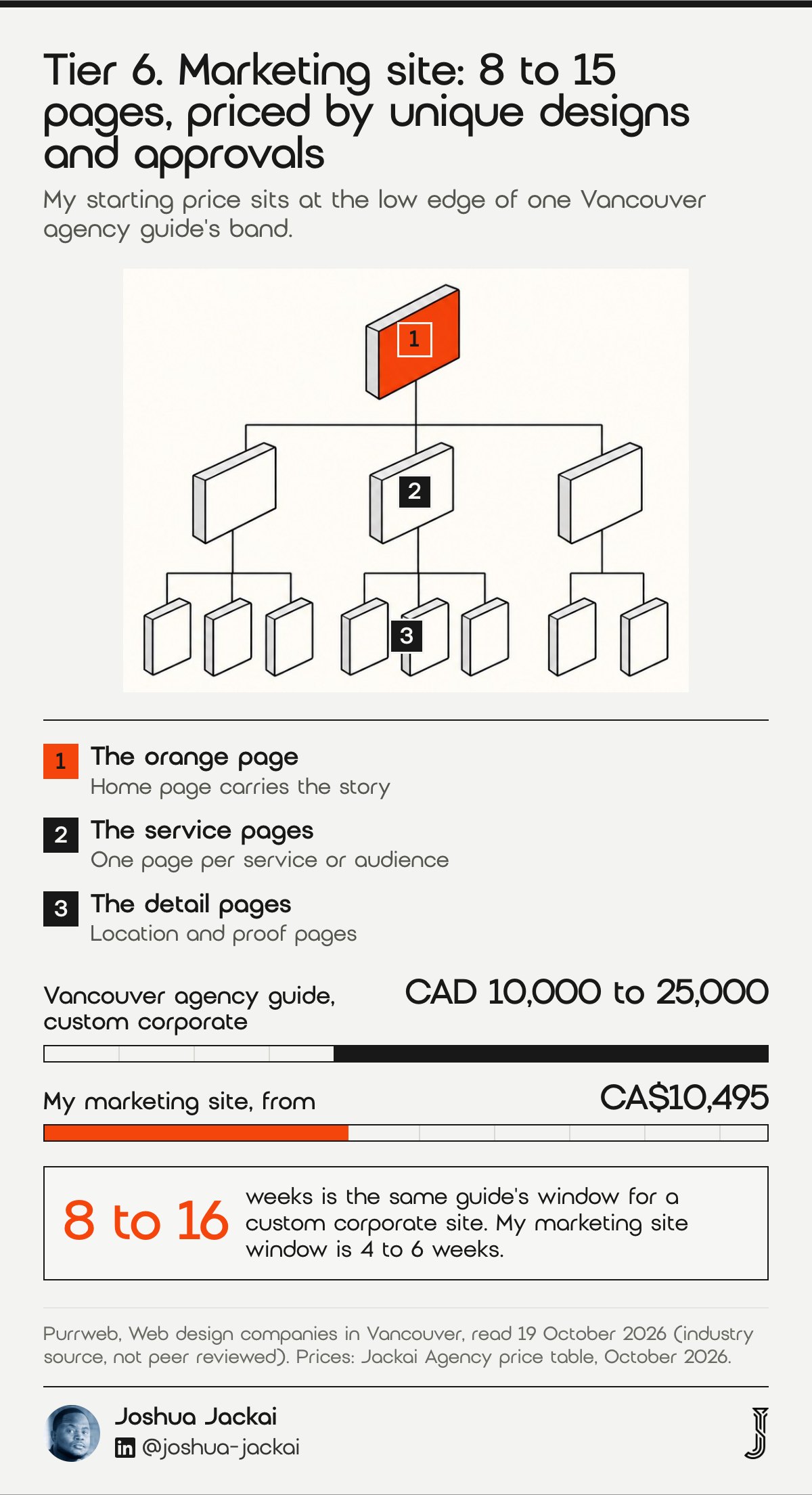
- Price: from CA$10,495
- Time: 4 to 6 weeks
- Pages: 8 to 15
- Best when: you sell more than one service to more than one buyer
- Watch for: pages added late, which move both price and date
The same agency guide puts a custom corporate site at CAD 10,000 to 25,000 over 8 to 16 weeks (Purrweb, industry source), so my 4 to 6 week window is shorter, and I say so because I would rather you question it than assume it. A short window is possible when the section library is reused and content arrives on time. When it does not, the date slips. The planning research is blunt about this. Buehler, Griffin and Ross found that people’s predictions of their completion times were too optimistic across a variety of academic and nonacademic tasks (Buehler, Griffin and Ross, 1994). I plan against that by setting the launch date in writing from the day your content lands. The largest cost drivers on a site this size are copy and approvals. Eight pages with one decision maker move quickly, while fifteen pages with four reviewers take twice as long. I ask you to name the final approver before the quote is written.
“predictions of their completion times were too optimistic for a variety of academic and nonacademic tasks,” Buehler, Griffin and Ross wrote in the Journal of Personality and Social Psychology, 1994.
“I say so because I would rather you question it than assume it,” Joshua Jackai wrote above about the shorter window.
7. Ecommerce redesign: best for a store where the checkout is the problem
An ecommerce redesign covers the store, the product pages and the checkout. A store redesign starts at CA$9,350. A new build or a migration starts at CA$15,995. The timeline runs from 3 to 10 weeks, depending on the number of products and integrations.
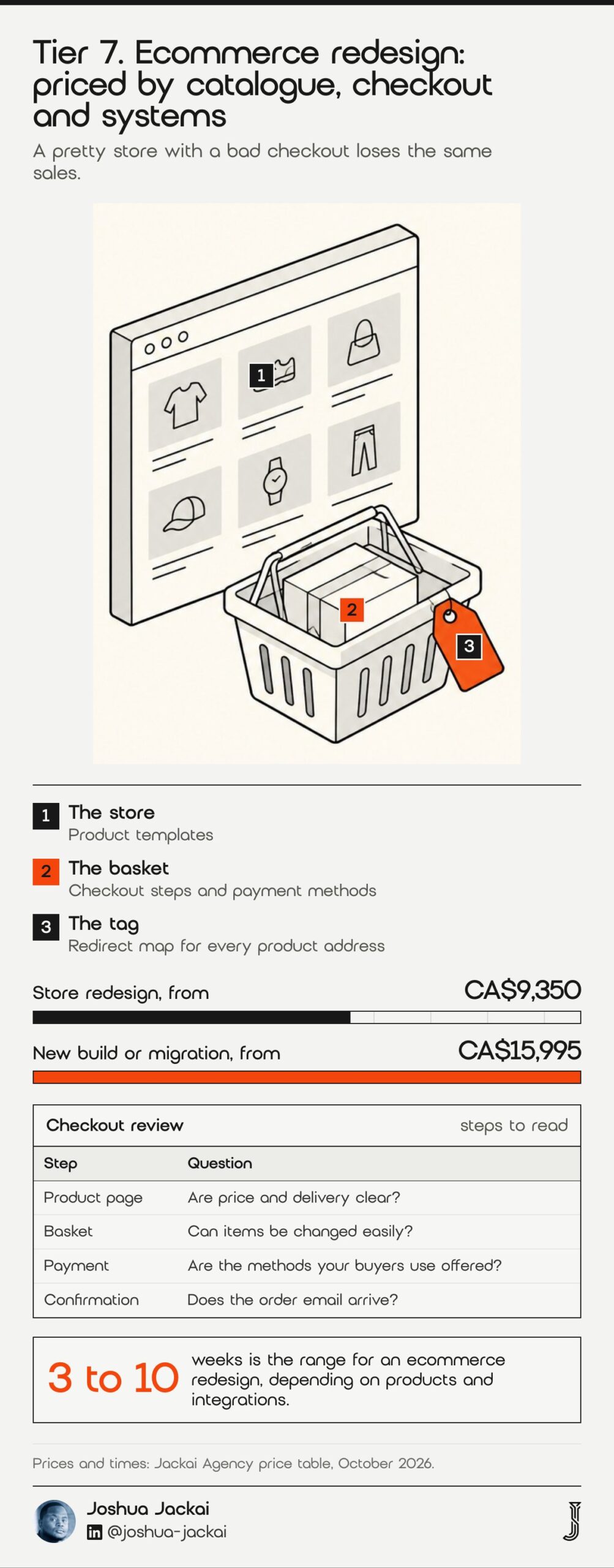
- Price: store redesign from CA$9,350; build or migration from CA$15,995
- Time: 3 to 10 weeks
- Includes: product templates, checkout review, redirect map
- Best when: sales drop between the product page and payment
- Not included: product photography, which I do not offer
Stores are priced by catalogue and by the systems behind them, which is why the range is wide. Before I redesign a store I read the checkout steps, the payment methods and the order of the product page, because a pretty store with a bad checkout loses the same sales. Software projects have a known tendency to run long. Shmueli, Pliskin and Fink found that time underestimation and scope overload show up in planning for fixed schedule software projects, and that reference information about past completion times reduces them without removing them (Shmueli, Pliskin and Fink, 2015). So I quote ecommerce from past projects, not from the hope that this one will be easy. Ask any provider what happens to existing orders, reviews and product URLs during the move. Losing product page addresses is the most common way a store redesign hurts revenue, and a redirect map for the whole catalogue is part of my price.
“the results show that these problems are mitigated, yet not eliminated, by presenting reference information about past completion times and by having a consultant role,” Shmueli, Pliskin and Fink wrote in Information Systems Journal, 2015.
How long does a website redesign take?
A website redesign takes 1 week for an audit, 2 to 3 weeks for a five page site from content, 4 to 6 weeks for a marketing site and 3 to 10 weeks for ecommerce at my agency. A Vancouver agency guide lists 4 to 8 weeks for small business sites (Purrweb). Content arrival decides most delays.
Ask any provider two timeline questions: from which day do the weeks count, and what happens to the date if content is late? A quote that starts the clock at signing and ignores your content is a quote you will argue about later. Add a buffer of about a fifth to any date you promise your own team, because estimates run optimistic, as the planning research above shows.
How often should you redesign a website?
Redesign when the site no longer does its job, not on a fixed calendar. For many B2B sites that means a look at 3 to 4 years, a yearly content and tracking review, and a rebuild only when the platform, brand or offer changes. Visitors judge the first screen in 50 ms (Lindgaard and colleagues, 2006).
I base the 3 to 4 year look on experience, not on a study, so treat it as a working rule. Between rebuilds, update the pages that earn leads, retest the form and keep the platform patched. If you are unsure, start with tier 1, because it tells you whether the problem is the design or something cheaper.
Compare the seven tiers and filter by what you need
This matrix lists every tier with its price, time and best use in Canadian dollars. Filter by budget or by the job you need done, and rows are hidden, not deleted. All prices come from my single October 2026 price table, and fees for hosting and domain are paid by you directly to the provider.
| Tier | Starts at (CAD) | Time | Best for |
|---|---|---|---|
| 1. Audit first | CA$995, credited | 1 week | Not knowing if you need a redesign |
| 2. Migration, no redesign | CA$2,500 | Set on the call | A platform you have outgrown |
| 3. Small Business Website | CA$4,950 Framer, CA$5,950 WordPress | 2 to 3 weeks from content | A clear five page brochure site |
| 4. Custom B2B website | From CA$7,450 | Set on the call | Selling on trust and proof |
| 5. Rebuild with migration | From CA$9,200 | Set on the call | New design on a new platform |
| 6. Marketing site | From CA$10,495 | 4 to 6 weeks | Several services, audiences or locations |
| 7. Ecommerce | From CA$9,350 | 3 to 10 weeks | A store where checkout is the problem |
Work out a budget range for your redesign
This calculator turns your page count and platform into a CAD range using my published prices. The defaults are placeholders, not a quote. Enter your own page count, pick the platform and the tier it suggests will match the tables above, then compare it with two written quotes that name the same scope.
Budget range from page count (placeholders, edit them)
Frequently asked questions
How much does a website redesign cost in Vancouver?
A redesign at my agency runs from CA$995 for an audit to CA$15,995 or more for ecommerce. A five page site is CA$4,950 on Framer or CA$5,950 on WordPress. A Vancouver agency guide lists CAD 4,000 to 10,000 for 6 to 12 pages (Purrweb).
How much does it cost to update an existing website?
Updating an existing site runs from a CA$995 audit to a CA$2,500 platform migration with no new design. Refreshing the pages that matter fits the five page tier from CA$4,950. Choose the audit first when you cannot say what is broken, because it is credited within 30 days.
Is a redesign worth it for a small business?
A redesign is worth it when the site loses leads for reasons a visitor can see: slow pages, an unclear offer, a dated first screen or a broken form. Visual appeal is judged within 50 ms (Lindgaard and colleagues, 2006), so a first screen fix can matter.
Can I redesign my website without losing SEO?
Yes. Keep the URLs that rank, map every old address to a new one with a permanent redirect, and check Search Console before and after launch. Google documents this process for site moves with URL changes (Google Search Central). I include the redirect map in every migration price.
Who sets this up for you
I design and build these sites in Vancouver for Canadian B2B companies, with fixed quotes, two revision rounds per phase and you owning the site, domain and hosting. Start with the CA$995 website audit, credited within 30 days, or read the website redesign cost page for details.
A free AI Visibility Report shows how answer engines see your company today.
Sources
Peer reviewed
- Lindgaard, G., Fernandes, G., Dudek, C. and Brown, J. (2006). Attention web designers: You have 50 milliseconds to make a good first impression! Behaviour & Information Technology. doi.org/10.1080/01449290500330448
- Reinecke, K., Yeh, T., Miratrix, L. and colleagues (2013). Predicting users’ first impressions of website aesthetics with a quantification of perceived visual complexity and colorfulness. CHI 2013. doi.org/10.1145/2470654.2481281
- Buehler, R., Griffin, D. and Ross, M. (1994). Exploring the “planning fallacy”: Why people underestimate their task completion times. Journal of Personality and Social Psychology. doi.org/10.1037/0022-3514.67.3.366
- Shmueli, O., Pliskin, N. and Fink, L. (2015). Can the outside-view approach improve planning decisions in software development projects? Information Systems Journal. doi.org/10.1111/isj.12091
- Virzi, R. A. (1992). Refining the test phase of usability evaluation: how many subjects is enough? Human Factors. doi.org/10.1177/001872089203400407
Industry, vendor and government (not peer reviewed)
- Purrweb. Web design companies in Vancouver, price bands and timelines, read 19 October 2026. purrweb.com
- Google. Search Central, site moves with URL changes, read 19 October 2026. developers.google.com
- Jackai Agency price table, October 2026 (first-party prices, CAD).