7 Reasons Web Design Quotes Vary: 2026 Field Guide
Seven reasons two web design quotes for one project can sit far apart, with the research behind each and a sheet that puts every quote on the same footing.
 Joshua Jackai
15 min read
Joshua Jackai
15 min read
Published 15 October 2026 · Last updated and fact-checked October 2026
Short answer: Web design quotes vary because each one prices a different project. Scope, team, estimate method, brief wording, work around the pages, unseen quality and support after launch all move the number. A Canadian vendor guide puts small business sites near CA$3,000 to 8,000 and corporate sites near CA$8,000 to 25,000 (Impeka, undated, read 15 October 2026).
I am Joshua Jackai, a Vancouver web designer, and I run Jackai Agency. Buyers often hold two or three quotes and wonder which one is wrong. Usually none of them is wrong. They describe three different projects under one name. This guide gives you seven causes and a sheet that puts every quote on the same footing.
In this guide
Key takeaways
- Quotes for one website spread widely because scope, team and risk differ; a Canadian pricing guide lists CA$2,000 to CA$100,000 for the agency market (Impeka, undated).
- A Toronto B2B cost comparison puts freelancer builds at CA$4,000 to 10,000 and agency builds at CA$8,000 to 30,000, with agency project management adding 15 to 20 percent of time (Kolonell, 8 October 2026).
- Software professionals gave different effort estimates for the same work when the request was worded differently, so your brief shapes the quote (Jørgensen and Halkjelsvik, Journal of Systems and Software, 2010).
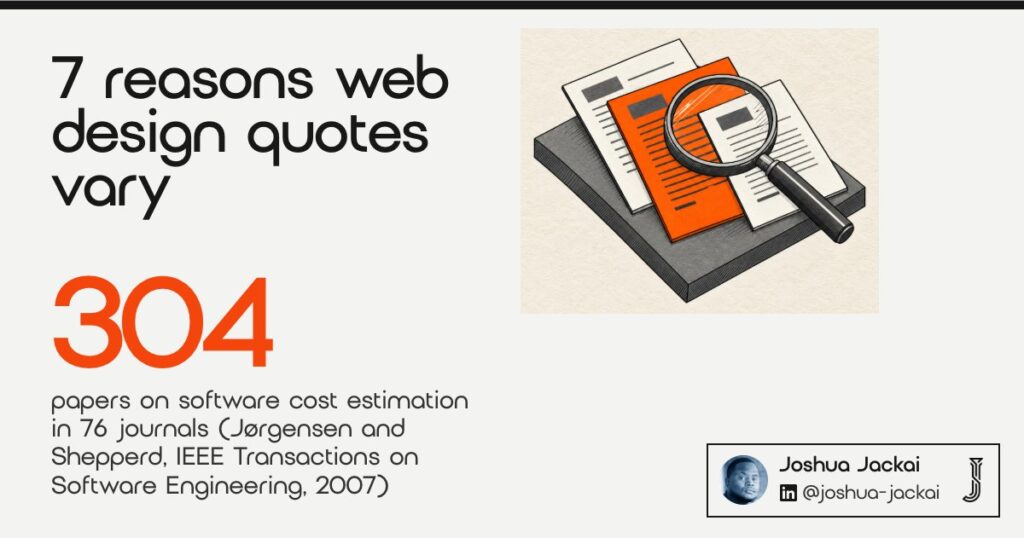
- A review of 304 papers in 76 journals shows how much research exists on estimating software work (Jørgensen and Shepperd, IEEE Transactions on Software Engineering, 2007).
- My own fixed prices for a five-page site are CA$4,950 on Framer and CA$5,950 on WordPress; extra pages are CA$425 each.
| Cause | What differs between quotes | Ask for it in writing | Price effect (my judgment) |
|---|---|---|---|
| 1. Scope | Page designs, templates, features | A named page list | High |
| 2. Who does the work | Freelancer, agency or builder | Names and roles | High |
| 3. The estimate | Method, templates, contingency | How it was built | Medium |
| 4. The brief | Wording and budget anchor | One shared brief | Medium |
| 5. Work around pages | Copy, research, tracking, search | Line items | High |
| 6. Quality you cannot see | Testing, security, accessibility | A test list | Medium |
| 7. After launch | Ownership, revisions, support | Terms and a fee | Medium |
1. Scope of the project: best for explaining the biggest gaps
The largest price gaps come from different scope, not different rates. One quote may include five designed pages and another five pages built from one template. Both say “five-page website”. The first takes more design time and costs more. The second is faster and costs less.
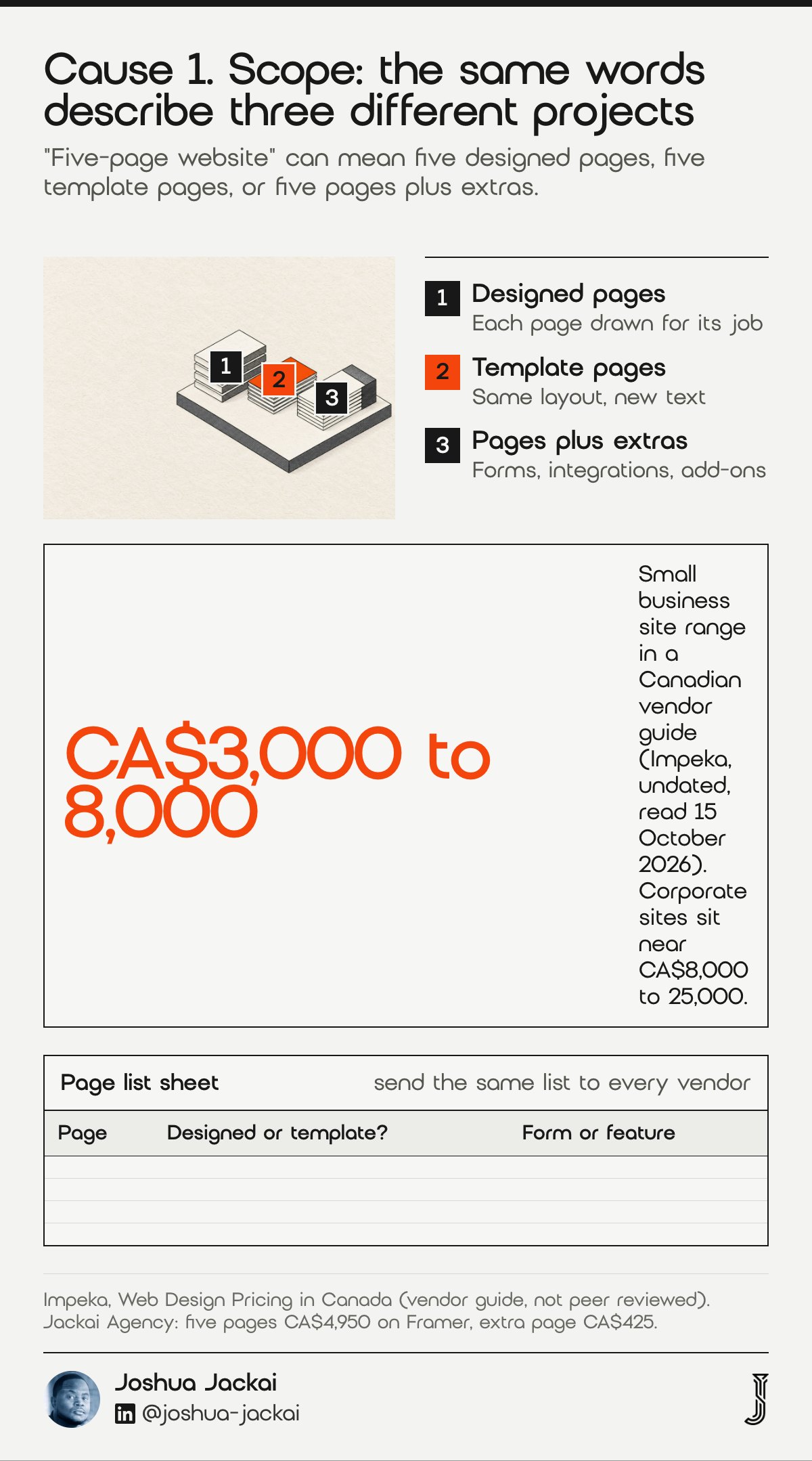
- What moves the price: pages designed, templates built, forms, integrations
- Common gap: a “contact page” with a working form, spam filter and confirmation versus a page with an email address
- Fair test: every page and feature named, one line each
- My example: five pages on Framer CA$4,950, extra page CA$425
- Where it hides: the words “standard” and “basic”
Canadian price guides show the effect of scope on the number. Small business sites sit near CA$3,000 to 8,000, mid-sized corporate sites near CA$8,000 to 25,000 and ecommerce near CA$10,000 to 60,000 (Impeka, undated). These are vendor benchmarks, not studies, but the shape is clear: more pages, more features and more integrations carry the price up in steps.
When I quote, I list the pages by name and count the extra ones. My Small Business Website covers up to five page designs, and each extra page is CA$425 up to seven in total. Past seven pages the Marketing Site, from CA$10,495, applies.
If it is not on the page list, assume it is not in the price. Two quotes are only comparable when the page list matches. If one lists pages and the other says “up to 10 pages”, ask what a page means. A page can mean a one-off design, a template with new text, or a blog post. Those three cost very different amounts to build.
“If it is not on the page list, assume it is not in the price,” said Joshua Jackai, Vancouver web designer.
2. Who does the work: best for understanding agency and freelancer gaps
A freelancer is usually one person. An agency usually adds a project manager, a designer, a developer and a tester. You pay for that team, and you get its continuity when someone is away. Neither is wrong. They are different products with different prices.
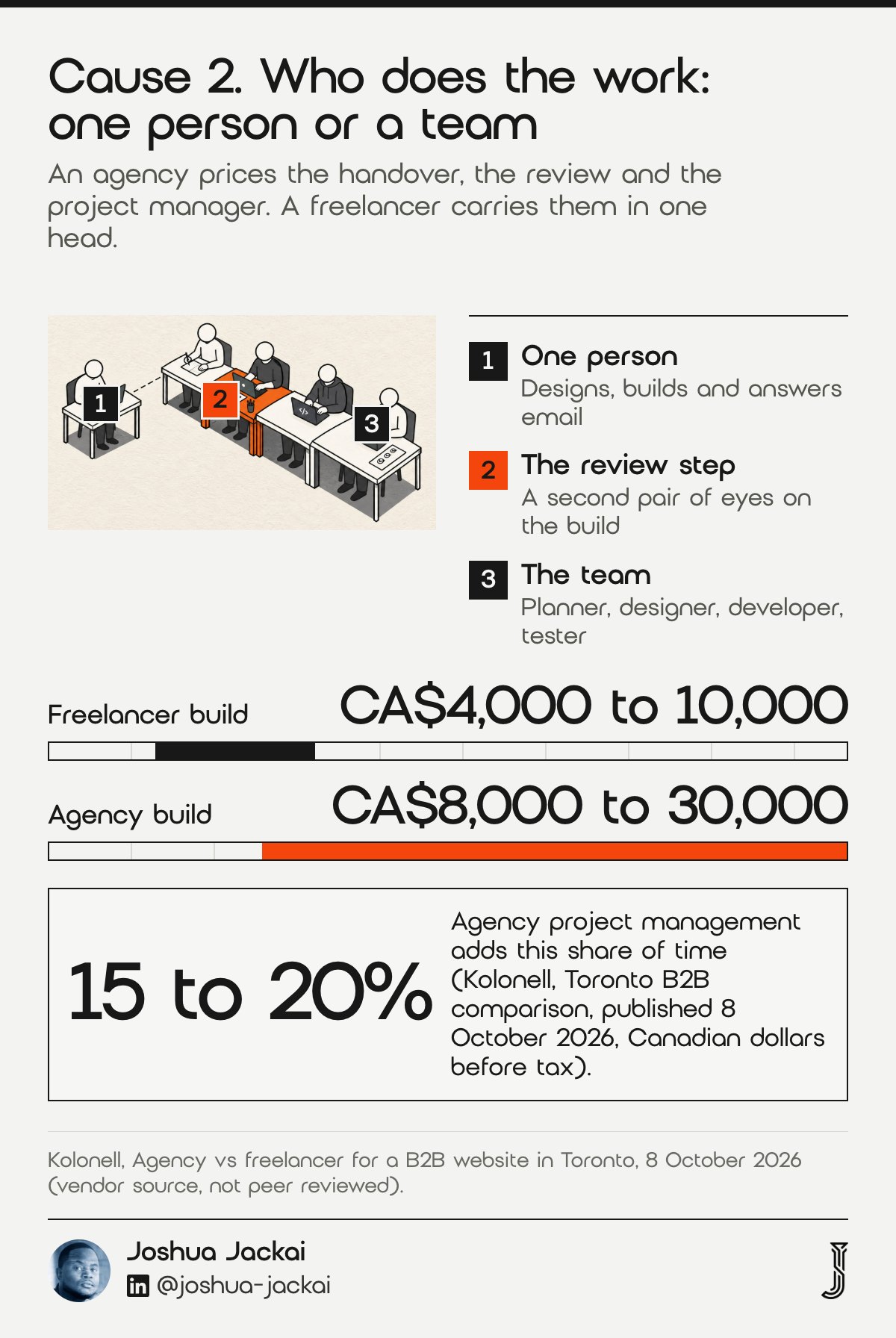
- Freelancer build: CA$4,000 to 10,000 in the Toronto comparison
- Agency build: CA$8,000 to 30,000 in the same comparison
- Project management: adds 15 to 20 percent of time at an agency
- Day rate: CA$500 to 800 for a freelance developer in Toronto
- Ask: who builds, who reviews and who answers email
The Toronto cost comparison by Kolonell, published on 8 October 2026, gives those figures in Canadian dollars before tax (Kolonell, 2026). It also says an eight to twelve page site takes eight to fourteen working days. Multiplying their own figures gives about CA$4,000 to CA$11,200 of labour before project management, which is my arithmetic, not theirs. The source is an agency that sells the work, so treat the ranges as a guide.
Why does this matter for a quote? A freelancer carrying the whole project in one head may be able to price lower, since there is less handover to pay for. An agency prices the handover, the meetings and the review. Ask each vendor to name the person who will do the design and the person who will check the build. If the answer is the same person, you are buying the freelancer model even from an agency.
My own model is a single senior designer with tested section libraries, which is why my five-page price sits at CA$4,950 rather than agency level. I say so in the quote.
“A cheap quote and an expensive quote can both be honest,” said Joshua Jackai, Vancouver web designer.
A cheap quote and an expensive quote can both be honest, because each one prices the team it describes.
3. How the estimate was made: best for seeing what a quote really is
A quote is an estimate built from a vendor’s method, reuse of past work and risk buffer, so two honest vendors can price one brief differently. Jørgensen and Shepperd reviewed 304 papers in 76 journals on software cost estimation, which I read as a sign that researchers treat estimating as hard.
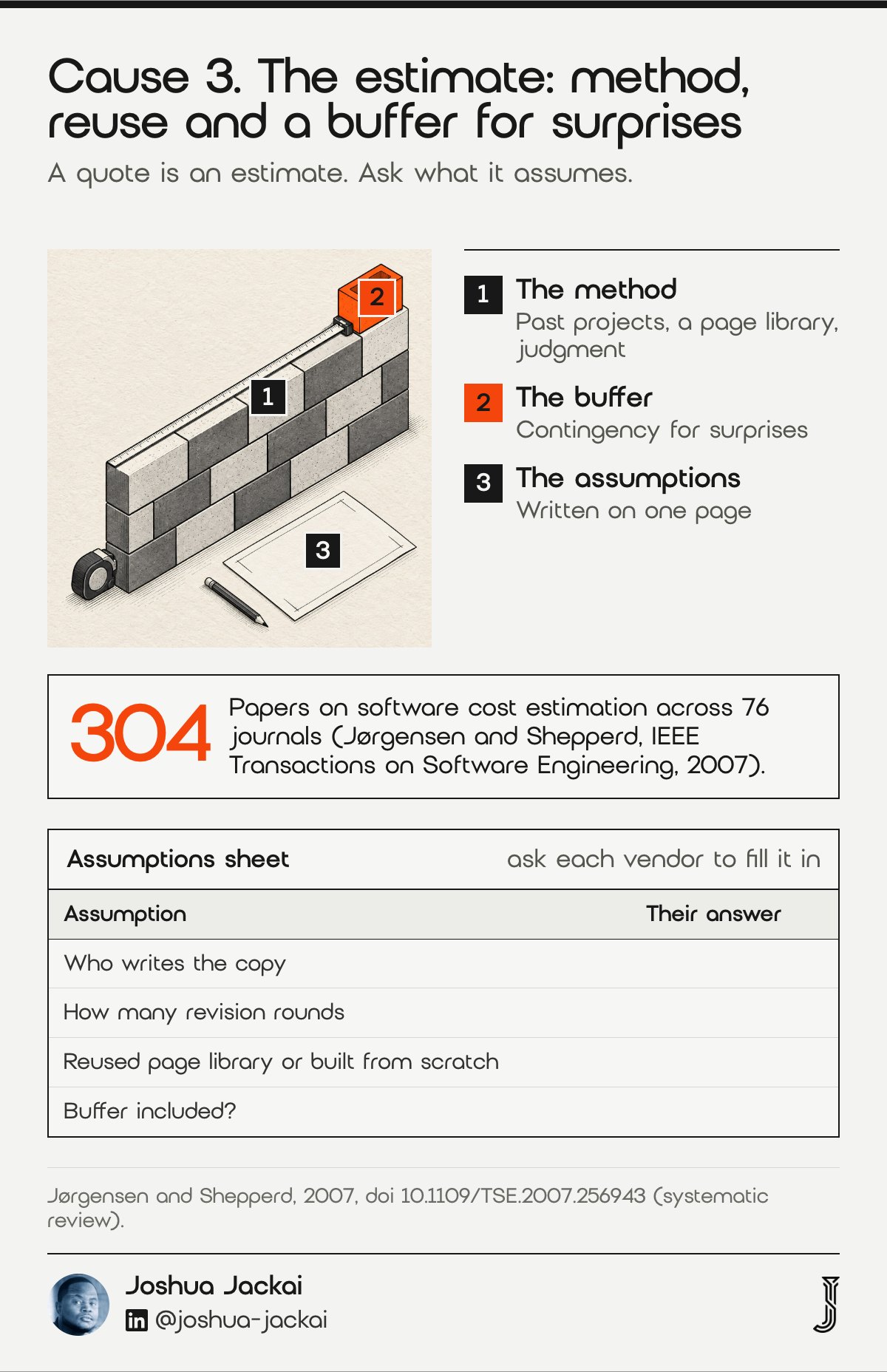
- Method: judgment, past projects, templates, or a mix
- Contingency: a buffer for surprises, sometimes hidden in the rate
- Template use: a built page library cuts hours
- Risk: vendors who expect trouble price it in
- Ask: how the number was built and what it assumes
The review appeared in IEEE Transactions on Software Engineering in 2007 (Jørgensen and Shepperd, 2007). Website projects are smaller than most of the software in that literature, but the same problem applies. Two vendors see the same brief and picture different amounts of work.
Three things sit inside the estimate that you do not see. The first is the reuse level: a vendor with a tested page library needs fewer hours than one building every block from scratch. The second is contingency: a vendor who has been burned by a late client may add a buffer. The third is the profit margin the vendor needs to stay in business.
I put my method in plain words in the quote. My five-page build uses a section library, a client who supplies copy and one form, and I state those assumptions. That is why the number is lower than a design built from nothing. A quote that does not state its assumptions cannot be compared with one that does.
“A number without assumptions is a guess with a logo on it,” said Joshua Jackai, Vancouver web designer.
A number without assumptions is a guess with a logo on it, so ask for the assumptions in writing.
4. What the brief asked: best for getting quotes you can compare
The words of your brief change the answer. Jørgensen and Halkjelsvik asked software professionals to estimate the same work in two forms: how much effort the work needs, or how much can be done in a set number of hours. The estimates differed with the wording of the request.
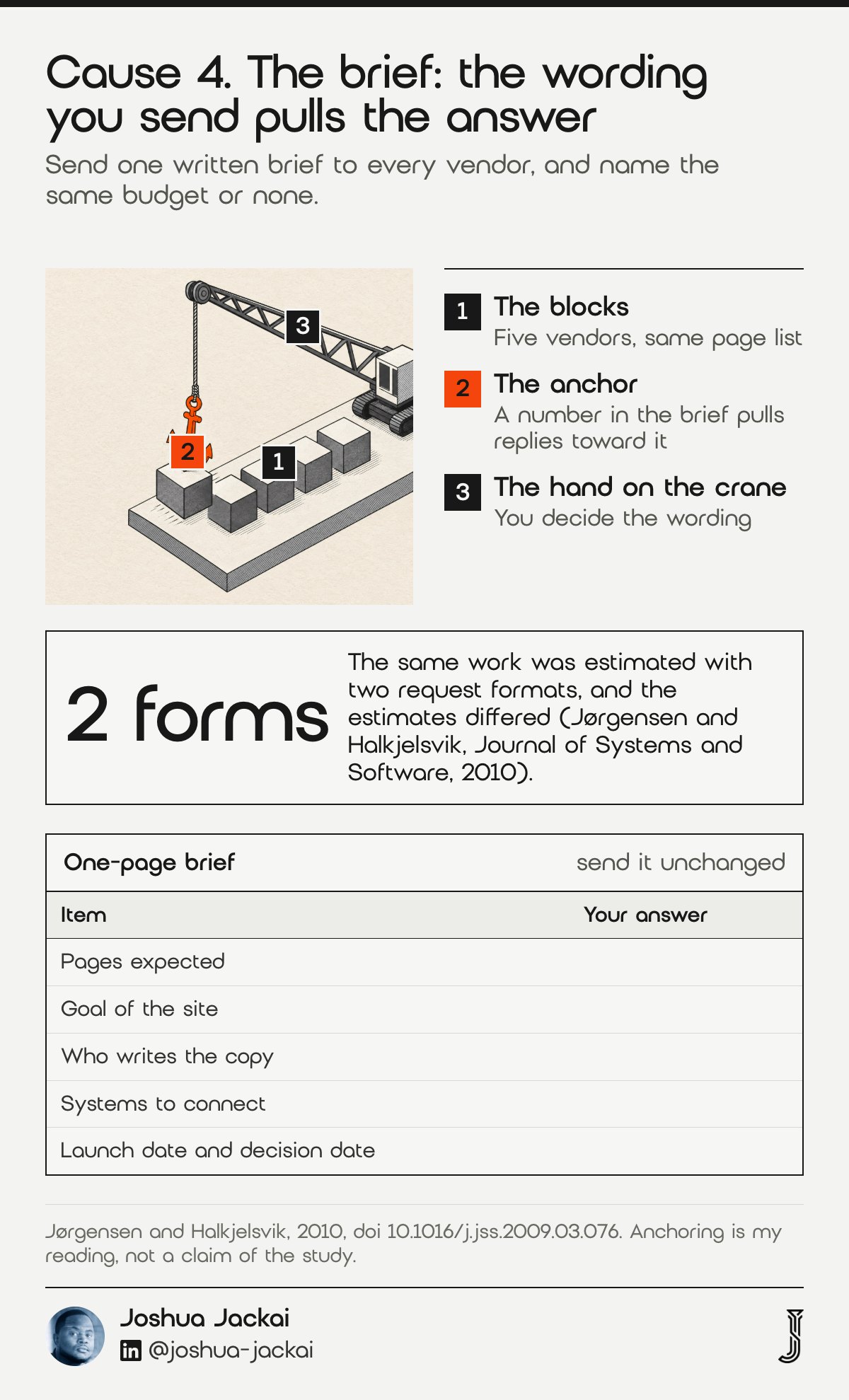
- Open brief: “we need a new website”
- Anchored brief: “we have a CA$10,000 budget”
- Best brief: page list, goals, content owner and a launch date
- Risk of a budget in the brief: quotes drift toward your number
- Fix: send every vendor the same written brief
The study was published in the Journal of Systems and Software in 2010 (Jørgensen and Halkjelsvik, 2010). Anchoring is my explanation, not something the study reports. I read its finding as a warning for buyers: how you phrase the request and whether you name a number can pull the replies in a direction.
A brief that says “we need a new website” invites each vendor to fill the gaps with its own assumptions. One imagines a ten-page marketing site. Another imagines three pages and a form. Both are honest. They are also not comparable.
Send one document to every vendor. Include the pages you expect, the goal of the site, who writes the copy, the systems it must connect to, the launch date and your decision date. Say whether you want a fixed quote. Ask each vendor to list what is excluded. If you name a budget, name the same one to everyone, or leave it out and ask for two options.
5. The work around the pages: best for spotting hidden line items
Pages are only part of the job. Copywriting, user research, lead tracking, search setup and redirects can each take as long as the design. One quote counts them. Another leaves them out and lists them as “extras” after you sign.
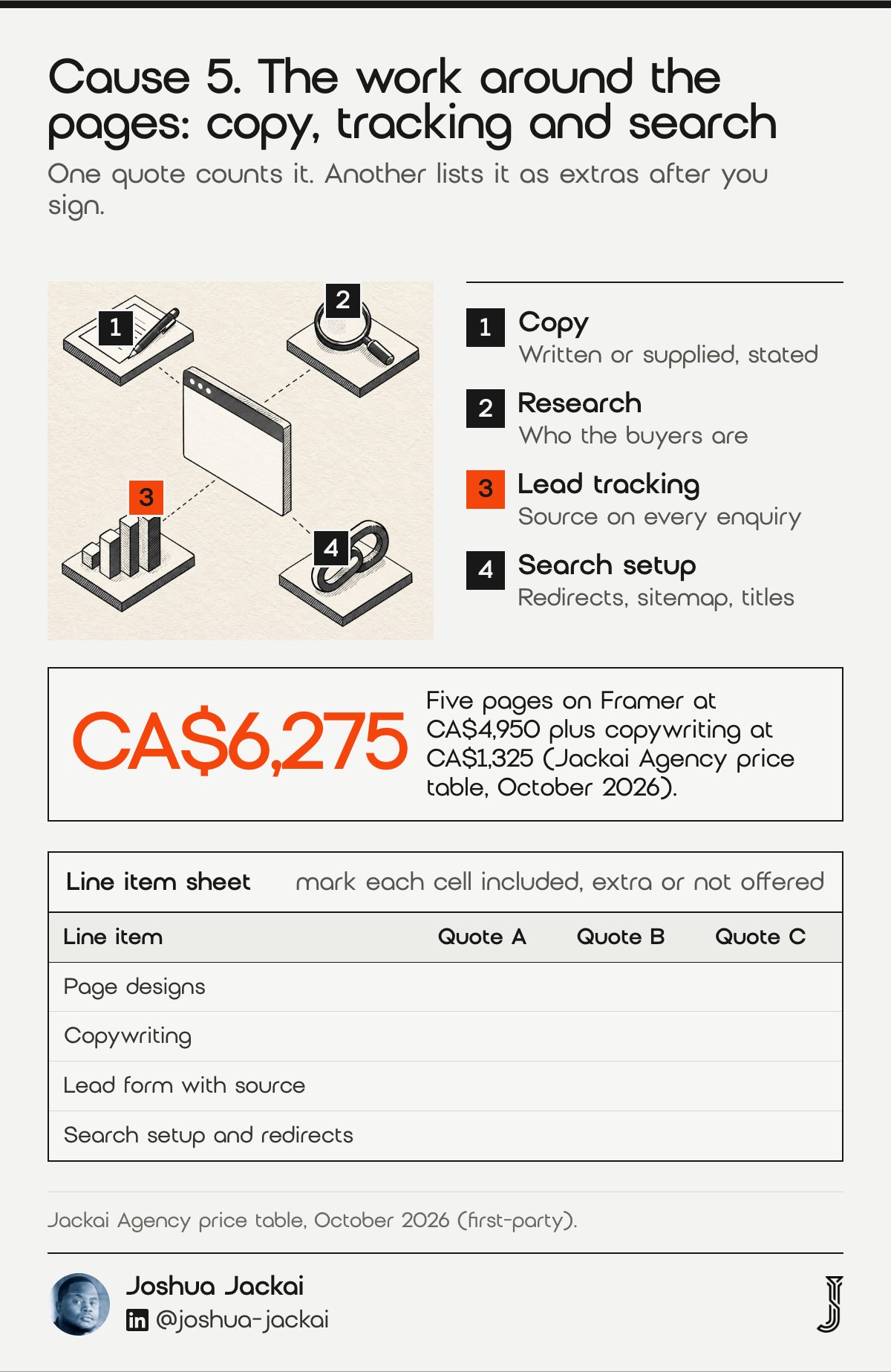
- Copywriting: my add-on for five pages is CA$1,325
- Lead source reporting: CA$2,600 as a standalone project
- Audit: CA$995, credited if you proceed within 30 days
- Search setup: titles, sitemap, structured data, redirects
- Ask: which of these are inside the price
The Toronto comparison lists SEO depth as one of the reasons agency quotes run higher: an audit, tags and content, against basic setup from many freelancers (Kolonell, 2026). The cheaper quote often leaves out the work that decides whether the site earns leads.
The quickest way to compare is a table of line items. Put design, development, copy, research, lead capture, tracking, search setup, redirects, accessibility checks and testing down the side. Put each vendor across the top. Mark each cell included, extra or not offered. The blank cells show where the spread comes from.
“The cheaper quote often leaves out the work that decides whether the site earns leads,” said Joshua Jackai, Vancouver web designer.
Take my five-page Framer site at CA$4,950. Add copywriting at CA$1,325 and the same pages cost CA$6,275. One quote with copy and one without can differ by that much for identical pages.
A B2B site with no lead source tracking can look complete and still tell you nothing about which page produced an enquiry. I include one form with source capture in the Small Business Website, and the fuller version is the Lead Source Reporting project. Ask every vendor whether you will be able to see where each lead came from after launch.
6. Quality you cannot see: best for judging risk in a cheap quote
You cannot check most of what you buy before you buy it. Testing on real phones, accessibility checks, security updates and clean code do not show on launch day. Economists call this a credence good: the buyer cannot judge quality even after the work is done.
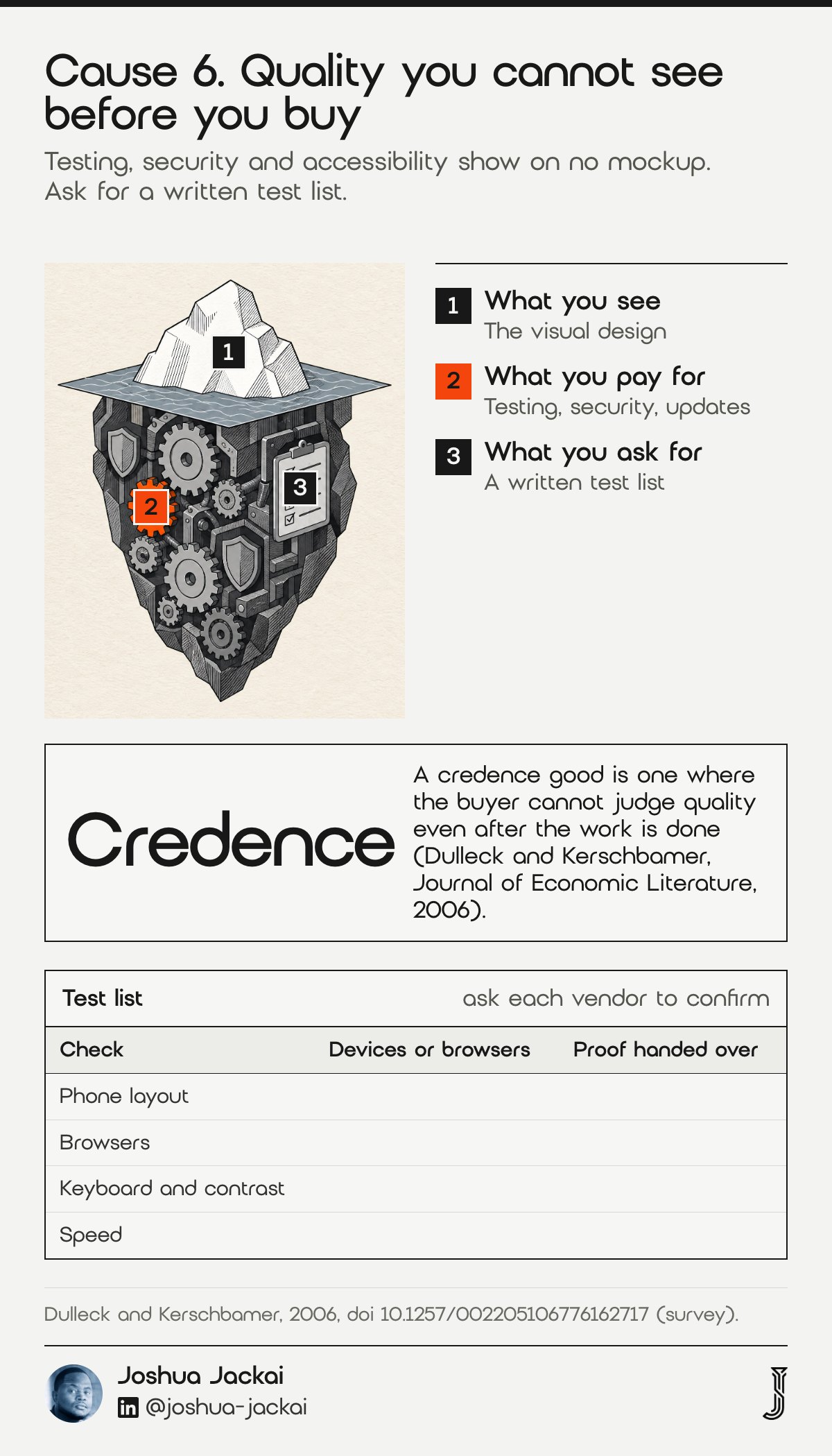
- Hard to see: phone testing, keyboard use, speed, security, backups
- Easy to see: the visual design in a mockup
- Risk in a low quote: the invisible work may shrink
- Risk in a high quote: you may pay for work you cannot check
- Fix: ask for a written test list
Dulleck and Kerschbamer describe the problem in their 2006 survey for the Journal of Economic Literature. The abstract asks “What are the methods and institutions for dealing with these informational problems?” (Dulleck and Kerschbamer, 2006).
“One worries about paying for a service that was not provided or receiving some unnecessary treatment,” wrote Dulleck and Kerschbamer in Journal of Economic Literature, 2006.
A written test list is a practical answer. Ask each vendor what they test, on which devices and browsers, and what they hand you as proof. Mine covers iPhone and Android, Chrome, Safari and Firefox, with colour contrast, image alt text, keyboard focus and heading order. If a vendor will not list the checks, the quote is pricing something you cannot see, and the difference may be the checks.
Price dispersion for the same product is normal in markets with imperfect information. A survey chapter by Baye, Morgan and Scholten covers the models that explain why identical goods sell at different prices (Baye, Morgan and Scholten, 2006). I read this as one more reason a wide range of quotes does not, by itself, mean someone is cheating.
7. After launch: best for comparing the full cost of ownership
The build is one cost. Hosting, maintenance, edits, security updates and support run for years. A cheap quote with a high monthly plan can cost more over three years than a higher quote with ownership, revisions and a handover included. Add the monthly cost before you compare.
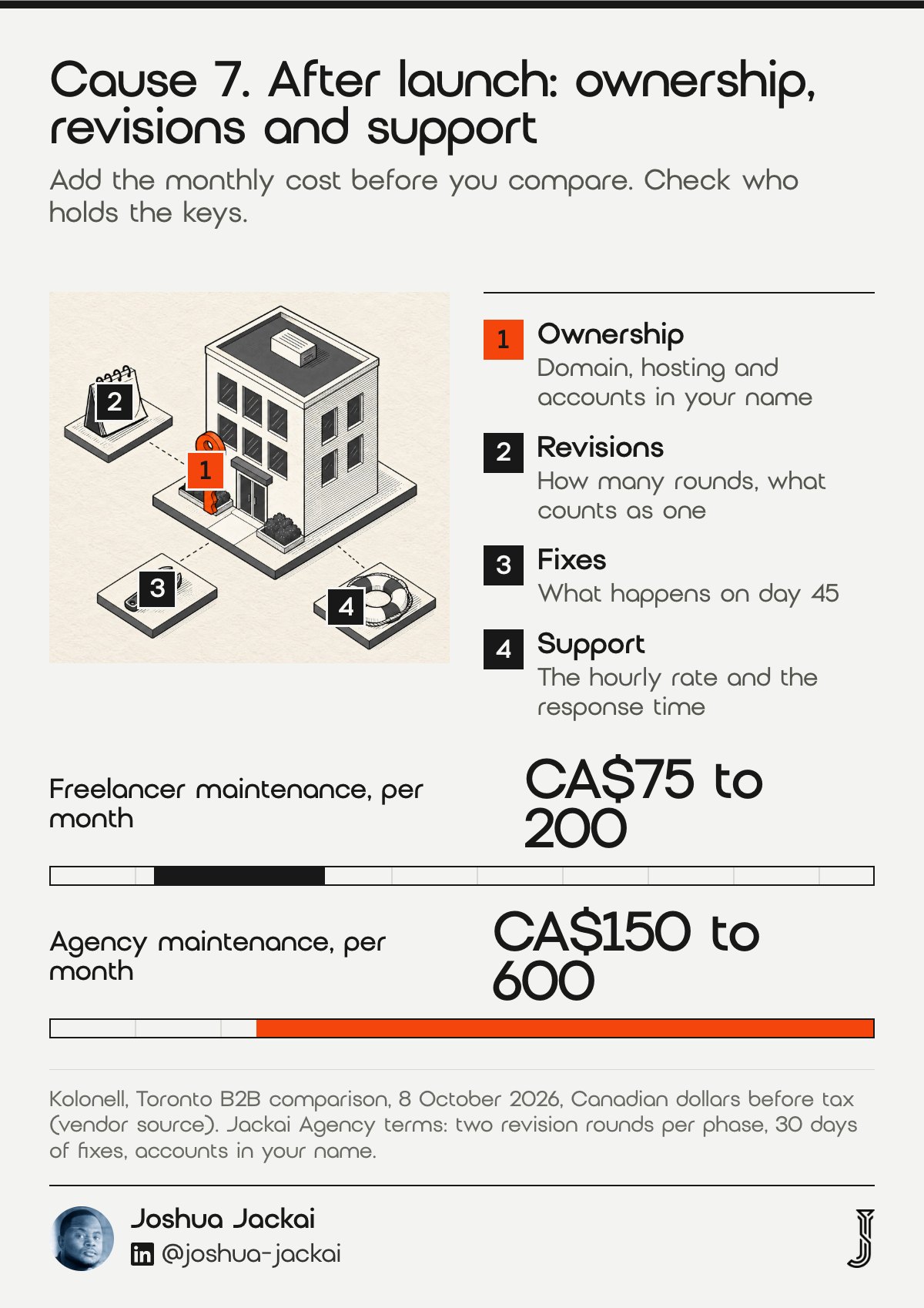
- Maintenance, freelancer: CA$75 to 200 a month in the Toronto comparison
- Maintenance, agency: CA$150 to 600 a month
- Revisions: how many rounds, and what counts as a round
- Ownership: who holds the domain, hosting and accounts
- My terms: two revision rounds per phase, 30 days of fixes, accounts in your name
The Toronto comparison estimates a three-year total of CA$21,400 for a freelancer and CA$34,900 for an agency, including the build (Kolonell, 2026). Use it as a model for your own sums, not as a price list. The point is that the gap between quotes at launch can shrink or grow once monthly costs are added.
Ask four questions before you sign. Who owns the site, the domain and the hosting? How many rounds of revisions are included? What happens after a bug appears on day 45? What does an hour of support cost? My optional support is CA$279 an hour, and every account is in your name from day one. Read my guide on who owns your website in Canada before you accept any terms.
A low quote that ends at launch can be a fair offer.
“Compare the cost of owning the site, not the cost of launching it,” said Joshua Jackai, Vancouver web designer.
Compare the cost of owning the site, not the cost of launching it. A launch-only quote and one that includes a month of fixes and a handover video are different products, so put both on the sheet in the next section.
Compare the seven causes and score your quotes
Use the filters to see which causes you can check yourself and which need a written answer. Then enter up to three quotes and tick what each lists. The sheet counts the ten line items each covers and the price per covered item. It starts empty and is a prompt for a conversation.
| Cause | Check yourself | Ask in writing | Price effect |
|---|---|---|---|
| 1. Scope | Yes | Yes | High |
| 2. Who does the work | Sometimes | Yes | High |
| 3. The estimate | No | Yes | Medium |
| 4. The brief | Yes | No | Medium |
| 5. Work around the pages | Sometimes | Yes | High |
| 6. Quality you cannot see | No | Yes | Medium |
| 7. After launch | Sometimes | Yes | Medium |
Showing 7 of 7 causes.
Quote sheet. Enter each quote in Canadian dollars, then tick the line items it lists in writing. The sheet shows how many of ten items each quote covers and the price per covered item. The fields start empty because the numbers are yours.
| Line item in writing | A | B | C |
|---|---|---|---|
| Each page design named | |||
| Who writes the copy stated | |||
| Platform and account ownership stated | |||
| Lead form with source tracking | |||
| Search setup and redirects | |||
| Accessibility checks | |||
| Testing on phone and three browsers | |||
| Revision rounds stated | |||
| Launch date in writing | |||
| Fixes after launch and a handover guide |
| Cause | Check yourself | Ask in writing | Price effect (my judgment) |
|---|---|---|---|
| 1. Scope | Yes | Yes | High |
| 2. Who does the work | Sometimes | Yes | High |
| 3. The estimate | No | Yes | Medium |
| 4. The brief | Yes | No | Medium |
| 5. Work around pages | Sometimes | Yes | High |
| 6. Quality you cannot see | No | Yes | Medium |
| 7. After launch | Sometimes | Yes | Medium |
Frequently asked questions about why web design quotes vary
Buyers ask the same few things when quotes arrive far apart. These answers use the seven causes and my October 2026 prices in Canadian dollars. They cover why the gap exists, what a fair range looks like, whether cheap means poor, and how to compare.
Why do web design quotes vary so much?
Because the vendors are rarely pricing the same project. Page count, team, estimate method, brief wording, extras and support all differ between them. Canadian guides list CA$2,000 to CA$100,000 for the agency market, so a wide spread is normal and not a sign that one vendor is wrong (Impeka, undated).
How much should a Canadian B2B website cost?
Canadian guides place small business sites near CA$3,000 to 8,000 and mid-sized corporate sites near CA$8,000 to 25,000. My own fixed prices start at CA$4,950 for five pages and CA$7,450 for a custom B2B site (Impeka, undated for the market ranges). Compare scope first, then price.
Is the cheapest quote the worst one?
Not always. A low quote can be fair if the scope is small and the assumptions are stated. It is a warning when it omits copy, tracking, testing or support that the other quotes include. Compare the line items, not the totals.
How do I compare web design quotes fairly?
Send one written brief to every vendor. Ask for a line-item quote that names pages, features and exclusions. Put the quotes on one sheet, mark each line included, extra or not offered, and divide each price by the lines covered.
How I quote a website so you can compare it
I write every assumption into a fixed quote: pages by name, who supplies the copy, what is tested, how many revision rounds, and that you own the site, the domain and the hosting. My Custom B2B website design starts at CA$7,450, and my website redesign cost page shows how the price moves with scope.
If you are holding two or three quotes and cannot tell why they differ, my CA$995 website audit puts them on one sheet and flags what each one leaves out. The fee comes off the project price if you proceed within 30 days.
Sources
Peer-reviewed research
- Jørgensen, M. and Shepperd, M. (2007). A systematic review of software development cost estimation studies. IEEE Transactions on Software Engineering. doi.org/10.1109/TSE.2007.256943
- Jørgensen, M. and Halkjelsvik, T. (2010). The effects of request formats on judgment-based effort estimation. Journal of Systems and Software. doi.org/10.1016/j.jss.2009.03.076
- Dulleck, U. and Kerschbamer, R. (2006). On doctors, mechanics, and computer specialists: the economics of credence goods. Journal of Economic Literature. doi.org/10.1257/002205106776162717
- Baye, M. R., Morgan, J. and Scholten, P. (2006). Information, search, and price dispersion. Handbook on Economics and Information Systems, Elsevier. doi.org/10.1016/S1574-0145(06)01006-3
Industry and vendor sources (not peer reviewed)
- Impeka, Web Design Pricing in Canada (2026), read 15 October 2026; the page carries no publication date and attributes its agency-market range to a Clutch dataset.
- Kolonell, Agency vs freelancer for a B2B website in Toronto, published 8 October 2026; prices in Canadian dollars before tax.
- Jackai Agency price table, October 2026 (first-party).