8 Website Redesign RFP Example Sections: Complete 2026 Guide
A website redesign RFP example for Canadian buyers: 8 sections from goals to scoring, a copy-and-paste template, the City of Vernon timetable and a weighted scoring tool.
 Joshua Jackai
22 min read
Published 23 October 2026 · Last updated and fact-checked 23 October 2026
Short answer: A website redesign RFP in Canada needs 8 sections: goals, scope, technical rules, Canadian requirements, budget format, timeline, response format and scoring. The City of Vernon, British Columbia, ran its 2026 website redesign RFP for 49 days from issue to expected award, and a survey of over 300 software professionals found certain requirements techniques correlated with lower volatility.
I am Joshua Jackai, a web designer and developer in Vancouver, British Columbia, and I run Jackai Agency, a Vancouver studio that builds websites for Canadian B2B companies on fixed quotes. Of the guides I read on 23 October 2026, most were bare templates or long checklists. This guide gives you the 8 sections, a copy-and-paste skeleton in Canadian dollars, a real BC public notice to compare against, and a scoring tool for the proposals that come back. I sell web design, so weigh my advice the way you would weigh any vendor’s. The time estimates are my own, from client work.
In this guide
Key takeaways
- Write 8 sections, in order: goals, scope, technical rules, Canadian requirements, budget, timeline, response format and scoring.
- Write the goals down with a dated baseline. A survey of over 300 software professionals linked certain requirements techniques to lower volatility (Ferreira and colleagues, 2010); it did not test numeric goals, so the baseline is my advice.
- Ask for written assumptions beside every price. In a study of 93 offshore projects, requirement uncertainty helped explain which contract type was chosen (Gopal and colleagues, 2003); that is a vendor-side finding.
- Publish your question deadline. The City of Vernon set it 16 days after issue and closed bids on day 29 (City of Vernon, RFP 26-55-COM).
| Section | What it settles | Who writes it | Time to write (my estimate) |
|---|---|---|---|
| 1. Goals and background | Why the site is changing | You | 60 minutes |
| 2. Scope | Pages, templates, content | You | 90 minutes |
| 3. Technical rules | Platform, hosting, redirects | You and your developer | 45 minutes |
| 4. Canadian requirements | Accessibility, privacy, CAD and GST | You | 30 minutes |
| 5. Budget format | How vendors must price | You | 30 minutes |
| 6. Timeline | Dates for questions, bids, award | You | 20 minutes |
| 7. Response format | What each proposal must contain | You | 30 minutes |
| 8. Scoring | How proposals are judged | You | 45 minutes |
What this guide is based on
This guide is based on the questions people ask about website redesign RFPs, the pages that answer them, one real BC public notice, and eight peer-reviewed studies. I read the top results on 23 October 2026. Most are either a bare template or a long checklist, and none I found shows a Canadian public example next to a scoring method.
I do not rank agencies or name any as winners. You get the structure and the tools to judge your own proposals. If you want a second opinion on a quote you already hold, the CA$995 audit described at the end covers that.
1. What goals and background belong in a website redesign RFP?
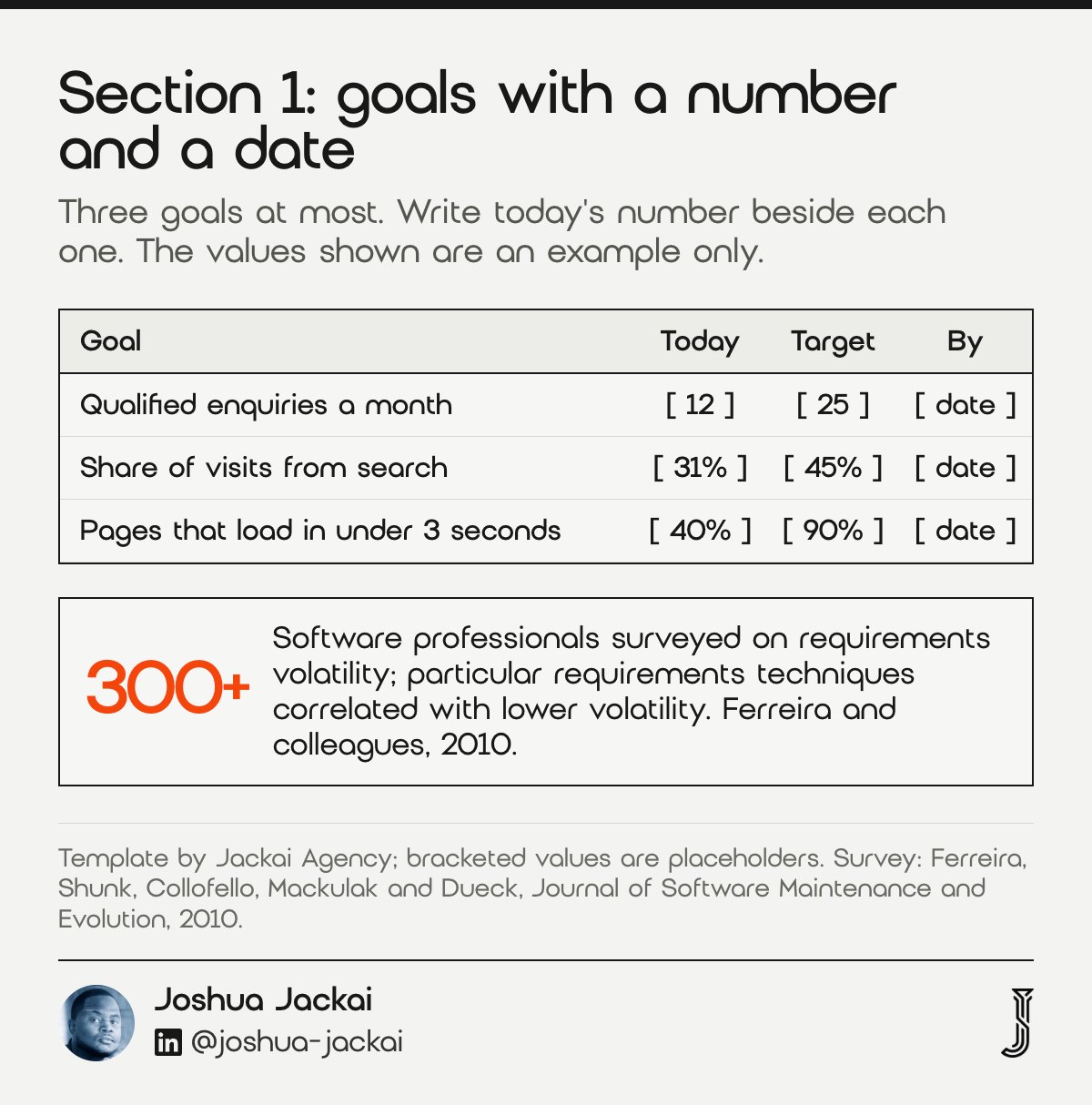
Start with why the site is changing, in numbers a vendor can plan around. Name the business trigger, three goals ranked by priority, and a current baseline for each. A proposal that answers “make it better” is a guess, and every vendor will guess differently. This section takes about an hour.
- Trigger: one sentence, such as a merger, a rebrand or a platform reaching end of life
- Goals: three at most, each with a number and a date
- Baseline: today’s monthly visits, leads and the platform the site runs on
- Audience: who visits and what they come to do
- Constraints: fixed dates, brand rules and systems that must stay
Requirements that change midway are a recognised risk on software projects, and a redesign is no exception. Ferreira and colleagues surveyed over 300 software project managers and other development staff and reported that the use of particular requirements engineering techniques correlated with lower levels of requirements volatility (Ferreira and colleagues, 2010). The survey covered software projects in general and did not test a goals section by name. A written goal list with a baseline is the cheapest requirements technique I know, so I treat it as the same idea in its simplest form. Give each vendor the same baseline too. If you cannot pull your own analytics, say so and ask each vendor to price a measurement setup, because without a baseline nobody can show the new site did better. Pull the baseline from your analytics the week you send the RFP, and date it. Vendors price risk, so a clear starting point lowers the padding in their quotes. Add the one number you would show your own board a year after launch, since that is the goal the proposals should be built around.
“Requirements volatility is a common development project risk that can have severe impacts,” wrote Ferreira and colleagues in the Journal of Software Maintenance and Evolution, 2010.
2. What scope and deliverables should the RFP list?
Scope is the list of pages, page types, features and content that the price covers. Name each template, such as home, service, article and contact, and give an approximate page count. Say who writes the copy and who supplies the images. Vendors cannot size a quote without these three facts.
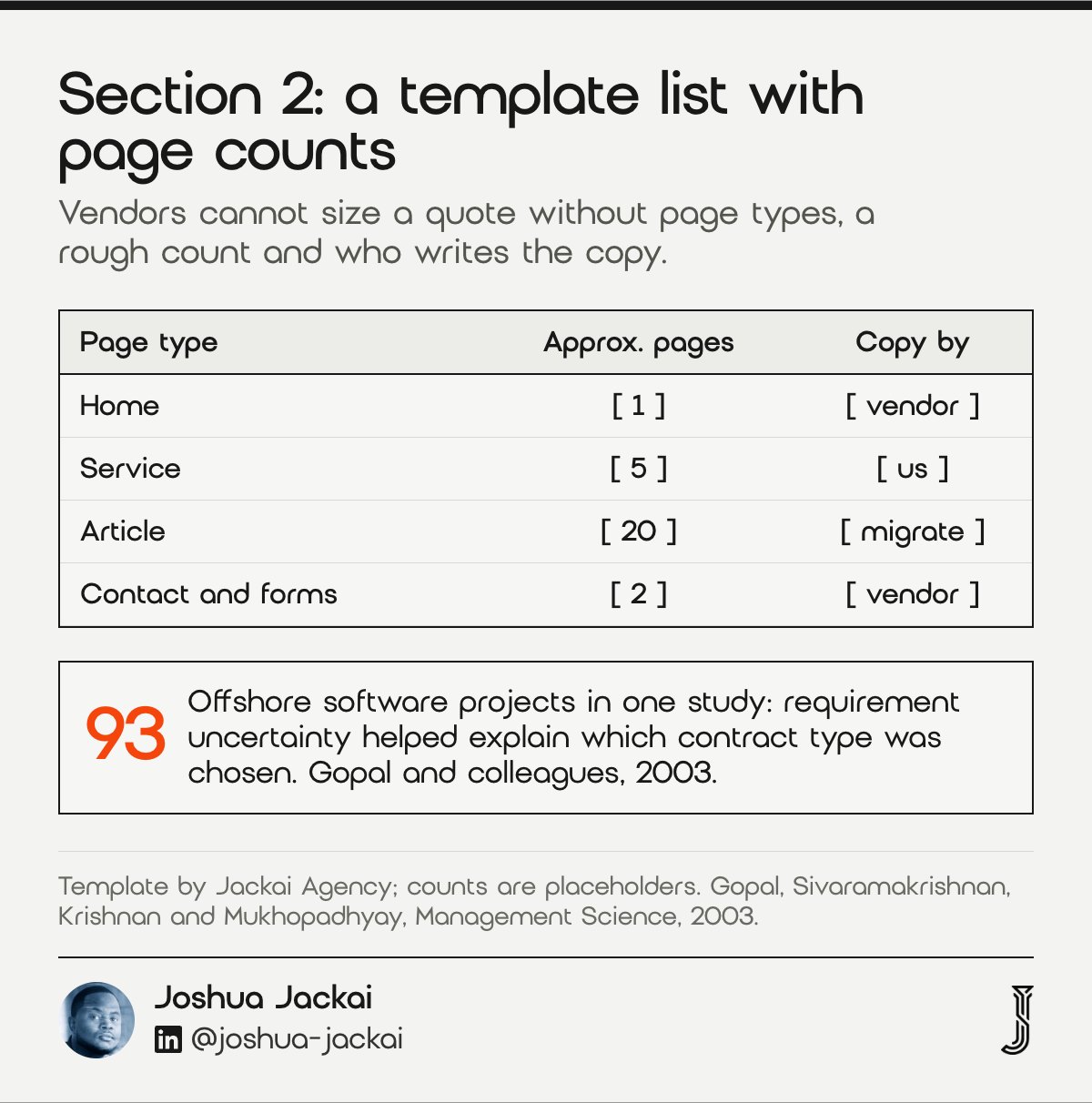
- Templates: a list, with a rough count of pages for each
- Features: forms, search, booking, members area, languages
- Content: who writes it, who migrates it, who approves it
- Integrations: CRM, email tool, analytics, payment provider
- Out of scope: what you will handle yourself or buy separately
Unclear scope changes which contract a vendor offers. Gopal and colleagues studied 93 offshore software projects from one vendor and found that requirement uncertainty, team size and resource shortage helped explain contract choice, which in turn affected project profit (Gopal and colleagues, 2003). The data came from one Indian vendor and offshore software work, not web design in Canada, so I read it as a direction. My reading, not the study’s finding: the more you pin down, the less a vendor has to pad for uncertainty. If you do not know the page count, say so and ask for a price per page type. In my experience, a template list takes about 90 minutes and removes many of the follow-up emails. List what you already have, too: a sitemap export, a content audit or brand files can save a vendor a week. If a page type is new, such as a resource library, describe it in a sentence and say who will fill it. A vendor can price what you describe, but not what you leave out.
“Our analysis suggests that contract choice significantly determines project profit,” Gopal and colleagues reported in Management Science, 2003.
3. Which technical requirements keep the redesign from losing search traffic?
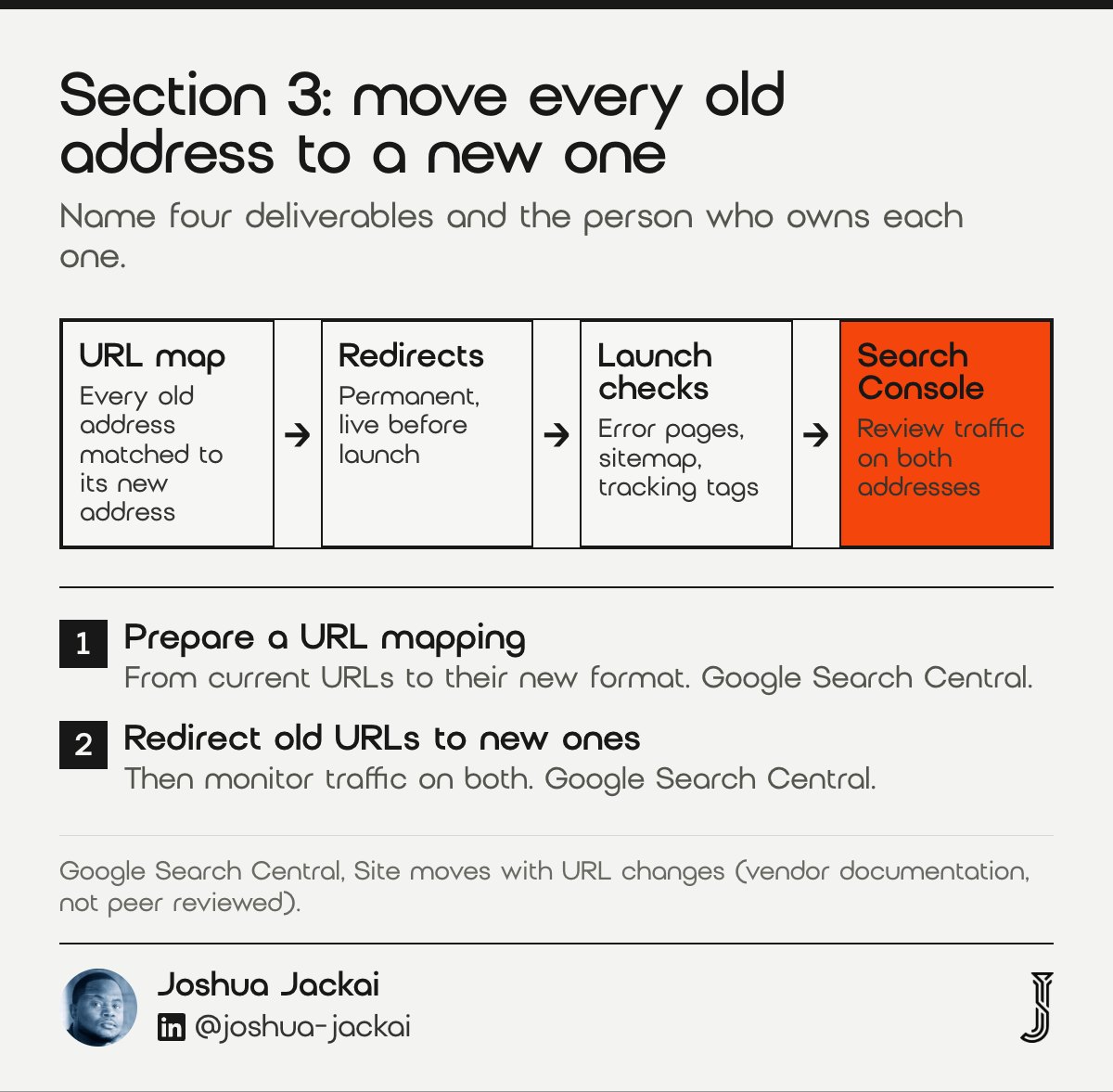
Technical rules cover the platform you want or will accept, who hosts it, who owns the accounts, and how old URLs move to new ones. The last point protects your search traffic. Ask every vendor to deliver a URL map and redirects as a named line item, not an assumption.
- Platform: the CMS you prefer, or “recommend one and say why”
- Ownership: site, domain and hosting in your name from day one
- URL map: every old address matched to its new address
- Redirects: permanent redirects set up before launch
- Checks: a Search Console review in the first weeks
Google’s own guidance on moving a site lists the same steps: prepare a URL mapping from current URLs to the new ones, redirect from the old URLs to the new ones, and monitor traffic on both (Google Search Central, site moves with URL changes). That page is vendor documentation, not research, but it is Google’s own instruction. Put the three steps in the RFP as deliverables and ask for the name of the person who owns each one. If you want that work priced alone, my migration-only service is CA$2,500 and covers redirect mapping and Search Console checks with no redesign. Ask about hosting costs and renewal dates in the same section, because a site hosted in the vendor’s account is hard to move later. Ask for a launch checklist that covers error pages, the sitemap file and tracking tags. Each line you name now is a line nobody can forget in the last week. For the wider process, read my guide to a B2B website redesign.
“Put the three steps in the RFP as deliverables and ask for the name of the person who owns each one,” Joshua Jackai, Vancouver web designer, wrote.
4. What Canadian requirements should a website redesign RFP include?
Canadian requirements are the rules and money terms a vendor must meet: an accessibility standard, privacy handling, Canadian dollars with GST shown, and where data is stored. Some depend on who you are. A federal body, a BC public body and a private B2B company face different duties, so state the standard you want.
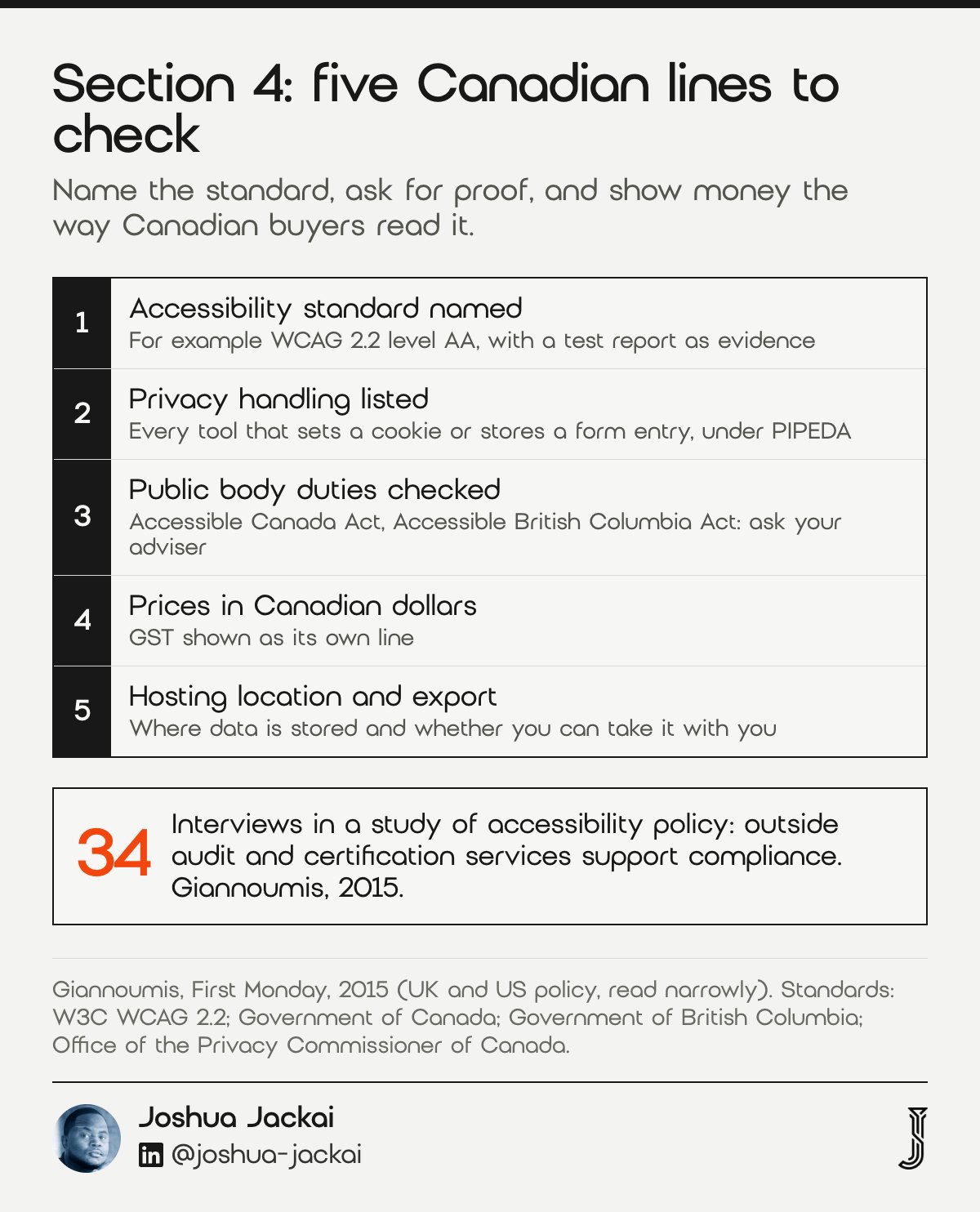
- Accessibility: name a standard, such as WCAG 2.2 level AA, and ask for evidence
- Privacy: ask how forms, analytics and cookies handle personal information under PIPEDA
- Public bodies: the Accessible Canada Act and the Accessible British Columbia Act may apply to you
- Money: prices in Canadian dollars, with GST as its own line
- Hosting: where the site and its form data are stored
A requirement is only useful if you can check it. Giannoumis interviewed 34 participants in the United Kingdom and United States and found that interest organizations support accessibility policy by providing audit and certification services (Giannoumis, 2015). The study was about accessibility policy outside Canada, so take it narrowly. The study does not cover RFPs. My own rule is to ask for proof, such as a test report or an outside audit, not only a claim. Pick the standard before you pick the vendor, because it gives every proposal the same target. Ask the vendor to list every tool that sets a cookie or stores a form entry, and who can see the data. Ask where it is hosted, whether you can export it, and how long the vendor keeps it. I am not a lawyer. Ask your own adviser which of these laws applies to your organization before you copy any wording.
“A requirement is only useful if you can check it,” Joshua Jackai, Vancouver web designer, wrote.
5. How should the RFP ask vendors to price the work?
Ask for a fixed price per phase, split into lines you can compare: discovery, design, build, content, launch and support. Tell vendors your budget range, because a stated range lets each of them say what fits. Ask for GST as its own line and a price for anything you listed as optional.
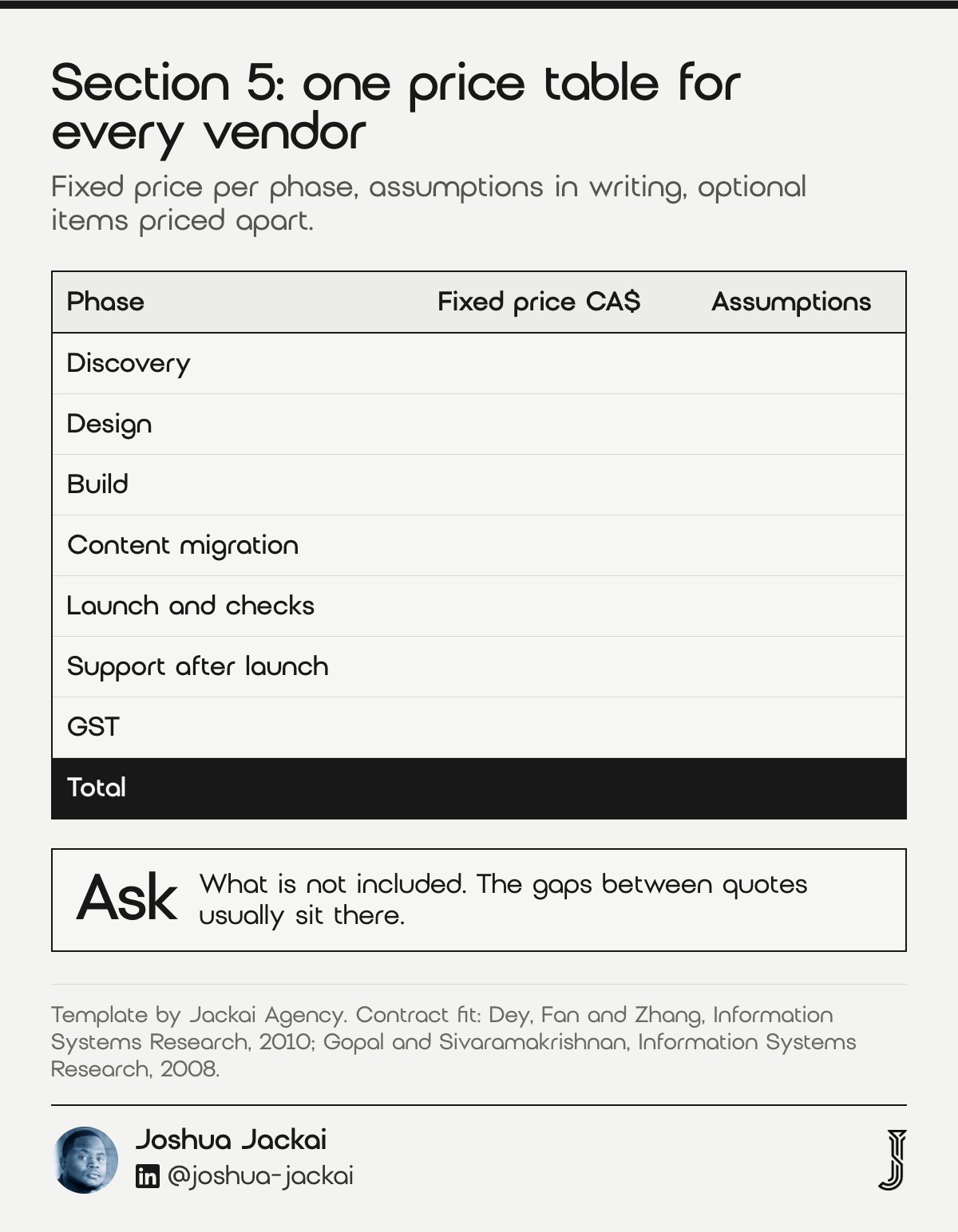
- Format: one table, the same lines for every vendor
- Fixed price: per phase, with the assumptions written out
- Range: your budget as a range in CAD
- Optional items: priced apart, so you can cut them
- Change rate: an hourly rate for work outside scope
Fixed prices suit some projects and not others. Dey, Fan and Zhang modelled software outsourcing contracts and concluded that fixed-price contracts are often appropriate for simple projects with a short development time (Dey, Fan and Zhang, 2010). Gopal and Sivaramakrishnan found that a vendor in their data would prefer the fixed-price contract for larger and longer projects with larger teams, and linked that to the vendor’s information advantage (Gopal and Sivaramakrishnan, 2008). Together they tell me to ask for assumptions in writing, because written assumptions give you something to compare. That is my inference, not something either study tested. Ask each vendor to state what is not included, since the gaps between quotes often sit there. For orientation, a Toronto-focused agency blog puts a well-scoped small business site at CA$9,000 to CA$22,000 over 6 to 10 weeks (Kolonell, 2026). That is one vendor’s estimate, not measured data. My own packages run from CA$4,950 to CA$10,495, and the detail is in my website redesign cost guide.
“fixed-price contracts are often appropriate for simple software projects that require short development time,” wrote Dey, Fan and Zhang in Information Systems Research, 2010.
“the vendor would prefer the FP contract for larger and longer projects with larger teams,” Gopal and Sivaramakrishnan wrote in Information Systems Research, 2008.
6. What timeline should a website redesign RFP set?
A timeline gives vendors the dates that matter to them: when questions close, when bids are due, when you decide, and when the site must launch. Publish the bid dates first and the project dates second. A public notice shows what a workable set of bid dates looks like.
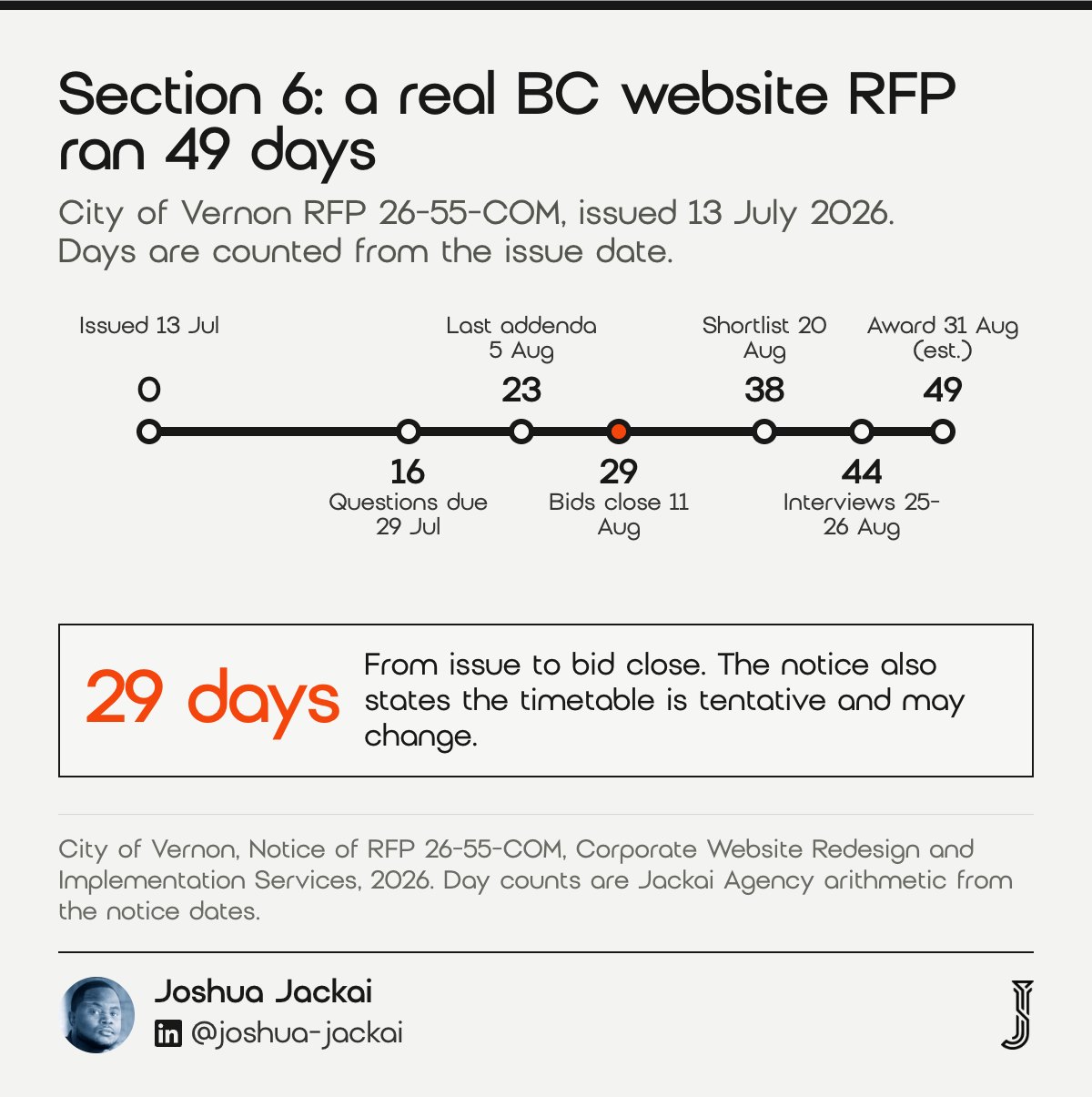
- Question deadline: the last day a vendor may ask, with answers shared with all
- Bid close: a date and a time, with the time zone
- Shortlist: the day you pick up to three finalists
- Interviews: a date range, so vendors can plan
- Award and launch: an estimated award date and a target launch
The City of Vernon in British Columbia issued RFP 26-55-COM for a corporate website redesign on 13 July 2026. Questions closed on 29 July, the last addenda went out on 5 August, bids closed on 11 August at 2:00 pm Pacific, shortlisted proponents presented on 25 and 26 August, and an award was expected on 31 August (City of Vernon, 2026). That is 29 days from issue to bid close and 49 days to expected award. The notice also says the timetable is tentative and may change, and I would add that line to yours. A private company can move faster, but giving vendors under 2 weeks to answer a 10 page RFP tends to produce thinner proposals, in my experience. Count backward from your own deadline. If the site must launch before a trade show in May, award in February, and give vendors time to bid well. Say how long your own reviews take, since in my experience late feedback from the buyer is a common cause of delay.
“Publish the bid dates first and the project dates second,” Joshua Jackai, Vancouver web designer, wrote.
7. What should vendors have to send back?
A response format tells vendors what each proposal must contain and in what order. When every proposal has the same parts, you can score them side by side. Ask for a team, a plan, similar work, references and the price table, with page limits so that length does not decide the result.
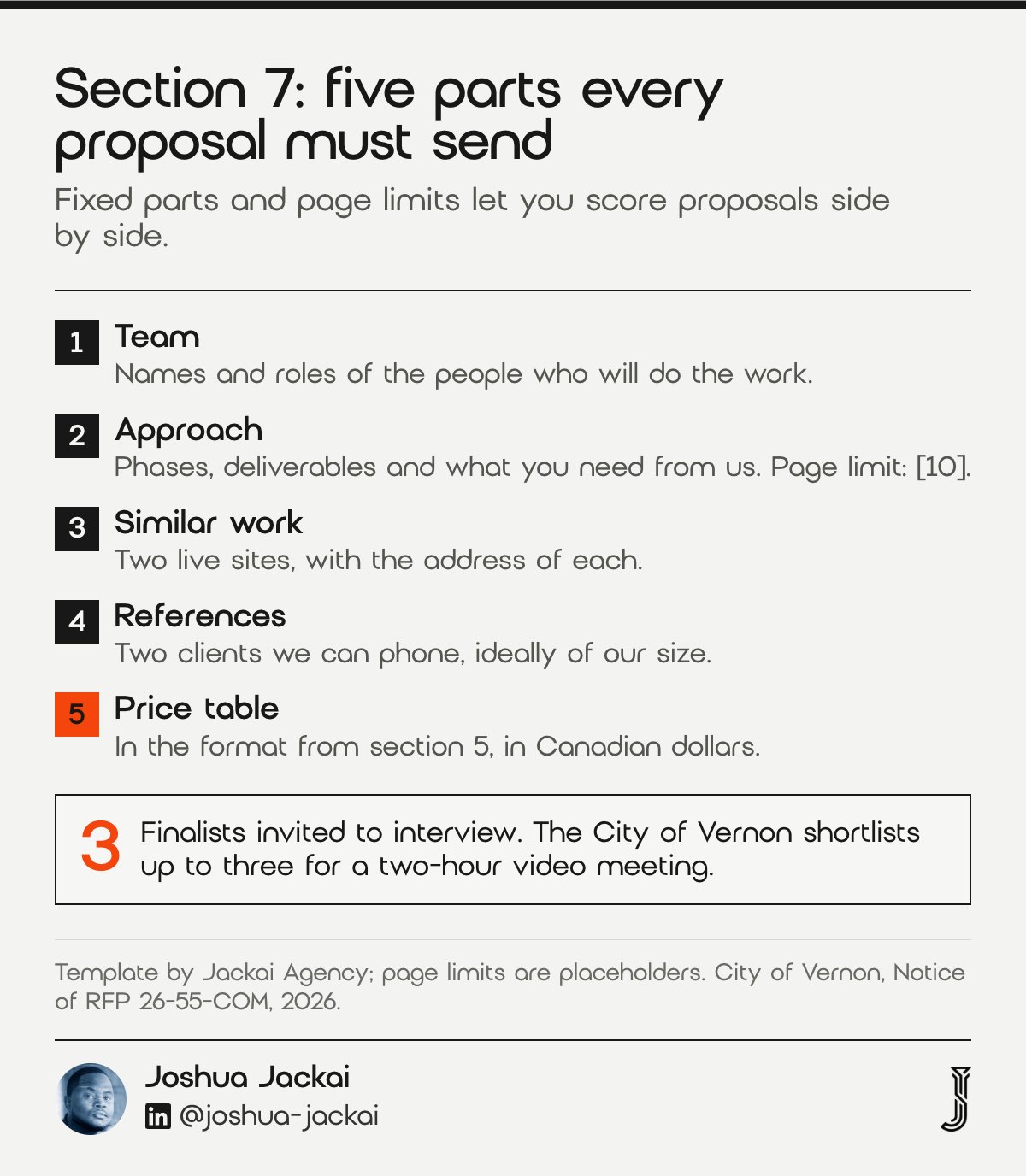
- Team: names and roles of the people who will do the work
- Approach: phases, deliverables and what you must supply
- Similar work: 2 live sites, with the address of each
- References: 2 clients you can phone, ideally of your size
- Price table: your format from section 5, in CAD
Keep the shortlist small. The City of Vernon shortlists up to 3 proponents for a two-hour video interview, and I think that is about right for a private buyer too. Ask finalists the same questions. Poppo and Zenger studied information service exchanges and found that formal contracts and relational governance work as complements (Poppo and Zenger, 2002), and my reading is that a reference call about how a vendor handled a problem is worth asking in addition to the contract terms. Set page limits on every part, such as 10 pages for the approach and 2 for each reference. Say how proposals must be sent and whether vendors may offer alternatives to your plan. Ask them to confirm that the people named will do the work, not only sell it. Ask finalists the same questions in the same order, and score each answer on the day, while it is fresh.
“formal contracts and relational governance function as complements,” Poppo and Zenger wrote in the Strategic Management Journal, 2002.
8. How should you score the proposals?
Scoring is the written rule for how proposals are judged: a short list of criteria, a weight for each, and a score from 1 to 5. Publish the criteria in the RFP so vendors know what counts. Weights should add to 100, and price should be one criterion, not the tie-breaker.
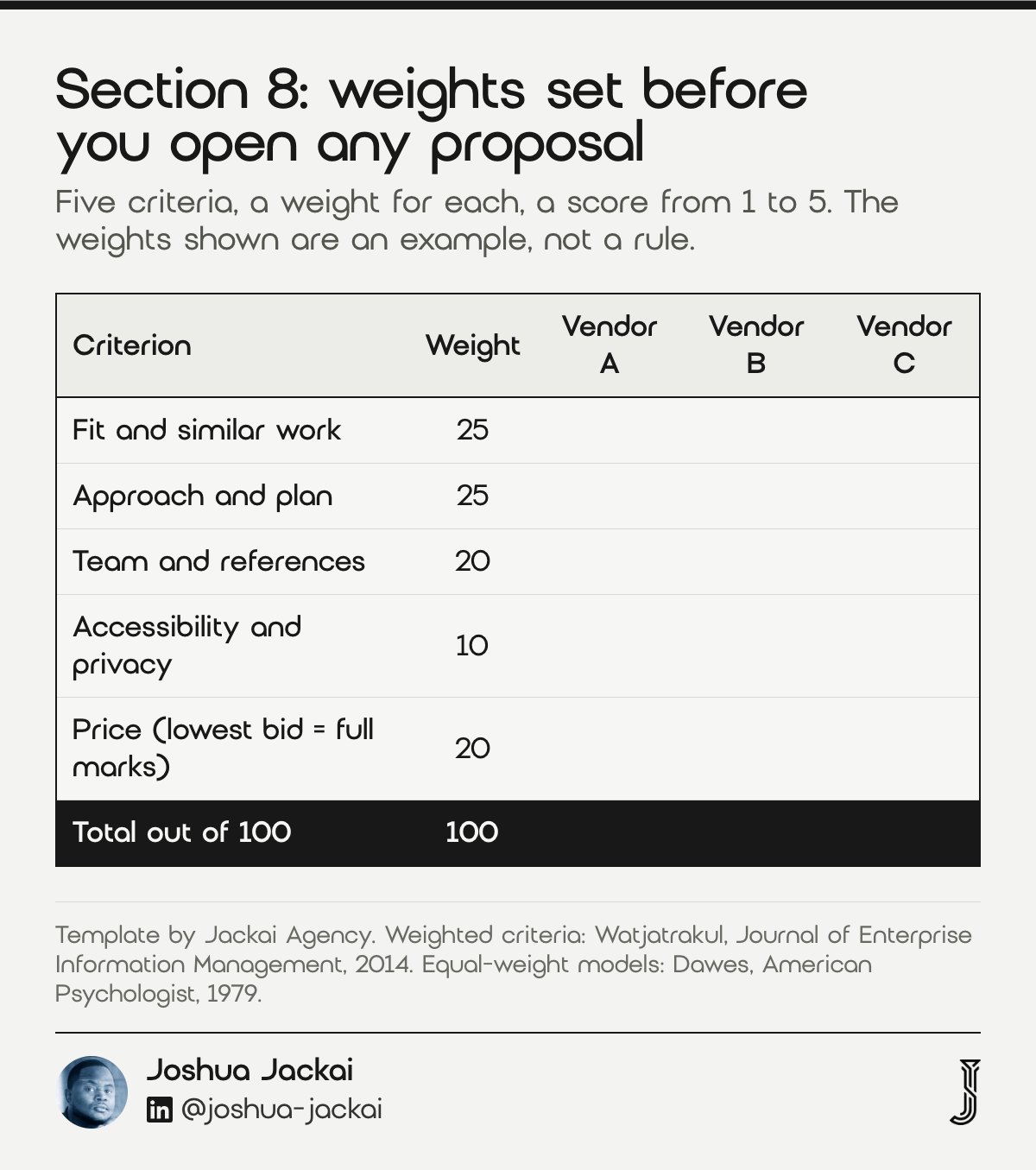
- Fit and similar work: for example 25 points
- Approach and plan: for example 25 points
- Team and references: for example 20 points
- Accessibility and privacy answers: for example 10 points
- Price: for example 20 points
Weights change outcomes, so set them before you open any proposal. Watjatrakul tested two weighted-criteria methods for choosing IT outsourcing vendors, in which the lowest bid receives the highest price score or the average bid receives the middle score, and reported that the proportions of qualification and price weights affect the selection results (Watjatrakul, 2014). Dawes showed that simple equal-weight models can come close to models with fitted weights (Dawes, 1979). I use 5 criteria with the example weights shown here, and I would not spend long agreeing them. The price score gives the lowest bid full marks: lowest bid divided by this bid, times the price weight. The scoring tool in this guide does that sum for you, with weights you can change. Write one line per criterion saying what a 1, a 3 and a 5 looks like. Have two people score alone, then compare, and talk about the differences before you add anything up. Keep the notes, because they let you tell the vendors that lost why.
“the proportions of qualification and price weights affect the selection results,” Watjatrakul reported in the Journal of Enterprise Information Management, 2014.
RFP, RFQ or RFI: which one fits a website redesign?
An RFP asks vendors to propose an approach and a price. An RFQ asks for a price on a defined list, and an RFI asks for information before you decide what to buy. For a redesign where the approach matters, an RFP is the usual choice. Procurement bodies define these terms in their own policies, so check yours.
An RFQ suits a small, well-defined job, such as a landing page with a fixed page list. An RFI suits the stage before that, when you do not yet know whether the project should be a redesign, a rebuild or a migration. The City of Vernon’s notice asks for redesign, development, implementation and post-launch support in one proposal, which is the kind of scope where an RFP fits. These are common usage and my own reading, not a legal definition, and public bodies in Canada follow trade agreements and policies that private buyers do not. A private company can use any of the three, and I would pick the RFP once the goals in section 1 are written.
Copy and paste this website redesign RFP template
This skeleton follows the 8 sections in the order a vendor reads them. Replace every bracket with your own text, delete what does not apply, and keep the whole document to 8 to 15 pages. The Copy button puts the text on your clipboard.
Compare the 8 RFP sections and filter by risk
This section lets you sort the 8 sections by the risk each one reduces. Pick a risk, and the table hides the sections that do not address it. The time ratings are my own estimates from client work, not measured data. Clear the filter to see all 8 sections again.
| Section | Risks it reduces | Time (my estimate) | You hold |
|---|---|---|---|
| 1. Goals and background | Scope, wasted time | 60 minutes | A one-page goal list with a baseline |
| 2. Scope | Scope, cost | 90 minutes | A template list with page counts |
| 3. Technical rules | Lost traffic, ownership | 45 minutes | A URL map and ownership terms |
| 4. Canadian requirements | Compliance, cost | 30 minutes | Named standard, privacy answers, CAD and GST |
| 5. Budget format | Cost | 30 minutes | One price table for every vendor |
| 6. Timeline | Wasted time | 20 minutes | Dates for questions, bids and award |
| 7. Response format | Hard comparison | 30 minutes | A fixed list of proposal parts |
| 8. Scoring | Hard comparison, cost | 45 minutes | Weights and a 1 to 5 scale |
Score your proposals with weights you set
Enter a weight for each criterion, a score from 1 to 5 for each vendor and each bid price in CAD. The tool gives the lowest bid full price marks, scales the others and adds the totals. The defaults are placeholders. A gap of under 5 points out of 100 means the proposals are close, and the interviews should decide.
Weights add to 100. Score each criterion from 1 to 5. Defaults are placeholders, not recommendations.
| Criterion | Weight | Vendor A | Vendor B | Vendor C |
|---|---|---|---|---|
| Fit and similar work | ||||
| Approach and plan | ||||
| Team and references | ||||
| Accessibility and privacy answers | ||||
| Price (bid in CAD) |
Frequently asked questions about a website redesign RFP in Canada
These are the questions people ask most when they search for a website redesign RFP example, answered in the same terms as the 8 sections. Each answer stands alone, so you can read only the one you need, and the scoring tool above uses the same price formula as the answer on proposals.
How do I write an RFP for a website redesign?
Write 8 sections: goals, scope by page type, technical rules, Canadian requirements, a price format, a timeline, a response format and a scoring rule. I suggest sending it to 3 to 5 vendors, with a question deadline about 2 weeks after issue. The City of Vernon used 16 days.
What is the difference between an RFP and an RFQ?
An RFP asks vendors to propose an approach and a price, so it suits a redesign where the approach matters. An RFQ asks for a price on a list you have defined, so it suits a small, fixed job. Check your procurement policy, because bodies define terms differently.
How much does a website redesign cost in Canada?
One Toronto-focused agency blog gives CA$9,000 to CA$22,000 for a well-scoped small business site, which is a vendor estimate (Kolonell, 2026). My fixed prices run from CA$4,950 for five pages to CA$10,495 for 8 to 15 pages. Compare line items, not totals, because pages, platform and content change the price.
How long should a website redesign take?
The same agency blog says 6 to 10 weeks for a well-scoped small business site. My small business package takes 2 to 3 weeks, counted from the day your text and images arrive. Ask what the clock starts from, the signing or the content.
How do I redesign a website without losing SEO?
Ask for a URL map, permanent redirects and a Search Console review as named deliverables. Google's site move guidance lists the same steps: map current URLs to new ones, redirect, and monitor traffic on both (Google Search Central). Put an owner on each step.
Who sets this up for you
I am Joshua Jackai, founder of Jackai Agency in Vancouver. I design, build and migrate websites for Canadian B2B companies on fixed quotes, and you own the site, the domain and the hosting. If you already hold proposals, the CA$995 website audit reviews your site and their quotes.
The audit is credited in full if a project starts within 30 days.
My custom B2B websites start at CA$7,450, described on the B2B web design in Vancouver page. To see how answer engines read your site before you write the RFP, start with the free AI visibility report.
Sources
Peer reviewed
- Ferreira, S., Shunk, D., Collofello, J., Mackulak, G. and Dueck, A. (2010). Reducing the risk of requirements volatility: findings from an empirical survey. Journal of Software Maintenance and Evolution: Research and Practice. doi.org/10.1002/smr.515
- Gopal, A., Sivaramakrishnan, K., Krishnan, M. S. and Mukhopadhyay, T. (2003). Contracts in offshore software development: an empirical analysis. Management Science. doi.org/10.1287/mnsc.49.12.1671.25120
- Gopal, A. and Sivaramakrishnan, K. (2008). On vendor preferences for contract types in offshore software projects: the case of fixed price vs. time and materials contracts. Information Systems Research. doi.org/10.1287/isre.1070.0162
- Dey, D., Fan, M. and Zhang, C. (2010). Design and analysis of contracts for software outsourcing. Information Systems Research. doi.org/10.1287/isre.1080.0223
- Giannoumis, G. A. (2015). Auditing Web accessibility: the role of interest organizations in promoting compliance through certification. First Monday. doi.org/10.5210/fm.v20i9.6167
- Poppo, L. and Zenger, T. (2002). Do formal contracts and relational governance function as substitutes or complements? Strategic Management Journal. doi.org/10.1002/smj.249
- Watjatrakul, B. (2014). Vendor selection strategy for IT outsourcing: the weighted-criteria evaluation technique. Journal of Enterprise Information Management. doi.org/10.1108/jeim-04-2012-0015
- Dawes, R. M. (1979). The robust beauty of improper linear models in decision making. American Psychologist. doi.org/10.1037/0003-066X.34.7.571
Industry, government, vendor and company pages (not peer reviewed)
- City of Vernon (2026). Notice of Request for Proposal 26-55-COM, Corporate Website Redesign and Implementation Services, public bid notice, read 23 October 2026.
- Google Search Central. Site moves with URL changes, read 23 October 2026.
- W3C. Web Content Accessibility Guidelines 2.2. Government of Canada. Accessible Canada Act. Government of British Columbia. Accessible British Columbia Act. Office of the Privacy Commissioner of Canada. PIPEDA.
- Kolonell (2026). Website redesign RFP checklist for SMEs in Toronto, an agency blog; cost and timeline figures are one vendor's estimates.
- Search results for "website redesign rfp template canada" and "website redesign rfp example", read 23 October 2026, including guides from Webstacks, Emulent and Thomas Digital, all agencies promoting their own services.
- Jackai Agency price table, October 2026 (first-party prices, CAD). Time estimates in the section table are my own judgment from client work, not measured data.