A practice manager in Seattle fills in a consultancy’s contact form on a Friday. The page says thanks. The alert goes to an inbox nobody checks. By Tuesday she has hired someone else. No headline test would have saved that lead, and that gap is where conversion rate optimization on B2B sites usually goes wrong.
Most conversion rate optimization advice starts with the page: a new hero, a new button, a shorter form. Sometimes that’s right. More often the leak sits underneath, in the platform the site runs on and the path a lead takes to your sales team.
I design and build sites for B2B and professional-service firms, with clients in Vancouver, Seattle, the UK, Arizona and Florida. WordPress, HubSpot, Framer and Shopify each break that path in their own way. This post covers the platform fixes and the page fixes, in the order I make them.
In this guide
What does conversion rate optimization mean for a B2B services firm?
Conversion rate optimization is the work of raising the share of visitors who take the step your business needs next. For a consultancy, a law firm or a B2B software company, that step is rarely a purchase. It’s a first conversation with someone your sales team wants to talk to.
So the definition comes from your own sales process, not from a benchmark. Before I change anything, I ask whoever takes the first call: what makes a lead worth an hour of your time? The answer becomes the rule for counting qualified leads.
Then I count four numbers on the service pages. Here’s a made-up example. The pages get 1,500 visits a month. Thirty people submit a form, so form conversion is 2%. Sales accepts 12 of them as qualified leads, which is 0.8% of visits. Eight book a first meeting.
Each gap points at a different fix. Low form conversion is a page or form problem. A big drop from submissions to qualified leads means the page attracts the wrong people. A drop from qualified leads to meetings points at follow-up, which is a platform and process problem, not a design one.
That’s why a change that doubles form fills and halves lead quality is a loss. The number that pays your invoices is qualified leads who become meetings.
Why start conversion rate optimization with the platform, not the page?
Platform faults hit every page at once, and they hide. A broken form alert, a missing source field or a slow load on phones hurts the homepage, the service pages and the campaign pages alike. Teams rarely notice, because few people fill in their own forms on a phone.
They also wreck measurement. If the form loses one lead in five, every conversion rate optimization test you run is measured through a leak. You can’t tell a better headline from a lucky week.
I know what losing measurement costs. W Communications, a Seattle communications and speaking practice, had four audiences arriving at one homepage. I rebuilt the WordPress site so each audience gets its own path. No analytics survived the rebuild, so the W Communications case study carries no result number.
So my order is fixed: four platform checks, then four page checks.
- The form reaches a person. Every form submits, sends and lands where someone reads it.
- The lead carries its source into the CRM, with the page it converted on.
- The pages load fast on a phone.
- Your team can edit without a developer.
- The first screen offers one next step.
- Proof sits beside the claim it backs.
- Service pages state scope, process and a price signal.
- The ask matches how you sell.
The first three are conversion rate optimization inside the platform you already pay for. The fourth can mean a rebuild.
How do you fix form conversion on WordPress, HubSpot, Framer and Shopify?
On a B2B site, conversion rate optimization starts with a test anyone can run. Submit every form from a phone, with a personal email address, and time how long the alert takes to reach a person. I do this on every audit. Form conversion fails differently on each platform:
- WordPress. A fault I check for first: form plugins sending alerts through the web server’s own mail, which spam filters distrust. Use a proper email sending service, and store every entry so a lost alert isn’t a lost lead.
- HubSpot. Native forms create a contact with its source attached. The usual faults are too many fields and no workflow alerting an owner.
- Framer. The built-in form can email you, but a CRM needs the data passed on. Embed the CRM’s own form or send Framer’s form through a webhook, then test that the source fields arrive.
- Shopify. The theme’s contact form emails the store inbox. That’s fine for order questions and weak for a service enquiry, which needs a brief and a source.
Then cut fields. Ask for what sales needs to prepare the first call: name, work email, company and one open question about the problem. Let the first call sort qualified leads from the rest, not a long form.
Check how the form shows mistakes. In two studies with 77 and 90 participants, showing errors after people finished the form worked better than flagging them instantly, and people often ignored the instant messages (Bargas-Avila et al., 2007). Fill yours in wrong on purpose and see what happens.
Check the phone layout too. In data from a microblogging service, browsing cost more effort on phones, and links at the top of the screen were especially likely to be clicked there (Ghose et al., 2013). Keep the form or its button near the top.
The clearest form result I can point to is Y Scouts, an executive search firm in Scottsdale running WordPress and HubSpot together. The capture path behind its free book wasn’t wired, so I rebuilt it in HubSpot with automated delivery and UTM tracking. The Hiring on Purpose funnel converts visitors to leads at 17.7% (166 of 938), measured in the client’s HubSpot. My work contributed to that rate. The content belongs to the founder and her consultants.
What should happen between the form and the CRM?
A submitted form is half a conversion. The other half is a lead record sales can act on: who it is, what they asked, where they came from and which page they converted on. When that record arrives empty, nobody can tell which work produced the qualified leads.
The lead attribution method I install fixes this as a chain. Every link you control carries UTM tags. A small script stores the first source and landing page in the visitor’s session. Hidden fields pass those values into the CRM. AI referral traffic from tools like ChatGPT gets its own channel instead of hiding in “direct”.
The platform decides how much wiring that takes. HubSpot forms write straight to HubSpot contacts. On WordPress, a form plugin needs a connector, and each hidden field is mapped by hand. Framer and Shopify need a webhook or an embedded CRM form. Miss one link and the chain breaks. My GA4 lead tracking guide covers the analytics side.
Then route the lead: an owner, an alert and a reply inside one business day, the standard I hold my own practice to. A fast page that hands a lead to a slow inbox still loses it. This is the least visible conversion rate optimization work, and the part sales notices first.
In a study of 337 companies in the European Union, the most successful setups had strong structural links between marketing and sales (Homburg et al., 2008). In a firm of 10 to 200 people, that link is a shared definition of qualified leads and a handoff that’s wired, not remembered.
How fast do your service pages need to load?
Fast enough that nobody waits. In an experiment, Nah found that people’s tolerable wait for information was about 2 seconds, and that progress feedback stretched it (Nah, 2004). Google’s guidance (industry data, not peer reviewed) calls Largest Contentful Paint, the moment the main content appears, good at 2.5 seconds or less.
Speed is conversion rate optimization for every page at once. I run the three busiest service pages through Google PageSpeed Insights on mobile, then look for the weight each platform tends to carry:
- WordPress: page builders that add layers of markup, plugins that load scripts on every page, uncompressed images and cheap hosting.
- HubSpot: heavy modules, embedded video and tracking scripts left over from past campaigns.
- Framer: large images, video backgrounds and scroll effects on the first screen.
- Shopify: app scripts still installed long after anyone used the app.
Chat widgets, cookie banners and heatmap tools sit on top of all four. Ask whether each one still earns its load time.
Scale makes it harder. For VTM UK, a B2B electronics distributor, I built a 1,546-item catalogue on WordPress and Elementor between February and May 2026. At that size, a script added for one page can load on every product page unless someone limits where it runs.
Who edits the site after launch, and why does it matter?
Conversion rate optimization is a cadence of small changes. If each change needs a developer ticket and a two-week wait, you’ll make three changes a year and learn almost nothing.
Snappy Kraken, a B2B FinTech SaaS selling marketing systems to financial advisors, had a roadmap bigger than its marketing team could build. I took the redesign from Figma to production on HubSpot CMS in 3 weeks: 6 pages on a design system the in-house team publishes with, no designer needed. The Snappy Kraken redesign influenced 7 figures of ARR (annual recurring revenue). Influenced, not attributed: sales, pricing and product moved in the same period.
Advisor Websites, a Vancouver SaaS platform for financial advisors, built every webinar replay page by hand, so marketing couldn’t publish one without a developer. I built the replay page as a template the team fills, inside a replay library. The Advisor Websites results, +58% organic traffic and +28% MQL (marketing-qualified lead) conversion, came from the replay library and opt-in templates.
The test: can a marketer swap a headline or publish a new service page in an afternoon without breaking the design? On WordPress I build reusable components with locked styles. On HubSpot, themes and modules do that job. My WordPress vs HubSpot comparison covers which suits which team.
Which page-level fixes come after the platform is sound?
Once leads arrive with their source, on fast pages your team can edit, page-level conversion rate optimization starts to pay back.
One next step on the first screen
Visitors judge a page before they read it. In studies by Lindgaard and colleagues, ratings of a homepage’s visual appeal after 50 milliseconds closely matched ratings after 500 milliseconds (Lindgaard et al., 2006).
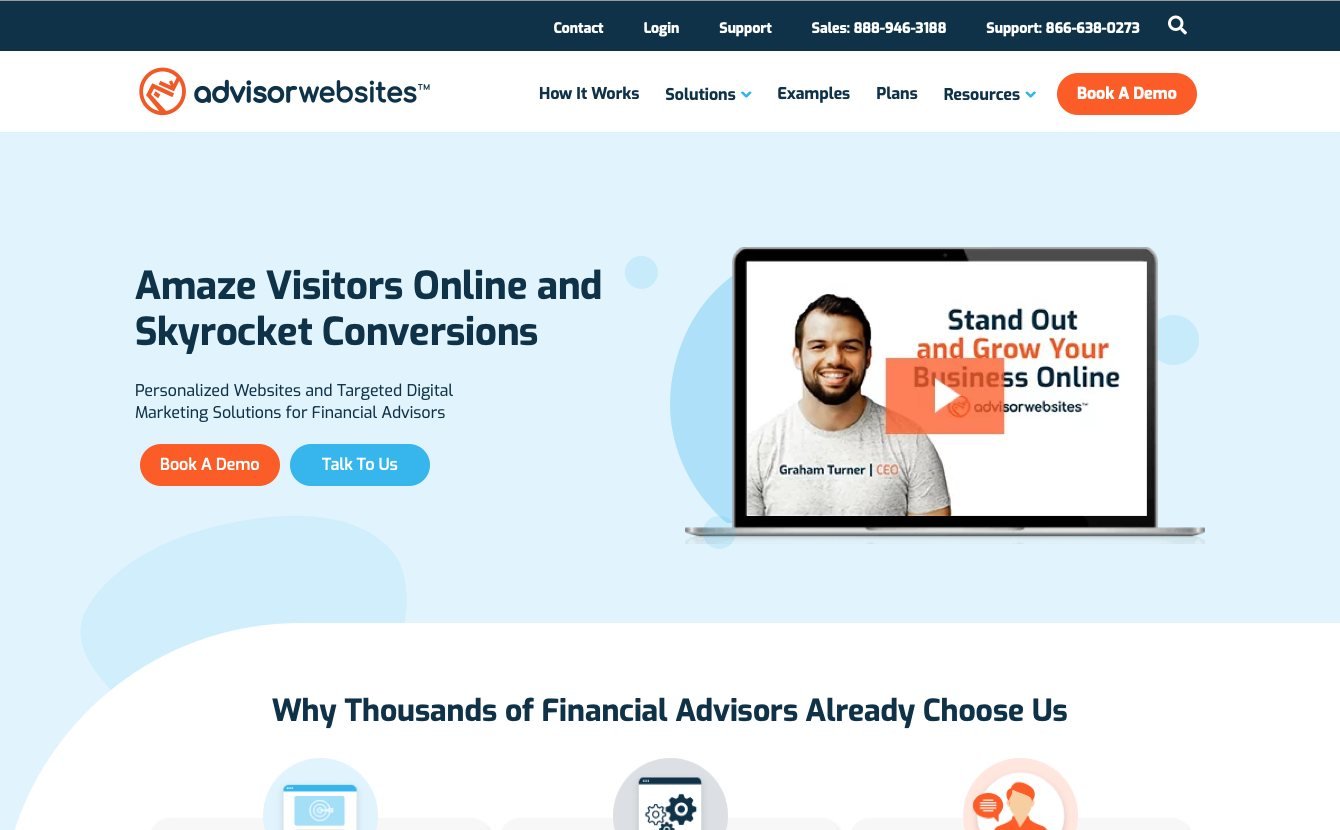
The Advisor Websites homepage had several competing actions and no route back to the webinar a visitor came from. The rebuild has 1 primary action and a visible route into the replay library. Fewer options help: Iyengar and Lepper found people were more likely to buy jams or chocolates from a set of 6 than from a set of 24 or 30 (Iyengar and Lepper, 2000).
The effect isn’t universal. A meta-analysis of 99 observations found choice overload depends on how complex the options are, how hard the decision is, how sure people are of what they want, and their goal (Chernev et al., 2015). A first-time buyer of professional services is often unsure. My guide to hero section design covers the first screen in detail.
Proof beside the claim it backs
On the W Communications biography page, the founder’s credential, former Starbucks senior vice president, sat below several paragraphs of story. I moved it above the story, into the first screen. If your page promises a six-week build, the evidence for six weeks belongs next to that sentence.
Service pages that state scope, process and a price signal
More than one person reads your service pages. In a study of purchases at 31 firms, the makeup of the buying group changed with what was being bought and how the company was organized (Johnston and Bonoma, 1981). Your champion forwards the page to people who never saw your ads.
So each service page should answer, in order: who it’s for, what’s included, how the work runs, roughly what it costs and what happens after the form. Rufous & Co, a Seattle interior design studio selling on Shopify, had a services page with no process or scope. The rebuilt Rufous & Co page states scope and process, then asks once, for the brief. No performance data was verified, so I claim no number.
Price is the part firms skip. Snappy Kraken’s old pricing page was a 3-column feature table with no sentence for a buyer who has to justify the number to a partner. The rebuild has 1 focal action per screen, plan differences written as sentences and the objection answered beside the price.
An ask that matches how you sell
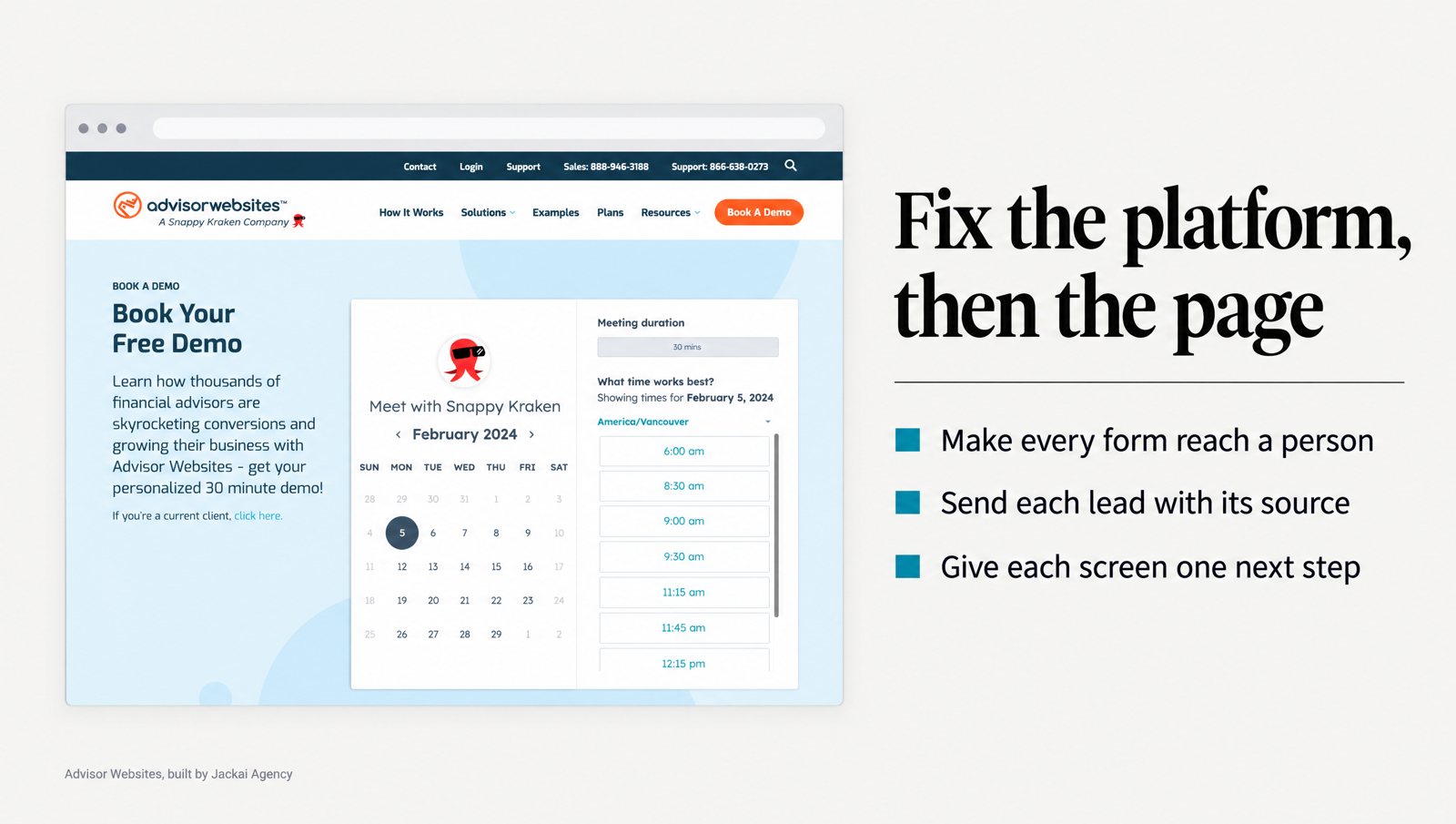
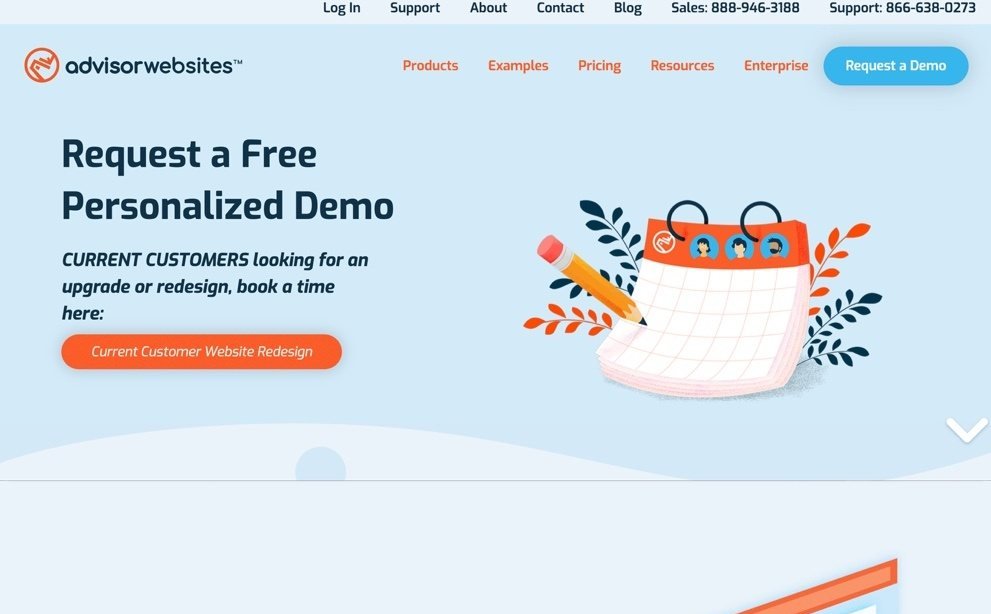
If your team sells on a first call, put a calendar on the page. The old Advisor Websites booking page asked for a decision before it gave a reason. I replaced the demo request form with real-time calendar booking, beside a CEO video and named testimonials. If you need a brief before you can quote, ask for the brief.
Paid traffic needs its own page. Copy Chief, a copywriting education business in St. Petersburg, Florida, runs on WordPress and ClickFunnels. On its Escape Velocity campaign, Meta ads into a mobile-first funnel, the landing page converted at 10.1%. Each acquisition cost $22 instead of $42. My B2B landing page anatomy walks through that kind of page.
How do you measure results against your own sales process?
Measure conversion rate optimization in the CRM, not in a page tool. Form conversion is the page’s number. Qualified leads and first meetings are the firm’s. Y Scouts’ 17.7% is read from the client’s own HubSpot dashboard, which is why I trust it.
Many B2B service pages lack the traffic for a clean A/B test, so I compare periods instead. Ship one meaningful change, hold it for a full sales cycle, then compare qualified leads with the same length of time before. Change three things at once and you won’t know which one worked.
Be honest about what the numbers can’t separate. At Y Scouts, inbound MQLs rose from 17 to 30 in Q3 2025 while a weekly video cadence ran, and my work contributed to that rise. When publishing paused in Q4, YouTube views fell back to 483 a month. Results belong to the period the work ran.
And if your service pages get a few hundred visits a month, conversion rate optimization alone won’t fill the calendar. That’s a demand problem. Seal the platform leaks, then buy traffic, and let your website ROI numbers pick the channel.
What does conversion rate optimization cost, and what would I skip?
Here’s how I match a symptom to a fix. Prices come from my current price table, in US dollars with Canadian dollars in brackets.
| What you see | Layer | First fix | Price |
|---|---|---|---|
| Sales says “we never got that enquiry” | Platform: form | Test, reroute and store every form entry | Care plan, CA$279/hr |
| Every lead’s source says “website” or “direct” | Platform: handoff | Lead Source Reporting, 2 weeks | CA$2,600 |
| Service pages are slow on phones | Platform: speed | Remove unused scripts, compress images, review hosting | Care plan, CA$279/hr |
| Every edit needs a developer | Platform: editing | Rebuild on components your team can edit, up to 5 pages | From CA$7,450 on Framer to CA$9,700 on HubSpot |
| Paid traffic has low form conversion | Page: campaign | Landing Page Design, 1 to 2 weeks | From CA$3,795 |
| You’re not sure where it breaks | Both | Website Audit, 1 week | CA$995 |
Project quotes are fixed, with two revision rounds per phase, and you own the site, domain and hosting. If the leak is in lead source tracking, that two-week job comes before any page work.
What I’d skip:
- Button color tests on pages with a few hundred visits a month. At that volume, a test needs months to show a difference you can trust.
- Exit pop-ups on phones. They cover the page the visitor came to read.
- A platform switch before the form works. Moving a leak keeps the leak.
- A rebuild without a measurement plan. If the old numbers don’t survive, you can’t show what changed.
Where is your site losing the lead?
None of the platform fixes here need more traffic. Same visitors. Same services. Same sales team. They need the path from form to first call to hold.
To find where yours breaks, the CA$995 Website Audit is a one-week read of your analytics and funnel, page by page. You get a ranked list of what’s costing you leads, with the reason for each item, plus a free AI Visibility Report. The fee is credited in full against a build (current terms on the offers page).
Sources
Peer-reviewed research
- Bargas-Avila, J. A., Oberholzer, G., Schmutz, P., de Vito, M., and Opwis, K. (2007). Usable error message presentation in the World Wide Web: Do not show errors right away. Interacting with Computers, 19(3), 330-341.
- Chernev, A., Böckenholt, U., and Goodman, J. (2015). Choice overload: A conceptual review and meta-analysis. Journal of Consumer Psychology, 25(2), 333-358.
- Ghose, A., Goldfarb, A., and Han, S. P. (2013). How is the mobile Internet different? Search costs and local activities. Information Systems Research, 24(3), 613-631.
- Homburg, C., Jensen, O., and Krohmer, H. (2008). Configurations of marketing and sales: A taxonomy. Journal of Marketing, 72(2), 133-154.
- Iyengar, S. S., and Lepper, M. R. (2000). When choice is demotivating: Can one desire too much of a good thing? Journal of Personality and Social Psychology, 79(6), 995-1006.
- Johnston, W. J., and Bonoma, T. V. (1981). The buying center: Structure and interaction patterns. Journal of Marketing, 45(3), 143-156.
- Lindgaard, G., Fernandes, G., Dudek, C., and Brown, J. (2006). Attention web designers: You have 50 milliseconds to make a good first impression! Behaviour and Information Technology, 25(2), 115-126.
- Nah, F. F.-H. (2004). A study on tolerable waiting time: How long are Web users willing to wait? Behaviour and Information Technology, 23(3), 153-163.
Industry and vendor data (not peer reviewed)
- Google, web.dev (checked October 2026). Largest Contentful Paint: sites should aim for 2.5 seconds or less.