
Conversion-Focused B2B Website Design in Vancouver and Canada
Conversion-focused B2B website design, built in Vancouver for Canadian companies
I design and build websites for B2B firms where the first screen says what you sell and to whom, proof sits beside every claim, the form asks only what you need, and every lead arrives in your CRM with its source. Fixed quote, in Canadian dollars.
Start with the CA$995 website audit
Recent B2B work: Snappy Kraken, Advisor Websites and Y Scouts.
What is a conversion-focused B2B website?
A conversion-focused B2B website is built around one job: turning the right visitors into qualified conversations with your sales team. Every page has a buyer, a question it answers, a piece of proof and one clear next step.
That sounds obvious. Most B2B sites I audit were built the other way round: a design system first, then pages filled with whatever copy the team had. They look fine and convert poorly, because nothing on them was decided by what a buyer needs to see before they book a call.
Clarity is not only a style preference. Research on processing fluency shows that people judge things they can take in easily more favourably, and read that ease as a sign that something is true and good (Reber, Schwarz and Winkielman, Personality and Social Psychology Review, 2004). A page that makes a buyer work to understand the offer is judged more harshly before your proof is even read.
So conversion-focused design changes the order of work. I start with research on your buyers, write the message and structure, design around that copy, then build and wire up the tracking. The design still matters; it just serves the decision instead of decorating it.
Why is my B2B website not generating leads?
Most B2B sites lose leads in the same five places: a first screen that does not say what you sell, proof that sits far from the claims, a form that asks too much, pages that load slowly on phones, and no record of where leads come from.
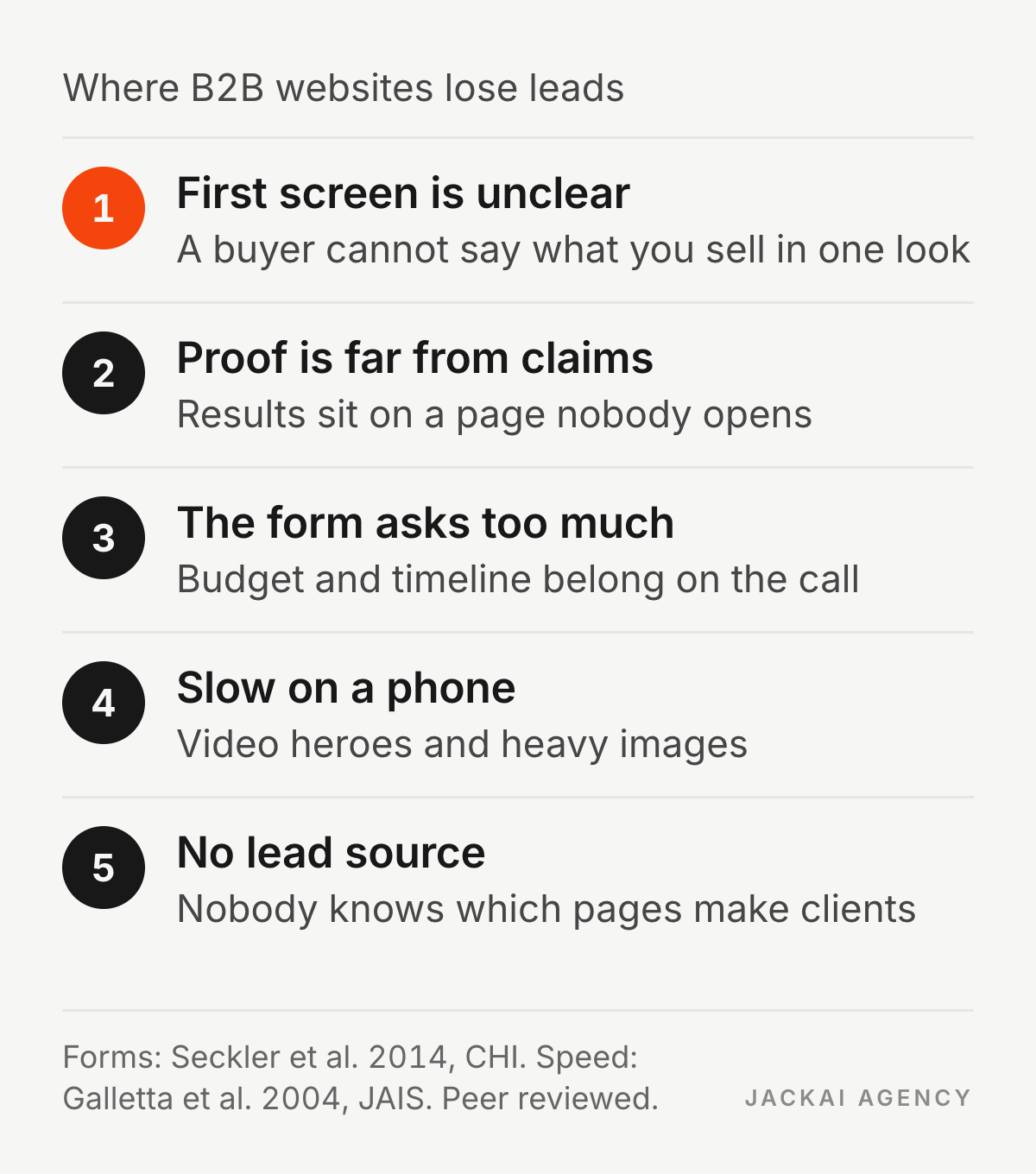
The first screen does not say what you sell
“Solutions that drive growth” could describe any company. A buyer should be able to say what you do, who it is for and what happens when they click, within one screen. I test this by showing the first screen to someone outside your industry for a few seconds and asking them to repeat it back.
Proof sits on a separate page
B2B buyers are spending company money and putting their name on the choice. When Fogg and colleagues asked 2,684 people to explain why they found a website credible, the design look of the site came up in 46.1% of the comments, more than any other factor (Fogg et al., Proceedings of DUX, 2003). Looks earn a first hearing. A named result beside the claim it supports does the rest. Put a client, a number and a timeframe next to every promise, not on a testimonials page nobody opens.
The form asks too much
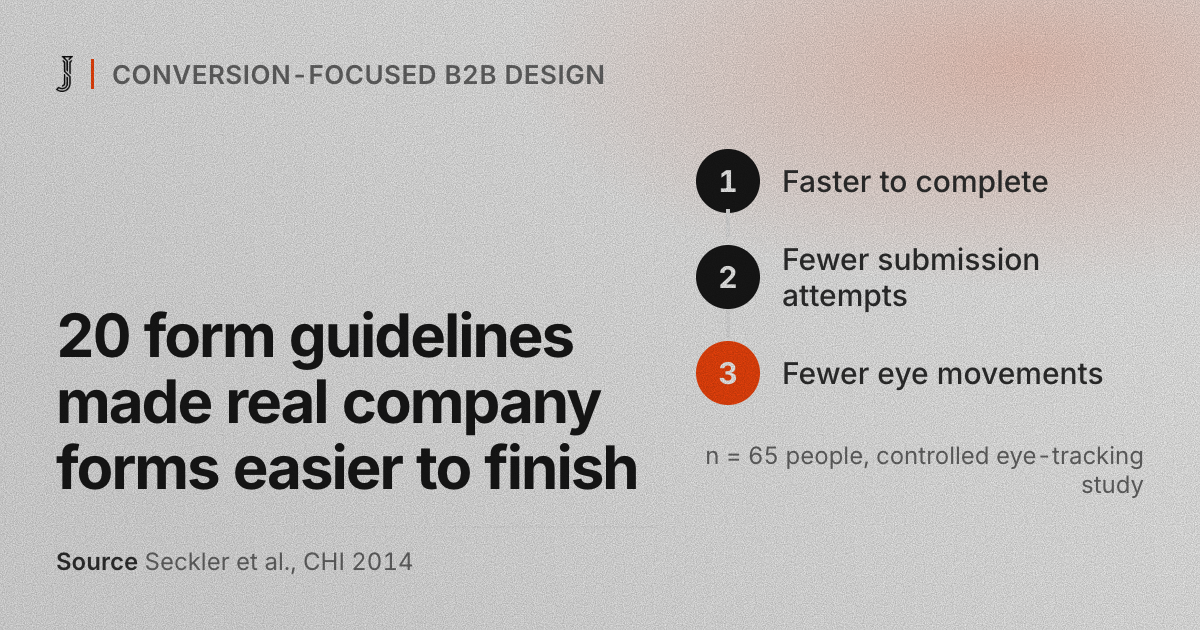
In a controlled eye-tracking study with 65 people, Seckler and colleagues applied 20 usability guidelines to forms taken from real company websites. The improved forms were completed faster, with fewer submission attempts and fewer eye movements, and people were more satisfied with them (Seckler et al., CHI 2014). On a B2B form I ask for name, work email, company and one question about the problem. Budget and timeline move to the call.
The pages are slow on a phone
Galletta, Henry, McCoy and Polak tested page delays from 0 to 12 seconds with 196 people working on search tasks. Longer delays lowered performance, attitudes and the intention to come back (Galletta et al., Journal of the Association for Information Systems, 2004). On B2B sites the usual causes are an autoplay hero video, uncompressed images and too many tracking scripts.
Nobody knows where the leads come from
If leads land in an inbox untagged, every change you make is judged on raw form fills. I set up lead source reporting so each enquiry carries its source, landing page and campaign into the CRM, with AI referrals from ChatGPT and Perplexity separated from direct traffic. My lead attribution method shows how it is wired.
What is a good conversion rate for a B2B website?
There is no single good number. Published benchmarks mix industries and count every form fill, including spam and job seekers. The rate that matters is your own last 90 days, split by traffic source, measured as qualified leads per visitor.
People often ask whether 2%, 2.5% or 3% is good. A 2% rate that produces qualified buyers beats a 6% rate full of students and vendors. So I track a short chain instead of one figure: visit to lead, lead to qualified, qualified to won, and revenue per visitor, which only rises when the whole chain improves.
For low-traffic B2B sites this matters even more. A firm with 2,000 visits a month cannot run a meaningful A/B test on a button colour, so the honest approach is to fix the obvious problems first and compare a full sales cycle before and after, by source. I covered the testing arithmetic for US firms in more depth on my B2B conversion rate optimization guide.
What is the difference between SEO and CRO?
SEO brings the right people to your site from search engines and AI answers. CRO, conversion rate optimization, turns more of those visitors into leads. On a B2B site they share the same pages, so I plan them together.
The overlap is bigger than most agencies admit. A page that answers a buyer’s question clearly, with proof and sources, tends to rank better, get cited more often by ChatGPT and Perplexity, and convert better, because all three reward the same thing: a specific answer a reader can trust. That is why every page I build is written to be quoted, and why AI visibility is part of my service list rather than an add-on.
How do you design a website for a B2B buying group?
You design for several readers at once. A B2B purchase usually involves someone who finds you, people who review you and someone who signs off, and each of them looks for different evidence on the same pages.
Johnston and Bonoma studied purchases of capital equipment and industrial services in 31 firms and found that who takes part in a purchase, and how they interact, changes with the kind of purchase and the structure of the buying firm (Johnston and Bonoma, Journal of Marketing, 1981). In practice that means a page needs proof for the operator who will use the work, the finance lead who approves it and the executive who carries the risk.
Trust plays a specific role. In a study of more than 200 purchasing managers, trust in a supplier and its salesperson shaped whether buyers expected to keep working with that supplier, but after controlling for past experience and supplier performance it did not decide the current choice (Doney and Cannon, Journal of Marketing, 1997). I read that as two jobs for a B2B site: show performance evidence to win the first project, and build the trust that keeps the relationship going.
- For the operator: what the work looks like, how long it takes, who does it.
- For the finance lead: a price range, contract length and what is included.
- For the executive: named results, with the client and the timeframe.
- For the reviewer who is not ready to talk: a lighter next step, such as a free report.
What does conversion-focused B2B web design include?
My projects run in five steps: buyer research, message and structure, design, build, and tracking. Each step produces something you can review before the next one starts, and the quote is fixed before any of it begins.
- Buyer research. I run user research on every project: interviews with your sales team and recent clients, a review of your CRM notes, and voice-of-customer mining from reviews and forums. The words buyers use become the words on the page.
- Message and structure. A page plan with one buyer, one question and one next step per page, plus the copy. I write the copy myself; you approve it before design starts.
- Design. Layouts built around the approved copy, phone first, in your brand.
- Build. Usually WordPress on Bricks, or HubSpot CMS, Framer or Shopify when that fits your team better. You own the site, the domain and the hosting.
- Tracking. Lead source reporting into your CRM, so you can see which pages and channels produce clients, not only clicks.
If you are not sure whether you need a rebuild, the CA$995 website audit is the place to start. It is a one-week teardown of your current site with a ranked list of fixes, and the fee is credited in full against a build. Current terms are on the offers page.
How much does conversion-focused B2B web design cost in Canada?
My custom B2B websites start at CA$7,450 on Framer and CA$8,950 on WordPress for up to five pages, with fixed quotes. Larger marketing sites of 8 to 15 pages start at CA$10,495.
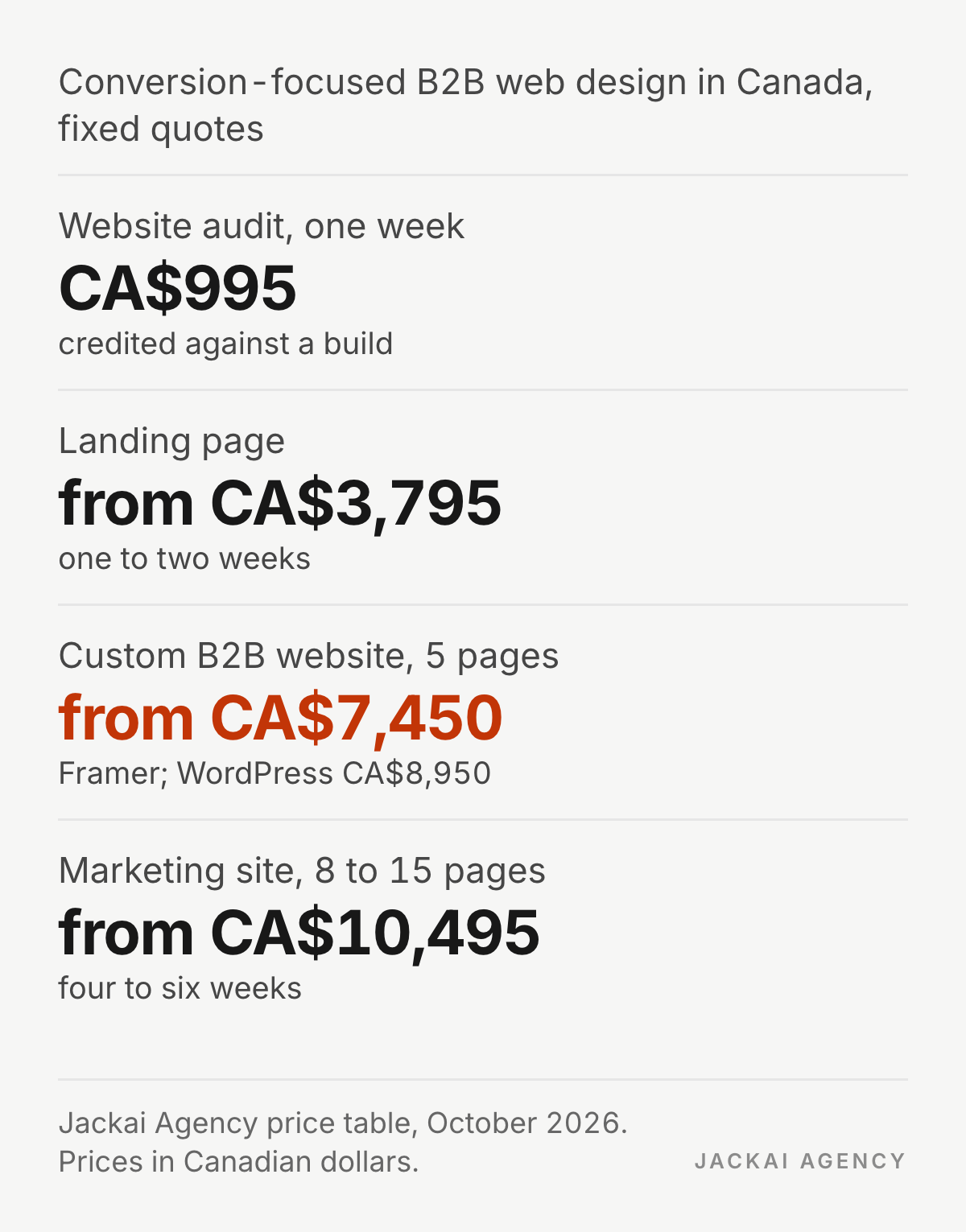
- Website audit, one week: CA$995, credited in full against a build.
- Landing page design, one to two weeks: from CA$3,795.
- Lead source reporting, two weeks: CA$2,600.
- Custom B2B website, up to 5 pages: from CA$7,450 on Framer; CA$8,950 on WordPress; CA$9,350 on Shopify; CA$9,700 on HubSpot.
- Custom B2B website plus 90 days of AI referral care: CA$10,050.
- Marketing site, 8 to 15 pages, four to six weeks: from CA$10,495.
Every quote includes two revision rounds per phase, and I reply within one business day. The pricing calculator gives a figure for your scope in about a minute.
What results has this work produced for B2B companies?
Three projects show the pattern: a clear message, proof beside claims, and a working path from page to sales team. Each result below names the client, and the caveat stays with the number.
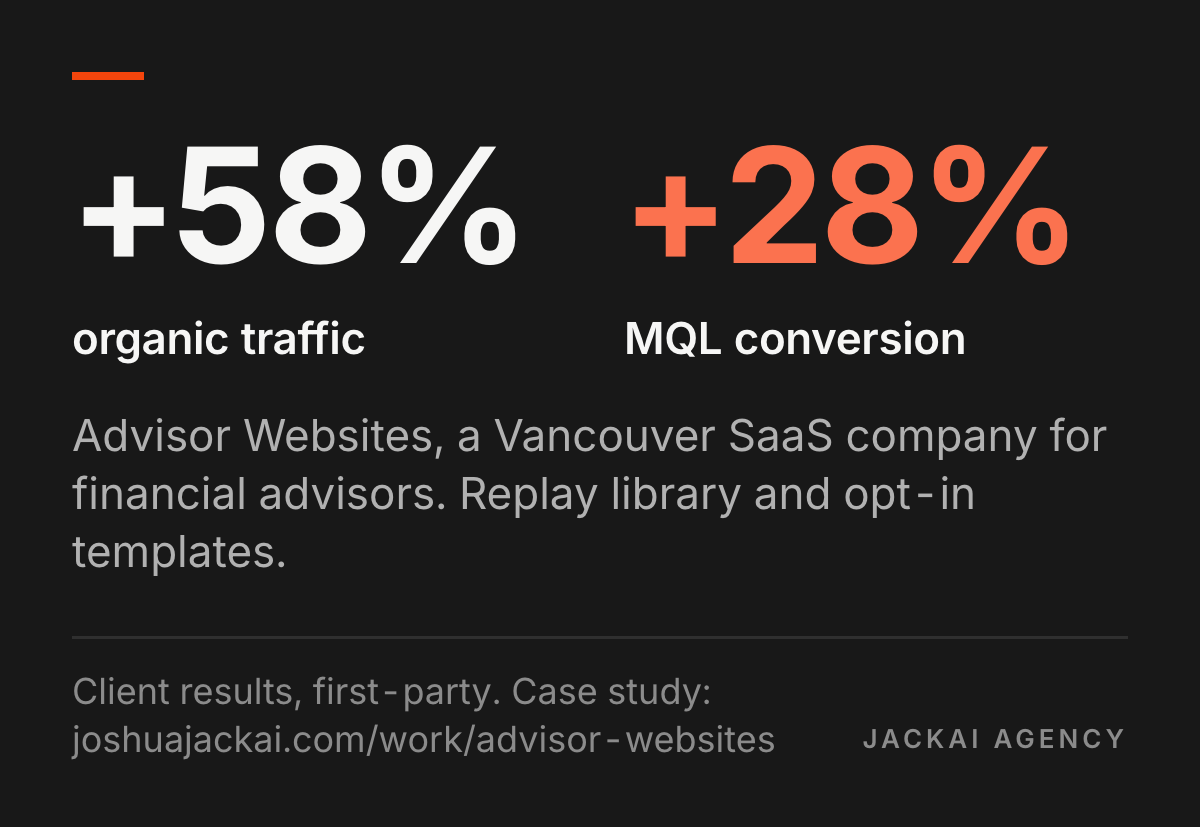
- Advisor Websites, a Vancouver SaaS company for financial advisors: organic traffic up 58% and MQL conversion up 28%, from the replay library and opt-in templates. Case study.
- Snappy Kraken, B2B software for financial advisors on HubSpot CMS: approved Figma designs to live pages in three weeks, with the marketing team editing inside the design system afterwards. The work influenced seven figures of ARR; influenced, not attributed, because sales, pricing and product changed in the same period. Case study.
- Y Scouts, executive search on WordPress and HubSpot: the Hiring on Purpose funnel converts 17.7% of visitors into leads (166 of 938, measured in the client’s HubSpot), with four form fields, one of them about the visitor’s problem. Case study.
How fast should you reply to a website lead?
As fast as you can, ideally within an hour. B2B buyers usually contact more than one firm, and the first useful reply often frames the whole conversation. A slow reply undoes the work the website did.
The “five minute rule” comes from industry studies of lead response, such as the Harvard Business Review analysis of online sales leads by Oldroyd, McElheran and Elkington (2011), which found that firms replying within an hour were far more likely to qualify the lead than firms that waited longer. That is industry research, not a peer-reviewed study, so I treat it as a direction rather than a precise number.
On the site side I set up three things: an instant confirmation email that says who will reply and when, a calendar link for buyers ready to book, and an alert to whoever handles new leads.
How long does a B2B website redesign take, and will I lose SEO?
A five-page custom B2B site takes two to three weeks once the content is ready; a marketing site of 8 to 15 pages takes four to six weeks. You keep your search rankings if every old URL is mapped and redirected before launch.
Most lost rankings after a redesign come from changed URLs without 301 redirects, deleted pages that had links pointing to them, and titles rewritten without checking which queries they ranked for. Before launch I export every URL with traffic or links, map each one to its new page, keep the pages that rank, and check Search Console for errors in the first weeks after launch.
If your current site mostly works and only a few pages leak, you may not need a full redesign. The audit tells you which it is.
What is the 3 second rule in website design?
It is the idea that visitors decide in about three seconds whether to stay. The visual judgement is faster than that: in one study people rated a page’s visual appeal after seeing it for 50 milliseconds.
Lindgaard, Fernandes, Dudek and Brown found that those 50 millisecond ratings matched the ratings people gave after a longer look (Lindgaard et al., Behaviour & Information Technology, 2006). The look of a page sets expectations before a word is read. The words then have a few seconds to confirm that the visitor is in the right place, which is why I write the first screen before I design it.
Conversion-focused B2B web design in Vancouver and across Canada
I am based in Vancouver, BC, and work with B2B companies across Canada, mostly remotely. Most clients are SaaS, clean-tech, professional services and financial advisory firms with 10 to 200 staff.
Quotes are in Canadian dollars and calls happen in Pacific time. I also work with firms in the US and the UK, but this page is written for Canadian buyers. If you are looking for a broader Vancouver service page, see B2B web design in Vancouver or web design in Vancouver.
Frequently asked questions
How long does a B2B website redesign take?
A five-page custom B2B site takes two to three weeks from approved content. A marketing site of 8 to 15 pages takes four to six weeks. Research and copy add about a week before design starts.
How much does B2B website design cost in Canada?
My custom B2B websites start at CA$7,450 on Framer and CA$8,950 on WordPress for up to five pages, with a fixed quote. Marketing sites of 8 to 15 pages start at CA$10,495. A one-week audit costs CA$995 and is credited against a build.
What platform do you build on?
Mostly WordPress on Bricks. I also build on HubSpot CMS, Framer and Shopify when that suits the team who will edit the site. You own the site, the domain and the hosting either way.
Can you improve our existing website, or do we need a full redesign?
Often the existing site can be fixed. The audit ranks the problems by how many leads they likely cost; if the message, structure and proof all need work, a rebuild is cheaper than patching. If only a few pages leak, I fix those.
What makes B2B web design different from B2C?
B2B purchases involve several people and long sales cycles, so a B2B site has to persuade a group over weeks, not one person in one visit. It needs proof for each role, a price range, and a lighter next step for people who are not ready to talk.
Do you write the copy as well as design the site?
Yes. I run the buyer research and write the copy myself, and you approve it before design starts. Copy written from real buyer language is the biggest single difference between a site that looks good and one that converts.
Do you work with companies outside Vancouver?
Yes. Most of my work is remote, with clients across Canada, the US and the UK. Quotes on this site are in Canadian dollars; calls are scheduled in Pacific time.
What is the first step?
Request the free AI Visibility Report or book the CA$995 website audit. The audit gives you a ranked list of fixes within a week, whether or not you hire me to make them.
Sources
Peer-reviewed research
- Doney, P. M. and Cannon, J. P. (1997). An examination of the nature of trust in buyer-seller relationships. Journal of Marketing, 61(2), 35 to 51. doi.org/10.1177/002224299706100203
- Fogg, B. J., Soohoo, C., Danielson, D. R., Marable, L., Stanford, J. and Tauber, E. R. (2003). How do users evaluate the credibility of Web sites? Proceedings of the 2003 Conference on Designing for User Experiences. doi.org/10.1145/997078.997097
- Galletta, D. F., Henry, R., McCoy, S. and Polak, P. (2004). Web site delays: How tolerant are users? Journal of the Association for Information Systems, 5(1). doi.org/10.17705/1jais.00044
- Johnston, W. J. and Bonoma, T. V. (1981). The buying center: Structure and interaction patterns. Journal of Marketing, 45(3), 143 to 156. doi.org/10.1177/002224298104500312
- Lindgaard, G., Fernandes, G., Dudek, C. and Brown, J. (2006). Attention web designers: You have 50 milliseconds to make a good first impression! Behaviour & Information Technology, 25(2). doi.org/10.1080/01449290500330448
- Reber, R., Schwarz, N. and Winkielman, P. (2004). Processing fluency and aesthetic pleasure: Is beauty in the perceiver’s processing experience? Personality and Social Psychology Review, 8(4). doi.org/10.1207/s15327957pspr0804_3
- Seckler, M., Heinz, S., Bargas-Avila, J. A., Opwis, K. and Tuch, A. N. (2014). Designing usable web forms: Empirical evaluation of web form improvement guidelines. Proceedings of the SIGCHI Conference on Human Factors in Computing Systems. doi.org/10.1145/2556288.2557265
Industry and first-party sources (not peer reviewed)
- Oldroyd, J. B., McElheran, K. and Elkington, D. (2011). The short life of online sales leads. Harvard Business Review, March 2011. Industry source, not peer reviewed.
- Jackai Agency price table, October 2026, and client results from the linked case studies (first-party).
Find out where your site loses leads
The CA$995 audit is a one-week teardown of your current site with a ranked list of fixes. The fee is credited in full if we build together.
Or get the free AI Visibility Report. Replies within one business day.
