CEO Personal Website Design: 8 Proven Essentials
Eight things every Canadian CEO personal website needs: a domain in your name, a clear first screen, a real headshot, a bio built from checkable facts, a dated writing list, sorted contact routes, disclosure guardrails for listed companies, and markup that search tools read, with my CAD prices.
 Joshua Jackai
18 min read
Published 27 November 2026 · Last updated and fact-checked November 2026
I am a web designer, not a lawyer or a securities adviser. If you lead a listed company, run the plan past your general counsel and your disclosure committee.
Short answer: Good CEO personal website design gives people who search your name one page you control: who you are, what you lead, proof they can check, and the right way to reach you. A well-regarded CEO helps the company’s reputation. My fixed builds for Canadian executives start at CA$4,950 for up to 5 pages.
Founders and chief executives in Vancouver ask me a version of the same question: do I need a site of my own, or is the company site and LinkedIn enough? My honest answer is that most of them need one small, plain site, and that the design work is mostly about what to leave out. This guide gives you the eight things I put on every CEO personal website, with the study, the policy or the Google document behind each one.
In this guide
Key takeaways
- In a study of CEOs and firm reputation, highly regarded CEOs raised their firms’ reputations, negative press about a CEO hurt them, and “CEO prominence alone is not associated with higher firm reputation” (Love, Lim and Bednar, 2017).
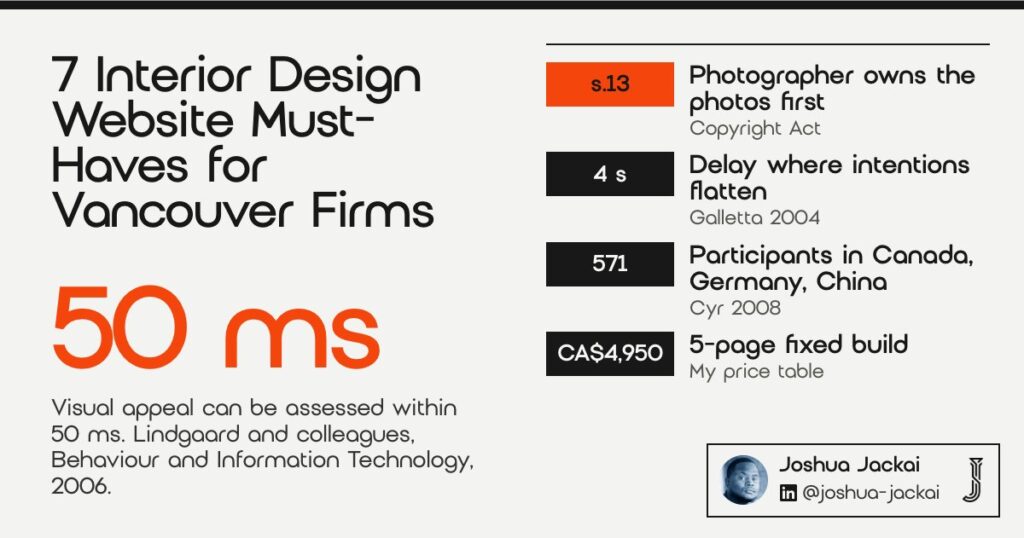
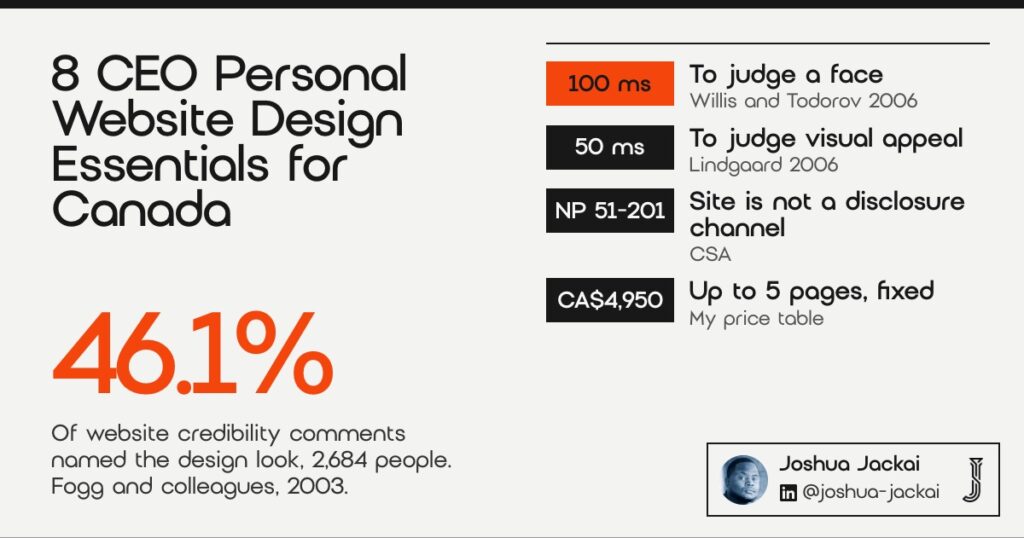
- In a study of 2,684 people judging websites, the design look came up in 46.1% of credibility comments (Fogg and colleagues, 2003).
- People formed trait judgments of a face after a 100 ms exposure, so your headshot does work before anyone reads a word (Willis and Todorov, 2006).
- If you lead a listed Canadian company, a personal site is not a disclosure channel: NP 51-201 says a website posting alone will not be likely to count as generally disclosed.
- My prices: CA$4,950 for up to 5 pages on Framer, CA$5,950 on WordPress, CA$3,795 for a one-page site.
| # | Essential | What it protects | Source |
|---|---|---|---|
| 1 | A domain in your own name | Your search results | Love, Lim and Bednar 2017 |
| 2 | A first screen that says who you are and what you lead | First impression | Lindgaard 2006, Fogg 2003 |
| 3 | A recent, real headshot | Trust | Willis and Todorov 2006, Dean 2019 |
| 4 | A bio built from facts people can check | Credibility | Hovland and Weiss 1951, Ohanian 1990 |
| 5 | Your writing and talks in one place | Reputation | Love, Lim and Bednar 2017 |
| 6 | Contact routes that sort the requests | Your time, privacy | PIPEDA, CASL |
| 7 | Disclosure guardrails for listed companies | Legal risk | NP 51-201 |
| 8 | Markup and speed that search tools and AI answers can read | Findability | Google Search Central, Galletta 2004 |
1. Why should a CEO own a domain in their own name?
Because the people who matter will search your name before a meeting, a board vote or a hire, and the first page should hold something you wrote. A domain in your name gives Google and AI answers one source you control, next to the press and profiles you do not.
- What to buy: yourname.ca and yourname.com, or a close variant if both are taken
- Where it points: your personal site, never a redirect to the company homepage
- Who owns it: you, on your own registrar account, not the company’s
- Renewal: set it to auto-renew on a card you control
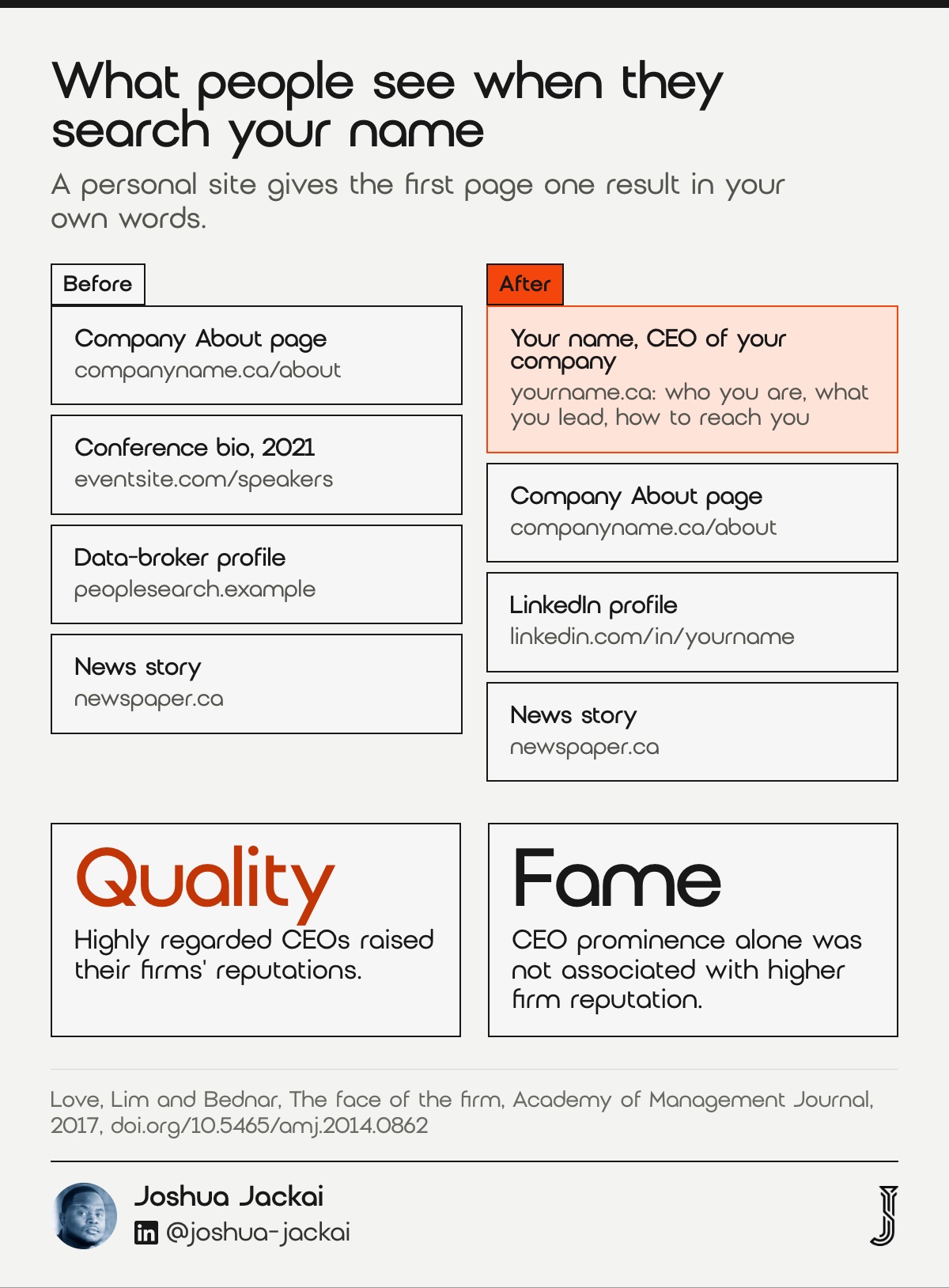
Search your own name in a private window and look at the first ten results. For most executives I work with, the first page is a mix of the company About page, an old conference bio, a data-broker profile and one news story. None of them is wrong, and none of them is yours. A personal site does not push the others away, but it gives search engines and AI tools a page that answers “who is this person” in your words.
The research on CEOs supports a careful version of this. In a 2017 study of how chief executives affect firm reputation (Love, Lim and Bednar, 2017), highly regarded CEOs helped their firms’ standing, sometimes by a lot, and CEOs who drew negative press hurt it. The same study found that being well known, by itself, did not help. So the goal is not more attention. It is a clear, checkable record. Register the domain on your own account so it moves with you if you change roles. I have seen founders lose their name domain because a former employer held it.
“Our findings indicate that highly regarded CEOs enhance their firms’ reputations, sometimes substantially, and CEOs who receive negative press coverage damage their firms’ reputations.”
E. Geoffrey Love and Michael Kay Bednar (University of Illinois Urbana-Champaign) and Jae-Goo Lim (Hong Kong Polytechnic University) wrote in Academy of Management Journal, 2017
2. What should the first screen of a CEO personal website say?
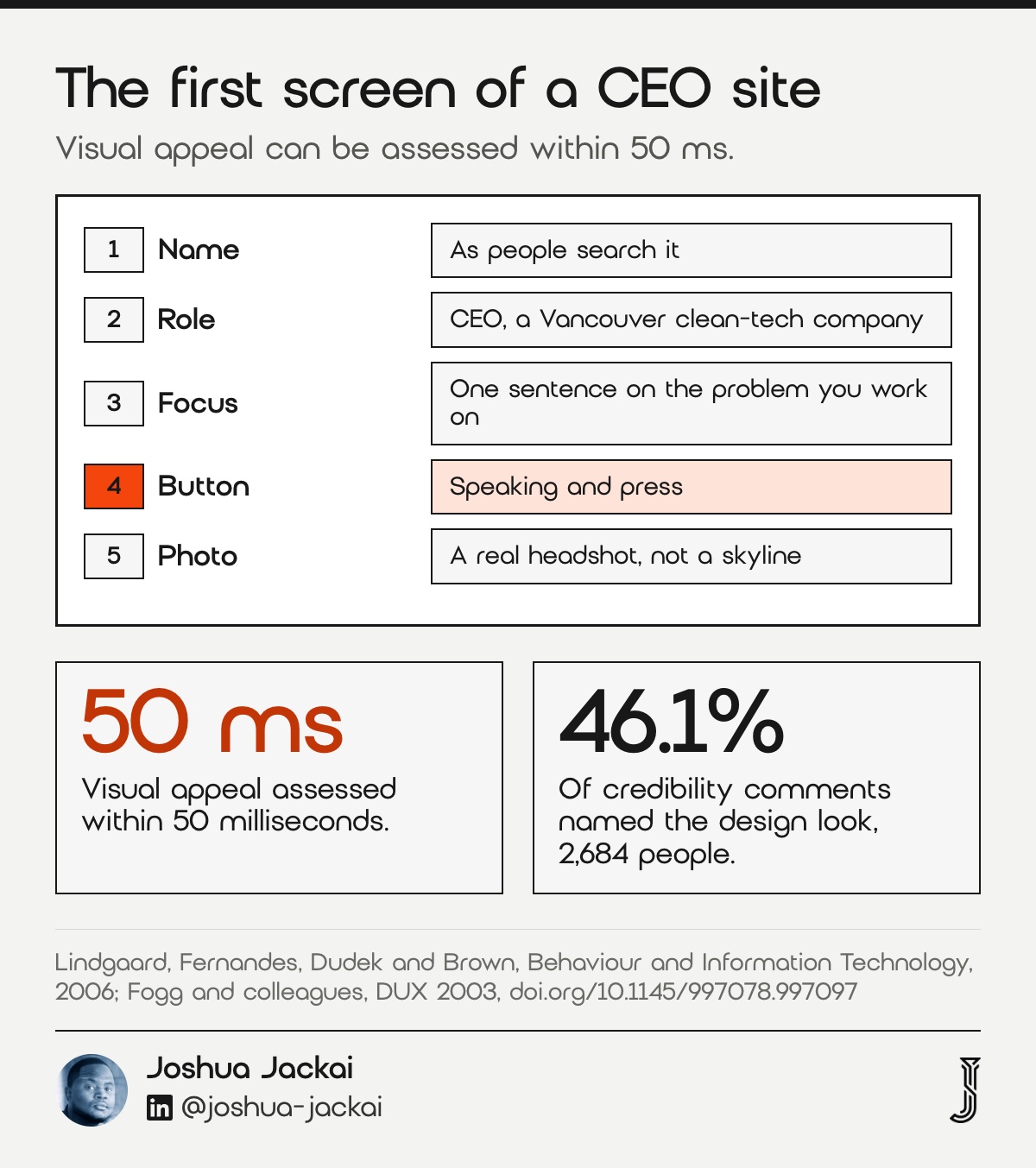
Your name, your current role and company, and one line on what you work on, with one clear next step. People judge a page’s visual appeal in a fraction of a second, so the first screen has to be plain and finished, not clever.
- Line 1: your name, as people search it
- Line 2: role and company, for example “CEO, a Vancouver clean-tech company”
- Line 3: the problem you work on, in one sentence
- One button: the most common request you want, such as “Speaking and press”
- One photo: your headshot (item 3), not a stock skyline
I write the first screen of a CEO site before I design anything. The test is simple: someone who has never heard of you should be able to say who you are and what you do after five seconds. Most executive sites fail it in the same way. They open with a motto (“Building the future of energy”) and hide the job title in the footer.
Two studies explain why this matters. Lindgaard and colleagues found that visual appeal can be assessed within 50 ms, and ratings at 50 ms matched ratings at 500 ms (Lindgaard and colleagues, 2006). Fogg and colleagues asked 2,684 people to judge real websites and found that the design look came up in 46.1% of their comments about credibility, ahead of every other factor (Fogg and colleagues, 2003). A plain layout, a real photo and good type do not prove you are competent. They stop the page from looking like it was rushed. See my notes on writing a website headline for the copy side.
“We found that the design look of the site was mentioned most frequently, being present in 46.1% of the comments.”
B. J. Fogg and colleagues (Stanford University) wrote in Proceedings of the 2003 Conference on Designing for User Experiences
3. Does a CEO personal website need a professional headshot?
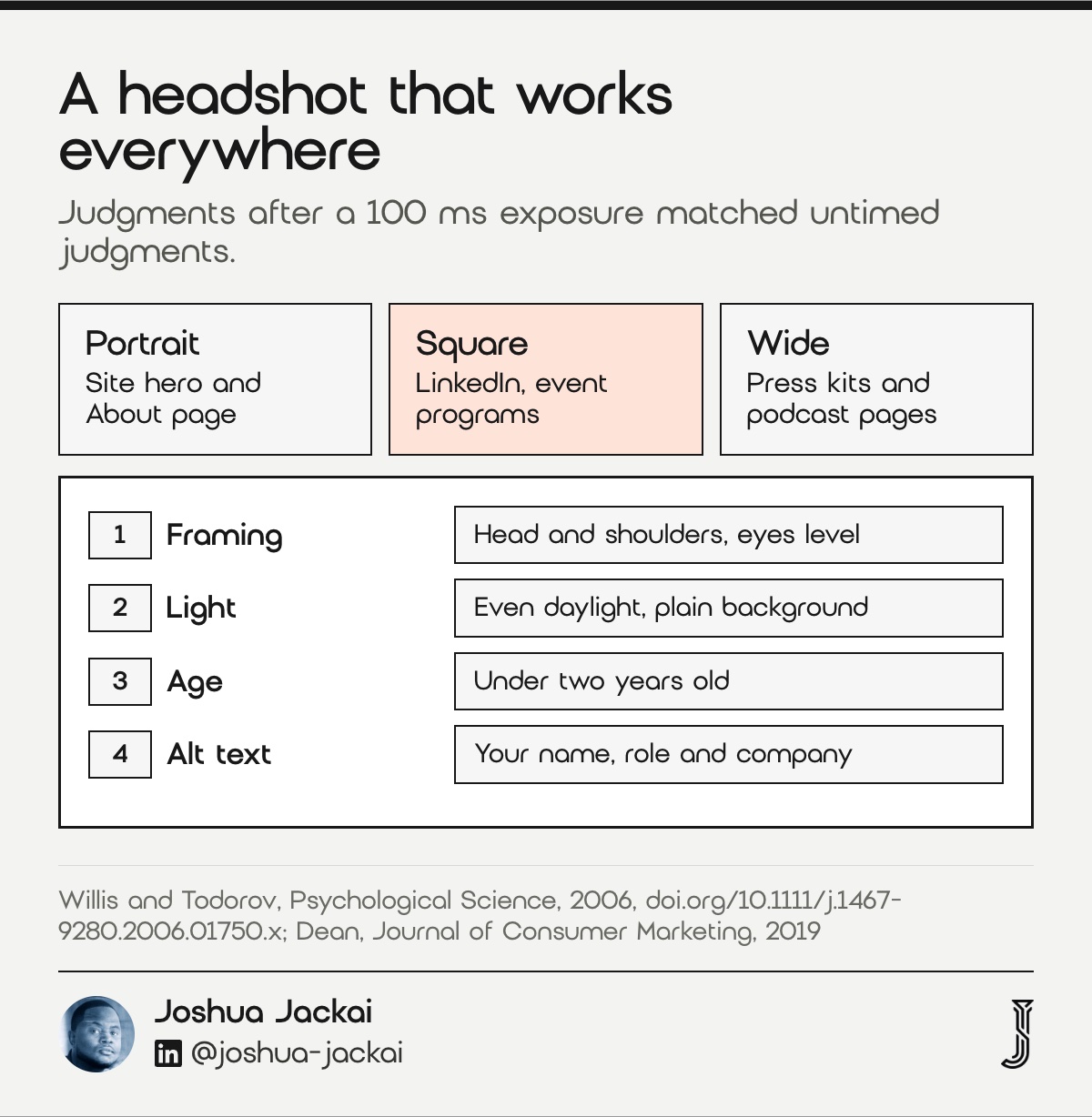
Yes. People form an impression of a face after a 100 ms exposure, so the photo is read before the bio. Use a recent photo that looks like you do today, shot in good light, and use the same one on your site, LinkedIn and speaker bios.
- Age of the photo: under two years
- Framing: head and shoulders, eyes level with the camera
- Files: one portrait crop, one square crop, one wide crop for press kits
- Alt text: your name and role, for example “[Your name], CEO of [company], Vancouver”
I ask every client for three crops of one photo session, because the same face then shows up everywhere people meet you: the site, LinkedIn, conference programs and press articles. Matching photos help people, and they help search tools connect the profiles.
Willis and Todorov showed people unfamiliar faces for 100 ms, 500 ms and 1,000 ms in five experiments (Willis and Todorov, 2006). Judgments made after 100 ms matched judgments made with no time limit for attractiveness, likeability, trustworthiness, competence and aggressiveness. Longer viewing mostly made people more confident, not different in their view. A separate study by Dean ran 2 experiments with CEO head-and-shoulder photos in corporate publicity and found that the face affected how readers regarded the firm (Dean, 2019). The point for you is not to look perfect. It is to look like yourself, on a good day, in a photo that does not distract. Book a photographer for one hour, shoot in daylight, and pick the frame where you look relaxed rather than posed. Ask for written permission to use the photo everywhere, including press kits.
“Judgments made after a 100-ms exposure correlated highly with judgments made in the absence of time constraints, suggesting that this exposure time was sufficient for participants to form an impression.”
Janine Willis and Alexander Todorov (Princeton University) wrote in Psychological Science, 2006
4. What should go in a CEO bio on a personal website?
Facts a reader can check: current role, past roles with years, board seats, degrees, and named results you are allowed to share. Write it in the first person, keep it under 250 words, and link each claim to a source such as the company page or a news story.
- Short bio: 50 words, for event programs
- Long bio: 200 to 250 words, for the About page
- Proof links: company page, board pages, published interviews
- Leave out: adjectives like “visionary”, unless someone else wrote them and you link to it
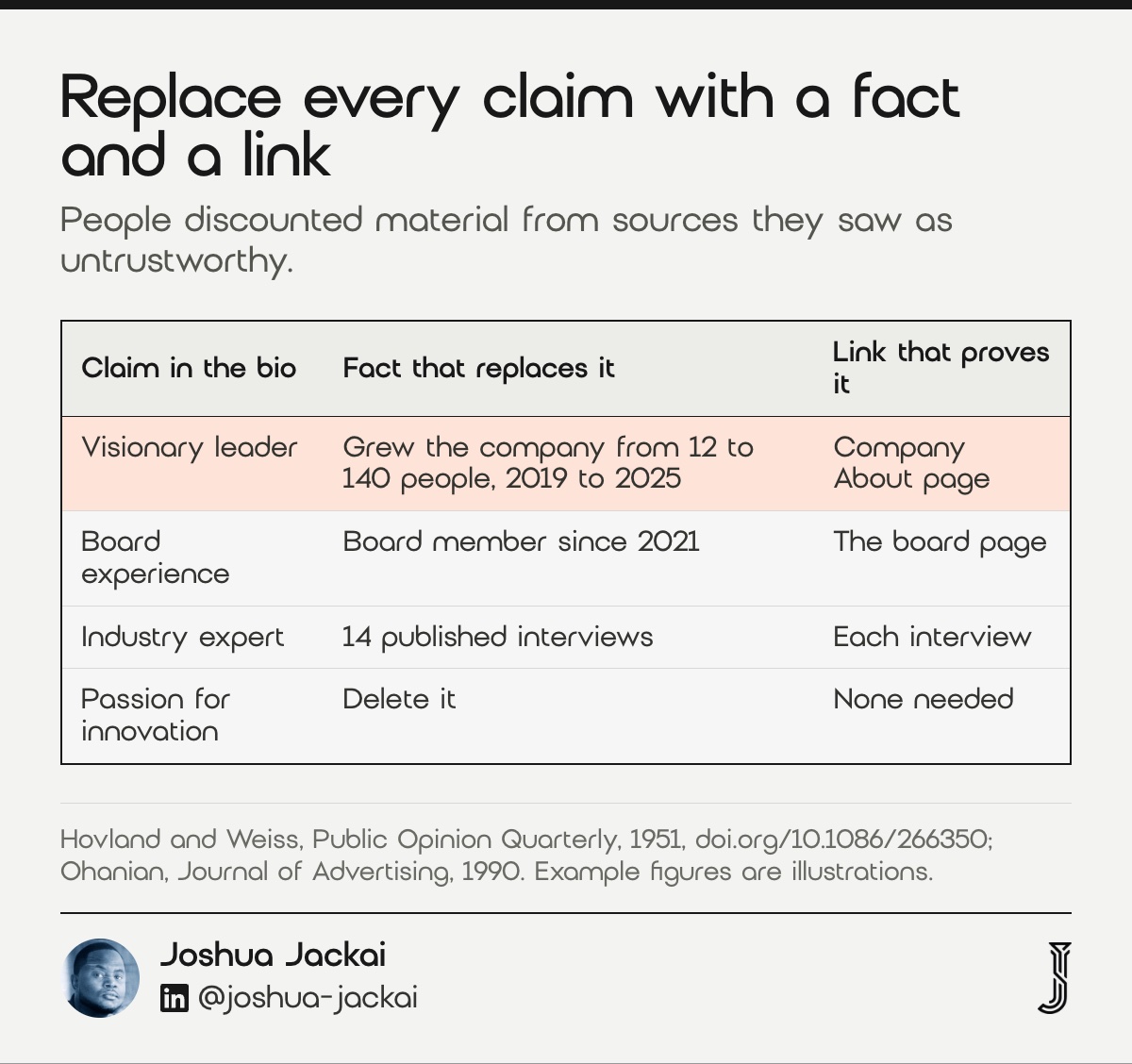
The bio is where most executive sites lose trust. They read like a press release: “a visionary leader with a passion for innovation”. Readers skip those lines because every bio has them. Replace each adjective with a fact. “Grew the company from 12 to 140 people between 2019 and 2025” says more than “proven track record”, and a reader can check it. In the same way, “board member since 2021” with a link beats “board experience”, and “14 published interviews”, each linked, beats “industry expert”. These are example lines; use your own facts.
Research on source credibility is old and still useful. Hovland and Weiss found in 1951 that people discounted material from sources they saw as untrustworthy (Hovland and Weiss, 1951). In 1990 Ohanian built a 15-item scale (Ohanian, 1990 that measures how people judge a speaker’s expertise and trustworthiness, as separate things. A CEO bio has to earn both: expertise from roles and results, trust from links, dates and plain language. Offer the 50-word version as a download, because event organisers will rewrite your bio badly if you make them. I also date the bio at the bottom (“updated November 2026”), so a reader knows the facts are current and a journalist knows which version to use.
“In a new test of the process of forgetting, the authors found that subjects, at the time of exposure, discounted material from untrustworthy sources.”
Carl Hovland and Walter Weiss wrote in Public Opinion Quarterly, 1951
5. Should a CEO publish articles and talks on a personal website?
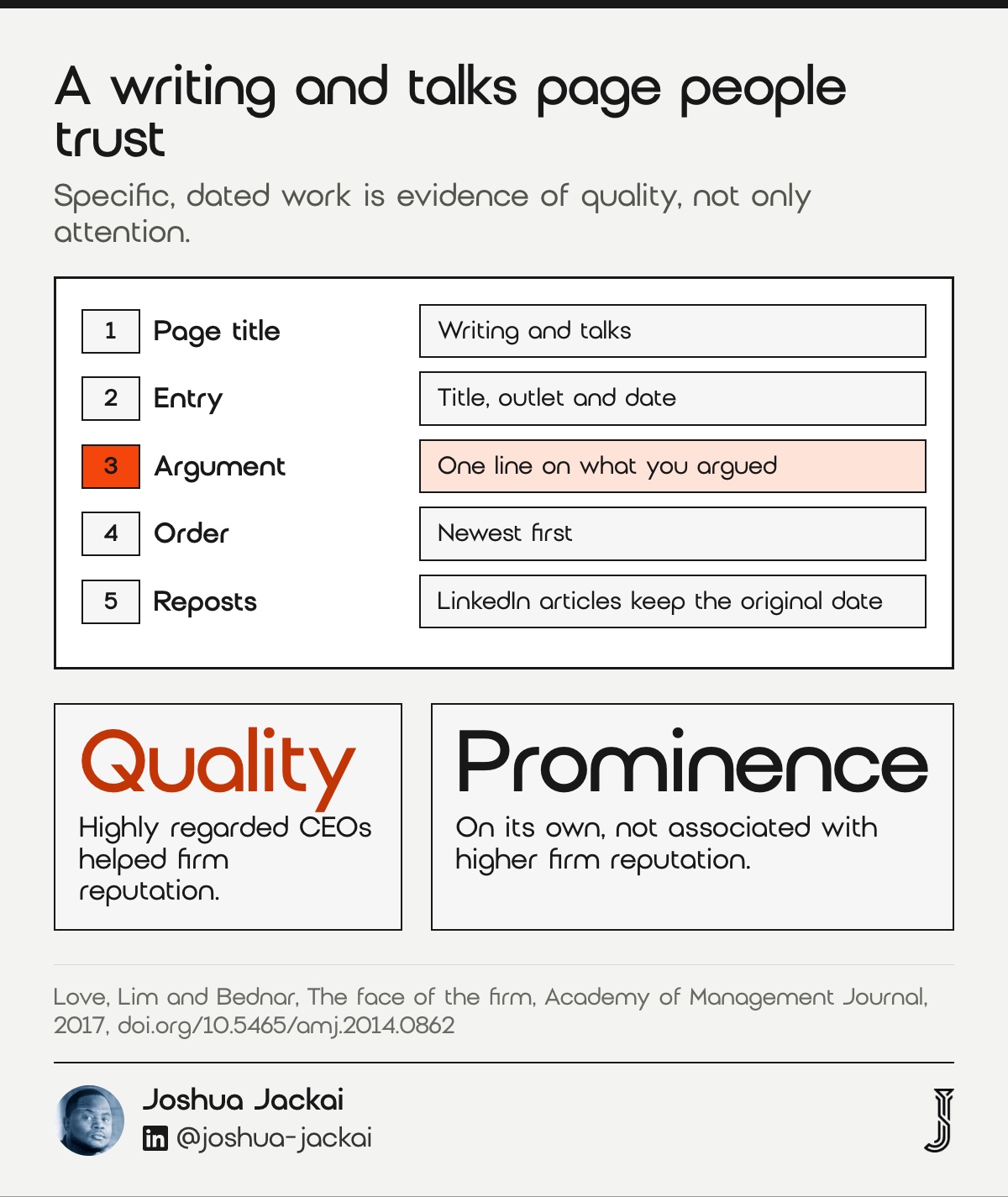
Yes, if you have them and can keep it up. One page that lists your articles, podcast appearances and talks, newest first, gives people proof of how you think. It also gives search engines and AI answers your own words to quote.
- Page name: “Writing and talks”, not “Thought leadership”
- Each entry: title, outlet, date, one line on what you argued, link
- Rhythm: a new entry every month or two is enough
- Owned pieces: repost your best LinkedIn articles here, with the original date
I would rather see four strong entries with dates than forty links to every panel you sat on. Readers look at the top three, and AI tools tend to quote pages that state a clear position.
This is where the 2017 Love, Lim and Bednar study matters most (Love, Lim and Bednar, 2017). Being prominent did not, on its own, improve firm reputation. What mattered was how well regarded the CEO was. A page of specific, dated work is evidence of quality, while a page of logos is only evidence of attention. If you do not write or speak yet, leave this page out at launch and add it later. An empty “Insights” page with one post from 2023 looks worse than no page. When you do start, pick one topic you can speak on for a year, write about it in plain language, and link each piece from your bio. Two or three focused pieces beat a wide spread of opinions on everything.
“However, CEO prominence alone is not associated with higher firm reputation.”
E. Geoffrey Love, Jae-Goo Lim and Michael Kay Bednar wrote in Academy of Management Journal, 2017
6. How should people contact a CEO through a personal website?
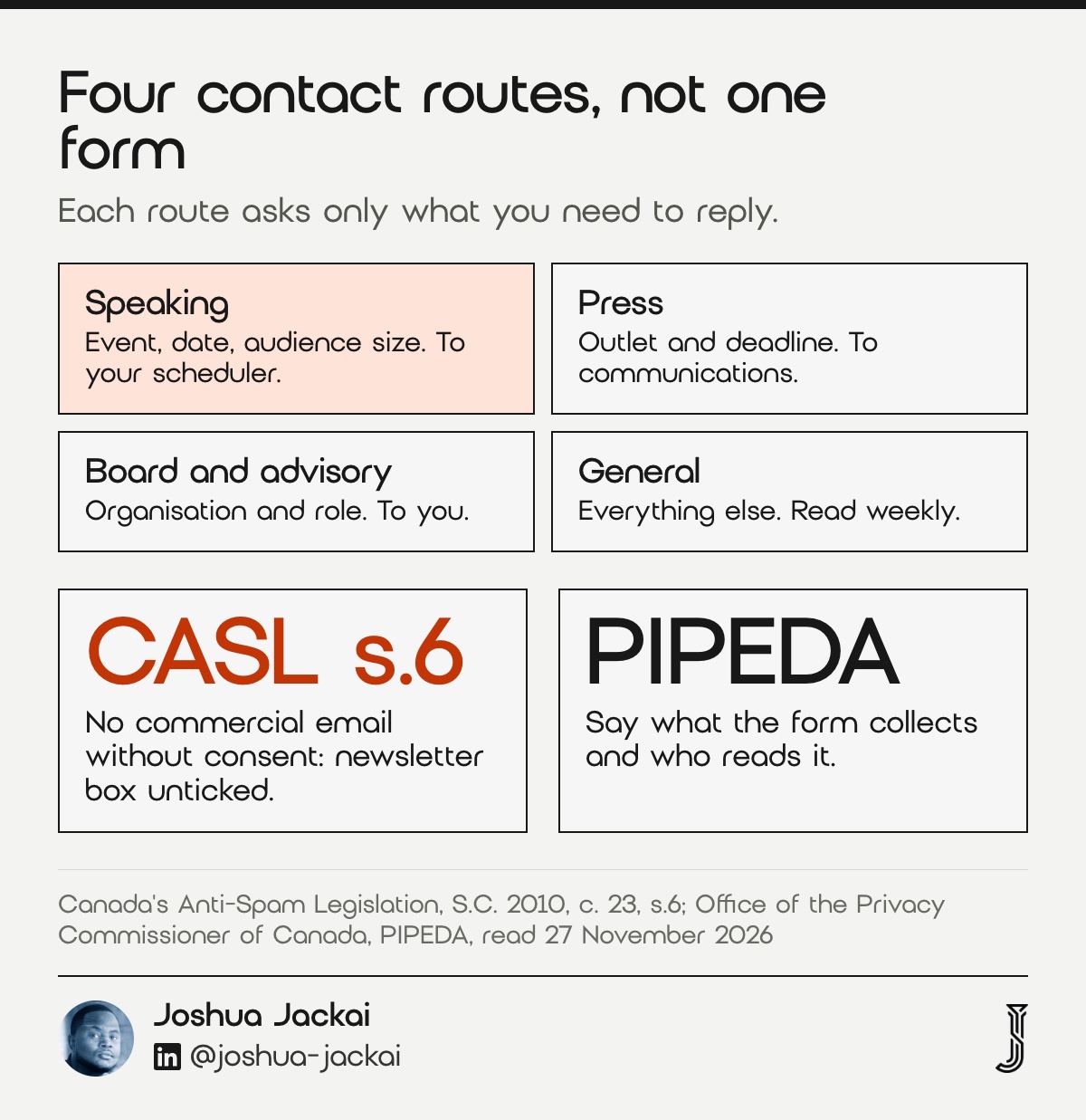
Through separate routes for each kind of request: speaking, press, board and advisory roles, and everything else. Each route goes to the right inbox or assistant, asks only for what you need to reply, and follows Canadian privacy law and anti-spam law.
- Routes: speaking, press, board and advisory, general
- Form fields: name, organisation, request type, date if any, message
- Not on the page: your personal email, phone number or home city
- Newsletter box: unticked by default, if you have a newsletter at all
- Privacy note: one line on what you collect and who reads it
The most common complaint I hear from executives after launch is too many sales pitches. A single “Contact me” form invites them. Four short routes fix most of it, because each one sets expectations: a speaking form asks for the event, date and audience size, and goes to whoever books your calendar. A press form asks for the outlet and deadline. A board form asks for the organisation and the role. Sales pitches still arrive, but they land in the general box, which your assistant can read once a week.
Two Canadian rules apply. PIPEDA governs how private-sector organisations collect, use and disclose personal information in commercial activity, so say what the form collects and who sees it (Office of the Privacy Commissioner). Canada’s anti-spam law, CASL, does not allow commercial email without consent, so a newsletter box starts unticked (CASL, section 6). In BC, a provincial law, PIPA, covers many private organisations, so ask your lawyer which one applies to you.
7. What can a public company CEO post on a personal website?
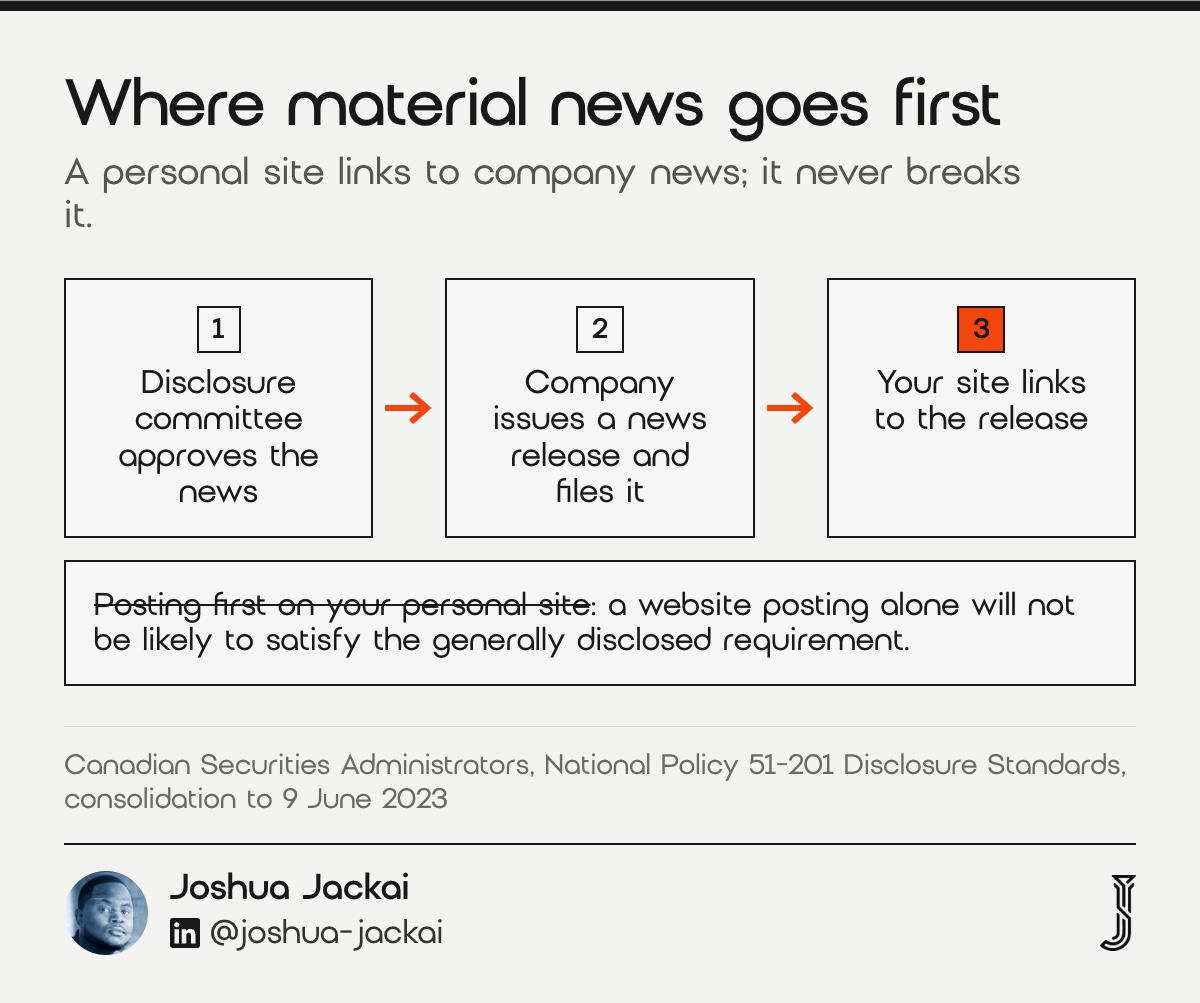
Only information the company has already made public, linked to where it was first released. If you lead a reporting issuer in Canada, your personal site is not a disclosure channel, and anything material goes out through the company’s news release process first.
- Safe to post: links to the company’s published news releases and filings
- Safe to post: your bio, talks and opinions that do not touch undisclosed results
- Do not post: forecasts, deal hints or numbers before the company releases them
- Who reviews: your disclosure committee or general counsel, before launch
This is the item that most generic advice leaves out, and for a listed company it matters most. Canadian securities regulators set out their view in National Policy 51-201, Disclosure Standards. It warns against selective disclosure, and the 2023 consolidation says that posting to a company website “will not, by itself, be likely to satisfy” the generally disclosed test (NP 51-201).
In practice I build listed-company CEO sites with a news page that only links out to the company’s investor relations page and SEDAR+ filings. I add a line under the bio that says opinions are the CEO’s own. I also ask counsel to read the copy before launch. It takes a week and it is cheaper than the alternative. Private-company founders have more room, but the same habit protects you if you raise money later. The policy also covers employees talking about the company in online forums, so your personal site should never host comments or a forum on company topics.
“Selective disclosure occurs when a company discloses material nonpublic information to one or more individuals or companies and not broadly to the investing public.”
The Canadian Securities Administrators wrote in National Policy 51-201 Disclosure Standards, consolidated 9 June 2023
8. How do search engines and AI answers read a CEO personal website?
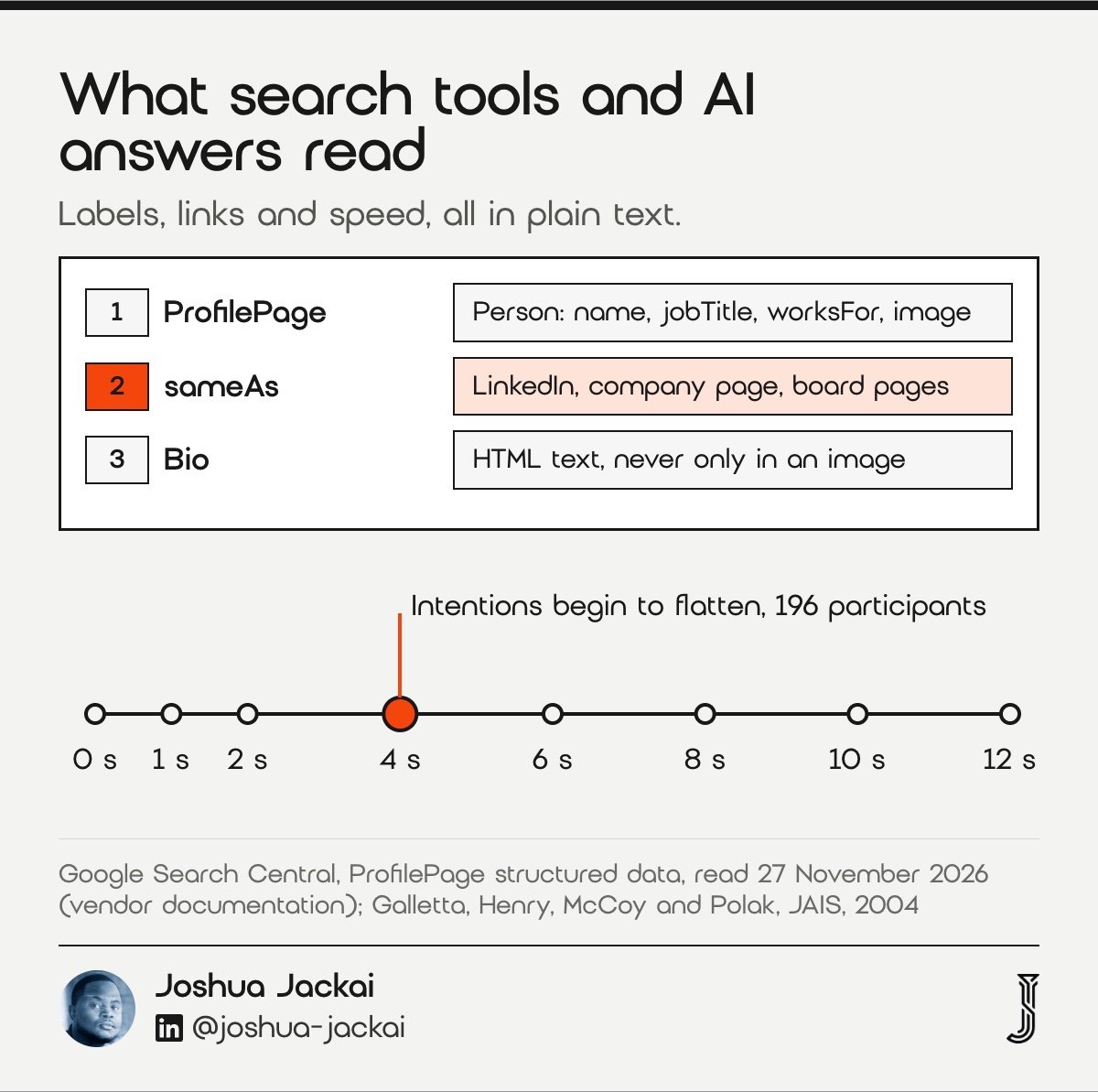
Through plain text, a fast page and structured data that names you as a person and links your other profiles. Add ProfilePage and Person markup with sameAs links to LinkedIn, the company page and board pages, and keep the page fast on a phone.
- Markup: ProfilePage with a Person, name, jobTitle, worksFor, image, sameAs
- Text: your bio in HTML text, never only inside an image or a video
- Speed: the first screen visible in under 4 seconds on a phone
- One URL per topic: About, Writing and talks, Contact
Google’s documentation says ProfilePage markup “is designed for any site where creators (either people or organizations) share first-hand perspectives” (Google Search Central). I add it with Person and sameAs links on every executive site I build, because it helps tools tie your site to your other profiles. I have no study showing it lifts citations in AI answers, so treat it as tidy labelling, not a ranking lever.
“ProfilePage markup is designed for any site where creators (either people or organizations) share first-hand perspectives.”
Google Search Central stated in Profile page (ProfilePage) structured data
Speed matters for a different reason. Galletta and colleagues tested 7 delay levels with 196 participants and found that drops in performance and intentions began to flatten at about 4 seconds (Galletta and colleagues, 2004). A CEO site is small, so there is no excuse for a slow one: compress the headshot, skip the background video and test on a phone. If you want a check on how AI answers describe you today, my free AI Visibility Report runs one in 24 hours. I then fix what it finds on the site itself, not with tricks.
Compare the eight essentials
Use the filters to see which essentials apply to the part of the site you are working on, or to the risk you care about most. A listed-company CEO should read every row; a private-company founder can skip row 7 until a raise.
Showing 8 of 8 essentials.
| # | Essential | Site area | Protects | Source |
|---|---|---|---|---|
| 1 | Own a domain in your own name | Homepage | Search and AI answers, Reputation | Love, Lim and Bednar 2017 |
| 2 | Say who you are and what you lead in the first screen | Homepage | First impression | Lindgaard 2006; Fogg 2003 |
| 3 | Use a recent, real headshot everywhere | Homepage, About and bio | Trust, First impression | Willis and Todorov 2006; Dean 2019 |
| 4 | Build the bio from facts people can check | About and bio | Trust, Reputation | Hovland and Weiss 1951; Ohanian 1990 |
| 5 | Keep your writing and talks in one dated list | Writing and news | Reputation, Search and AI answers | Love, Lim and Bednar 2017 |
| 6 | Give each kind of request its own contact route | Contact | Privacy and consent, Your time | PIPEDA; CASL s.6 |
| 7 | Link to company news instead of posting it first | Writing and news, Homepage | Disclosure risk | NP 51-201 |
| 8 | Add ProfilePage markup and keep the page fast | Homepage, About and bio | Search and AI answers, First impression | Google Search Central; Galletta 2004 |
What does a CEO personal website cost in Canada?
My fixed price for a CEO personal website is CA$4,950 for up to 5 pages on Framer, or CA$5,950 on WordPress. A one-page site starts at CA$3,795, and extra pages are CA$425 each. Your domain, hosting and photographer are paid separately.
| Option | Pages | My price (CAD) | Good fit for |
|---|---|---|---|
| One-page site | 1 | from CA$3,795 | A founder who needs a credible page for a raise or a talk |
| Small site on Framer | up to 5 | CA$4,950 | Most CEOs: Home, About, Writing and talks, Speaking, Contact |
| Small site on WordPress | up to 5 | CA$5,950 | Executives who want WordPress for a blog they will run |
| Extra page | 1 | CA$425 each | A board page or a book page |
| Audit of an existing site | n/a | CA$995, credited if a project starts within 30 days | A site you already have that underperforms |
The price is fixed because a CEO site is small and the scope is clear. What moves the cost is copy: if I write the bio and the first screen from an interview, that is part of the build; if you need the writing archive moved from an old blog, it can add a page or two. See my pricing page for the full table, and questions to ask a web designer before you hire anyone, including me.
Tick what is already true of your current page to see what is left.
CEO personal website check
Tick each statement that is true for your page today. Your answers stay in this browser.
CEO personal website questions, answered
Is having your own website worth it for a CEO?
For most CEOs, yes. People search your name before meetings, deals and hires. A personal site gives them one accurate page you control. Research links a well-regarded CEO to a stronger firm reputation, while fame alone did not help. Keep it small, factual and current.
How much does it cost to have someone design a personal website?
In Canada I charge CA$4,950 for up to 5 pages on Framer, CA$5,950 on WordPress, and from CA$3,795 for one page. Prices elsewhere vary widely. Ask any designer for a fixed quote, a launch date in writing, and who owns the domain and the site account.
Should a CEO personal website link to the company website?
Yes, from your bio and your contact page, but it should not redirect to it. Your personal site answers who you are; the company site answers what it sells. If you lead a listed company, link to its news releases instead of repeating material news.
Can AI build a CEO personal website?
AI tools can draft a page in minutes, and I use them for first drafts. The parts that matter here are judgment: which facts to show, what to leave out, disclosure rules and a real photo. Have a person check every claim and link before you publish.
Sources
Peer-reviewed
- Love, E. G., Lim, J., and Bednar, M. K. (2017). The face of the firm: The influence of CEOs on corporate reputation. Academy of Management Journal, 60(4). https://doi.org/10.5465/amj.2014.0862
- Fogg, B. J., Soohoo, C., Danielson, D. R., Marable, L., Stanford, J., and Tauber, E. R. (2003). How do users evaluate the credibility of Web sites? Proceedings of the 2003 Conference on Designing for User Experiences. https://doi.org/10.1145/997078.997097
- Willis, J., and Todorov, A. (2006). First impressions: Making up your mind after a 100-ms exposure to a face. Psychological Science, 17(7). https://doi.org/10.1111/j.1467-9280.2006.01750.x
- Lindgaard, G., Fernandes, G., Dudek, C., and Brown, J. (2006). Attention web designers: You have 50 milliseconds to make a good first impression! Behaviour and Information Technology, 25(2). https://doi.org/10.1080/01449290500330448
- Dean, D. H. (2019). Face of CEO in corporate publicity affects viewer regard for the firm. Journal of Consumer Marketing. https://doi.org/10.1108/jcm-09-2018-2852
- Hovland, C. I., and Weiss, W. (1951). The influence of source credibility on communication effectiveness. Public Opinion Quarterly, 15(4). https://doi.org/10.1086/266350
- Ohanian, R. (1990). Construction and validation of a scale to measure celebrity endorsers’ perceived expertise, trustworthiness, and attractiveness. Journal of Advertising, 19(3). https://doi.org/10.1080/00913367.1990.10673191
- Galletta, D. F., Henry, R., McCoy, S., and Polak, P. (2004). Web site delays: How tolerant are users? Journal of the Association for Information Systems, 5(1). https://doi.org/10.17705/1jais.00044
Government, regulator and vendor sources (not peer reviewed)
- Canadian Securities Administrators. National Policy 51-201 Disclosure Standards, unofficial consolidation to 9 June 2023, hosted by the Financial and Consumer Services Commission of New Brunswick. https://fcnb.ca/sites/default/files/2024-12/51-201-NP-CONS-2023-06-09-E.pdf, read 27 November 2026.
- Office of the Privacy Commissioner of Canada. The Personal Information Protection and Electronic Documents Act (PIPEDA). https://www.priv.gc.ca/en/privacy-topics/privacy-laws-in-canada/the-personal-information-protection-and-electronic-documents-act-pipeda/, read 27 November 2026.
- Canada’s Anti-Spam Legislation, S.C. 2010, c. 23, section 6. Justice Laws Website. https://laws-lois.justice.gc.ca/eng/acts/E-1.6/page-2.html, read 27 November 2026.
- Google Search Central. Profile page (ProfilePage) structured data. https://developers.google.com/search/docs/appearance/structured-data/profile-page, read 27 November 2026.
- Jackai Agency price table, CAD, November 2026 (my own prices).