7 Web Design Agency Vancouver Steps: 2026 Field Guide
A 7 step method for choosing a Vancouver web design agency: brief, builder type, shortlist of 3, live work, reviews, call questions and a score sheet, with a peer-reviewed study behind each step.
 Joshua Jackai
19 min read
Published 23 October 2026 · Last updated and fact-checked 23 October 2026
Short answer: Choose a Vancouver web design agency in 7 steps: write a one-page brief, pick agency, freelancer or AI tool, cut the list to 3, check their live sites on your phone, read reviews and phone 1 past client, ask each the same questions, then score all 3 and read the contract.
I am Joshua Jackai, a web designer and developer in Vancouver, British Columbia, and I run Jackai Agency, a Vancouver studio that builds websites for Canadian B2B companies on fixed quotes. Search results for this question are mostly written by agencies, and each one ends by telling you to hire the agency that wrote it. I sell web design too, so you should weigh my advice the same way. What I can offer is a method that works whoever you pick, with research behind each step and a score sheet you can fill in tonight. All time estimates in this guide are my own, from client work.
In this guide
Key takeaways
- Shortlist 3 agencies, not 10. In a supermarket study, 30 percent of shoppers who stopped at a 6 jam table bought one, against 3 percent at a 24 jam table (Iyengar and Lepper, 2000).
- Take a first look at every portfolio on your phone, since people judged visual appeal within 50 milliseconds (Lindgaard and colleagues, 2006).
- Read reviews for patterns, not stars: about 16 percent of Yelp restaurant reviews were filtered as suspicious (Luca and Zervas, 2016).
- Ask for a fixed price once you have a brief, because fixed-price contracts suit simple projects with a short build (Dey, Fan and Zhang, 2010).
- My own fixed prices in Vancouver start at CA$4,950 for a five-page Framer site and CA$7,450 for a custom B2B site.
| Step | What it protects you from | What you hold at the end |
|---|---|---|
| 1. Write the brief | Vague quotes that cannot be compared | A one-page brief |
| 2. Pick the kind of builder | Paying agency rates for a template job | Agency, freelancer or AI tool |
| 3. Cut to three | Choice overload | A shortlist of three |
| 4. Judge the work on a phone | Screenshots that hide slow pages | Notes on 2 live sites each |
| 5. Check reviews and references | Reviews that were curated | One call with a past client |
| 6. Ask on the call | Surprises about who does the work | Written answers |
| 7. Score and read the contract | Gut-feel decisions | One score sheet and a signed scope |
What this guide is based on
This guide is based on the questions Canadians ask about choosing a web design agency, the pages that answer them, and nine peer-reviewed studies. I checked the top results on 23 October 2026. The best list sensible criteria, but none says how to weigh them, how many agencies to meet, or what to ask.
I did not rank any Vancouver agencies and I do not name any, because a ranking built from public pages would be opinion dressed as data. You will get a method and a sheet instead. If you want a second opinion on a quote, the CA$995 audit described at the end covers that.
1. How do I write a brief for a web design agency?
A brief is one page that says what the site must do, who it is for, which pages it needs, and what you can spend. Without it, every agency answers a different question and the quotes cannot be compared. Writing it takes about an hour and is the cheapest step in the process.
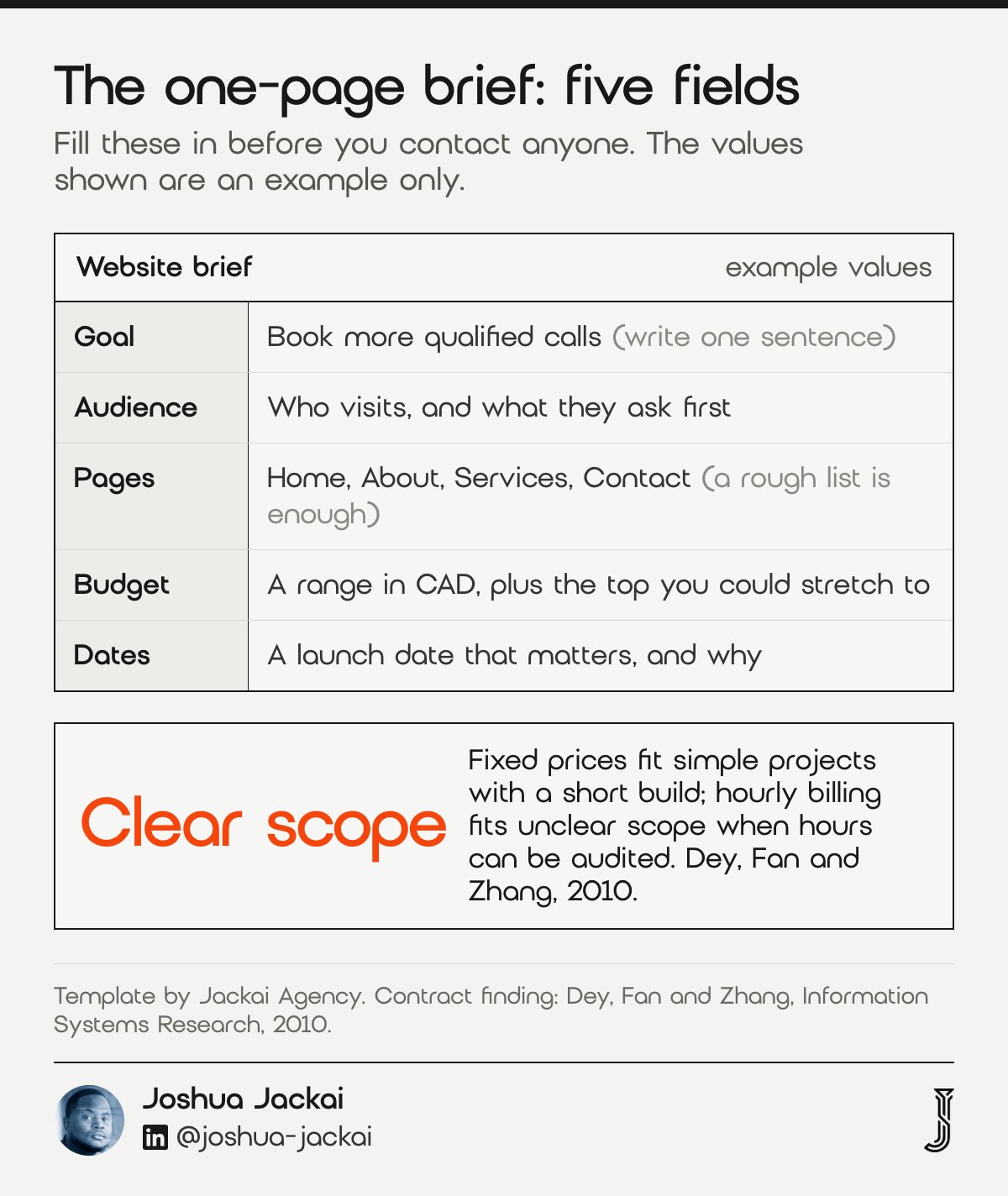
- Goal: one sentence, such as “book 10 more qualified calls a month”
- Audience: who visits, and what they ask before they contact you
- Pages: a list, even a rough one, with the forms and tools you need
- Budget: a range in CAD, with the top number you could stretch to
- Dates: a launch date that matters, and why
A written brief lets an agency quote a fixed price instead of an open hourly rate. Dey, Fan and Zhang built a model of software outsourcing contracts and compared the fixed-price form with time-and-materials billing. Fixed prices fit when the scope is clear and the build is short, while hourly billing fits unclear scope when the hours can be audited (Dey, Fan and Zhang, 2010). A brief is what makes the first case possible for you. If you can list the pages, an agency can quote a fixed price. If you cannot, you will be offered an hourly rate with no ceiling. Spend the hour on the brief before you spend a week on calls, and your first conversation with each agency will start from the real questions, not from a general chat about what a website is.
“fixed-price contracts are often appropriate for simple software projects that require short development time,” wrote Dey, Fan and Zhang in Information Systems Research, 2010.
State the budget. Many buyers hold the number back, hoping for a lower quote. In practice it makes the quotes less useful, because each agency then guesses. A range lets the agency say what fits and what does not. If the range is too low for the scope, you hear it on the first call instead of the third. Keep the brief to one page, and send the same page to every agency, so that differences in the quotes come from the agencies and not from what each was told.
“In practice it makes the quotes less useful, because each agency then guesses,” Joshua Jackai, Vancouver web designer, wrote.
2. Should I hire an agency, a freelancer or an AI builder?
You are choosing between three products, and the cheapest is not always the right one. An agency gives you a team and a handover. A freelancer gives you one person and a direct line. An AI site builder gives you speed and low cost, and leaves the checking to you. Match the type to the job before you compare names.
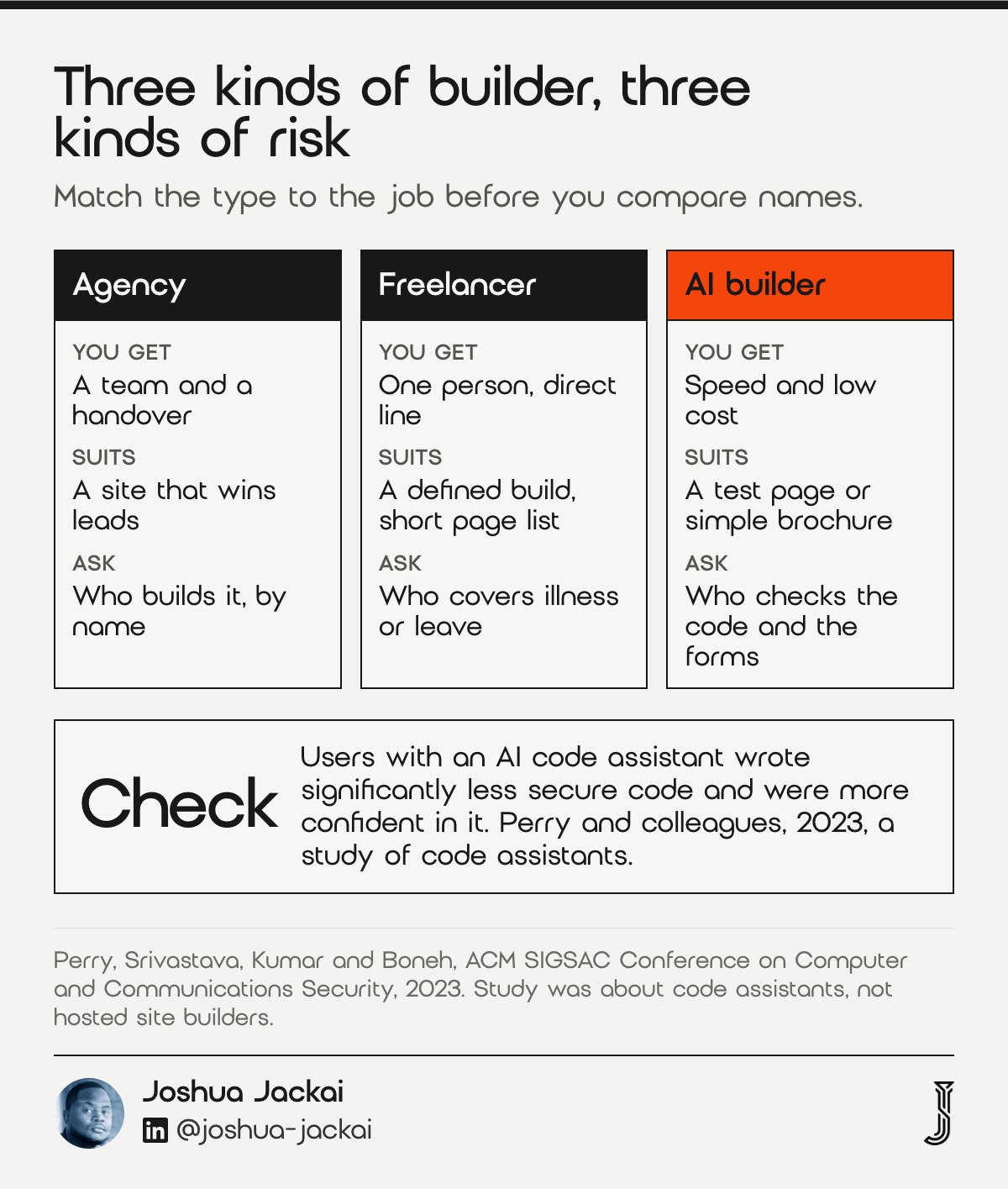
- Agency: designer, developer and project manager, so it suits a site that drives leads
- Freelancer: one person, so it suits a defined build with a short list of pages
- AI builder: a template and a prompt, so it suits a test page or a simple brochure
- My fixed prices: CA$4,950 on Framer or CA$5,950 on WordPress for five pages
- Ownership: on my projects you own the site, the domain and the hosting
On AI tools, take the security finding seriously. Perry, Srivastava, Kumar and Boneh ran a user study of AI code assistants and found that participants with an assistant wrote less secure code and were more confident that it was secure (Perry and colleagues, 2023). That study was about code written with an assistant, not about hosted site builders, so apply it narrowly. If the site takes payments, stores form data or runs custom code, ask who checks it.
“participants who had access to an AI assistant wrote significantly less secure code than those without access to an assistant,” Perry and colleagues reported in the ACM SIGSAC Conference on Computer and Communications Security, 2023.
The useful question is not which option costs least. It is what a bad outcome costs you. A slow, confusing or insecure site loses leads quietly, and you may not notice for months. If your site is a single page that tests an offer, an AI builder may be enough. If the site is your main source of leads, a person should answer for it. I wrote a separate guide on what to check before you hire a web developer in Vancouver, which covers contract type and security upkeep in more detail.
3. How many web design agencies should I talk to?
Three is my rule of thumb for how many agencies to talk to. One gives you no comparison, and ten gives you a pile of notes you will not finish reading. Search for your need, add names from people you trust, and stop at three. Keep a reserve name in case one of the three does not reply.
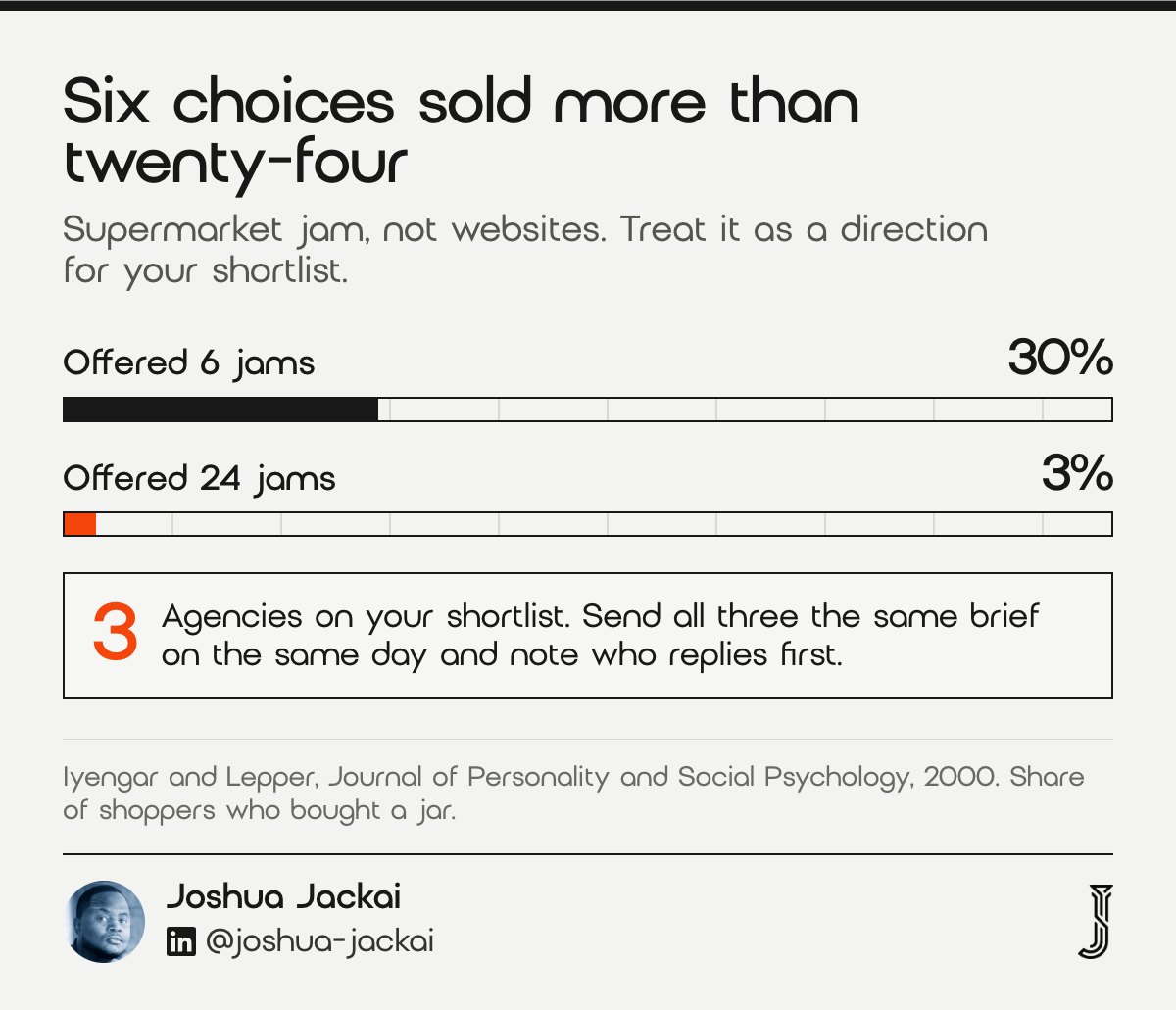
- Number to talk to: three
- Where names come from: a colleague, a site you admire, one search result
- Filter 1: serves companies of your size and type
- Filter 2: replies within 2 business days
- Time cost: about 30 minutes to build the list
Iyengar and Lepper tested choice size at a supermarket tasting table, offering either 24 jams or 6. The larger display drew more people to stop, but of those who stopped, 30 percent bought at the 6 jam table against 3 percent at the 24 jam table (Iyengar and Lepper, 2000). Three is my rule of thumb, not a finding. The study compared 6 options with 24, so it supports only the idea that fewer is easier to act on, and later reviews found the effect varies by context. In my experience, buyers who collect ten proposals tend to stall, then pick the lowest price because it is the one number they can compare.
Fewer options also makes the later steps possible. Checking work, reading reviews and holding calls takes about two hours per agency by my estimate, so three agencies is a six hour job that fits in a week, and ten is not. Pick on fit, not on the biggest name, and ask each one the same opening question so you can compare the answers. Send all three the same brief on the same day. Note how long each takes to reply, and how closely the reply matches what you asked. That is a free preview of how the project will run.
4. How do I judge an agency’s past work?
A portfolio page shows the best angle of each project. The live site shows the truth. Open two live sites per agency on your phone, on mobile data, and look at three things: what you see first, how long it takes to appear, and whether the contact form works. Fifteen minutes per agency is enough.
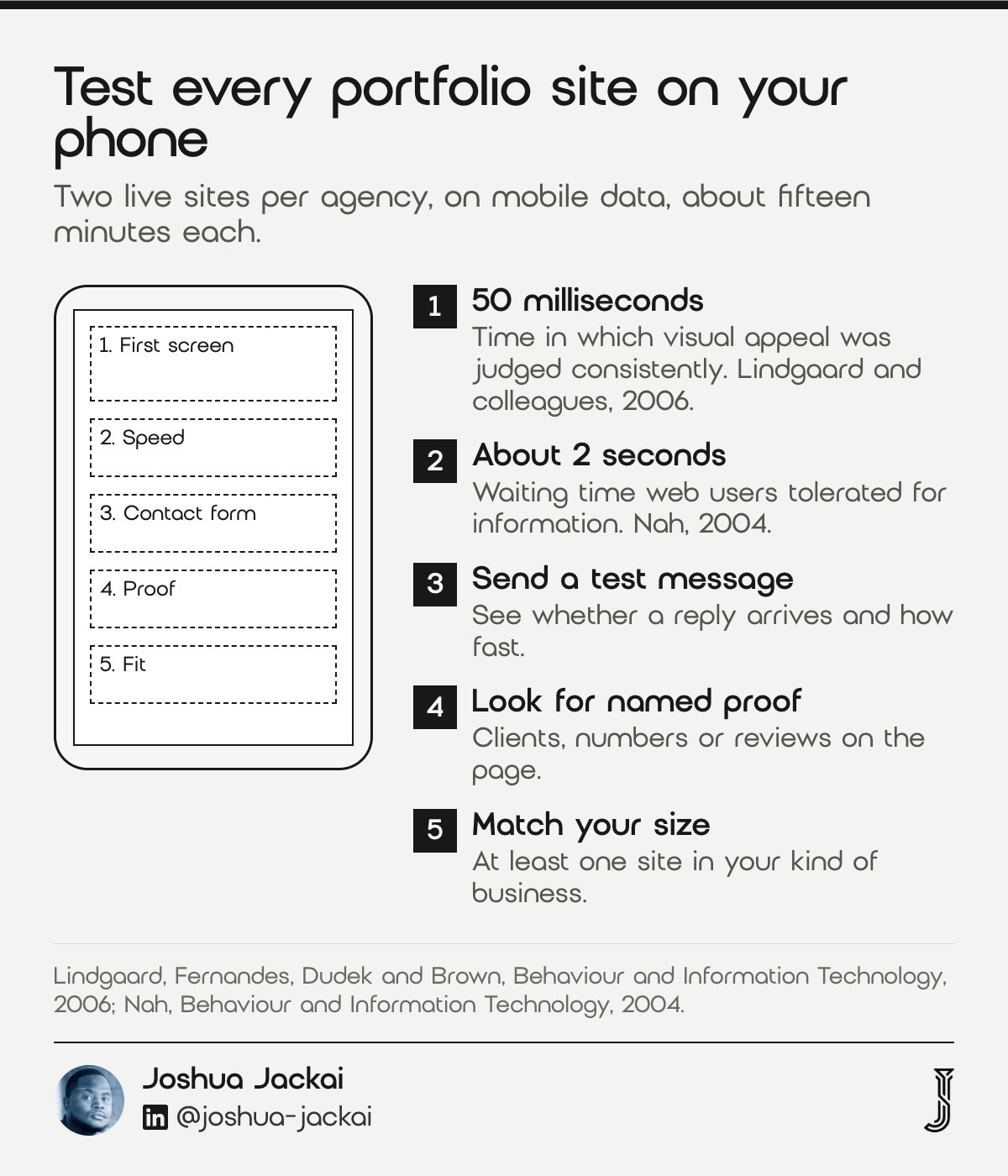
- First screen: can you tell what the company does in a few seconds?
- Speed: does anything load slowly on a phone?
- Form: fill in the contact form with a test message and see if a reply arrives
- Proof: are there named clients, numbers or reviews on the page?
- Fit: is at least one site in your size and kind of business?
Two studies show how quickly people react. Lindgaard and colleagues showed people web pages for 50 milliseconds and found that judgments of visual appeal were consistent in that time (Lindgaard and colleagues, 2006). Nah found that web users tolerated roughly 2 seconds of waiting for information, in a 2004 lab setting (Nah, 2004). That number is dated, so read it as a direction for how little patience visitors have. The first study is about looks, not quality, so take a first look before you read any copy, then check speed and the form.
Lindgaard, Fernandes, Dudek and Brown wrote that “visual appeal can be assessed within 50 ms,” in Behaviour and Information Technology, 2006.
Do this on a phone, because weak builds show on a small screen first. A slow page, a menu that does not open, or a form that fails on a small screen is a sign of how the agency tests its work. Note what you would change as a visitor, then ask the agency about it on the call. Beware of a portfolio made of mockups on laptop frames. Ask for the live address. If a project is no longer live, ask why. Sometimes the client moved on, and sometimes the site failed. Either answer is useful, and a good agency gives it without fuss.
5. How do I check an agency’s reviews and references?
Reviews help, but they are a marketing channel and can be curated. Read them for patterns: the same strength from different people, the same complaint, and how the agency answers a bad one. Then phone one past client. In my experience, ten minutes with a past client tells me more than a page of stars.
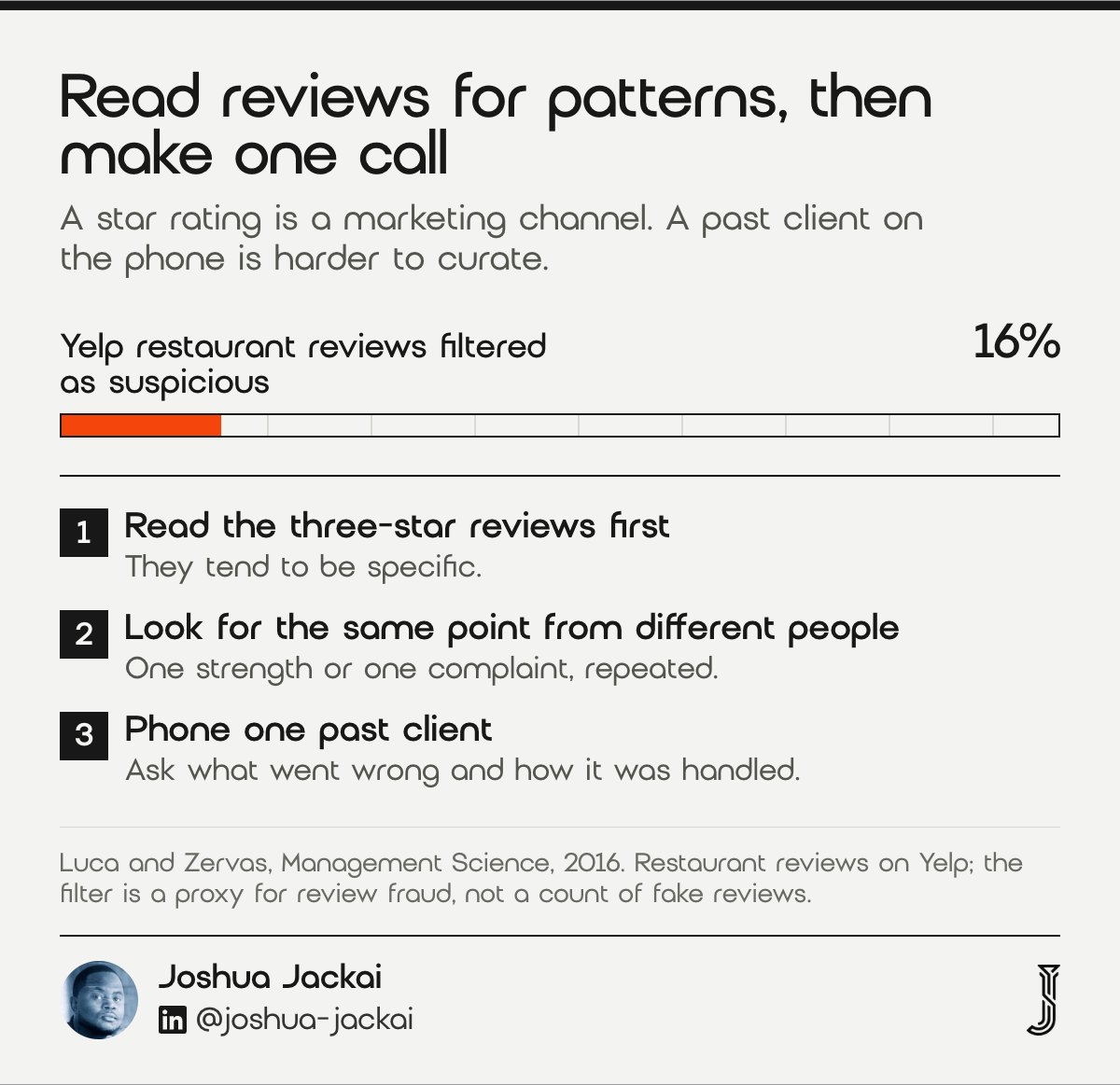
- Google reviews: read the three-star ones first, which in my experience are the most specific
- Pattern to find: the same praise or the same complaint from different people
- Reply check: how the agency answers a negative review
- Reference: one client you can phone, ideally of your size
- Three questions for the client: were you on time, on budget, and would you hire again?
Review research is a caution, not a reason to ignore reviews. Luca and Zervas studied Yelp and found that roughly 16 percent of restaurant reviews were filtered by the platform’s own algorithm as suspicious (Luca and Zervas, 2016). That is restaurants, not web design, and Yelp’s filter is a proxy, not a count of fake reviews. But the lesson carries: where a review earns money, some will be written for it. A reference call is much harder to fake.
“roughly 16% of restaurant reviews on Yelp are filtered,” Luca and Zervas wrote in Management Science, 2016.
A reference works best when you ask about problems. Ask what went wrong and how the agency handled it. Every project has a hiccup, and the way it was handled is what you are hiring. A client who cannot name one is either being polite or the project was very small. Also check the dates. A run of five-star reviews posted in one week deserves a second look, and so does a profile with no reviews older than a year.
6. What should I ask a web design agency on a call?
A discovery call is where you learn who does the work, how decisions get made, and what happens when things change. Come with five questions, ask the follow-ups, and write the answers down. Then ask the agency to confirm the important ones by email, because an answer in writing is one you can hold them to.
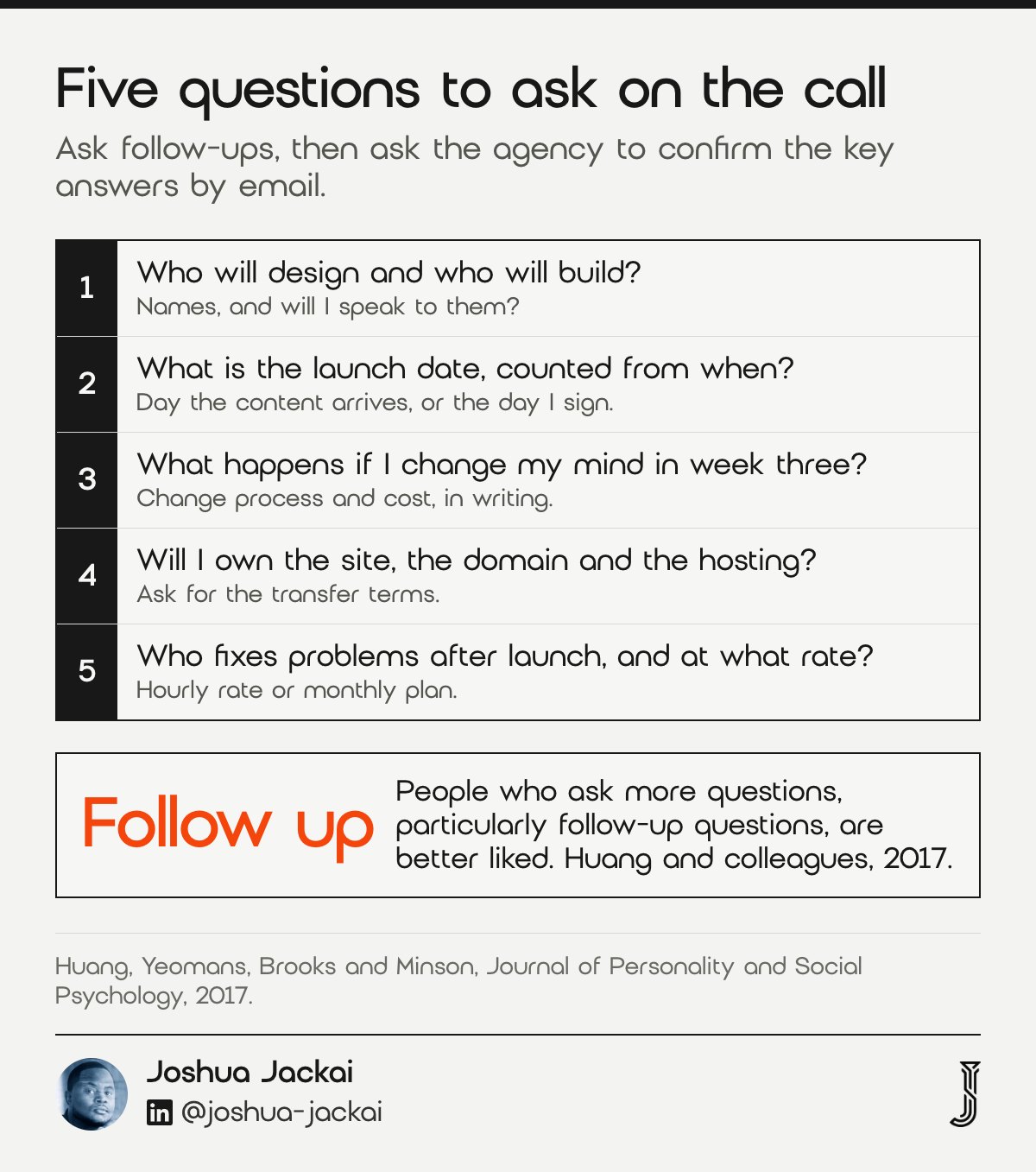
- Who: who will design, who will build, and will I speak to them?
- Timeline: what is the launch date, counted from when?
- Changes: what happens if I change my mind in week three?
- Ownership: will I own the site, the domain and the hosting?
- After launch: who fixes problems, and what does it cost per hour?
Asking questions also improves the relationship. Huang, Yeomans, Brooks and Minson ran studies of live conversations, including speed dating, and found that people who ask more questions, particularly follow-up questions, are better liked by their conversation partners (Huang and colleagues, 2017). The study measured liking, not answer quality. In my experience follow-ups also pull out specifics, and a buyer who asks them is easier to work with.
“people who ask more questions, particularly follow-up questions, are better liked by their conversation partners,” wrote Huang and colleagues in the Journal of Personality and Social Psychology, 2017.
Take the call as a working session, not a pitch. Ask them to describe the last project that ran late, what caused it, and what they changed afterward. Ask how they handle content that arrives late, since that is the most common delay. The answers show whether the team has a process or only a pitch. Listen for specifics. “We handle everything” is not an answer to “who builds it”. “Sam builds it, and you will meet Sam in week one” is. Also ask what they would not do for your project. A team that can say no is a team that has thought about your scope.
7. How do I compare agencies and read the contract?
Put all three agencies on one sheet. Score each from 1 to 5 on the same six criteria, add the totals, and let the numbers argue with your gut. Then read the contract of the winner, because the contract sets what happens when the plan meets the real world. Do both before you pay a deposit.
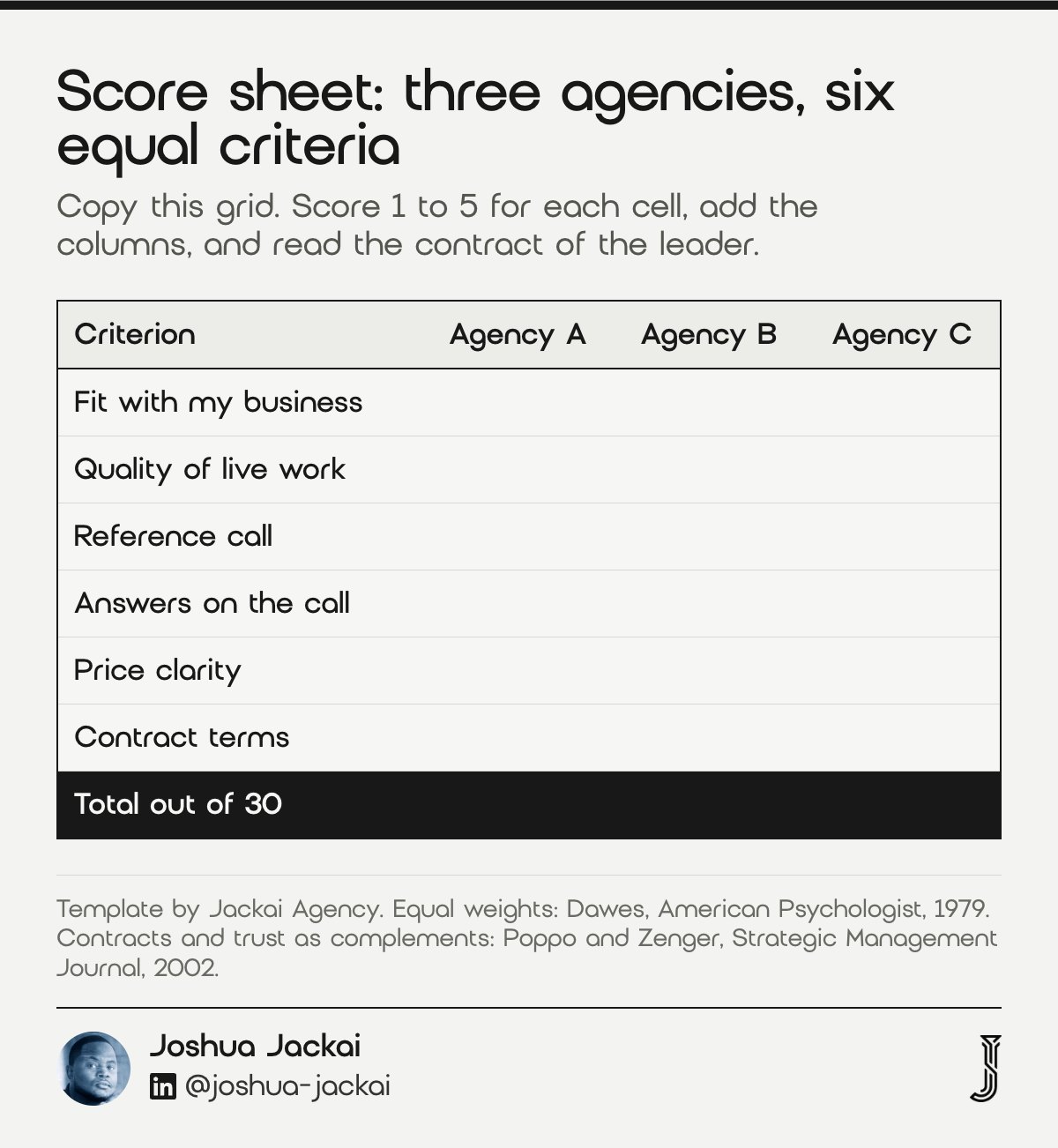
- Criteria: fit, work quality, references, answers on the call, price clarity, contract terms
- Weights: equal, which is simpler and holds up well
- Gut check: if the total and your gut disagree, find out why before you sign
- Contract must name: scope, pages, revision rounds, change process, ownership
- Payment: staged against milestones, not all upfront
On the scoring, Dawes showed that simple equal-weight models can predict nearly as well as models whose weights are fitted with effort (Dawes, 1979). You do not need clever weights. You need the same criteria for everyone, written before you meet them, so that a charming salesperson does not change what counts. On the contract, Poppo and Zenger studied information service exchanges and found that detailed contracts and good working relationships reinforce each other, not substitute for each other (Poppo and Zenger, 2002).
“formal contracts and relational governance function as complements,” Poppo and Zenger wrote in the Strategic Management Journal, 2002.
So read the contract even if you like the team. A good agency welcomes it. Take a day with it, and mark every term about money, dates and ownership. Those three decide most disputes, and they are easy to fix before signing and hard to fix after. Check that the scope lists pages and features, that revision rounds are counted, and that ownership transfers to you on payment. If a clause confuses you, ask for plain words in an email. You can compare quotes in more depth with my guide on why web design quotes vary so much.
What is different about hiring in Vancouver?
Hiring in Vancouver adds a few checks that a generic guide skips. Ask for the quote in Canadian dollars, ask whether GST is shown on the quote and not added later, and ask where your visitors’ data is stored. Local meetings are easy to arrange, and a Pacific time zone agency answers during your business day.
- Currency and tax: the quote in CAD, with GST shown as its own line
- Privacy: an agency that builds forms should know PIPEDA, the federal law on private-sector personal information, and the provincial rules from the BC Office of the Information and Privacy Commissioner
- Local reference: a past client in BC you can phone
- Meetings: in person or on video, in your time zone
I am not a lawyer, so ask your own adviser about which privacy rules apply to your forms and records.
Compare the seven steps and filter by risk
This section lets you sort the seven steps by the risk each one reduces. Pick a risk, and the table hides the steps that do not address it. The ratings of time and effort are my own estimates from running these processes with clients, not measured data. Clear the filter to see all seven again.
| Step | Risks it reduces | Time (my estimate) | You hold |
|---|---|---|---|
| 1. Write the brief | Cost, scope | 60 minutes | A one-page brief |
| 2. Pick the kind of builder | Cost, quality | 30 minutes | Agency, freelancer or AI tool |
| 3. Cut to three | Time | 30 minutes | A shortlist of three |
| 4. Judge the work on a phone | Quality | 45 minutes | Notes on two live sites each |
| 5. Check reviews and references | Trust | 60 minutes | One call with a past client |
| 6. Ask on the call | Trust, scope | 45 minutes | Written answers |
| 7. Score and read the contract | Cost, scope, ownership | 90 minutes | A score sheet and a signed scope |
Score your three agencies on one sheet
Enter a score from 1 to 5 for each agency on each criterion, and the calculator adds the totals and names the leader. The default scores are placeholders, so replace them with your own notes from steps 4 to 6. A gap of less than 3 points means the agencies are close, and the call and the contract should decide.
Score each agency from 1 to 5. Defaults are placeholders.
| Criterion | Agency A | Agency B | Agency C |
|---|---|---|---|
| Fit with my size and kind of business | |||
| Quality of live work on a phone | |||
| Reference call result | |||
| Answers on the call | |||
| Price clarity | |||
| Contract terms |
Frequently asked questions about choosing a web design agency in Vancouver
These are the questions people ask most when they search for how to choose a web design agency in Vancouver, answered in the same terms as the seven steps. Each answer stands alone, so you can read only the one you need, and each links its evidence.
How do I choose a web design agency in Vancouver?
Write a one-page brief, shortlist 3 agencies, open 2 of each agency's live sites on your phone, read reviews and phone 1 past client, ask each the same questions on a call, then score all 3 on one sheet. Read the winner's contract before you pay a deposit.
How much should I pay for a website in Vancouver?
Fixed prices in Vancouver vary with scope, platform and who builds. At Jackai Agency a five-page small business site costs CA$4,950 on Framer or CA$5,950 on WordPress, and a custom B2B site starts at CA$7,450. Ask each agency what the quote includes before you compare the totals.
Is it worth hiring a web designer instead of using AI?
It depends on the site. A test page may suit an AI builder. For a site that wins leads or takes payments, I want a named person checking it. A 2023 study found AI assistant users wrote less secure code, but it tested code, not builders (Perry and colleagues, 2023).
How many agencies should I get quotes from?
Three. One gives you nothing to compare, and ten gives you more notes than you will read. A supermarket study found shoppers more likely to buy from 6 jams than 24 (Iyengar and Lepper, 2000). Send all three the same brief.
How do I check a web design agency's reviews?
Read the three-star reviews first, look for the same point from different people, and see how the agency replies to complaints. Then phone one past client. A call is harder to curate: roughly 16 percent of Yelp restaurant reviews were filtered as suspicious (Luca and Zervas, 2016).
Who sets this up for you
I am Joshua Jackai, founder of Jackai Agency in Vancouver. I design, build and migrate websites for Canadian B2B companies on fixed quotes, and you own the site, the domain and the hosting. If you hold quotes from other agencies, the CA$995 website audit reviews your site and them, credited in full if a project starts within 30 days.
My custom B2B websites start at CA$7,450, described on the B2B web design in Vancouver page, and the wider web design in Vancouver page lists the packages. To see how answer engines read your site before you spend anything, start with the free AI visibility report.
Sources
Peer reviewed
- Iyengar, S. S. and Lepper, M. R. (2000). When choice is demotivating: can one desire too much of a good thing? Journal of Personality and Social Psychology. doi.org/10.1037/0022-3514.79.6.995
- Dey, D., Fan, M. and Zhang, C. (2010). Design and analysis of contracts for software outsourcing. Information Systems Research. doi.org/10.1287/isre.1080.0223
- Perry, N., Srivastava, M., Kumar, D. and Boneh, D. (2023). Do users write more insecure code with AI assistants? Proceedings of the ACM SIGSAC Conference on Computer and Communications Security. doi.org/10.1145/3576915.3623157
- Lindgaard, G., Fernandes, G., Dudek, C. and Brown, J. (2006). Attention web designers: you have 50 milliseconds to make a good first impression! Behaviour and Information Technology. doi.org/10.1080/01449290500330448
- Nah, F. F.-H. (2004). A study on tolerable waiting time: how long are web users willing to wait? Behaviour and Information Technology. doi.org/10.1080/01449290410001669914
- Luca, M. and Zervas, G. (2016). Fake it till you make it: reputation, competition, and Yelp review fraud. Management Science. doi.org/10.1287/mnsc.2015.2304
- Huang, K., Yeomans, M., Brooks, A. W. and Minson, J. (2017). It doesn't hurt to ask: question-asking increases liking. Journal of Personality and Social Psychology. doi.org/10.1037/pspi0000097
- Dawes, R. M. (1979). The robust beauty of improper linear models in decision making. American Psychologist. doi.org/10.1037/0003-066X.34.7.571
- Poppo, L. and Zenger, T. (2002). Do formal contracts and relational governance function as substitutes or complements? Strategic Management Journal. doi.org/10.1002/smj.249
Industry, vendor and company pages (not peer reviewed)
- Search results for "how to choose a web design agency vancouver", read 23 October 2026, including guides from Nirvana Canada and OneNine, both agencies promoting their own services.
- Jackai Agency price table, October 2026 (first-party prices, CAD).
- First-party estimates of time and effort in the step table are my own judgment from client work, not measured data.