A marketing lead at an engineering firm taps a LinkedIn ad between meetings. The ad offered a salary benchmark report. The page opens with the firm’s founding story and a form that wants her phone number. She closes the tab. B2B landing page design is the work of making that page keep the ad’s promise, on the phone she is holding.
Not a prettier page. A page with one job. This guide takes B2B landing page design apart section by section, the way I build pages for paid and campaign traffic: message match, the first screen, proof, form fields, the conversion path after the click, objections, speed, measurement and cost.
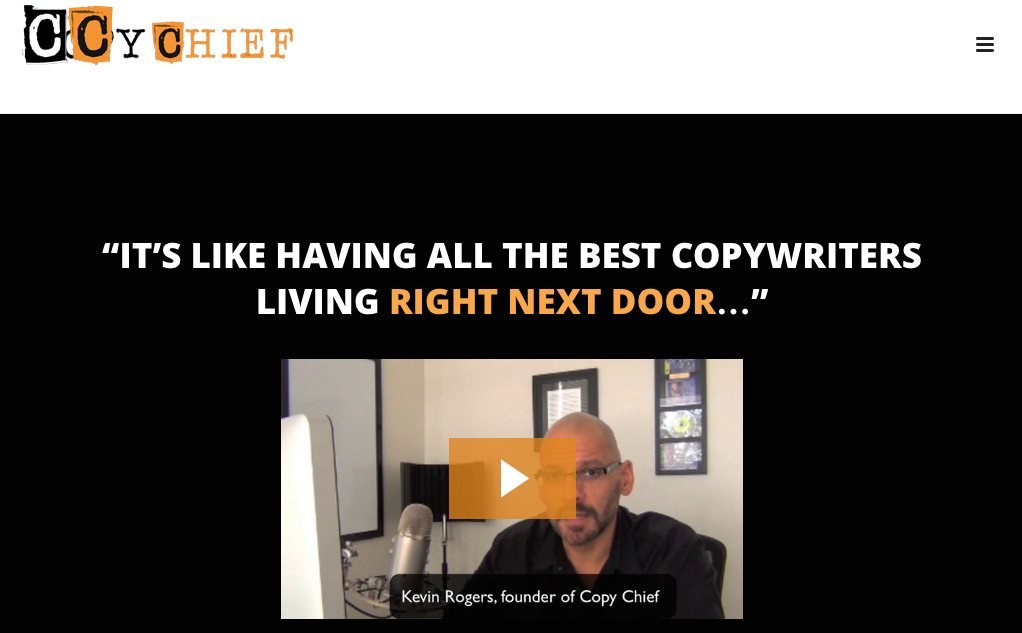
Two numbers from my own projects sit under it. The Hiring on Purpose funnel I rebuilt for Y Scouts, an executive search firm in Scottsdale, converts visitors to leads at 17.7%, read from the client’s own HubSpot. The Escape Velocity landing page for Copy Chief, a copywriting education business, converted at 10.1%. Neither page is clever. Both do one thing.
In this guide
What is B2B landing page design, and how is it different from a website page?
A landing page is built for one campaign, one audience and one action. A website page serves everyone who might arrive: buyers, job seekers, partners, reporters. B2B landing page design takes the opposite bet. It assumes you know who clicked and what they were promised, and it removes anything that does not serve that person.
That is why I take the main menu off campaign pages. On a homepage, menu links help people find what they came for. On a paid page, each one is an exit for the click you paid for.
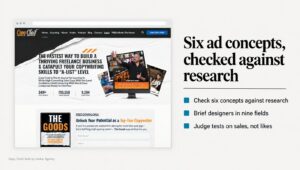
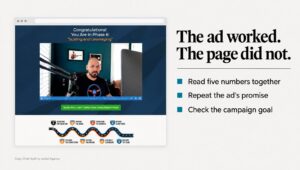
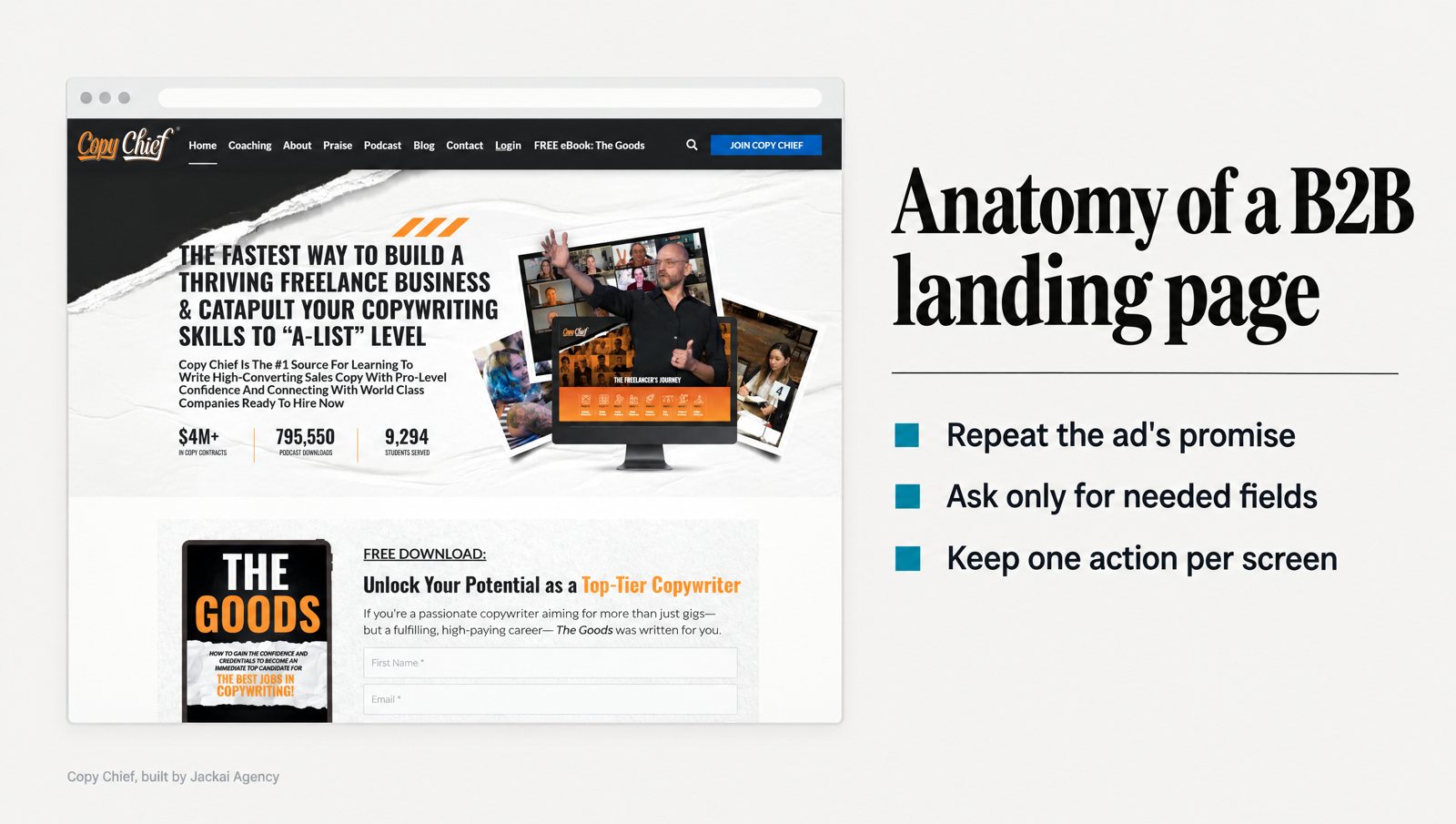
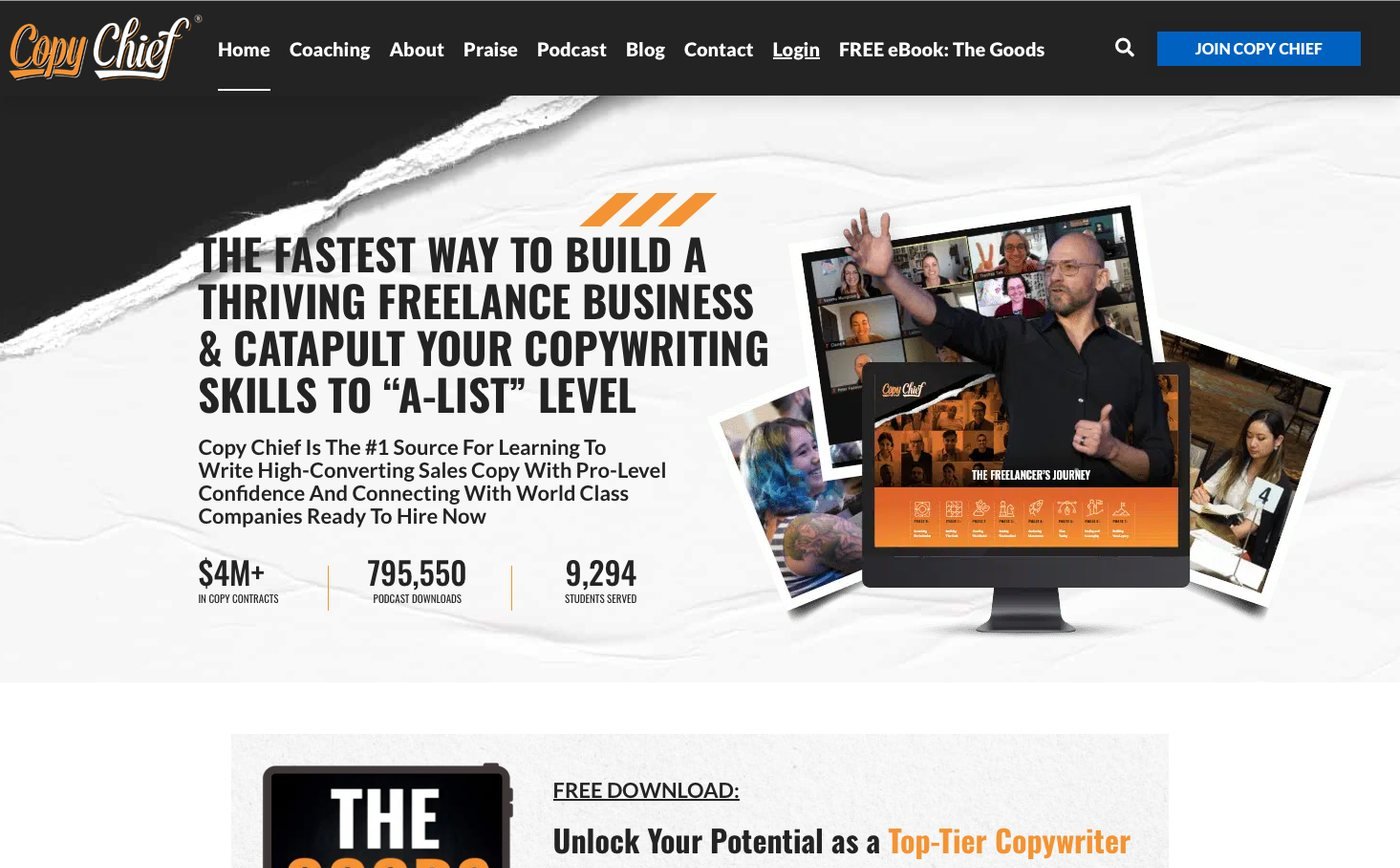
Copy Chief, a membership platform for working copywriters, was sending paid traffic to a page written for existing members. The ad’s promise appeared nowhere on it, and the sign-up button appeared once, below the fold. I built a separate mobile-first funnel in ClickFunnels for paid traffic only. The Membership Funnel Redesign campaign, August to October 2023: 31x return on ad spend, 215 paid subscriptions.
The membership did not change. The destination did. That 31x belongs to a campaign that ran to a deadline, not to the funnel forever.
B2B adds a second reader. In a study of purchases at 31 firms, Johnston and Bonoma (1981) found the makeup of the buying group changed with what was being bought and how the company was organized. So the page gets forwarded, and it has to make sense to a finance lead who never saw the ad.
How does message match keep the ad’s promise on the page?
Message match means the first thing a visitor reads on the page repeats the promise of the ad they clicked, in the same words. Not a paraphrase. Not the brand tagline. The same noun, the same number and the same offer name.
The idea comes from information foraging theory. Pirolli and Card (1999) described people looking for information as foragers who judge where to go by cues they can see before they commit, which they called information scent. The ad is the scent. If the page smells different, it reads as the wrong place.
On the Copy Chief funnel the fix was literal: the first line repeats the ad’s promise word for word. I can’t hand the whole 31x to that line. The case study marks message match as not measured in isolation, because the headline, the destination and the creative all changed in the same campaign.
Message match is still the cheapest fix in B2B landing page design, because it costs a sentence:
- Copy the ad’s main claim into the headline. If the ad says “Fixed-price IT audit in 10 days”, so does the headline.
- Keep the offer name identical. If the ad says report, the page does not say playbook.
- Repeat the image. Use the same screenshot or cover in the ad and on the first screen.
- Give each ad angle its own headline. A page written for a price angle and a compliance angle at once matches neither.
When an ad’s click-through rate is high and the page’s conversion rate is low, the first thing I check is message match: the ad and the headline, side by side.
What goes on the first screen of a B2B landing page?
The first screen decides whether anyone sees the second. Lindgaard and colleagues (2006) found people rate a web page’s visual appeal within 50 milliseconds, and those snap ratings closely matched the ones they gave after a 500-millisecond look. You do not get a paragraph to warm up.
Looks carry trust as well. In Fogg and colleagues’ 2003 study, 2,684 people judged the credibility of real websites, and the design look came up in 46.1% of their comments, more than any other factor. I read that as a warning: a page that looks thrown together tells a buyer how the project might go.
Above the fold, my B2B landing page design carries five things:
- The headline. Message match first: the ad’s promise, in the ad’s words.
- One line on who it is for. “For finance teams of 20 to 200 people” filters better than a paragraph of benefits.
- One call to action. A verb and an object, like “Get the benchmark report”. Never “Submit”.
- One proof line. A named client and a number with its context.
- A real image. The report cover, the dashboard or the person who runs the call. Never a stock handshake.
What I leave off: sliders, autoplaying video, a second button competing with the first, and rows of integration logos. Each asks for a choice before the visitor knows the page is for them.
Where should proof sit on a campaign page, and what counts as proof?
In B2B landing page design, proof is anything a skeptical buyer can check: a named client, what they sell, the number and the conditions it was measured under. “Trusted by 500+ companies” is not proof unless you can name them.
Put proof directly under the claim it supports, so if the headline promises faster hiring, the first proof block is about hiring. Proof saved for a carousel at the foot of the page only reaches people already reading to the end.
Keep the caveat in the same sentence as the number. The Y Scouts figure is 17.7% visitor-to-lead, 166 leads from 938 visitors, measured in the client’s HubSpot. I show the denominator so a careful reader can judge the sample.
Then match proof to each reader in the buying group. The person who clicked wants to know it works, the owner wants the cost, and operations wants the timeline. One number, a link to the Y Scouts case study and a line on timing cover all three.
How many form fields should a B2B landing page ask for?
As few as the next step needs. Each of your form fields is a question the visitor answers before getting anything back. If the next step is a report sent by email, the form needs an email address. If it is a sales call, it needs a name, a work email, a company and, at most, one qualifying question.
Form fields are the part of B2B landing page design with the cleanest experimental evidence. Seckler and colleagues (2014) applied 20 usability guidelines to forms from real company websites and tested old against new with 65 people. The improved forms were finished faster, needed fewer submission attempts and scored higher on satisfaction.
Error messages matter too: in two studies, Bargas-Avila and colleagues (2007) found that showing errors after the form was finished worked better than flagging them live. People in the middle of a form often ignored the live messages and kept typing.
This is how I decide which form fields stay:
| Field | Keep it when | Cut it when |
|---|---|---|
| Work email | Always. The follow-up needs it. | Never. |
| Name | A person will reply. | The next step is an automatic download. |
| Company | Sales qualifies by company. | Your CRM can fill it from the email domain. |
| Phone | The call happens by phone, and the page says so. | Almost every other time. |
| Company size or budget | Sales turns away small accounts, and the page says so. | Nobody acts on the answer. |
| Message box | The request is custom work. | The offer is a fixed asset like a report. |
When sales needs more than four form fields, I split the form: a work email first, the rest on a second step. Freedman and Fraser (1966) found people who agreed to a small request were more likely to agree to a larger one later. Their study was not about web forms, so I treat it as a reason to test the split, not proof it will win on your page.
Every form also carries hidden form fields: the UTM source, medium and campaign, plus the page the lead converted on. Without them, nobody can say which ad paid for the lead. My lead attribution method shows that chain link by link.
What does the conversion path look like after someone submits?
The conversion path is every step from the ad to the first conversation: page, form, thank-you page, delivery email, CRM record, follow-up. Most B2B landing page design advice stops at the button. The leads I see wasted are usually lost after it.
That was the before state on the Y Scouts lead-gen pages. A book, an executive interview guide and an AI hiring tool were being given away, but the forms, delivery and follow-up ran as separate pieces. Book delivery was not automated, and with no campaign tracking the founder couldn’t tell which channel produced a lead.
I rebuilt it as one HubSpot flow on every surface: form, delivery email, follow-up workflow and UTM tracking, so a submission becomes a contact with a source, and calls to action repeat down the page where attention lands. On the Hiring on Purpose book funnel, that conversion path converts visitors to leads at 17.7%. The content feeding the page contributed to that rate too, so I don’t credit the page alone.
Keep one action, worded the same way each time it appears. On the Copy Chief funnel the ask repeats on every screen in identical wording. Iyengar and Lepper (2000) found shoppers offered 6 jams were more likely to buy than shoppers offered 24, and the pattern held for chocolates and essay assignments. Two equal buttons split the decision. One button makes it.
In my work, the thank-you page is the most wasted screen in a B2B conversion path. The visitor just raised their hand, so give them the next step right there: the download, a calendar, or one case study that matches their request.
On the Book a Demo page for Advisor Websites, a Vancouver SaaS platform for financial advisors, I replaced the demo request form with real-time calendar booking, a CEO video and named testimonials. Picking a time takes a step out of the conversion path. The Advisor Websites landing page work shows the before and after.
Which objections should the page answer before the form?
The ones your sales team hears on calls, in the words prospects use. Not the ones a template suggests. On the Role Visioning landing page for Y Scouts’ AI hiring tool, the page is split for two readers, hiring teams and executive candidates, and it closes on six real objections.
I find objections in call notes and sales emails. For Copy Chief I also mined pain points with Perplexity and a custom Python Reddit scraper that fed Reddit comments to a language model to pull out pains and desires. The output is a list of sentences real people actually wrote.
Answer them plainly, because Oppenheimer (2006) found that needlessly complex wording made readers judge the writer as less intelligent, not more, and that the effect ran through how hard the text was to read.
These five come up in almost every B2B landing page design project I take on:
- What does it cost? A starting price or a range, if you can publish one.
- How long until I see something? A timeline in weeks, with the first deliverable named.
- Who does the work? A named person beats “our team”.
- What do you need from us? The hours and the logins you need from their team, stated up front.
- What if it isn’t right? Revision rounds and exit terms, one sentence each.
How fast and how mobile does the page need to be?
Fast, and designed for the phone first. Escape Velocity, Copy Chief’s Meta campaign, ran into a mobile-first funnel: the phone layout came first and the desktop layout was adapted from it.
Load time does damage you can measure: Galletta and colleagues (2004) tested page delays from 0 to 12 seconds with 196 people. Task performance, attitudes toward the site and intention to come back all fell as the delay grew, and most of the drop in performance and intentions had happened by about 4 seconds.
My speed checklist for B2B landing page design before a campaign goes live:
- Size the hero image for the phone. Compress it and serve it at the width the screen shows.
- Load extra scripts late. Chat widgets, heatmaps and extra pixels wait until the page renders.
- Use the right keyboard. An email field opens the email keyboard; a phone field opens the number pad.
- Test on a real phone. A mid-range phone on a cellular connection, not only desktop dev tools.
How do you know if your B2B landing page design is working?
Measure the rate the page owns: visitors to leads, counted in your CRM at the end of the conversion path. Analytics counts form submissions, while the CRM shows which of those were real people at real companies and, later, which became deals.
Compare like with like. Y Scouts’ 17.7% comes from a free book funnel, while Escape Velocity’s 10.1% is landing-page conversion on a paid offer. I would never set one as the target for the other.
Read the rate next to cost. Over the Escape Velocity campaign, cost per acquisition fell from $42 to $22 and ad click-through rose from 0.9% to 3.0%. The creative and the page changed in the same campaign, so I don’t split that credit between them.
A page with a few hundred visitors a month usually can’t settle an A/B test in a few weeks, so I change one thing at a time and watch a full campaign. If you can’t see the source of each lead at all, start with Lead Source Reporting before redesigning anything.
What does B2B landing page design cost, and how long does it take?
On my price list, B2B landing page design (the Landing Page Design offer) starts at CA$3,795 and takes 1 to 2 weeks. Every project gets a fixed quote before work starts and two revision rounds per phase, and you own the page, the domain and the hosting.
If your forms don’t pass a source into the CRM yet, that is a separate two-week job, Lead Source Reporting, at CA$2,600. If the problem is the whole site rather than one page, a custom B2B website starts at CA$7,450 on Framer or CA$8,950 on WordPress. Current numbers are on the pricing page.
Which job you need depends on where the leak is:
| Your situation | What I would build first |
|---|---|
| Ads send traffic to the homepage | A dedicated landing page for that campaign |
| Several ad angles point at one page | One headline per angle, for message match |
| Leads arrive with no source | Lead source tracking, then the page |
| A few hundred visits a month | Fix the offer and the form fields before testing layouts |
| The whole site is out of date | A site rebuild; one landing page will not carry it |
To brief a landing page, send me the ads, the offer and the conversion path after someone converts, five to ten real questions from sales calls, CRM access, and your current page with its numbers. When the whole site needs the same treatment, my B2B conversion web design work starts from the same brief.
Is your landing page keeping the ad’s promise?
Same ad. Same budget. A page with message match from the first line, fewer form fields, and a conversion path that hands sales a lead with its source attached.
If you want a second opinion on your B2B landing page design, book a 30-minute call with me. I measure your starting numbers with you on the call, including mobile conversion rate and lead count, before any work starts. You leave with those numbers whether or not you hire me.
Sources
Peer-reviewed research
- Bargas-Avila, J. A., Oberholzer, G., Schmutz, P., de Vito, M., and Opwis, K. (2007). Usable error message presentation in the World Wide Web: Do not show errors right away. Interacting with Computers, 19(3), 330-341.
- Fogg, B. J., Soohoo, C., Danielson, D. R., Marable, L., Stanford, J., and Tauber, E. R. (2003). How do users evaluate the credibility of Web sites? Proceedings of the 2003 Conference on Designing for User Experiences, 1-15.
- Freedman, J. L., and Fraser, S. C. (1966). Compliance without pressure: The foot-in-the-door technique. Journal of Personality and Social Psychology, 4(2), 195-202.
- Galletta, D., Henry, R., McCoy, S., and Polak, P. (2004). Web site delays: How tolerant are users? Journal of the Association for Information Systems, 5(1), 1-28.
- Iyengar, S. S., and Lepper, M. R. (2000). When choice is demotivating: Can one desire too much of a good thing? Journal of Personality and Social Psychology, 79(6), 995-1006.
- Johnston, W. J., and Bonoma, T. V. (1981). The buying center: Structure and interaction patterns. Journal of Marketing, 45(3), 143-156.
- Lindgaard, G., Fernandes, G., Dudek, C., and Brown, J. (2006). Attention web designers: You have 50 milliseconds to make a good first impression! Behaviour and Information Technology, 25(2), 115-126.
- Oppenheimer, D. M. (2006). Consequences of erudite vernacular utilized irrespective of necessity: Problems with using long words needlessly. Applied Cognitive Psychology, 20(2), 139-156.
- Pirolli, P., and Card, S. (1999). Information foraging. Psychological Review, 106(4), 643-675.
- Seckler, M., Heinz, S., Bargas-Avila, J. A., Opwis, K., and Tuch, A. N. (2014). Designing usable web forms: Empirical evaluation of web form improvement guidelines. Proceedings of the SIGCHI Conference on Human Factors in Computing Systems, 1275-1284.