High-value clients almost never tell you why they didn’t call. Picture an operations director with your homepage open in one tab and two competitors in the others. She owes her CFO a shortlist by Friday. She reads your headline, scrolls once, and still can’t tell who you work for or whether you’ve done this before. She closes the tab. Nothing in your analytics explains it.
It isn’t a traffic problem, and it isn’t a “make it prettier” problem. On the B2B websites I audit, the firm usually has the proof a serious buyer needs. It sits in the wrong place: under three screens of story, in the footer, or on a page nobody opens.
This post covers the four places high-value clients drop off: the first screen, where your proof sits, the buying committee, and your pricing signals. For each: what I check, what I changed on client sites, and the research behind it.
In this guide
Why do high-value clients leave a B2B website before they call?
Because they can’t test your work before they buy it: a buyer can try a laptop in a store, but she can’t try your audit or your legal advice first. Kirmani and Rao’s review of the signaling research covers this case: when buyers can’t observe quality, firms show it through things buyers can observe, such as price, warranties and advertising spend (Kirmani and Rao, 2000).
Your website is the first of those signals, and buyers read it fast. In one study, people rated the visual appeal of web pages shown for 50 milliseconds, and those ratings were highly correlated with ratings given after 500 milliseconds (Lindgaard et al., 2006). Your first screen gets judged before anyone reads a word of it.
Then buyers judge credibility on what they can see. When 2,684 people assessed the credibility of live websites, the look of the design came up in 46.1% of their comments, more than any other factor (Fogg et al., 2003). For a firm selling a service nobody can try in advance, the page does the first round of due diligence alone.
That’s the pattern I see in audits. High-value clients don’t leave because your firm is weak. They leave because the page made them work to find out it isn’t, and a buyer with two other tabs open won’t do that work. You get the traffic without the qualified leads.
What does the first screen of a B2B website have to answer?
Three questions, in this order: who is this for, what changes for them, and why should I believe it. If a buyer can answer all three without scrolling, she keeps reading. If she can answer one, she’s guessing, and a guessing buyer goes back to her shortlist.
Most first screens answer none of them. “Strategic solutions for growing businesses” names no reader, no outcome and no proof. Compare a line written for one buyer: “Fractional finance teams for Canadian manufacturers with 50 to 200 staff. Month-end close in five days, not fifteen.” That firm is an illustration, not a client. Only the second line gives a buyer something to act on.
Keep the words plain, because in a series of experiments needlessly complex vocabulary made writers seem less intelligent, not more, and the effect ran through how hard the text was to read (Oppenheimer, 2006). Your buying committee is reading between meetings, often on a phone. Jargon spends credibility you haven’t earned yet.
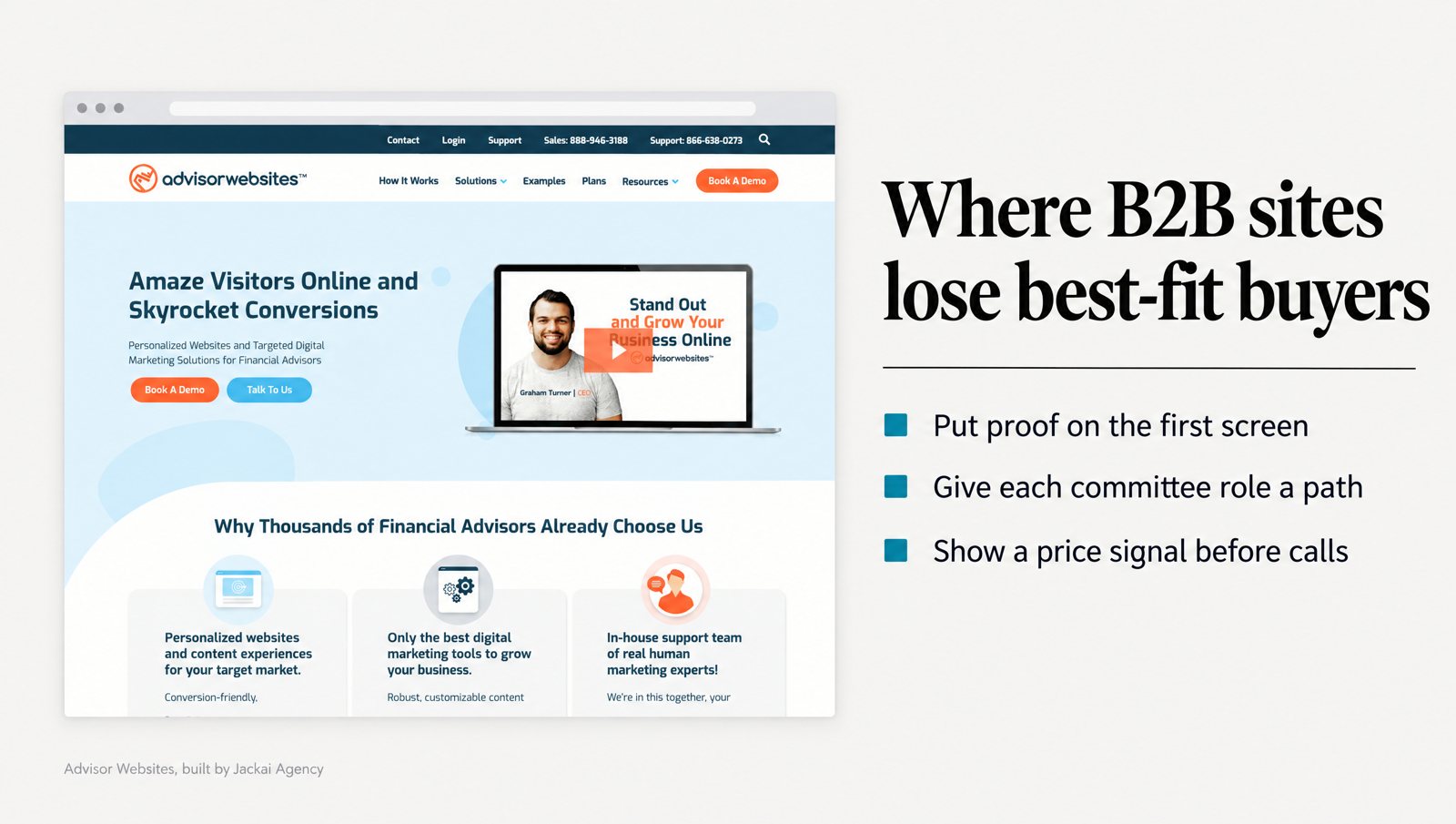
The first screen also needs one next step, not five. Advisor Websites, a Vancouver SaaS platform that builds websites for financial advisors, had a homepage with several equal-weight calls to action and no route back to the webinar a visitor had just attended. I rebuilt it around one primary action and a visible route into a replay library. The Advisor Websites case study shows both versions.
The research carries a caveat: people offered 6 jams or chocolates were more likely to buy than people offered 24 or 30 (Iyengar and Lepper, 2000). A meta-analysis of 50 experiments later found the average effect was close to zero, with large swings between studies (Scheibehenne et al., 2010). So treat extra buttons as a risk, not a law. My first-screen checklist:
- Name the reader. Industry, size or role, in the headline or the line under it.
- State the outcome. A result a buyer could check later, not an adjective.
- Show one piece of proof. A named client with a number, a credential, or an authorization.
- Offer one next step. One button, worded as what happens when you click it.
Where should proof sit so buyers actually see it?
On the first screen, beside the claim it supports. That sounds obvious until you look at where B2B websites keep their best evidence: the footer, the last paragraph of the About page, or a case study the buyer has to hunt for.
S.T. Dupont Vancouver is the authorized S.T. Dupont flagship store in Canada, selling luxury lighters, pens and leather goods. Its authorized dealer status, the one fact that separates it from a reseller, sat in the footer of a Wix template. First-time buyers missed it, and some phoned the store to ask whether the shop was real.
When I moved the store from Wix to WordPress and WooCommerce, I put the dealer statement in the first screen and repeated it on every product page. Online sales grew 5x in the first 90 days, against the last 90 days the old Wix store could sell. Same license. Same products. Same store.
I won’t tell you the dealer line did that alone, because the whole storefront changed at once, including 290 products migrated with taxonomy, pricing and copy intact. The S.T. Dupont Vancouver case study marks the dealer move as not measured on its own. It’s also retail, not B2B, but the lesson carries over: the fact that removes a buyer’s biggest doubt belongs where she looks first.
Professional-service firms bury credentials the same way. W Communications, a Seattle strategic communications and speaking practice, had a biography page that opened with several paragraphs of story. The strongest credential on the page, former Starbucks senior vice president, sat below them. In the rebuild, the credential leads. The W Communications case study reports no number, because no analytics survived the rebuild. The before and after captures are the evidence.
What counts as proof for high-value clients?
Specific proof beats impressive proof, because a logo wall says you’ve met some companies. A named client with a measured result, scoped to the work you did, says you can do it again. In my experience, high-value clients read proof the way an auditor reads a claim: who, what, and compared with what.
Precision helps, with a catch: in four experiments on green advertising, precise numbers made a company seem more competent, mainly to readers low in advertising skepticism; highly skeptical readers were less affected (Xie and Kronrod, 2012). I’d assume high-value clients are the skeptical kind. So a precise number needs its source and its limits right beside it.
Here’s a real result: Advisor Websites saw +58% organic traffic and +28% MQL conversion (MQL means marketing-qualified lead). Both came from two things I built: a webinar replay library, where each recording became its own page, and opt-in templates the marketing team could reuse. I don’t claim them for the homepage or the brand. Scoped like that, the numbers survive a careful buyer’s questions.
| Weak proof | Why it fails | Stronger version |
|---|---|---|
| A wall of client logos | Says who you met, not what changed | One named client, the work, the result and its limit |
| “Trusted by 500+ businesses” | Nobody can check it | A count the buyer could verify, or nothing |
| “Great to work with!” | Describes a mood, not an outcome | A quote that names the problem and what happened after |
| “Award-winning team” | No award is named | The credential itself: issuer, year, what it covers |
| A big percentage, no baseline | Reads as marketing | Before, after, the period and what else changed |
How does a buying committee read your B2B website?
Not as one person. Webster and Wind modeled organizational buying as a decision process run by a buying center, where people play different roles: users, influencers, buyers, deciders and gatekeepers (Webster and Wind, 1972). A field study of 31 firms found that the makeup of that group, and how its members interact, differs between equipment and service purchases (Johnston and Bonoma, 1981).
So the person who finds you is rarely the person who signs. Your champion forwards a link, the finance lead opens it on a phone, and someone in operations checks whether your process will eat their team’s time. Each member of the buying committee brings a different question, and most B2B websites answer only the champion’s. On my projects, high-value clients arrive with the biggest committees.
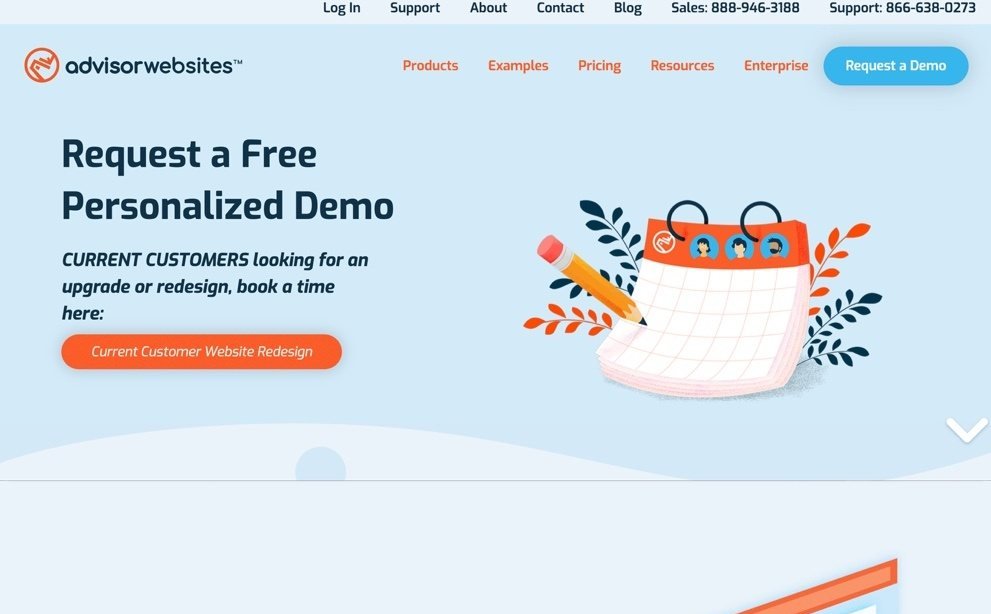
Advisor Websites had this on its demo page, because a financial advisory firm choosing a website platform involves the advisor who owns the practice, an office manager and often a compliance officer. The page had to serve each without splitting the main goal, a booked demo. The rebuilt page pairs real-time calendar booking with a CEO video and named testimonials.
| Committee role | The question they bring | Where your site should answer it |
|---|---|---|
| Champion (found you) | Can I defend this choice to my boss? | A case study they can forward, result in the first paragraph |
| Decider (signs) | What will this cost and what do we get? | Pricing or a “how pricing works” page, plus scope and timeline |
| Finance | Is this in the range we expected? | Starting prices or ranges, and payment terms |
| Operations or IT | How much of our time will this take? | A process page: steps, who does what, what you need from them |
| Procurement or compliance | Can we contract with this firm? | Legal entity, location, ownership terms and policies |
On W Communications the readers weren’t a buying committee, but the fix was the same. Media, clients, event bookers and readers all landed on one homepage and got one general paragraph. The rebuild names each audience in the first screen and sends it to its own page. Four people on the buying committee need four short paths, not one long page.
Should a B2B website show pricing to high-value clients?
Show enough to qualify them, which rarely means a full price list and almost never means nothing. When a firm hides every price signal, the buyer doesn’t think “premium”. She thinks “I’ll need a call just to find out if we can afford this”, and her finance lead may stop the process there.
Price is one of the quality signals Kirmani and Rao describe. Trust research points the same way: people hesitate with online vendors because of uncertainty about how the vendor will behave, and trust is what helps them get past that risk (McKnight et al., 2002). A visible starting price removes one uncertainty before the first call, and it helps filter for qualified leads.
| Your situation | What I’d show |
|---|---|
| Packaged services with a set scope | Exact prices and what each one includes |
| Projects that vary by size | “From” prices, plus the factors that move the number |
| Retainers | A monthly figure, the minimum term and what a month covers |
| Fully custom enterprise work | Typical ranges from past projects, or a “how we price” page |
| Pricing bound by contract or regulation | The process and timeline instead of numbers |
The usual objection is that published prices anchor the talk too low, but a “from” price sets the floor, not the ceiling, so high-value clients with a bigger scope know where the conversation starts.
I do this myself: Jackai Agency publishes every price on the Jackai Agency pricing page, with paid work starting at CA$995. The point isn’t to close on the page. It’s to get qualified leads onto a first call that starts with the budget question answered.

How do you turn interest into qualified leads without scaring off big buyers?
Ask for less, ask later, and say exactly what happens next. A “Contact us” form with nine fields asks high-value clients to do admin for you before you’ve given them anything. Advisor Websites had a version of this: the booking page asked for a decision before it had given a reason to make one.
I make three changes on almost every project. First, name the action and the time: “Book a 30-minute call” says more than “Get in touch”. Second, ask only for what you need to prepare: name, work email, company, and one question about the problem. Third, put proof next to the button, so the last thing she reads before deciding is a reason to say yes.
Then make sure you can see where qualified leads come from. If every form arrives tagged “website”, you can’t tell whether the case study, the pricing page or a LinkedIn post did the work. My lead attribution method puts a UTM on every link, carries the tags through the form into the CRM, records the landing page, and separates AI referral traffic from direct.
Without that, a redesign can bring in more form fills and fewer qualified leads, and you won’t know until sales complains. If you’d rather hand it off, Lead Source Reporting is a two-week project at CA$2,600.
How do you audit your own B2B website for these leaks?
You can run most of this in an afternoon, on a phone first, because the finance lead on your buying committee may never see the desktop version.
- Run a five-second test. Show your homepage to someone outside your industry for five seconds, then hide it. Ask who it’s for and what you do.
- List your proof. Every credential, named result and authorization, and where each one sits.
- Measure the distance. Count the scrolls between your main claim and the proof behind it.
- Map the buying committee. For your last three won deals, list everyone involved. Check that each person’s question has a page.
- Check your price signal. Can a buyer tell, without a call, whether you’re in her range?
- Count your calls to action. Pick one primary button per key page.
- Read your search queries. In Google Search Console, compare what people typed with your headline.
- Watch real sessions. Ten recordings in a free tool such as Microsoft Clarity show where people stop.
- Trace one lead end to end. Submit your own form and check what reaches the CRM. If qualified leads arrive as “unknown”, fix that first.
On the In Communications client accounts, every redesign started with this kind of conversion audit: which pages had the highest exit rates, what path converting visitors took, and where busy pages failed to produce leads. The brief named one specific buyer. The In Communications case study walks through that framework.
What I would not do: redesign the whole site before you know where high-value clients drop off, add a logo wall to look bigger, or add a chatbot. I’d also skip A/B tests on a page with a few hundred visitors a month; on the small B2B sites I work on, those run for months without a winner. Fix the obvious leaks, then track qualified leads by source over a quarter.
What does fixing this cost, and how long does it take?
It depends on what the audit finds: some leaks are an afternoon of copy changes, while others mean the B2B website itself can’t carry the pages your buyers need. Here’s how my published prices, dated October 2026, map to the problems above.
| What the audit finds | Fix | Price (CAD) | Time |
|---|---|---|---|
| You don’t know where buyers drop off | Website Audit (teardown) | CA$995 | 1 week |
| Qualified leads arrive with no source | Lead Source Reporting | CA$2,600 | 2 weeks |
| One service needs its own page | Landing Page Design | from CA$3,795 | 1 to 2 weeks |
| The site can’t carry proof, paths and pricing | Custom B2B Website, up to 5 pages, WordPress | CA$8,950 | Set in the fixed quote |
| Several services, case studies and buying committee paths | Marketing Site, 8 to 15 pages | from CA$10,495 | 4 to 6 weeks |
Each one comes as a fixed quote with two revision rounds per phase, and you own the site, domain and hosting. I reply within one business day.
Where to start if high-value clients are slipping away
Start with your B2B website’s first screen and its proof. Those two fixes cost the least and reach the buyer who matters most: the one who gives you a single screen before deciding whether you’ve earned a call. Your traffic doesn’t have to change. Your services don’t have to change. The page has to stop hiding the reason to call.
For a second pair of eyes, book the CA$995 Website Audit. In one week I read your analytics and funnel page by page and give you a ranked list of what is costing you leads, with the reason for each item. The document is yours to keep, and the fee is credited against a build on the terms listed on the offers page.
Sources
Peer-reviewed research
- Fogg, B. J., et al. (2003). How do users evaluate the credibility of Web sites? A study with over 2,500 participants. Proceedings of the 2003 Conference on Designing for User Experiences, ACM.
- Iyengar, S. S., and Lepper, M. R. (2000). When choice is demotivating: Can one desire too much of a good thing? Journal of Personality and Social Psychology.
- Johnston, W. J., and Bonoma, T. V. (1981). The buying center: Structure and interaction patterns. Journal of Marketing.
- Kirmani, A., and Rao, A. R. (2000). No pain, no gain: A critical review of the literature on signaling unobservable product quality. Journal of Marketing.
- Lindgaard, G., et al. (2006). Attention web designers: You have 50 milliseconds to make a good first impression! Behaviour and Information Technology.
- McKnight, D. H., et al. (2002). Developing and validating trust measures for e-commerce: An integrative typology. Information Systems Research.
- Oppenheimer, D. M. (2006). Consequences of erudite vernacular utilized irrespective of necessity: Problems with using long words needlessly. Applied Cognitive Psychology.
- Scheibehenne, B., et al. (2010). Can there ever be too many options? A meta-analytic review of choice overload. Journal of Consumer Research.
- Webster, F. E., and Wind, Y. (1972). A general model for understanding organizational buying behavior. Journal of Marketing.
- Xie, G.-X., and Kronrod, A. (2012). Is the devil in the details? The signaling effect of numerical precision in environmental advertising claims. Journal of Advertising.
Industry and vendor data (not peer reviewed)
- Jackai Agency price table, published 3 October 2026 (first-party prices). Jackai Agency pricing