Website Design for Interior Design Firms: 7 Proven Rules
Seven things every Vancouver interior design firm website needs: photos you have the right to publish, a portfolio with project stories, a clear first screen, honest credentials and reviews, a CASL-safe enquiry form, phone speed and text that search engines and AI answers can read, with my CAD prices.
 Joshua Jackai
18 min read
Published 26 November 2026 · Last updated and fact-checked November 2026
I am a web designer, not a lawyer. Confirm copyright and privacy questions with your own lawyer, and designation questions with IDIBC.
Short answer: Good website design for an interior design firm shows finished rooms fast, proves the firm can be trusted with a budget, and turns the right visitors into enquiries. In Canada, the photographer owns your project photos unless a signed agreement says otherwise. My fixed builds for Vancouver studios start at CA$4,950.
Interior design firms in Vancouver ask me for the same thing: a site that looks as good as their rooms and brings in projects that fit. The first part is easy to get wrong in a quiet way. A beautiful portfolio that loads slowly, uses photos the firm has no licence to publish, and ends in a contact form asking only for a name and email will look fine and still waste your time. This guide gives you the seven things I check on every interior design website, with the study or the statute behind each one.
In this guide
Key takeaways
- Under Canada’s Copyright Act, the author of a work is its first owner, and an assignment is valid only “in writing signed by the owner”, so get a written licence for every project photo before it goes on your site (Copyright Act, s.13).
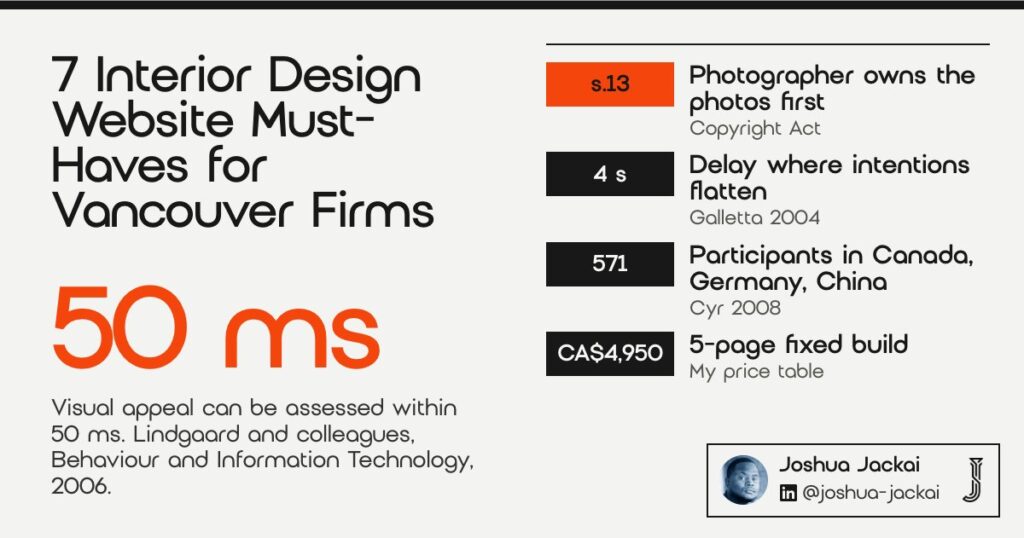
- Visual appeal can be assessed within 50 milliseconds, so the first photo and headline do most of the work (Lindgaard and colleagues, 2006).
- In a study of 571 participants in Canada, Germany and China, information design, navigation design and visual design were tested as drivers of trust and satisfaction (Cyr, 2008).
- An improvement in reviews led to an increase in relative sales in a peer-reviewed study of online book sales, and one-star reviews weighed more than five-star ones (Chevalier and Mayzlin, 2006).
- Canada’s anti-spam law requires consent before you send a commercial email, so the newsletter box on your enquiry form starts unticked.
- My fixed prices run from CA$4,950 for a 5-page small business site to CA$7,450 and up for a custom build, and a CA$995 audit is credited within 30 days.
| # | Must-have | What it protects | Source |
|---|---|---|---|
| 1 | Project photos you have the right to publish | Copyright risk, first impression | Copyright Act s.13, Lindgaard 2006 |
| 2 | A portfolio sorted by project type, with the story | Trust, fit | Tractinsky 2000, Cyr 2008 |
| 3 | Who you serve, where and how, in the first screen | Fit, enquiry quality | Cyr 2008, Reinecke 2014 |
| 4 | Credentials and reviews shown honestly | Trust | IDIBC, Chevalier 2006 |
| 5 | An enquiry form that qualifies and follows CASL | Consent, time | CASL s.6, Gefen 2003 |
| 6 | Speed on a phone, even with large images | First impression, enquiries | Galletta 2004, Lindgaard 2006 |
| 7 | Pages that search engines and AI answers can read | Findability | Google Search Central |
1. Who owns the project photos on an interior design website?
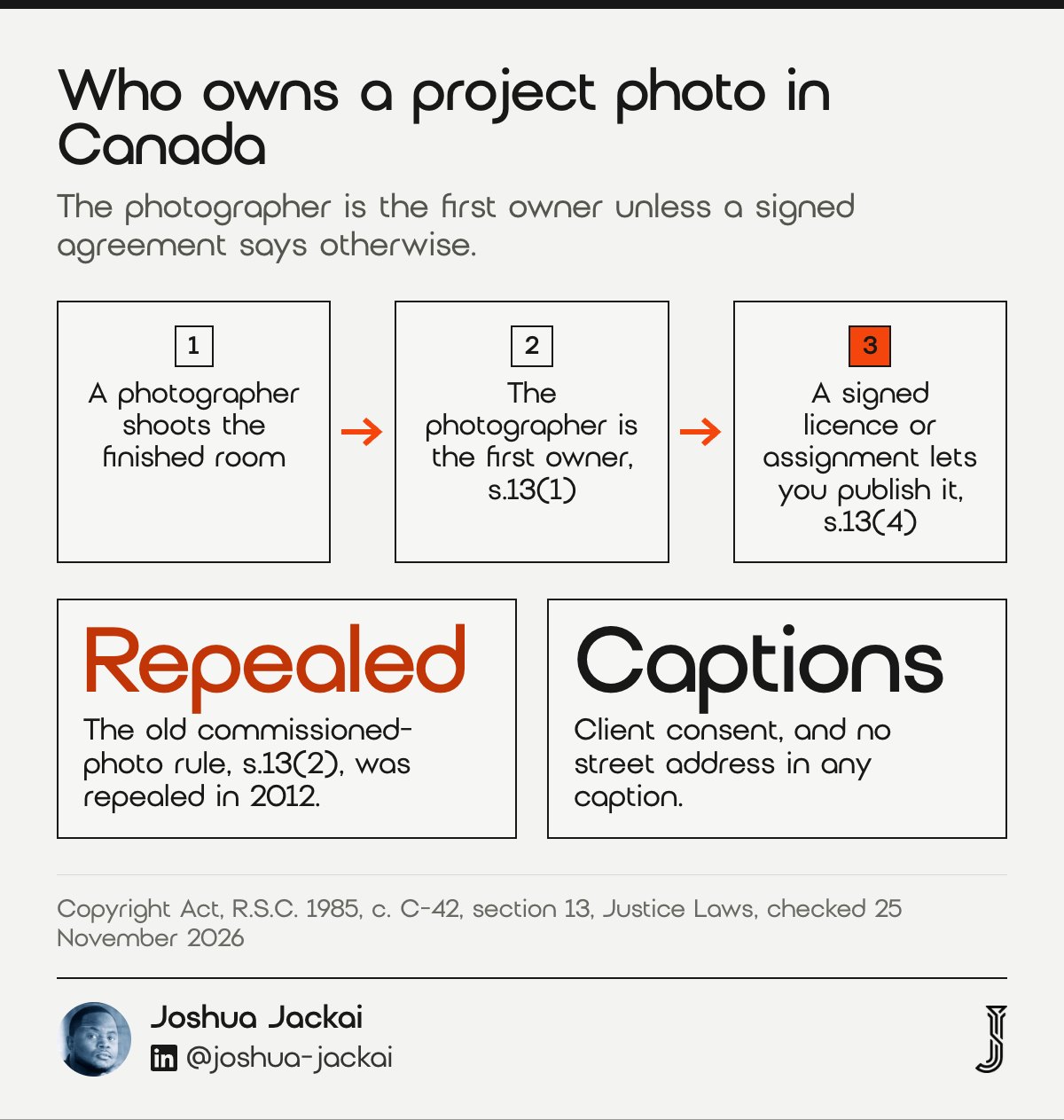
In Canada the photographer usually owns them. The Copyright Act makes the author the first owner, and the old rule that gave commissioned photos to the client was repealed in 2012. Put a written licence or assignment in every photography contract before the photos go on your website.
- Photographer: a signed licence that names web, social and print use
- Architect or builder photos: written permission, with the credit they want
- Magazine shoots: check the publisher’s terms before you reuse the images
- Client homes: written consent to publish, and no street numbers in captions
- File names and alt text: describe the room, not the client’s address
The Copyright Act is short on this point. Section 13(1) says the author of a work is the first owner of the copyright, and section 13(2), the commissioned-photo rule that used to hand ownership to whoever paid, now reads “[Repealed, 2012, c. 20, s. 7]”. An interior designer who paid for a shoot owns the invoice, not the photos, unless the contract says more.
This matters more for interior design than almost any other trade, because the photos are the product on your site. I have seen studios pull their best project off a new site the week before launch because the photographer’s contract covered print only. Checking the contracts first takes an afternoon and saves the redesign.
“No assignment or grant is valid unless it is in writing signed by the owner of the right in respect of which the assignment or grant is made,” stated section 13(4) of Canada’s Copyright Act (Justice Laws).
Privacy is the second check. Your clients’ homes are private spaces, and a caption that names the street or the client lets a stranger find them. I keep captions to the neighbourhood, the room and the scope, such as “Kitsilano kitchen, full renovation”.
Data point: Section 13(2) of the Copyright Act, which gave ownership of commissioned photographs to the person who ordered them, was repealed by S.C. 2012, c. 20, s. 7 (Copyright Act, s.13).
2. How should an interior design portfolio be organised?
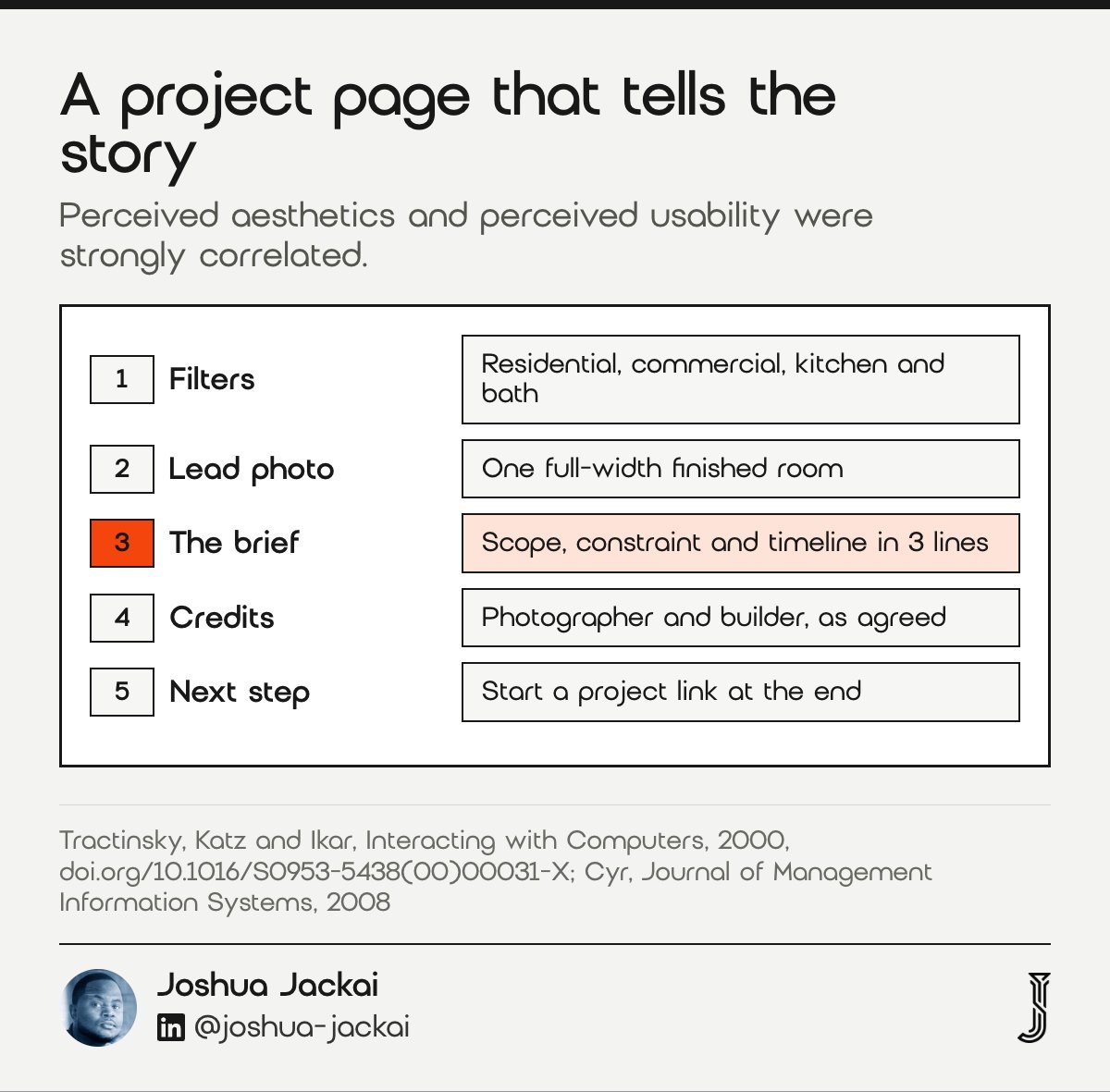
Sort projects by the type of work a visitor wants, such as kitchens, full homes or offices, and give each project a short story: the brief, the constraint, what changed. A grid of pretty photos with no words tells a visitor you have taste, but not whether you can do their project.
- Filters: residential, commercial, kitchen and bath, full renovation
- Project page: 8 to 15 photos, the brief, the scope, the timeline
- Before and after: one pair per project where you have it
- Credits: photographer, builder and architect, as agreed
- Next step: an enquiry link at the end of every project page
Looks carry more weight than most owners expect. Tractinsky, Katz and Ikar tested a cash machine interface and found “strong correlations between system’s perceived aesthetics and perceived usability”, and the effect stayed after people used it. A visitor who finds your portfolio beautiful will also tend to find it easy to use, and that halo is worth protecting.
“The degree of system’s aesthetics affected the post-use perceptions of both aesthetics and usability, whereas the degree of actual usability had no such effect,” reported Tractinsky, Katz and Ikar (Interacting with Computers, 2000).
Looks alone do not close a project, though. Cyr tested three parts of web design, information design, navigation design and visual design, against trust and satisfaction with participants in Canada, Germany and China. The finding I take from it is that the words and the structure count alongside the photos. A project page that says “3-bedroom Point Grey home, kitchen moved to the garden side, 14 weeks on site” tells a buyer far more than a caption that says “Point Grey Residence”.
“Design characteristics should be a central consideration in Web site design across cultures,” wrote Cyr (Journal of Management Information Systems, 2008).
Data point: Cyr’s model used data from 571 participants in Canada, Germany and China, and all paths in the overall model were confirmed (Journal of Management Information Systems, 2008).
3. What should the first screen of an interior design website say?
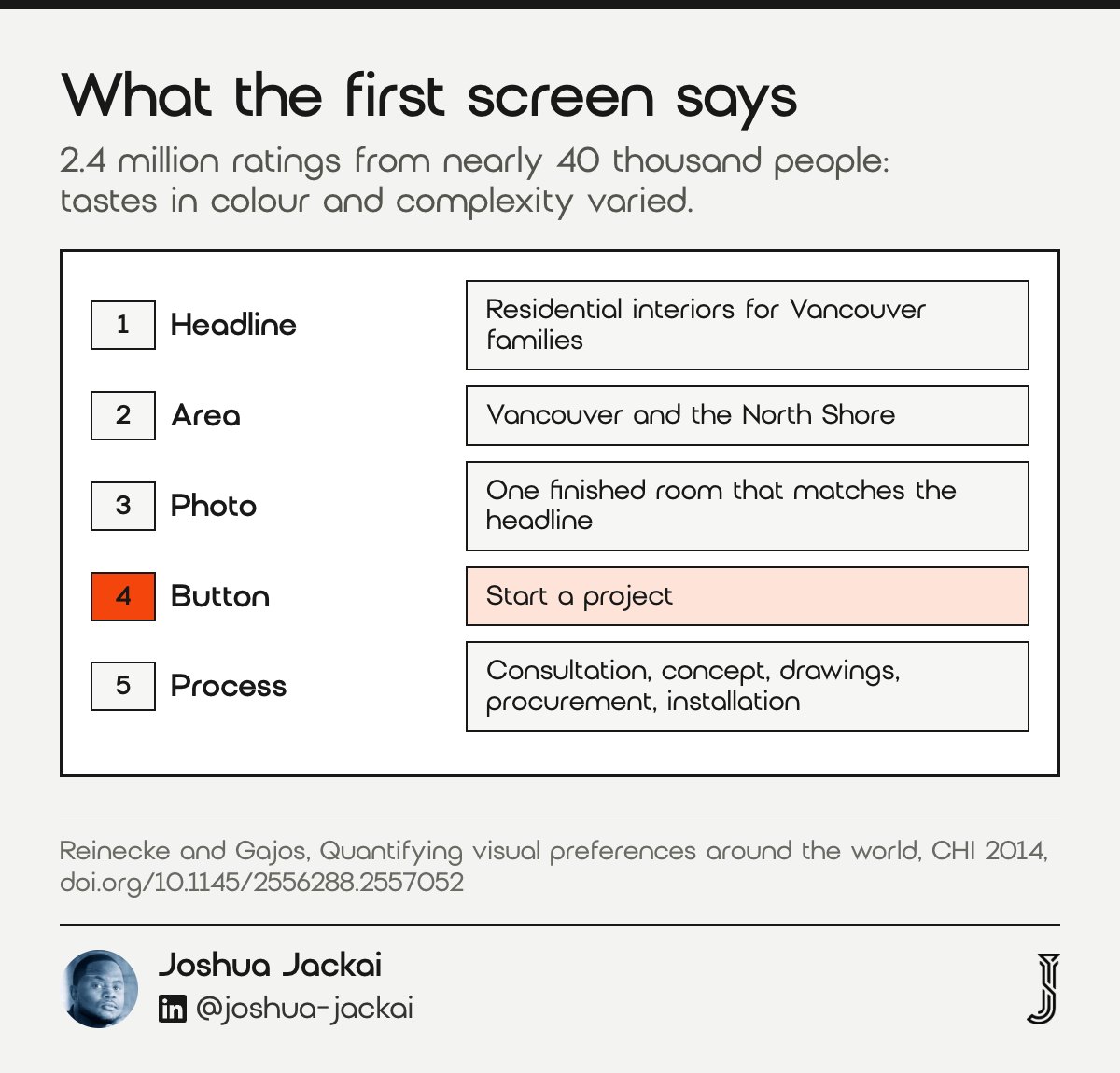
The first screen should name who you design for, where you work and what a project with you looks like, next to one strong finished room. “Residential interiors for Vancouver families renovating their main home” filters better than “Timeless spaces, thoughtfully designed”, and it still reads well.
- Headline: the client and the project type, in plain words
- Location: Vancouver, the North Shore, the Fraser Valley, wherever you take work
- Photo: one finished room that matches the headline
- One button: start a project, book a consultation, or see the work
- Proof line: years in practice, projects completed or a short review
Taste varies, which is one more reason to state your style in words. Reinecke and Gajos collected 2.4 million ratings of website visual appeal from nearly 40 thousand participants and found that the colourfulness and visual complexity people liked most varied by group. A minimal Scandinavian portfolio will put off a client who wants rich colour, and that is fine, as long as the headline tells both of them who you are for.
“What users perceive as ‘good design’ is subject to individual preferences, questioning the feasibility of universal design guidelines,” wrote Reinecke and Gajos (CHI, 2014).
The process line is the part most studio sites leave out. A short strip, such as “Consultation, concept, drawings, procurement, installation”, answers the question a new client is afraid to ask: what happens after I call? I put it on the homepage and again on the services page, with the typical length of each stage.
Data point: Reinecke and Gajos analysed 2.4 million visual appeal ratings from nearly 40 thousand participants (Proceedings of the SIGCHI Conference on Human Factors in Computing Systems, 2014).
4. How do you show credentials and reviews on a design firm website?
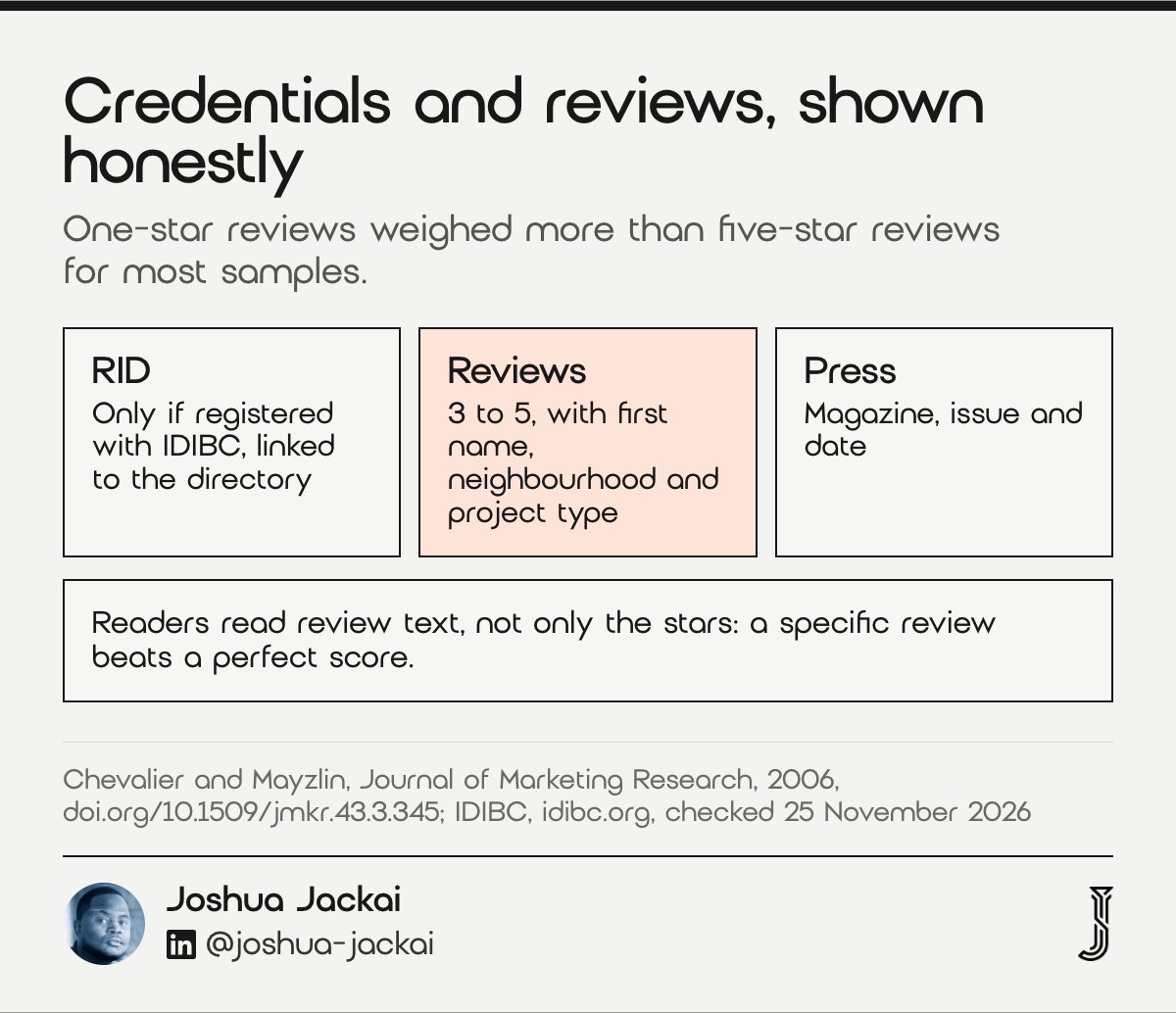
Show the designations you actually hold, the associations you belong to and real client reviews with names and projects, and link each one to where it can be checked. In BC, the Registered Interior Designer designation comes from IDIBC, so use RID only if you are registered there.
- Designations: RID only if registered with IDIBC; NCIDQ only if certified
- Reviews: 3 to 5 with first name, neighbourhood and project type
- Review source: link to your Google or Houzz profile so they can be checked
- Press: magazine features, with the issue and the date
- Awards: the award, the year and the category, nothing vague
IDIBC presents RID as the designation that signals a qualified designer, and it describes the profession as heading toward regulation. Claiming a designation you do not hold is the kind of thing a client discovers in five minutes on the association’s directory, and it costs more trust than it ever earned.
“As the profession moves toward regulation, public trust will become even more critical,” stated the Interior Designers Institute of British Columbia (IDIBC).
Reviews do measurable work. Chevalier and Mayzlin studied reviews at two large online booksellers and found that better reviews raised a book’s relative sales at that site, that one-star reviews hurt more than five-star reviews helped, and that people read the text rather than only the stars. For a design firm, that means a specific review beats a perfect score. “She found storage in a 600 square foot condo I had given up on” sells harder than five gold stars.
Data point: In Chevalier and Mayzlin’s study, for most samples the impact of one-star reviews was greater than the impact of five-star reviews (Journal of Marketing Research, 2006).
5. What should an interior design enquiry form ask?
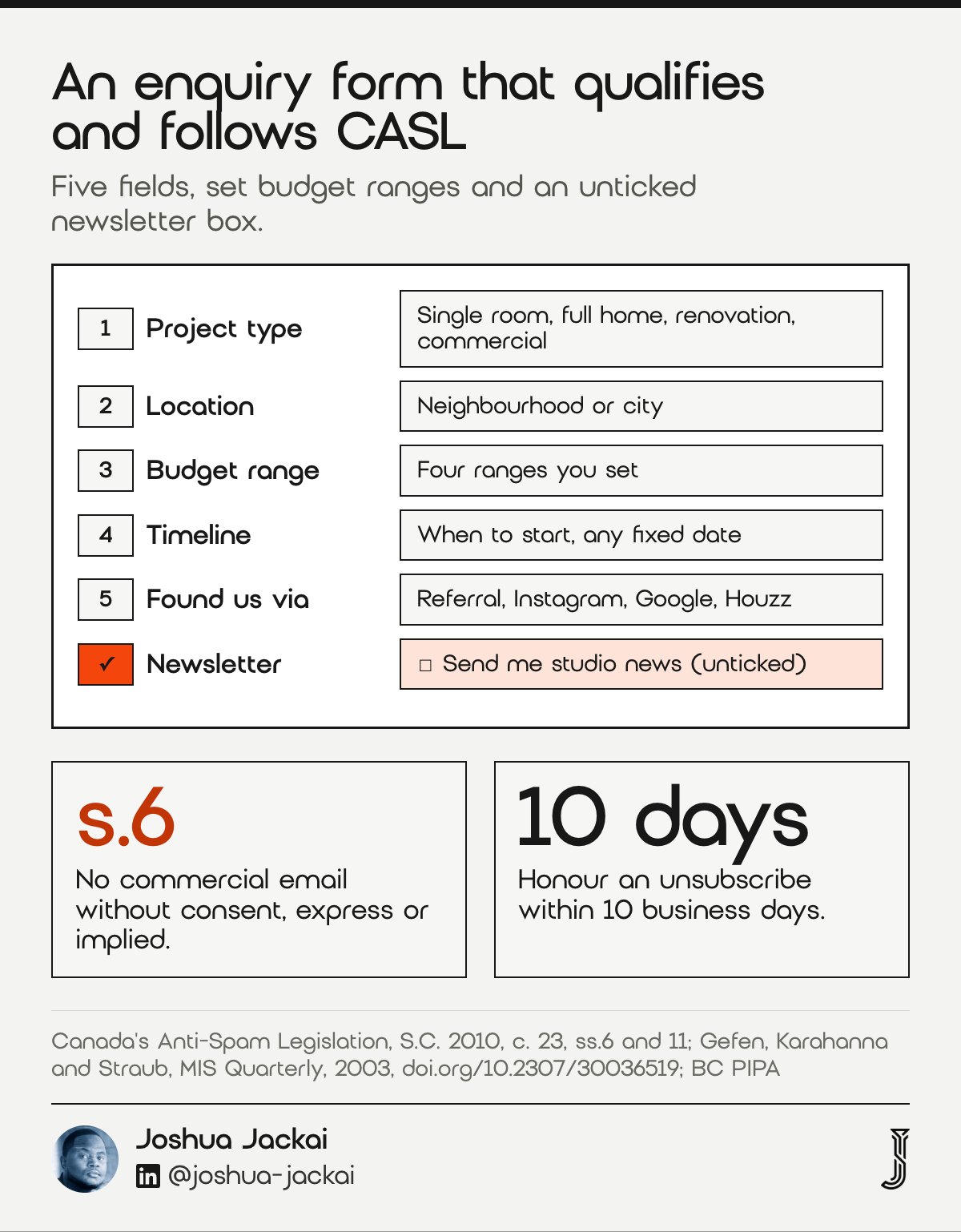
Ask for the few things you need to decide whether a call is worth it: project type, location, rough budget range, timeline and how the person found you. Add an unticked box for your newsletter, because Canada’s anti-spam law needs consent before you send commercial email.
- Project type: single room, full home, renovation with a builder, commercial
- Location: neighbourhood or city
- Budget range: ranges you set, not an open box
- Timeline: when they want to start and any fixed date
- Source: referral, Instagram, Google, Houzz, a magazine
- Newsletter: a separate unticked box, never bundled with the enquiry
Budget ranges feel awkward to ask, but they save both sides a wasted consultation. I set the ranges with the firm before launch, usually four, starting at its real minimum project size. Visitors who are below it still get a helpful reply, such as a link to an e-design package or a consultation-only offer.
The consent part is the law, not a style choice. Section 6 of Canada’s Anti-Spam Legislation bars sending a commercial electronic message without consent, express or implied, and section 11 says an unsubscribe request must take effect no later than 10 business days after it is sent. Replying to an enquiry is fine. Adding that person to a monthly newsletter without the box ticked is not.
Trust also rides on the form. Gefen, Karahanna and Straub found that online trust is built partly through “a belief that there are safety mechanisms built into the Web site”. A short privacy line under the button, saying what you do with the details and that you never sell them, is one of those mechanisms. In BC that line should also match the Personal Information Protection Act.
“Our research on experienced repeat online shoppers shows that consumer trust is as important to online commerce as the widely accepted TAM use-antecedents, perceived usefulness and perceived ease of use,” wrote Gefen, Karahanna and Straub (MIS Quarterly, 2003).
Data point: CASL section 11 requires an unsubscribe request to take effect no later than 10 business days after it is sent (Canada’s Anti-Spam Legislation, S.C. 2010, c. 23).
6. How do you keep an image-heavy design website fast on a phone?
Resize every photo to the largest size it will be shown at, serve modern formats, load images below the first screen only as the visitor scrolls, and test on a mid-range phone. Portfolio sites are image-heavy by nature, so speed has to be designed in, not fixed later.
- Size: export at the display width, not the camera’s 6,000 pixels
- Format: WebP or AVIF, with a JPEG fallback where needed
- Loading: lazy-load everything below the first screen
- Galleries: load the next photo when it is asked for, not all 15 at once
- Video: a poster image first, the video only on tap
- Test: a mid-range phone on a cellular connection
Visitors decide fast. Lindgaard and colleagues titled their paper “Attention web designers: You have 50 milliseconds to make a good first impression!” and showed that ratings at 50 milliseconds tracked ratings at 500 milliseconds. If the first photo is still a grey box at that point, the first impression is a grey box.
“Visual appeal can be assessed within 50 ms, suggesting that web designers have about 50 ms to make a good first impression,” wrote Lindgaard and colleagues (Behaviour and Information Technology, 2006).
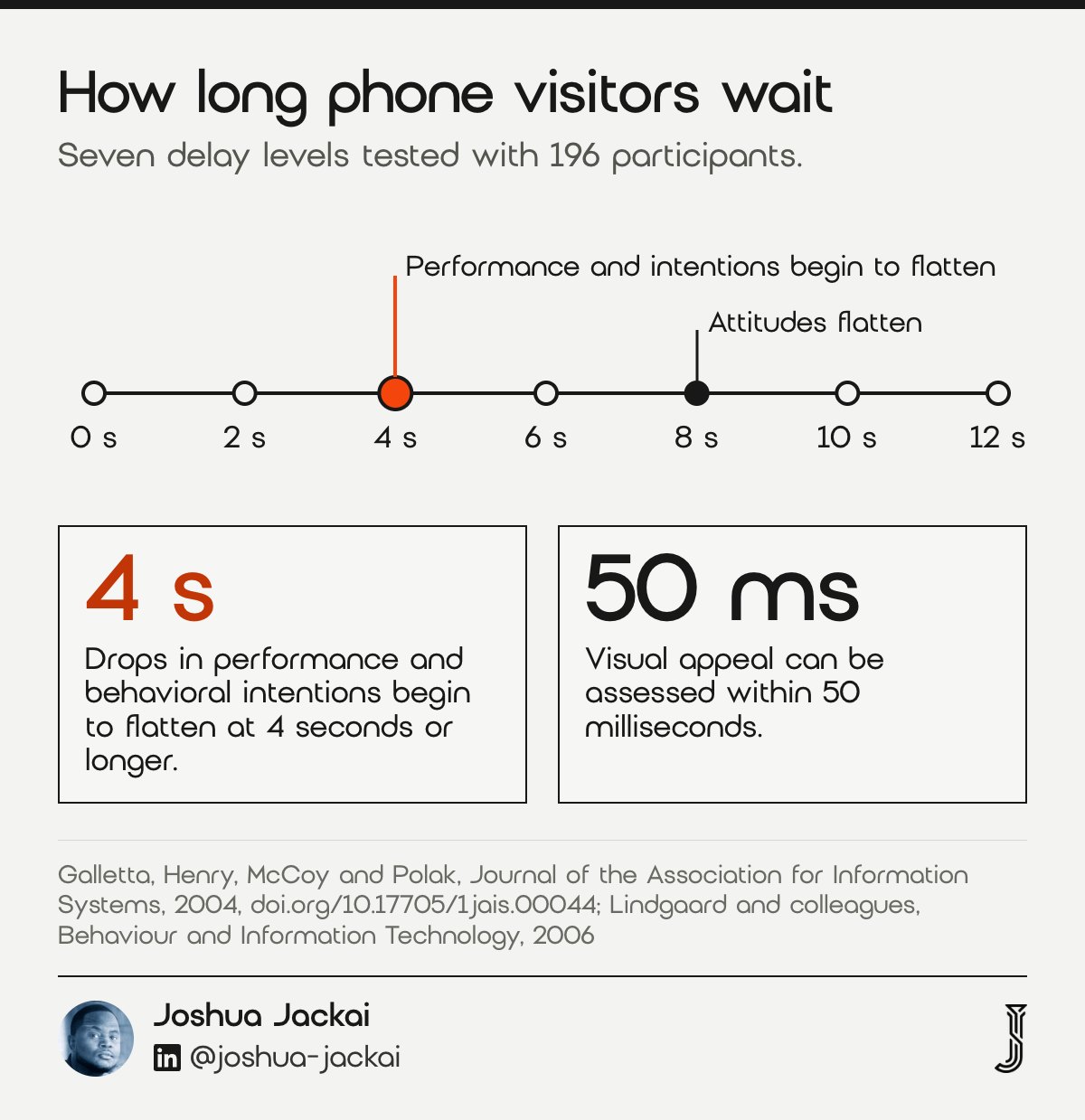
Waiting costs more. Galletta, Henry, McCoy and Polak tested seven delay levels with 196 participants and found that “decreases in performance and behavioral intentions begin to flatten when the delays extend to 4 seconds or longer”. In plain words, most of the damage is done by 4 seconds. On interior design sites I aim to show the lead photo well before that on a phone, and I check it with Google’s PageSpeed test before launch and again after the client adds new projects.
Data point: Galletta and colleagues tested delays of 0, 2, 4, 6, 8, 10 and 12 seconds with 196 participants (Journal of the Association for Information Systems, 2004).
7. What SEO does an interior design firm website need?
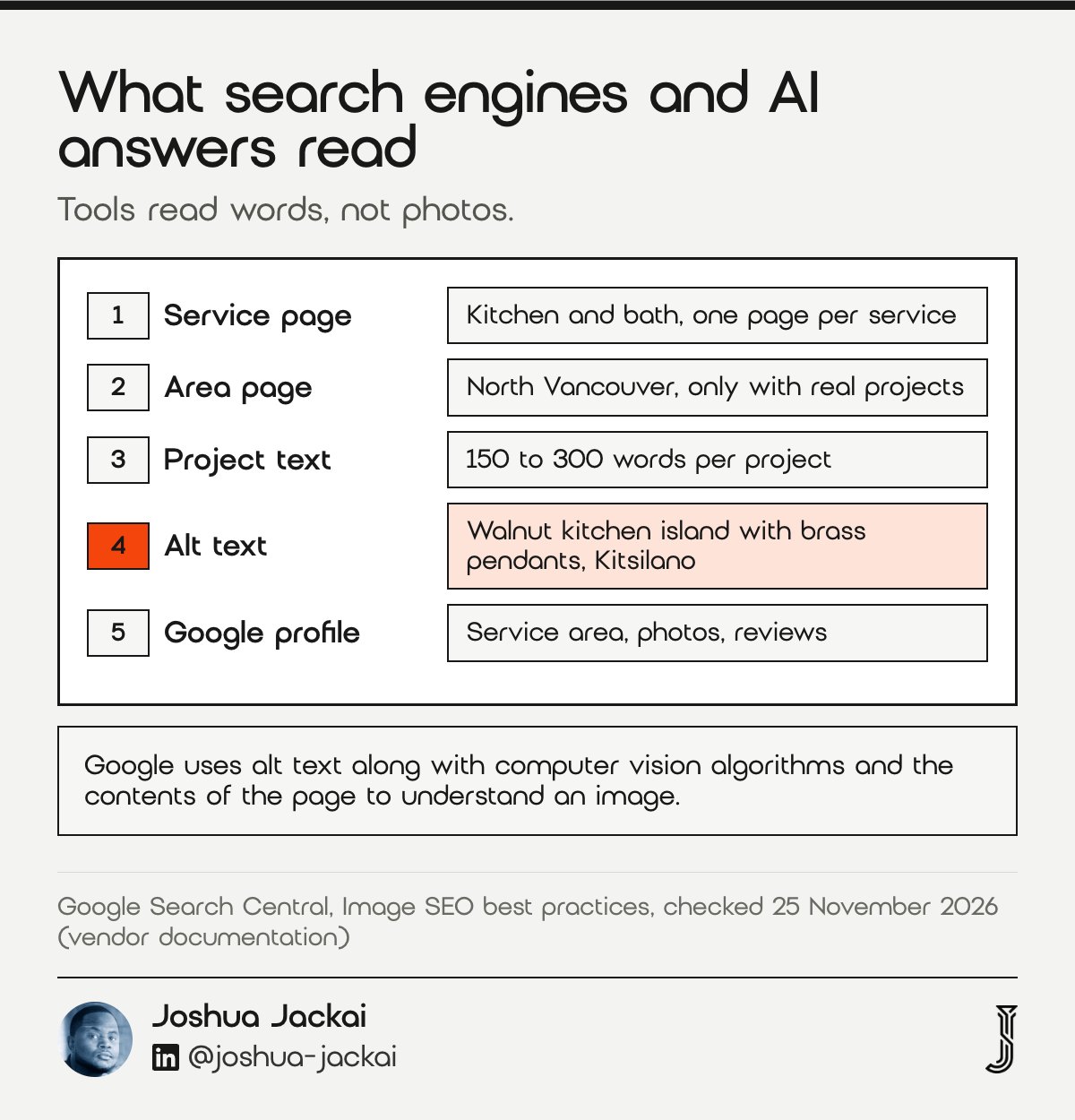
It needs a page for each service and area you want to be found for, project pages with real text, descriptive alt text on photos and a complete Google Business Profile. Search engines and AI answer tools read words, not photos, so a portfolio with no text is close to invisible.
- Service pages: one each for residential, commercial, kitchen and bath, renovation
- Area pages: only where you have real projects, such as Kitsilano or North Vancouver
- Alt text: “Walnut kitchen island with brass pendants, Kitsilano”, not “IMG_4021”
- Project text: 150 to 300 words on each project page
- Google Business Profile: categories, service area, photos and reviews
- Structured data: LocalBusiness and FAQ markup that matches the visible page
Google’s own image guidance says it uses alt text along with computer vision algorithms and the contents of the page to understand an image, and it recommends descriptive filenames, titles and alt text. That is the cheapest SEO win on a design site, because the photos are already there and the alt text is usually empty.
AI answer tools work the same way. When someone asks ChatGPT or Google’s AI Overview for “an interior designer in North Vancouver who does heritage homes”, the tool needs text on a page that says exactly that. If you want to know where your firm shows up today, my free AI Visibility Report checks the answers for your services and area.
Data point: Google Search Central says it uses alt text along with computer vision algorithms and the contents of the page to understand the subject matter of an image (Google Search Central, Image SEO best practices, checked 25 November 2026, vendor documentation).
How much does an interior design website cost in Vancouver?
My fixed quotes are CA$4,950 for a 5-page small business site on Framer, CA$5,950 on WordPress, and CA$7,450 and up for a custom build. These are my own prices, not a survey of other studios. Photography, hosting and the domain are separate, and a CA$995 audit is credited in full if a project starts within 30 days.
What moves the price for a design firm is mostly the portfolio, not the homepage. Ten project pages with proper stories and well-sized photos take more time than the rest of the site. Shop or e-design sales, booking tools and a second language add to it.
| Firm need | What you get | Price (my fixed quotes, CAD) |
|---|---|---|
| Solo designer or small studio | Small business site, up to 5 pages | CA$4,950 Framer or CA$5,950 WordPress |
| Studio with a large portfolio and services | Custom build with project pages and lead routing | from CA$7,450 |
| One campaign or a new service | Landing page | from CA$3,795 |
| Know where every enquiry came from | Lead source reporting | CA$2,600 |
| Before you decide | Website audit with a written report | CA$995, credited within 30 days |
Ask any designer to list the monthly costs in writing, and to confirm that you own the domain and the site files at the end. If you are weighing a rebuild against a refresh, my guide to website redesign costs in Vancouver explains what drives the range.
Compare the seven must-haves side by side
Use this matrix to filter the seven must-haves by the part of the site they touch and by what each one protects. Every row comes from a source cited in this guide: Canada’s Copyright Act, Canada’s anti-spam law, IDIBC, Google’s documentation or a peer-reviewed paper. Choose a site area to hide the rows that do not apply.
Showing 7 of 7 must-haves.
| # | Must-have | Site area | Protects | Source |
|---|---|---|---|---|
| 1 | Use project photos you have the right to publish | home, portfolio | rights, first impression | Copyright Act s.13; Lindgaard 2006 |
| 2 | Sort the portfolio by project type and tell each story | portfolio | trust, fit | Tractinsky 2000; Cyr 2008 |
| 3 | Say who you serve, where and how in the first screen | home | fit, first impression | Cyr 2008; Reinecke 2014 |
| 4 | Show credentials and reviews honestly | about, home | trust | IDIBC; Chevalier and Mayzlin 2006 |
| 5 | Build an enquiry form that qualifies and follows CASL | forms | privacy, trust, fit | CASL s.6 and s.11; BC PIPA; Gefen 2003 |
| 6 | Keep image-heavy pages fast on a phone | home, portfolio | first impression | Lindgaard 2006; Galletta 2004 |
| 7 | Give search engines and AI answers text to read | portfolio, services | search | Google Search Central |
Check your interior design website against the seven must-haves
Answer eight yes or no questions about your current site to see which must-haves still need work. The score is how many of the eight questions you pass, based on the sources in this guide. Your answers stay in your browser, and the result is a checklist, not legal advice.
Interior design website check
Tick each statement that is true for your site today. Your answers stay in this browser.
Interior design website questions, answered
These are questions people search before building a design firm website or hiring someone to do it, drawn from Google’s People Also Ask results for Vancouver, captured with AlsoAsked. Each answer is short, written for a studio owner rather than a developer, and points to the must-have that covers it.
How do you build a website for an interior design business?
Start with the portfolio: pick 6 to 10 finished projects with photos you have a written licence to use. Then write who you serve and where, set up project pages with short stories, add an enquiry form with budget ranges, and test the site on a phone before launch.
How do you make an interior design website look luxury?
Use fewer, larger photos, generous white space and one or two typefaces, and let finished rooms carry the page. Luxury also reads as restraint in the copy: specific, calm words, no exclamation marks and no stock photos. Speed matters too, because a slow page never feels expensive.
What are the best SEO practices for interior designers?
Give each service and area its own page, write 150 to 300 words on every project page, add descriptive alt text to photos and complete your Google Business Profile. Ask happy clients for reviews that mention the project type and neighbourhood, and link each review source from your site.
How much does a website designer cost for an interior design firm in Canada?
It depends on the number of project pages, integrations and who writes the copy. My fixed quotes are CA$4,950 for a 5-page site on Framer, CA$5,950 on WordPress and CA$7,450 and up for a custom build. Photography and hosting are separate costs.
Should an interior designer use Squarespace, Wix or a custom website?
A template builder works for a solo designer with a small portfolio who wants to edit everything alone. A custom build makes sense when the portfolio is large, speed and search matter, or enquiries need routing to a CRM. Either way, check photo rights, image sizes and the enquiry form.
How I design websites for interior design firms in Vancouver
I build fixed-quote websites for Canadian businesses, and design studios get three extra steps. At kickoff I check the photography contracts for web use. I write project pages with the designer, so each one says what changed and why. And I connect the enquiry form to the CRM, with each lead’s source attached.
“On an interior design website, the photos make the first impression, but the project story and the enquiry form decide whether the right client calls,” said Joshua Jackai, Vancouver web designer.
If you work alongside realtors on staging or new builds, my guide to realtor website design in Vancouver covers BC’s real estate advertising rules, and my guide to professional services website design in Vancouver covers firms with regulated titles. To see where your site stands today, start with the free AI Visibility Report, or book the CA$995 website audit, credited if a project starts within 30 days.
Sources
Peer reviewed
- Chevalier, J. A. and Mayzlin, D. (2006). The effect of word of mouth on sales: Online book reviews. Journal of Marketing Research. https://doi.org/10.1509/jmkr.43.3.345
- Cyr, D. (2008). Modeling web site design across cultures: Relationships to trust, satisfaction, and e-loyalty. Journal of Management Information Systems. https://doi.org/10.2753/MIS0742-1222240402
- Galletta, D. F., Henry, R. M., McCoy, S. and Polak, P. (2004). Web site delays: How tolerant are users? Journal of the Association for Information Systems. https://doi.org/10.17705/1jais.00044
- Gefen, D., Karahanna, E. and Straub, D. W. (2003). Trust and TAM in online shopping: An integrated model. MIS Quarterly. https://doi.org/10.2307/30036519
- Lindgaard, G., Fernandes, G., Dudek, C. and Brown, J. (2006). Attention web designers: You have 50 milliseconds to make a good first impression! Behaviour and Information Technology. https://doi.org/10.1080/01449290500330448
- Reinecke, K. and Gajos, K. Z. (2014). Quantifying visual preferences around the world. Proceedings of the SIGCHI Conference on Human Factors in Computing Systems. https://doi.org/10.1145/2556288.2557052
- Tractinsky, N., Katz, A. S. and Ikar, D. (2000). What is beautiful is usable. Interacting with Computers. https://doi.org/10.1016/S0953-5438(00)00031-X
Statute, association and vendor (not peer reviewed)
- Copyright Act, R.S.C. 1985, c. C-42, section 13, Justice Laws, checked 25 November 2026. https://laws-lois.justice.gc.ca/eng/acts/C-42/section-13.html
- Canada’s Anti-Spam Legislation, S.C. 2010, c. 23, sections 6 and 11, Justice Laws, checked 25 November 2026. https://laws-lois.justice.gc.ca/eng/acts/E-1.6/FullText.html
- Personal Information Protection Act, S.B.C. 2003, c. 63, BC Laws, checked 25 November 2026. https://www.bclaws.gov.bc.ca/civix/document/id/complete/statreg/03063_01
- Interior Designers Institute of British Columbia (IDIBC), homepage, checked 25 November 2026. https://idibc.org/
- Google Search Central, Image SEO best practices, checked 25 November 2026 (vendor documentation). https://developers.google.com/search/docs/appearance/google-images
First party
- Jackai Agency price table, joshuajackai.com/pricing, November 2026.