
7 Website Design Steps for Early-Stage Startups in Canada
Seven steps for website design at an early-stage Canadian startup: a one-page launch site, when to hire, the five or six pages a seed-stage site needs, CASL-compliant sign-up forms, trial or demo, speed and accessibility, and when to redesign.
 Joshua Jackai
19 min read
Published 23 November 2026 · Last updated and fact-checked November 2026
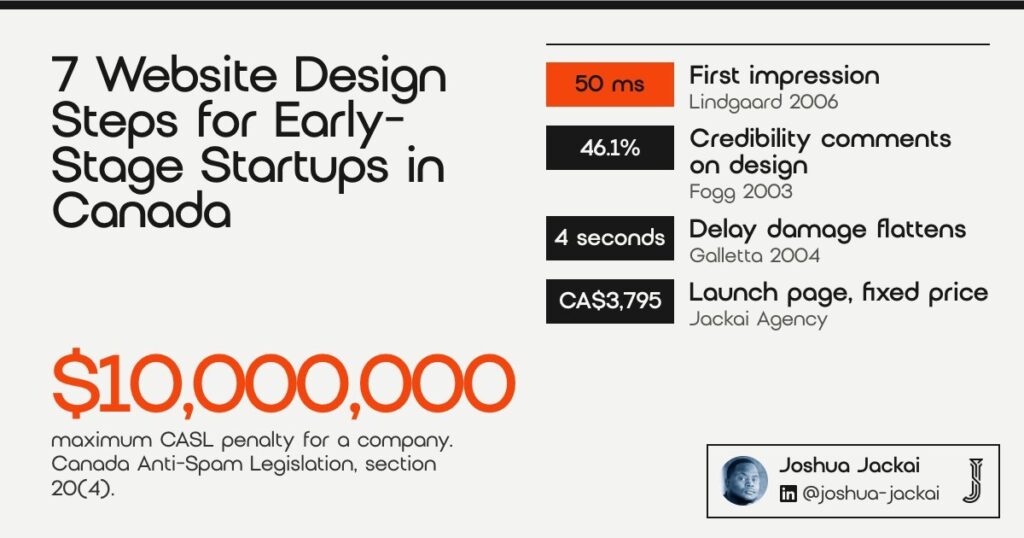
Short answer: Good website design for early stage startups is a small site that says what the product does, collects demo requests and emails legally, and loads fast. In Canada that means a privacy page under PIPEDA and CASL-compliant sign-up forms, where the maximum penalty is $10,000,000 per violation for a company. Start with one page, then grow to five or six.
Founders in Vancouver usually ask me two things about their first website: what it should cost, and how many pages it needs. Both answers depend on the stage. A pre-seed company with no customers needs a page that earns a reply from an investor or a first buyer. A seed-stage company with a sales process needs a site the sales team can send without apologizing for it. This guide walks through seven steps in the order I take them with B2B founders, with the Canadian rules that most startup web design guides skip.
In this guide
Key takeaways
- People rate a homepage’s visual appeal within 50 milliseconds, and those ratings were highly correlated with their ratings at 500 milliseconds (Lindgaard and colleagues, Behaviour and Information Technology, 2006).
- In a study of 2,684 people judging website credibility, the design look was mentioned in 46.1% of comments, more than any other feature (Fogg and colleagues, DUX, 2003).
- Canada’s Anti-Spam Legislation (CASL) puts the onus of proving consent on the sender, and the maximum penalty is $10,000,000 for a company (CASL, sections 13 and 20(4)).
- Ontario requires public websites of businesses with 50 or more employees to meet WCAG 2.0 Level AA (Government of Ontario).
- My fixed prices for a startup site run from CA$3,795 for a landing page to CA$7,450 and up for a custom B2B site.
| # | Step | Stage it fits | What it costs or protects | Source |
|---|---|---|---|---|
| 1 | One page that says what you do | Pre-seed | First impression in 50 ms | Lindgaard 2006 |
| 2 | Build it yourself or hire | Pre-seed to seed | CA$0 to CA$7,450+ | Fogg 2003, JJ price table |
| 3 | Five or six core pages plus privacy | Seed | Trust and PIPEDA openness | Gefen 2003, PIPEDA 4.8 |
| 4 | CASL-compliant sign-up forms | Any stage | Fines up to $10,000,000 | CASL s.10, s.13, s.20 |
| 5 | Trial, demo or waitlist | Seed | Lost buyers after a bad trial | Foubert 2016 |
| 6 | Speed and accessibility | Seed to Series A | Visitor intent, AODA duties | Galletta 2004, Ontario |
| 7 | Redesign on evidence | Series A | Proof the change worked | Kohavi 2009 |
1. What should a pre-seed startup website include?
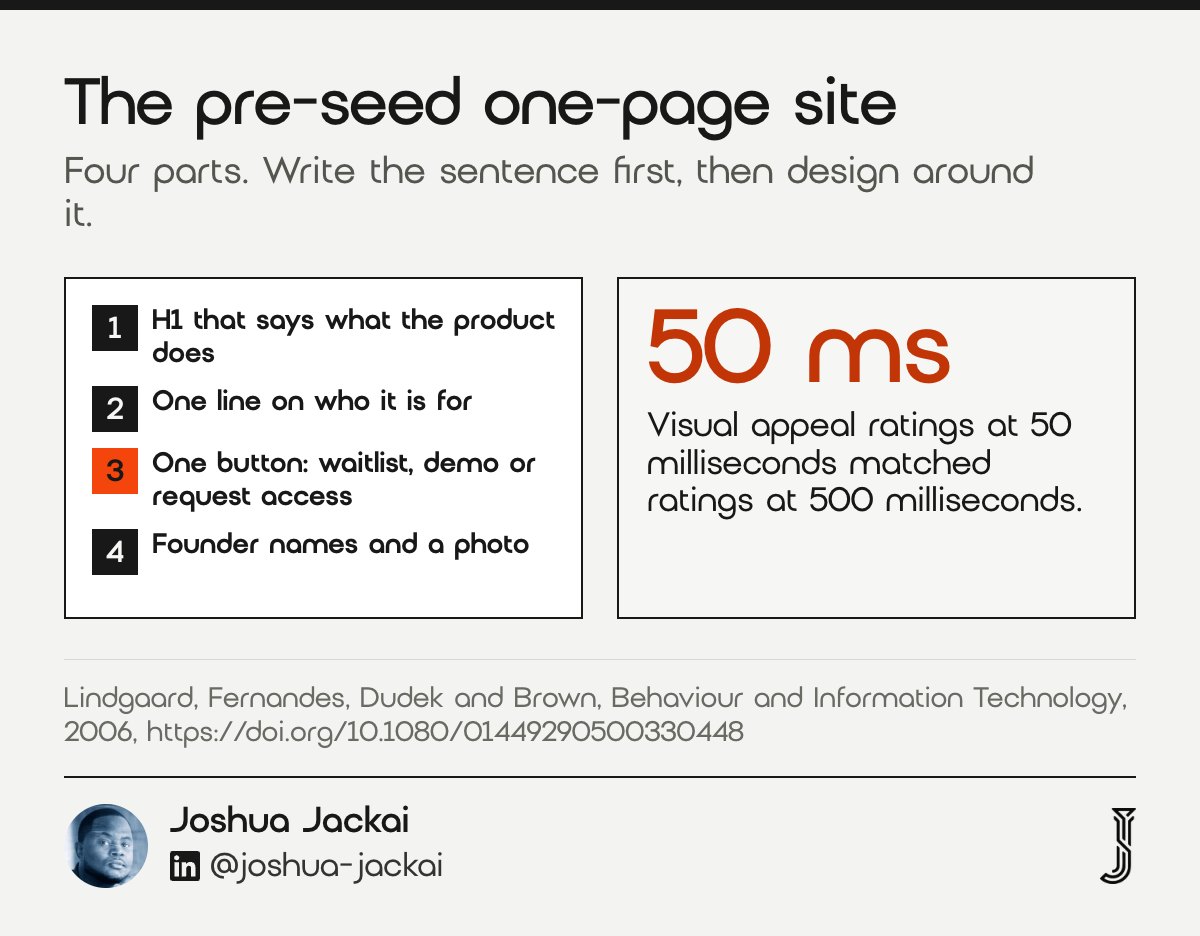
A pre-seed startup website needs one page with four things: an H1 that says what the product does, a line on who it is for, one call to action, and the founders’ names. Visitors judge it fast: visual appeal ratings at 50 milliseconds were highly correlated with ratings at 500 milliseconds.
- Pages: 1 (a single landing page)
- Must have: plain H1, audience line, one call to action, founder names
- Call to action: book a call, join the waitlist or request access
- Build time: 1 to 2 weeks
- Price on my table: landing page from CA$3,795
The first version of a startup website is a sentence with a page around it. If you cannot write the sentence, no layout will save the page. I ask founders to finish this line before I design anything: “We help [who] [do what] without [the pain they have now].” That sentence becomes the H1 or the line under it.
Keep the first screen to that sentence, one button and some proof that real people are behind the company. At pre-seed the proof is usually the founders: names, a photo, and the problem you saw in your last job. Investors and early buyers want to know who they are dealing with before they care about features.
Avoid three things I see on most first sites: a slogan that could belong to any company, a menu with eight items when there is one page of content, and stock photos of people pointing at laptops. Each one makes the page look like a template. A plain page with a clear sentence looks more credible than a busy one.
Lindgaard and colleagues ran three studies on how fast people judge web pages and reached a blunt conclusion:
“Visual appeal can be assessed within 50 ms, suggesting that web designers have about 50 ms to make a good first impression,” wrote Gitte Lindgaard and colleagues (Behaviour and Information Technology, 2006).
Data point: Visual appeal ratings at 50 milliseconds were highly correlated with ratings at 500 milliseconds (Lindgaard and colleagues, 2006).
2. Should a startup build its own website or hire a designer?
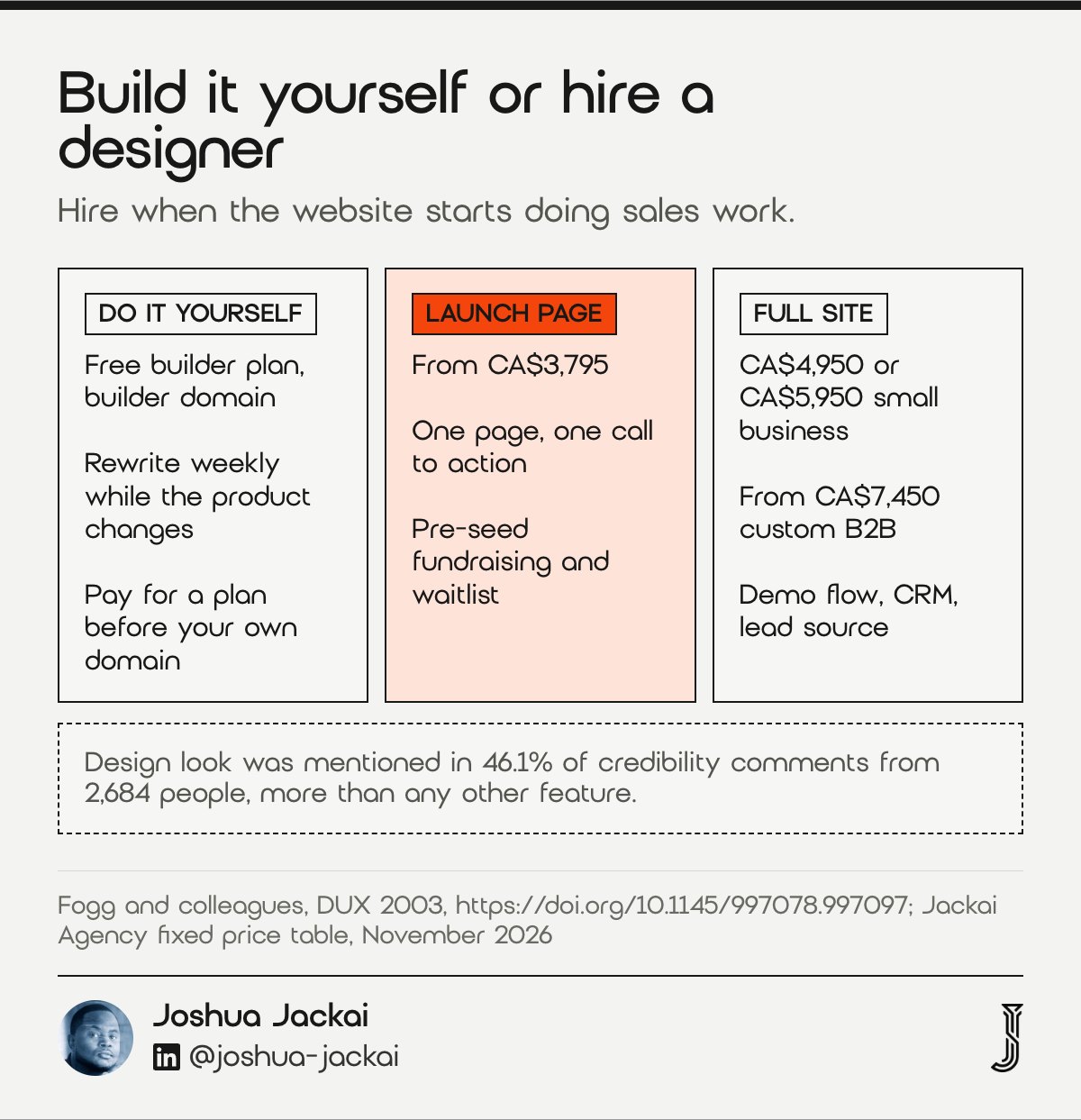
Build it yourself while you are still finding your first customers, and hire a designer when the website starts doing sales work: investors and buyers visit it before calls. In a study of 2,684 people, the design look was the feature mentioned most when judging credibility, in 46.1% of comments.
- Do it yourself: free tiers on site builders, with the builder’s domain
- Hire a freelancer or studio: when sales calls depend on the site
- My fixed prices: landing page from CA$3,795; small business site CA$4,950 or CA$5,950; custom B2B from CA$7,450
- Free check: an AI Visibility Report in 24 hours
- Paid check: a website audit at CA$995, credited if a project starts within 30 days
A do-it-yourself site is the right call when you are still changing the product every week. You will rewrite the homepage often, and paying a designer for each rewrite wastes money you need for the product. Most site builders have free plans, though a free plan usually means the builder’s own domain and branding, so expect to pay for a plan before you point your own domain at it.
The point to hire is when the site starts costing you deals. Signs I hear from founders: an investor asked who built the site, a buyer’s procurement team asked for a security page you do not have, or your sales lead sends a slide deck instead of the website. At that point the site is part of the sales process, Fogg and colleagues found that among 2,684 people judging website credibility, the design look came up in 46.1% of comments, so I treat design quality as part of how a buyer decides whether a company is credible.
Ask any designer for a fixed quote with a written list of pages and features. An hourly estimate moves the risk of overruns onto you. My own prices are fixed and listed on the pricing page, and they are the same numbers quoted here.
“We found that the design look of the site was mentioned most frequently, being present in 46.1% of the comments,” wrote B. J. Fogg and colleagues (DUX, 2003).
Data point: The design look of a site was mentioned in 46.1% of 2,684 people’s credibility comments, the most of any feature (Fogg and colleagues, 2003).
3. How many pages does a startup website need?
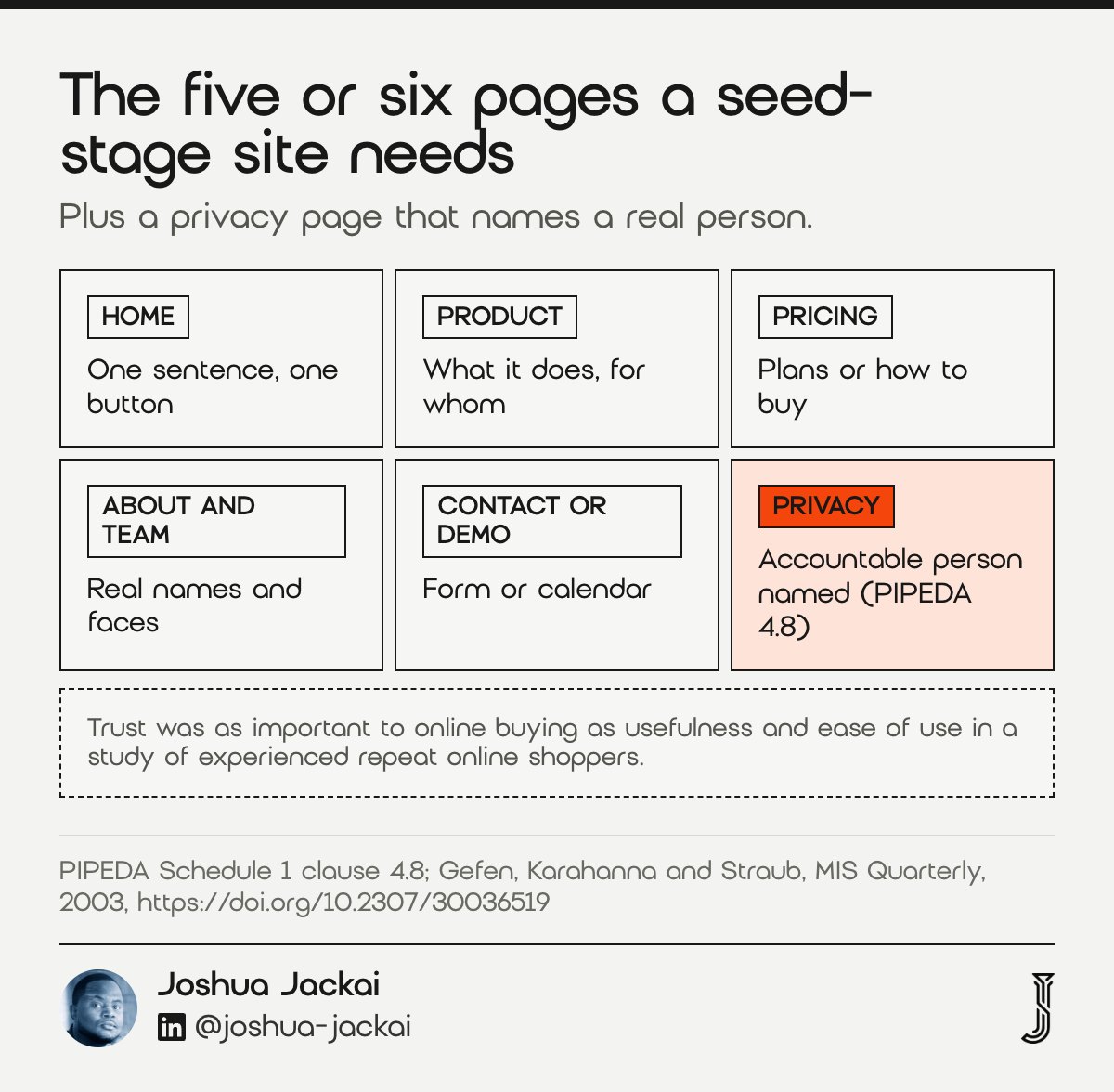
A seed-stage B2B startup website needs five or six pages: home, product, pricing or plans, about and team, contact or demo, and a privacy page. Canada’s federal privacy law, PIPEDA, requires an organization to make its personal information practices available to people without unreasonable effort.
- Core pages: home, product, pricing, about and team, contact or demo
- Required in Canada: privacy page naming the person accountable
- Add when asked: security page, customers page, careers page
- Skip for now: blog until you can publish monthly
- Trust: consumer trust was as important as usefulness and ease of use in online buying
PIPEDA’s openness principle, clause 4.8, lists what the information must include. The first item is the name or title, and the address, of the person accountable for your privacy practices and to whom complaints go. A privacy page copied from another company’s site usually names the wrong person, or nobody. Write your own, name a real person or role, and link it in the footer and next to every form.
“Individuals shall be able to acquire information about an organization’s policies and practices without unreasonable effort,” Parliament stated in PIPEDA, Schedule 1, clause 4.8.1.
The other five pages exist to build trust. Gefen, Karahanna and Straub found in a study of experienced repeat online shoppers that trust in the vendor mattered as much as how useful and easy the site was. For a young company, the about and team page carries most of that trust: real names, real faces, and where you are based. That study was of online shoppers, so for B2B I apply it by inference: the about page is where a buyer checks who is behind the product.
Leave the blog until you can publish at least once a month. An empty blog with two posts from last year tells a buyer the company may have stalled.
Data point: In a study of experienced repeat online shoppers, trust was as important to online commerce as perceived usefulness and ease of use (Gefen, Karahanna and Straub, MIS Quarterly, 2003).
4. How do you collect emails and demo requests legally in Canada?
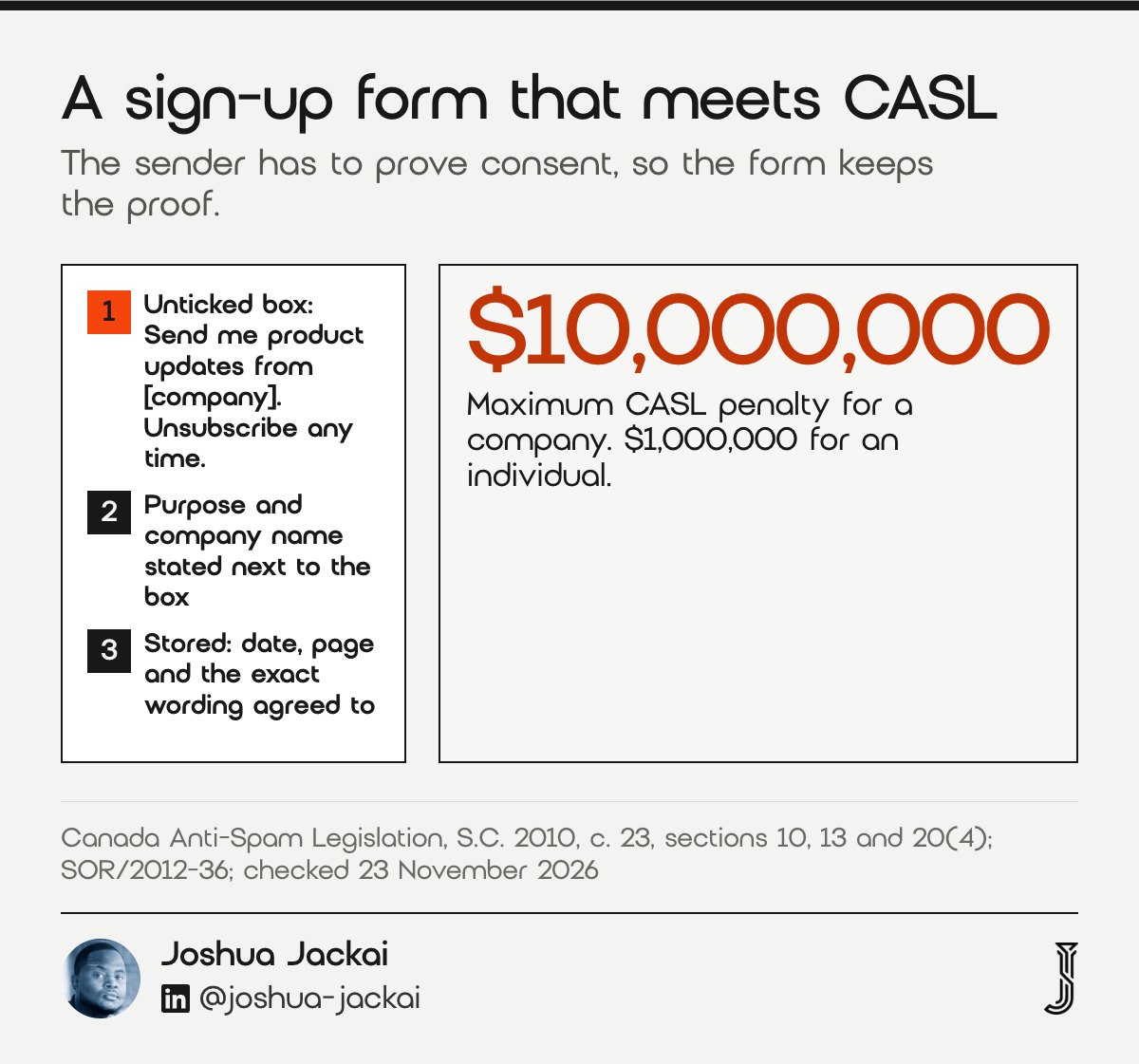
Use an unticked checkbox or a clear opt-in on every form that adds people to marketing email, say why you are asking, and name the company asking. Canada’s Anti-Spam Legislation puts the burden of proving consent on the sender, and the maximum penalty is $10,000,000 for a company.
- Law: Canada’s Anti-Spam Legislation (CASL), S.C. 2010, c. 23
- When asking for consent: state the purpose and who is asking (section 10)
- Proof: the sender has the onus of proving consent (section 13)
- Maximum penalty: $1,000,000 for an individual, $10,000,000 for any other person (section 20(4))
- Every message: an unsubscribe link and contact details valid for 60 days
Most startup sites have a waitlist or newsletter form in the footer. Under CASL, a person seeking express consent must, in the words of section 10(1), “set out clearly and simply” the purpose of the consent and who is asking. The Electronic Commerce Protection Regulations (CRTC), SOR/2012-36, list the identifying details: the name you do business under and a way to contact you.
In practice I build every startup form the same way. The email field is followed by an unticked checkbox with a plain label such as “Send me product updates from [company]. Unsubscribe any time.” The form stores the date, the page and the exact wording the person agreed to, because section 13 puts the onus of proving consent on you. A demo request form can answer the demo without that checkbox, but adding the person to a newsletter later needs the opt-in.
This is not legal advice, and a lawyer should review your consent wording if email is a big part of your growth plan. It is the setup I use so a startup does not have to retrofit its forms after its first investor asks about compliance.
Data point: CASL sets the maximum penalty for a violation at $10,000,000 for a person other than an individual (CASL, section 20(4), Justice Laws Website).
5. Should a startup website offer a free trial, a demo or a waitlist?
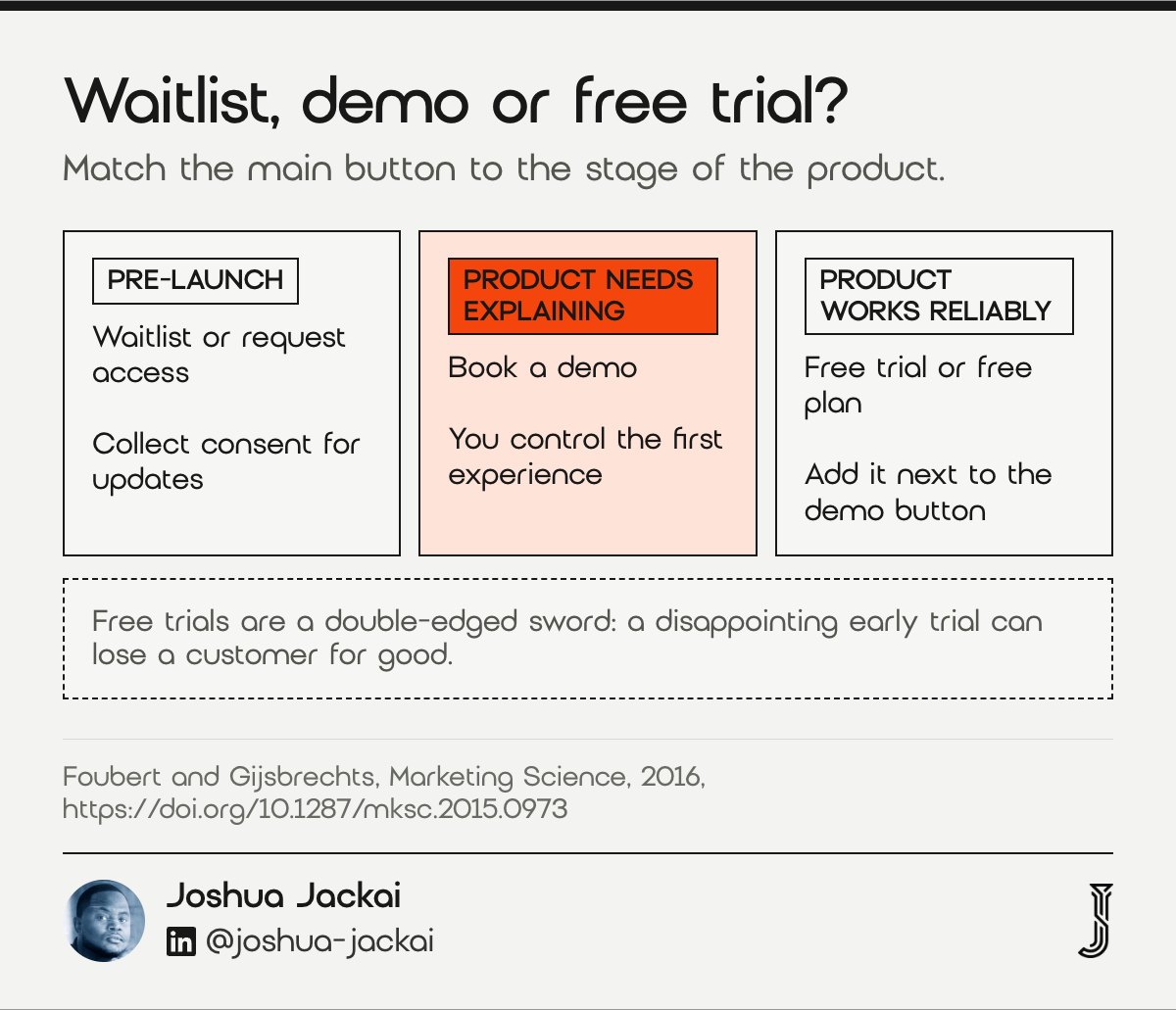
Offer a waitlist before launch, a demo when the product needs explaining, and a free trial only once the product works reliably. A study of a new high-tech subscription service found free trials a double-edged sword: a disappointing early trial can lose a customer.
- Pre-launch: waitlist or request access
- Complex B2B product: book a demo, with a calendar on the page
- Self-serve product that works: free trial or free plan
- Both paths: show a self-serve start and a sales path only if you can support both
- Risk: early trials during quality problems can cost you adopters
Foubert and Gijsbrechts modelled how people decided to try and then buy a new high-tech subscription service, using real trial, adoption and usage data. Their warning is aimed at the early period, when the service has not been tested in the field and breakdowns happen:
“Free trials constitute a double-edged sword, and that timing and consumers’ usage intensity during the trial are key to the effectiveness of these promotions,” wrote Bram Foubert and Els Gijsbrechts (Marketing Science, 2016).
For an early-stage startup, that argues for a waitlist or a guided demo first. A demo lets you control the first experience, watch where people get confused, and fix the product before strangers try it alone. Once the product holds up, add the trial next to the demo button so self-serve buyers do not have to talk to sales.
Whatever you choose, use one main button in the first screen and repeat it at the bottom of the page. Two buttons can work when they serve two kinds of buyer, such as “Start free” and “Talk to sales”. Three or more compete for the same click.
Data point: Free trials were a double-edged sword in a model built on trial, adoption and usage data for a high-tech subscription service (Foubert and Gijsbrechts, 2016).
6. How fast and accessible does a startup website need to be?
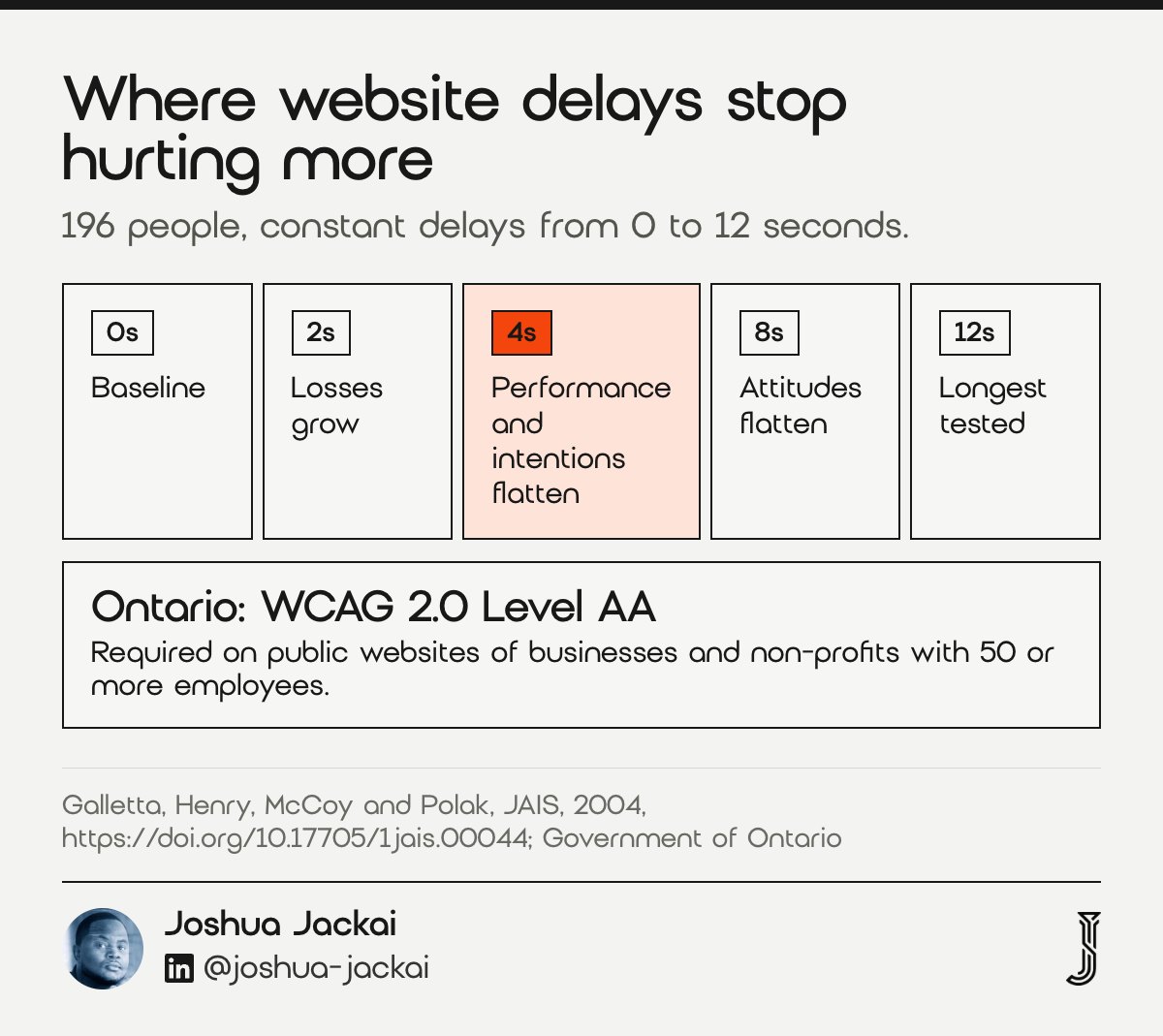
Treat 4 seconds as a ceiling, not a goal, and meet WCAG accessibility guidelines from the start. In an experiment with delays of 0 to 12 seconds, task performance and intentions to return dropped as delays grew, then flattened from about 4 seconds on.
- Speed target: under 4 seconds to respond on a mid-range phone
- Accessibility target: WCAG 2.0 Level AA as the floor
- Ontario rule: businesses with 50 or more employees must meet WCAG 2.0 AA on public sites
- Cheap wins: compressed images, alt text, one font family, no autoplay video
- Check: run Google PageSpeed Insights on the phone setting
Galletta and colleagues gave 196 people search tasks on websites with constant delays of 0, 2, 4, 6, 8, 10 or 12 seconds. Performance and behavioural intentions fell as delays rose and began to flatten at 4 seconds or longer; attitudes flattened at 8 seconds. The study ran in 2004 on desktop search tasks, not phones, so I use 4 seconds as a ceiling, not a target.
Accessibility is a legal duty for some Canadian companies and good practice for all of them. Ontario’s Accessibility for Ontarians with Disabilities Act requires public websites to meet WCAG 2.0 Level AA for designated public sector organizations and for businesses or non-profits with 50 or more employees. A Vancouver startup with 12 people is not covered today, but a startup that sells to Ontario public bodies may be asked about it in procurement.
Building it in from the first version costs little: alt text on every image, real headings, enough colour contrast, forms with labels, and buttons a keyboard can reach. Fixing it after a 50-page build costs far more.
“Decreases in performance and behavioral intentions begin to flatten when the delays extend to 4 seconds or longer,” wrote Dennis Galletta and colleagues (Journal of the Association for Information Systems, 2004).
Data point: In an experiment with 196 participants, drops in performance and behavioural intentions began to flatten at delays of 4 seconds or longer (Galletta and colleagues, Journal of the Association for Information Systems, 2004).
7. When should a startup redesign its website?
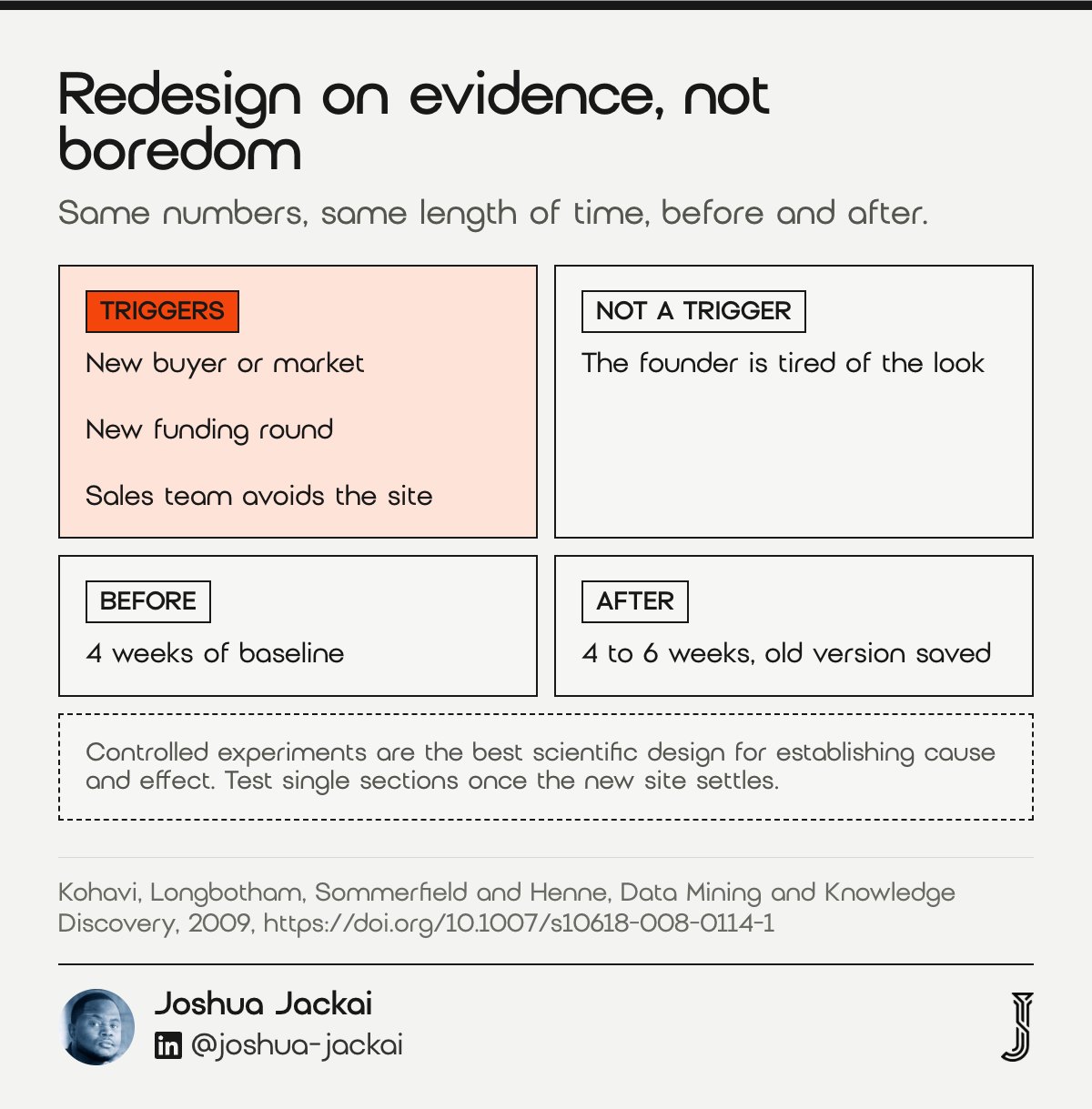
Redesign when the business has changed: a new market or buyer, a new funding round, a product that no longer matches the homepage, or a sales team that avoids sending the site. Then measure the same numbers before and after, because a before and after comparison shows what moved, though not why.
- Triggers: new positioning, new buyer, new round, sales team avoids the site
- Not a trigger: boredom with the current look
- Before: 4 weeks of baseline numbers
- After: 4 to 6 weeks with the old version saved
- Numbers to track: demo requests, sign-ups, conversion rate, organic clicks
Startups redesign too often for the wrong reason. A founder gets tired of the homepage long before buyers do. The right reasons are business changes: you moved from selling to small firms to selling to enterprises, you raised a round and need to look the part, or your product grew a second module the site does not mention.
Kohavi and colleagues, who ran experiments at Microsoft, described why tests beat opinions:
“Controlled experiments embody the best scientific design for establishing a causal relationship between changes and their influence on user-observable behavior,” wrote Ron Kohavi and colleagues (Data Mining and Knowledge Discovery, 2009).
A startup rarely has the traffic for a clean A/B test of a whole redesign. What you can do is record four weeks of numbers before launch, keep the old version saved, and compare the same four to six weeks after. Those windows are my rule of thumb, not a sourced figure. Then test single sections, such as the hero or the demo form, once the new site settles. If you are moving platforms at the same time, map every old URL to a new one first; my guide to B2B SaaS website design covers the pages that matter most at that stage.
Data point: Controlled experiments are the best scientific design for establishing cause and effect on websites, according to a survey and practical guide by Microsoft researchers (Kohavi and colleagues, 2009).
How much does a startup website cost in Canada?
A do-it-yourself page on a free builder plan costs little beyond a domain and a paid plan. My fixed quotes, not a survey of other studios, are CA$3,795 and up for a launch landing page, CA$4,950 or CA$5,950 for a small business site, and CA$7,450 and up for custom B2B.
The price moves with four things: the number of page templates, whether the copy is written for you, integrations such as a CRM or a calendar, and how much of the site you need to edit yourself after launch. A one-page launch site with your own copy sits at the low end. A seed-stage site with product pages, pricing, a demo flow connected to HubSpot and lead source tracking sits at the high end. If you are weighing Framer, my breakdown of Framer website costs in Canada lists the platform fees in CAD, and the landing page cost guide covers single-page launches.
| Stage | What you get | Price (my fixed quotes, CAD) |
|---|---|---|
| Pre-seed | One landing page with a waitlist or demo form | from CA$3,795 |
| Pre-seed to seed | Small business site, 5 to 6 pages | CA$4,950 or CA$5,950 |
| Seed to Series A | Custom B2B site with demo flow and CRM | from CA$7,450 |
| Any stage | Website audit before you spend | CA$995, credited within 30 days |
Compare the seven startup website steps side by side
Use this table to filter the seven steps by stage and by what each one protects. Every row comes from the sections above, and each source is a peer-reviewed study, a Canadian statute, a government page or my own price table. Pick your stage to hide the steps you can leave for later.
Showing 7 of 7 steps.
| # | Step | Key figure | Stage | Source |
|---|---|---|---|---|
| 1 | One page that says what you do | 50 ms first impression | Pre-seed | Lindgaard 2006 |
| 2 | Build it yourself or hire | CA$0 to CA$7,450+ | Pre-seed to seed | Fogg 2003; JJ price table |
| 3 | Five or six core pages plus privacy | PIPEDA clause 4.8 | Seed | Gefen 2003; PIPEDA |
| 4 | CASL-compliant sign-up forms | Up to $10,000,000 penalty | Any stage | CASL s.10, s.13, s.20(4) |
| 5 | Trial, demo or waitlist | Trials are a double-edged sword | Seed | Foubert 2016 |
| 6 | Speed and accessibility | Flattens at 4 seconds; WCAG 2.0 AA | Seed to Series A | Galletta 2004; Ontario |
| 7 | Redesign on evidence | 4 weeks before, 4 to 6 after | Series A | Kohavi 2009 |
Score how ready your startup website is
Answer eight yes or no questions about your current site to see which of the seven steps still needs work. The score is a simple count of the checks you pass, out of 8, built from the steps in this guide. It does not send your answers anywhere and it is a checklist, not a legal review.
Tick every statement that is true for your site today. Nothing is sent anywhere. This is a checklist, not a legal review.
Startup website design questions, answered
These are the questions founders search most about building a first startup website, captured from Google’s People Also Ask results for Vancouver with AlsoAsked. Each answer is short and points back to the step that covers it in depth, so you can jump to the part that matters for your stage.
Can I build my startup website for free?
Yes, for a first version. Most site builders offer a free plan, usually on the builder’s own domain with its branding. That is fine for testing an idea. Once investors or buyers visit the site before calls, pay for a plan, connect your own domain and add a privacy page.
Can ChatGPT build a website for my startup?
ChatGPT and similar AI tools can draft copy, suggest page layouts and write simple code for a first page. They cannot decide your positioning, check your CASL wording or test on real phones. Use AI for drafts and a person for the decisions that carry legal or sales risk.
How many pages should a startup website have?
Start with one page before launch. A seed-stage B2B startup usually needs five or six: home, product, pricing, about and team, contact or demo, and a privacy page that names the person accountable under PIPEDA. Add a security or customers page when buyers start asking for one.
How much should I pay someone to design my startup website?
Pay for a fixed quote with a written scope rather than an hourly estimate. My fixed prices are CA$3,795 and up for a launch landing page, CA$4,950 or CA$5,950 for a small business site and CA$7,450 and up for custom B2B. A CA$995 audit is credited within 30 days.
Do startups still need a website in 2026?
Yes. In my projects, investors and buyers visit the site before a first call to confirm the company is real. A one-page site with a clear sentence, the founders’ names and a contact path is enough to start, and gives AI engines a source to cite.
How I design startup websites in Vancouver
I build fixed-quote websites for Canadian B2B companies, and startups get the same process at a smaller size: I write the one sentence with the founder first, then build only the pages the stage needs. Every form ships with CASL opt-in wording and a privacy page draft, and every page is checked on real phones.
“The first version of a startup website is a sentence with a page around it,” said Joshua Jackai, Vancouver web designer.
I also set up lead source tracking, so you know which channel each demo request came from, and I structure pages so AI answer engines such as ChatGPT can read and cite them. If you want to see where your current site stands, start with the free AI Visibility Report, or book the CA$995 website audit, which is credited if a project starts within 30 days.
“A plain page with a clear sentence looks more credible than a busy one,” said Joshua Jackai, Vancouver web designer.
Sources
Peer reviewed
- Fogg, B. J., Soohoo, C., Danielson, D. R., Marable, L., Stanford, J. and Tauber, E. R. (2003). How do users evaluate the credibility of Web sites? Proceedings of the 2003 Conference on Designing for User Experiences (DUX). https://doi.org/10.1145/997078.997097
- Foubert, B. and Gijsbrechts, E. (2016). Try it, you’ll like it, or will you? The perils of early free-trial promotions for high-tech service adoption. Marketing Science. https://doi.org/10.1287/mksc.2015.0973
- Galletta, D. F., Henry, R., McCoy, S. and Polak, P. (2004). Web site delays: How tolerant are users? Journal of the Association for Information Systems. https://doi.org/10.17705/1jais.00044
- Gefen, D., Karahanna, E. and Straub, D. W. (2003). Trust and TAM in online shopping: An integrated model. MIS Quarterly. https://doi.org/10.2307/30036519
- Kohavi, R., Longbotham, R., Sommerfield, D. and Henne, R. M. (2009). Controlled experiments on the web: Survey and practical guide. Data Mining and Knowledge Discovery. https://doi.org/10.1007/s10618-008-0114-1
- Lindgaard, G., Fernandes, G., Dudek, C. and Brown, J. (2006). Attention web designers: You have 50 milliseconds to make a good first impression! Behaviour and Information Technology. https://doi.org/10.1080/01449290500330448
Government and statute (not peer reviewed)
- Canada’s Anti-Spam Legislation, S.C. 2010, c. 23, sections 10, 11, 13 and 20, Justice Laws Website, checked 23 November 2026. https://laws-lois.justice.gc.ca/eng/acts/E-1.6/FullText.html
- Electronic Commerce Protection Regulations (CRTC), SOR/2012-36, checked 23 November 2026. https://laws-lois.justice.gc.ca/eng/regulations/SOR-2012-36/FullText.html
- Personal Information Protection and Electronic Documents Act, S.C. 2000, c. 5, Schedule 1, clause 4.8, checked 23 November 2026. https://laws-lois.justice.gc.ca/eng/acts/P-8.6/FullText.html
- Government of Ontario, How to make websites accessible, checked 23 November 2026. https://www.ontario.ca/page/how-make-websites-accessible
First party
- Jackai Agency price table, joshuajackai.com/pricing, November 2026.
More B2B guides
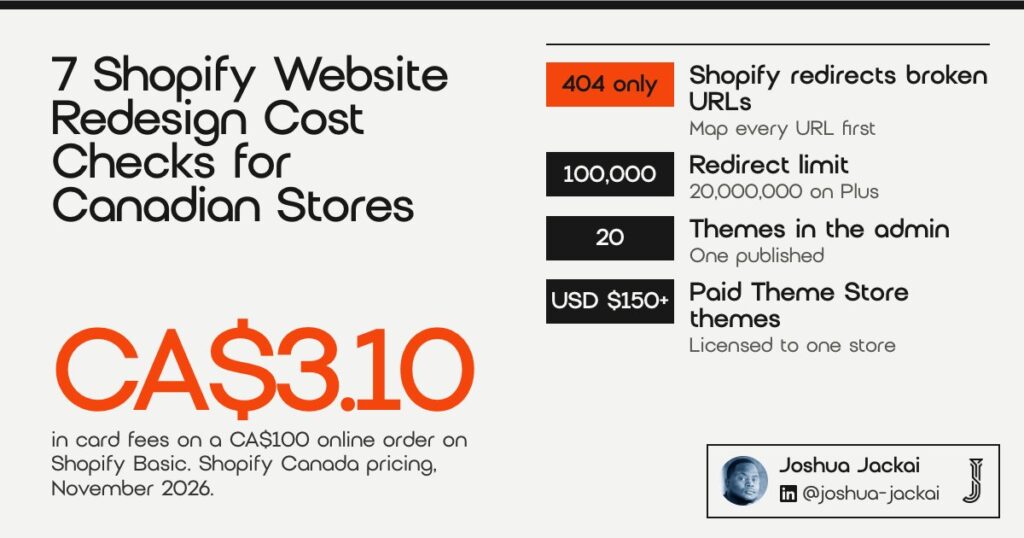
7 Shopify Website Redesign Cost Checks for Canadian Stores
What a Shopify redesign costs in Canada and the 7 checks that protect your sales and search traffic: theme route, CAD plan and card fees, the 404-only redirect…
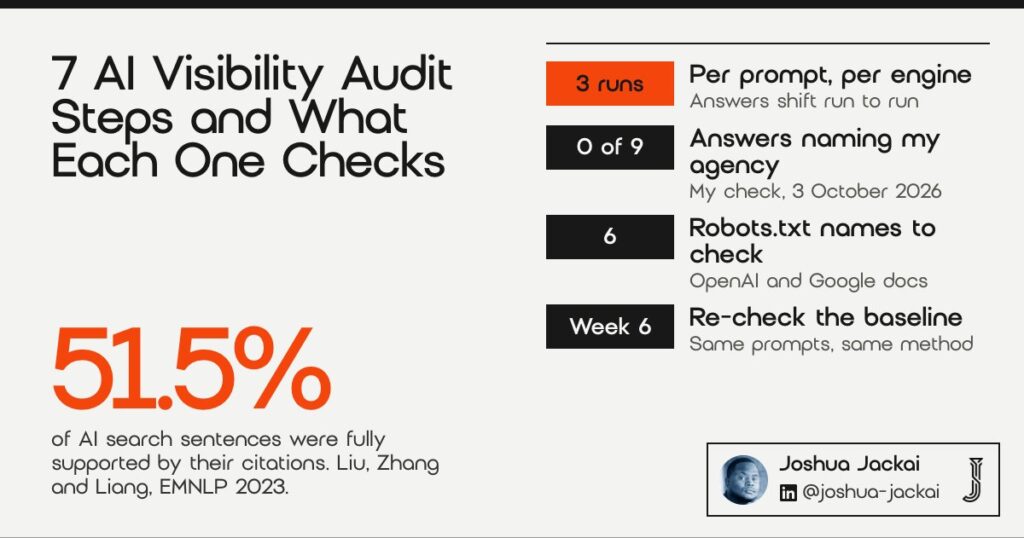
7 AI Visibility Audit Steps and What Each One Checks
An AI visibility audit tests whether ChatGPT, Perplexity and Google AI Overviews name your business, cite your pages and get facts right. Here are the 7 steps, with…
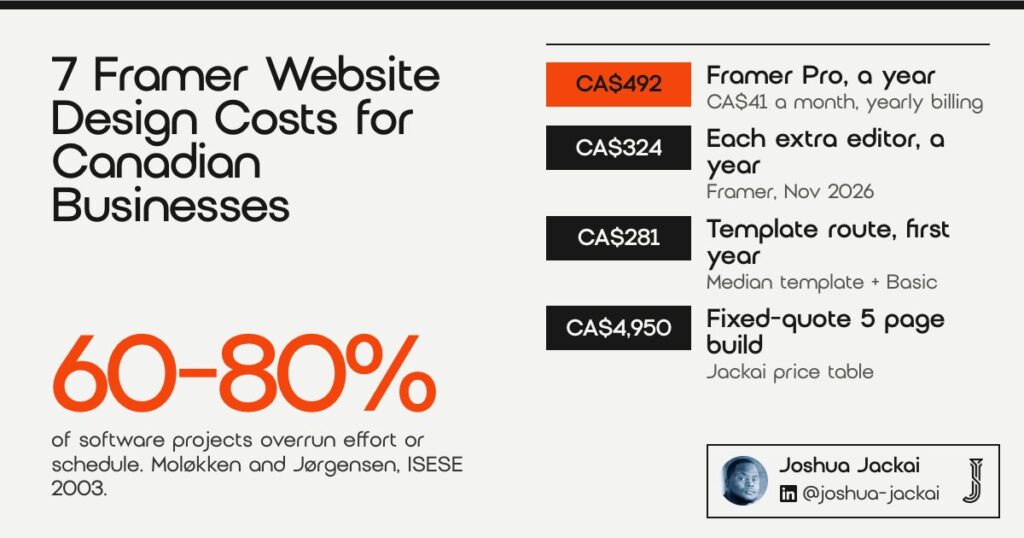
7 Framer Website Design Costs for Canadian Businesses
Framer shows Canadian visitors its prices in Canadian dollars. Here is every cost line for a Framer website in Canada, from the CA$168 Basic plan and CA$27 editor…
