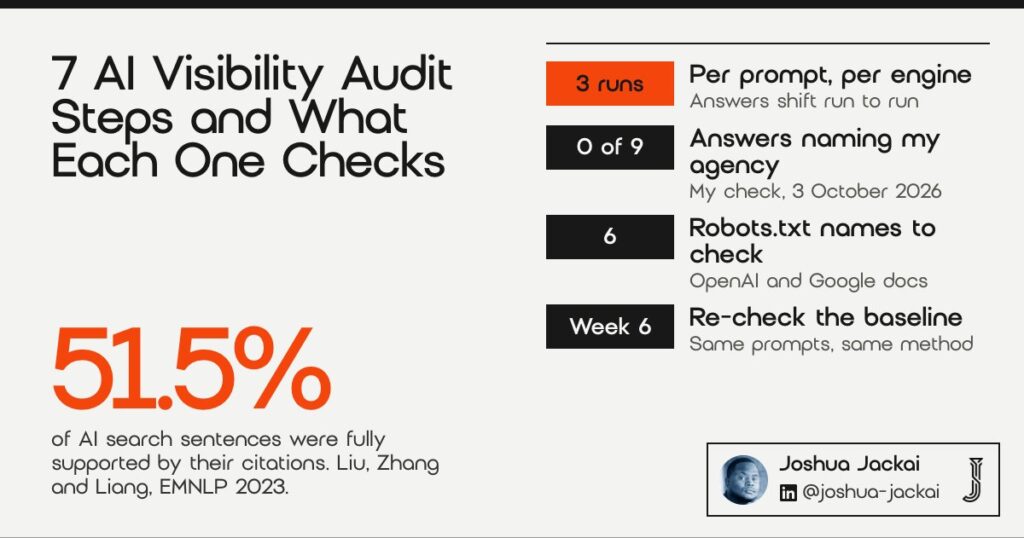
7 AI Visibility Audit Steps and What Each One Checks
An AI visibility audit tests whether ChatGPT, Perplexity and Google AI Overviews name your business, cite your pages and get facts right. Here are the 7 steps, with my own October 2026 answer check and a log template you can copy.
 Joshua Jackai
18 min read
Published 21 November 2026 · Last updated and fact-checked November 2026
Short answer: An AI visibility audit tests whether ChatGPT, Perplexity and Google AI Overviews name your business, cite your pages and get facts right. Run every prompt three times, as answers shift: in my check on 3 October 2026, OpenAI’s gpt-4.1 with web search named 12 different businesses across 3 runs of one Vancouver prompt, and only 2 appeared in all 3.
Most Canadian owners find out about AI visibility the same way. A prospect says “ChatGPT recommended you”, or a competitor says it about themselves, and nobody on the team knows how to check. An audit answers that question with a log instead of a guess. I am a Vancouver web designer, and I run this audit before any AI visibility work, because the week-one answers are the baseline the later work is measured against. This guide is the procedure itself, step by step, with the tools you already have. If you want to claim the new ChatGPT business profile, read my guide to claiming your business in ChatGPT in Canada as well, because the audit is how you find out whether the claim changed anything.
Two terms come up throughout. A mention is your business named in an AI answer. A citation is a link to one of your pages in the answer’s sources.
In this guide
Key takeaways
- An audit has 7 steps: prompts, repeated runs, a mention and citation log, crawler access, quotable pages, fact accuracy and a dated baseline.
- On 3 October 2026 I asked OpenAI’s gpt-4.1 with web search 3 Vancouver web design prompts, 3 times each. My agency was named in 0 of the 9 answers.
- A 2023 human audit of 4 generative search engines found only 51.5% of sentences fully supported by their citations (Liu, Zhang and Liang, EMNLP 2023). Those engines have changed since, so I still open every citation.
- OpenAI’s crawler documentation treats OAI-SearchBot and GPTBot as separate robots.txt settings, so a site can block training and still appear in ChatGPT search.
- Content changes raised visibility in generative engine answers by up to 40% in a 2024 benchmark (Aggarwal and colleagues, KDD 2024).
| # | Audit step | What you record | Time for a small firm | Tool needed |
|---|---|---|---|---|
| 1 | Write the prompt set | 10 to 20 buyer questions, tagged by type | 1 hour | A spreadsheet |
| 2 | Run each prompt three times | Every answer, per engine, per run | 2 to 3 hours | Free ChatGPT, Perplexity, Google |
| 3 | Log mentions and citations | Named or not, linked or not, which URL | Included in step 2 | The same spreadsheet |
| 4 | Check crawler access | robots.txt rules for 6 AI user agents | 20 minutes | A browser |
| 5 | Check quotable pages | Answer-first copy, FAQ, schema, sources | 1 to 2 hours | Google Rich Results Test |
| 6 | Check the facts AI repeats | Prices, location, services, wrong claims | 1 hour | Your price table |
| 7 | Score and set a baseline | Share of answers, re-check date | 30 minutes | A calendar reminder |
1. How do you write the prompt set for an AI visibility audit?
Write 10 to 20 prompts in the words your buyers use, split into category prompts (“best B2B web designer in Vancouver”), problem prompts and brand prompts. The prompt set decides what the audit can find, so take the wording from real questions: People Also Ask, sales calls and your contact form.
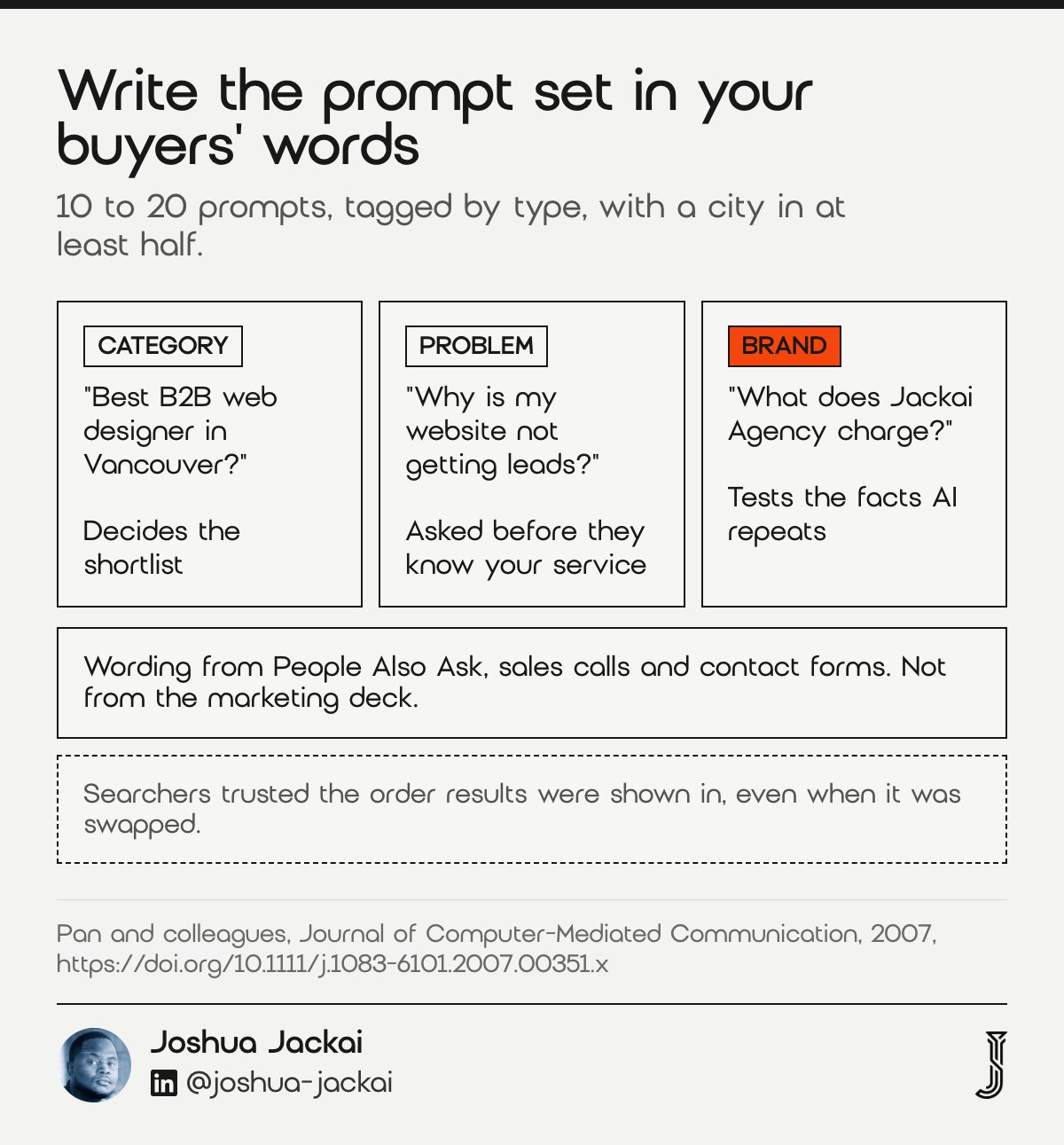
- Category prompts: “Who is the best [service] in [city]?” These decide whether you are on the shortlist.
- Problem prompts: the question a buyer asks before they know your service exists.
- Brand prompts: “What does [your business] charge?” and “Is [your business] any good?”
- Count: 10 to 20 prompts for a firm with one location and three or four services.
- Wording source: People Also Ask, AlsoAsked exports, call notes, form submissions.
Most audits I see fail before the first prompt is typed, because the prompt list was written by the marketing team in marketing words. A buyer in Burnaby does not ask for “holistic digital solutions”. They ask “how much does a website cost in Vancouver” or “why is my site not showing up on Google”. I pull wording from three places: the People Also Ask questions for the service in the Vancouver location, the last ten contact form messages, and the first sentence a prospect said on recent calls.
Tag each prompt by type, because the three types fail for different reasons. A firm that is missing from category prompts usually has a third-party proof problem: few reviews, directories or articles name it. A firm that is wrong on brand prompts usually has a facts problem on its own site. Keep a city in at least half the prompts. ChatGPT and Google both localise answers, and a Canadian firm that tests only national wording will miss the Vancouver shortlist entirely.
Position matters once you are on the list. In a 2007 eye-tracking study of Google results, students still favoured the top results when researchers reversed the order (Pan and colleagues, Journal of Computer-Mediated Communication, 2007).
2. Why should you run each AI prompt three times?
Run every prompt at least three times in each engine, in a fresh chat with no history, because the same question returns different answers. A single run is an anecdote. Three runs show you which mentions are stable and which ones came and went, and they take a small firm about two to three hours.
- Runs per prompt: 3 at minimum, 5 for the prompts that matter most.
- Session: a new chat each time, signed out or with memory off.
- Engines: ChatGPT with search, Perplexity, Google AI Overviews and AI Mode, Microsoft Copilot.
- Location: set or note it; Vancouver results differ from Toronto results.
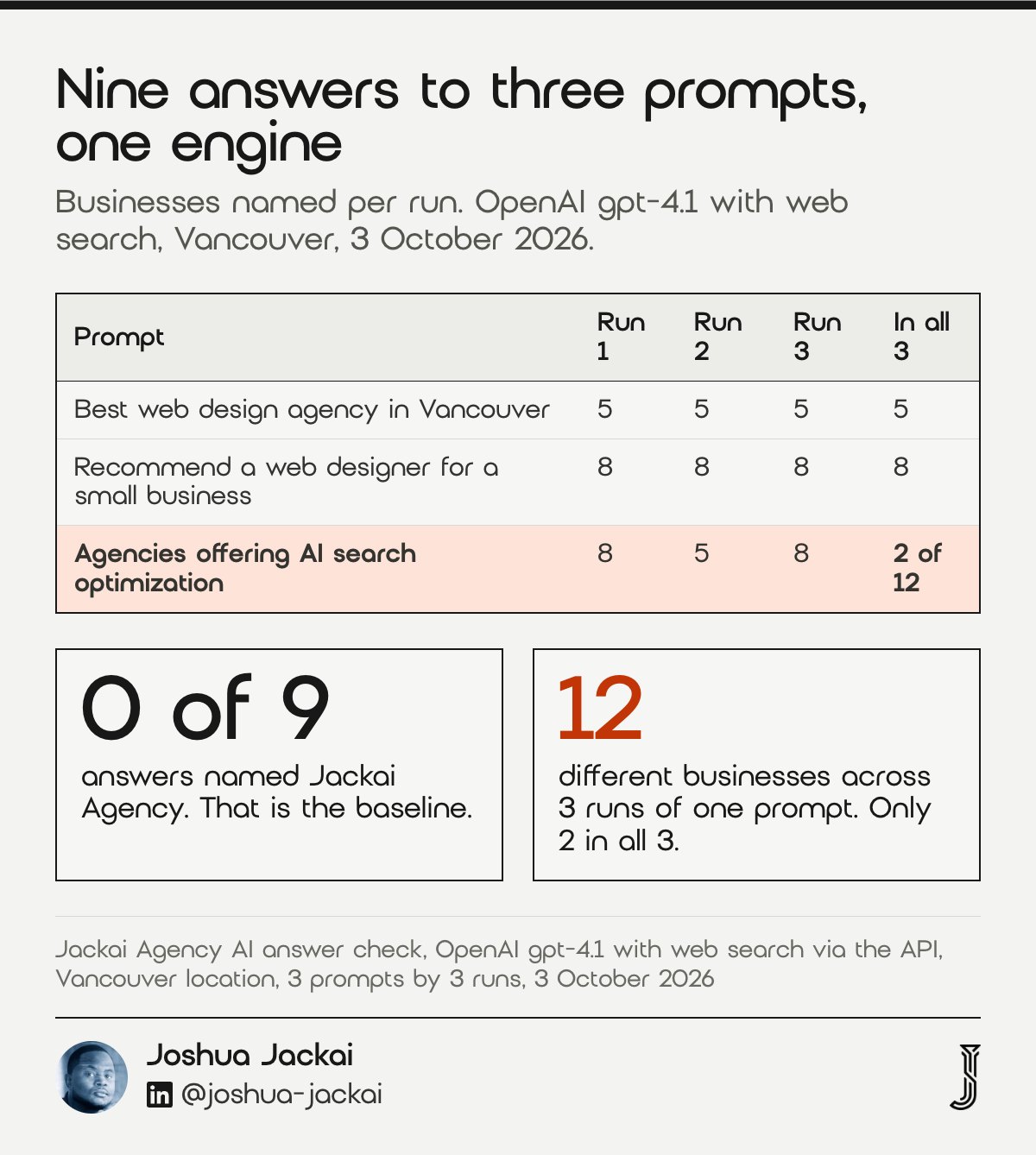
- My October check: 3 prompts, 3 runs, 9 answers, 0 mentions of my agency.
The variation is not a quirk of one tool. Researchers who sent ChatGPT the same 829 coding problems repeatedly found the share of tasks with zero equal test output across requests was 75.76% on CodeContests, the highest of three benchmarks (Ouyang and colleagues, ACM Transactions on Software Engineering and Methodology, 2025). That study tested code, not search answers, so I use it only as a reason to repeat prompts, not as a measure of AI search.
“Results from LLMs can be highly unstable; non-deterministically returning very different code for the same prompt,” wrote Shuyin Ouyang and colleagues (ACM Transactions on Software Engineering and Methodology, 2025).
My own check showed both patterns. On 3 October 2026 I sent OpenAI’s gpt-4.1 with web search three Vancouver web design prompts, three times each. The “best web design agency in Vancouver” prompt named the same 5 businesses in all 3 runs, and the small business prompt named the same 8 in all 3: stable shortlists. The prompt about agencies that offer AI search optimization named 12 different businesses across the 3 runs, and only 2 appeared in all 3. A single run would have shown me well under half of the businesses the engine names for that prompt. My agency was named in 0 of the 9 answers, which is the honest baseline.
3. What should you log for every AI answer?
Log five things per answer: the engine, the prompt and run number, whether your business was named, whether one of your URLs was cited, and which other sites were cited. Then open each citation and check that it says what the answer claims. That last check catches more errors than any tool.
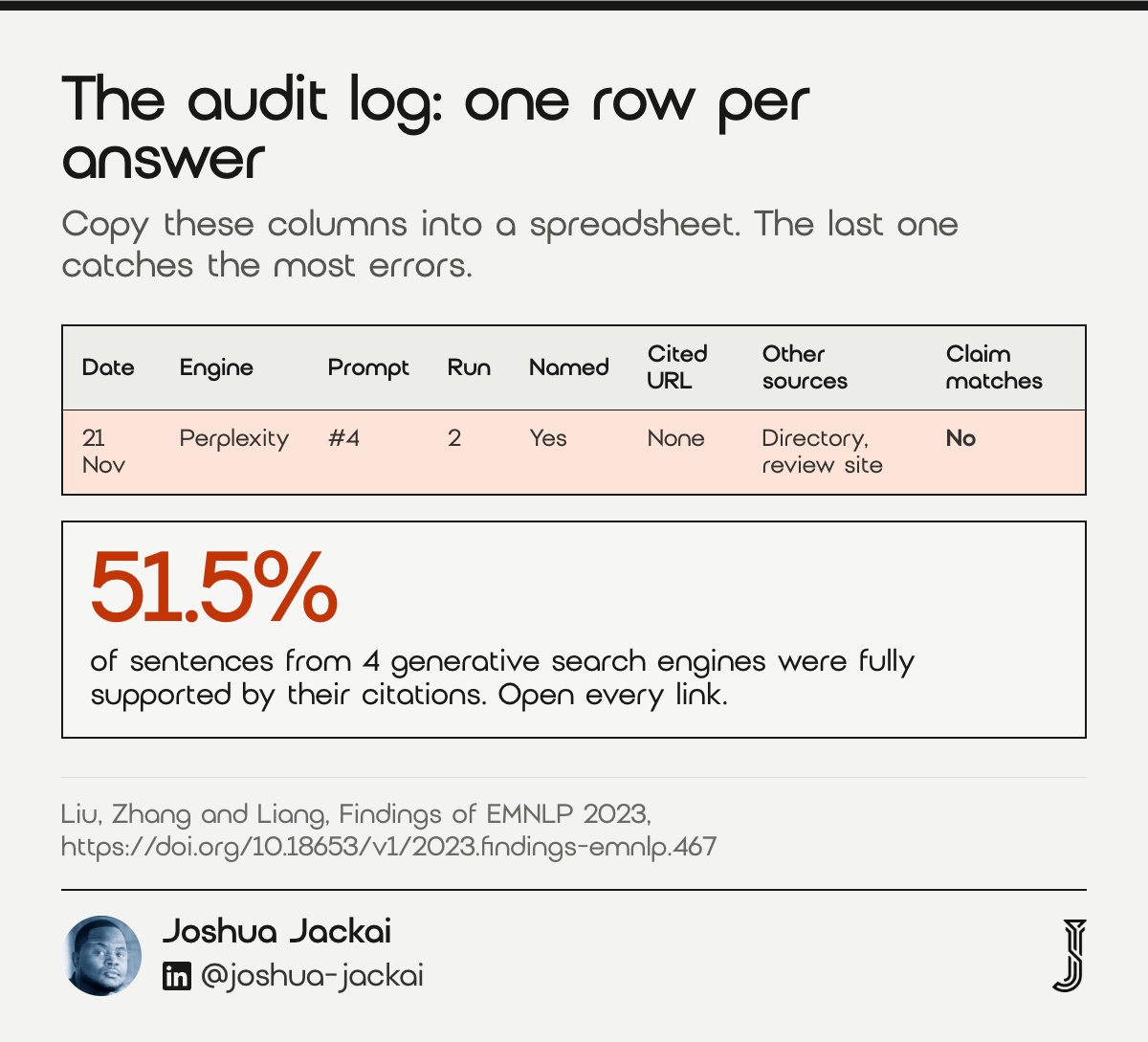
- Named: yes or no, plus the exact words used about you.
- Cited: the URL of yours that was linked, or none.
- Other sources: every domain in the citations, so you can see who the engine trusts.
- Claim check: does the cited page support the sentence? Yes, partly or no.
- Screenshot: one per answer, dated, because answers change.
A mention without a citation and a citation without a mention are different problems, so log them in separate columns. A mention without a citation means the engine learned about you somewhere else, often a directory, a review site or an article. A citation without a mention means your page was used as evidence but your name did not make the answer, which is common for how-to content.
The claim check matters because generative engines often link sources that do not back the sentence next to them. In a human audit of Bing Chat, NeevaAI, perplexity.ai and YouChat, only 51.5% of generated sentences were fully supported by citations and 74.5% of citations supported their sentence (Liu, Zhang and Liang, Findings of EMNLP, 2023).
“Responses from existing generative search engines are fluent and appear informative, but frequently contain unsupported statements and inaccurate citations,” wrote Nelson F. Liu, Tianyi Zhang and Percy Liang (Findings of EMNLP, 2023).
The “other sources” column is the most useful one for planning. If the same two directories and one Vancouver business publication appear in most category answers, those are the places your name needs to be. I keep that list sorted by how often each domain is cited.
4. How do you check whether AI crawlers can reach your site?
Open yoursite.ca/robots.txt and look for rules naming OAI-SearchBot, GPTBot, ChatGPT-User, PerplexityBot, ClaudeBot and Google-Extended. A disallow on the search bots keeps you out of those engines’ live answers. This check takes 20 minutes and it is the one most often broken by a plugin or a hosting default.
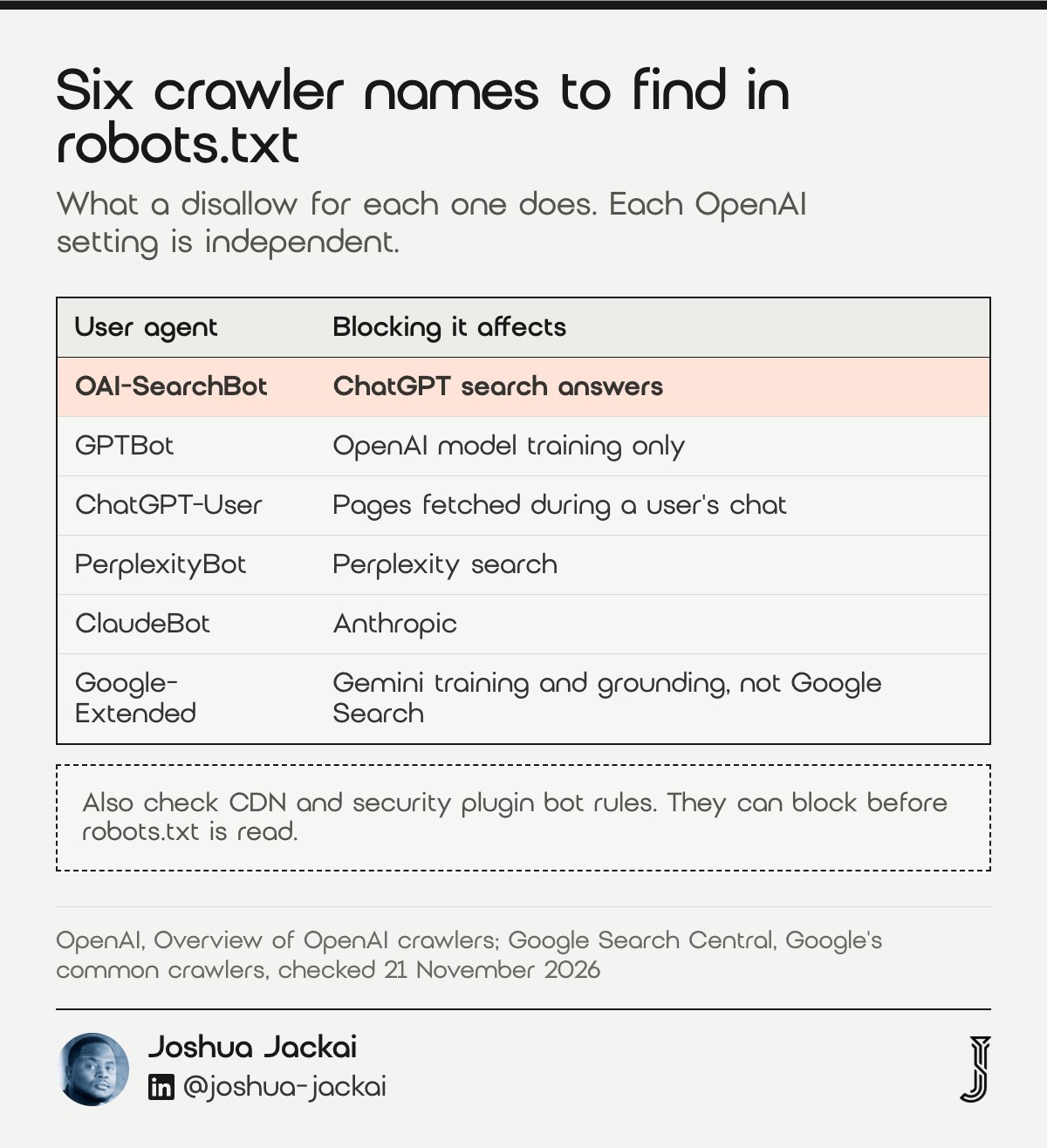
- OAI-SearchBot: used for ChatGPT search results. Blocking it removes you from those answers.
- GPTBot: used for model training. You can block it and still allow OAI-SearchBot.
- ChatGPT-User: fetches a page when a user’s chat asks for it.
- Google-Extended: controls Gemini training and grounding, not Google Search.
- Also check: a CDN or security plugin bot rule that blocks crawlers before robots.txt is read.
The common mistake I see on Canadian business sites is a blanket rule added in 2023 or 2024, when blocking “AI bots” was a popular privacy step. It often blocks every OpenAI agent at once. OpenAI’s documentation says each setting is independent, so a webmaster can allow OAI-SearchBot to appear in search results while disallowing GPTBot. That is a reasonable choice for many firms, and it keeps you eligible for ChatGPT search answers while opting out of training.
Google works differently. AI Overviews are part of Google Search, and Google says the Google-Extended token does not change Search inclusion.
“Google-Extended does not impact a site’s inclusion in Google Search nor is it used as a ranking signal in Google Search,” Google stated in its crawler documentation.
robots.txt is not the only gate. A Cloudflare bot setting or a WordPress security plugin can return a block page to these agents while robots.txt says allow. If your hosting dashboard has a bot or AI crawler panel, check it in the same sitting, and note the setting and date in the audit log.
5. How do you check whether your pages are easy for AI to quote?
Pick the five pages that should answer your main prompts and check four things: an answer in the first two sentences, question-style headings, a sourced number, and valid structured data. Pages that state a fact plainly near the top are easier to quote than pages that build up to it.
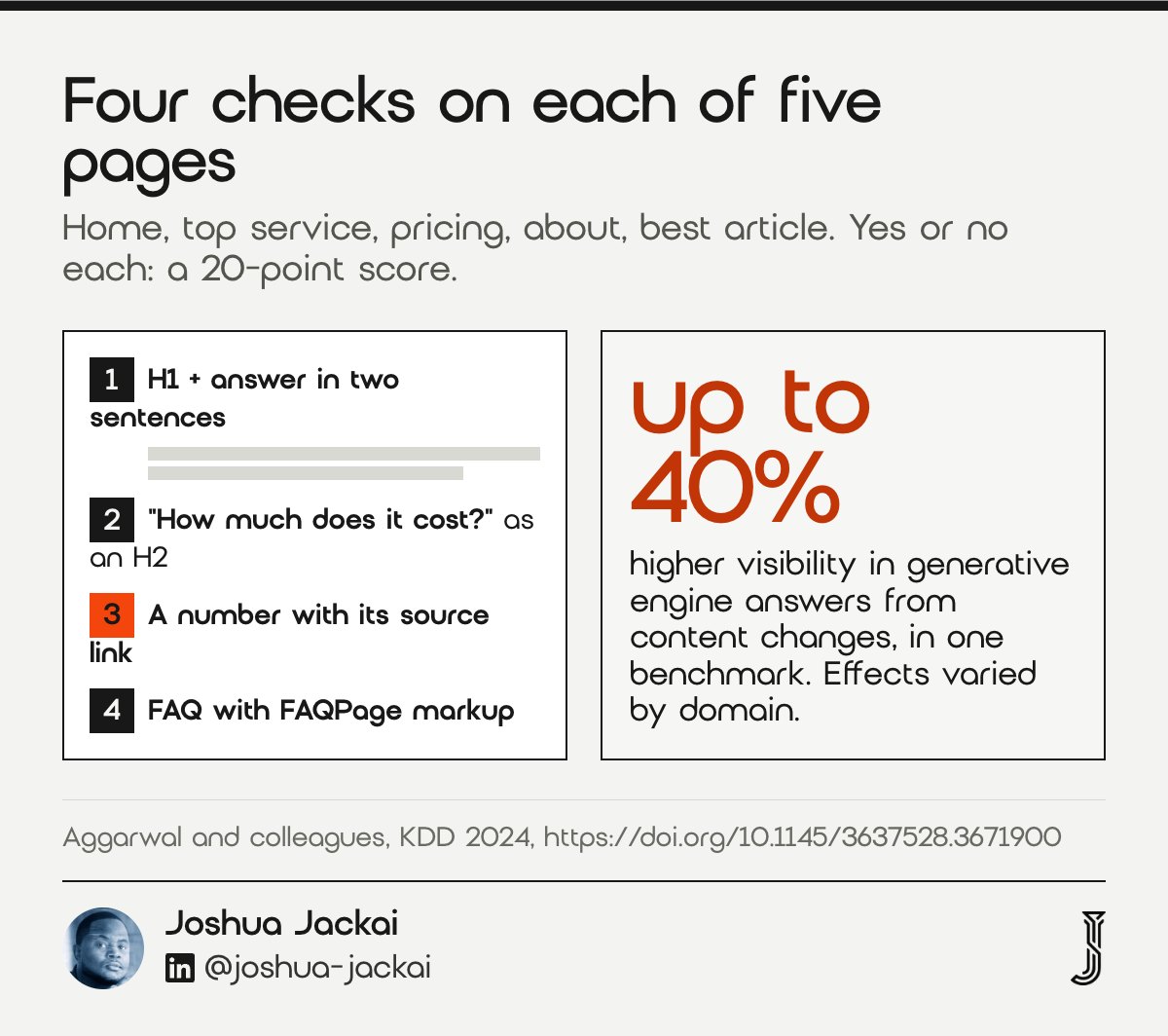
- Answer first: the first two sentences answer the page’s main question with a fact.
- Headings: written as the question a buyer types, not as a slogan.
- Evidence: a number with its source, a price, a timeline or a named client result you are allowed to share.
- Structured data: Organization, Service or LocalBusiness and FAQPage, tested in Google’s Rich Results Test.
- Pages to check: home, top service page, pricing, about, and your best article.
The research on this is still young, but it points one way. In the paper that named the field, the authors built a benchmark of queries and tested content changes on a generative engine. The authors report that their methods raised visibility by up to 40% (Aggarwal and colleagues, KDD 2024). The same paper says the effect varied by domain, so treat 40% as a ceiling seen in a benchmark, not a promise.
“Content creators have little to no control over when and how their content is displayed,” wrote Pranjal Aggarwal and colleagues (KDD 2024).
In practice, the audit finding is usually simple. The service page opens with a mission statement, the price lives in a PDF, and the FAQ is an accordion with no markup. None of that is hard to fix, and the audit is where each gap gets written down with its page. I record a yes or no for each of the four checks on each of the five pages, which gives a 20-point score you can re-run later.
6. How do you check the facts AI repeats about your business?
Ask every engine your brand prompts and compare each claim with your own records: prices, services, location, years in business, team size and clients. Mark each claim right, out of date or wrong. Wrong facts in AI answers matter because, in lab studies, people followed advice more readily when they believed it came from an algorithm.
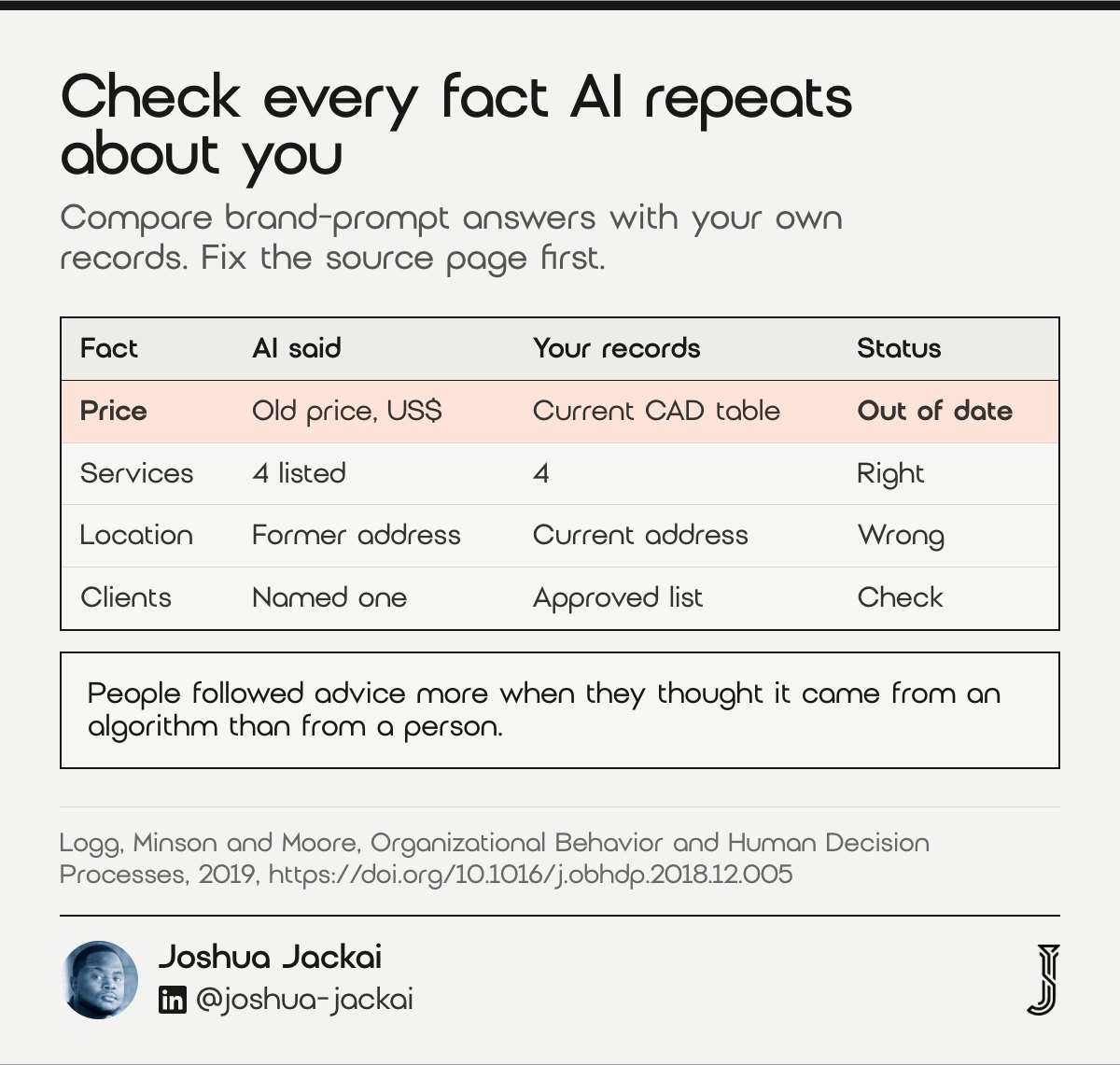
- Brand prompts: “What does [business] charge?”, “Where is [business] located?”, “Who has [business] worked with?”
- Compare against: your published price table, Google Business Profile and about page.
- Status: right, out of date or wrong, with the source the engine cited.
- Typical cause: an old price on a directory, a former address, a retired service page still live.
- Fix order: your own site first, then Google Business Profile, then directories.
This step matters more than it looks. In six experiments on estimates and forecasts, lay people followed advice more when they believed it came from an algorithm than from a person, though experts relied on it less (Logg, Minson and Moore, Organizational Behavior and Human Decision Processes, 2019).
“Lay people adhere more to advice when they think it comes from an algorithm than from a person,” wrote Jennifer Logg, Julia Minson and Don Moore (Organizational Behavior and Human Decision Processes, 2019).
So if ChatGPT tells a Kelowna buyer your websites start at a price you retired two years ago, they may believe it over your own page. The fix is rarely inside the AI tool. Engines repeat what they find, so the work is finding the page that carries the old fact. Check the cited sources in your log first, before you edit anything. In my experience the culprit is usually an old directory listing, a forgotten landing page or a press mention with a past price. For Canadian firms, also check the currency. An answer that quotes your prices in US dollars usually found a US directory, a reseller listing or an old pricing page.
7. How do you score an AI visibility audit and set a baseline?
Score two numbers: share of answers (answers that name you divided by all answers) and share of citations (answers that link one of your pages). Date the result, save the log and set a re-check six weeks out. The baseline is the point of the audit, because AI answers change even when you change nothing.
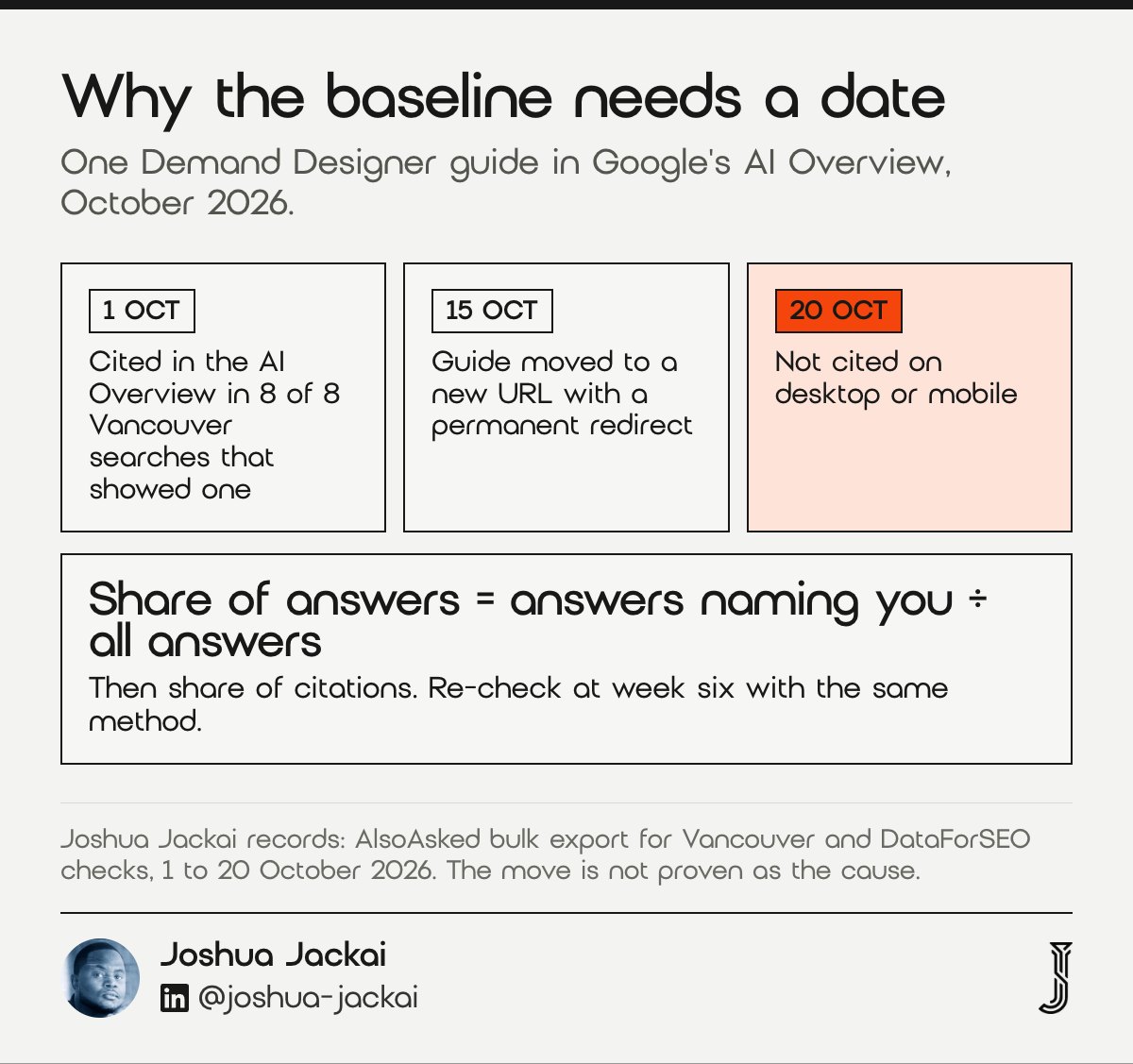
- Share of answers: answers naming you ÷ all answers logged.
- Share of citations: answers linking your URL ÷ all answers logged.
- Fact score: right claims ÷ all claims about you.
- Re-check: the same prompts, engines and run counts, six weeks later.
- Keep: the full log and screenshots, dated.
A baseline protects you from two mistakes: claiming credit for a change that would have happened anyway, and panicking about a drop you caused yourself. I have a dated example from Demand Designer, a separate agency site I run for US clients. On 1 October 2026 Google’s AI Overview for “How much does a Shopify website designer cost?” cited its Shopify cost guide, in 8 of the 8 Vancouver searches I checked that showed an overview. On 15 October the guide moved to a new URL with a permanent redirect. On 20 October it was not cited on desktop or mobile. I cannot prove the move caused the loss, but without the 1 October record I would not even know it happened.
That is why the score needs a date and a re-check. Use the same prompts, the same engines and the same number of runs, so the comparison is fair. If you make changes between the two checks, write down what changed and when. Re-run the claim column too: in one human audit only 74.5% of citations supported their sentence (Liu, Zhang and Liang, 2023), so a new citation is worth opening before you count it. The audit gives you a before; only a second audit with the same method gives you an after.
What does an AI visibility audit cost in Canada?
An AI visibility audit costs nothing but time if you run it yourself: about six to eight hours for a small firm using free tools. Paid trackers automate the repeated runs. My own AI Visibility Report is free and delivered in 24 hours, and the six-week optimization work is CA$4,775.
| Route | What you get | Cost in CAD | Best for |
|---|---|---|---|
| Do it yourself | The 7 steps in this guide, a spreadsheet log | Your time, about 6 to 8 hours | Firms with one location and a few services |
| Free AI Visibility Report | Answer check, crawler check, top fixes, in 24 hours | Free | A first look before you commit hours |
| Paid tracking tool | Automated repeated prompts, trend charts | Vendor pricing, monthly | Firms tracking many prompts or brands |
| AI Visibility Optimization | Week-one baseline, six weeks of fixes, week-six comparison | CA$4,775, then CA$1,870 a month optional | Firms that want the fixes done |
A paid tracker saves the repetition in step 2, but it does not do steps 5 and 6. No tool knows your real prices or which client names you are allowed to publish. If you buy one, check that it lets you set the location to a Canadian city and shows the cited URLs, not just a visibility percentage.
Compare every AI visibility audit check side by side
Every check in this guide is in the matrix: which step it belongs to, which engines it applies to, how long it takes and whether you need a paid tool. Filter by engine or by effort to plan a first afternoon. Rows hide, they are not removed, and every time estimate assumes a firm with one location.
| Check | Step | Applies to | Time | Paid tool |
|---|---|---|---|---|
| Write 10 to 20 buyer prompts, tagged by type | 1 | All engines | 1 hour | No |
| Run every prompt 3 times in a fresh chat | 2 | All engines | 2 to 3 hours | Optional |
| Log named, cited URL and other sources | 3 | All engines | Included in step 2 | No |
| Open each citation: does it support the claim? | 3 | All engines | About 45 minutes | No |
| robots.txt allows OAI-SearchBot and ChatGPT-User | 4 | ChatGPT | 5 minutes | No |
| robots.txt allows PerplexityBot | 4 | Perplexity | 5 minutes | No |
| Pages indexed in Google Search (Google-Extended does not affect Search) | 4 | Google AI Overviews | 10 minutes | No |
| CDN or security plugin bot rules | 4 | ChatGPT, Perplexity | 10 minutes | No |
| Answer in the first two sentences on 5 key pages | 5 | Your own site | 30 minutes | No |
| Structured data passes the Rich Results Test | 5 | Your own site | 20 minutes | No |
| Brand prompts: prices, location, services, clients | 6 | All engines | 1 hour | No |
| Score share of answers and citations, set a re-check date | 7 | All engines | 30 minutes | Optional |
Times assume one location and three or four services. 12 of 12 checks shown.
Estimate the size of your own AI visibility audit
The calculator estimates how many answers your audit will log and roughly how many hours it takes, then turns your own results into share of answers. Enter your prompt count, engines and runs. Defaults are placeholders: about two minutes per answer, including the screenshot and the claim check.
Defaults are placeholders. Minutes per answer include the screenshot and opening each citation. Add about 3 hours for steps 1, 4, 5 and 6.
AI visibility audit: questions, answered
These are the questions Vancouver searchers ask most about AI visibility audits, from People Also Ask data for the Vancouver location in November 2026. Each answer is short enough to act on, and each links back to the step that covers it in full.
What is an AI visibility audit?
An AI visibility audit is a repeatable test of whether AI answer engines such as ChatGPT, Perplexity and Google AI Overviews name your business, link your pages and repeat your facts correctly. It logs answers to real buyer prompts, checks crawler access and page quality, and sets a dated baseline.
How do you measure AI visibility?
Measure AI visibility with share of answers, which is answers that name you divided by all answers logged, and share of citations, which is answers linking one of your pages. Run each prompt three times per engine, because single answers vary, and compare against the same method six weeks later.
Can ChatGPT do an SEO audit of my website?
ChatGPT can review pages you paste or link and spot missing headings or thin copy, but it cannot see your rankings, crawl logs or how other engines answer about you. Use it as one input. An AI visibility audit tests ChatGPT’s answers rather than asking it to grade itself.
How do I monitor my visibility in AI search?
Monitor AI visibility by re-running the same prompt set on a schedule, every four to six weeks, with the same engines, location and run count. Save every answer with a date. A paid tracker automates the runs, but keep checking the cited pages yourself, because citations often misstate their sources.
Is SEO dead now that AI answers exist?
SEO is not dead. AI Overviews sit inside Google Search, and Google says its Google-Extended control does not change Search inclusion. Pages that are crawlable, fast and plainly written give AI engines more to work with, and in my experience the two audits share many fixes.
How I run AI visibility audits for Canadian firms
I run this audit for Canadian B2B firms as the first week of every AI visibility project, and on its own as a free report. The answers, crawler rules, page checks and fact errors go into one dated log that you keep.
The free AI Visibility Report arrives in 24 hours and covers the answer check, the crawler check and the three fixes I would make first. If you want the fixes done, AI Visibility Optimization is CA$4,775 for six weeks, with week six compared against week one. No citation is guaranteed; the change is measured. If the problem turns out to be the site itself, the CA$995 website audit is credited against a project that starts within 30 days.
For the testing side, my AI visibility experiment roadmap covers how to tell a real change from noise once the baseline exists.
“A single run is an anecdote,” wrote Joshua Jackai, Vancouver web designer.
“The baseline is the point of the audit, because AI answers change even when you change nothing,” wrote Joshua Jackai, Vancouver web designer.
Sources
Peer-reviewed research
- Aggarwal, P., Murahari, V., Rajpurohit, T., Kalyan, A., Narasimhan, K., and Deshpande, A. (2024). GEO: Generative Engine Optimization. Proceedings of the 30th ACM SIGKDD Conference on Knowledge Discovery and Data Mining, 5 to 16.
- Liu, N. F., Zhang, T., and Liang, P. (2023). Evaluating verifiability in generative search engines. Findings of the Association for Computational Linguistics: EMNLP 2023, 7001 to 7025.
- Logg, J. M., Minson, J. A., and Moore, D. A. (2019). Algorithm appreciation: People prefer algorithmic to human judgment. Organizational Behavior and Human Decision Processes, 151, 90 to 103.
- Ouyang, S., Zhang, J. M., Harman, M., and Wang, M. (2025). An empirical study of the non-determinism of ChatGPT in code generation. ACM Transactions on Software Engineering and Methodology, 34(2).
- Pan, B., Hembrooke, H., Joachims, T., Lorigo, L., Gay, G., and Granka, L. (2007). In Google we trust: Users’ decisions on rank, position, and relevance. Journal of Computer-Mediated Communication, 12(3), 801 to 823.
Industry, vendor and first-party sources (not peer reviewed, checked 21 November 2026)
- OpenAI. Overview of OpenAI crawlers. platform.openai.com/docs/bots
- Google Search Central. Google’s common crawlers, Google-Extended. developers.google.com
- Jackai Agency AI answer check, 3 October 2026: OpenAI gpt-4.1 with web search via the API, Vancouver location, 3 prompts by 3 runs (first-party data).
- Demand Designer AI Overview citation record, 1 to 20 October 2026: AlsoAsked bulk export for Vancouver and DataForSEO checks (first-party data).
- Vancouver People Also Ask data for AI visibility audit searches, AlsoAsked export, accessed November 2026.
- Jackai Agency price table, November 2026 (first-party prices, CAD before tax). Jackai Agency pricing